Disclosure: airfryerkitchensupply.com is reader-supported. When you buy through links on our site, we may earn an affiliate commission at no extra cost to you.
Where to buy
The best catering espresso machines split into two worlds — true commercial equipment and high-end self-serve automatics — and both are sold on Amazon. For a staffed coffee station at events, start with the Nuova Simonelli Appia Life Volumetric 2 Group; for unattended self-serve at offices and venues, look at the Jura Z10 or the Philips 5500 Series.
Before ordering any commercial machine, confirm the electrical and plumbing requirements on the listing against your venue: group machines may need dedicated circuits and water lines, and that check is cheaper before delivery than after. Check the current price on Amazon through the links in this guide, and budget for installation and a grinder where the machine doesn’t include one.
Introduction
The best catering espresso machines are not simply bigger home machines. Catering is a duty-cycle problem: a wedding station might pull eighty drinks in ninety minutes, an office machine serves all day with no barista present, and a conference coffee break compresses a café’s morning rush into twenty brutal minutes. Machines fail caterers not on flavour but on recovery — steam pressure that sags, boilers that can’t keep up, and workflows that need a trained hand when the operator is a temp with ten minutes of training.
This guide therefore ranks six machines by catering scenario rather than by prestige. At one end sit true commercial group machines from Nuova Simonelli, built for plumbed, staffed, high-volume service. At the other sit super-automatics from Jura and Philips that trade a little craft for push-button consistency with zero staffing. In between, Breville’s Oracle Touch serves premium pop-ups where drinks are made to order in modest numbers. Every machine was verified against its manufacturer’s Amazon listing before earning a link.
In this guide
Quick Picks
1. Nuova Simonelli Appia Life Volumetric 2 Group — Best True Commercial for Catered Events. A plumbed, two-group, volumetric commercial machine from the World Barista Championship’s long-time machine sponsor — the real catering workhorse.
2. Jura Z10 — Best Self-Serve Super-Automatic. A premium super-automatic that grinds, brews and serves a wide menu — including cold-brew-style drinks — at one touch, with no barista at all.
3. Nuova Simonelli Appia Life Volumetric 1 Group (110V) — Best Single-Group Commercial. The Appia Life’s commercial build and volumetric dosing in a single group that runs on standard 110V power — the mobile caterer’s machine.
4. Breville Oracle Touch (BES990) — Best for Premium Pop-Ups. Automated grinding, tamping and milk texturing behind a touchscreen — barista-looking drinks from staff with an hour of training.
5. Nuova Simonelli Oscar II — Best Prosumer for Small Catering. A compact heat-exchanger machine from a commercial maker — steam and brew simultaneously, at a size and tier small caterers can justify.
6. Philips 5500 Series Fully Automatic Espresso Machine — Best High-Variety Self-Serve. Twenty hot and iced presets with the LatteGo milk system — the widest self-serve menu in this guide, with the easiest milk cleaning.
How These Picks Were Chosen
We chose these six by mapping the catering market’s real segments: staffed event stations, mobile coffee carts, self-serve office and venue coffee, hotel and breakfast service, and premium pop-ups. Each segment has a different bottleneck — throughput, training, power supply, or drink variety — so each pick leads its segment rather than pretending one machine serves all of catering.
Verification ran against manufacturer listings. Commercial machines were checked for group configuration and volumetric dosing, because those determine whether a machine can sustain a queue. We deliberately excluded no-name commercial machines with unverifiable specifications and no service network: in catering, a machine that cannot be serviced before Saturday’s wedding is not cheap at any price. Where a scenario’s honest answer is ‘rent instead of buy,’ the guide says so.
The 6 Best Catering Espresso Machines

1. Nuova Simonelli Appia Life Volumetric 2 Group — Best True Commercial for Catered Events
The Appia Life is what ‘catering espresso machine’ means when a professional says it: two group heads so two drinks extract at once, volumetric dosing so shot volumes are programmed and repeatable, a boiler sized for continuous steam, and a chassis designed to be plumbed, drained and serviced in commercial duty. Nuova Simonelli built its reputation in cafés worldwide, and the Appia line is its volume workhorse.
It suits staffed catering: weddings, conferences, festivals and coffee carts with a trained operator. In that setting nothing else in this guide touches its throughput or its cost per cup over a long service life. It does not suit self-serve, venues without water and power provision, or buyers hoping to skip the barista — this machine is a professional tool that assumes a professional workflow.
Strengths
- Two groups and volumetric dosing sustain a real event queue
- Commercial boiler capacity keeps steam pressure through the rush
- Nuova Simonelli’s global service network supports working machines
Trade-offs
- Requires plumbing, drainage and suitable electrical supply
- Needs a trained operator and a commercial grinder alongside
- Serious weight and footprint — a venue decision, not a countertop one
| Groups | 2 |
| Dosing | Automatic volumetric |
| Class | Commercial, plumbed |
Volumetric dosing is the feature caterers should care about most and home buyers least. Programming each group’s dose means every shot stops at the same volume while the barista steams milk and talks to the next guest; consistency stops depending on one person’s attention during the exact minutes attention is scarcest. Combined with two groups, the Appia turns the conference-break surge from a crisis into a rhythm.
Ownership is commercial too: budget installation, water treatment (scale destroys commercial boilers expensively), and a service relationship. Nuova Simonelli’s network is the reason this machine anchors the guide — when a gasket fails on a Friday, parts and technicians exist. That ecosystem, more than any specification, is what a catering business is actually buying.
Best for: staffed event catering, coffee carts and cafés needing true throughput / Not suited for: self-serve settings, unplumbed venues, or untrained operators
Check the current price on Amazon

2. Jura Z10 — Best Self-Serve Super-Automatic
Most catering is not a barista performance; it is a beverage station that must serve a crowd with nobody standing behind it. The Jura Z10 is built for exactly that: a super-automatic that grinds fresh beans per drink, brews hot and cold-extracted coffee specialties at a touch, and presents a menu guests can operate themselves without instruction or embarrassment.
It suits offices, showrooms, hotel lounges, wedding venues offering self-serve coffee, and executive catering where consistency and cleanliness beat theatre. Every drink is identical, the machine manages its own rinsing cycles, and the only staffing required is refilling beans, water and milk and emptying grounds on a schedule.
Strengths
- True one-touch menu guests can self-serve confidently
- Grinds fresh for every drink — no stale carafe coffee
- Cold extraction expands the menu beyond standard automatics
Trade-offs
- Per-hour throughput is one drink at a time — queues form at big events
- Premium price tier; a luxury self-serve solution
- Milk system needs disciplined daily cleaning in catering use
| Type | Fully automatic, bean-to-cup |
| Operation | One-touch self-serve |
| Menu | Hot and cold coffee specialties |
The Z10’s catering logic is labour arithmetic. A staffed station costs wages every hour it runs; the Jura costs a cleaning routine and consumables. For a venue serving thirty to eighty drinks spread across a day, the automatic wins on cost and consistency while freeing staff for everything else. Its drinks will not beat a skilled barista on the Appia — they will beat an unskilled temp on any machine, which is the comparison that matters in most real catering.
Place it where guests linger rather than surge: it is a superb all-day station and a poor twenty-minute-break solution. Caterers who understand that distinction deploy the Z10 constantly and happily.
Best for: self-serve venues, offices and all-day beverage stations / Not suited for: compressed rush service or barista-theatre events
Check the current price on Amazon

3. Nuova Simonelli Appia Life Volumetric 1 Group (110V) — Best Single-Group Commercial
The single-group Appia Life solves the mobile caterer’s core problem: commercial construction and programmable volumetric dosing on a standard 110V circuit, so it can work in halls, offices and marquees where 220V commercial power doesn’t exist. One group limits simultaneous drinks, but the boiler, steam capacity and build are commercial-grade throughout.
It suits coffee carts, small event caterers, bakeries adding espresso, and offices that want café equipment without café infrastructure. If your events are dozens of drinks rather than hundreds, this is the professional machine sized to your reality — with Nuova Simonelli’s service network behind it.
Strengths
- Commercial build and volumetric dosing on 110V power
- Same service network and parts world as the 2-group
- Right-sized throughput for carts and small venues
Trade-offs
- One group caps peak throughput — plan menus accordingly
- Still a plumbed-class machine in workflow and maintenance
- Requires a trained operator and a separate commercial grinder
| Groups | 1 |
| Power | 110V |
| Dosing | Volumetric |
Power is the unglamorous spec that decides mobile catering. A machine that needs a special circuit is a machine that fails at the venue walk-through; the 110V Appia Life plugs into the world as it is. Within that constraint it behaves like its bigger sibling — consistent volumetric shots, strong steam recovery, and a workflow a single barista can run at a cart all day.
Choose it over the 2-group when your honest peak is a steady stream rather than a surge, and over prosumer machines when the machine is a business asset that must be serviced, warrantied and depended on. It is the professional floor of this guide, and a high floor it is.
Best for: mobile carts, small caterers and cafés on standard power / Not suited for: high-surge event stations needing two groups
Check the current price on Amazon
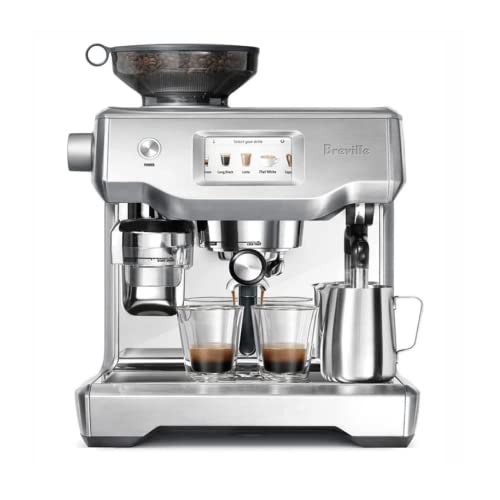
4. Breville Oracle Touch (BES990) — Best for Premium Pop-Ups
The Oracle Touch automates the hard parts of espresso — grinding, dosing, tamping and milk texturing — while keeping the theatre of a portafilter machine. For premium pop-ups, brand activations, tasting events and boutique catering, that combination is gold: drinks look crafted, taste consistent, and can be produced by staff whose training fits in a morning.
It suits caterers selling experience as much as coffee: weddings with a signature-drink station, product launches, and high-end retail events. Throughput is one drink at a time, so it serves occasions measured in dozens of drinks with pauses, not conference-break stampedes.
Strengths
- Automation makes consistent drinks from lightly trained staff
- Touchscreen menu shortens training to minutes per drink type
- Presentation suits premium events where the station is a feature
Trade-offs
- Single-drink workflow caps rush throughput
- Consumer-class internals under commercial-looking skin — duty cycle is prosumer
- Premium price for a machine that still needs supervision
| Model | BES990 Oracle Touch |
| Interface | Touchscreen |
| Milk | Automatic texturing |
The Oracle Touch’s catering niche is real but specific. Where a Jura hides the process, the Oracle performs it — guests watch the portafilter lock in and the milk swirl — while the automation quietly guarantees the result. Event planners pay for exactly that combination of show and safety.
Respect its duty cycle and it performs beautifully; run it like an Appia through a 200-drink surge and you will find its limits in heat recovery and queue length. The professional move is pairing: Oracle for the feature station, a super-automatic for volume self-serve. Many premium caterers in this guide’s audience run exactly that two-machine play.
Best for: premium pop-ups, weddings and brand events with modest volume / Not suited for: high-volume rush service or unattended operation
Check the current price on Amazon
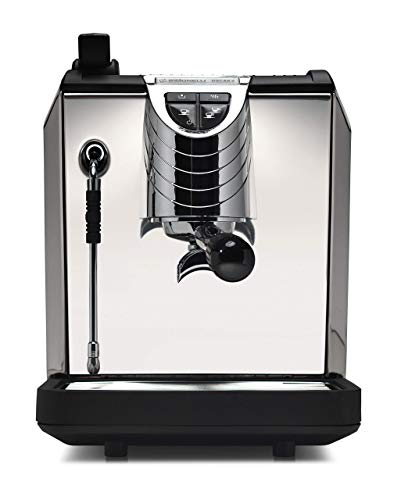
5. Nuova Simonelli Oscar II — Best Prosumer for Small Catering
The Oscar II is the bridge between home and commercial: Nuova Simonelli engineering in a compact, tank-fed machine that can brew and steam at the same time thanks to its heat-exchanger design. For small caterers, food trucks, market stalls and cafés’ second stations, it delivers professional shot quality without plumbing or three-phase anything.
It suits operators who have barista skills but not commercial infrastructure. The workflow is manual — no volumetric dosing — so consistency lives in the operator’s hands, but the machine’s steam power and temperature stability are a class above home machines at similar footprints.
Strengths
- Heat-exchanger design brews and steams simultaneously
- Commercial maker’s build in a compact, tank-fed format
- Strong steam performance for milk-heavy catering menus
Trade-offs
- Manual dosing — consistency depends on the operator
- Tank-fed means refills during long services
- No volumetric programming for multi-operator consistency
| Maker | Nuova Simonelli |
| Design | Heat exchanger, compact |
| Feed | Water tank |
Simultaneous brew and steam sounds like a spec-sheet detail until you have a queue: while a shot extracts, milk is already texturing, and drinks-per-hour roughly doubles against heat-up-between-tasks machines. For a market stall or a small wedding station, that rhythm is the difference between a line that moves and a line that photographs badly.
The Oscar II asks for a real grinder and a real operator, and rewards them with drinks indistinguishable from café output. As a business purchase it sits in the value sweet spot of this guide: professional results, prosumer commitment.
Best for: skilled small-scale caterers, stalls and food trucks / Not suited for: untrained staffing or set-and-forget self-serve
Check the current price on Amazon

6. Philips 5500 Series Fully Automatic Espresso Machine — Best High-Variety Self-Serve
The Philips 5500 is the variety play for self-serve catering: twenty hot and iced coffee presets, user profiles that remember preferences, and the LatteGo milk system whose two-part, tube-free design is the fastest milk system in the category to clean — a decisive advantage when the machine is serviced by venue staff rather than coffee people.
It suits offices, hotels, breakfast rooms and venues where the menu breadth is the attraction and drinks spread across the day. Iced options make it a genuine all-season station, and QuickStart behaviour suits the guest who wants coffee without studying a machine.
Strengths
- 20 hot and iced presets — the broadest menu here
- LatteGo milk system cleans in seconds, with no tubes
- User profiles make repeat self-serve effortless
Trade-offs
- One drink at a time — not a surge machine
- Consumer-duty build under heavy all-day catering volume
- Milk drinks depend on disciplined LatteGo rinsing between services
| Presets | 20 hot and iced |
| Milk system | LatteGo |
| Grinder | Ceramic, built-in |
In self-serve catering, the machine that gets cleaned properly beats the machine with better specs that doesn’t. LatteGo’s design — a small carafe that rinses clean in seconds and stores in the fridge — removes the sour-milk failure mode that plagues venue coffee. Combined with twenty presets, the 5500 covers the widest guest range in this guide, from the espresso purist to the iced-latte teenager at a family event.
Deploy it as the Jura is deployed: all-day stations, not break-time surges. Between the two, the Philips wins on menu breadth and milk hygiene, the Jura on premium build and cold extraction. Either is a defensible professional choice; the menu usually decides.
Best for: offices, hotels and venues wanting maximum self-serve variety / Not suited for: compressed rushes or staffed barista service
Check the current price on Amazon
Comparison Table
| Pick | Badge | Key spec | Best for |
|---|---|---|---|
| Nuova Simonelli Appia Life Volumetric 2 Group | Best True Commercial for Catered Events | 2-group volumetric commercial machine | Professional staffed service |
| Jura Z10 | Best Self-Serve Super-Automatic | One-touch super-automatic with cold extraction | Unattended premium self-serve |
| Nuova Simonelli Appia Life Volumetric 1 Group (110V) | Best Single-Group Commercial | 1-group volumetric, 110V commercial | Mobile and small-venue professional |
| Breville Oracle Touch (BES990) | Best for Premium Pop-Ups | Touchscreen, auto grind/tamp/milk, prosumer duty | Premium event theatre |
| Nuova Simonelli Oscar II | Best Prosumer for Small Catering | Heat-exchanger prosumer, brew + steam together | Small-scale professional quality |
| Philips 5500 Series Fully Automatic Espresso Machine | Best High-Variety Self-Serve | 20 presets, LatteGo milk, bean-to-cup | Menu variety, easy hygiene |
How to Choose a Catering Espresso Machine
Start with your service pattern, because it eliminates most machines immediately. Ask three questions: How many drinks in the busiest thirty minutes? Who operates the machine — a trained barista, a temp, or the guests themselves? And what do the venues provide — plumbed water, drainage, and what electrical supply? A staffed surge points to the Appia Life 2 Group. A staffed trickle points to the 1 Group or the Oscar II. No operator at all points to the Jura or the Philips. Theatre with modest volume points to the Oracle Touch.
Then price the whole station, not the machine. Commercial group machines need a commercial grinder, water treatment, installation and a service plan; super-automatics need consumables and a cleaning rota. The machine’s sticker is often only half the working budget, and the caterers who thrive are the ones who knew that before the first event.
- Count peak drinks per 30 minutes, not drinks per day
- Decide staffed, assisted or self-serve before choosing a class
- Verify venue power and water before falling for a commercial machine
- Budget the grinder, water treatment and service — not just the machine
- Match the menu to the machine: milk-heavy menus need steam capacity
Throughput: The Only Spec That Really Matters in Catering
A café spreads its rush across a morning; catering compresses it into the minutes after a keynote ends. Throughput is therefore measured in drinks per hour sustained, with milk, by your actual operator. Two-group volumetric machines sustain professional numbers because extraction and steaming overlap across two groups. Single-group and prosumer machines sustain a respectable stream with a skilled hand. Super-automatics produce one complete drink at a time with zero skill — slower per hour, but immune to staffing quality.
The planning rule: if your peak window needs more drinks than one operator on one group can physically produce, no machine quality saves you — you need a second group, a second machine, or a menu redesign (batch filter coffee alongside espresso is the classic pressure valve). Honest caterers design the station around the peak, then let the quiet hours be easy.
Power, Plumbing and Water: The Venue Reality Check
Commercial espresso runs on infrastructure. Group machines want a water line, a drain, and a circuit that matches their draw — the Appia Life line spans configurations, which is why this guide lists a dedicated 110V single-group model for North American mobile work and why you must confirm the exact configuration on any listing before purchase. Super-automatics and the Oscar II run from tanks and standard outlets, trading peak capacity for the ability to work anywhere with a socket.
Water quality is the silent budget line. Scale is the leading killer of commercial boilers, and catering machines that travel between venues meet every kind of water. A treatment and testing routine — filtration matched to local hardness, regular testing, scheduled descaling or professional service — is not optional garnish; it is the difference between a five-year asset and a two-year write-off. Build it into the business from the first event.
Staffed vs Self-Serve: The Labour Economics
A staffed station sells craft and costs wages, training and management forever. A self-serve station sells convenience and costs a cleaning rota and consumables. Neither is superior; they are different products. Weddings and brand events often monetise the barista’s presence — the station is entertainment and hospitality in one. Offices and hotels monetise the absence of friction — coffee that simply works at 7 a.m. without a human roster.
The expensive mistake is the mismatch: a volumetric Appia idle behind a self-serve crowd that can’t operate it, or a lone super-automatic drowning in a 300-person break. This guide’s six picks exist so each model of catering gets its correct machine. Choose the labour model first, honestly, and the machine choice usually makes itself.
Buy, Lease or Rent: How Caterers Actually Acquire Machines
Established caterers with weekly volume should buy: the machines in this guide hold value, and ownership wins quickly against rental rates. Seasonal or occasional caterers should run the numbers on leasing, which bundles service — the thing that actually keeps a machine earning — into the payment. One-off events should rent, ideally from the same local company that will service the machine on the day.
Whichever route, the service question dominates: who answers the phone on a Saturday morning? Nuova Simonelli’s network strength is a genuine buying argument for the Appia and Oscar picks; Jura and Philips support their automatics through national channels; Breville’s consumer network suits the Oracle’s prosumer duty. A slightly lesser machine with same-day service beats a greater machine with a two-week parts wait, every single time, in a business where the event cannot be rescheduled.
Menu Engineering: Designing Drinks Your Station Can Actually Serve
The menu is a throughput tool. Every drink that requires a different milk, a syrup pump and a garnish costs seconds that multiply across a queue, so professional caterers design menus backwards from the station. A tight catering menu — espresso, americano, cappuccino, latte, and one signature drink — covers nearly every guest’s desire while keeping the operator’s movements rehearsed and fast. The super-automatics invert the logic: their twenty-preset menus cost no operator time at all, which is why variety belongs to self-serve stations and discipline belongs to staffed ones.
Milk is the pacing item in almost every catering context. Milk drinks take longer than black drinks, alternative milks texture differently and slower, and every milk drink dirties a pitcher. Plan for it: two pitchers rotating on a staffed station, oat milk as the single alternative rather than three, and — on the Philips 5500 — the LatteGo carafe system that turns milk cleanup from a scrub into a rinse. Caterers who menu-engineer honestly serve more drinks, waste less, and finish events with a clean station and a calm team.
The Two-Machine Station: How Premium Caterers Combine These Picks
Look behind the coffee service at a well-run large event and you will often find two of this guide’s machines working as a system. The pattern repeats: a staffed Appia or Oracle station near the action, making crafted drinks and providing the visible theatre, backed by a Jura or Philips self-serve station that absorbs the guests who simply want coffee without a queue or a conversation. Each machine covers the other’s weakness — the automatics can’t perform, the performance machines can’t scale unattended — and the client experiences abundance instead of lines.
The economics work because the two stations serve different peaks. The self-serve machine flattens the arrival surge, when everyone wants coffee at once and few care about craft; the staffed station shines in the long middle of the event, when drinks are social and unhurried. If your catering regularly exceeds a hundred coffee-drinking guests, design for two machines from the start rather than discovering the pattern mid-season with a struggling single station.
Cost Per Cup and the Business Case for Each Class
Without printing prices — which move constantly — the structure of catering coffee costs is stable enough to plan around. Your cost per cup is beans, milk, consumables, labour minutes and machine amortisation, and the classes in this guide arrange those ingredients differently. Group machines minimise machine cost per cup at high volume (the asset is expensive but serves for years at café pace) while maximising labour cost, since a skilled barista stands behind every drink. Super-automatics invert it: higher machine cost per cup at low volume, near-zero labour, and consistency that needs no training budget.
The crossover point is your calendar. A caterer running three events a week crosses into group-machine economics quickly; a venue serving office coffee daily but thinly may never leave super-automatic territory, and shouldn’t. Run your own numbers with current prices from the links in this guide, using your real event count and staffing rates — and remember to include the service contract, because the cheapest machine is the one that has never cancelled an event.
Training Staff for a Catering Station: A Realistic Plan
The machine you choose sets the training budget, so choose with your actual roster in mind. On a super-automatic, training is a fifteen-minute briefing: refill points, the cleaning cycle, what to do when the grounds bin warning appears. On the Oracle Touch, add drink-menu operation and basic presentation — an hour makes a temp genuinely useful. On the Oscar II or an Appia, you are training a barista: dosing, tamping, extraction timing, milk texturing, and the cleaning liturgy, which is days of practice to basic competence and weeks to speed.
Smart caterers build a ladder: every crew member certified on the automatics, your best two trained on the group machines, and those two scheduled as the station leads who also handle the test shots and the troubleshooting. Written station cards — doses, volumes, cleaning steps, the service company’s phone number — live at the machine, because memory fails at exactly the moment a queue forms. The caterers whose stations run calmly are not the ones with the best machines; they are the ones whose training matched the machines they bought.
Insurance, Hygiene and the Unsexy Side of Catering Coffee
Coffee at events is food service, with food service’s obligations. Milk is a perishable that lives under time-and-temperature rules: keep it cold, date it, discard what sat out beyond your local code’s allowance, and treat the milk system cleaning in this guide as a compliance activity, not a preference. The Philips LatteGo’s fridge-storable carafe and the automatics’ guided rinse cycles exist partly because manufacturers understand this world. Water systems need the same respect — a tank left wet and warm between events is a biology experiment, so drain, dry and sanitise on schedule.
On the business side, confirm your liability cover actually names beverage service with commercial electrical equipment at third-party venues, and keep your machines’ service records with your event paperwork. None of this is the romantic part of the coffee business, but it is the part that keeps a catering company a going concern — and it is another argument for buying machines with real manufacturers and service networks behind them, as every pick in this guide has.
A Brief History of the Catering Machine Market — and Where It Is Heading
Catering espresso used to mean one thing: a commercial group machine, a trained barista, and infrastructure to match. The last decade added the second world this guide covers — super-automatics good enough that offices, hotels and venues quietly replaced staffed coffee with self-serve stations, and manufacturers like Jura and Philips engineered explicitly for that duty with one-touch menus, self-rinsing systems and milk solutions designed for non-specialist cleaning. The professional market responded by clarifying its own value: Nuova Simonelli’s volumetric machines sell consistency under genuine load, which no automatic yet matches.
The direction of travel is convergence at the edges: automatics gaining drink quality and cold-extraction tricks, commercial machines gaining programmability and telemetry, and prosumer machines like the Oracle Touch automating the manual ritual itself. For today’s buyer the practical conclusion is stable, though: the six machines in this guide represent the six durable answers, and the category’s evolution is making each of them better at its own job rather than making any one of them universal. Buy for the catering you actually do this season; the market will happily sell you the next machine when your model changes.
How to Set Up a Catering Espresso Station That Survives the Rush
A catering station is a small system. Set it up in this order and the rush becomes routine:
- Arrive with water sorted: filled tanks or confirmed lines, treatment in place, and a test shot pulled and tasted before guests appear
- Lay out the workflow in a line — grinder, machine, milk, cups, waste — so the operator never crosses their own path
- Programme volumetric doses (on the Appia machines) or confirm presets (on the automatics) and pull one of every menu drink as a quality check
- Stage milk cold and in small pitchers; refill little and often rather than leaving a large jug warming
- Put the self-serve machines’ instructions at eye level: one line — ‘Choose your drink, press start’ — prevents most guest hesitation
- During service, clean as you go: purge wands, knock out pucks, wipe the station every lull — the station’s appearance is part of the product
After service, the closing routine decides whether the next event starts clean: backflush or run cleaning cycles, wash milk systems completely (the Philips LatteGo makes this a two-minute job), empty and rinse tanks and trays, and log any odd behaviour while you still remember it. Catering machines rarely die mid-event without having whispered warnings at the previous one.
Staffing note for the setup itself: the person who sets up the station should pull the first drinks, because setup errors — a dose drifting, a wand tip loose, an automatic’s milk carafe not seated — announce themselves in the first three drinks and in no other reliable way. Build the tasting into the run sheet as a named step with a named owner, and photograph the finished station before service: the photo is your reset guide for the next event and your evidence, if a client ever questions the setup, that the station left your hands correctly.
Common Buying Mistakes
Buying a home machine for event volume. Duty cycle is destiny. A domestic machine run through a wedding will overheat, slow, and eventually fail — usually during the toast.
Ignoring the venue’s power and water. A commercial machine that can’t be plugged in or plumbed at the venue is an expensive sculpture. Walk the venue or confirm in writing first.
Skipping water treatment. Scale kills more catering machines than wear does. Filtration and a descale schedule are part of the machine’s price.
Staffing a volumetric machine with untrained temps. Commercial machines assume skill. If your staffing is whoever is available, buy the super-automatic and sleep at night.
Planning for average volume instead of the peak. Catering is peaks. Size the station for the busiest thirty minutes, or redesign the menu to flatten them.
Final Recommendation
Match the machine to the model of catering and this category becomes simple. Staffed, high-volume events belong to the Nuova Simonelli Appia Life 2 Group, the genuine commercial article. Mobile and small-venue professionals get the same pedigree in the 110V single-group Appia or the heat-exchanger Oscar II. Self-serve belongs to the automatics: the Jura Z10 for premium consistency and cold drinks, the Philips 5500 for menu breadth and the easiest milk hygiene in the business. Premium theatre at modest volume is the Breville Oracle Touch’s stage.
Check the current price on Amazon through the links above, then verify the power and water requirements carefully against your venues before ordering commercial equipment, and budget the grinder, the water treatment and the service plan alongside the machine itself. In catering, the machine genuinely is the business — buy the one your busiest half-hour, on your busiest day, would choose for you.
One last practical planning note: whichever class you choose, order with lead time. Commercial machines ship freight, automatics sell out around event seasons, and the accessory ecosystem — grinder, treatment, pitchers, spares — has its own delivery clock. The caterers who start events calmly are the ones whose equipment arrived a month before it was needed, was tested at base, and had already made a hundred drinks before it ever met a paying guest.
Keep exploring: Best Coffee And Espresso Machines Best Calphalon Espresso Machines Best Automatic Espresso Machines Best Coffee And Espresso Combo Machines
Frequently Asked Questions
What makes an espresso machine ‘commercial’ rather than domestic?
Duty cycle and infrastructure: boilers sized for continuous service, components rated for hundreds of drinks a day, plumbed water and drainage, and a professional service network. The Appia Life machines in this guide are commercial in that full sense; the Oscar II and Oracle Touch are prosumer — professional results at lower duty; the Jura and Philips are domestic-premium machines deployed in light catering roles.
How many drinks can one catering machine handle at an event?
It depends on the class and the operator. A two-group volumetric machine with a skilled barista sustains café-pace output through a long event. A single-group or prosumer machine handles a steady stream for small events. A super-automatic makes one drink at a time — excellent across a whole day, wrong for a 200-person coffee break. Plan against your busiest thirty minutes, not your total.
Do catering machines need plumbing?
True commercial group machines are designed for a water line and drain, though some configurations and prosumer machines like the Oscar II run from internal tanks. Tank operation suits small events but adds refilling to the operator’s load. Confirm the exact configuration of any machine on its listing before planning a venue setup.
What grinder do I need for a commercial catering machine?
A commercial espresso grinder matched to your volume — the grinder, not the machine, is where drink consistency is decided. Group machines in this guide assume a separate grinder in the budget. Super-automatics (Jura, Philips) and the Oracle Touch grind internally, which is part of their catering appeal.
Is a super-automatic good enough for paid catering?
For self-serve models — offices, venues, hotel stations — yes, and often preferable: consistency without staffing is the product. For events where guests are paying for craft and theatre, a staffed group machine or the Oracle Touch delivers the experience a super-automatic cannot. The question is what your client is buying, not which machine is ‘better.’
What maintenance does a catering machine need between events?
Full cleaning of milk systems after every service, group cleaning or automatic cycles per the manual, tank and tray washing, and a descale/water-treatment schedule tracked across events. Keep a log: in catering, the machine’s history is a business asset, and the log is what turns a strange noise at one event into a service call before the next.
Can I run a catering station from a generator or outdoor power?
Yes, with planning: the 110V single-group Appia Life and the tank-fed machines in this guide are the realistic candidates, and the station’s total draw — machine, grinder, and any hot-water or refrigeration loads — must be summed against the supply with headroom. Confirm the exact electrical configuration of any machine on its listing, test the full station under load before the event, and keep the super-automatics as the fallback for venues where power is uncertain, since they ask the least of the supply.
What should I serve alongside espresso at a catered event?
Batch filter coffee for volume, hot water with a tea selection for non-coffee drinkers, and water itself — the three additions that prevent your espresso station from becoming the event’s only tap. This is also a throughput strategy: every guest happily drinking filter coffee is a guest not adding thirty seconds to the espresso queue during the peak. Professional caterers treat the espresso station as the centrepiece of a beverage system, not the whole system.
Should a small café buy a catering machine or a café machine?
They are the same machines wearing different schedules. A café’s rush repeats daily and rewards the two-group Appia’s throughput and a plumbed installation; a caterer’s load travels and rewards the 110V single-group or tank-fed flexibility. If your business is fixed, buy as a café; if it moves, buy as a caterer — and if it does both, the single-group Appia plus a super-automatic covers both lives better than one compromised machine.
How long do catering espresso machines last?
Commercial group machines are built for many years of daily service and are routinely rebuilt rather than replaced; their lifespan is set by water care and service discipline more than by time. Super-automatics in daily venue duty live shorter, harder lives and should be budgeted as multi-year assets with a replacement horizon. In both classes, the log book and the water routine decide more than the brand badge does.


