Disclosure: airfryerkitchensupply.com is reader-supported. When you buy through links on our site, we may earn an affiliate commission at no extra cost to you.
Where to buy
If you came looking for the best calphalon espresso machines, here is the short version before the links: Calphalon’s espresso range, as verified against Amazon’s catalogue, is one machine — the Calphalon Temp iQ Espresso Machine (BVCLECMP1). If that is the machine you want, it is the only Calphalon decision you need to make. If its feature set doesn’t fit you, the honest alternatives in this guide start with the De’Longhi Stilosa at the budget end and the Breville Bambino as the step-up.
We will not pad this page with invented Calphalon models. Check the current price on Amazon through the links for each machine, and read the section below on why the Calphalon espresso catalogue is a single product before assuming you missed a model.
Introduction
Shoppers searching for the best calphalon espresso machines expect a range to compare — and the first honest thing this guide can tell you is that the range barely exists. Calphalon, a cookware giant, makes exactly one current espresso machine platform: the Temp iQ, sold as model BVCLECMP1 with a steam wand and stainless finish. We verified this twice through Amazon’s own catalogue data, searching both the brand broadly and the model line specifically; one machine came back. There is no Calphalon with a built-in grinder, no Calphalon super-automatic, and no second tier hiding under a different name.
So this guide does two jobs. First, it reviews the Temp iQ properly — who it suits, where it shines, and where its single-machine reality pinches. Second, it lines up the five closest alternatives that Calphalon shoppers actually cross-shop, each verified the same way, so you can decide whether the Calphalon badge is worth its compromises or whether your money works harder elsewhere. Every machine with a link below was confirmed against the manufacturer’s Amazon listing; nothing here is padded with discontinued models or guesswork.
In this guide
Quick Picks
1. Calphalon Temp iQ Espresso Machine (BVCLECMP1) — Best Calphalon — the Only Current Model. Calphalon’s single espresso platform: a pump machine with a steam wand for cappuccinos and lattes, in a stainless finish that matches the brand’s cookware.
2. De’Longhi Stilosa Espresso Machine (EC260) — Closest Budget Alternative. A 15-bar manual machine with a frothing wand from the world’s biggest espresso maker — the value benchmark the Temp iQ has to beat.
3. CASABREWS CM5418 Compact Espresso Machine — Best Alternative with a Pressure Gauge. A 20-bar compact machine whose built-in pressure gauge shows beginners what a good extraction looks like — feedback the Temp iQ doesn’t offer.
4. Breville Bambino Espresso Machine (BES450) — Best Step-Up Alternative. Breville’s fast-heating, small-footprint manual machine — the refinement upgrade for shoppers who outgrow the Temp iQ’s basics.
5. De’Longhi Classic Signature Espresso Machine — Best Mid-Range Alternative. Rapid heat-up and preset single/double shots soften the manual learning curve — De’Longhi’s friendlier middle option.
6. Breville Barista Express Espresso Machine (BES870) — Best All-in-One Alternative with Grinder. The built-in-grinder answer to the Temp iQ’s biggest gap — the machine for shoppers who wanted Calphalon to sell a complete espresso station.
How These Picks Were Chosen
Our method for this unusual keyword started with verification, not selection. We searched the Amazon catalogue for Calphalon espresso machines twice, with two different queries, and cross-checked the results: a single machine, the Temp iQ BVCLECMP1, is Calphalon’s espresso offering. Rather than inventing variants, we built the guide around that fact and chose alternatives by the questions Temp iQ shoppers ask next: What costs less? What has a pressure gauge? What heats up faster? What includes a grinder?
Each alternative had to be a pump espresso machine with a steam wand in the same broad class — no pod machines, no stovetop pots — and had to be verifiable against its manufacturer’s listing. Machines that failed verification were dropped rather than written up from memory. The result is a short, honest list: one Calphalon, five genuine rivals, and a buying guide that explains the category Calphalon competes in.
The 6 Best Calphalon Espresso Machines (and the Alternatives Worth Considering)
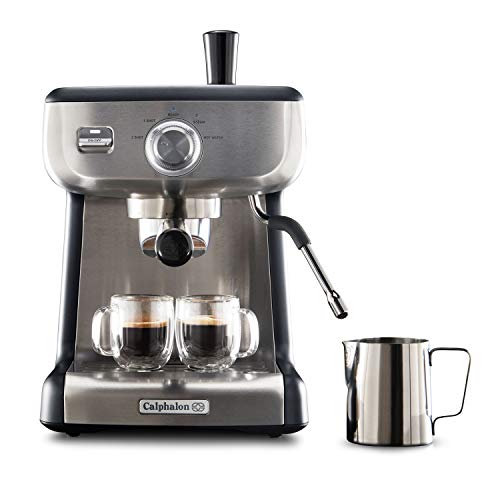
1. Calphalon Temp iQ Espresso Machine (BVCLECMP1) — Best Calphalon — the Only Current Model
The Temp iQ is the Calphalon espresso machine — definite article. It is a manual pump machine: you dose and tamp ground coffee in the portafilter, pull the shot yourself, and texture milk with the steam wand for cappuccinos and lattes. The Temp iQ name refers to the machine’s temperature management, the brand’s pitch being consistent brewing temperature shot to shot, which is the unglamorous variable that separates drinkable home espresso from sour guesswork.
It suits the Calphalon loyalist and the design-matcher: if your kitchen already runs on Calphalon cookware, this machine’s stainless look belongs on the same counter, and its manual workflow teaches real espresso skills. It does not suit anyone wanting a grinder in the box, one-touch drinks, or a choice of sizes — Calphalon simply doesn’t sell those.
Strengths
- The genuine Calphalon option, with matching stainless kitchen styling
- Steam wand gives full manual control over milk texture
- Manual workflow teaches transferable espresso skills
Trade-offs
- It is the only model — no grinder version, no bigger sibling, no upgrade path within the brand
- Separate grinder purchase is effectively required for best results
- Calphalon’s espresso support ecosystem is smaller than espresso-first brands’
| Model | BVCLECMP1 Temp iQ |
| Milk | Manual steam wand |
| Finish | Stainless |
Judged as a manual machine rather than as a range, the Temp iQ does the honest basics: pump extraction, a proper portafilter workflow, and a wand that lets you learn milk. Its natural rivals — the Stilosa and CM5418 below — compete on price and gauges, while the Bambino competes on speed and refinement. The Temp iQ’s case rests on brand trust and temperature consistency, and for buyers who already trust Calphalon’s cookware support, that case is coherent.
The strategic warning is about the ecosystem. Espresso-first brands publish descaling schedules, sell every gasket and group-head part, and maintain deep troubleshooting knowledge bases. A one-machine sideline from a cookware company will never match that depth. If you expect to keep a machine for a decade and service it yourself, weigh that honestly against the badge.
Best for: Calphalon loyalists wanting a manual machine that matches their kitchen / Not suited for: anyone wanting a built-in grinder, automation, or a model range to grow through
Check the current price on Amazon
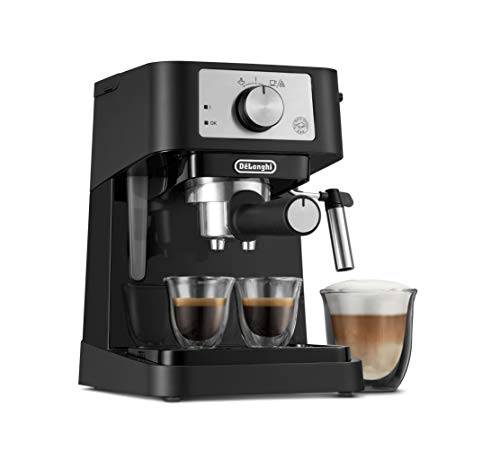
2. De’Longhi Stilosa Espresso Machine (EC260) — Closest Budget Alternative
The Stilosa is what most Temp iQ shoppers end up cross-shopping: a compact manual machine with a 15-bar pump and a manual milk frother, from De’Longhi, a company that makes nothing but coffee machines at every level. It does the same job — portafilter shots, wand-textured milk — with a smaller footprint and a value-tier price position.
It suits beginners and small counters. The manual frother asks you to learn the same milk skills as the Calphalon, the machine heats and works without ceremony, and De’Longhi’s parts and support network is as deep as the category offers. If the Calphalon badge isn’t doing specific work for you, this is the rational default.
Strengths
- 15-bar pump and manual frother cover the full espresso drink range
- Compact design suits small counters the Temp iQ crowds
- De’Longhi’s support, parts and descaling ecosystem is category-leading
Trade-offs
- Value-tier build materials compared with pricier rivals
- Manual frother has a learning curve for latte-quality microfoam
- No pressure gauge to guide extraction
| Pump | 15 bar |
| Milk | Manual frothing wand |
| Design | Compact, small counter spaces |
The Stilosa’s virtue is focus: De’Longhi stripped everything that doesn’t make espresso or steam milk, and the result is a machine that does the fundamentals reliably for years. Owners stepping up later to a Bambino or Barista-class machine consistently report that the Stilosa taught them dosing, tamping and milk timing — the same skills the Temp iQ teaches — at the friendliest price of admission in this guide.
Choose it over the Calphalon when budget or counter space is the binding constraint, or when you value a deep support network over brand matching. It is the alternative we would hand a friend who asked for ‘a real espresso machine, cheap, that won’t embarrass me.’
Best for: beginners and small kitchens wanting the manual espresso fundamentals for less / Not suited for: buyers set on Calphalon styling or wanting a gauge-guided machine
Check the current price on Amazon

3. CASABREWS CM5418 Compact Espresso Machine — Best Alternative with a Pressure Gauge
The CM5418’s party trick is the dial on its face: a built-in pressure gauge that tells you whether your grind and tamp landed in the extraction zone. For a learner, that feedback loop is worth more than any other single feature — it turns the first month of espresso from superstition into calibration. A steam wand handles milk for cappuccinos and lattes, and the stainless compact body sits easily on small counters.
It suits the analytical beginner: the person who will adjust one variable at a time and watch the needle. CASABREWS is a younger brand than De’Longhi or Calphalon, so the support network is thinner, but the machine’s teaching value at its tier is real and rare.
Strengths
- Built-in pressure gauge makes learning extraction dramatically faster
- Steam wand covers cappuccinos and lattes
- Compact stainless design fits small kitchens
Trade-offs
- Younger brand with a shallower parts and service network
- Gauge or not, you still need a capable separate grinder
- Compact water capacity means frequent refills for households
| Pump | 20 bar |
| Gauge | Built-in pressure gauge |
| Milk | Steam wand |
Why does the gauge matter so much? Because espresso fails invisibly: a shot can pour in the right time and still be wrong, and without pressure feedback a beginner can’t tell a grind problem from a tamp problem. The CM5418’s dial collapses that mystery. Pair it with a decent burr grinder and a kitchen scale, and a motivated learner reaches café-plausible shots faster on this machine than on gauge-less rivals costing more.
Its limits are the limits of its class: thermoblock-class heating, modest tank, and a brand still building its reputation. As a first machine bought deliberately for learning, it is arguably the smartest alternative in this guide.
Best for: learners who want extraction feedback while they build skills / Not suited for: buyers prioritising a decades-deep service network
Check the current price on Amazon
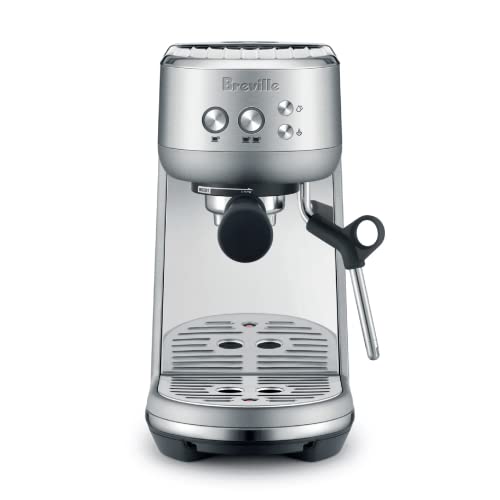
4. Breville Bambino Espresso Machine (BES450) — Best Step-Up Alternative
The Bambino is where espresso-first engineering shows. Breville’s ThermoJet heating is ready in seconds rather than minutes, the footprint is among the smallest of any real portafilter machine, and the steam wand produces genuinely good milk texture for a machine of its class. It is the step-up for shoppers who liked the Temp iQ’s manual concept but want speed and polish.
It suits busy households: espresso before work cannot wait for a long heat-up, and the Bambino’s near-instant readiness removes the friction that kills weekday routines. It remains a manual machine — you dose, tamp and time — but every interaction feels a generation more refined than the value tier.
Strengths
- Near-instant heat-up makes weekday espresso realistic
- Tiny footprint with full-size portafilter workflow
- Steam performance punches above its class for lattes
Trade-offs
- Costs more than the Temp iQ and value-tier rivals
- Small drip tray and tank need regular attention
- Still no built-in grinder — budget for one
| Model | BES450 Bambino |
| Format | Manual pump machine |
| Footprint | Compact |
Breville’s advantage compounds over ownership: the accessory ecosystem (tampers, distribution tools, replacement baskets) is enormous, the knowledge base is deep, and the machine’s pre-infusion and temperature control produce shots that value machines approximate but rarely match. Shoppers who start on a Bambino tend to keep it for years, upgrading the grinder instead of the machine — the correct order of operations in espresso.
If your Temp iQ research has quietly become ‘maybe I should buy the better machine first,’ this is that machine in this guide. The price step is real; so is the daily difference.
Best for: busy buyers wanting fast heat-up and refined manual espresso / Not suited for: strict budgets or anyone wanting one-touch automation
Check the current price on Amazon

5. De’Longhi Classic Signature Espresso Machine — Best Mid-Range Alternative
The Classic Signature sits between the Stilosa’s austerity and fully automatic machines: a manual portafilter workflow, but with rapid heat-up and preset single and double shot volumes that remove the stopwatch from your first month. The adjustable milk frother helps beginners produce cappuccino foam without mastering wand angle on day one.
It suits the household that wants real espresso with training wheels it can later ignore. The presets get drinks made; as skills grow, the manual workflow underneath lets you take control. For Temp iQ shoppers who wanted a little more guidance from the machine, this is the natural alternative.
Strengths
- Preset single and double shots simplify the first month
- Rapid heat-up suits morning routines
- Adjustable frother is forgiving for milk beginners
Trade-offs
- Presets are training wheels — enthusiasts will outgrow them
- Mid-range price overlaps step-up rivals like the Bambino
- Still requires a separate grinder for fresh espresso
| Shots | Preset single and double |
| Heat-up | Rapid |
| Milk | Adjustable frother |
Volume presets sound trivial until you have made espresso half-awake: the machine stops the shot at a sensible volume while you steam milk, and the drink is consistent while your technique catches up. De’Longhi’s frother, adjustable between cappuccino foam and latte milk, similarly flattens the hardest beginner curve in espresso — milk.
Against the Temp iQ, the Classic Signature trades brand novelty for depth of support and beginner assistance. Against the Bambino, it trades speed and refinement for presets and price. It is the middle path, and for many households the middle path is the one that survives contact with real mornings.
Best for: households wanting guided manual espresso with preset help / Not suited for: purists who want full manual control from day one
Check the current price on Amazon

6. Breville Barista Express Espresso Machine (BES870) — Best All-in-One Alternative with Grinder
Every Temp iQ shopper eventually asks the grinder question, and the Barista Express is the machine built around answering it: a capable manual espresso machine with an integrated conical burr grinder, a pressure gauge, and the accessory kit to start immediately. It has been the default recommendation in home espresso for years because it removes the two-machine research project entirely.
It suits the buyer who wants one purchase, one footprint, and a genuine skill ceiling. The grinder’s dose and grind-size controls, the gauge-guided extraction, and Breville’s deep support make it a machine people keep through several grinder-upgrade cycles — or never upgrade at all.
Strengths
- Built-in burr grinder completes the station in one box
- Pressure gauge plus manual control teaches real espresso
- The category’s deepest owner community and accessory market
Trade-offs
- The largest footprint and highest commitment in this guide
- Integrated grinder means one unit to service if either side fails
- Overkill for households that drink espresso twice a month
| Model | BES870 Barista Express |
| Grinder | Built-in conical burr |
| Gauge | Built-in pressure gauge |
The Barista Express reframes the Calphalon decision: the Temp iQ plus a separate quality grinder approaches this machine’s total outlay, while demanding two purchases and more counter coordination. For the shopper whose heart was set on Calphalon styling, that arithmetic is the honest counter-argument — and many will still choose the Calphalon for the kitchen match, which is a legitimate reason when stated plainly.
As an espresso proposition alone, though, this is the most complete machine in the guide, and the one least likely to be replaced within five years. If you buy one alternative instead of the Calphalon, the evidence of a decade of owners says buy this one.
Best for: buyers wanting a complete, grinder-included espresso station / Not suited for: small counters, small budgets, or the Calphalon-committed
Check the current price on Amazon
Comparison Table
| Pick | Badge | Key spec | Best for |
|---|---|---|---|
| Calphalon Temp iQ Espresso Machine (BVCLECMP1) | Best Calphalon — the Only Current Model | BVCLECMP1, steam wand, stainless — Calphalon’s only espresso model | The Calphalon buyer, full stop |
| De’Longhi Stilosa Espresso Machine (EC260) | Closest Budget Alternative | 15-bar pump, manual frother, compact body | Budget manual espresso |
| CASABREWS CM5418 Compact Espresso Machine | Best Alternative with a Pressure Gauge | 20-bar pump, built-in pressure gauge, steam wand | Learning with feedback |
| Breville Bambino Espresso Machine (BES450) | Best Step-Up Alternative | BES450, fast heat-up, compact manual machine | Step-up quality and speed |
| De’Longhi Classic Signature Espresso Machine | Best Mid-Range Alternative | Preset shots, rapid heat-up, adjustable frother | Guided manual espresso |
| Breville Barista Express Espresso Machine (BES870) | Best All-in-One Alternative with Grinder | BES870 with built-in grinder and gauge | Complete one-box station |
Why Calphalon Sells Only One Espresso Machine
Calphalon is a cookware company that added an espresso machine, not an espresso company. Its brand equity lives in pans, and the Temp iQ exists so a Calphalon kitchen can be completed with a matching coffee appliance. That strategy explains the catalogue shape: one well-specified manual machine, no grinder variant, no super-automatic, no commercial line. Espresso specialists like De’Longhi and Breville invert the strategy — dozens of models across every tier — because espresso is their entire business.
Neither strategy is dishonest, but they produce different ownership experiences. A one-model line means simpler support for that model and no upgrade path; a deep line means parts, accessories and knowledge everywhere, plus decision fatigue at purchase. This guide’s structure mirrors the reality: buy the Temp iQ if the brand and the basics fit, and treat the alternatives as the range Calphalon doesn’t offer.
How to Choose Between the Temp iQ and Its Alternatives
Work through four questions in order. First, brand: does matching Calphalon cookware and trusting its support matter enough to anchor the decision? If yes, your research is done — buy the Temp iQ and a good grinder. Second, guidance: do you want the machine to help you learn (the CM5418’s gauge, the Classic Signature’s presets) or to get out of the way (Stilosa, Bambino)? Third, completeness: will you happily research a separate grinder, or should the Barista Express’s integrated grinder end the project today? Fourth, pace: is this a weekday-before-work machine, where the Bambino’s instant heat-up quietly wins?
- Decide whether the Calphalon brand itself is a feature you are buying
- Budget for a burr grinder with any manual machine that lacks one
- Choose gauge or presets if you are learning; choose speed if you are busy
- Measure your counter — these machines differ more in footprint than in function
- Buy from a listing with easy returns; espresso fit is personal
The Grinder Question Every Temp iQ Buyer Must Answer
Manual espresso machines are only half a system. The Temp iQ, Stilosa, Bambino and Classic Signature all assume ground coffee, and espresso is brutally sensitive to grind quality: pre-ground coffee stales within days of opening and offers no adjustment when a shot runs fast or slow. A burr grinder — chosen for fine, consistent, adjustable output — is not an accessory to these machines; it is the other half of them. Budget for it in the same purchase decision, or choose the Barista Express and fold the grinder into the machine.
This is also where the total-cost comparison flips. A Temp iQ plus a competent grinder can cost as much as the integrated Barista Express while taking more counter space. Conversely, a separate grinder can later upgrade independently, which integrated owners cannot do. There is no universally right answer — but there is a wrong one, which is buying any manual machine in this guide and feeding it supermarket pre-ground coffee, then blaming the machine for sour shots.
Manual vs Automatic: Where the Temp iQ Sits in the Espresso World
The Temp iQ is a manual machine: the human doses, tamps, starts, stops and steams. That involvement is the point for its buyers — espresso as a small daily craft — and the ceiling on drink quality is high once skills form. Semi-automatics add preset volumes (the Classic Signature), super-automatics grind, brew and froth at a button press, and pod machines trade freshness for total convenience. Each step up in automation costs more and removes both effort and control.
Calphalon sells nothing above the manual tier, so shoppers wanting automation must leave the brand — the Philips and De’Longhi super-automatics in our wider espresso guides are the usual destinations. Be honest about your mornings: a manual machine bought aspirationally and abandoned for pods within a year is the most expensive outcome in this category. The Temp iQ rewards the buyer who genuinely wants the ritual.
What Ownership of a One-Model Brand Looks Like
Owning the Temp iQ means owning a machine with a small but sufficient support footprint: Calphalon’s customer service stands behind it, consumables like descaler are universal, and wear parts such as portafilter baskets and gaskets follow standard manual-machine patterns. What you won’t find is the deep third-party ecosystem — the forums, upgrade baskets, and specialist repair shops — that Breville and De’Longhi owners enjoy. For most households that never matters; for tinkerers, it might.
Longevity in manual machines is mostly about water and cleaning discipline, not brand. Descale on schedule for your water hardness, backflush and wipe the group after use as the manual directs, and purge and wipe the steam wand every single time — milk residue is the number-one killer of home espresso machines across all brands. Do those things and the Temp iQ’s simple, pump-and-wand architecture should serve for years.
A Day With the Temp iQ: The Manual Workflow, Honestly Described
Owning a manual machine means owning a small ritual, and it is worth describing plainly so you can decide whether it sounds like pleasure or chore. You fill and check the water tank, switch on and let the machine heat while you weigh beans. You grind, dose the portafilter, level, tamp, and lock in. The shot pulls in under a minute; you watch it, because watching is how you learn. Then milk: purge the wand, texture a small pitcher, wipe and purge again. Total elapsed time for a latte, once practised, is three to four minutes, plus a minute of rinsing. That is the Temp iQ’s daily reality — and the Stilosa’s, Bambino’s and CM5418’s too, since the workflow is the category’s, not the model’s.
Two honest observations from that routine. First, the second drink is much faster than the first, so households making two lattes together barely notice the manual cost. Second, the cleanup is front-loaded into seconds-long habits — the wand wipe, the knock-out of the puck, the tray rinse — and skipping them is what turns a pleasant machine into a crusty one. If that routine sounds like a small daily pleasure, manual espresso will suit you and the Temp iQ is a perfectly good place to practise it. If it sounds like a burden before a commute, automation exists and this guide’s wider links will take you there without judgement.
The Accessory Kit Every Machine in This Guide Needs
Budget beyond the machine. The non-negotiables for the manual picks here are a burr grinder (covered above), a milk pitcher sized to your usual drink, and a knock box or a sturdy routine for spent pucks. Close behind come a kitchen scale accurate to a gram — the single cheapest upgrade to shot consistency ever sold — and a tamper that fits the basket properly if the included one feels flimsy. A small brush for the group head and a microfibre cloth dedicated to the steam wand complete a kit that keeps any of these machines pleasant for years.
What you can skip: distribution gadgets, bottomless portafilters and precision baskets are enthusiast refinements that matter after the fundamentals are boring, not before. Spend the first months’ accessory money on better beans instead — fresh, recently roasted beans from a local roaster will improve your drinks more than any tool, on the Calphalon or any rival. This ordering of priorities — beans, grinder, technique, then toys — is the closest thing home espresso has to a universal law.
Calphalon the Brand: What Its Cookware Reputation Does and Doesn’t Transfer
Calphalon earned its name in hard-anodized cookware, and that history cuts both ways for the Temp iQ. Positively, the company understands kitchen products, distribution and warranty support at scale; a Temp iQ bought today is backed by a real consumer-products organisation, not a pop-up brand. Its stainless styling is deliberately coordinated with the cookware, which is a legitimate aesthetic system for buyers building a kitchen in one brand’s language.
What doesn’t transfer is espresso depth. Decades of pan-making teach nothing about pump curves, thermoblocks or steam-tip design, and Calphalon’s single-model line reflects a company renting a seat in the category rather than living in it. Breville and De’Longhi employ the engineers, sponsor the barista knowledge and stock the parts because espresso is their home turf. None of this makes the Temp iQ a bad machine — it makes it a simple one from a generalist, and buyers who understand that distinction tend to be satisfied with it. Buy the badge for the right reasons and it will not disappoint you.
Scenario Guide: Which Machine for Which Calphalon Shopper
The loyalist: your kitchen is Calphalon, your pans match, and you want the coffee corner to match too. Buy the Temp iQ and a quality burr grinder in a finish that coordinates. You are purchasing a system look plus a competent manual machine, and that is a complete, defensible decision. The student: budget is the whole story, and every saved dollar goes to beans. Buy the Stilosa, learn the fundamentals on De’Longhi’s deep support network, and know that your skills — not the machine — are the appreciating asset. The analyst: you want to see what the machine is doing. Buy the CM5418 for its gauge, weigh everything, keep notes, and expect to reach good espresso faster than any other beginner in this guide.
The busy professional: mornings are timed to the minute. Buy the Bambino, whose near-instant heat-up is the only feature that matters at 6:40 a.m., and pre-dose the night before if you must. The guided household: several people with mixed enthusiasm will use the machine. Buy the Classic Signature, whose presets let a novice produce a decent drink while the enthusiast still gets a manual workflow. The completionist: you want the project finished in one box. Buy the Barista Express and spend your remaining research energy on choosing beans. Every one of these is a shopper who started by typing Calphalon into a search box — the brand got you here; let your actual scenario finish the decision.
Water, Descaling and the Maintenance Calendar That Keeps Any of These Alive
Espresso machines die of water, not of use. Mineral scale builds inside boilers and thermoblocks, narrows passages, insulates heating elements and eventually strangles temperature and flow. Your defence is boring and total: use filtered water if your tap is hard, and descale on a calendar — every two to three months for typical municipal water, monthly for hard water, following the machine’s own procedure and a descaler made for espresso equipment. Put the dates in your phone when the machine arrives, because nobody remembers month three without a reminder.
The rest of the calendar is small. Weekly: wash the drip tray and tank properly rather than rinsing, and brush the group head. Monthly: inspect the portafilter basket for clogged holes and the group gasket for cracking or leaks. Always: wipe and purge the steam wand after every single milk drink — baked-on milk is both a hygiene problem and the most common cause of wand blockages across every brand in this guide. Machines maintained this way routinely outlast their owners’ interest in upgrading, which is the real secret behind the ‘my ten-year-old machine’ stories in every espresso forum.
How We Verified the ‘One Machine’ Claim — and Why You Can Trust It
Because this guide’s central claim is unusual — a famous brand with a one-product range — it is worth showing the working. We queried Amazon’s catalogue, the same data source behind the links on this page, using the airfry site’s own provider account. The first search, for Calphalon espresso machines generally, returned one Calphalon machine among rival brands. A second, deliberately different search built around the Temp iQ name and grinder terms returned the same single machine again, surrounded by grinders and other brands’ products. Two independent queries, one answer.
Could a Calphalon model exist somewhere the catalogue doesn’t reach — a regional exclusive, a discontinued line in a warehouse? Possibly, and if one surfaces we will update this guide. But a buying guide’s duty is to the catalogue you can actually buy from, and in that catalogue the answer is unambiguous. We would rather publish a shorter, stranger, true guide than a conventional-looking list padded with machines that don’t exist — and we think that is the right trade for a reader about to spend real money.
How to Pull Your First Good Shot on the Temp iQ (or Any Manual Machine Here)
Manual espresso is a short skill ladder. Climb it in this order and any machine in this guide will perform:
- Start with fresh beans and a burr grinder set fine; dose consistently — weigh the dose if you can, because consistency is the whole game
- Distribute the grounds evenly in the basket, tamp level with firm, even pressure, and lock the portafilter in promptly
- Start the shot and watch: you want a slow, honey-like stream that blondes gradually, finishing a double in roughly the time the machine’s guidance suggests
- If it gushes, grind finer; if it drips and chokes, grind coarser — change only the grinder, one step at a time, and taste again
- For milk, purge the wand, submerge the tip just under the surface to add air early, then sink it to heat; wipe and purge the wand the second you finish
Your first shots will be imperfect; that is the tuition every manual machine charges, and it is lower than it looks — most beginners pull a genuinely enjoyable shot within the first bag of beans. Keep the variables written down for the first week (dose, grind setting, time, result) and the learning curve compresses dramatically. The gauge-equipped machines in this guide exist to make exactly this process faster.
A final note on beans for your first month: buy a medium-roast espresso blend from a roaster who prints a roast date, in small bags you will finish within a few weeks. Very dark roasts extract easily but taste one-dimensional; very light roasts punish beginners with sour shots. The forgiving middle is where learning happens fastest, on the Temp iQ and on every alternative in this guide.
Common Buying Mistakes
Assuming Calphalon sells a range. It sells one espresso machine. Research that assumes a grinder version or a bigger model will waste your time — verified twice against the catalogue for this guide.
Buying a manual machine without a grinder plan. Pre-ground coffee caps any machine in this guide at mediocre. Budget the grinder or buy the integrated Barista Express.
Judging by pump bar numbers alone. A 20-bar badge doesn’t out-pull a well-made 15-bar machine; extraction happens at lower pressure, and grind quality matters more than the headline number.
Skipping descaling. Scale is the silent killer of home espresso. Follow the schedule for your water hardness from month one, whatever brand you buy.
Expecting café drinks on day one. Manual espresso is a skill. Give yourself a bag of beans of practice before judging the machine — or choose presets and automation honestly.
Final Recommendation
If you came here for a Calphalon, the decision is refreshingly simple: the Temp iQ is the Calphalon espresso machine, it is a competent manual platform with a steam wand and kitchen-matching stainless style, and paired with a good burr grinder it will make satisfying espresso drinks for years. Buy it with your eyes fully open about the one-model reality — no grinder sibling, no automation tier above it, a smaller ecosystem than the espresso-first brands.
If the badge isn’t the point, the alternatives rank themselves by need: the Stilosa for value, the CM5418 for learning with a gauge, the Classic Signature for preset-guided ease, the Bambino for speed and refinement, and the Barista Express for the complete one-box station. Check the current price on Amazon for each through the links above — and whichever machine you choose in the end, spend the grinder money without hesitation. In home espresso, the grinder is quietly the real machine; the gleaming box beside it is, in the end, the accessory.
Keep exploring: Best Coffee And Espresso Machines Best Cheaper Espresso Machines Best Coffee And Espresso Combo Machines Best Catering Espresso Machines
Frequently Asked Questions
How many espresso machines does Calphalon make?
One current platform: the Temp iQ, model BVCLECMP1, a manual pump machine with a steam wand. We verified this with two separate searches of Amazon’s catalogue data for this guide. Older or regional listings occasionally surface, but there is no second current model, no grinder version and no super-automatic in the Calphalon line.
Does the Calphalon Temp iQ have a built-in grinder?
No. Like most manual machines, it assumes a separate grinder. For fresh espresso you will want a burr grinder capable of fine, adjustable output; budget for it alongside the machine, or consider an integrated alternative such as the Breville Barista Express in this guide.
Is the Temp iQ good for beginners?
It is a fair first manual machine: the workflow is standard, so skills transfer to any future machine, and the steam wand teaches real milk technique. Beginners who want the machine to help more should look at the pressure-gauge CASABREWS CM5418 or the preset-guided De’Longhi Classic Signature among the alternatives here.
What drinks can the Temp iQ make?
Espresso in single and double shots, and — using the steam wand and a milk pitcher — cappuccinos, lattes and other milk drinks. It does not brew drip coffee; households wanting one machine for both should look at combination machines, which we cover in the linked combo guide.
How does the Temp iQ compare with the Breville Bambino?
Both are manual, wand-equipped machines. The Bambino heats up almost instantly, has a smaller footprint, and sits inside Breville’s deep espresso ecosystem; the Temp iQ offers Calphalon styling and brand support. The Bambino is the step-up in speed and refinement; the Calphalon is the brand-loyal choice.
What maintenance does a manual espresso machine need?
Daily: wipe and purge the steam wand after every use, empty and rinse the drip tray, and keep the group head clean. Periodically: descale on the schedule your water hardness demands, and replace the group gasket when shots start leaking around the portafilter. None of this is brand-specific, and it is the difference between a three-year machine and a ten-year machine.
Why do other sites list several Calphalon espresso machines?
Most such lists recycle older content, count colour or bundle variants of the Temp iQ as separate machines, or quietly include other brands under a Calphalon headline. Checked against the current catalogue, there is one machine. When a guide’s list and the catalogue disagree, trust the catalogue — it’s the one that has to ship you a product.
Can the Temp iQ use pre-ground coffee or pods?
Manual portafilter machines like the Temp iQ are designed for ground coffee you dose yourself, and most include a pressurised basket option that tolerates pre-ground coffee better than a standard basket. Results with pre-ground coffee are drinkable but noticeably flatter than fresh-ground, which is why this guide keeps returning to the grinder. Pod adapters are not part of Calphalon’s offering; if pod convenience is your priority, a dedicated pod or combination machine from our linked guides is the honest recommendation.

