Disclosure: airfryerkitchensupply.com is reader-supported. When you buy through links on our site, we may earn an affiliate commission at no extra cost to you.
Where to buy
Every linked pick in this guide to the best charcoal filter air purifiers was cross-checked against the Amazon catalog data available to this site before publication, and only listings we could confirm get a buy link. Prices move constantly, so we never print a fixed price here: use the links below to check the current price on Amazon for the exact size, color, or configuration you want, because options on the same listing can sit in different tiers.
- WINIX 5510 Air Purifier (Best Overall) — Check the current price on Amazon
- Oransi TrueCarbon 200C Carbon Air Purifier (Best for Serious Odor Problems) — Check the current price on Amazon
- Austin Air HealthMate Plus Air Purifier (B450) (Best Long-Life Carbon Bed) — Check the current price on Amazon
- COWAY Airmega 150 Air Purifier (Best for Bedrooms) — Check the current price on Amazon
- COWAY Airmega 100 Air Purifier (Best Compact) — Check the current price on Amazon
- WINIX 5520 Air Purifier (Best Large-Room Alternative) — Check the current price on Amazon
Shopping for the best charcoal filter air purifiers starts with a vocabulary problem: almost every purifier on the market mentions carbon somewhere in its copy, but the amount of activated charcoal behind that word ranges from several pounds of granular media to a scented foam sheet thinner than a place mat. Only the first kind does meaningful work on odors, smoke, and the volatile organic compounds (VOCs) that evaporate from paint, cleaning products, new furniture, and cooking. This guide exists to separate those two categories, and every pick below has a carbon stage its manufacturer is willing to name, quantify, or headline in the listing itself.
A second honesty note: charcoal does not trap dust, pollen, or pet dander. Those are particles, and they are the HEPA filter’s job. Carbon works on gases by adsorption — molecules stick to the enormous internal surface area of activated charcoal — which is why the strongest odor setups in this guide pair a real carbon stage with True HEPA rather than asking either technology to do both jobs. If your problem is purely airborne particles, a HEPA-only machine is a rational buy; if smells, smoke, or chemical freshness are any part of the complaint, read on.
We also flag the limits plainly. No purifier removes an odor source, carbon saturates and must be replaced, and coverage figures are laboratory numbers for empty rooms. The picks below span a deep-carbon specialist for one problem room, a five-year-filter heavyweight for large spaces, two sensor-led Winix towers, and two Coway units for bedrooms — so the right answer depends on your room and your odor load, not on a single winner.
In this guide
Quick Picks
WINIX 5510 Air Purifier — Best Overall. The successor to the long-running 5500-2 pairs a True HEPA filter with what Winix calls a High Deodorization Carbon Filter, adds app support, and is sized for large rooms up to 1,881 square feet in one hour according to its listing title. Check price on Amazon.
Oransi TrueCarbon 200C Carbon Air Purifier — Best for Serious Odor Problems. A specialist: 3.2 pounds of treated activated carbon (per its listing title) aimed squarely at odors, smoke smell, pet odors, and VOCs in rooms up to 375 square feet — the heaviest carbon load in this guide relative to its room size. Check price on Amazon.
Austin Air HealthMate Plus Air Purifier (B450) — Best Long-Life Carbon Bed. A steel-box heavyweight whose listing promises 4-stage filtration with activated carbon and zeolite, coverage up to 1,500 square feet, and a 5-year filter life — the long-interval option for buyers who hate consumables. Check price on Amazon.
COWAY Airmega 150 Air Purifier — Best for Bedrooms. A bedroom-friendly Coway with HEPA, carbon, and a washable pre-filter, an air quality monitor, Auto Mode, and a stated 3-year warranty, sized for rooms up to 1,035 square feet per its listing. Check price on Amazon.
COWAY Airmega 100 Air Purifier — Best Compact. The smaller Coway sibling: HEPA and carbon filtration for rooms up to 810 square feet, with AQI monitor, Auto Mode, timer, filter indicator, and a night light, backed by a stated 2-year warranty. Check price on Amazon.
WINIX 5520 Air Purifier — Best Large-Room Alternative. A near-twin of our top pick with the same True HEPA and High Deodorization Carbon Filter pairing, an air quality monitor, and large-room sizing up to 1,882 square feet in one hour per its listing. Check price on Amazon.
How These Picks Were Chosen
We built this shortlist from listings verified through the Amazon catalog data available to this site, and we applied one rule ruthlessly: the carbon stage had to be a stated, substantive feature of the machine — named as a carbon or charcoal filter in the listing title, quantified by weight, or paired with a second adsorbent such as zeolite. Machines whose only carbon claim was a replaceable pad accessory, and replacement filters sold without the machine itself, were excluded; a filter cartridge is not a purifier.
Within that rule we prioritized range. Room sizes run from a 375-square-foot problem room to large spaces above 1,800 square feet (all coverage figures are the manufacturers’ own, quoted from their listings). We also weighed ownership honestly: filter replacement interval and hassle, whether the machine tells you when its filter is spent, whether an air quality monitor and Auto Mode are present, and warranty length where the listing states it. We do not print prices or fixed ratings anywhere in this guide, because both change constantly; each pick links to its listing so you can check the current price on Amazon for the configuration you actually want.
Finally, a note on claims discipline. Where a listing title makes a specific claim — a carbon weight, a coverage figure, a filter life — we attribute it to the listing rather than presenting it as our own measurement. Where a title is silent, for example on noise level or CADR for a specific pollutant, we say nothing rather than invent a number. That restraint is deliberate: in a category this full of vague freshness language, the most useful thing a buying guide can do is show you exactly what each maker is and is not willing to state.
The 6 Best Charcoal Filter Air Purifiers

WINIX 5510 Air Purifier — Best Overall
The 5510 suits households whose main complaint is smell as much as dust: cooking odors that linger, a smoker on the porch whose smoke drifts in, a litter box in a utility room, or a musty basement room that never quite airs out. The carbon stage is the reason to choose it over a basic HEPA-only tower, and the large-room sizing means it can work in an open-plan living area rather than only a bedroom.
It is less suited to buyers who want the smallest possible footprint. This is a full-size floor unit, and it asks for floor space, clearance around its intake, and a filter budget that includes periodic carbon and HEPA replacement. If your only problem is seasonal pollen in a small bedroom, a compact unit further down this list will serve you with less bulk.
Strengths
- High Deodorization Carbon Filter is named in the listing title, so the charcoal stage is a headline feature rather than a thin carbon sheet
- True HEPA stage handles the fine particles — dust, pollen, dander — that carbon cannot trap
- App support and Auto Mode let the fan respond to conditions instead of running flat-out all day
- Large-room rating (1,881 square feet in one hour, per the title) suits open-plan spaces
Trade-offs
- Full-size tower footprint needs real floor space and intake clearance
- Replacement filters are an ongoing cost, and the carbon stage saturates fastest in smoky homes
- App features are wasted on buyers who prefer a simple dial and no account
| Coverage (per Amazon title) | Up to 1,881 ft² in 1 hr |
| Filtration (per Amazon title) | True HEPA + High Deodorization Carbon Filter |
| Modes (per Amazon title) | Auto Mode, app support |
What separates a charcoal-filter purifier from a HEPA purifier with a token carbon pad is the amount and quality of the carbon stage, and Winix positions this model’s carbon filter as a deodorizing component in its own right. In practice that means the 5510 is built for the gas-phase side of indoor air — the volatile compounds behind cooking smells, paint fumes, and stale-room odor — while the HEPA element does the particle work. Neither stage substitutes for the other, and this guide only shortlists machines where the manufacturer states the carbon stage plainly in the listing.
Ownership is straightforward but not free. Carbon works by adsorption, and once its surface is loaded it quietly stops helping, which is why homes with heavy odor loads should expect to change the carbon stage sooner than the interval printed for average use. Run the unit continuously on Auto rather than in bursts: odor control is a whole-day problem, and a purifier that only runs for an hour after dinner is mostly moving air, not treating it.
Best for: Most households that need real odor control plus particle filtration in a large living space / Not suited for: Tiny bedrooms, or buyers who will never replace a filter on schedule
Check on Amazon — check price on Amazon for the current configuration before you order.

Oransi TrueCarbon 200C Carbon Air Purifier — Best for Serious Odor Problems
Choose the TrueCarbon 200C when odor is not a side complaint but the whole complaint: a home office next to a kitchen, a room used by a smoker, a craft space with solvents and paints, or a pet room where litter and bedding smells build up. Its listing states the carbon weight outright — 3.2 lb of treated activated carbon — which is the single most useful honesty signal in this category, because carbon performance scales with carbon mass.
Skip it if your problem is mainly dust and pollen across a big open floor plan. The stated room size is up to 375 square feet, and this is a targeted odor tool rather than a whole-home particle machine. Allergy-led buyers with large rooms will get more from the Winix or Austin Air picks.
Strengths
- Carbon quantity is stated in the title: 3.2 lb of treated activated carbon
- Purpose-built for odors, smoke smell, pet odors, and VOCs rather than adapted from a particle purifier
- Listed as No Ozone and Assembled in USA, both stated in the Amazon title
- Right-sized for a single problem room instead of oversold for a whole house
Trade-offs
- Room rating (up to 375 sq ft) is the smallest in this guide
- Carbon-first design is not the pick for buyers whose main issue is fine dust
- A specialty unit from a smaller brand means checking replacement-filter availability before you commit
| Carbon (per Amazon title) | 3.2 lb treated activated carbon filter |
| Coverage (per Amazon title) | Rooms up to 375 sq ft |
| Model (per Amazon title) | AMD-200C; No Ozone; Assembled in USA |
Most purifiers in this category hide their carbon behind adjectives. Oransi prints a weight, and that matters because adsorption capacity is finite and roughly proportional to how much carbon the air passes through. Treated carbon is additionally processed to target specific gas families, which is why this unit is marketed at smoke smell and VOCs rather than generic freshness. For a single room with a persistent odor source, a deep carbon bed in a modest box will usually outperform a large HEPA tower with a thin carbon sheet.
Set expectations correctly, though. Carbon reduces odor concentration; it does not remove the source. Vent the litter area, fix the damp patch, and seal the paint cans, then let the 200C handle what remains in the air. Place it in the room where the odor lives rather than down a hallway, keep doors in that room closed while it works, and replace the carbon on the maker’s schedule — a saturated bed can even start to release a sour note of its own.
Best for: One problem room with persistent smoke, pet, or chemical odor / Not suited for: Whole-home particle control or rooms far above its stated 375 sq ft rating
Check on Amazon — check price on Amazon for the current configuration before you order.

Austin Air HealthMate Plus Air Purifier (B450) — Best Long-Life Carbon Bed
The HealthMate Plus fits buyers who want to install a purifier and think about it as rarely as possible. Its stated 5-year filter life is the headline: instead of a calendar of quarterly pads and annual HEPA swaps, you get one deep combined filter built around activated carbon blended with zeolite, a mineral adsorbent often paired with carbon for ammonia and similar compounds. The coverage claim — up to 1,500 square feet — puts it in large-room territory.
It is not the pick for anyone who wants smart features, an air-quality display, or a light unit they can carry room to room. Austin Air’s design philosophy is a heavy, simple, always-on appliance. It is also a premium-tier purchase, so buyers in small apartments will be paying for capacity and filter life they cannot use.
Strengths
- Activated carbon and zeolite blend stated in the title — two adsorbents, not one
- Stated 5-year filter life slashes consumable hassle compared with quarterly-pad designs
- Coverage up to 1,500 sq ft suits large living areas
- 4-stage filtration covers particles and gases in one cabinet
Trade-offs
- Premium tier: the highest-commitment purchase in this guide
- Heavy steel cabinet is a place-it-and-leave-it appliance, not a portable
- No app or sensor-driven features are claimed in its listing title
| Coverage (per Amazon title) | Up to 1,500 sq ft |
| Filtration (per Amazon title) | 4-stage; activated carbon and zeolite |
| Filter life (per Amazon title) | 5 years |
| Model (per Amazon title) | B450, White |
The carbon-plus-zeolite formula is the technical story here. Plain activated carbon is excellent for many organic vapors but weaker on some small, polar gases; zeolite’s crystalline structure adsorbs a different slice of the spectrum, which is why the Plus variant exists alongside the standard HealthMate. For homes near traffic, with gas cooking, attached garages, or new furnishings off-gassing, that broader adsorption profile is a rational reason to pay more.
The 5-year filter claim deserves one caveat: filter life ratings assume average conditions. A house with a heavy, continuous odor load will consume any adsorbent bed faster, carbon or zeolite alike. Even so, starting from a much larger bed means the interval between changes stays long in real homes, and the total cost of ownership over five years often looks better than a cheap tower that eats two filters a year. Verify the current filter terms on the listing before ordering.
Best for: Large rooms and low-maintenance ownership with a long filter interval / Not suited for: Small apartments, smart-home tinkerers, or anyone who moves units between rooms
Check on Amazon — check price on Amazon for the current configuration before you order.

COWAY Airmega 150 Air Purifier — Best for Bedrooms
The Airmega 150 is the natural bedroom pick in this guide: its listing names a carbon filter for the odor side, a washable pre-filter that keeps pet hair and lint off the expensive stages, an air quality monitor that shows what the Auto Mode is reacting to, and coverage up to 1,035 square feet, which comfortably covers a primary bedroom plus bath. The stated 3-year warranty is longer than the one-year norm in this class.
It is not a heavy-duty smoke or chemical unit. The carbon stage here is a combined filter stage sized for household odors — cooking drift, mild pet smell, stale air — not for a dedicated smoking room or workshop solvents. For those jobs, the Oransi or Austin Air picks carry far more adsorbent.
Strengths
- HEPA + carbon + washable pre-filter stack is stated in the title
- Air Quality Monitor and Auto Mode for set-and-forget bedroom use
- Stated 3-year warranty beats the class norm
- Coverage up to 1,035 ft² handles large bedrooms and small living rooms
Trade-offs
- Carbon stage is a combined filter, not a deep standalone carbon bed
- White finish and tower form will not suit every room
- Washable pre-filter still needs regular rinsing to protect the main filter
| Coverage (per Amazon title) | Up to 1,035 ft² |
| Filtration (per Amazon title) | HEPA filter, carbon filter, washable filter |
| Extras (per Amazon title) | Air Quality Monitor, Auto Mode, 3yr warranty |
Coway’s Airmega line is a staple of bedroom purification because it balances the three things bedroom buyers actually feel: noise discipline on low, a sensor that proves the machine is doing something, and a filter stack that does not need attention every month. The washable pre-filter is quietly the most valuable part for pet owners — hair intercepted there is hair that never mats into the HEPA stage, and the carbon stage then only has to handle gases rather than acting as a lint trap.
Use Auto Mode and leave the door mostly closed; a bedroom is a small, controllable air volume, and that is where a mid-size purifier performs closest to its lab numbers. If the monitor shows the unit ramping up at the same time every day, that pattern is diagnostic — cooking hour, a window left open to a busy street, or a dog settling onto the bed — and fixing the source beats buying a bigger machine.
Best for: Bedrooms and nurseries where odor, dander, and pollen all matter / Not suited for: Dedicated smoke rooms or heavy chemical/VOC problems
Check on Amazon — check price on Amazon for the current configuration before you order.

COWAY Airmega 100 Air Purifier — Best Compact
The Airmega 100 suits smaller rooms and tighter budgets within the Coway approach: a child’s bedroom, a home office, a studio apartment’s sleeping corner. Its listing still names both HEPA and carbon filtration — the combination this guide exists to shortlist — and adds the conveniences that make a small-room unit livable: a timer, a filter indicator so you are not guessing, a night light, and an AQI monitor driving Auto Mode.
It is not the choice for a large open-plan floor or a serious odor load. Coverage is stated up to 810 square feet, and like its bigger sibling its carbon stage is a combined filter aimed at everyday household odor — smoke drift, allergies, pet dander, and general odor are the listing’s own words — not industrial smells.
Strengths
- HEPA and carbon filter both named in the title, in a compact-room format
- Filter Indicator removes the guesswork from replacement timing
- AQI Monitor, Auto Mode, Timer, and Night Light all stated in the listing
- Stated 2-year warranty, above the one-year baseline
Trade-offs
- Up to 810 ft² coverage is for smaller spaces; large rooms need a bigger unit
- Combined carbon stage is for household odor, not heavy smoke or solvents
- Night light is a plus in a bedroom but not everyone wants any light at all — check its settings on the listing
| Coverage (per Amazon title) | Up to 810 ft² |
| Filtration (per Amazon title) | HEPA and carbon filter |
| Extras (per Amazon title) | AQI Monitor, Auto Mode, Timer, Filter Indicator, Night Light, 2yr warranty |
Compact purifiers are where carbon stages most often get tokenized into a scented pad, so the Airmega 100 earning its place here rests on Coway naming a carbon filter as a core stage for smoke and odor in the listing itself. In a small room the physics help you: fewer cubic feet of air means more complete air changes per hour from a modest fan, so a compact unit in a closed bedroom can deliver real-world results close to a big unit idling in a hall.
The filter indicator matters more than it looks. Carbon gives no visual sign when it is spent — it does not clog, it saturates — so an owner without an indicator tends to run a dead carbon stage for months. Whether the indicator is time-based or sensor-assisted, treat its signal as the outer limit, and sooner if the room’s odor starts creeping back. That creeping return of a smell you had beaten is the most reliable home test that any carbon filter, in any brand, is done.
Best for: Small bedrooms, offices, and studios that still need a real carbon stage / Not suited for: Large open-plan rooms or heavy, continuous odor sources
Check on Amazon — check price on Amazon for the current configuration before you order.
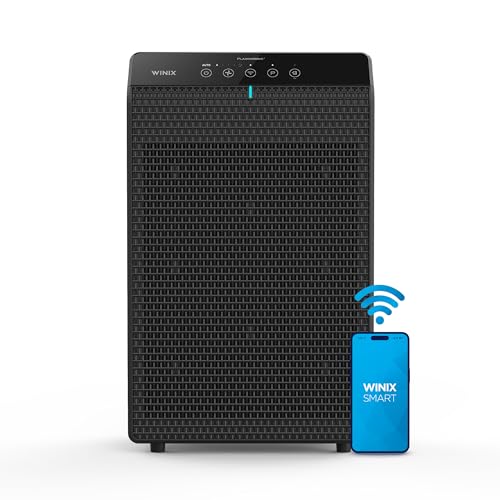
WINIX 5520 Air Purifier — Best Large-Room Alternative
The 5520 is for buyers who like the 5510 formula — True HEPA plus a named High Deodorization Carbon Filter — and want the air quality monitor front and center. Its listing leads with the monitor and Auto Mode, which suits households that will actually look at the readout: allergy families tracking pollen days, pet owners checking whether the litter corner is under control, anyone who wants evidence rather than faith.
Because it overlaps so closely with the 5510, the honest advice is to compare the two listings side by side at order time and take whichever configuration, finish, or bundle is better value that week. It shares the family trade-offs too: full-size footprint and an ongoing filter budget.
Strengths
- Same High Deodorization Carbon Filter + True HEPA pairing as the top pick
- Air Quality Monitor stated in the title, paired with Auto Mode
- Large-room sizing up to 1,882 ft² in 1 hr (per title)
- A second route into the same filtration formula if one model is out of stock
Trade-offs
- Overlaps heavily with the 5510 — little reason to own both
- Full-size unit with the same filter-replacement commitment
- Monitor-driven Auto Mode still cannot fix a saturated carbon filter; replacements remain on you
| Coverage (per Amazon title) | Up to 1,882 ft² in 1 hr |
| Filtration (per Amazon title) | True HEPA, High Deodorization Carbon Filter |
| Extras (per Amazon title) | Air Quality Monitor, Auto Mode |
Listing both Winix models is deliberate. They represent the current generation of a design that has been a default recommendation for odor-aware buyers for years, and stock and pricing between sibling models fluctuate enough that the better buy changes month to month. What does not change is the formula: a genuine HEPA stage for particles, a carbon stage the maker is willing to name as a deodorizing filter, and sensor-driven fan control to run the combination without constant attention.
Whichever sibling you choose, placement decides half the result. Give the intake a clear foot or more on all sides, keep it out of the dead corner behind a sofa, and run it in the room where people and pets actually spend the evening. A large-room rating is measured in an empty test chamber; furniture, open doors, and a unit parked behind a curtain all tax the real number, which is another reason continuous Auto operation beats heroic bursts on turbo.
Best for: Large living rooms where you want the monitor-led version of the Winix formula / Not suited for: Buyers wanting a meaningfully different design from the 5510
Check on Amazon — check price on Amazon for the current configuration before you order.
Comparison Table
| Pick | Badge | Key spec | Best for |
|---|---|---|---|
| WINIX 5510 Air Purifier | Best Overall | True HEPA + High Deodorization Carbon Filter; up to 1,881 ft² in 1 hr | Most households that need real odor control plus particle filtration in a large living space |
| Oransi TrueCarbon 200C Carbon Air Purifier | Best for Serious Odor Problems | 3.2 lb treated activated carbon; up to 375 sq ft | One problem room with persistent smoke, pet, or chemical odor |
| Austin Air HealthMate Plus Air Purifier (B450) | Best Long-Life Carbon Bed | Activated carbon + zeolite; up to 1,500 sq ft; 5-year filter life | Large rooms and low-maintenance ownership with a long filter interval |
| COWAY Airmega 150 Air Purifier | Best for Bedrooms | HEPA + carbon + washable pre-filter; up to 1,035 ft² | Bedrooms and nurseries where odor, dander, and pollen all matter |
| COWAY Airmega 100 Air Purifier | Best Compact | HEPA + carbon filter; up to 810 ft² | Small bedrooms, offices, and studios that still need a real carbon stage |
| WINIX 5520 Air Purifier | Best Large-Room Alternative | True HEPA + High Deodorization Carbon Filter; up to 1,882 ft² in 1 hr | Large living rooms where you want the monitor-led version of the Winix formula |
How to Choose the Best Charcoal Filter Air Purifiers for Your Home
Start with the problem, not the product page. Write down what actually bothers you: lingering cooking smells, cigarette or wood smoke, pet odor, a musty room, new-renovation fumes, or some blend. Odor-dominant problems argue for the deepest carbon bed you can fit in the room — the Oransi and Austin Air end of this guide. Mixed problems, where dust and dander ride along with smell, argue for a balanced HEPA-plus-carbon tower like the Winix or Coway picks. Particle-only problems honestly do not need this guide at all.
Then size the machine to the room it will live in, using the manufacturer’s coverage figure as a ceiling rather than a promise. Coverage ratings assume the purifier can cycle the room’s air multiple times per hour in an empty chamber; a furnished room with open doors delivers less. A useful rule is to choose a unit whose stated coverage comfortably exceeds your room’s area, then run it continuously on Auto. An oversized unit loafing on low is quieter and more effective than a small unit screaming on turbo — and in a bedroom, that noise difference decides whether the machine stays on at all.
Finally, price the ownership, not the box. Add up the replacement filter rhythm each design implies: deep carbon beds cost more per change but change rarely; combined HEPA-carbon cartridges change more often but are simpler. A purifier with a saturated carbon stage is furniture, so the cheapest machine to buy is often the most expensive machine to actually keep working. The listings linked from each pick show the current filter options; check them before you commit.
Charcoal, Carbon, and Zeolite: What the Filter Words Actually Mean
Charcoal filter and carbon filter mean the same thing in this category: activated carbon, usually made from coconut shell or coal, treated to create a labyrinth of microscopic pores. A single gram can carry thousands of square feet of internal surface, and gas molecules adsorb onto that surface as air passes. The word activated is the whole game — plain charcoal briquettes from a grill bag have a fraction of the surface area and do not belong in an air purifier.
Form matters as much as chemistry. Granular or pelletized carbon in a deep bed gives air a long, slow path across a lot of media, which is what heavy odor control needs. Carbon-impregnated foam or fiber sheets are cheaper and fine for mild freshness duty, but they saturate quickly under real smoke or pet loads. When a listing states a carbon weight, as the Oransi does, that is the maker telling you which form you are getting. When a listing says nothing about the carbon beyond the word itself, assume the lighter form until proven otherwise.
Zeolite, which appears in the Austin Air pick, is a naturally occurring mineral with its own porous structure and a particular appetite for ammonia and some compounds carbon handles less well. Blending the two is not marketing garnish; it widens the range of gases the bed can adsorb. No adsorbent handles everything — carbon monoxide, for instance, is not meaningfully removed by room purifiers at all, which is why a purifier never substitutes for a CO alarm — but a carbon or carbon-zeolite bed is the right tool for the everyday gas-phase load of a real home.
Sizing, Placement, and the Coverage Numbers on the Box
Coverage figures in this guide are quoted exactly as each manufacturer states them, and they are not measured the same way by every brand. Some cite the room size the unit can treat in one hour, others a smaller area for multiple air changes per hour, which is the standard that matters for allergy relief. Treat every figure as a best-case ceiling, compare within a brand more confidently than across brands, and when a room sits near a unit’s limit, step up a size rather than hoping.
Placement is free performance. Put the purifier in the room where the problem lives — odor control especially is local, because gases disperse and dilute as they travel, and a unit in the hall is treating hall air. Keep intakes clear of walls, curtains, and furniture by roughly a foot or more, keep the door of a bedroom or problem room closed while the unit works, and resist the urge to hide the machine behind the sofa: the prettiest placement is usually the worst-performing one.
Run time is the third variable buyers underestimate. Adsorption is a contact process; the carbon bed can only treat the air that passes through it. Continuous operation on an automatic setting, where the machine idles quietly and ramps when the sensor notices cooking or a pet accident, treats far more air over a week than short heroic sessions. That is also why the sensor-equipped picks in this guide earn their place for real homes, even though a sensor cannot rescue a saturated filter.
Filter Life, Saturation, and Knowing When Charcoal Is Done
HEPA filters announce their decline by clogging: airflow drops and the fan works harder. Carbon fails silently. As adsorption sites fill, odor breakthrough begins — the room starts smelling like the problem again, a few hours after cooking rather than not at all — and eventually a spent bed can lend a stale, sour note to the exhaust. There is no reliable visual check, which is why filter indicators and honest replacement intervals matter, and why the return of a beaten odor is your most trustworthy home signal.
Intervals printed by manufacturers assume average homes. A household with an indoor smoker, a large dog, a gas range used twice a day, or a workshop in the garage will consume a carbon bed far faster than the box suggests, while a low-odor apartment may stretch it. Budget accordingly: if your odor load is heavy, either buy the deep-bed designs that start with more media, or accept a shorter replacement rhythm on a combined cartridge — but do not buy a thin-pad machine and expect deep-bed results.
One more ownership habit separates satisfied owners from disappointed ones: change the pre-filter and HEPA stage on time too. A clogged particle stage starves the whole machine of airflow, and air that never reaches the carbon cannot be treated by it. The washable pre-filters on the Coway picks exist precisely to make that maintenance cheap and obvious. Keep a spare cartridge on the shelf if your household depends on the machine; a purifier waiting a week for a filter delivery is a purifier that is not running.
How to Set Up and Run a Charcoal Filter Air Purifier
Setup takes ten minutes, but the choices you make in those ten minutes — room, position, and mode — decide most of the performance you will ever get from the machine. Work through these steps in order.
- Unpack the unit and remove every filter from its shipping plastic before first use. Most purifiers ship with their filters sealed in bags inside the cabinet, and running the machine with a bagged filter is the single most common setup mistake in this category.
- Choose the room by problem, not by convenience: the bedroom for sleep and dander, the problem room for smoke, pet, or chemical odor. One purifier treats one closed space well; it does not treat a whole open floor unless it is sized for it.
- Position the unit on a hard floor with clear space around its intakes and outlet — roughly a foot or more from walls and furniture — and never behind curtains or inside a cabinet.
- Fit the filters in the order the manual specifies, typically pre-filter first, then HEPA, then carbon on the room side or as directed, and note the replacement date on a label on the cabinet.
- Run the machine on its highest tolerable setting for the first hour to pull the room’s standing load down, then switch to Auto Mode if equipped and leave it there, running continuously.
- For the first week, pay attention to the pattern: when does the monitor react, when does odor break through? Adjust placement toward the source — nearer the kitchen doorway, the litter corner, or the smoking-adjacent room — rather than simply turning the fan up.
- Set a calendar reminder for the pre-filter wash or check and for the carbon replacement interval, shortened if your household’s odor load is heavy.
After setup, the discipline is simply not turning the machine off. A charcoal purifier that runs all day on Auto uses modest electricity, treats the most air, and keeps the carbon bed working against a steady, dilute load instead of a concentrated one — the conditions adsorption handles best.
Charcoal Filters and Smoke: Honest Expectations
Smoke is the use case that sells most charcoal purifiers and disappoints the most buyers, so it deserves a plain paragraph. A good carbon bed genuinely reduces smoke odor and many of the gas-phase compounds in tobacco and wood smoke, and the HEPA stage captures smoke particles efficiently. What no room purifier does is make an actively smoked-in room smell like nobody smokes there, or render secondhand smoke safe. Ventilation at the source — a window, an exhaust path, smoking outside — outperforms any filter, and the purifier’s job is to handle the residue that remains.
If smoke is your primary problem, buy from the deep end of this guide: the Oransi for a single room, the Austin Air for a large space, or the Winix towers for a mixed particle-and-odor load, and shorten your carbon replacement interval without waiting for the indicator. If wildfire smoke is the concern, the same logic applies with the emphasis flipped — HEPA capacity and a sealed, well-fitting filter matter most for the particle surge, and the carbon stage handles the accompanying smell. Either way, a purifier is one layer; source control is the other, and honest guides should say so.
Common Buying Mistakes
Buying a token carbon pad for a real odor problem. A scented foam sheet marketed as a carbon filter will freshen a closet, not fix a smoking room or a two-dog household. If odor is the complaint, the carbon stage must be a named, substantive part of the machine — the standard every pick in this guide had to meet.
Confusing a replacement filter with a purifier. Search results for this category are full of cartridges. A replacement carbon filter only helps if you already own the machine it fits. Every pick above is a complete purifier; check that what you are ordering is the appliance, not its consumable.
Running the purifier in bursts. An hour after dinner does almost nothing for a whole day’s odor load. Continuous Auto operation treats far more air and is how these machines are designed to be used.
Ignoring carbon saturation. Carbon gives no clog, no noise change, no warning light on most models — just gradually returning odor. Track replacement dates yourself, and treat returning smell as the signal it is.
Sizing to the whole house from one box. A purifier treats the air in its room. Open-plan spaces need a large-room unit; separate closed rooms need their own machines or a moved unit. One compact purifier cannot cover a floor plan.
Hiding the unit for looks. Behind the sofa, inside a cabinet, or tight against a wall, intake-starved purifiers underperform their ratings dramatically. Clearance is performance.
Final Recommendation
If you buy one machine from this guide, make it the WINIX 5510: its named High Deodorization Carbon Filter, True HEPA stage, app support, and large-room sizing cover the widest range of real households. For a single room with a serious odor problem, the Oransi TrueCarbon 200C and its stated 3.2 lb carbon bed is the specialist’s choice, and for large spaces with minimal maintenance, the Austin Air HealthMate Plus pairs carbon with zeolite and a stated 5-year filter life. Bedrooms belong to the COWAY Airmega 150, smaller rooms to the Airmega 100, and buyers who want the monitor-led Winix variant should compare the 5520 against the 5510 at order time and take the better-value listing that week.
Whichever you choose, commit to the unglamorous half of ownership: run it continuously, keep its intakes clear, and replace the carbon before the room tells you it is spent. Charcoal filtration rewards exactly that kind of steady, boring consistency.
- WINIX 5510 Air Purifier — Check on Amazon
- Oransi TrueCarbon 200C Carbon Air Purifier — Check on Amazon
- Austin Air HealthMate Plus Air Purifier (B450) — Check on Amazon
- COWAY Airmega 150 Air Purifier — Check on Amazon
- COWAY Airmega 100 Air Purifier — Check on Amazon
- WINIX 5520 Air Purifier — Check on Amazon
Keep exploring the cluster: Best Carbon Air Purifiers Best Air Purifiers For Smells Best Air Purifiers For Dust Best Air Purifiers Under $100 Best Inexpensive Air Purifiers Best Air Purifiers For Asthma
Frequently Asked Questions
Do charcoal filter air purifiers remove dust and pollen?
Not by themselves. Charcoal adsorbs gases — odors, smoke compounds, and many VOCs — while particles such as dust, pollen, and dander are captured by the HEPA stage. That is why every pick in this guide pairs a stated carbon stage with HEPA filtration instead of relying on carbon alone.
How long does a charcoal filter actually last?
It depends on the depth of the bed and the odor load it faces. Deep beds such as the Austin Air’s are rated by their makers in years, while combined cartridges in compact machines work in months. Heavy smoke, pet, or cooking loads shorten every interval, and the return of an odor you had beaten is the most reliable sign a bed is saturated.
Can a charcoal purifier make a smoking room safe?
No. It can reduce smoke odor and many gas-phase compounds, and the HEPA stage captures smoke particles, but it does not make secondhand smoke safe and cannot keep up with an active, continuous source the way ventilation can. Treat it as residue control, not as protection.
What is the difference between a carbon sheet and a carbon bed?
A sheet is a thin foam or fiber layer lightly loaded with carbon — fine for mild freshness, quick to saturate. A bed is a deep layer of granular or pelletized activated carbon that air passes through slowly, giving far more adsorption capacity. Listings that state a carbon weight, like the Oransi’s 3.2 lb, are describing a bed.
Where should I place a charcoal filter purifier?
In the room where the odor or particle problem actually is, on a hard floor, with clear space around the intakes, and with the room’s door mostly closed. Odor control is local: a unit in the hallway treats hallway air.
Do I still need to replace the HEPA filter if the carbon is the point?
Yes. A clogged HEPA or pre-filter starves the machine of airflow, and air that never reaches the carbon bed cannot be treated by it. Keep every stage on its schedule; the washable pre-filters on the Coway picks make that part cheap.


