Disclosure: airfryerkitchensupply.com is reader-supported. When you buy through links on our site, we may earn an affiliate commission at no extra cost to you.
Where to buy
Every purifier linked below was verified, so each link lands on the exact model described. For odor duty, the machine is only half the purchase — the carbon filter’s size and replacement cost decide how the next five years smell — so check the current price on Amazon for both the unit and its replacement filter before you commit.
- Austin Air HealthMate Plus Air Purifier, Model B450 — Check the current price on Amazon
- WINIX 5510 Air Purifier — Check the current price on Amazon
- WINIX 5520 Air Purifier — Check the current price on Amazon
- Medify MA-40 Air Purifier — Check the current price on Amazon
- Rabbit Air MinusA2 SPA-780A Air Purifier — Check the current price on Amazon
- COWAY Mighty Air Purifier AP-1512HH — Check the current price on Amazon
The best air purifiers for smells are not simply the best air purifiers with a marketing line about freshness. Odor is a gas problem, not a particle problem: the molecules that make a kitchen smell like last night’s fish, a basement smell like mildew, or a living room smell like a wet dog are far too small for a HEPA filter to catch, and they sail straight through particle filters that excel at dust and dander. Odor control lives in a different medium entirely — activated carbon, ideally pounds of it, often blended with minerals like zeolite that target specific gases. A purifier with a dusting of carbon sprayed on a foam sheet will freshen a room for a week; a purifier with a deep carbon bed will keep working for months or, in the Austin Air’s case, years per filter.
That is the lens this roundup of the best air purifiers for smells applies to every pick. We weighted carbon capacity and honest odor engineering ahead of app features and air-quality light shows, and we say plainly where a model is a strong all-rounder with decent odor handling rather than a true odor specialist. Every unit below was verified — brand, model, coverage claim, and filter description matched to the manufacturer’s own listing — before it earned a link. Where a listing states room coverage, that figure is the manufacturer’s claim in its title; treat the “in 1 hour” coverage numbers as best-case ratings and size your room against the more conservative guidance in our buying section.
In this guide
Quick Picks
- Best Overall for Odors: Austin Air HealthMate Plus — a 4-stage system built around activated carbon and zeolite, rated by its listing for up to 1,500 sq ft with a 5-year filter life. Check the current price on Amazon
- Best for Large Rooms: WINIX 5510 — true HEPA plus a High Deodorization Carbon Filter, rated for rooms up to 1,881 ft² in 1 hour, with app support. Check the current price on Amazon
- Best Smart Pick: WINIX 5520 — an air quality monitor, auto mode, true HEPA and high deodorization carbon, rated up to 1,882 ft² in 1 hour. Check the current price on Amazon
- Best Coverage Value: Medify MA-40 — HEPA filtration with 1,793 ft² coverage in 1 hour, positioned for smoke, wildfires, odors, pollen, and pets. Check the current price on Amazon
- Best Design: Rabbit Air MinusA2 SPA-780A — an ultra-quiet, wall-mountable HEPA purifier whose listing leads with “Odor Remover.” Check the current price on Amazon
- Best All-Rounder: COWAY Mighty AP-1512HH — HEPA filtration for smoke, allergies, pet dander, and odor, with an air quality monitor and auto and eco modes, rated up to 1,748 ft². Check the current price on Amazon
How These Picks Were Chosen
Odor removal is adsorption, not filtration: gas molecules stick to the enormous internal surface of activated carbon as air passes through it. Two variables dominate real-world performance — how much carbon the air meets, and how long the air spends meeting it. Deep granular carbon beds beat thin carbon-coated sheets on both counts, which is why the Austin Air’s carbon-and-zeolite stage anchors this list and why we scrutinized every other pick’s carbon description rather than accepting the word “carbon” at face value. Zeolite earns its mention honestly: its mineral structure targets ammonia and certain volatile compounds that plain carbon handles less eagerly, which matters for pet and bathroom odors.
We also required real particle filtration alongside the carbon, because most household smells travel with particles — cooking aerosols, smoke, pet dander — and a purifier that handles gases but not particles solves only half the sensory problem. Every pick here pairs its carbon stage with HEPA-grade particle filtration per its verified listing. Room coverage figures are quoted exactly as the manufacturers state them in their titles, including their “in 1 hour” framing; our buying guide explains how to translate those claims into honest room sizing, because oversizing claims are this category’s favorite exaggeration.
Verification followed this site’s standard: each model was searched by brand and model, the returned title was matched to the intended product, and the ASIN came from the listing response. Claims in this article — coverage, filter types, the Austin’s 5-year filter life, the Rabbit Air’s wall-mountable design — are drawn from those verified titles. Where a listing does not state a detail, such as the exact carbon weight of the WINIX filters, we describe the manufacturer’s own wording (“High Deodorization Carbon Filter”) and do not invent a poundage.
One more selection note, because it shapes the list below: we did not require smart features, and we did not penalize their absence. Odor control is a chemistry-and-airflow problem, and a dumb machine with a deep carbon bed will beat a brilliant machine with a thin one every week of the year, in every room, against every household smell. Features earned their place only where they change outcomes — auto mode that answers odor events while nobody is home, monitors that prompt filter changes before saturation becomes smell, timers that keep a bedroom unit honest. Everything else, from color displays to voice control, is decoration, and decoration never saved a smelly room.
The 6 Best Air Purifiers for Smells

Austin Air HealthMate Plus, Model B450 — Best Overall for Odors
If smells are the actual problem — not dust, not pollen, but the persistent odor of a smoker’s room, a musty basement, a multi-pet household, or a home near traffic — the HealthMate Plus is the machine this category quietly revolves around. Its verified listing describes 4-stage filtration built on activated carbon and zeolite, coverage up to 1,500 sq ft, and a 5-year filter life. That filter life is the headline hiding in plain sight: the carbon bed is substantial enough that Austin rates it in years rather than months, and a carbon stage that lasts years is, by construction, a carbon stage with serious capacity. Zeolite in the blend targets the ammonia-family odors that pure carbon handles reluctantly, which is exactly the chemistry of litter boxes and bathrooms.
Strengths
- Activated carbon plus zeolite stage aimed squarely at gases and odors, not just particles.
- Five-year filter life per the listing — the lowest filter-replacement burden in this roundup by a wide margin.
- Coverage rated up to 1,500 sq ft, enough for open-plan living spaces and large basements.
Trade-offs
- A boxy, utilitarian appliance with none of the app, sensor-display, or design polish of the WINIX and Rabbit Air picks.
- Premium positioning: check the current price on Amazon, though the multi-year filter offsets much of the lifetime cost.
- Overkill for a single small bedroom with a mild odor issue.
The ownership math deserves emphasis. Odor purifiers are filter subscriptions wearing an appliance costume, and a machine whose main filter lasts five years changes the total cost picture completely — as well as the performance picture, since owners of six-month-carbon machines often stretch filters past saturation, at which point the purifier stops removing odors and can even re-emit them. The HealthMate Plus removes that temptation by design. Buy it when the smell is structural and long-term: the smoking room, the damp lower level, the house with four animals and wall-to-wall carpet.
Best for: serious, persistent household odors and buyers who hate filter subscriptions. / Not suited for: design-led rooms or light, occasional freshness duty. Check the current price on Amazon

WINIX 5510 Air Purifier — Best for Large Rooms
The WINIX 5510 is the modern counterpoint to the Austin: a sensor-driven, app-supported tower whose listing pairs true HEPA with a “High Deodorization Carbon Filter” and rates the unit for large rooms up to 1,881 ft² in 1 hour. That deodorization wording matters — WINIX distinguishes this carbon stage from the token carbon sheets in budget purifiers, and the 5510’s predecessor line built its reputation specifically on odor handling in pet and smoking households. Auto mode lets the machine answer a cooking event or a litter-box event without you touching it, which is how odor control actually succeeds day to day.
Strengths
- High Deodorization Carbon Filter named in the listing — a deliberate odor stage, not an afterthought.
- Large-room rating (up to 1,881 ft² in 1 hour per the listing) with true HEPA for the particle side of smells.
- App support and auto operation make it set-and-forget in living spaces.
Trade-offs
- Carbon capacity, while serious for a tower, is not in the Austin’s multi-year class; plan on periodic filter replacement.
- Manufacturer “in 1 hour” coverage is a best-case figure — size down for honest continuous odor control.
- Tower styling and display lights are not for everyone in a bedroom.
Choose the 5510 when the smelly room is also the main living room and the purifier must be a good citizen there: quiet enough, smart enough to react on its own, and strong enough on carbon to matter. It is the pick we would place in an open-plan kitchen-living space where cooking odors are the daily enemy and a boxy industrial unit would be banished to a closet — where, it must be said, a banished purifier removes no odors at all.
Best for: large living spaces and cooking-odor households that want smart automation. / Not suited for: buyers seeking multi-year filter life. Check the current price on Amazon
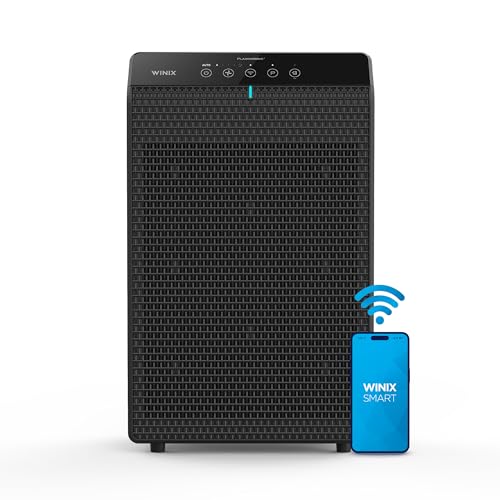
WINIX 5520 Air Purifier — Best Smart Pick
The 5520 is the 5510’s sibling with the emphasis shifted to monitoring: its listing adds an air quality monitor to the same formula of true HEPA, high deodorization carbon, and auto mode, rated up to 1,882 ft² in 1 hour. The monitor earns its place in an odor roundup for a subtle reason — odor events are episodic (the burnt toast, the visiting smoker, the rainy-day dog), and a machine that senses and answers them automatically will outperform a stronger machine left idling on low by a forgetful owner. For households that will never think about their purifier after setup day, sensing plus auto mode is the feature that delivers the benefit.
Strengths
- Air quality monitor plus auto mode answers odor events without human input.
- High deodorization carbon stage and true HEPA, per the verified listing.
- Large-room rating on par with the 5510.
Trade-offs
- Sensors estimate air quality; they do not literally smell, and sensor readings should be treated as guidance, not chemistry.
- Same periodic carbon replacement reality as the 5510.
- Feature overlap with the 5510 means the choice between them is about monitoring preference, not cleaning class.
Buy the 5520 if your household’s odor problem arrives in episodes and nobody wants to manage an appliance. Set it to auto, place it where the episodes happen, and let it work. Between the two WINIX models, pick the 5520 for the monitor if the price difference is small when you check the current price on Amazon; pick the 5510 if it is not.
Best for: hands-off households with episodic odor events. / Not suited for: buyers who prefer manual, sensor-free appliances. Check the current price on Amazon

Medify MA-40 Air Purifier — Best Coverage Value
The MA-40’s listing is a study in directness: HEPA filtration, 1,793 ft² coverage in 1 hour, and an explicit target list — smoke, wildfires, odors, pollen, pets. Medify built its name on strong coverage-per-dollar in exactly the smoke-and-odor scenarios this roundup cares about, and the MA-40 is the value expression of that formula: a serious room rating and an odor-explicit brief without the Austin’s premium or the towers’ smart features. Removal “to 0.3 microns” per the listing covers the particle side; the odor side rides on its carbon stage, which is honest mid-class equipment — effective for household smells, not a chemical-plant solution.
Strengths
- Large stated coverage (1,793 ft² in 1 hour) at a value tier; check the current price on Amazon.
- Odors and smoke named explicitly in the listing’s purpose list.
- Straightforward operation without app dependency.
Trade-offs
- Carbon stage is mid-class; the heaviest chronic odor loads belong to the Austin.
- Plainer design and feature set than the WINIX pair.
- As with all “in 1 hour” ratings, real continuous-duty room sizing should be more conservative.
The MA-40 is the pick for the renter, the first-time purifier buyer, and the wildfire-season household: people who need real coverage and real odor help now, at a price that does not require a committee meeting. It also makes a sensible second machine — the bedroom unit behind a HealthMate Plus that guards the living areas.
Best for: value-focused buyers needing large coverage and smoke/odor help. / Not suited for: the most severe chronic odor environments. Check the current price on Amazon
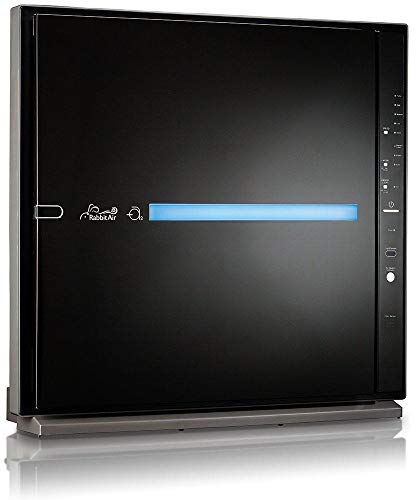
Rabbit Air MinusA2 SPA-780A — Best Design
The MinusA2 leads its listing with two words most purifiers bury: “Odor Remover.” Rabbit Air builds the MinusA2 around customizable filter stages — the odor-focused configuration is the one relevant here — in a slim, ultra-quiet, wall-mountable body that looks like wall art rather than an appliance. For odor duty in a design-sensitive room — the dining room that smells like the kitchen, the nursery-adjacent hallway, the home office that hosts video calls — the best purifier is the one that stays in the room, and no pick here is easier to keep in the room than this one.
Strengths
- Odor removal is the headline purpose in the verified listing, with a filter system built around that brief.
- Wall-mountable and ultra-quiet per the listing — unique placement freedom in this roundup.
- Design-led appearance suits living and dining spaces where towers look intrusive.
Trade-offs
- Premium pricing for its coverage class; you pay for the design and the quiet.
- Room coverage is more modest than the big towers and the Austin; this is a one-room specialist.
- Wall mounting is optional but the slim body still needs floor or wall space with airflow clearance.
Choose the MinusA2 when aesthetics have veto power — and recognize that they legitimately do, because a purifier exiled to a closet purifies the closet. In a bedroom or dining room with a defined odor issue (cooking drift, a nearby litter box, street smells through old windows), its combination of quiet, looks, and an odor-first filter brief is unmatched in this list.
Best for: design-sensitive rooms with a defined odor problem. / Not suited for: whole-floor coverage on a budget. Check the current price on Amazon

COWAY Mighty Air Purifier AP-1512HH — Best All-Rounder
The Mighty is the purifier that appears in every category roundup for a reason, and its listing earns it here too: HEPA filtration explicitly for smoke, allergies, pet dander, and odor; an air quality monitor; auto and eco modes; a timer and filter indicator; and coverage up to 1,748 ft². Its odor handling is competent rather than specialized — the carbon stage is a supporting player, not the star — and we say so plainly because this article’s promise is honesty about smells. What the Mighty offers instead is the most balanced total package: if your room has a smell problem plus dust, dander, and pollen problems, it addresses all of them gracefully in one compact footprint.
Strengths
- Odor named in the listing alongside smoke, dander, and allergens — a true all-problem machine.
- Air quality monitor, auto and eco modes, and a filter indicator for managed ownership.
- Compact form for its coverage class suits bedrooms and apartments.
Trade-offs
- Carbon capacity is mid-class; severe chronic odors will saturate it faster than the Austin’s bed.
- Not the cheapest route to its coverage; check the current price on Amazon against the Medify.
- Odor-first buyers may find the deodorization emphasis lighter than the WINIX pair’s.
Buy the Mighty when smells are one item on a longer list — the typical allergy-plus-pets-plus-cooking household — and you want one well-mannered machine to run the room. Buy the Austin instead when smells are the list.
Best for: mixed air problems with a moderate odor component. / Not suited for: odor-only, heavy-duty briefs. Check the current price on Amazon
Comparison Table
| Pick | Badge | Key spec | Best for |
|---|---|---|---|
| Austin Air HealthMate Plus B450 | Best Overall for Odors | Activated carbon + zeolite, up to 1,500 sq ft, 5-year filter life | Chronic, serious odors |
| WINIX 5510 | Best for Large Rooms | True HEPA + High Deodorization Carbon, up to 1,881 ft² in 1 hr | Open-plan living, cooking odors |
| WINIX 5520 | Best Smart Pick | Air quality monitor, auto mode, deodorization carbon, up to 1,882 ft² in 1 hr | Episodic odors, hands-off use |
| Medify MA-40 | Best Coverage Value | HEPA, 1,793 ft² in 1 hr, smoke/odor brief | Value, wildfire season, renters |
| Rabbit Air MinusA2 SPA-780A | Best Design | Odor Remover brief, ultra quiet, wall mountable | Bedrooms, dining rooms |
| COWAY Mighty AP-1512HH | Best All-Rounder | HEPA for smoke/dander/odor, AQI monitor, up to 1,748 ft² | Mixed air problems |
How Odor Filtration Actually Works: Carbon, Zeolite, and Contact Time
Activated carbon is charcoal treated to hold an immense internal surface — a single gram can present hundreds of square meters of microscopic pores. Odor molecules stick to that surface as air passes (adsorption), and the filter keeps working until the accessible surface fills. Three consequences follow for shoppers. First, carbon quantity is destiny: a deep granular bed holds orders of magnitude more capacity than a carbon-coated foam sheet, which is why filter weight and rated filter life are the most honest odor specs a listing can offer — and why the Austin’s five-year filter life signals more than any adjective could. Second, contact time matters: air rushing through a thin pad at maximum fan speed gets less treatment than air moving steadily through a deep bed, so a purifier run continuously at medium often beats one blasted at turbo for an hour. Third, saturation is silent and reversible in the worst way — an exhausted carbon filter stops adsorbing and can release previously captured compounds when conditions change, so replacement discipline is part of odor control, not an optional extra.
Zeolite, the mineral blended into the HealthMate Plus’s carbon stage, complements carbon by targeting smaller, more polar molecules — ammonia being the household headline — that carbon alone adsorbs less eagerly. Potassium-permanganate media, found in some specialty filters though not claimed in these listings, attack yet another slice of the odor spectrum. The practical lesson is that “carbon filter” on a box can mean anything from a perfume-grade dusting to a multi-pound engineered bed; the picks above were chosen because their listings describe odor engineering — deodorization carbon, carbon-and-zeolite stages, an odor-remover brief — rather than a checkbox.
What about ionizers and ozone? This roundup deliberately excludes ozone-generating designs from its picks: ozone is itself an irritant gas, and trading one airborne problem for another is not odor control. Every pick here does its gas work with adsorbent media and its particle work with HEPA-grade filtration, the two technologies with straightforward, verifiable mechanisms.
Matching the Purifier to the Smell: A Room-by-Room Guide
Cooking odors. Episodic, intense, and mixed with grease aerosols. The answer is a purifier in or beside the kitchen-living space with strong airflow and auto response — the WINIX pair — plus the unglamorous truth that a range hood vented outdoors beats any purifier; run both. Carbon handles the lingering day-after smell that the hood missed.
Pet odors. A blend of dander particles, ammonia-family litter smells, and general animal musk in fabrics. HEPA handles the dander; carbon and zeolite handle the gases. The Austin is the heavy answer; the COWAY Mighty is the balanced one. Place the unit near the litter or sleeping area, not across the room from it.
Smoke — tobacco, fireplace, and wildfire. Smoke is particles plus a stubborn gas load that soaks into textiles. During wildfire events, the Medify’s coverage value shines; for a chronic indoor smoking room, only the deep carbon bed of the Austin keeps pace month after month, and even it cannot fully defeat smoke that is continuously replenished — source control outperforms filtration every time it is available.
Musty and basement odors. Mildew smell signals moisture first and odor second. A purifier — the Austin for a finished basement living space — will clear the smell from the air, but if the moisture source persists, the smell returns and the underlying problem grows. Fix the water, then filter the air.
Bathroom and diaper odors. Small rooms, sharp ammonia-family smells, episodic intensity. A compact unit with carbon near the source outperforms a large unit down the hall; the Rabbit Air’s wall-mountable slim body is the elegant version of this strategy where space is tight.
How to Set Up and Run an Air Purifier for Odor Control
- Place the unit in the room where the odor is generated, as close to the source as airflow allows — purifiers clean the air that reaches them, and odor concentration is highest near the source.
- Keep intake and outlet clear: a hand’s breadth from walls and furniture at minimum, and never inside a closed closet or behind a sofa.
- Run it continuously at the highest speed you can tolerate acoustically, rather than in short turbo bursts; odor control rewards contact time and consistency.
- Close the room’s door during heavy odor events (cooking, smoking visitors) so the machine processes a defined volume instead of the whole house.
- Track the filter calendar, not the filter’s looks: carbon gives no visual warning at saturation. Mark the install date on the filter itself with a pen.
- Vacuum washable pre-filters monthly; a clogged pre-filter starves the carbon stage of airflow and quietly halves the machine’s odor work.
The Five-Year Cost of Smelling Nothing: Filter Economics
Odor purifiers should be priced the way printers should be priced — machine plus consumables, across the years you will own them. A tower with a modest purchase price and a carbon filter that needs replacing two or three times a year can quietly overtake a premium machine whose filter lasts five years, and the crossover arrives sooner than most buyers expect. This is the Austin Air’s structural advantage: its listing’s five-year filter life converts the most expensive habit in odor control — feeding a machine fresh carbon — into a rare event. The WINIX and COWAY models sit in the middle: real filters with real costs at regular intervals, predictable and budgetable. The Medify competes on machine value, with filter costs to be weighed per replacement. The discipline this article recommends is simple: before buying any purifier for smells, price its replacement filter, multiply by the replacements expected across five years at the manufacturer’s stated interval, and add the machine. That total — not the sticker — is the product’s real price over its working life, and it is also a useful proxy for carbon capacity, since longer intervals generally mean deeper beds.
There is a performance corollary. Owners stretch expensive, frequent filters; everyone has done it. A stretched particle filter merely cleans less. A stretched carbon filter does something worse — it occupies the machine while contributing nothing, giving the owner false confidence while odors rebuild. Choosing a machine whose replacement rhythm you will actually honor is therefore a cleaning decision, not just a financial one. If you know you will not buy filters three times a year, buy the machine that asks once in five years, or the one whose filters are cheap enough that you will never hesitate.
Noise, Fan Speed, and the Setting You Will Actually Use
Every purifier in this roundup is quieter on low and stronger on high, and odor control lives or dies on the speed you can live with for eighteen hours a day. A machine rated for a huge room but run on its lowest, silent setting moves little air and treats less of it; a smaller machine run steadily at a comfortable medium will usually win the real-world odor contest. This is the second argument — after carbon capacity — for oversizing: a large-room unit loafing at medium is both quiet and effective, while a just-big-enough unit must scream at turbo to keep up, and screaming machines get switched off. The Rabbit Air’s ultra-quiet positioning and wall mounting serve exactly this reality in bedrooms, where the acceptable speed is the one that does not disturb sleep. When you compare picks, compare them at the speed you will actually use in the room they will actually occupy — and remember that a purifier’s most important specification is that it is switched on.
When a Purifier Is Not the Answer
Honesty about limits sells fewer machines and better outcomes. A purifier will not fix a smell whose source is growing: mold inside a wall cavity, a slow drain leak, a refrigerator drip pan, or carpet padding soaked long ago. It will not defeat continuous heavy smoking in a small sealed room to the standard of a non-smoker’s nose. It will not help a room it is not in, and it cannot compensate for a carbon filter two years past its date. In each case the purifier is the finishing step — after the leak is fixed, the carpet replaced, the source removed — and in that role it is genuinely excellent, clearing the residual odor load from air and soft furnishings over days to weeks. Buy it for that role, with the source handled, and the six machines above will do what their listings promise. Buy it as a substitute for the repair, and no carbon bed on the market will save the purchase.
Reading Coverage Claims Honestly: CADR, ACH, and the “In 1 Hour” Asterisk
Nearly every rating quoted in this roundup carries the phrase “in 1 hour,” and understanding that phrase is the difference between a purifier that works and one that disappoints. A rating like “1,881 ft² in 1 hour” describes the room size in which the machine can complete roughly one full air change per hour at its highest speed. One air change per hour is a gentle standard — fine for maintenance, weak for active odor events. Practitioners who size purifiers seriously aim for two to four or more air changes per hour in the target room (ACH), which means dividing the headline coverage by two, three, or four to get the honest room size for strong continuous treatment. A unit rated at 1,800 ft² in 1 hour is, by that arithmetic, a strong continuous odor machine for a room of roughly 450–900 sq ft — still generous, but a very different number from the one on the box.
Where an AHAM-verified CADR (Clean Air Delivery Rate) is published for a model, it is the most trustworthy sizing figure available, because AHAM tests are standardized and the room-size guidance derived from them assumes a sensible air-change rate. Not every listing states it, and we have quoted only what the verified titles state — coverage claims in the manufacturers’ own words — rather than importing figures we could not verify. The shopper’s rule survives regardless of which numbers a listing offers: for odor duty, buy at least one size class above your room, run the machine continuously, and treat any coverage claim as a ceiling, not a promise. The picks above were selected with that discount already applied, which is why their headline numbers look large relative to the rooms we recommend them for.
Placement Scenarios: Getting the Most From the Machine You Bought
Three placements account for most odor success stories, and they are worth describing concretely. In the kitchen-living open plan, the purifier belongs at the boundary — near enough to the kitchen to intercept cooking plumes before they colonize the sofa, far enough from the stove that grease aerosols do not clog its pre-filter in a month; the WINIX towers on auto mode are built for exactly this post. In the pet household, the machine belongs in the pet’s room at the pet’s end of it, low and unobstructed, running through the night when doors are closed and odors concentrate; this is where the COWAY’s compact footprint or the Austin’s set-and-forget filter life pays off. In the bedroom with street or hallway smells, the machine belongs between the door or window and the bed, treating incoming air before it reaches the sleeper — the Rabbit Air’s quiet, wall-mounted form exists for this geometry. In every scenario the pattern is identical: intercept at the source or the entry point, keep the air path open, and let runtime do the work. Placement cannot rescue an undersized or carbon-poor machine, but correct placement routinely makes a good machine perform like a great one, and poor placement makes a great machine perform like a decoration.
Common Buying Mistakes
Judging by the first hour. A new purifier in a saturated room smells like it is failing for the first days, because the furnishings keep re-emitting what they absorbed. Judge at one week of continuous running, not at bedtime on day one — several of the returns in this category are machines that were working exactly as physics allows.
Buying HEPA alone for a gas problem. A superb particle filter with a token carbon sheet will leave the smell untouched and the buyer convinced purifiers do not work. Odor briefs need carbon capacity first.
Trusting the biggest coverage number. “Up to X ft² in 1 hour” is a best-case rating. For continuous odor control, choose a unit whose rating comfortably exceeds your room, or step up a class.
Stretching carbon filters past saturation. A saturated carbon stage does nothing at best and re-emits at worst. The replacement date is part of the product’s price; budget it when you buy.
Placing the purifier in the wrong room. A hallway unit serving “the house” serves no room well. Odor control is local: source room, near the source.
Expecting filtration to defeat an active source. A leaking drain, a damp wall, a litter box overdue for changing — fix the source first; the purifier maintains the victory, it does not win it alone.
Final Recommendation
For a genuine, persistent smell problem, buy the Austin Air HealthMate Plus and be done: its carbon-and-zeolite stage and five-year filter life are the strongest odor proposition in this roundup. For open-plan living with cooking odors and a preference for smart automation, choose between the WINIX 5510 and the monitor-equipped 5520. The Medify MA-40 is the coverage value for smoke seasons and first-time buyers, the Rabbit Air MinusA2 is the design-led room specialist, and the COWAY Mighty is the balanced all-rounder when odors share the stage with dander and dust. Whichever you pick, size it generously, place it at the source, run it continuously rather than in occasional bursts, mark the filter’s install date the day it goes in, and check the current price on Amazon for the unit and its replacement filter together, because the two together are the real price of a room that smells like nothing at all.
Related reading in this program: Best Air Purifiers For Wood Smoke, Best Air Purifiers For Respiratory Problems, Best Air Purifiers For Dog Owners, Best Carbon Air Purifiers, Best Air Purifiers For Dirty Diapers.
A final calibration before the questions: expect days, not minutes. A purifier clears the air in its room within hours, but odor that has soaked into carpet, upholstery, and curtains re-emits into that clean air for days afterward, and the machine must keep pace while the furnishings slowly give up their load. Judge an odor purifier at the end of its first week of continuous running, with its filter fresh and its placement right — that is the honest test, and it is the test the six machines above were chosen to pass.
A Quick Decision Guide by Household
For the household with a smoker, or a room that has absorbed years of smoke: the Austin Air HealthMate Plus, full stop — nothing else here carries its carbon depth or its filter interval, and smoke is the brief where both matter most. For the family whose living room smells like dinner until midnight: a WINIX, with the 5520’s monitor if your household runs on autopilot and the 5510 if it does not. For the renter in a wildfire-prone region who needs smoke and odor coverage without a premium commitment: the Medify MA-40, bought before the season rather than during it, when stock and prices both behave worse. For the design-conscious household with one problem room: the Rabbit Air MinusA2, mounted or placed where it will actually stay. For the allergy-and-pets household where smell is one complaint among several: the COWAY Mighty, the most graceful generalist here. And for every household on this list, the same closing advice: buy the replacement filter once, at the start, so the first change is a swap rather than a shopping trip — odor control fails at the calendar more often than at the machine.
Frequently Asked Questions
Do air purifiers really remove smells, or just mask them?
Properly specified purifiers remove them: activated carbon adsorbs odor molecules from the air passing through it. Masking products add fragrance; a carbon-stage purifier subtracts the offending gases. The catch is capacity — a thin carbon sheet saturates in days under a heavy load, while a deep bed works for months or years.
How long does a carbon filter last for odor control?
It depends entirely on carbon quantity and odor load. Light-duty carbon stages may need replacement every few months; the Austin Air in this roundup rates its main filter at five years. Mark the install date and replace on schedule — carbon shows no visual sign of exhaustion.
What size purifier do I need for a smelly room?
Choose a unit whose stated coverage comfortably exceeds your room’s area, because headline figures are usually “in 1 hour” best cases. For continuous odor control in a 300 sq ft room, a purifier rated for several times that area on its high setting will run quieter and treat air more often on medium.
Can an air purifier remove cigarette smoke smell?
It can reduce it substantially — HEPA captures the particles and carbon adsorbs many of the gases — but smoke compounds embed in fabrics and walls, and a continuously smoking room replenishes them. Deep-carbon machines like the Austin perform best here; for a permanently smoke-free smell, the source has to stop.
How soon should I notice a difference in a smelly room?
The air itself improves within hours of continuous running. The room’s smell — which lives mostly in fabrics, carpet, and soft furnishings that keep re-emitting odor into the cleaned air — typically takes several days to a week of continuous operation to fade noticeably, and heavily saturated rooms take longer. If a full week of correct placement and continuous running changes nothing, the problem is an active source or a saturated filter, not patience.
Is ozone good for odors?
Ozone does react with odor molecules, but it is also a respiratory irritant, and we do not recommend ozone-generating purifiers for occupied homes. Every pick in this roundup uses adsorbent carbon media and HEPA filtration instead — mechanisms that remove pollutants without adding one.

