Disclosure: airfryerkitchensupply.com is reader-supported. When you buy through links on our site, we may earn an affiliate commission at no extra cost to you.
Where to buy
All six purifiers below were confirmed through the airfry site’s Amazon listing data, so every Amazon link on this page points at a verified listing. Prices move, so each pick says check price on Amazon rather than printing a figure that could go stale. If you live with a respiratory condition, treat this shortlist as a comfort and air-cleanliness aid only: an air purifier is not a medical device, it does not treat any condition, and it never replaces the plan you have agreed with your clinician.
- WINIX 5510 Air Purifier — Check the current price on Amazon
- LEVOIT Core 300S-P Smart Air Purifier — Check the current price on Amazon
- BLUEAIR Blue 311i Max Air Purifier — Check the current price on Amazon
- COWAY Airmega Mighty AP-1512HH Air Purifier — Check the current price on Amazon
- Medify MA-40 Air Purifier — Check the current price on Amazon
- LEVOIT Core 600S-P Smart Air Purifier — Check the current price on Amazon
Shopping for the best air purifiers for respiratory problems starts with an honest limit: a purifier can reduce the airborne particles floating through a room — dust, pollen, pet dander and smoke particles — and a cleaner-feeling room is a reasonable comfort goal, but no purifier on this page is a treatment, and this guide makes no medical claims. Anyone managing asthma, COPD or another diagnosed condition should keep following their clinician’s advice first and treat a purifier as household equipment, not healthcare.
Within that honest frame, the buying decision is still a real one, and it is mostly about filtration and sizing. True HEPA filtration is the baseline worth paying for, because the filter grade is what decides which fine particles get captured instead of blown back into the room. Room-size coverage stated in the listing title matters just as much: an undersized unit running flat out in a big living room moves too little air to keep up, while a correctly sized unit can idle quietly on a low setting and still turn the room’s air over regularly.
Noise is the third factor, and for this audience it is not a luxury detail. A purifier only helps a bedroom if it can run all night without disturbing sleep, so the listings below were screened for stated quiet figures and sleep modes wherever the Amazon title confirms them. Running costs matter too: filter replacement is the real long-term expense of ownership, so each review flags how the filter system is structured — combined multi-stage cartridges, washable pre-filters and filter-life indicators all change what you will spend and how often you will think about maintenance over the years ahead.
In this guide
Quick Picks
WINIX 5510 Air Purifier — Best Overall: The successor to a long-running favourite formula: true HEPA filtration, a high-deodorization carbon filter for household smells, auto mode and app support, sized for large rooms up to the coverage figure stated in its title. Check price on Amazon
LEVOIT Core 300S-P Smart Air Purifier — Best for Bedrooms: A smart bedroom purifier with WiFi control, a HEPA sleep mode and a stated quiet figure of 24dB in its title — the overnight-running pick for light sleepers who want the machine beside the bed, not down the hall. Check price on Amazon
BLUEAIR Blue 311i Max Air Purifier — Best Quiet Large-Room Pick: Large-room coverage up to the figure in its title, a stated 23dB quiet level, HEPASilent filtration, auto mode and a washable pre-filter that cuts consumable costs — the quietest big-room option on this list. Check price on Amazon
COWAY Airmega Mighty AP-1512HH Air Purifier — Best Set-and-Forget Pick: A long-established model with HEPA filtration, an air quality monitor, auto and eco modes, a filter indicator and a stated multi-year warranty in its title — the low-management choice for a medium-to-large room. Check price on Amazon
Medify MA-40 Air Purifier — Best for Smoke-Prone Areas: Built around smoke and wildfire season: HEPA filtration with stated coverage of 1,793 square feet in an hour and capture down to 0.3 microns in its title — the pick for homes that face seasonal smoke drift. Check price on Amazon
LEVOIT Core 600S-P Smart Air Purifier — Best for Very Large Rooms: The largest coverage figure in this guide — up to 2,933 square feet in its title — with HEPA filtration, sleep mode, remote and app/voice control: one machine for a big open-plan space instead of two small ones. Check price on Amazon
How These Picks Were Chosen
Every pick in this guide was cross-checked against Amazon listing data through this site’s own provider account: the product was searched by brand and model, the returned title was matched line by line against the product described here, and only then was the ASIN taken from the listing response and given a purchase link. Products that could not be matched with confidence were left out rather than guessed at, which is why this shortlist contains six well-documented machines instead of a longer list padded with uncertain listings.
The selection criteria were, in order: a true HEPA or HEPA-grade main filter confirmed in the listing title; a stated room-coverage figure that lets you size the machine to a real bedroom or living room; a low-noise or sleep mode suitable for overnight running; and a filter system whose replacement parts are standard for the model, so ownership does not depend on obscure cartridges. Activated carbon was treated as a bonus for odours and household fumes rather than a substitute for particle filtration, and smart features such as app control and air-quality sensors were valued only where they help the machine run itself — an auto mode that reacts to the room is genuinely useful for someone who does not want to manage settings all day.
No fixed prices and no fixed star ratings appear anywhere in this guide, deliberately. Prices change with promotions and filter bundles, and ratings counts change daily; either figure printed here would quietly become wrong. Instead, each pick is positioned by tier in words — budget, mid-range or premium — and the Amazon link is there so you can check the current price on Amazon at the moment you are actually deciding.
The 6 Best Air Purifiers for Respiratory Problems

WINIX 5510 Air Purifier — Best Overall
The WINIX 5510 earns the top spot because it covers the whole brief in one machine: true HEPA particle capture for the dust and dander side of the equation, a serious carbon stage for the cooking smells and household odours that make a room feel stuffy, and an auto mode that lets the machine manage its own fan speed. It suits a main living space or a large bedroom where the purifier needs to run for long stretches without being fiddled with. It is less suited to a tiny box room, where its capacity is simply more machine than the space needs.
Strengths
- True HEPA filtration confirmed in the Amazon title, the baseline that matters most for fine particles
- High-deodorization carbon filter tackles household odours alongside particle capture
- Auto mode plus app support, so the machine adjusts itself instead of needing constant attention
Trade-offs
- Sized for large rooms, so it is physically and financially more than a small bedroom requires
- Carbon stages are consumables; heavy odour loads shorten the interval between filter changes
- App features only add value if you actually use connected controls
Key spec: True HEPA + high-deodorization carbon filter; coverage up to 1,881 ft² in 1 hour (as stated in Amazon title); auto mode; app support
What separates the 5510 from cheaper large-room machines is the balance between its two filter jobs. Many purifiers treat carbon as a thin afterthought sheet behind the HEPA filter; the title’s explicit high-deodorization callout reflects a heavier carbon stage, which is the part of the machine you notice on cooking days, after cleaning products have been used, or when outdoor smoke drifts in and the whole flat starts to smell of it. The HEPA stage handles the invisible side — the fine particles you never see — while the carbon stage handles the noticeable side, and for someone whose comfort goal is simply a room that feels easier to be in, that combination is the practical one.
Day to day, expect to run the 5510 on auto and forget it: the sensor watches the room, the fan rises when cooking or cleaning stirs the air, and it settles again afterwards. Keep the doors to the room in their normal state — purifiers are sized per enclosed space, and a machine rated for the room works best when it is cleaning that room’s air rather than the whole home’s. When the filter indicator calls for a change, treat it as the running cost you budgeted for; a clogged filter quietly turns an effective machine into a fan moving dirty air.
Best for: a main living room or large bedroom that needs one machine to handle particles and odours on autopilot / Not suited for: a tiny single room, where a compact bedroom unit is the proportionate buy
Check on Amazon — check price on Amazon for the current listing, options and availability.
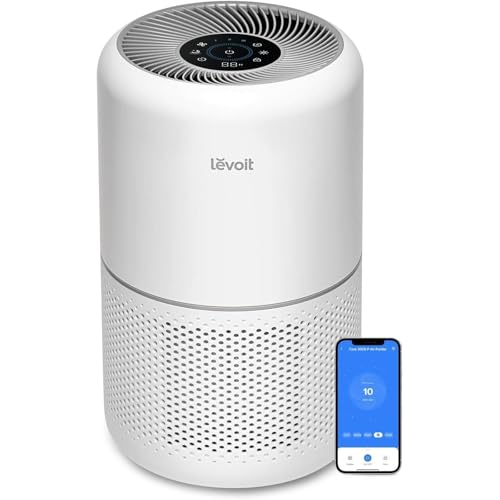
LEVOIT Core 300S-P Smart Air Purifier — Best for Bedrooms
The Core 300S-P is the pick built around the night. Its title confirms the details that matter at 2 a.m.: a dedicated sleep mode, HEPA filtration and a stated 24dB quiet figure, which is the kind of number that belongs in a spec sheet rather than a marketing claim — decibels are a measurement, and this one is low enough for most light sleepers. The smart WiFi control means the machine can be scheduled, dimmed and adjusted from the phone instead of by getting up. It suits bedrooms and nurseries-sized spaces; a very large open-plan room will ask more of it than its format is built to give.
Strengths
- Stated 24dB quiet figure and HEPA sleep mode, both confirmed in the Amazon title
- Smart WiFi control for schedules and adjustments without getting out of bed
- AHAM VERIFIDE mark in the title, meaning its room-size claims sit inside a recognised verification programme
Trade-offs
- Compact format is happiest in bedrooms rather than very large open-plan spaces
- Smart features assume a home WiFi network and the brand’s app
- Cylindrical filters are model-specific, so replacements must match the Core 300 series
Key spec: HEPA filtration with sleep mode; stated 24dB quiet figure; smart WiFi; AHAM VERIFIDE (all as stated in Amazon title)
Bedroom purifiers fail in a predictable way: they clean well at a fan speed nobody can sleep through, so they get switched off at night — exactly the hours when a bedroom machine matters most for comfort. The 300S-P’s design answers that failure directly, pairing the low stated noise figure with a sleep mode that trades raw airflow for near-silence, and with app scheduling so the machine can run harder in the hour before bed and settle down as you do. For a reader whose priority is an undisturbed night in a cleaner-feeling room, that behaviour is worth more than a bigger coverage number on the box.
Set the 300S-P up on a schedule before you judge it: an hour of higher-speed cleaning before bed, then sleep mode through the night, is the pattern its design assumes. Place it where air can reach it — a little clearance on all sides, not wedged between the bed and the wall — and keep the bedroom door in whatever position you normally sleep with, since the sizing assumes one room’s volume. If WiFi setup is not for you, the on-unit controls still run the machine; the smart layer is a convenience, not a requirement.
Best for: bedrooms and light sleepers who need a purifier that can genuinely run all night / Not suited for: very large open-plan living spaces that need a high-capacity tower
Check on Amazon — check price on Amazon for the current listing, options and availability.

BLUEAIR Blue 311i Max Air Purifier — Best Quiet Large-Room Pick
The Blue 311i Max suits the reader who needs large-room capacity but refuses to listen to it. Its title states coverage up to 2,107 square feet alongside a 23dB quiet figure — an unusual pairing, because big airflow usually means big noise — plus auto mode, WiFi and a washable pre-filter that keeps the main filter cleaner for longer. It fits open living areas, larger bedrooms and studio flats where one machine has to cover the whole space unobtrusively. Buyers who want a basic machine with physical buttons and no connected features may find its app-led approach more than they asked for.
Strengths
- Stated 23dB quiet figure at the low end, unusually quiet for its coverage class
- HEPASilent filtration with AHAM Verified room claims in the title
- Washable pre-filter reduces how fast the main filter loads up with coarse dust
Trade-offs
- Premium-tier machine; the quiet large-room combination is what you are paying for
- Connected, app-forward controls are not for buyers who want purely manual operation
- Main filters remain a recurring cost even with the washable pre-filter helping
Key spec: HEPASilent filtration; coverage up to 2,107 ft² and stated 23dB quiet figure (as stated in Amazon title); auto mode; WiFi; washable pre-filter; AHAM Verified
HEPASilent is Blueair’s hybrid approach, combining electrostatic and mechanical filtration to move a lot of air at lower fan pressure, which is how the stated noise figure stays so low for a machine of this coverage. In daily life the washable pre-filter is the unsung feature: pet hair and household lint get caught on a layer you rinse under the tap, so the expensive main filter spends its life on the fine particles it is actually designed for. For a household that wants to set a purifier running in the corner of a big room and forget it exists — sonically and visually — this is the most complete answer on the list.
For the 311i Max, the washable pre-filter should become a monthly habit: rinse, dry fully, refit. It takes minutes and it is the cheapest performance you will ever buy, because a clean pre-filter is what lets the main filter last its full life. In auto mode the machine will spend most of its life near its quiet floor, which is the point of the design — judge it over a week of living with it, not over five minutes on turbo in a shop listing video.
Best for: large rooms and open-plan spaces where the purifier must be heard as little as possible / Not suited for: buyers who want a simple, non-connected machine at a budget tier
Check on Amazon — check price on Amazon for the current listing, options and availability.

COWAY Airmega Mighty AP-1512HH Air Purifier — Best Set-and-Forget Pick
The Coway Airmega Mighty has been on the market for years, and its title reads like a checklist of the features that make a purifier easy to live with: a real air quality monitor driving auto mode, an eco mode that rests the fan when the air is already clean, a timer, and a filter indicator that removes the guesswork from maintenance. It suits a bedroom or living room up to the coverage stated in the title, and the buyer who wants the machine to make its own decisions. It is a single-room machine in a classic boxy format; households wanting whole-flat coverage from one unit should look at the largest picks instead.
Strengths
- Air quality monitor with auto and eco modes confirmed in the Amazon title
- Filter indicator takes the guesswork out of replacement timing
- Stated warranty coverage in the title is longer than the budget tier typically offers
Trade-offs
- Classic boxy design is less discreet than the slimmest towers
- No app control in the title’s feature list; management is on the unit itself
- Coverage is generous but below the two largest machines in this guide
Key spec: HEPA filter; coverage up to 1,748 ft² (as stated in Amazon title); air quality monitor; auto and eco modes; timer; filter indicator
The Mighty’s longevity on the market is itself useful information: a model that has sold for years has a deep, stable supply of replacement filters, which is the least glamorous and most important ownership question for any purifier. Its eco mode deserves a specific mention for this audience — when the sensor reads clean air, the fan rests instead of churning, so the machine is silent for long stretches and only wakes when cooking, cleaning or an open window loads the room with particles. That behaviour suits someone who wants cleaner-feeling air as a background condition of the home, not as a gadget to operate.
With the Mighty, trust the eco mode. New owners often run a purifier on a fixed medium speed out of habit, but the sensor-driven rest is the feature that makes this model so easy to own: clean air, still room, no fan noise at all, and instant response when the air loads up. Position it near the room’s main activity rather than beside an open window, where it would spend its life cleaning the outdoors one breath at a time.
Best for: a medium-to-large bedroom or living room where the purifier should manage itself / Not suited for: buyers who specifically want app control and smart-home integration
Check on Amazon — check price on Amazon for the current listing, options and availability.

Medify MA-40 Air Purifier — Best for Smoke-Prone Areas
The MA-40 is the pick for a specific and increasingly common situation: a home where the air problem arrives from outside, in the form of wildfire smoke, a neighbour’s wood stove or heavy traffic fumes, and the purifier needs to scrub a large room quickly when conditions turn. Its title states 1,793 square feet of coverage in one hour and particle capture to 0.3 microns, which is the size language that matters for smoke. It suits larger rooms and open spaces in smoke-prone regions. If your only concern is bedroom dust and you sleep lightly, one of the quieter bedroom-focused picks above will fit your nights better.
Strengths
- Stated 1,793 ft² coverage in 1 hour, sized for fast turnover of a large room
- Capture to 0.3 microns stated in the title — the particle range smoke occupies
- Framed by its maker for smoke, wildfires, odours, pollen and pets, matching this guide’s use cases
Trade-offs
- High-capacity machines work harder audibly on their top settings during smoke events
- Filter replacements for large-format machines cost more than compact bedroom cartridges
- White single-pack format only, per the title — no smaller companion unit in this listing
Key spec: HEPA filter; stated 1,793 ft² coverage in 1 hour; capture to 0.3 microns (as stated in Amazon title)
Smoke changes the purifier calculation. Ordinary dust loads a room slowly, so a modest machine keeping up is enough; smoke arrives as an event, the room fills within the hour, and what matters is how fast the purifier can turn the whole volume over. That is why this guide reads the MA-40’s one-hour coverage figure as its headline: it describes a machine built to recover a room, not just maintain one. Pair it with the household habits in the how-to section below — windows shut during smoke drift, the purifier placed away from corners so it can draw freely — and it is the strongest comfort tool on this list for a smoke-season home.
During a smoke event, run the MA-40 high and continuously, keep windows and exterior doors shut, and let it work the whole room rather than a corner — clearance around the intake is what lets a high-capacity machine actually move its rated air. Between events, a lower maintenance speed keeps the room’s baseline clean so the next event starts from a better position. Change filters on the indicator or schedule the maker states; smoke-loaded filters are doing heavy work and should not be stretched.
Best for: larger rooms in wildfire-smoke or wood-smoke areas that need fast air turnover / Not suited for: light sleepers wanting the quietest possible bedroom-only machine
Check on Amazon — check price on Amazon for the current listing, options and availability.

LEVOIT Core 600S-P Smart Air Purifier — Best for Very Large Rooms
The Core 600S-P answers the open-plan problem. Where a big living-dining space would otherwise need two mid-sized purifiers competing in opposite corners, this single unit’s stated coverage — the largest in the guide — lets one machine do the job, with one filter system to maintain. Its title confirms HEPA filtration, a sleep mode for overnight use in a studio layout, and control by remote, app and voice assistant. It suits large living rooms, open-plan flats and big primary bedrooms. In a small flat it is simply oversized; the Core 300S-P above is the proportionate Levoit for ordinary bedrooms.
Strengths
- Largest stated coverage in this guide, up to 2,933 ft² in the Amazon title
- HEPA sleep mode lets a big machine behave itself overnight in studio layouts
- Remote, app and voice control — useful when the unit sits across a large room
Trade-offs
- A large machine with a large footprint; small rooms do not need it
- One big filter system to replace rather than smaller, cheaper cartridges
- Smart control features are wasted in a household that will never connect it
Key spec: HEPA filtration; coverage up to 2,933 ft² (as stated in Amazon title); sleep mode; remote control; app and voice control; AHAM VERIFIDE
Sizing up has a quiet advantage that rarely gets mentioned: a large purifier achieves a room’s air changes at a lower fan setting than a small purifier straining at maximum, and lower fan settings are where purifiers are quiet and frugal. The 600S-P exploits exactly that — in a genuinely big room it can cruise where a compact unit would howl. The control options matter at this scale too, because a machine across an open-plan space is a machine you will not walk over to adjust; the remote and app support in the title are what make its auto behaviour practical rather than theoretical.
The 600S-P rewards a central placement: in an open-plan space, put it where the living and dining zones meet rather than at the far end, and its stated coverage becomes a realistic description instead of a best case. Use the app or voice control to build the routine — stronger cleaning while the space is occupied and cooking happens, sleep mode when the studio becomes a bedroom — and the machine’s size stops being something you notice and becomes something that simply handles the whole flat.
Best for: very large living rooms, open-plan flats and studio layouts needing one high-capacity unit / Not suited for: small flats and single small bedrooms, where it is more machine than the space can use
Check on Amazon — check price on Amazon for the current listing, options and availability.
Comparison Table
| Pick | Badge | Key spec | Best for |
|---|---|---|---|
| WINIX 5510 Air Purifier — Check price | Best Overall | True HEPA + high-deodorization carbon filter; coverage up to 1,881 ft² in 1 hour (as stated in Amazon title); auto mode; app support | a main living room or large bedroom that needs one machine to handle particles and odours on autopilot |
| LEVOIT Core 300S-P Smart Air Purifier — Check price | Best for Bedrooms | HEPA filtration with sleep mode; stated 24dB quiet figure; smart WiFi; AHAM VERIFIDE (all as stated in Amazon title) | bedrooms and light sleepers who need a purifier that can genuinely run all night |
| BLUEAIR Blue 311i Max Air Purifier — Check price | Best Quiet Large-Room Pick | HEPASilent filtration; coverage up to 2,107 ft² and stated 23dB quiet figure (as stated in Amazon title); auto mode; WiFi; washable pre-filter; AHAM Verified | large rooms and open-plan spaces where the purifier must be heard as little as possible |
| COWAY Airmega Mighty AP-1512HH Air Purifier — Check price | Best Set-and-Forget Pick | HEPA filter; coverage up to 1,748 ft² (as stated in Amazon title); air quality monitor; auto and eco modes; timer; filter indicator | a medium-to-large bedroom or living room where the purifier should manage itself |
| Medify MA-40 Air Purifier — Check price | Best for Smoke-Prone Areas | HEPA filter; stated 1,793 ft² coverage in 1 hour; capture to 0.3 microns (as stated in Amazon title) | larger rooms in wildfire-smoke or wood-smoke areas that need fast air turnover |
| LEVOIT Core 600S-P Smart Air Purifier — Check price | Best for Very Large Rooms | HEPA filtration; coverage up to 2,933 ft² (as stated in Amazon title); sleep mode; remote control; app and voice control; AHAM VERIFIDE | very large living rooms, open-plan flats and studio layouts needing one high-capacity unit |
How to Choose the Best Air Purifiers for Respiratory Problems
The first decision is filtration grade, and it is a short decision: choose true HEPA or a named HEPA-grade system, confirmed in the listing, over vague language about HEPA-style or HEPA-type filters. Those softer phrases describe filters that borrow the shape of the standard without meeting it. For a reader buying specifically because the air in a room matters to their comfort, the filter grade is the product — everything else is a fan and a box around it.
The second decision is sizing. Every pick in this guide states a coverage figure in its title; match that figure to the room the machine will actually live in, remembering that headline coverage usually describes air changes at high speed. A useful rule is to choose a machine whose stated coverage comfortably exceeds your room, so it can do its work at a civilised fan setting. Two rooms need two machines: a purifier in the living room does almost nothing for the bedroom down the hall, because doors and walls divide the air into separate volumes.
The third decision is noise, and it should be made with your nights in mind. Where a listing states a decibel figure, as two picks in this guide do, treat it as the spec that decides whether the machine will still be switched on in a month. A purifier that disturbs sleep gets unplugged, and an unplugged purifier filters nothing. Sleep modes, auto modes and sensors are not gimmicks in this category — they are the mechanisms that keep the machine running unattended, which is when it does most of its work.
Filters, Carbon and What Ownership Actually Costs
The purchase price of a purifier is the smaller half of its cost. The main filter is a consumable with a working life, and over several years the replacements will exceed what the machine cost. Before choosing, check what the replacement filter for that exact model is, how the maker says it should be changed, and whether the machine tells you when — a filter indicator, like the one confirmed on the Coway pick, turns maintenance from a guess into a routine. Washable pre-filters, like the Blueair pick’s, stretch the main filter’s life by catching the coarse load first.
Activated carbon deserves a clear-eyed paragraph. Carbon stages adsorb gases and odours — cooking smells, household fumes, the stale note a room gets in winter — and a heavier carbon stage, like the high-deodorization filter on the WINIX pick, does that job for longer before it saturates. What carbon does not do is capture particles; that is the HEPA stage’s work. A machine strong in both is the complete answer for a room that needs to feel fresher, but if you must choose where the money goes, particle filtration comes first for this guide’s purpose.
Avoid two filter traps. The first is the washable-forever main filter claim: a HEPA filter that can be washed is, in practice, a filter whose fine structure degrades, and the makers of every pick in this guide treat the HEPA stage as a replaceable part. The second is the unbranded replacement cartridge that almost fits. Filters seal against the housing; an almost-right seal lets air bypass the filter entirely, and bypassed air is unfiltered air no matter what the cartridge is made of. Buy the filter made for the model.
Where an Air Purifier Helps — and Where It Does Not
An air purifier works on the air in one enclosed space, and it works on particles suspended in that air: household dust, pollen that drifted in, pet dander, smoke particles. Used at the right size, run consistently, it keeps that particle load lower than it would otherwise be, and many people find the room more comfortable for it. That is the whole claim, and it is enough to justify the purchase for plenty of households — but it is a comfort claim about a room, not a health claim about a person.
A purifier does not treat, prevent or cure any respiratory condition, and nothing in this guide should be read that way. It does not replace medication, an inhaler, a clinician’s management plan, or source control — fixing a damp problem, keeping a smoke-free home, and vacuuming with the windows open on a clean-air day all act on causes a purifier cannot touch. If symptoms are part of your life, the purifier decision belongs in a conversation with your clinician, who may have views on your specific triggers that no buying guide can have.
What a purifier can sensibly be is one layer in a cleaner-air home: the layer that works overnight, unattended, in the room where you spend a third of your life. Bought at the right size, with the right filter, and maintained on schedule, the six machines in this guide each do that job honestly — which is exactly the standard a purchase in this category should be held to.
Running a Purifier Alongside Everyday Life
A purifier settles into a household routine faster than most appliances, because it asks for almost nothing daily. The habits that make the difference are small ones: leave it running when you leave the room rather than switching it off, since a room’s air does not stay clean out of loyalty; keep interior doors in their usual positions so the machine’s sizing stays honest; and when you vacuum or dust, let the purifier run on a higher setting for the following hour, because cleaning stirs settled particles back into the air where the machine can finally capture them.
Seasonality matters too. Pollen months load a bedroom machine differently from winter, when windows stay shut and indoor sources dominate, and smoke season — for homes in affected regions — is the one period when a purifier should run high and continuously rather than on a gentle maintenance setting. Planning filter purchases around those seasons, so a fresh filter goes in before the hardest months rather than after them, is the kind of unglamorous decision that separates a machine that performs from a machine that merely runs.
How to Set Up and Run an Air Purifier for the Best Results
A purifier’s results are half machine, half placement and routine. These steps take a new unit from box to background appliance, and they apply to every pick in this guide.
- Unpack the machine and remove every filter from its shipping packaging before first use — most purifiers ship with the filter sealed in plastic inside the unit, and running it that way cleans nothing.
- Place the unit inside the room it is sized for, with clear space around the intakes: off the wall, out of corners, and not hidden behind furniture or curtains.
- Put bedroom machines where they serve the bed but do not blow directly across it; a steady draught on the sleeper is the fastest way to get a purifier switched off.
- Run the machine on its highest comfortable setting for the first hour to bring the room’s particle load down, then switch to auto or sleep mode for maintenance running.
- Keep windows and exterior doors in their normal position while the machine works; during outdoor smoke events, keep them shut and let the purifier handle the indoor volume.
- Set a schedule if the model supports one: stronger cleaning before bedtime and during cooking hours, quiet maintenance overnight.
- Note the filter-change date or indicator behaviour from day one, and order the first replacement when the indicator calls — not weeks later.
- Wipe or rinse the pre-filter monthly where the model has a washable one, and vacuum exterior intakes so coarse dust never becomes the main filter’s problem.
After a week, judge the machine by the room, not by the gadget: is the air in the morning fresher-feeling, is there less dust settling on surfaces near the unit, and — most importantly — has it stayed switched on without annoying anyone? A purifier that passes those three tests is doing its job.
Common Buying Mistakes
Buying by room-name instead of room size. A purifier labelled for bedrooms may be sized for a small one. Compare the stated coverage figure with your actual room, and size up so the machine can work at a quiet setting.
Believing softer filter language. HEPA-style and HEPA-type are not HEPA. For this category, the filter grade stated plainly in the listing is the difference between capturing fine particles and moving them around.
Putting one machine in charge of the whole home. Air does not circulate freely through closed doors. One purifier per key room — bedroom first, then living room — beats one oversized unit in the hallway.
Stretching filters past their life. A loaded filter strangles airflow and quietly ends the machine’s usefulness. The indicator or the maker’s schedule is the instruction; follow it and budget for it.
Expecting a medical outcome. A purifier improves a room’s air; it does not treat a condition. Buying it as healthcare sets an expectation no household appliance can meet, and can delay care that actually helps.
Judging noise in the first five minutes on turbo. Every purifier is loud at maximum. Judge the setting you will live with — auto or sleep mode across a whole night — before deciding a machine is too noisy.
Final Recommendation
If you buy one machine from this guide, make it the WINIX 5510: it pairs true HEPA filtration with a serious carbon stage and an auto mode that suits a main room completely. For the bedroom specifically, the LEVOIT Core 300S-P’s stated quiet figure and sleep mode make it the overnight pick, while the BLUEAIR Blue 311i Max is the answer when the room is large and the requirement is near-silence. The COWAY Airmega Mighty remains the set-and-forget classic, the Medify MA-40 is the smoke-season specialist, and the LEVOIT Core 600S-P covers the very large, open-plan spaces the others cannot.
Whichever you choose, keep the frame from the start of this guide: size it to the room, run it consistently, maintain its filters, and treat it as what it is — a comfort appliance that keeps a room’s air cleaner — alongside, never instead of, the advice of the clinician who knows your situation.
Keep exploring the shortlist: Best Air Purifiers For Asthma Best Air Purifiers For Dust Best Air Purifiers For Pet Dander Best Air Purifiers For Fire Smoke Removal Best Air Purifiers For Dog Owners Best Quiet Air Purifiers For Large Rooms
Frequently Asked Questions
Can an air purifier treat asthma or another respiratory condition?
No. An air purifier is a household appliance that reduces particles in a room’s air; it does not treat, prevent or cure any medical condition and it is not a substitute for medication or a clinician’s care. If you have a diagnosed condition, discuss any purchase with your clinician and keep following your management plan.
What filter type should I look for?
True HEPA, or a named HEPA-grade system, stated plainly in the listing. Every pick in this guide has its filtration confirmed in its listing-verified title. Softer phrases such as HEPA-style describe filters that do not meet the same standard.
How do I size a purifier to my room?
Compare the coverage figure stated in the listing with your room’s floor area, and choose a machine rated comfortably above it. Headline coverage assumes high fan speeds; oversizing slightly lets the machine clean effectively at a quieter, cheaper-to-run setting.
How loud are these machines at night?
Two picks state their quiet figures directly: 24dB for the LEVOIT Core 300S-P and 23dB for the BLUEAIR Blue 311i Max, both in sleep-oriented modes. In practice, judge any purifier by its auto or sleep setting across a night, not by its turbo speed.
How often do filters need changing?
It depends on the model, the room and how hard the machine works; smoke and pets shorten filter life. Machines with a filter indicator, like the COWAY pick, tell you when. Treat replacements as a planned running cost and use the filter made for your exact model.
Should I run a purifier all day?
Consistent running is how purifiers earn their keep, because rooms refill with particles whenever doors open and people move around. Auto and eco modes exist precisely to make all-day running quiet and economical: the machine works hard when the air needs it and rests when it does not.

