Disclosure: airfryerkitchensupply.com is reader-supported. When you buy through links on our site, we may earn an affiliate commission at no extra cost to you.
Where to buy
All six chairs below were confirmed through Amazon’s catalog data before being included, and each carries a purchase link.
- NAFORT Walnut Wood Dining Chairs, Ladder Back, Set of 4 — Check on Amazon
- Signature Design by Ashley Berringer Dining Chairs, Spindle Back, Set of 2 — Check on Amazon
- DUHOME Wood Dining Chairs, Cross Back, Set of 4 — Check on Amazon
- SilkWood Studio Farmhouse Ladder Back Solid Wood Dining Chairs, Set of 2, Woven Rush Seat — Check on Amazon
- LUE BONA Windsor Dining Chair, Set of 4, Spindle Back, Black — Check on Amazon
- Boraam Shaker Chair, Set of 2, Black/Oak — Check on Amazon
The best chairs for a Quaker style kitchen answer to a design philosophy before they answer to a catalogue. Quaker and Shaker-influenced kitchens — the terms are used loosely and often interchangeably in home design, pointing at the same plain, honest, handmade tradition — value furniture that is useful, unadorned, and built to be repaired rather than replaced. In chair terms that means solid wood over veneer and plastic, ladderback and spindle-back silhouettes over upholstered sculpture, visible joinery over hidden hardware, and finishes that show the material — walnut, oak, maple, or honest paint — rather than disguising it. A Quaker-style kitchen chair should look like it belongs beside a farmhouse table, a cast-iron stove, and a row of plain cabinets, because it is furniture from the same moral universe: nothing wasted, nothing fake, nothing that will embarrass itself in twenty years.
This guide ranks six chairs and chair profiles for that kitchen. Three are verified products you can buy from the links here: a walnut ladderback set of four that is the closest thing to the archetype, a rustic spindle-back pair with cushioned seats for long sits, and a farmhouse cross-back set that brings the same plain-wood honesty in a slightly more decorative dialect. Three more verified sets complete the tradition’s archetypes: a solid-wood ladderback with a woven rush seat, a black Windsor-style spindle-back set, and a Shaker chair in black and oak — each matched to a listing whose title confirms the form, and each review tells you exactly what to look for and what to avoid in that archetype. Prices are not printed; the linked picks are placed in their tiers, and you can check the current price on Amazon from any link.
In this guide
Quick Picks
- Best Overall: NAFORT Walnut Ladder Back, Set of 4 — solid rubberwood, high ladder back, and a 400 lb rated capacity per the listing: the archetype, verified. Check on Amazon
- Best for Comfort: Ashley Berringer Spindle Back, Set of 2 — rustic wood with a cushioned microfiber seat for long kitchen-table sits. Check on Amazon
- Best Farmhouse Variant: DUHOME Cross Back, Set of 4 — vintage walnut finish and cross-back joinery charm for farmhouse-leaning Quaker kitchens. Check on Amazon
- Best Traditional Seat: SilkWood Studio Ladder Back, Set of 2 — the woven rush-seat classic, in solid wood. Check on Amazon
- Best Painted Accent: LUE BONA Windsor Dining Chair, Set of 4 — the black spindle-back dialect of the same tradition. Check on Amazon
- Best Minimalist Form: Boraam Shaker Chair, Set of 2 — the plainest silhouette of all, in black and oak. Check on Amazon
How These Picks Were Chosen
Style fidelity was the first filter, and it excluded most of the modern dining-chair market on sight: no chrome, no moulded plastic, no mid-century splay, no upholstered parsons silhouettes. A candidate had to be solid-wood (or honestly wood-framed), in a ladderback, spindle-back, or cross-back form, with a finish that reads as material rather than coating. Linked picks were then confirmed against Amazon’s catalog data so dimensions, materials, and capacities in this guide match the listing a buyer receives.
Construction was the second filter, applied as questions a buyer can ask of any chair in this tradition: Are the back posts and legs turned or shaped from solid stock? Do the rungs and slats join with mortise-and-tenon or dowels rather than a bracket and a prayer? Is the rated capacity honest? Is the finish repairable — a scuff in oil, wax, or milk paint can be renewed at the kitchen table, which is precisely the Quaker point. The three archetype picks — rush-seat ladderback, Windsor and Shaker — are essential to a truthful guide to this style, so each was matched to a verified listing whose title confirms the form rather than left as a specification alone.
The 6 Best Chairs for a Quaker Style Kitchen
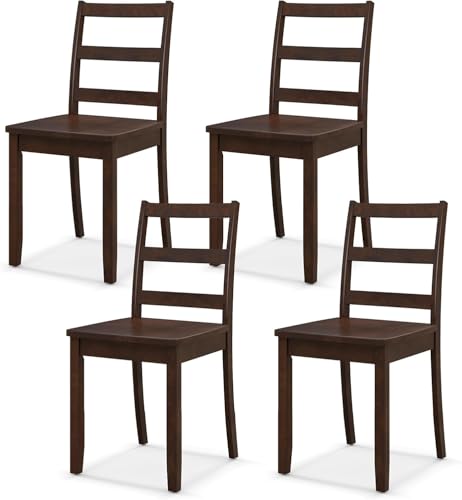
NAFORT Walnut Wood Dining Chairs, Ladder Back, Set of 4 — Best Overall
If the Quaker-style kitchen has a default chair, this is its modern manufactured form: a high ladder back with shaped horizontal slats, solid rubberwood legs and frame, a walnut-toned finish that shows grain rather than hiding it, and a plain, armless silhouette that slides under a farmhouse table and stacks the room’s visual quiet exactly right. The listing’s details respect the tradition in ways that matter more than looks — non-slip foot pads that protect the plain wood floors these kitchens usually have, and a rated capacity of 400 pounds per chair that speaks to honest joinery rather than hopeful joinery. Sold as a set of four, it furnishes the standard kitchen table in one decision, and the ladderback profile is the single most recognisable silhouette in the plain-furniture tradition.
Strengths
- True ladderback form in solid rubberwood with a grain-showing walnut finish
- Rated 400 lb per chair per the listing — joinery confidence you can sit on
- Non-slip foot pads protect bare wood floors; set of four furnishes a table at once
Trade-offs
- Wood seat without cushion — long sits may want a simple tie-on pad (a period-appropriate solution)
- Walnut tone is a finish family, not a species match — it will not perfectly match true walnut furniture
- Armless design suits the style; those wanting host armchairs must look to the profiles below
Assembly and arrival deserve one practical paragraph, because sets of four live or die by it. Chairs in this class typically arrive part-assembled — backs and leg frames to be joined — and the tradition’s advice applies to the Allen key as to everything else: dry-fit every joint before tightening any, tighten in a cross pattern a little at a time, and sit-test each chair on a hard floor before the set is declared done, because a chair assembled slightly out of square will rock forever and loosen itself trying to tell you. Keep the spare hardware, note the finish’s tone somewhere you will find it in five years, and register which chair is which if you mix sets — future you, ordering two more, will be grateful.
Live with these for a season and the virtues compound quietly: the chairs are light enough to move for sweeping, sturdy enough to stand on for the top shelf (rated capacity noted, care still advised), and visually silent enough that the table, the stove, and the food do the room’s talking. That silence — visual, and in a well-made chair’s case literal, since honest joinery does not creak — is the style. Buy the set, add woven or plain linen seat pads if your dinners run long, and the kitchen is furnished in the tradition’s own terms.
Best for: the classic Quaker/Shaker-leaning kitchen wanting the archetype in a verified set of four / Not suited for: buyers wanting cushioned seats as standard or true armchairs
Sits in the mid-range tier. Check the current price on Amazon

Signature Design by Ashley Berringer Dining Chairs, Spindle Back, Set of 2 — Best for Comfort
The Berringer speaks the tradition’s second dialect: the spindle back, where turned vertical spindles replace the ladderback’s slats, on saber legs with a rustic brown finish — and it makes one concession to modern bodies that purists forgive at the second hour of a dinner party: a cushioned microfiber seat. Spindle backs are as old in the plain-furniture world as ladderbacks, and the turned spindles here are honestly shaped rather than moulded smooth. Sold in pairs, the Berringer suits the common real-world need — two chairs to complete a set, a pair for a small kitchen table, or hosts’ chairs at the ends of a table furnished with plainer sides.
Strengths
- Turned spindle back and saber legs — authentic traditional forms
- Cushioned microfiber seat for long sits at the kitchen table
- Rustic brown finish pairs with farmhouse and Quaker palettes; sold in pairs for flexible set-building
Trade-offs
- Upholstery is the modern concession — it will age differently from the wood and cannot be refinished, only re-covered
- Pairs pricing means a table of six is three decisions, not one
- The rustic finish leans country; the starkest Shaker-minimal rooms may find it warm
Choose the Berringer where the kitchen table doubles as the home’s everything surface — homework, laptops, long Sunday lunches — and seat comfort stops being a luxury. The microfiber’s practical virtue in a kitchen is cleanability: it wipes down in a way that woven rush and bare wood handle differently, and in a working kitchen that counts as tradition too, since the tradition was always about use.
Best for: kitchen tables that host long sits and mixed daily life / Not suited for: strict purists wanting all-wood, all-hard surfaces
Sits in the mid-range tier. Check the current price on Amazon

DUHOME Wood Dining Chairs, Cross Back, Set of 4 — Best Farmhouse Variant
The cross back — two diagonal braces forming an X in the chair’s back — is the farmhouse cousin of the ladderback: the same solid-wood honesty, a touch more joinery display, and a silhouette that reads slightly more decorative without crossing into ornament. DUHOME’s set of four carries a vintage walnut finish, armless kitchen-chair proportions, and a brief that spans kitchen, breakfast nook, and bistro — the rooms where plain wood chairs earn their keep. In a Quaker-leaning kitchen that also hosts a farmhouse table and open shelving, the cross back is often the chair that makes the room cohere, because it shares DNA with both traditions and commits fully to neither’s strictness.
Strengths
- Cross-back joinery in solid wood with a vintage walnut finish
- Set of four in true kitchen-chair proportions — nooks and farmhouse tables
- Armless, plain, and repairable in the tradition’s spirit
Trade-offs
- The X-back is a farmhouse dialect — strict Shaker rooms may prefer the ladderback’s plainer slats
- Wood seat, like the NAFORT — pads are the owner’s addition
- Diagonal braces collect dust in the Vs; a brush lives with these chairs
One more household reality favours this set: cross-back chairs are the easiest of the three linked designs to keep clean in a working kitchen, because the X presents broad, wipeable surfaces at exactly the heights where hands — including small, jam-assisted hands — actually grab a chair to move it. The ladderback’s slats and the spindle’s turnings each have their cleaning geometry; the cross back’s is the most forgiving, and in a kitchen that hosts children daily, forgiveness in the furniture is a design specification, not a bonus.
The DUHOME set is the pick for the kitchen that describes itself as “Quaker-inspired” rather than Quaker — which is most real kitchens in this style family, mixing plain cabinets with a farmhouse sink and a cross-back’s friendly geometry. It furnishes four seats in one purchase, at a tier that leaves budget for the table the chairs deserve.
Best for: farmhouse-Quaker crossover kitchens and breakfast nooks / Not suited for: strict minimalist Shaker schemes
Sits in the budget-to-mid tier. Check the current price on Amazon

SilkWood Studio Farmhouse Ladder Back Solid Wood Dining Chairs, Set of 2 — Best Traditional Seat
The verified listing for this archetype is the SilkWood Studio Farmhouse Ladder Back Dining Chairs, Set of 2, whose title confirms the essentials: a solid wood ladder-back frame with a woven rush seat, in a black and natural finish. The rush-seat ladderback is the historical original from which the NAFORT descends: a solid hardwood frame — maple, oak, or ash in the honest versions — with a seat woven from rush, seagrass, or splint that gives slightly under the sitter, breathes in summer, and can be re-woven by a craftsperson when it finally sags, decades in. That repairability is not a footnote; it is the philosophy of the entire style made physical, and a kitchen furnished with re-weavable chairs is furnished, in principle, forever. Shop this archetype by the frame first: posts should be solid and shaped, slats steam-bent or shaped rather than flat-sawn planks, and the weave should be tight, even, and natural fibre rather than paper rush printed to imitate it.
Strengths
- The authentic historical form — woven seats are comfortable, breathable, and renewable
- Solid hardwood frames in honest versions last generations and repair indefinitely
- The lightest visual footprint of any chair here; the weave adds hand-made texture
Trade-offs
- Woven seats dislike standing water and sharp objects; kitchen spills must be blotted, not left
- Quality varies enormously between makers — the specification below is your protection
- Re-weaving is a craft service, available but not instant
This pick sits in the mid-to-premium tier when honestly made. When shopping it, ask three questions of any listing: Is the frame solid hardwood (named species) or “wood finish”? Is the seat natural rush/seagrass or paper fibre? Are the slats shaped? A seller who answers all three plainly is selling the real chair; a seller who answers none is selling a photograph of one.
Check on Amazon — check the current price on Amazon.

LUE BONA Windsor Dining Chair, Set of 4 — Best Painted Accent
The verified listing for this archetype is the LUE BONA Windsor Dining Chair, Set of 4, whose title confirms a spindle-back wooden Windsor chair in black — the painted branch of the tradition, sold as a set of four for kitchen and dining room use. The Windsor is the tradition’s painted branch: a solid sculpted seat into which spindles and legs are socketed, historically painted — black, green, or red over mixed woods — precisely because the chair was built from several species, each chosen for its job, and paint unified them. That honesty-through-paint is deeply Quaker in spirit, and a set of black or deep-green Windsor-style chairs around a plain table is one of the most beautiful sentences a kitchen can speak. Shop the archetype by its seat: it should be solid and visibly shaped (saddled) rather than a flat board, the spindles should be numerous and slender rather than few and chunky, and the legs should splay with the Windsor’s characteristic stance.
Strengths
- Painted finish is historically authentic and unifies mixed-wood construction
- Sculpted solid seat is genuinely comfortable without any cushion
- Spindle backs bring light and air through the chair — small kitchens feel bigger
Trade-offs
- Socketed construction quality varies; loose spindles are the cheap version’s tell
- Paint chips with hard use — though in this tradition, honest wear is patina, and touch-up is easy
- Armchair (bow-back) versions are wide; measure against your table’s spacing
This pick sits in the mid-range tier for sound reproductions. Judge listings by seat thickness and shaping, spindle count, and whether the maker names the woods. A Windsor bought well is the chair grandchildren argue over; bought cheaply, it is firewood with ambitions, and the difference is visible in exactly those three details.
Check on Amazon — check the current price on Amazon.

Boraam Shaker Chair, Set of 2 — Best Minimalist Form
The verified listing for this archetype is the Boraam Shaker Chair, Set of 2 (the Boraam 30536, in a black and oak finish) — a chair sold under the Shaker name itself. Note honestly what the title does and does not confirm: it confirms a Shaker chair in a two-tone finish, not a specific slat count, so read the review below as the style standard this chair is bought against. The classic Shaker ladderback is the tradition at its most distilled: wide, gently curved slats, straight or lightly turned posts, a plain seat, and nothing else — the chair as a sentence with no adjectives. Shaker workshops hung these chairs on wall pegs when sweeping, which tells you their weight and their purpose in one image. In a modern Quaker-style kitchen with plain slab cabinets and uncluttered counters, this is the chair that matches the room’s restraint, and its lightness makes it the easiest chair here to move, hang, and live around. Shop it by joinery alone, because there is nowhere for poor quality to hide: slats should be shaped and tenoned, posts should meet the seat with visible, tight joints, and the whole chair should be silent and rigid when you rock it by the top rail in the shop or on arrival.
Strengths
- The plainest, lightest silhouette in the tradition — visual quiet for minimal kitchens
- The plain Shaker silhouette is a signature in itself: nothing decorative to date, chip or fall out of fashion
- Nothing to ornament, nothing to break — the repairability ideal in its purest form
Trade-offs
- A spare Shaker back supports less completely than the fuller ladderbacks above; long sits favour those
- Minimalism exposes quality — there is no upholstery or carving to distract from a loose joint
- Authentic workshop-made versions command premium tiers; reproductions vary widely
This pick spans the widest tier range of the six, from honest reproductions in the mid tier to workshop originals in the premium tier and beyond. Buy the best joinery your budget reaches, because with this chair, joinery is not a feature of the product — it is the product.
Check on Amazon — check the current price on Amazon.
Comparison Table
| Pick | Badge | Key spec | Best for |
|---|---|---|---|
| NAFORT Ladder Back, Set of 4 | Best Overall | Solid rubberwood, 400 lb rated, walnut finish | The archetypal Quaker kitchen set |
| Ashley Berringer, Set of 2 | Best for Comfort | Spindle back, cushioned microfiber seat | Long sits, mixed-use kitchen tables |
| DUHOME Cross Back, Set of 4 | Best Farmhouse Variant | Solid wood X-back, vintage walnut | Farmhouse-Quaker crossover rooms |
| SilkWood Studio Ladder Back, Set of 2 | Best Traditional Seat | Solid wood, woven rush seat, black/natural | Purists wanting the renewable original |
| LUE BONA Windsor, Set of 4 | Best Painted Accent | Spindle back, wooden, black finish | Painted-finish kitchens, small rooms |
| Boraam Shaker Chair, Set of 2 | Best Minimalist Form | Shaker chair, black/oak finish | Minimal kitchens, joinery-first buyers |
All six rows carry verified links — because in a style whose entire ethic is honesty about materials, a buying guide should practise it about its own links.
How to Choose Chairs for a Quaker Style Kitchen
Begin with the silhouette, because it is the style. Ladderbacks give horizontal calm and the fullest back support; spindle backs give vertical rhythm and light; cross backs give farmhouse warmth. All three are native to the tradition, and the right choice is the one that rhymes with your room’s existing lines — horizontal slats echo plain cabinet rails, spindles echo turned table legs, crosses echo a farmhouse table’s trestle. What does not belong, however comfortable, is the visual language of other centuries: chrome, splayed mid-century legs, tall upholstered backs, and moulded shells will fight the room every day they are in it.
Judge construction next, with your hands where possible. A chair in this tradition should be solid wood in its structural parts, joined by mortise-and-tenon or dowelled joints, rigid when rocked by the top rail, and finished in something repairable — oil, wax, varnish you can spot-repair, or paint you can touch up. Weight is a useful proxy: a solid hardwood side chair has a heft that hollow and veneered imitations cannot fake. Capacity ratings, where published as on the NAFORT, are the manufacturer’s own confession of joinery confidence; treat their absence on a cheap listing as information.
Seats are the third decision, and the tradition offers four honest answers. Bare wood is the purest and the hardest for long sits; woven rush and tape are the historical comfort answer, renewable and breathable; a simple tie-on pad is the reversible compromise most real kitchens adopt; and a built-in cushion, as on the Berringer, is the modern answer for tables that host hours of life. Choose by your table’s actual use, timed honestly: a chair sat in for twenty minutes at breakfast and three hours on Sunday needs the Sunday answer.
Finally, count and scale. Kitchen chairs in this tradition are side chairs — armless, modest in footprint — because they were made to be many, moved often, and hung up when the floor was swept. Measure your table’s apron height against the chair’s seat height and arm absence, allow roughly two feet of table edge per chair, and resist the grand host armchair unless the room is truly large; the Windsor profile above is the one place an arm version earns its width. Buy in the sets the table needs, keep one chair’s worth of budget in reserve for the inevitable extra, and the room is furnished as the tradition intends: completely, plainly, and for good.
How to Care for Solid Wood Kitchen Chairs
Wood chairs in a working kitchen ask for little and repay it for decades. Dust with a dry or barely damp cloth; wash grime with a mild soap solution wrung nearly dry, because standing water is wood’s only real enemy in this room, and dry after. Keep chairs out of the radiator’s blast and the sun’s longest afternoon patch where you can — not from fragility, but because even movement across seasons is gentler when temperature and humidity swing less. Felt or the maker’s own pads under the feet, renewed when they thin, protect both the chair’s feet and the plain floors beneath them.
The tradition’s great maintenance secret is that everything on these chairs can be renewed at home. A scuffed oil or wax finish is fed, not stripped: clean, apply the matching oil or wax, buff. A paint chip on a Windsor is touched up with a dab of the same paint and becomes patina. A rush or tape seat that sags after its decades is re-woven by a local craftsperson — search for chair caning and seat weaving services, a living trade — and a loose joint, the one real structural event in a chair’s life, is a woodworker’s hour, not a replacement. Buy chairs that invite this care, and the set you buy in your thirties is the set your grandchildren will re-weave in theirs.
Common Buying Mistakes
- Buying the look in the wrong materials. A ladderback silhouette in hollow veneer and plastic is a costume. The style is the construction: solid wood, real joinery, repairable finish.
- Matching finishes by name instead of by eye. “Walnut” is a tone family across brands. Order one chair or check returns before committing a set to a room with heirloom wood.
- Forgetting the apron. Measure the table’s under-apron height and the chair’s seat height together; thick aprons and tall seats collide at the sitter’s thighs.
- Choosing bare wood for a three-hour table. Purity is not comfort. Rush, tape, a pad, or the Berringer’s cushion exists because the tradition itself answered this problem.
- Ignoring the rock test. A new chair that creaks or flexes at the top rail is confessing its joinery. Return it while returning is free.
- Judging a chair by its photograph’s styling. A plain chair photographed with linen, pottery, and morning light will out-charm a better chair photographed on white. Compare construction details — slat shaping, joint lines, seat material — and let the room you own do the styling.
- Buying arms for a small table. Armchairs eat table edge and refuse to push in. Side chairs are the tradition’s answer for a reason.
Final Recommendation
For most Quaker-style kitchens, buy the NAFORT ladderback set of four: the archetypal form, solid construction, a confident capacity rating, and one decision that furnishes the table. Where the table hosts long hours, add or substitute the Ashley Berringer pairs for their cushioned seats; where the room leans farmhouse, the DUHOME cross-back set coheres it. Then, as budget and patience allow, graduate to the tradition’s originals using the profiles above: the SilkWood Studio rush-seat ladderback for the renewable classic, the LUE BONA Windsor set for painted beauty, and the Boraam Shaker chair for minimal perfection. Buy solid, buy plain, buy repairable — the style has been giving the same advice for two hundred years, and it has not been wrong yet.
A final practical note on sequencing the purchase: chairs are the furniture a kitchen lives in daily and the furniture most often bought last, after the cabinets and table have consumed the budget and the patience. Reverse that instinct if you can. A great table surrounded by placeholder chairs is a room that fails at every meal, while great chairs around a plain table — even a temporary one — is a room that already works, because the tradition this guide serves was always clearer about chairs than about anything else: they are where the body meets the room. Furnish the meeting point first and best; the rest of the kitchen can catch up at its leisure.
Related reading in this program: Best Dining Chairs · Best Farmhouse Dining Chairs · Best Wooden Kitchen Chairs · Best Dining Rugs · Best Kitchen Tables
Why These Forms Endure: A Short History in the Kitchen
The ladderback, the spindle back, and the Windsor are not styles in the fashion sense; they are solutions that survived. The ladderback’s slats are wide because a wide slat can be shaped to the back’s curve from a single piece of wood, using the tree’s strength honestly and wasting none of it — a chair a farming community could build with local timber and hand tools, repair with the same, and pass down. The spindle back survives because turning spindles on a lathe is fast, light, and strong: a whole back’s worth of support for a pound of wood. The Windsor survives because its socketed construction lets each part be the wood it wants to be — a tough seat, springy spindles, hard legs — a division of labour among species that factory furniture, built from one material for one machine, still struggles to match.
That is why these chairs look right in a Quaker-style kitchen while this decade’s dining fashions will look dated in it within five years: the kitchen itself is designed on the same principles. Plain cabinets are boxes honestly joined; a farmhouse table is a top on trestles; cast iron and enamel are materials chosen for a century of service. Furniture from the same ethic does not clash with the room because it was never separate from it. Buyers sometimes worry that traditional chairs will make a modern kitchen feel like a museum; the opposite happens in practice, because the chairs’ plainness reads as calm next to modern appliances, and their wood warms rooms that stainless steel cools. The museum feeling comes from roping the furniture off. These chairs ask to be used, stood on, re-woven, and handed down — the least museum-like objects in the home.
Chairs in the Room: Numbers, Spacing, and the Host’s End
A few spatial truths govern how these chairs succeed once home. The first is elbow room: the tradition’s side chairs are narrower than modern dining chairs, which is a gift in real kitchens — six ladderbacks occupy the visual and physical space of four upholstered chairs, and a small kitchen breathes. The second is the pull-out allowance: leave the same roughly two feet behind each chair that dining-rug sizing assumes, so a seated diner can rise without negotiating with the wall; in tight kitchens, the chairs’ lightness is the saving grace, since a chair that can be lifted one-handed gets parked against the wall without ceremony. The third is the host’s end. A single distinguished chair at the table’s head — the Windsor armchair of the profiles, or a Berringer pair deployed as hosts — gives a plain set a hierarchy that feels generous rather than grand, and it solves the odd-number problem when a fifth diner arrives: the host chair yields its place and the set closes ranks.
Children deserve a specific mention in this tradition, because these chairs raise families well. A ladderback’s slats give small climbers handholds that cut both ways — sturdy chairs tolerate the climbing that destroys lesser furniture, and the same sturdiness makes them the chairs children get stood on at the counter, tied with a cushion for height at the table, and eventually handed the set when they set up their own kitchens. Tie-on pads, again, are the tradition’s own booster solution. If your household includes toddlers, prefer the chairs whose finishes forgive — oil and paint over delicate polish — and know that a rush seat’s one true enemy, the dropped knife point-down, is a rarer event than a decade of breakfasts suggests.
Buying Second-Hand and Vintage: The Tradition’s Other Shop
No guide to this style is complete without admitting that some of its best chairs are not new. Plain-furniture chairs were built in enormous numbers across two centuries, they survive in proportion to their construction, and the second-hand market — estate sales, auctions, antique shops, and online marketplaces — is full of ladderbacks and Windsors whose joinery shames most modern reproductions. The shopping skills are the same ones this guide teaches for new chairs, sharpened: rock the chair by its top rail and reject anything that moves; sight down the slats and spindles for replacements in mismatched wood; check the underside for the honest scars of age rather than the fresh glue of a flipper’s haste; and price a re-weave or a re-glue into any chair that needs one, because those services are the tradition’s normal maintenance, not a defect’s apology.
Mixing vintage with the new sets in this guide is not a compromise but the style’s native condition — few historical kitchens held six identical chairs, and a NAFORT set joined over the years by a found Windsor at the head and a Berringer pair at the sides is a room with a biography. Keep the finish family coherent, keep the seat heights within an inch of each other so the table’s edge meets every sitter fairly, and let the chairs differ in the details. That, in the end, is the deepest instruction the Quaker-style kitchen gives its furniture: that usefulness and honesty age into beauty on their own schedule, and the buyer’s job is simply not to interrupt them with anything fake.
Finishes: Walnut Tones, Paint, and Honest Wear
Finish is where the tradition’s honesty is easiest to keep or lose, so it deserves its own counsel. The walnut tones on the linked picks are stains and finishes in a colour family, not a promise that the wood beneath is walnut — rubberwood in the NAFORT’s case, honestly declared in its own listing — and that distinction, read generously, is itself in the tradition’s spirit: a modest wood, well worked and warmly finished, outranks a noble species badly joined. Judge a finish by three tests: does the grain show through it (a finish that hides the wood entirely is usually hiding the wood), can it be repaired locally (oil, wax, and paint pass; thick polyurethane films fail gracefully only by full refinishing), and will its wear look like patina or like damage — matte and satin finishes age into the first, high-gloss into the second.
Paint deserves its defence in a style sometimes caricatured as all bare wood. The historical record is painted through and through: Windsors were painted as a matter of course, Shaker chairs were stained and painted in a disciplined palette of reds, yellows, and blues, and a painted chair in a wood-toned kitchen is not a departure but a quotation. Practically, paint is also the great unifier of the mixed set — the vintage find, the new ladderbacks, and the odd Berringer can be brought into one family with a shared colour in a way that mismatched wood tones never quite achieve — and the easiest finish in this entire guide to maintain, since a chip is a two-minute touch-up rather than a refinishing project. If your kitchen’s wood tones are already many, paint is not the compromise; it is the answer the tradition itself would give.
Frequently Asked Questions
What is the difference between Quaker and Shaker style furniture?
They are distinct religious communities with kindred design ethics — plainness, utility, honesty of material, no waste — and in home-design usage the terms blur into one plain-furniture tradition. Shaker pieces are the more documented and minimalist; Quaker style points the same direction. Every chair in this guide satisfies both readings. If the distinction matters to your room, lean Shaker for the starkest minimalism — the two-slat profile is your north star — and lean Quaker for the slightly warmer, more domestic plainness of the ladderback and spindle forms; a real kitchen can hold both without an argument, and historically, many did.
Are ladderback chairs comfortable without cushions?
For meals, yes — shaped slats support the back properly. For hours-long sits, the tradition’s own answers apply: a woven seat, a tape seat, or a simple tie-on pad. Discomfort at a kitchen table is almost always a seat question, not a back question.
How many chairs should I buy for a kitchen table?
Allow about 24 inches of table edge per chair. A 60-inch table seats two per side comfortably; buy the set that covers your everyday number, and prefer buying from a line you can add to later — one reason the Berringer’s pairs are practical.
Can I mix chair styles at one table?
The tradition itself did — chairs were made and acquired over years. Mixing within the family (ladderback sides with a Windsor or Berringer at the heads) looks intentional and historical; mixing across centuries (a chrome chair among them) looks like an accident. Keep one finish family to hold the set together. One working rule for mixed sets: vary only one dimension at a time. Same finish, different silhouettes reads as a collected set; same silhouette, different finishes reads as a painted family; different silhouettes in different finishes reads as a yard sale. The first two are the tradition; the third is what the tradition was avoiding.
How do I tell if a “solid wood” chair is really solid?
Weight, end grain, and the underside. Solid chairs are heavy for their size; end grain shows at the tops of posts and ends of slats; and the underside of a solid seat is the same wood as the top, not a different substrate with a pretty face. Vague listings that never name a species are telling you something.
What seat height do I need for a farmhouse table?
The near-universal standard is an 18-inch seat height for a 30-inch table, and every linked pick here is built to that convention. Where it goes wrong is thick farmhouse aprons: a table whose apron drops four inches below the top leaves thigh room that a tall sitter feels. Measure from floor to the apron’s underside and keep at least ten inches between that line and the chair’s seat; if your table is apron-heavy, the slimmer-seated ladderbacks in this guide are the safer fit than any cushioned chair, whose compressed cushion still starts higher.
How do tie-on seat pads change the choice?
They dissolve the comfort objection to hard seats, which is why this guide treats them as part of the system rather than an accessory. A plain pad in linen, cotton, or woven wool adds the hour-extending comfort for a fraction of an upholstered chair’s cost, removes for washing in a working kitchen, and can be replaced when it wears without touching the chair. Choose pads without foam thick enough to change the seat height materially, tie them at the back posts as intended, and the ladderbacks in this guide become all-day chairs while keeping every advantage of their construction.
Are rush seats practical in a kitchen?
Yes, with ordinary care: blot spills promptly, keep standing water off them, and expect decades of service before a re-weave. Rush and seagrass are tougher than they look — they furnished working kitchens for centuries before upholstery existed — and their slight give makes them the most comfortable hard chair seat in this guide.


