Disclosure: airfryerkitchensupply.com is reader-supported. When you buy through links on our site, we may earn an affiliate commission at no extra cost to you.
Where to buy
Every rug below was confirmed through Amazon’s catalog data before being included, and the links point to the exact models and sizes reviewed.
- Boho Dining Room Rug for Under Table, 6×9 Washable — Check on Amazon
- SparkleGaze Vintage Floral Washable Area Rug, 8×10 — Check on Amazon
- Washable Low Pile Area Rug, 8×10, Beige — Check on Amazon
- Miukiki Moroccan Washable Area Rug, 8×10 — Check on Amazon
- AMADA Washable Area Rug, 8×10, Blue — Check on Amazon
- Vintage Washable Medallion Rug, 5×7, Beige — Check on Amazon
The best dining rugs are not simply living-room rugs that wandered under a table. A dining rug lives the hardest life of any rug in the house: chairs drag across it four times a meal, food falls on it daily, red wine eventually tests it, and it must stay flat and grippy through all of it while still looking like something you chose on purpose. That job description eliminates most of the rug market. High pile snags chair legs and hoards crumbs. Delicate fibres stain permanently at the first bolognese. Unbacked rugs creep across hard floors until a chair leg catches the fold at the worst possible moment. What survives the filter — and what this guide ranks — is a specific modern category: low-pile, machine-washable, non-slip-backed rugs, printed with patterns that disguise the small evidence of meals between washes.
All six picks here are washable low-pile rugs, because for a dining room that is not a compromise but the correct engineering. It is worth pausing on how recently that sentence became true: a generation ago, a washable rug meant a thin cotton dhurrie that faded to string, and a serious dining room meant wool and professional cleaning bills. The current printed flat-weave generation changed the trade — the patterns are genuinely handsome, the backings genuinely grip, and the wash genuinely resets them — and this guide is written from the position that the category has earned its place as the default recommendation, with the older materials now the special cases rather than the standard. They differ in the things that should decide your choice: size relative to your table, pattern density (your camouflage level), colour family, and how formal or relaxed the room reads with the rug under it. Prices are not printed — they vary by size and promotion — but each pick is placed in its tier, and you can check the current price on Amazon from any link. One measurement matters more than everything else in this guide combined, and it is developed fully in the buying guide below, with a tape-measure method for checking your own room before you spend anything: the rug must extend beyond the table far enough that chairs stay on it when pulled out. Get that right and any of these six will serve; get it wrong and none of them can save you.
In this guide
Quick Picks
- Best Overall: Boho Dining Room Rug, 6×9 — sized and specced explicitly for under-table duty, washable, low pile, stain resistant. Check on Amazon
- Best for Large Dining Rooms: SparkleGaze Vintage Floral, 8×10 — a big, soft, farmhouse-floral field that anchors a full-size table and eight chairs. Check on Amazon
- Best Neutral Modern: Washable Low Pile 8×10, Beige — abstract, quiet, and endlessly compatible with changing decor. Check on Amazon
- Best Pattern: Miukiki Moroccan, 8×10 — a trellis pattern with the density to hide a week of dinners. Check on Amazon
- Best Colour Statement: AMADA 8×10, Blue — vintage blue that gives a plain dining room a point of view. Check on Amazon
- Best for Small Dining Spaces: Vintage Medallion 5×7 — the right footprint for breakfast nooks and four-seat tables. Check on Amazon
How These Picks Were Chosen
We filtered hard on the dining-specific requirements before looking at a single pattern. Pile had to be low — chair legs must slide, not climb. The rug had to be machine washable, because a dining rug that needs professional cleaning will simply live dirty. A non-slip backing was mandatory for hard floors, which is where most dining rooms live. Each candidate was then confirmed against Amazon’s catalog data so the size, construction, and care claims in this guide match the listing a buyer receives.
One more filter deserves stating, because it excluded several popular rugs: we required the pattern to be printed or woven into a genuinely low, dense surface rather than simulated by varying pile height. Sculpted or high-low pile photographs beautifully and fails the chair test — legs catch on the raised elements and the recessed ones collect debris that vacuums cannot reach. A dining rug’s surface should be boring to a chair leg and interesting only to the eye.
Within that filter, we weighted pattern as a functional feature, not decoration: medallions, trellises, and distressed vintage prints are camouflage systems for crumb and splash, and they dominate this list for that reason. We also balanced sizes — a 5×7 for nooks, a 6×9 for the standard six-seat table, and 8x10s for large rooms — because the most common dining-rug failure is a beautiful rug bought one size too small. Every pick is a printed, flat-weave style rug rather than a tufted one; that is what makes the washability and the low pile possible at these tiers.
The 6 Best Dining Rugs

Boho Dining Room Rug for Under Table, 6×9 — Best Overall
Most rugs in this guide are area rugs that happen to suit dining rooms; this one was designed for the job, and it shows in the specification. The 6×9 footprint is the correct answer for the most common dining setup in the country — a rectangular table seating six — giving pulled-out chairs a rug to stand on at both sides and both ends. The low-pile washable construction shrugs off the daily cycle of crumbs and chair drag, the non-slip backing keeps it planted on hard floors, and the boho pattern in its ashen, multi-tonal colourway does the camouflage work between washes: small spills land on a busy, forgiving field instead of a plain one that reports every incident. Stain resistance is part of the design brief, per the catalog listing, which matters because the first spill always arrives before the first wash.
Strengths
- Purpose-sized 6×9 for six-seat tables — chairs stay on the rug when pulled out
- Low pile, machine washable, stain resistant, non-slip backing
- Busy boho pattern hides crumbs and minor spills between washes
Trade-offs
- The boho look commits the room to a relaxed, farmhouse-leaning style
- Too small for eight-seat tables — size up to an 8×10 from this list instead
- Printed flat weave feels firmer underfoot than a padded living-room rug
What earns it the top spot is the absence of a wrong note for its stated job. It is the rug we would send to a friend who said “just tell me which one” for a family dining room with hard floors and a six-seat table — the size is right, the care is right, the pattern works for its living, and the price tier is the honest middle of the washable category rather than the printed-rug bargain bin whose backings fail in the first wash.
Best for: six-seat dining tables on hard floors in busy family homes / Not suited for: formal dining rooms or tables seating eight or more
Sits in the mid-range tier. Check the current price on Amazon

SparkleGaze Vintage Floral Washable Rug, 8×10 — Best for Large Dining Rooms
Large dining rooms fail in a specific way: the table floats in a sea of floor, the room echoes, and chairs at the far settings end up half off any modest rug. The SparkleGaze’s 8×10 field solves the geometry, and its vintage white-ivory-beige floral design solves the styling problem that comes with covering that much floor — a soft, light, farmhouse floral that reads as texture from across the room rather than as a shout. It is ultra-soft for a low-pile washable, stain resistant, and non-slip, per its catalog listing, which makes it as practical as it is pretty: this is the rug for the dining room that hosts Sunday roasts and holiday dinners, where the spill stakes are highest and the room still has to look composed in photographs.
Strengths
- True 8×10 coverage for eight-seat tables and spacious rooms
- Light vintage floral brightens rooms and disguises everyday dust
- Washable, stain resistant, non-slip — party-proof under the prettiness
Trade-offs
- Light colours show a major red-wine event more than dark patterns — wash promptly
- An 8×10 washable needs a large-capacity machine or a laundromat trip
- The floral-farmhouse style is a commitment in modern minimalist rooms
The honest test of a light rug under a dining table is not whether spills happen — they will — but whether the rug’s care story matches them. This one washes, and its distressed vintage printing means the pattern already contains tonal variation, so a faint shadow of an old spill disappears into the design rather than announcing itself. Hosts who entertain often and photograph the table will understand the assignment this rug is completing.
Best for: large dining rooms, eight-seat tables, and frequent entertainers who like a light, farmhouse look / Not suited for: small rooms or households wanting the darkest, most camouflaging pattern possible
Sits in the mid-range tier. Check the current price on Amazon

Washable Low Pile Area Rug, 8×10, Beige — Best Neutral Modern
Some dining rooms do not want the rug to have opinions. For those, this beige abstract 8×10 is the pick: a modern, softly abstract pattern in neutral tones that sits quietly under any table style — oak farmhouse, black metal, glass — and survives redecoration around it, because beige abstracts do not clash with the next wall colour or the new chairs. The construction is the category standard done right: low pile for chair glide, machine washable, non-slip backing, soft enough underfoot for bare feet at breakfast. Its catalog listing explicitly spans dining rooms among its intended spaces, and the abstract distressing gives it more spill forgiveness than a true solid would.
Strengths
- Neutral abstract design pairs with any table, chairs, and future decor changes
- 8×10 size covers large tables; low pile keeps chairs sliding freely
- Washable and non-slip — the full practical specification
Trade-offs
- The quietest camouflage in this guide — crumbs show sooner than on busy patterns
- Beige can read cool or warm depending on your floor; check your light
- Less personality — rooms wanting a focal point should look at the Miukiki or AMADA
This is the landlord-and-stager special as much as the homeowner’s: it makes a dining space look finished in listing photos, offends no buyer’s taste, and can be washed back to neutral between tenancies or between dinner parties. In a home, it is the rug you buy when the table and the art are the statements and the floor’s job is to support them quietly.
Best for: modern and transitional dining rooms, open-plan spaces, and anyone redecorating around the rug later / Not suited for: households wanting maximum spill camouflage or a strong pattern statement
Sits in the budget-to-mid tier. Check the current price on Amazon

Miukiki Moroccan Washable Area Rug, 8×10 — Best Pattern
The Moroccan trellis is the hardest-working pattern in the dining category, and the Miukiki’s grey-based 8×10 shows why: a repeating geometric lattice breaks the field into hundreds of small cells, and a crumb, a splash, or a dropped pea has to be genuinely large to register against it. Between washes — which is where dining rugs actually live — that camouflage is worth more than any stain treatment. The rug is a soft, non-slip, washable low pile sized for large rooms, and the grey Moroccan scheme threads the needle between traditional and modern rooms: it has enough pattern to be the room’s texture and enough restraint to sit under a busy tablescape.
Strengths
- Dense trellis pattern — the best crumb and spill camouflage in this guide
- 8×10 coverage for large tables; washable, non-slip, low pile
- Grey palette pairs with wood, white, and metal dining sets alike
Trade-offs
- A strong pattern competes with patterned upholstery or busy curtains
- Large washable size needs a big machine for home laundering
- Geometric prints show crooked placement — take the extra minute to square it to the table
Pattern placement is this rug’s one skill requirement: a trellis laid two inches off-square under a rectangular table will quietly bother someone at every meal. The fix is free — align the rug to the table first, then the table to the room — and the payoff is a dining room that looks deliberately designed rather than furnished. For households with children, where the floor under the table is a nightly archaeological dig, this is the pattern that keeps the room looking adult between cleanings.
Best for: busy family dining rooms and anyone whose top priority is hiding the evidence between washes / Not suited for: rooms already rich in competing patterns
Sits in the mid-range tier. Check the current price on Amazon

AMADA Washable Area Rug, 8×10, Blue — Best Colour Statement
Most dining rugs are beige, grey, or apologetic. The AMADA is blue — a vintage-washed blue with a low-profile, soft-textured weave — and for the many dining rooms that are currently a wooden table, neutral walls, and no idea what is missing, that colour is the missing thing. Blue does particular work in dining spaces: it cools warm wood tones, it photographs beautifully under warm evening light, and in its distressed vintage form it carries the same spill-camouflage virtues as the other patterned picks. The specification is the full one — washable, non-slip, low profile, pet friendly per the catalog listing — so the statement does not come at the cost of the practicalities.
Strengths
- Distressed vintage blue gives neutral dining rooms an instant focal point
- Washable, non-slip, low profile — chairs glide, rug stays
- Pet-friendly positioning suits dining rooms that double as pet territory
Trade-offs
- Colour commitment: blue anchors the room’s palette for everything after
- Vintage distressing reads casual — formal dining rooms should look elsewhere
- As with all 8×10 washables, laundering needs a large-capacity machine
Choose the AMADA when the room needs a decision made for it. It pairs classically with natural oak and walnut, with white-painted chairs, and with brass or black metal — and it turns the under-table zone, usually the deadest square footage in the house, into the room’s colour story. Guests will comment on it, which no one has ever said about a beige rug, however sensible.
Best for: neutral dining rooms needing colour, coastal and vintage-leaning schemes / Not suited for: formal dining rooms or palettes already committed to warm reds and oranges
Sits in the mid-range tier. Check the current price on Amazon
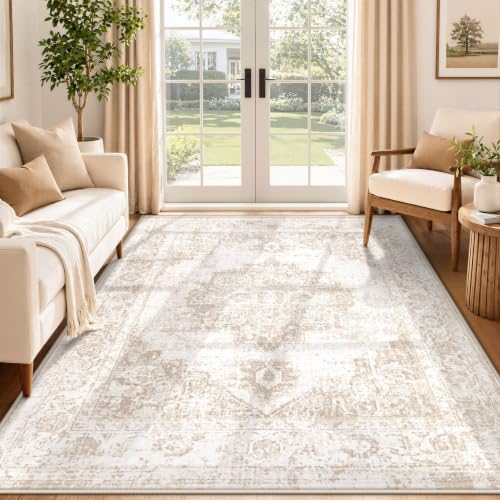
Vintage Washable Medallion Rug, 5×7, Beige — Best for Small Dining Spaces
Breakfast nooks, apartment dining corners, and four-seat tables have their own geometry, and an 8×10 rug in those spaces is a wall-to-wall mistake. This 5×7 vintage medallion is the right footprint: large enough that four chairs stay on it when pulled out from a small table, small enough to leave a border of floor that makes the nook feel intentional. The distressed medallion print in beige does the camouflage work at small scale, the low pile keeps chairs moving on what is often a tight radius, and it washes in a standard home machine — a practical advantage the big sizes cannot claim.
Strengths
- Correct 5×7 footprint for four-seat tables and dining nooks
- Washes in a standard home machine — no laundromat logistics
- Distressed medallion print hides daily crumbs at small scale
Trade-offs
- Too small for six-seat tables — chairs will ride the edge
- Beige palette is the conservative choice; bolder nooks may want the AMADA’s blue in a smaller size
- Printed flat weave, like all picks here, is firmer than a padded rug
Apartments are this rug’s natural habitat: it defines the dining zone in an open-plan room without a single nail or partition, it protects the landlord’s floor under the messiest furniture in the home, and when the lease ends it washes, rolls, and moves to the next place. That portability is a feature the large sizes, for all their presence, cannot match.
Best for: apartments, breakfast nooks, and four-seat dining sets / Not suited for: tables seating six or more
Sits in the budget tier. Check the current price on Amazon
Comparison Table
| Pick | Badge | Key spec | Best for |
|---|---|---|---|
| Boho Dining Rug 6×9 | Best Overall | Dining-designed, washable, stain resistant | Six-seat tables, family dining |
| SparkleGaze Vintage Floral 8×10 | Best for Large Rooms | Light floral, washable, non-slip | Eight-seat tables, entertainers |
| Washable Low Pile 8×10 Beige | Best Neutral Modern | Abstract neutral, washable, low pile | Modern and open-plan rooms |
| Miukiki Moroccan 8×10 | Best Pattern | Grey trellis, washable, non-slip | Maximum crumb camouflage |
| AMADA 8×10 Blue | Best Colour Statement | Vintage blue, low profile, pet friendly | Neutral rooms needing colour |
| Vintage Medallion 5×7 | Best for Small Spaces | Distressed medallion, home-machine washable | Nooks and four-seat tables |
Every row shares the same engineering — low pile, washable, non-slip — because that is what dining duty requires. The table’s real question is therefore size first, camouflage second, colour third. Answer them in that order and the right row picks itself.
How to Choose a Dining Rug
Size is the whole game, so start there with the only rule that matters: the rug should extend at least 24 inches beyond the tabletop on every side — enough that a pulled-out chair’s four legs all remain on the rug, with margin for the diner who scoots back mid-meal. Work it backwards from your table. A 60-inch rectangular table wants roughly a 6×9 rug; a 72-inch table wants an 8×10; a 48-inch round table wants a 6×9 or an 8-foot round. When your calculation lands between sizes, size up: a rug slightly too large looks generous, while a rug slightly too small looks like a mistake at every single meal, and chairs catching the edge will remind you physically as well as visually.
Pile comes next, and for dining it is a short conversation: low, always. Chair legs are the reason — they must slide across the surface as diners sit and rise, and anything above a low pile makes that a climb, catches casters, and eventually tears at the rug’s edges. Low pile has the second virtue of releasing crumbs to a vacuum instead of storing them; the space under a dining table generates a daily ration of debris, and the rug should be an accomplice in removing it, not a pantry. If your heart wants plush, put the plush rug in the living room and let the dining rug be the athlete of the house.
Material and care form the third decision, and it is where this guide’s washable-only filter earns its strictness. Dining spills are not hypothetical; they are scheduled. A rug that can go in a washing machine converts every spill from a stain-management project into laundry. Printed flat-weave rugs — all six picks — achieve their patterns with surface printing on a low woven base, which is precisely what makes them washable, fade-tolerant, and inexpensive enough to replace in a few years if a household’s hardest era (toddlers, puppies) wears one out. Natural-fibre and tufted wool rugs are lovelier objects and worse dining employees; if you already own one you love, move it to a room where nobody eats spaghetti.
Pattern and colour close the decision, and the principle is camouflage with intent. Busy, distressed, multi-tonal patterns — medallion, trellis, vintage floral — hide the interval between cleanings. Solids and near-solids show everything and suit households that vacuum under the table daily or dine formally and carefully. Colour should answer the room: light rugs brighten dark dining rooms and show dark crumbs; dark and mid-tone rugs ground light rooms and hide light debris. There is no universally right answer, only the answer that matches your floor, your light, and your honest cleaning rhythm.
How to Place and Care for a Dining Rug
Placement takes ten minutes and pays for years. Centre the rug under the table with the table’s legs — not the tabletop — as your reference, then pull each chair out to dining position and confirm all four legs rest on the rug with inches to spare; adjust before the first meal, not after the first caught edge. On hard floors, the non-slip backing on these picks does the gripping; if your floor is unusually polished, a thin rug pad beneath adds insurance and a whisper of cushion, at the cost of a slightly higher edge for chairs to climb — test with one chair before committing. On top of existing carpet, expect any rug to creep a little and re-square it weekly.
Daily care is a crumb strategy: a quick pass with a handheld vacuum or a shake-outside habit for the under-table zone keeps the pattern honest. Weekly, vacuum the whole rug slowly — flat weaves release debris to suction well, and fast passes mostly skate over it. Washing follows the maker’s instructions, typically a cold gentle cycle for these constructions, and the two rules that protect the backing are to avoid high heat in drying and to lay the rug flat until it is fully dry before chairs return. Spot-treat spills when they happen with blotting, never scrubbing, which drives pigment into the print; the wash cycle is the heavy artillery and it works best on spills that were blotted, not ground in.
Rotate the rug 180 degrees every few months if your table allows it. Dining wear is not even — the host’s end, the children’s side, the path to the kitchen all take more traffic — and rotation spreads that wear across the pattern so the rug ages uniformly instead of developing a visible biography of your seating plan.
Common Buying Mistakes
- Buying the table’s size, not the chairs’ size. The rug must fit the table plus pulled-out chairs — 24 inches beyond the top on all sides. This is the category’s number-one failure.
- Choosing high pile for comfort. Chairs must slide. Plush under a dining table becomes a daily wrestling match and a crumb warehouse.
- Buying a rug that cannot be machine washed. Dining spills are certain. A “spot clean only” dining rug is a countdown to a permanently stained floor covering.
- Picking a solid pale colour for a family table. Beautiful on day one, a documentary of every meal by month two. Patterns are camouflage; use them.
- Skipping the backing question on hard floors. An unbacked rug creeps until a chair leg folds its edge mid-dinner. Non-slip backing or a pad is not optional on wood and tile.
- Forgetting the washing machine’s size. An 8×10 washable rug needs a large-capacity machine. If yours is small, budget the laundromat or choose the 5×7/6×9 class.
Final Recommendation
For the standard family dining room — six-seat table, hard floor, real life — buy the Boho Dining Room Rug 6×9: it is the one pick designed from the first sketch for the job, and its size, care, and camouflage are all correct. Large rooms and entertainers should take the SparkleGaze 8×10 and enjoy how it photographs; modern, quiet rooms take the beige abstract 8×10; households at war with crumbs take the Miukiki Moroccan; neutral rooms needing a decision take the AMADA blue; and nooks and apartments take the 5×7 medallion. Measure for the chairs, insist on washable and low pile, and let pattern do the housekeeping between washes.
A closing word on renting and staging, since dining rugs quietly excel at both. Few purchases change a dining space’s photographed feel as cheaply as the right rug: it supplies the colour, pattern, and finished-floor signal that listings and guests register in the first three seconds. Renters get that transformation with zero permanent alteration and take the rug with them at the lease’s end; sellers get it for the cost of a single washable rug that the next household may even ask to keep. If your dining room currently reads as a table in a corridor, the rug is not an accessory to the room — it is the room, waiting to be switched on.
Related reading in this program: Best Washable Rugs · Best Rugs For Under Kitchen Tables · Best Low Pile Rugs · Best Dining Chairs · Best Rug Pads For Hardwood Floors
Dining Rugs by Table Type and Room Shape
Round tables change the maths and the aesthetics. A round rug under a round table is the textbook pairing, but a rectangular rug under a round table is often the smarter buy in a rectangular room, because it respects the room’s geometry while the table supplies the curve. Either way, the 24-inch rule survives translation: measure from the table’s edge outward in every direction a chair travels, remembering that round-table chairs pull out radially, so the rug’s coverage must be a halo, not a stripe. Pedestal tables are the forgiving case — no corner legs to straddle the rug’s edge — while trestle and four-legged tables demand that the rug’s border clear the table legs entirely, since a leg half-on the rug tilts the table and worries every glass on it.
Open-plan homes give the dining rug a second job: zoning. In a combined living-dining space, the rug is the dining room’s walls — it tells the eye where one room ends and the other begins, and it tells guests where the evening’s centre is. For zoning, size up generously and let the pattern carry more presence than you would in a closed dining room; the AMADA’s blue or the Miukiki’s trellis can hold a zone against a sofa’s competition in a way the quiet beige deliberately does not. In small closed dining rooms the opposite instinct applies: a rug that stops a hand’s width from the walls looks tailored, while one that touches every wall reads as carpet that lost its way — the 5×7 medallion’s restraint is built for exactly that room.
Bench seating, increasingly common on one side of family tables, relaxes the rule on that side only: a bench slides straight back and its wide feet tolerate the rug’s edge better than chair legs do, but the chair side still needs full coverage. Extendable tables deserve a moment of honesty too — size the rug for the table’s extended form if that is how it lives during holidays and gatherings, because the whole point of the rug is tested precisely when the table is fullest and the chairs are furthest out. A rug sized for the everyday form and abandoned by chairs at Christmas fails at its biggest audition.
A Year of Dinners: How Washable Dining Rugs Age
The washable flat-weave category is young enough that many buyers wonder whether the convenience survives contact with a year of real use. The honest report, across the category, is that the surface print ages gracefully and the backing decides the lifespan. Prints are the forgiving part: because the patterns begin distressed, a year of fading from washing reads as more distressing — the vintage designs in this guide are effectively fade-proof by intent. What degrades in cheap versions is the non-slip layer, which can crack or lose grip after repeated hot washes; the defence is behavioural — cold cycles, no high-heat drying — and it is why the care section insists on both. The picks here sit in the tiers where backings survive that treatment.
Edges are the second ageing front. Chair traffic concentrates at the rug’s border where legs mount and dismount, and a year’s dinners will show there first as a slight softening or curl if the rug was marginally sized — another way the size rule pays rent long after purchase. A rug large enough that chairs never meet its edge simply does not develop edge wear. Under-table fading from sunlight is the third front in sun-struck dining rooms; rotation, already recommended for wear, evens that too.
Set against the alternative, the category’s proposition is easy to state: a washable dining rug is a semi-durable good with a two-to-four-year prime in a hard-working household, at a tier of cost that makes replacing it a shrug rather than a project — while a fine wool rug is a decade-long object that spends that decade accumulating the permanent record of your dinners unless it is professionally cleaned at intervals that cost more than these rugs do. Households in the toddler-and-puppy era, especially, should buy the washable rug’s honesty without a moment’s guilt. There will be time for heirloom rugs when nobody eats with their hands.
Pairing a Dining Rug With Your Floor
Hardwood is the classic dining floor and the easiest pairing: every pick here grips it with its own backing, the low pile lets chairs glide without the rug bunching, and the rug returns the favour by catching the grit that chair legs would otherwise grind into the finish. The one caution is moisture — a rug washed and replaced while still damp can mark a wood floor, so the lay-flat-until-dry rule in the care section is a floor rule as much as a rug rule. On very dark hardwood, mid-tone and patterned rugs (the Miukiki, the boho 6×9) keep the room from going cave-like; on pale oak, the AMADA’s blue is the classic counterpoint.
Tile and stone floors bring the opposite problem: they are cold, hard, and acoustically bright, and a dining room on tile can sound like a café at full service. A rug is the single most effective acoustic softener available to such a room, and even these thin flat weaves take the clatter edge off chair legs and dropped cutlery. Grip is excellent on tile’s texture; the caution is grout lines telegraphing through very thin rugs under chair pressure, which a thin pad underneath solves while adding the slightest cushion. LVT and laminate sit between the cases — treat them like hardwood for backing and like tile for sound, and avoid rubber-heavy pads that some manufacturers warn can react with vinyl finishes over years; the picks’ own backings are the safer interface.
Wall-to-wall carpet under a dining table is the hardest case and deserves honesty: any rug laid over carpet will creep and wrinkle as chairs work it, and no backing fully prevents it. If the dining zone must be defined on carpet, choose the largest, stiffest option the room accepts, expect weekly re-squaring, and know that the true fix is removing the carpet, not buying a better rug. Most households in this position skip the rug and let the table itself define the zone — a legitimate answer this guide will not pretend away.
Dining Rugs With Children and Pets at the Table
Households with small children should read the size rule differently: the drop zone extends beyond the chairs, because a toddler’s relationship with food involves range. The practical move is to size the rug to the highchair’s orbit as well as the table’s, and to choose the pattern tier accordingly — this is the Miukiki’s and the medallion’s home turf, where a day of meals disappears into the print and the weekly wash resets the record entirely. Silicone mats under highchairs protect the rug’s busiest square metre and shake clean in seconds; combined with a washable rug beneath, they make the under-table zone the lowest-stress floor in the house.
Pets add two variables: claws and the water bowl. Flat weaves are the claw-proof choice — there are no loops to snag, which is one more reason every pick here is a flat weave — and a dining rug in a pet household should be judged partly as a mat: it will catch the drips, the kibble scatter, and the post-meal patrol. The AMADA’s pet-friendly positioning is noted in its listing, but in truth the whole washable category serves pet households, because the answer to pet mess is the same as the answer to toddler mess: a rug that treats the washing machine as a normal part of its life. Choose the darkest, busiest pattern your room can love, wash on the rhythm the household actually keeps, and the dining room stays the calmest room in a chaotic, well-fed house.
Frequently Asked Questions
How big should a rug under a dining table be?
At least 24 inches larger than the tabletop on every side, so pulled-out chairs keep all four legs on the rug. In practice: a 5-foot table suits a 6×9, a 6-foot table suits an 8×10, and a 4-seat round table suits a 5×7 or 6×9. When between sizes, go larger. To check your own room before ordering, sit at the table, pull your chair out to the position you actually eat in, and have someone mark the floor at the chair’s back legs with tape; repeat on every side and measure the taped rectangle. That rectangle — not the tabletop, not the room’s proportions, not the rug you fell in love with online — is your minimum rug size, and it settles the question more honestly than any chart, including this one.
Can I put a washable rug in a standard washing machine?
The 5×7 and most 6×9 sizes, yes, on a cold gentle cycle. The 8×10 picks need a large-capacity home machine or a laundromat’s commercial washer. Check the folded bulk, not just the weight — a rug that cannot tumble cannot wash.
Do low-pile rugs feel cheap underfoot?
They feel firmer than plush rugs — that firmness is what chairs need. Under a dining table, feet are mostly in shoes or resting briefly; the trade is deliberate and correct for this room. If barefoot comfort matters at breakfast, a thin pad underneath adds a little give.
Will chair legs damage a printed flat-weave rug?
Sliding chairs are the designed use case for low-pile flat weaves, and they hold up far better than tufted rugs, whose loops chairs can pull. Felt pads on chair feet reduce friction further and protect both the rug and the floor beneath.
How do I stop a dining rug creeping on hardwood?
Start with the non-slip backing all six picks include, keep the floor under it clean and dry, and add a thin rug pad if your floor is highly polished. Re-square the rug after big gatherings; creep is gradual and a weekly nudge prevents the folded-edge stage entirely.
Should a dining rug be lighter or darker than the floor?
Contrast is what makes a rug read as a designed zone rather than a patch. On dark floors, a lighter or mid-tone rug (the SparkleGaze floral, the beige abstract) lifts the dining area and shows the table’s silhouette; on pale floors, a mid-tone or coloured rug (the AMADA blue, the Miukiki grey) grounds it. Match the rug’s tone to the floor exactly and the edges disappear — occasionally the goal in a tiny room, but usually a missed opportunity. Judge with your actual light: north-facing rooms cool every colour, and beige rugs can read grey by day and warm by lamplight.
How often should a dining rug be washed?
On the household’s rhythm, not the calendar’s: weekly in toddler or heavy-use homes, monthly in careful adult households, and always after a major spill event rather than letting it set through several heat cycles of the room. These flat weaves tolerate frequent cold washing well; it is heat — hot water and hot drying — that ages the backing, so a frequent-but-gentle rhythm beats a rare aggressive one.
What pattern hides spills best?
Dense, distressed, multi-tonal patterns — the Miukiki’s trellis and the medallion and vintage floral prints here — because the eye cannot separate a small spill from the pattern’s own variation. Solids and pale abstracts are the most revealing; choose them only if your cleaning rhythm is daily.


