Disclosure: airfryerkitchensupply.com is reader-supported. When you buy through links on our site, we may earn an affiliate commission at no extra cost to you.
Where to buy
Every chair in this guide to the best chairs for 7 year olds was cross-checked against the live Amazon catalogue before it earned a place here. Most families should start with the VIVO Children’s Height Adjustable Desk Chair; if your child’s feet will not reach the floor at desk height, look first at the HONEY JOY Kids Desk Chair with its adjustable footrest. We never print product prices — they change too often to stay honest — so use the check-price links throughout instead.
What a Chair Has to Do for a Seven-Year-Old
The best chairs for 7 year olds are not small adult chairs and not leftover toddler furniture — seven is a specific ergonomic moment, and this guide starts with what makes it specific. A seven-year-old has usually just started real desk work: homework that takes twenty to forty minutes, reading in a chair, drawing and building projects that spread out. At the same time, their legs are at the awkward length where a chair that fits the desk leaves their feet dangling, and a chair that fits their feet leaves the desk at chin height. The right purchase is the one that resolves that mismatch — almost always through adjustability — and then survives three or four years of growth, snacks, spinning and being used as a climbing frame.
Here is the market reality. Children’s chairs split into three families that listings blur together: adjustable study chairs (the core of this roundup), fixed wooden or upholstered kids’ chairs sized for a moment in time, and chair-desk units for younger children. All three can be right; they are right for different children and different years. We label each pick with the family it belongs to and the age window it honestly serves, because the most common buying mistake in this category is purchasing a fixed chair that fits beautifully in September and is outgrown by spring.
Our six cover the spread: a benchmark adjustable study chair, the most adjustable model we could verify, a brake-caster chair for lively sitters, a colour-led chair with full function, an armless space-saver, and a chair-desk unit for the younger end of seven. Every one was verified against Amazon’s catalogue.
And a word about what this guide will not do: it will not tell you that one chair is right for every seven-year-old. A tall child doing an hour of homework, a small child who mostly draws, and a whirlwind who cannot sit through breakfast are three different briefs wearing the same age. The badges are the shortcut through that — match the badge to your child first, and the brand second.
In this guide
Quick Picks
Best Overall — VIVO Children’s Height Adjustable Desk Chair (DESK-V201G-CH): A purpose-built kids’ desk chair from a workspace brand, with height adjustment sized for children, a supportive seat and back, and none of the shrunken-office-chair compromises.
Best Adjustable Features — HONEY JOY Kids Desk Chair: Height, armrests and footrest all adjust on this mesh study chair, making it the most adaptable fit for a growing seven-year-old and the desk they will use for years.
Best with Sit-Brake Casters — Costzon Kids Desk Chair: A height-adjustable mesh study chair whose sit-brake casters lock when the child sits down — the chair stays where homework happens instead of touring the room.
Best Colour and Style Choice — Primy Kids Desk Chair (Pink): A height-adjustable mesh study chair in a proper pink finish, with the same swivel, mesh and growth range as the neutral picks — style without surrendering function.
Best Armless for Small Spaces — Giantex Kids Desk Chair: An armless, height-adjustable mesh task chair that tucks fully under the desk — the space-saving pick for small bedrooms and shared study corners.
Best All-in-One for Younger Sevens — Delta Children MySize Chair Desk with Storage Bin (Navy): A chair-and-desk in one, with an attached writing surface and storage bin, from a children’s furniture specialist — best for the younger, play-and-draw end of age seven.
How These Picks Were Chosen
We chose these six against the criteria a paediatric physiotherapist would recognise and a parent would pay for — fit, growth, stability and cleanability — in that order. Fit meant child-scaled proportions: a seat depth a seven-year-old’s legs can actually use, and a lowest seat height (or a footrest) that lets feet rest supported. Growth meant an adjustment range covering several years, or, for the one fixed pick, an honest label about its shorter window. Stability meant bases that resist tipping when a child inevitably leans, climbs or spins, with a special credit for the sit-brake casters that solve the rolling problem mechanically.
Every candidate was verified with its title matched to the chair described. We excluded adult desk chairs marketed with a child in the photo (their lowest settings are still adult), novelty character chairs with no fit information, and any listing whose stated age range we could not reconcile with its dimensions. Where a pick has a real weakness — a fixed size, a light colour, no footrest — it is stated in its trade-offs.
The 6 Best Chairs for 7 Year Olds

1. VIVO Children’s Height Adjustable Desk Chair (DESK-V201G-CH) — Best Overall
VIVO makes desk equipment for a living, and this chair shows it: it is designed from the start as a child’s study chair rather than a small adult chair. The seat height adjusts across the range a seven-year-old will grow through, the back supports an upright homework posture, and the whole chair is sized so a child’s feet can rest properly instead of dangling.
Strengths
- Height range genuinely sized for children, not a cut-down adult range
- Supportive back shape that encourages upright sitting for homework
- From a workspace-equipment brand with available support and parts
Trade-offs
- Utilitarian looks; it is a study chair, not a piece of bedroom furniture
- No footrest ring, so check the lowest setting against your child’s leg length
- Armless design suits desks but not lounging or reading in the chair
| Type | Kids desk/study chair |
| Adjustment | Height adjustable |
| Model | DESK-V201G-CH |
| Colour shown | Gray |
The fit question for a seven-year-old is specific: seat height must let the feet rest flat (or on a support) with knees near a right angle, and seat depth must let the back reach the backrest without slumping. Most “kids’ chairs” fail the second test because their seats are adult-depth. The VIVO’s proportions are child-scaled on both counts, which is why it leads this list: a chair that fits at seven and still fits at nine, because the height range covers the growth between. Build quality is a step above the no-name mesh chairs — the lift mechanism is the same class VIVO uses across its range — and the grey finish survives the pen marks and shoe scuffs of real childhood better than pastel colours do. It is not a reading chair or a gaming throne, and it does not pretend to be; it is the correct tool for the desk where homework happens.
A note on assembly: like most chairs in this class it arrives flat-packed, and the fifteen minutes of assembly is worth doing with the bolts fully tightened in sequence rather than as-you-go — a chair tightened unevenly develops the wobble that owners later blame on build quality. Re-check the base bolts after the first week of use; new chairs settle, and a quarter-turn then prevents a year of creaks.
Best for: the main homework desk, ages roughly 6 to 10 / Not suited for: reading corners or children who need armrests to sit comfortably
Check on Amazon: VIVO Children’s Height Adjustable Desk Chair (DESK-V201G-CH) — check the current price on Amazon.
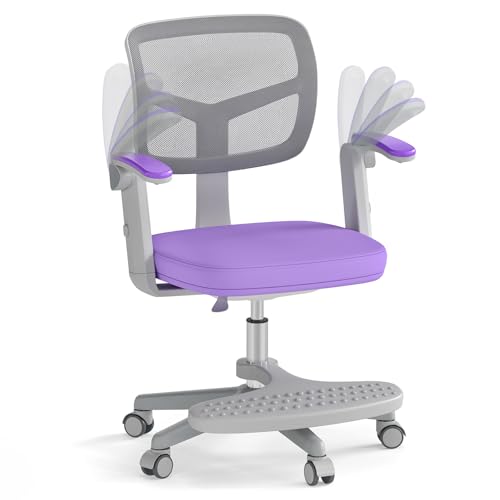
2. HONEY JOY Kids Desk Chair — Best Adjustable Features
Where the VIVO adjusts one thing well, the HONEY JOY adjusts nearly everything: seat height, armrest height and a footrest, wrapped in a breathable mesh swivel chair. For a seven-year-old whose feet do not yet reach the floor at desk height — which is most seven-year-olds — the footrest is not a luxury; it is the piece that makes correct posture physically possible.
Strengths
- Adjustable footrest solves the dangling-feet problem at desk height
- Height-adjustable armrests keep shoulders relaxed at the desk
- Breathable mesh back suits warm rooms and long homework sessions
Trade-offs
- More adjustments mean more knobs for a child to fiddle with
- Mesh and mechanisms make it the most complex chair here to keep clean
- Wheeled swivel base needs a calm sitter or a rug to stay put
| Type | Kids mesh study chair, swivel |
| Adjustments | Height, armrests, footrest |
| Back | Mesh |
| Base | Rolling casters |
Posture advice for children usually fails on a physical technicality: you cannot ask a child to sit with feet supported when the chair that fits the desk leaves their feet swinging six inches off the floor. The footrest on this chair closes that gap, and because it adjusts, it keeps closing it as legs grow. The adjustable armrests matter for the same reason — at the right height they let shoulders drop while forearms rest level with the desk; at the wrong height they are worse than none, so the adjustability is the feature. The mesh back is the warm-climate choice and the honest trade: it breathes, and it also collects dust and crayon in its weave, and a seven-year-old will treat the swivel as a ride unless the household sets the rule early. For a child who will use one chair from seven to eleven, this is the most future-proof pick in the roundup.
The footrest deserves one more word, because it is the feature parents most often undervalue at purchase and most value a month later. Homework resistance in seven-year-olds is frequently discomfort in disguise: a child whose feet swing and whose shoulders ache is a child who finds reasons to leave the desk. Remove the discomfort and a surprising share of the negotiation goes with it.
Best for: growing children at a fixed-height desk, warm rooms / Not suited for: children who will spin and roll instead of sitting
Check on Amazon: HONEY JOY Kids Desk Chair — check the current price on Amazon.

3. Costzon Kids Desk Chair — Best with Sit-Brake Casters
Costzon solved the rolling-chair problem with engineering rather than rules: its sit-brake casters resist rolling while the chair is occupied, so the chair behaves like a fixed chair during homework and rolls only when the child stands and pushes it. Add height adjustment, armrests and a mesh back, and it is the pragmatic parent’s pick.
Strengths
- Sit-brake casters stop the chair wandering while occupied
- Height adjustment and armrests cover the fit essentials
- Mesh back and padded seat balance comfort with cleanability
Trade-offs
- Brakes engage by weight, so a very light child should test the feel
- Rolling base still needs floor protection on delicate wood
- Design is functional rather than decorative
| Type | Kids study chair, swivel |
| Casters | Sit-brake (lock when seated) |
| Adjustments | Height, armrests |
| Back | Mesh with padded seat |
Every parent who has bought a wheeled chair for a seven-year-old has watched the same film: the chair becomes a vehicle, homework becomes a commute, and someone eventually meets a wall. Sit-brake casters change the physics of that film — the chair rolls freely when pushed empty (so the child can move it and clean under the desk) and settles when sat in. It is the single most parent-relevant feature in this roundup. The rest of the chair is competently mainstream: mesh ventilation, a padded seat for longer sits, armrests at a sensible fixed relationship to the adjusted height. It lacks the HONEY JOY’s footrest, so pair it with a small footstool or a box of the right height if your child’s feet dangle at the desk setting — the guide below explains how to check. For hard floors and lively children, this is the chair we would buy first.
On the sit-brake mechanism: the brakes release when the child stands, which means the chair can still be pushed aside for cleaning and floor play — it is not a fixed chair in disguise. Teach the child that distinction in the first day and the chair keeps both personalities: furniture when sat in, movable when not.
Best for: lively seven-year-olds on hard floors / Not suited for: very light children or homes wanting a footrest built in
Check on Amazon: Costzon Kids Desk Chair — check the current price on Amazon.

4. Primy Kids Desk Chair (Pink) — Best Colour and Style Choice
Plenty of seven-year-olds have strong opinions about their room, and a chair they chose is a chair they will sit in. The Primy delivers the full study-chair formula — height adjustment, swivel mesh back, padded seat — in a pink finish that is a genuine colour choice rather than a licensed-character print the child will outgrow by eight.
Strengths
- Real study-chair function in a colour children actually pick
- Height range covers the 4-to-12 growth span the desk years demand
- Mesh back keeps the chair light and breathable
Trade-offs
- Light colour shows pen, paint and snack evidence faster
- Swivel-and-wheels base has no brake; expect some touring
- One-colour commitment in a room that may be redecorated
| Type | Kids study chair, swivel |
| Ages (maker) | 4-12 |
| Adjustments | Height |
| Finish | Pink |
It would be easy to dismiss a colour-led pick, and wrong. The functional core here is the same as the neutral chairs — adjustable height across the primary-school years, a breathable mesh back, a padded seat — and the colour is doing real work: children take ownership of objects they chose, and a homework chair that feels like theirs gets used with less negotiation. The honest costs are maintenance and taste half-life. Pink mesh shows marks that grey mesh hides, so budget a fabric-cleaner habit; and a colour chosen at seven may be renegotiated at ten, though the chair’s price tier makes that a softer problem than it would be with furniture. If your child’s room scheme is the deciding factor in your house, this pick lets you say yes without buying a worse chair — which is the only basis on which style should ever win.
Care note for the pink finish: mesh cleans well with a vacuum brush and a damp cloth with mild soap, and marks come out far better treated the same day. If the chair will live where art happens, a washable throw over the seat during painting sessions preserves both the chair and everyone’s temper — prevention is cheaper than the second chair.
Best for: children who want a say in their room, gift purchases / Not suited for: mud-and-marker households wanting a hide-everything finish
Check on Amazon: Primy Kids Desk Chair (Pink) — check the current price on Amazon.

5. Giantex Kids Desk Chair — Best Armless for Small Spaces
Armless is a feature when the desk is small: the Giantex slides completely under the desktop, freeing floor space in a small bedroom and letting the child sit close to the work without armrests colliding with the desk edge. It keeps the essentials — height adjustment, lumbar-shaped mesh back, swivel — and drops everything else.
Strengths
- Armless design tucks fully under the desk and suits close-in work
- Height adjustment with lumbar-supporting back shape
- Light and simple; easy to move between rooms and tasks
Trade-offs
- No armrests for children who lean and lounge while reading
- No footrest; pair with a foot support if feet dangle
- Minimal padding for very long sits
| Type | Kids task chair, armless |
| Adjustments | Height |
| Back | Mesh with lumbar support |
| Base | Swivel, casters |
Small bedrooms are the reality behind many chair purchases, and in a small room a chair that cannot park under the desk is a chair that lives in the middle of the floor. The Giantex’s armless profile is the tidiest here, and its back is shaped to give a child’s lower back something to rest against rather than a flat board. The compromises follow from the brief: no armrests means no leaning perch for long reading sessions, and the seat padding is adequate for homework rather than luxurious for an afternoon. As a second chair — the homework station in a shared room, the desk in a corner of the parents’ study — it is often the smartest money in the list. Measure your desk’s knee-hole height before buying any chair, but especially this one: its whole advantage depends on sliding home underneath.
The armless profile has one more advantage in shared rooms: it can be borrowed. An armless chair slides up to a dining table or a sibling’s desk without the armrest-height clash that makes armed chairs guests at some tables and exiles at others. In a household with one good kids’ chair and several places it is needed, that versatility is quietly decisive.
Best for: small bedrooms, shared study corners, second desks / Not suited for: long reading sessions or children who need armrests
Check on Amazon: Giantex Kids Desk Chair — check the current price on Amazon.

6. Delta Children MySize Chair Desk with Storage Bin (Navy) — Best All-in-One for Younger Sevens
Not every seven-year-old does homework at a desk; some draw, build and do worksheets wherever they land. Delta Children’s MySize Chair Desk is a single unit — seat, attached desk surface, storage bin underneath — from a brand that specialises in children’s furniture and certifies this line to GREENGUARD Gold. It is the pick for the play end of seven, and we label its limits clearly.
Strengths
- Chair, desk surface and storage in one movable unit
- GREENGUARD Gold certified, from a children’s-furniture specialist
- No separate desk needed; works in any corner of any room
Trade-offs
- Fixed size: it does not grow with the child like the adjustable chairs
- Attached surface suits drawing and short tasks, not full homework spreads
- A child at the tall end of seven may already be near its comfort limit
| Type | Chair desk with storage bin |
| Certification | GREENGUARD Gold |
| Brand | Delta Children |
| Colour shown | Navy |
Read this pick as a different category wearing the same keyword. The five chairs above serve a desk; this unit replaces the desk for the years when a child’s work is drawing, early writing and short tasks, and when the “study space” is wherever the family is. The storage bin swallows the crayons and paper that otherwise colonise the floor, and the whole thing can be carried to another room by a parent in one hand. Its ceiling is equally clear: it does not adjust, so it is a two-or-three-year piece rather than a seven-to-eleven piece, and a tall seven-year-old or a child already doing sustained homework belongs in the adjustable chairs above. Bought with those expectations — often for a younger sibling who will inherit it — it is excellent value and genuinely loved by its users. Bought as a homework station for a big seven-year-old, it will be outgrown before the school year ends.
For the hand-down calculation: GREENGUARD Gold certification speaks to low chemical emissions, which matters most for the youngest users — a younger sibling inheriting this unit at three or four is exactly the scenario the certification is for. The navy finish also hands down neutrally, which is more than can be said for most character-themed equivalents.
Best for: younger or smaller seven-year-olds, play-and-draw work / Not suited for: tall seven-year-olds or sustained homework at a real desk
Check on Amazon: Delta Children MySize Chair Desk with Storage Bin (Navy) — check the current price on Amazon.
Comparison Table
| Pick | Badge | Key spec | Best for |
|---|---|---|---|
| VIVO Children’s Height Adjustable Desk Chair (DESK-V201G-CH) | Best Overall | Kids desk/study chair | the main homework desk, ages roughly 6 to 10 |
| HONEY JOY Kids Desk Chair | Best Adjustable Features | Kids mesh study chair, swivel | growing children at a fixed-height desk, warm rooms |
| Costzon Kids Desk Chair | Best with Sit-Brake Casters | Kids study chair, swivel | lively seven-year-olds on hard floors |
| Primy Kids Desk Chair (Pink) | Best Colour and Style Choice | Kids study chair, swivel | children who want a say in their room, gift purchases |
| Giantex Kids Desk Chair | Best Armless for Small Spaces | Kids task chair, armless | small bedrooms, shared study corners, second desks |
| Delta Children MySize Chair Desk with Storage Bin (Navy) | Best All-in-One for Younger Sevens | Chair desk with storage bin | younger or smaller seven-year-olds, play-and-draw work |
How to Choose a Chair for a 7 Year Old
Measure three things before you buy anything: your child’s popliteal height (floor to the back of the knee, seated), the desk’s underside height, and the floor the chair will live on. Those three numbers decide almost everything below.
Seat height and the feet question
The seat should sit at or slightly below your child’s popliteal height so feet rest flat with knees near ninety degrees. At a standard desk, that usually means the seat must be higher than the child’s legs are long — which is exactly why footrests exist. If the chair’s lowest comfortable desk setting leaves feet dangling more than an inch or two, choose a chair with an adjustable footrest like the HONEY JOY, or plan a stable foot support under the desk. Dangling feet are not a minor detail: they pull a child into a slouch within minutes, and no amount of reminding fixes physics.
Seat depth and back support
Seat depth should leave a small gap — two or three finger-widths — between the seat edge and the back of the child’s knees when their back is against the backrest. Adult-depth seats force a choice between dangling legs and a slumped back. A shaped backrest that meets the lower back is worth more than thick padding; children sit light, and support is about shape, not softness.
Wheels, brakes and floors
On hard floors, an unbraked wheeled chair will travel — choose sit-brake casters, a rug under the desk zone, or a fixed chair. On carpet, wheels matter less and a swivel is mostly harmless fun. Whatever the base, protect wood floors with a mat or choose casters described as floor-safe, and check the desk’s knee-hole: an armless chair like the Giantex parks underneath and returns the room’s floor space every evening.
Growth range and the honest window
An adjustable chair bought at seven should serve to ten or eleven; check that the top of its height range and its weight capacity leave headroom, because children grow in sudden inches. Fixed chairs and chair-desks are legitimate purchases with shorter windows — price them as two-to-three-year pieces and plan the hand-down or the replacement.
Wood, mesh or padded: the cleanability question
Seven-year-olds do homework with snacks, glue and felt-tips, and the chair will meet all three. Mesh vacuums clean and forgives crumbs; padded vinyl or fabric seats wipe clean if treated promptly; wooden chairs shrug off everything but offer the least comfort for long sits. Choose the surface for the child you actually have: the art-heavy household should weight cleanability as heavily as ergonomics, because a chair that looks grubby by half-term is a chair the child starts avoiding.
Weight capacity and build: buy headroom
Check the stated weight capacity and treat it as a growth budget, not a challenge. A chair near its limit flexes, creaks and wears its lift mechanism early; a chair with generous headroom feels solid for years. The same applies to the base: a five-point base with a wide stance resists the sideways lean-and-reach that tips lesser chairs, and it is worth more than any styling. If two chairs tie on fit, buy the one with the stronger stated capacity.
Where the chair will actually live
A homework chair in the child’s bedroom competes with toys and a bed; a chair in a family study competes with nothing and gets used under supervision. Bedroom chairs benefit from the space-saving and brake features; study chairs can be simpler. Also consider siblings: a chair that will be inherited should be a neutral colour and the most durable build you can justify, while a chair bought for one child’s room can follow that child’s taste — the Primy exists for exactly that logic.
Second-hand and hand-me-down chairs: a fair warning
Children’s chairs circulate between families, and a sound used chair can be a bargain — but inspect the lift and casters before accepting one. A gas lift that sinks under weight is finished, whatever the fabric looks like, and worn casters that no longer roll straight make a chair drag and mark floors. Check the stated age range on the original listing where you can; a chair designed for toddlers being passed to a seven-year-old is the wrong tool however free it was. The picks in this guide are inexpensive enough that a new, correctly-sized chair is often the better economics once a replacement lift or caster set is priced in.
Setting Up a Seven-Year-Old’s Desk Station Properly
The chair is half the station; the desk relationship is the other half. Set it up once, properly, in this order. First, set the chair height so the feet are supported — flat on the floor or on the footrest — with knees near a right angle. Second, check the desk against the seated child: forearms should rest on the desktop with shoulders relaxed, not hiked toward the ears. If the desk is too high for that, raise the chair and add foot support; if too low, the desk, not the child, is the problem, and risers under desk legs are a legitimate fix.
Light matters as much as furniture. A desk lamp on the opposite side to the writing hand prevents the child’s own shadow falling on the page, and it is a cheaper posture fix than any chair, because children lean toward what they can see. Keep the chair’s zone defined — a small rug under the desk area both protects the floor and gives the chair’s casters a boundary that lively sitters respect without being told.
Finally, revisit the setup every school term. Children grow in spurts, and a station fitted in September can be quietly wrong by February: feet that reached now dangle differently, the desk sits at a new relative height. Two minutes with the adjustment lever each term is the entire maintenance schedule of a good adjustable chair, and it is what the adjustability is for.
One caution on posture claims, in the spirit of this guide’s honesty: no chair makes a child sit well by itself, and none of these picks is a medical device. What a well-fitted chair does is remove the physical obstacles to sitting comfortably — dangling feet, a seat that swallows the child, a desk relationship that forces a hunch. Children still fidget, perch and sprawl, and that movement is normal and healthy; the goal of the station is comfortable work in reasonable positions, not a frozen ideal posture held for an hour.
Siblings and sharing deserve a mention, because the desk station rarely belongs to one child for long. If two children of different sizes share a station, the adjustable chair earns its cost twice over — but only if resetting it is effortless, which is why the tape-mark trick in the how-to matters. Households that mark both children’s settings on the column find the station actually gets refitted; households that rely on memory find the smaller child quietly using the bigger child’s setup, feet swinging, all year.
The station also has a social dimension worth one paragraph. A seven-year-old’s desk is often where a parent sits alongside for reading and homework support, which means the station needs a second place to sit — a stool, the edge of the bed, a parent chair pulled up. Stations that only work for one person get abandoned for the kitchen table, where the light is worse and the distractions are better. If the homework keeps migrating, look at the station’s seating for two before blaming the child’s chair.
How to Fit and Adjust the Chair When It Arrives
- Assemble on the floor it will live on, and check every caster and the lift mechanism before the first sit; a chair that wobbles on day one has a loose fitting, not a settling-in period.
- Set height by the feet, not by eye. Seat the child, adjust until feet are flat or fully on the footrest, then check the desk relationship and fine-tune.
- Set the footrest (where fitted) so the whole foot rests on it with the knee near ninety degrees; a footrest used as a toe perch does nothing.
- Set armrests (where adjustable) to just support the forearms with shoulders down; if the child shrugs to use them, lower them or treat the chair as armless.
- Agree the wheels rule on day one. Chairs are for sitting; the brake-caster pick enforces it mechanically, the others need the household rule while habits form.
- Mark the settings. A small tape mark on the lift column at the correct height lets the chair be restored in seconds after a sibling or a cleaning session changes it.
Cleaning is part of ownership: mesh backs vacuum clean with a brush attachment, padded seats spot-clean best the day the spill happens, and caster axles collect hair and thread that a monthly pick-out keeps from becoming a drag. Teach the child the caster clean-out as a job of their own — seven is old enough, and a chair they maintain is a chair they treat better.
Problem: the chair slowly sinks during the week → the lift is being sat on at an angle or a younger sibling is using it as a pogo stick; reset the height, check the tape mark, and restate the rule. Problem: casters leave the rug and roam → the rug is too small for the desk zone; size the rug to the chair’s working circle, not to the desk’s footprint. Problem: the child perches on the front edge regardless → the seat is probably too deep for them yet; a small cushion behind the back effectively shortens the seat until they grow into it.
After the first month, do one deliberate refit: children adapt to a slightly wrong setup without complaint, and the month-one check catches the settings that were guesses on day one. Watch the child work for five minutes — where do the feet go, do the shoulders rise, does the child sit on the back edge or the front — and adjust to the child you observe, not the one you measured.
Common Buying Mistakes
- Buying an adult chair “to grow into”. An adult chair’s lowest setting is still adult: feet dangle, the seat is too deep, and the child slumps for years before growing into it. Buy the child-scaled chair now; it is the one that fits the child you have.
- Buying a fixed chair at the top of its size. A fixed chair that fits perfectly today is outgrown on the next growth spurt. Fixed chairs should be bought with room, or bought knowing their window is short.
- Ignoring the desk. The perfect chair at the wrong desk is still a bad station. Measure the desk first; the pair is the product.
- Choosing character over fit. A licensed-character chair with no adjustment is outgrown in size and in taste within a couple of years. If character matters, put it in the accessories, not the furniture.
- Forgetting the floor. Unbraked casters on wood mean a travelling chair and a marked floor. Decide the floor strategy — brakes, rug or mat — at purchase, not after the first scratch.
- Setting the chair once and never again. The adjustment exists to be used. A chair fitted at seven and untouched until nine has been the wrong size for most of its life; the termly two-minute check is the whole point of buying adjustable.
- Letting the chair double as a scooter. Beyond the safety point, riding a chair wrecks casters and lift columns designed for static loads. If the household cannot hold that line, the brake-caster pick or a fixed chair is the honest purchase.
- Judging by the showroom sit. A chair that feels fun for thirty seconds of spinning tells you nothing about forty minutes of homework; judge by fit measurements and adjustment range, which predict the fortieth minute far better than the first impression.
- Forgetting a lamp. Children lean toward light; a dim desk undoes a good chair’s work entirely.
Final Recommendation
Buy the VIVO desk chair for the benchmark homework station, the HONEY JOY if dangling feet are your child’s reality, and the Costzon if the sitter is lively and the floor is hard. The Primy wins on colour without losing function, the Giantex on space, and the Delta chair-desk for the younger, play-first seven. Measure the desk, set the chair by the feet, and revisit the fit each term. Fit is not a one-time event but a habit the chair makes easy; buy the chair that makes the habit easiest in your house, and the homework battles shrink to the work itself.
Related guides in this series: Best Area Rugs For Childrens Bedrooms · Best Carpet For Under Desk Chairs · Best Children Quilts · Best Bathtubs For Children
Related guides
Frequently Asked Questions
What seat height does a 7 year old need?
It depends on the child, not the birthday: the seat should be at or just below the height of the back of the knee when seated, so feet rest flat. Many seven-year-olds need a seat in the mid-teens of inches with a footrest at a standard desk. Measure your child seated, and choose a chair whose range covers that number with room to grow.
Is a wheeled swivel chair a good idea at seven?
It can be, with the right controls. Sit-brake casters that lock under the child’s weight solve most of the mischief, a rug defines the chair’s territory, and a clear household rule handles the rest. For a very lively child on hard floors, a fixed chair or the brake-caster pick is the calmer purchase.
How long will an adjustable kids’ desk chair last?
A child-scaled adjustable chair bought at seven typically serves to ten or eleven, when an adult small-frame chair takes over. The limit is usually seat size and weight capacity rather than the lift, so check those numbers have headroom when you buy.
Does my child need armrests?
Not necessarily. Armrests help if they are at the right height — forearms supported, shoulders relaxed — and hinder if they are too high or stop the chair tucking under the desk. Adjustable armrests are the safe version of the feature; a good armless chair beats a bad-armed one.
Chair desk or separate desk and chair?
A chair desk suits the younger end of seven — drawing, early writing, short tasks, and rooms without space for a desk. Sustained homework, books and a lamp need a real desk with a separate adjustable chair. Many families use the chair desk at six or seven and graduate to the desk station at eight.
What if my child’s feet dangle at the desk?
Add support: a chair with an adjustable footrest, or a stable box, step or footstool under the desk. Supported feet are the foundation of an upright sit; without them a child will slouch, perch on the seat edge or wrap their legs around the chair base, whatever chair you buy.
What colour or style should I choose?
Let the child choose within a shortlist you have already vetted for fit — ownership improves use, and every pick in this guide passed the fit test before colour was considered. In shared or inherited scenarios, choose the neutral finish; in a one-child room, the colour the child picks is a feature, not a compromise.


