Disclosure: airfryerkitchensupply.com is reader-supported. When you buy through links on our site, we may earn an affiliate commission at no extra cost to you.
Where to buy
Every linked pick in this guide to the best bathtubs for children was verified against Amazon’s catalog on 2026-11-22, so the model names below are the models you will actually land on. Start with Ingenuity Tuckaway Toddler Folding Tub, MoreFeel Collapsible Baby Bathtub, BUNWAG Collapsible Baby Bathtub. Any pick described in prose without a link could not be pinned to a single verified listing, and it is flagged honestly rather than dressed up with a guessed link. Check the current price on Amazon from any pick’s link, because colors, sizes and bundle contents rotate often.
The best bathtubs for children are, in practice, mostly tubs for babies and toddlers — and it is worth saying that plainly at the start, because the market’s naming will not. Once a child can sit in the family bath safely, a separate tub stops being necessary for most households; the years where a dedicated children’s tub earns its place are the years when the big bath is too deep, too slippery and too wasteful of water for a small body. Every pick below is an infant-to-toddler tub, verified, and the guide is honest about which ages each one truly serves.
Within that honest frame, the designs split usefully. Collapsible tubs fold flat for small bathrooms and travel. Contoured tubs with slings and cushions support newborns who cannot sit. Roomier toddler tubs convert a shower stall into a bath or give a preschooler space to splash without filling the whole family tub. The right choice depends on the child’s age today, the bathroom you actually have, and whether this tub must also survive a younger sibling later.
Safety framing runs through everything below: a children’s tub is a bathing aid used with an adult present and within arm’s reach, never a babysitter, and the how-to section covers the water-depth and temperature discipline that matters more than any product feature. No prices are printed — check price on Amazon from each link — and no pick here claims anything beyond bathing comfort and practicality.
In this guide
Quick Picks
Six models made the cut for this guide to the best bathtubs for children. Each carries its own badge, and the same badge follows it into the full review below so you can track a recommendation from summary to verdict.
- Best Overall — Ingenuity Tuckaway Toddler Folding Tub: The household default for the toddler years: roomy in use, flat in storage, and able to turn a shower stall into a bath. Key spec: Folds flat to store, converts a shower to a tub, no assembly per listing.
- Best for Newborns — MoreFeel Collapsible Baby Bathtub: A newborn-ready bundle: cushioned support and a water thermometer in the box, folding down when bath time ends. Key spec: Collapsible tub with thermometer, hooded towel and soft floating cushion per listing.
- Best with Thermometer Sensing — BUNWAG Collapsible Baby Bathtub: A collapsible all-stager with a soft cushion for the early months and no-slip feet for the wiggly ones. Key spec: Collapsible newborn-to-toddler tub with soft cushion and thermometer, no-slip feet per listing.
- Best for Travel — AVIDOR Collapsible Baby Bathtub: The travel-ready pick: a soft bath net for newborns and a folding basin that packs into a suitcase or a grandparent’s closet. Key spec: Collapsible newborn-to-toddler tub with soft bath net, portable travel design per listing.
- Best Drain Design — Orzbow Travel Toddler Bathtub: A sit-up-stage tub with a side drain plug — empty it without lifting a heavy, sloshing basin. Key spec: Portable collapsible tub for 6 months+, side drain plug, stable and foldable per listing.
- Best Convertible — CheerTry 4-in-1 Collapsible Baby Bathtub: The stage-by-stage convertible: sling for newborns, supported recline, then an open basin — four configurations in one tub. Key spec: 4-in-1 collapsible tub for 0–24 months with adjustable sling, T-shaped support and thermometer per listing.
How These Picks Were Chosen
Picks were chosen on fit to real children’s bathing stages: newborn support (sling, cushion or contoured recline), sit-up toddler space, and older-toddler room to move. Bathroom fit was scored equally — folded size for small homes, whether the tub works inside a family bath or converts a shower, and how it drains and dries, because a tub that stays damp becomes a cleaning chore parents quietly abandon.
Excluded: bath toys, seats and cushions sold as accessories rather than tubs, and any design whose listing could not confirm dimensions or age fit. Two well-known rigid European-style tubs could not be pinned to a single verified listing at review time, so the six linked picks are all complete, orderable tubs; the buying guide explains what to look for if you shop beyond this list.
The 6 Best Bathtubs for Children

Ingenuity Tuckaway Toddler Folding Tub — Best Overall
This suits families whose child has outgrown the newborn sling stage and now sits, splashes and plays — and whose bathroom has no spare corner for a rigid tub. It is the pick for shower-only bathrooms, where it creates a bath where none exists.
Strengths
- Folds away flat between baths
- Converts a shower stall into a toddler bath
- No assembly — unfold and use
Trade-offs
- Less newborn support than sling designs
- Toddler-sized — big preschoolers outgrow it
- Must be dried before folding away for storage
| Spec | Detail |
|---|---|
| Form | Folding toddler tub |
| Storage | Folds flat per listing |
| Use | In shower or on bathroom floor |
The Tuckaway answers the two questions that decide toddler bathing in real homes: where does the child bathe, and where does the tub live the other twenty-three hours? Its folding design is not a gimmick — in a small bathroom, a rigid tub colonizes the shower or the closet permanently, while this one hangs or slides away. In use it is a sensible toddler basin: enough room to sit and play, low enough sides for a parent kneeling beside it. Its honest limit is the newborn stage; without a sling or contoured recline, very young babies are better served by the supported designs below, which is why families expecting to start from birth often buy the convertible picks instead.
Best for: Toddlers in small or shower-only bathrooms / Not suited for: Newborns who still need sling support
Check on Amazon — check price on Amazon for the current configuration.

MoreFeel Collapsible Baby Bathtub — Best for Newborns
This suits first-time parents starting from day one who want the support accessories handled rather than researched. The floating cushion cradles a newborn, and the thermometer takes the guesswork out of water temperature during the weeks when everything is new.
Strengths
- Cushion supports newborns who cannot sit
- Thermometer included for water checks
- Folds down for storage and travel
Trade-offs
- Bundle pieces outgrow at different rates
- Cushion needs thorough drying after use
- Collapsible joints need a rinse-and-dry habit
| Spec | Detail |
|---|---|
| Form | Collapsible baby tub |
| Included | Thermometer, hooded towel, floating cushion |
| Stage | Newborn to toddler |
Newborn bathing is mostly about support and temperature, and the MoreFeel bundle is built around exactly those two anxieties. The cushion holds a small baby at a reclined angle so both parental hands stay free for washing — the real safety feature of any newborn tub is the adult’s free hands. The thermometer earns its place for the first months, after which the elbow test most parents graduate to works fine. As the child sits, the cushion retires and the tub continues as a toddler basin, which is the correct lifecycle: judge this pick as a newborn system that becomes a plain good tub, not as a bundle you will use whole for two years.
Best for: Newborns and first-time parents wanting support included / Not suited for: Families who prefer a rigid, single-piece tub
Check on Amazon — check price on Amazon for the current configuration.

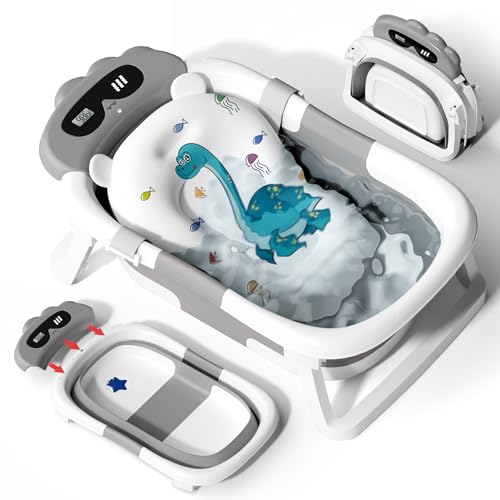
BUNWAG Collapsible Baby Bathtub — Best with Thermometer Sensing
This suits parents who want one tub from newborn through toddler without a bundle of extras — the cushion covers the reclined stage, and the base tub with its no-slip feet covers the sitting and splashing stage.
Strengths
- One tub spans newborn to toddler
- Soft cushion included for early support
- No-slip feet steady it in the big bath or shower
Trade-offs
- Cushion stage is brief for fast growers
- Folding design needs drying before storage
- Mid-size basin — not the roomiest for tall toddlers
| Spec | Detail |
|---|---|
| Form | Collapsible, newborn to toddler |
| Support | Soft cushion included |
| Base | No-slip feet per listing |
The BUNWAG is the pragmatic middle of this list: no bundle to manage, no single-stage limitation. Its thermometer and cushion handle the newborn checklist, and its steadiness handles the toddler reality, which is a wet, moving child in a wet, smooth environment. Placed inside the family bath or a shower tray, the no-slip feet matter more than any aesthetic feature. Ownership is simple: rinse, shake out, hang or stand it to dry fully before folding. Families in humid bathrooms should be honest about that drying step — every collapsible tub on this page rewards the habit and punishes its absence with musty folds.
Best for: One-tub households from newborn through toddler / Not suited for: Parents wanting the largest possible toddler basin
Check on Amazon — check price on Amazon for the current configuration.
AVIDOR Collapsible Baby Bathtub — Best for Travel
This suits families who bathe a baby in more than one home — travel, grandparents, a second bathroom — and anyone whose storage is a single closet shelf. The bath net gives newborns a hammock-style support that packs to nothing.
Strengths
- Packs flat for travel and visits
- Bath net supports the newborn stage
- Works as the home tub and the away tub
Trade-offs
- Net support suits smaller newborns best
- Travel weight still adds up in a suitcase
- Basin size is a compromise for long toddlers
| Spec | Detail |
|---|---|
| Form | Collapsible, portable |
| Support | Soft bath net included |
| Stage | Newborn to toddler |
A dedicated travel tub sounds like a luxury until a family tries bathing a three-month-old in a hotel sink or a strange shower. The AVIDOR makes the familiar portable: same basin, same net, same routine, wherever the night is spent, and babies are creatures of routine even at bath time. At home it is a perfectly good collapsible tub; its distinction is that it is also the one you throw in the car without a second thought. The net is its newborn answer — soft, hammock-like, and quick-drying, which suits travel better than a bulky foam cushion. Long toddlers will test its length sooner than the roomiest picks; that is the honest price of packability.
Best for: Traveling families and grandparents’ houses / Not suited for: Maximum toddler legroom at home
Check on Amazon — check price on Amazon for the current configuration.

Orzbow Travel Toddler Bathtub — Best Drain Design
This suits parents of sitting babies and toddlers who are tired of hoisting a full tub to the drain, and anyone bathing a child on the bathroom floor or in a shower where lifting is awkward.
Strengths
- Side drain plug empties it in place
- Stable base for the wiggly sitting stage
- Folds for storage and travel
Trade-offs
- Starts at the sitting stage — not for newborns
- Drain plug is a part to keep track of and check
- Smaller than the biggest toddler basins
| Spec | Detail |
|---|---|
| Form | Collapsible toddler tub |
| Drain | Side drain plug per listing |
| Stage | 6 months and up per listing |
Water is heavy, and a full toddler tub weighs more than many parents should be lifting out of a bath one-handed while holding a wet child with the other. The Orzbow’s side drain is the kind of unglamorous feature that decides whether a tub gets used happily for a year: position it over or near the drain, pull the plug, and the heavy work disappears. It starts at the sitting stage by design — no sling, no recline — so it is a second tub for families who began with a newborn system, or a first tub bought at six months. Check the plug’s seal in your routine cleaning; drain plugs are the one moving part in this category and the one that rewards a monthly glance.
Best for: Sitting babies and toddlers; parents avoiding heavy lifting / Not suited for: Newborn bathing
Check on Amazon — check price on Amazon for the current configuration.
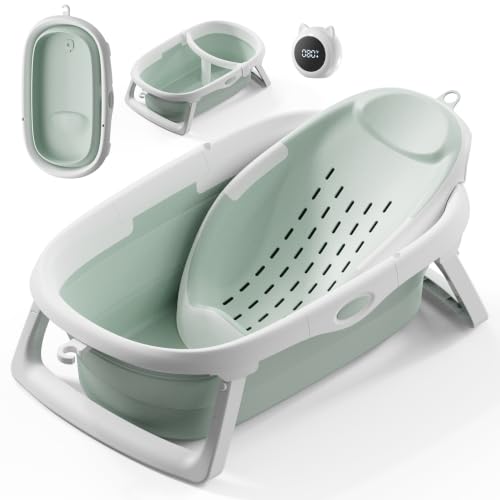
CheerTry 4-in-1 Collapsible Baby Bathtub — Best Convertible
This suits parents who like systems: one purchase whose support pieces reconfigure as the child grows through the first two years, with a thermometer built into the routine from the start.
Strengths
- Adjustable sling adapts to growth stages
- T-shaped support for the in-between months
- Thermometer included for temperature checks
Trade-offs
- Most parts of any pick here — keep track of pieces
- Configuration changes take a minute to learn
- 24-month ceiling ends the toddler run earlier
| Spec | Detail |
|---|---|
| Form | 4-in-1 collapsible |
| Support | Adjustable sling, T-shaped support |
| Stage | 0–24 months per listing |
The awkward months of baby bathing are the in-between ones — too big for the newborn sling, not yet sitting steadily — and the CheerTry’s T-shaped support exists for exactly that gap, which is why it earns the convertible badge. The discipline it asks in return is parts management: sling, support and plug need a home, ideally a mesh bag hung with the tub, or the system quietly becomes a plain basin by month eight. Its stated ceiling of 24 months is honest and worth respecting in your planning; tall toddlers will move to the family bath or a roomier toddler tub sooner. For the first two years, though, it is the most thought-through staging on this page.
Best for: Parents wanting one staged system for the first two years / Not suited for: Anyone who loses small parts or needs a tub past age two
Check on Amazon — check price on Amazon for the current configuration.
Comparison Table
The table below compresses the six picks into the four facts that decide most purchases of best bathtubs for children: the badge, the verified headline spec, and the job each model does best. Read it alongside the full reviews, because the spec column never tells the whole story — ownership effort, sizing and fit live in the review text.
| Pick | Badge | Key spec | Best for |
|---|---|---|---|
| Ingenuity Tuckaway Toddler Folding Tub | Best Overall | Folds flat to store, converts a shower to a tub, no assembly per listing | Toddlers in small or shower-only bathrooms |
| MoreFeel Collapsible Baby Bathtub | Best for Newborns | Collapsible tub with thermometer, hooded towel and soft floating cushion per listing | Newborns and first-time parents wanting support included |
| BUNWAG Collapsible Baby Bathtub | Best with Thermometer Sensing | Collapsible newborn-to-toddler tub with soft cushion and thermometer, no-slip feet per listing | One-tub households from newborn through toddler |
| AVIDOR Collapsible Baby Bathtub | Best for Travel | Collapsible newborn-to-toddler tub with soft bath net, portable travel design per listing | Traveling families and grandparents’ houses |
| Orzbow Travel Toddler Bathtub | Best Drain Design | Portable collapsible tub for 6 months+, side drain plug, stable and foldable per listing | Sitting babies and toddlers; parents avoiding heavy lifting |
| CheerTry 4-in-1 Collapsible Baby Bathtub | Best Convertible | 4-in-1 collapsible tub for 0–24 months with adjustable sling, T-shaped support and thermometer per listing | Parents wanting one staged system for the first two years |
How to Choose Bathtubs for Children
Match the tub to the stage your child is in now
Children’s tubs fail by stage, not by quality. A newborn needs reclined support that keeps the head up and frees the adult’s hands. A baby in the in-between months needs supported sitting. A toddler needs room, stability and a parent-manageable way to empty the water. Buy for the stage arriving in the next three months, and be suspicious of any single product promising perfection from birth to age four — the convertible picks handle stages by reconfiguring, which is the honest way to span them.
Also plan the handover: most children graduate to the family bath — with a non-slip mat and an adult present — somewhere in the preschool years. A tub bought at age two should be judged on a one-to-two-year service life, not a decade.
Where the tub will live: bathroom fit and storage
Measure two spaces before buying: the space the tub occupies open — inside your family bath, shower tray or on the floor — and the space it occupies stored. Rigid tubs are simpler and dry fastest but demand a permanent home; collapsible designs trade a drying habit for a closet shelf. In shower-only homes, confirm the tub’s footprint against the shower tray, not the bathroom floor area, since the tray is where it will actually sit.
Drainage decides daily happiness. A tub used inside the family bath empties by tipping; a tub on the floor or in a shower needs a drain plug or a strong back. The Orzbow’s side drain is the extreme of a spectrum every buyer should think about: how, exactly, does this water leave, every night, when you are holding a wet toddler?
Materials, cleaning and the drying habit
Every tub in this category is a wet object stored in a humid room, which makes the cleaning routine a product feature whether the listing says so or not. Smooth, single-surface basins rinse and wipe fastest. Cushions, nets and slings add newborn support and add drying obligations — they should be rinsed, shaken and hung after use, and checked regularly. Collapsible folds need the tub stored fully dry, or the folds hold moisture.
Keep cleaning simple and product-safe: warm water, a soft cloth, and the maker’s guidance. Harsh chemicals have no place on a surface a baby’s skin contacts for a whole bath. Inspect drain plugs, fold seams and cushion stitching monthly; a tub is a simple object, and a monthly ten-second inspection is its entire maintenance program.
Water, temperature and supervision: the non-negotiables
No tub feature substitutes for the basics. Bath water for babies and young children should be comfortably warm — checked with a thermometer in the early months or a bare elbow or inner wrist — and shallow: a few inches for infants, and only ever what the child can sit in steadily as they grow. The picks with included thermometers exist because new parents deserve one less guess.
Supervision is absolute: an adult within arm’s reach, for the whole bath, every bath. Children can slip silently and quickly, and no tub, seat or cushion changes that. Gather everything — towel, clothes, wash supplies — before the child goes in, so the bath never creates a reason to step away. Treat this section as the actual product review; the six picks above are just the vessels it happens in.
From newborn tub to family bath: planning the transitions
Most families use two bathing arrangements across the early years, and planning for that beats hunting for one mythical birth-to-preschool tub. The first arrangement covers birth to sitting: support, warmth and shallow water. The second covers sitting to independence: room, stability and easy emptying. The convertible picks compress those two arrangements into one purchase by reconfiguring, while the staged approach — a newborn system, then a toddler basin like the Tuckaway or Orzbow — lets each product be simpler and better at its one job.
The final transition, to the family bath, is a skills milestone rather than a purchase: the child sits steadily, follows simple instructions, and treats standing in the tub as not allowed. A non-slip mat, a faucet cover if your child is a lunger, and the same arm’s-reach rule carry the safety story forward. When a younger sibling is expected, store the newborn system dry and complete — the families who bag the sling with the tub are the ones who find a working system, not a basin and a memory, two years later.
How to Bathe a Baby or Toddler in a Children’s Tub
A calm, repeatable routine matters more than any technique: same order, same setup, every bath.
- Set up before the child. Place the tub where it will be used, gather towel, washcloth, mild cleanser, clean clothes and diaper within reach, and close the bathroom door against drafts. Nothing should require leaving the room once the bath starts.
- Fill and check the water. Fill to the depth suited to the child’s stage — a few inches for infants — and check the temperature with the included thermometer or your inner wrist or elbow. It should feel comfortably warm, never hot.
- Support through the whole bath. Lower the child in gradually, keeping a supporting hand on a baby who cannot sit steadily. In sling and cushion tubs, confirm the child is settled before letting your hands move to washing.
- Wash in a simple order. Face first with plain water, then body with a mild cleanser, hair last so the child’s head is wet for the shortest time. Keep the unwashed parts warm by pouring cupfuls of bath water over them.
- Lift out onto the towel. Bring the towel to the tub, lift the child straight onto it, and wrap before carrying anywhere. Wet children are slippery children; the wrap is a grip as much as a comfort.
- Empty, rinse and dry the tub. Drain or tip the water out, rinse the tub and any cushion or net, shake off water, and store the tub only when dry — open or hung — so the next bath starts with a clean, dry vessel.
Common Buying Mistakes
Buying for age four when the child is four months old
Oversized tubs are worse, not safer, for babies: too much room to slide, too much water to manage. Buy the stage you are entering; the toddler tub purchase will be easier for having waited.
Leaving the bath to fetch a forgotten towel
Every accident-prevention rule in this category reduces to presence. The setup step exists so the bath never gives you a reason to step away — do the gathering before the water, every time.
Judging water temperature by the back of your hand
Hands that wash dishes all day are desensitized judges. Use the thermometer included with several picks here, or the inner wrist or elbow, which read warmth honestly.
Storing a collapsible tub while it is still damp
Folded damp plastic in a warm closet is how musty smells are made. The collapsible convenience is real, but it is rented with a drying habit — rinse, shake, air, then fold.
Assuming a bath seat or tub makes bathing hands-free
Tubs and seats are positioning aids used with an adult present and attentive. The moment a product is treated as supervision, it has been misunderstood in the most dangerous direction available.
Final Recommendation
For most families, the Ingenuity Tuckaway is the toddler-years default: roomy in use, invisible in storage. Starting from birth, the MoreFeel bundle and the CheerTry 4-in-1 build the newborn support in, the BUNWAG covers the same span more simply, the AVIDOR travels, and the Orzbow’s side drain saves your back from the sitting stage onward.
Whichever you choose, run the routine in the how-to section exactly as written for the first week. Bath time becomes one of the best parts of the day precisely when it becomes boring in its predictability — for the child and for you.
Keep exploring the cluster: Best Bathtubs For Children Best Blankets For Queen Bed Best Alarm Clocks For College Best Air Purifiers For Wildfire Smoke Best Certified Organic Pillows
Bath Time as the Child Grows: What Changes and What Does Not
The newborn bath is an exercise in support: a small body that cannot hold its own head, water kept shallow and warm, an adult’s hands doing everything. By the sitting stage the job transforms — the child holds themselves up and the bath becomes about stability and space, with the adult’s role shifting from holder to supervisor and entertainer. By the toddler stage the bath is a play session with water in it, and the tub’s job is containment, room to splash, and an exit strategy for several gallons of water that a small person has thoroughly enjoyed. The picks in this guide map onto those stages deliberately, and the families who enjoy bath time most are the ones who notice which stage they are actually in.
What does not change across the stages is the structure around the bath. The setup-before-the-child rule holds at every age. The temperature check holds. The arm’s-reach rule holds longest of all — it relaxes only gradually, over years, as the child’s competence is proven bath by bath, and it is never traded for a product feature. Even the drying habit holds: a toddler tub stored wet is the same musty object as a newborn tub stored wet. The stages change the vessel; the discipline is the constant, and children absorb the routine’s calm as much as its safety.
Expect the transitions to announce themselves. The newborn has outgrown the sling when the bath becomes a wrestling match to keep them in it. The sitter has outgrown the small basin when knees and toys compete for the same water. The toddler is ready for the family bath when sitting steadily, following the simple rules, and asking for the big water. Each graduation is a small milestone worth noticing — and each makes the previous stage’s equipment available to be cleaned, dried, bagged complete, and stored for a sibling or passed to a friend whose stage is just beginning.
Secondhand, Siblings and Storage: The Economics of a Children’s Tub
A children’s tub is one of the best secondhand and hand-me-down objects in the nursery economy: it is a simple, washable, single-purpose item with no sizing mystery and no hidden mechanism. If you accept one from family or friends, the diligence is equally simple — inspect it completely. Check fold seams and hinges on collapsibles for cracks or stiffness, confirm the drain plug is present and seals, look over slings and cushions for worn stitching or any surface that cannot be cleaned back to confidence, and wash the whole thing thoroughly before its first bath in your home. A tub that passes that inspection is a bargain; one that fails any part of it is not, at any price including free.
For siblings, the storage discipline from the guide’s cleaning section pays its dividend: a tub rinsed, dried fully, and stored with its sling, cushion and plug bagged together comes back into service in minutes, two or three years later, as a complete system. The families who skip the bagging spend the second child’s first bath hunting a drain plug through a closet. Write the storage date on the bag if you are the organized sort; even the disorganized sort can manage a bag.
And when the last child graduates to the family bath, pass the system on the same way — clean, dry, complete, with its stage honestly described. The infant-to-toddler tub market runs on thiscycle of trust between households, and every pick in this guide is built simply enough to survive it. Buy the stage you need, keep it clean, store it complete: the tub will do the rest, possibly for several children in several homes.
Bath Toys, Seats and Add-Ons: What Is Worth Adding
Around every children’s tub grows an ecosystem of accessories, and parents deserve a sorting rule: add what improves safety, comfort or the adult’s ergonomics; admire the rest in the store. In the worth-it column, a simple rinse cup earns its place at every stage — it is the water-delivery tool for washing hair without drama and for the keep-them-warm pours of the newborn stage. A non-slip mat belongs in the plan for the family-bath graduation, whenever it comes. A small stool or kneeler for the adult is the accessory nobody photographs and every parent’s knees vote for by the second month; bath time happens at floor level, and the adult’s comfort is a safety feature too, because comfortable adults rush less.
Bath seats and supports sit in the careful middle. As positioning aids used with an adult present and attentive, they can help in the in-between months — but they are the category most often misunderstood as supervision substitutes, which they never are. If one joins your routine, it joins under the same arm’s-reach rule as everything else in this guide, and it leaves the routine the moment it tempts anyone to step away. Suction-cup accessories deserve a specific skepticism: cups fail on textured surfaces and fail silently, so nothing a child’s safety depends on should hang from one.
Toys need the least analysis and give the most joy: cups that pour, boats that float, and anything that can be fully rinsed and dried. The drying rule applies to toys as to tubs — squeeze toys that trap water inside are the ones that grow interesting interiors, so choose toys that drain completely or open for cleaning, and retire any that cannot be kept clean. Bath time’s accessories should be few, washable and boring in their reliability, leaving all the excitement to the small person in the water, who will provide plenty.
Bathing Twins, Siblings and More Than One Child
Households with more than one small child bathe on a different logistics map, and the tub choice follows it. Twins in the newborn stage are bathed sequentially almost everywhere — one baby, one adult’s full attention, then the other — which makes the support quality of a single newborn tub the whole question, and makes a second pair of adult hands, when available, worth more than a second tub. As twins reach the sitting stage, a roomier basin that fits two sitters becomes genuinely useful, and the toddler-sized picks in this guide start earning their footprint twice over.
Siblings of different ages split differently. The common pattern is the toddler in the big bath or the toddler tub, the baby in the newborn system beside it, with the adult kneeling between two jurisdictions — a layout that argues for compact, floor-stable tubs and against any arrangement that puts a baby tub on a raised stand in a crowded bathroom. Some families bathe the toddler first and the baby in the same warmed room immediately after; some reverse it so the baby’s clean water is never the toddler’s splash water. Either order works; what matters is that the setup step now covers two children’s worth of towels, clothes and containment, gathered before the first child gets wet.
The equipment conclusion is modest: one good newborn system and one roomy toddler basin cover almost every multi-child permutation, which is another way of saying the staged approach this guide recommends is also the sibling-proof approach. Buy stages, keep them complete, and the bathroom scales from one child to three without a single emergency purchase — only, perhaps, a second kneeler for the other adult, whose knees have also filed a request.
Grandparents, Caregivers and the Second Bathroom
A children’s tub often serves more households than its owner’s. Grandparents keeping a baby for a weekend need the same stage-appropriate setup without the research project, which is why the travel and folding picks in this guide double as the grandparent picks: they arrive flat, set up in minutes, and store in a closet between visits. If you are equipping a grandparent’s house, choose the simplest system for the child’s current stage and leave the routine — water depth, temperature check, setup order — written on a card with the tub. The routine is the safety system; the card is how it transfers between homes.
Childminders and shared-care arrangements make the same argument at higher frequency: a tub that one adult can set up, use and put away dry, alone, while supervising, is worth more than a feature-rich system that needs two hands and a manual. The collapsible picks earn their keep here precisely because their entire operation — unfold, fill, drain, dry, fold — is a one-adult job with no assembly and no small parts to audit between children.
The second bathroom at home is the quiet beneficiary of the folding category. A tub that lives flat behind the door of the small bathroom turns it into a full bathing station for the years it is needed, then vanishes when the children graduate, leaving no fixture, no clutter and no evidence. Permanence is overrated in children’s equipment; the best of it, like everything in this guide, does its stage completely and then gets out of the way.
A last word on confidence: new parents often approach the first baths as an examination they might fail, and the equipment industry is happy to sell to that feeling. The truth available from every experienced parent is simpler — a supported baby, warm shallow water, everything gathered, and an adult who is present and unhurried is a bath that is already succeeding, whatever vessel it happens in. The tubs in this guide were chosen to make that simple thing easier to arrange in real bathrooms: smaller, shower-only, storage-poor, travel-split bathrooms. Choose the one that fits your room and your child’s stage, run the routine until it is boring, and let bath time become what it becomes in every household that gets the setup right — the calmest half hour of the day, for the small person in the water and the large one kneeling beside it.
One more practical note belongs in every bathing household’s calendar: replace the routine’s consumables before they fail. The washcloth that has gone rough, the rinse cup that has cracked, the thermometer whose reading you have started to doubt — small degradations in the setup become small hesitations in the routine, and the routine’s smoothness is its safety margin. None of it costs much, and all of it is cheaper bought on a calm Saturday than improvised around a wet baby. The same logic retires the tub itself one day: a fold seam that no longer flexes cleanly, a plug that weeps, a cushion whose stitching has opened. Simple objects announce their endings plainly. Listen the first time, and the bath stays what this guide wants it to be — the easiest, warmest routine of the child’s day.
Frequently Asked Questions
What age do children stop needing a separate bathtub?
Most children graduate to the family bath — with a non-slip mat and an adult present — in the preschool years, once they sit steadily and follow simple instructions. Until then, a dedicated tub gives the right water depth, support and stability for each stage, which is why every pick here serves the infant-to-toddler span.
Are collapsible baby bathtubs a good idea?
Yes, for homes short on storage or families who travel — the good ones are stable in use and fold genuinely flat. Their one demand is drying: rinse, shake and air the tub fully before folding, and the folds stay fresh. If your bathroom has permanent space and you dislike routines, a rigid tub is the simpler ownership.
How much water should go in a baby bathtub?
Only a few inches for infants — enough to keep the body warm with cupfuls poured over, never so much that the baby is floating or sliding. As children sit steadily, depth can rise modestly, but shallow and supervised always beats deep. The tub maker’s fill line, where marked, is the guide to follow.
What temperature should bath water be for a child?
Comfortably warm — checked with a thermometer in the newborn months, or with your inner wrist or elbow, which sense heat more honestly than the back of a hand. It should feel warm, never hot. Several picks here include a thermometer precisely so new parents do not have to guess.
Can a toddler tub be used in a shower?
Yes — that is one of the main reasons folding toddler tubs exist. The Ingenuity Tuckaway is designed to convert a shower into a bath, and the other collapsibles work on a shower tray too. Measure the tray first, keep the drain accessible, and bathe with the same arm’s-reach supervision as anywhere else.
How do I keep a children’s bathtub clean?
Rinse it after every use, wipe with a soft cloth and warm water, and let it dry fully before storing — that routine prevents almost every problem. Check cushions, nets, fold seams and drain plugs regularly, follow the maker’s cleaning guidance, and skip harsh chemicals on a surface that touches a child’s skin for the whole bath.


