Disclosure: airfryerkitchensupply.com is reader-supported. When you buy through links on our site, we may earn an affiliate commission at no extra cost to you.
Where to buy
Every linked pick in this guide to the best alarm clocks for college was verified against Amazon’s catalog on 2026-11-22, so the model names below are the models you will actually land on. Start with JALL Sunrise Alarm Clock, Sonic Bomb Dual Alarm Clock with Bed Shaker, DreamSky Small Digital Alarm Clock. Any pick described in prose without a link could not be pinned to a single verified listing, and it is flagged honestly rather than dressed up with a guessed link. Check the current price on Amazon from any pick’s link, because colors, sizes and bundle contents rotate often.
The best alarm clocks for college solve a problem a phone pretends to solve and often does not: getting a student out of bed, in a shared room, on a schedule that changes every semester, without a dead battery, a silenced notification or a roommate feud ending the experiment. Dorm life adds constraints no bedroom at home has — a roommate sleeping three feet away, outlets in the wrong places, lofted beds, quiet hours, and 8 a.m. lectures that follow 1 a.m. study sessions.
The market splits into four honest families, and all four appear below. Sunrise clocks wake with gradually brightening light and suit students whose rooms can be dark in the morning. Loud and vibrating clocks exist for genuinely heavy sleepers and for students who must not wake a roommate — a bed shaker wakes one bunk silently. Simple digital clocks with big numbers and battery backup cover the student who just wants reliability. And one premium phone-free design serves students deliberately removing the phone from the nightstand.
Every pick was verified. Prices are never printed here — check price on Amazon from each pick’s link — because student budgets are better served by matching the wake style to the sleeper than by chasing the cheapest box. A clock that fails in week three of the semester costs more than any of these.
In this guide
Quick Picks
Six models made the cut for this guide to the best alarm clocks for college. Each carries its own badge, and the same badge follows it into the full review below so you can track a recommendation from summary to verdict.
- Best Overall — JALL Sunrise Alarm Clock: The dorm all-rounder: gradual light plus sound, so it wakes gently on normal mornings and still has volume in reserve. Key spec: Sunrise simulation wake-up light, 25 sounds, FM radio, Bluetooth per listing.
- Best for Heavy Sleepers — Sonic Bomb Dual Alarm Clock with Bed Shaker: The nuclear option that respects roommates: the shaker under the pillow wakes the sleeper by vibration, with a very loud audible alarm in reserve. Key spec: Extra-loud alarm with vibrating bed shaker, dual alarms, battery backup per listing.
- Best Simple and Compact — DreamSky Small Digital Alarm Clock: A small, honest digital clock: big readable numbers, a dimmer that actually dims, adjustable volume and a USB port for the phone. Key spec: Large numbers, USB charging port, brightness dimmer, adjustable alarm volume per listing.
- Best for Light Sleepers and Wind-Down — REACHER Wood Grain Sunrise Alarm Clock and Sound Machine: A wake light that also works the other end of the day: sleep sounds and white noise to mask dorm hallway noise at night. Key spec: Sunrise wake light with 26 sleep sounds, white noise machine and nightlight per listing.
- Best Phone-Free Premium — Loftie Alarm Clock with Sound Machine: The deliberate choice for students removing the phone from the nightstand: a designed object with a two-phase alarm and a deep sound library. Key spec: Smart alarm clock with night light, white noise and 100+ sounds included, Bluetooth speaker per listing.
- Best Battery and Travel — Peakeep Battery Operated Digital Alarm Clock: No cord, no outlet hunt: a battery clock with a big auto-dimming display that works on a loft, a shelf or a windowsill. Key spec: Cordless battery operation, large display, auto dimming, adjustable volume per listing.
How These Picks Were Chosen
Picks were chosen for dorm realities first and features second. Each model had to wake its owner reliably (audible alarm, light, vibration or a combination), survive a power blink without losing the alarm (battery backup or battery operation), and fit a dorm nightstand or desk corner. Roommate impact was scored as a real criterion: vibrating and light-based options rank highly in shared rooms, and dual alarms matter for couples of roommates on different schedules or students with different weekday and weekend times.
Excluded: novelty clocks that roll or fly (fun for a week, lost under a dorm bed by midterms), clocks with no backup that reset in a power flicker, and phone-dependent devices that are really just apps with a stand. The six below cover heavy sleepers, light sleepers, shared rooms, tiny desks and the phone-free crowd.
The 6 Best Alarm Clocks for College

JALL Sunrise Alarm Clock — Best Overall
This suits the typical student in a typical dorm: a room that can be darkened, a schedule that needs a civilized wake-up, and a roommate who appreciates light arriving gradually instead of a buzzer at full blast. It doubles as a reading light and radio, earning its nightstand space.
Strengths
- Sunrise simulation wakes before the sound starts
- Multiple sounds plus FM radio for preference-proof mornings
- Doubles as a bedside light in a dark dorm room
Trade-offs
- Light wake works poorly in a sun-blasted room
- Menu setup takes longer than a simple digital clock
- Needs a powered outlet within cord reach of the bed
| Spec | Detail |
|---|---|
| Wake style | Gradual light plus sound |
| Sounds | 25 sounds, FM radio per listing |
| Extras | Bluetooth, bedside light |
Sunrise clocks work because the light does the first half of the job: brightening over a set window lifts sleep depth gradually, so the sound alarm — when it arrives — meets a brain already near the surface. In a dorm with blackout curtains or a windowless interior room, that effect is at full strength, and students consistently report it as the least miserable way to make an early lecture. The JALL adds enough sound options that the alarm tone can be rotated when one starts getting slept through, which is the quiet killer of every alarm by November. Set the light window generously; students who shrink it to five minutes own a lamp with a beeper, not a sunrise clock.
Best for: Most dorm students wanting a gentler, reliable wake-up / Not suited for: Rooms flooded with morning sunlight or the deepest heavy sleepers
Check on Amazon — check price on Amazon for the current configuration.

Sonic Bomb Dual Alarm Clock with Bed Shaker — Best for Heavy Sleepers
This suits the student who has slept through phone alarms, a roommate shaking them, and one ordinary clock already. It also suits shared rooms brilliantly when used shaker-only: the bed vibrates, the sleeper wakes, the roommate hears almost nothing.
Strengths
- Bed shaker wakes without sound — roommate-friendly
- Audible alarm is genuinely extra-loud when needed
- Dual alarms and battery backup for class schedules
Trade-offs
- Overkill for normal sleepers
- Shaker puck placement takes a night or two to dial in
- Design is purely functional, no bedside-light extras
| Spec | Detail |
|---|---|
| Wake style | Vibration puck plus extra-loud sound |
| Alarms | Dual, with battery backup |
| Best placement | Shaker under pillow or mattress edge |
Heavy sleeping in college is usually a schedule problem wearing an alarm problem’s clothes, but while the schedule gets fixed, the Sonic Bomb is the tool that holds the line. The puck is the real product: placed between mattress and pillow or under the pillow itself, it delivers a wake-up that is impossible to incorporate into a dream. Use it shaker-only in shared rooms and reserve the audible alarm for solo mornings. One discipline matters: the clock cannot fix a 3 a.m. bedtime before an 8 a.m. lecture for long, and students who treat it as permission to do that burn out by midterms — the buying guide below covers the schedule half of the problem.
Best for: Heavy sleepers and shaker-only waking in shared dorm rooms / Not suited for: Light sleepers or students wanting a sunrise-light experience
Check on Amazon — check price on Amazon for the current configuration.

DreamSky Small Digital Alarm Clock — Best Simple and Compact
This suits the student with a tiny desk, a normal relationship with mornings, and a preference for setting an alarm in ten seconds rather than learning a menu system. It is also the pick for students whose room has a lofted bed — the display is readable from across a small room.
Strengths
- Large display readable from a lofted bed
- Adjustable volume and brightness suit shared rooms
- USB charging port saves a scarce dorm outlet
Trade-offs
- Single wake style — sound only
- No sunrise light or vibration option
- Basic styling, no radio or sound library
| Spec | Detail |
|---|---|
| Display | Large digital numbers with dimmer |
| Alarm | Adjustable volume |
| Extras | USB charging port |
There is a durable case for the simple clock in a dorm: it does one job, it does it after power blinks thanks to backup power, and its alarm can be set half-asleep. The DreamSky earns its spot by getting the two shared-room details right — volume that can be set considerately rather than just loud, and a display dimmer that lets a roommate sleep in actual darkness. The USB port sounds minor until you count dorm outlets; charging the phone from the clock frees the wall socket for the lamp. Students who need more than a beep should look up the list; students who need reliability should stop here.
Best for: Small desks, lofted beds and set-it-in-seconds simplicity / Not suited for: Heavy sleepers or anyone wanting light or vibration waking
Check on Amazon — check price on Amazon for the current configuration.
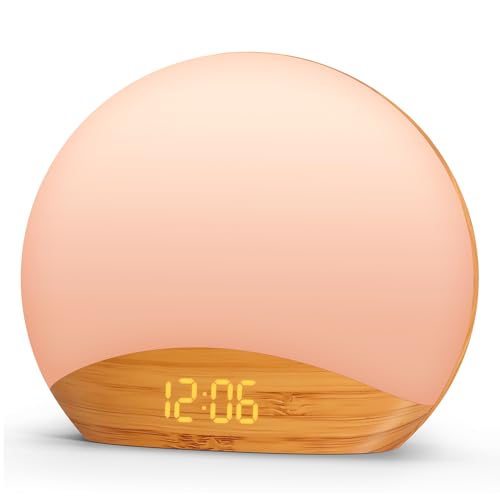
REACHER Wood Grain Sunrise Alarm Clock and Sound Machine — Best for Light Sleepers and Wind-Down
This suits the student whose problem is both ends of the night — falling asleep in a loud dorm and waking in a dark one. The sound machine half earns its keep during midterms when hallways stay loud past midnight.
Strengths
- Sleep sounds mask dorm corridor noise
- Sunrise wake pairs with the wind-down routine
- Wood-grain finish looks at home on a desk
Trade-offs
- Sound library is fixed — no streaming your own
- Light output is gentler than the biggest sunrise clocks
- More features to configure than a basic clock
| Spec | Detail |
|---|---|
| Wake style | Sunrise light plus sound |
| Night role | 26 sleep sounds, white noise, nightlight |
| Finish | Wood grain |
Dorm sleep fails at both ends, and this REACHER is the only pick that works both shifts. At night it is a noise masker: steady white noise or a sleep sound raises the floor so door slams and hallway conversations stop registering as events. In the morning the light takes over. Students in older dorms with thin doors get the most from it, and it pairs naturally with the schedule advice in the guide — a fixed wind-down sound becomes a sleep cue within a couple of weeks, which is worth more than any single feature on this page. Keep expectations calibrated on the wake side: its sunrise is a gentle one, better for normal sleepers than for the truly deep.
Best for: Noisy dorms where falling asleep is half the problem / Not suited for: Heavy sleepers who need vibration or maximum volume
Check on Amazon — check price on Amazon for the current configuration.

Loftie Alarm Clock with Sound Machine — Best Phone-Free Premium
This suits the student who has identified the phone itself as the sleep problem — the scroll at midnight and the notifications at dawn — and wants the nightstand to hold a clock instead. It is a premium-tier pick and makes no apology for it.
Strengths
- Two-phase alarm designed for a calmer wake
- Large included sound library for sleep and focus
- Removes the phone from the bedside entirely
Trade-offs
- Premium tier — the priciest philosophy on this list
- Some features assume Wi-Fi availability
- Over-featured for students who just need a beep
| Spec | Detail |
|---|---|
| Wake style | Two-phase tone alarm |
| Library | 100+ sounds included per listing |
| Extras | Night light, Bluetooth speaker |
The Loftie is best understood as a behavior tool that happens to tell time. Its alarm is staged — a gentler tone first, then the full alarm — on the theory that waking should be a ramp, not a cliff. For the college use case its real value is subtraction: phone charging in the kitchen or desk drawer, no lock screen at 1 a.m., no alarm app to be silenced by an operating system update. Judge it as you would a gym membership for sleep: worth it for the student who will actually use the routine, an expensive paperweight for the one who will not. Dorm Wi-Fi quirks are the one practical check — confirm the clock’s core alarm works on your network setup before relying on connected features.
Best for: Students deliberately going phone-free at the nightstand / Not suited for: Tight budgets or anyone who just needs maximum loudness
Check on Amazon — check price on Amazon for the current configuration.

Peakeep Battery Operated Digital Alarm Clock — Best Battery and Travel
This suits the student whose bed is nowhere near an outlet — lofted beds, beds against the wrong wall — and the student who travels for weekends, sports or internships and wants one familiar alarm everywhere.
Strengths
- Battery operation frees it from outlet geography
- Auto-dimming large display suits shared rooms
- Portable for travel, breaks and summer internships
Trade-offs
- Batteries are an ongoing consumable
- Sound-only waking, no light or shaker
- No charging port or radio extras
| Spec | Detail |
|---|---|
| Power | Battery operated, cordless |
| Display | Large, auto dimming |
| Alarm | Adjustable volume per listing |
Outlet geography decides more dorm purchases than any feature list, and the Peakeep simply opts out of the problem. Put it on the loft railing, the headboard shelf or the desk across the room — across the room being a legitimate strategy for students who must physically stand up to silence an alarm. Battery operation also makes it immune to the dorm power blink that resets lesser clocks mid-semester. The ownership note is batteries: keep a spare set in the desk from week one, because the morning it dies will be the morning of the midterm. For a student in university housing with strict rules about extension cords, cordless is not a compromise; it is the compliant choice.
Best for: Lofted beds, outlet-poor rooms and student travelers / Not suited for: Anyone wanting sunrise light, vibration or smart features
Check on Amazon — check price on Amazon for the current configuration.
Comparison Table
The table below compresses the six picks into the four facts that decide most purchases of best alarm clocks for college: the badge, the verified headline spec, and the job each model does best. Read it alongside the full reviews, because the spec column never tells the whole story — ownership effort, sizing and fit live in the review text.
| Pick | Badge | Key spec | Best for |
|---|---|---|---|
| JALL Sunrise Alarm Clock | Best Overall | Sunrise simulation wake-up light, 25 sounds, FM radio, Bluetooth per listing | Most dorm students wanting a gentler, reliable wake-up |
| Sonic Bomb Dual Alarm Clock with Bed Shaker | Best for Heavy Sleepers | Extra-loud alarm with vibrating bed shaker, dual alarms, battery backup per listing | Heavy sleepers and shaker-only waking in shared dorm rooms |
| DreamSky Small Digital Alarm Clock | Best Simple and Compact | Large numbers, USB charging port, brightness dimmer, adjustable alarm volume per listing | Small desks, lofted beds and set-it-in-seconds simplicity |
| REACHER Wood Grain Sunrise Alarm Clock and Sound Machine | Best for Light Sleepers and Wind-Down | Sunrise wake light with 26 sleep sounds, white noise machine and nightlight per listing | Noisy dorms where falling asleep is half the problem |
| Loftie Alarm Clock with Sound Machine | Best Phone-Free Premium | Smart alarm clock with night light, white noise and 100+ sounds included, Bluetooth speaker per listing | Students deliberately going phone-free at the nightstand |
| Peakeep Battery Operated Digital Alarm Clock | Best Battery and Travel | Cordless battery operation, large display, auto dimming, adjustable volume per listing | Lofted beds, outlet-poor rooms and student travelers |
How to Choose Alarm Clocks for College
Match the wake style to the sleeper, not the brochure
Four wake mechanisms appear in this guide, and they are not interchangeable. Sound alarms suit normal sleepers in private or tolerant rooms. Sunrise light suits normal sleepers in darkenable rooms and improves the feel of waking more than its force. Vibration suits heavy sleepers and anyone who must not wake a roommate. Volume — true extra-loud volume — is the last resort for deep sleepers in single rooms. Diagnose honestly: a student who has slept through three phone alarms does not need a prettier beep, they need the shaker or a schedule intervention, usually both.
Also consider the semester, not the week. Schedules rotate, roommates change, and an 8 a.m. semester follows a noon semester. Dual alarms and weekday/weekend settings look like spec-sheet filler until the first schedule change, when they become the feature that matters.
The roommate rules of dorm alarms
In a shared room, an alarm is a social contract. Agree the terms in week one: how many snoozes are acceptable (one is the civilized ceiling), whether light-based waking is welcome, and who owns the earliest wake time. Bed-shaker and sunrise clocks exist largely to make this contract easy to keep — both wake one person while barely disturbing the other, which is why two of the six picks are built around them.
Volume discipline matters as much as volume. A clock with genuinely adjustable volume, set to the lowest level that works, respects the room; a fixed loud clock in a shared room is a conflict scheduled daily. If schedules diverge wildly — one student at 6 a.m. training, one at noon — the early riser should own a silent-to-others wake method as a matter of basic dorm citizenship.
Power, backup and outlet geography
Dorm power is unreliable in small ways: breakers trip, cleaners unplug things, and a clock that loses its alarm in a blink fails at the only moment that counts. Every pick here either runs on batteries or carries backup that preserves the alarm through an outage — treat that as a non-negotiable filter for any clock you consider beyond this list.
Then walk the room before buying. Where is the bed relative to the outlets? Is the bed lofted? University housing often restricts extension cords and power strips, which quietly eliminates corded clocks from some rooms and makes the battery pick the only compliant option. The best clock is the one that can physically live where the sleeper sleeps.
The alarm is only half the system
No clock on this page can out-wake a chaotic schedule for long. The students who stop missing morning classes usually change two things alongside the hardware: a fixed wake time kept within an hour on weekends, which stops the Monday-morning social jet lag, and a light cue — opening curtains or a sunrise clock — that anchors the body clock far better than sound alone. Caffeine cutoffs and a phone that sleeps outside arm’s reach do more than any snooze button.
Use the clock as the backstop of that system, not the whole of it. Set one alarm, place it deliberately, and let consistency do the heavy lifting. Students who set five alarms train themselves to sleep through four of them.
Setting up your dorm wake system in the first week
Do the setup during the first week, while motivation is high and classes are still forgiving. Night one: place the clock, set the real wake time for your earliest class minus your honest getting-ready time, and test the volume or light level from the bed, not from the desk chair where you set it. Night two: adjust once — shaker position, light window length, or volume — based on how the first morning actually felt. Then freeze the setup; constant reconfiguration is procrastination wearing a productivity costume.
Agree the roommate terms the same week: snooze ceiling, earliest-alarm etiquette, and what happens on the mornings one of you has an exam. Write the exam-week exception into the agreement before anyone needs it. Finally, put a spare battery set or the charging cable in a known drawer. Every dorm wake failure story ends with a dead device and no spare; the whole point of the first-week setup is to make your story boring.
How to Set Up Your College Alarm Clock for the Semester
Fifteen minutes of setup in week one prevents the missed-lecture morning in week nine.
- Place it for the sleeper, not the room. Put the clock where the person in bed can see and reach it — or deliberately across the room if standing up is part of your wake strategy. Test visibility from the pillow, including from a loft.
- Set one alarm, set it honestly. Work backward from the class: arrival time, minus travel, minus getting ready at your real pace, not your optimistic pace. Set that single alarm and resist adding four backups.
- Calibrate the wake stimulus. Run a test at your chosen volume, light window or shaker position while lying in bed. Adjust once, then leave it alone for two weeks so your body can learn the cue.
- Program the week, not the day. Enter weekday and weekend times and any dual alarms for different class days now, while the syllabus is in front of you.
- Agree the roommate terms. Snooze ceiling, light etiquette and exam-week exceptions — decided in week one, in daylight, like adults.
- Stage the spares. Spare batteries or the cable in a labeled drawer spot. The failure you prevent is always the mundane one.
Common Buying Mistakes
Relying on a phone as the only alarm
Phones die, update overnight, get silenced by focus modes and end up across the room on a charger. A dedicated clock with backup power is not nostalgia; it is redundancy for the one appointment that repeats all semester.
Buying maximum volume for a shared room
An extra-loud alarm in a two-person dorm room wakes two people, one of whom did not consent. Heavy sleepers in shared rooms need vibration, not decibels — the shaker exists precisely for this room.
Training yourself to snooze
Five alarms at ten-minute intervals teach your brain that the first four are optional. One alarm, placed deliberately, with a body that expects it, outperforms the snooze ladder within two weeks.
Ignoring outlet geography until move-in day
The perfect corded clock is useless at a lofted bed with no outlet in reach and a housing ban on extension cords. Walk the room — or its measurements — before the purchase, not after.
Expecting hardware to fix a broken schedule
A 3 a.m. bedtime defeats every clock eventually. The alarm is the backstop; a consistent wake time and a caffeine cutoff are the system. Students who fix only the hardware re-buy this problem every semester.
Final Recommendation
Most students should start with the JALL Sunrise: it wakes the way mornings should feel and covers the ordinary dorm case completely. Heavy sleepers — and considerate roommates of light sleepers — go straight to the Sonic Bomb and its shaker. The DreamSky is the compact simple answer, the REACHER adds the wind-down half for noisy halls, the Loftie serves the phone-free commitment, and the Peakeep solves the loft-and-outlet problem on batteries.
Whichever you pick, do the first-week setup and the roommate conversation. In a dorm, the alarm clock is a social device as much as a timing one, and the students who treat it that way are the ones still making their 8 a.m. lectures in November.
Keep exploring the cluster: Best Alarm Clocks For Heavy Sleepers Best Blankets For Queen Bed Best Air Purifiers For Wildfire Smoke Best Certified Organic Pillows Best Sheet Sets For Icomfort Queen
Waking Up for the Class You Hate: A Field Guide
Every student has one: the early class in the subject that chose them rather than the other way round, in the building furthest from the dorm, taught at a pace that punishes absence. Alarm strategy for that class is different from alarm strategy in general, because motivation — the invisible ingredient in every successful wake-up — is at its weekly minimum. The first rule is to move the wake time earlier than strictly necessary and spend the surplus on something pleasant: coffee made properly, a shower while the bathroom is empty, ten unhurried minutes that convert the morning from an ambush into a routine. Students protect mornings they like; they sleep through mornings that begin with sprinting.
The second rule is environmental. Lay out the class’s physical requirements the night before — bag by the door, clothes decided, the bike unlocked in your head if not in fact — so the waking brain faces no decisions, because a brain offered decisions at 7 a.m. will decide on sleep. The third rule is social: a classmate in the same lecture, expecting you, is an alarm no manufacturer sells. Study groups that meet for breakfast before the hated class have attendance records that shame every clock in this guide, and forming one costs nothing but the admission that willpower needs scaffolding.
Finally, audit honestly after any miss. A slept-through morning has a cause, and it is rarely the clock’s volume: it is the 2 a.m. bedtime, the phone in the bed, the alarm set for the optimistic version of getting ready. Fix the cause in the system — bedtime, phone location, honest timing — and let the clock return to its proper job as the backstop. The students who make every early class by senior year are not the ones with the loudest alarms. They are the ones who stopped needing them to be loud.
Alarm Clocks Beyond the Dorm: Breaks, Internships and First Apartments
A good college alarm clock has a longer career than the dorm. The same clock travels home for breaks — where a familiar wake cue in a childhood bedroom is worth more than any novelty — and on to summer internships, where a rented room and a 9 a.m. start date punish the phone-only sleeper exactly as the dorm did. Battery and compact picks earn a second dividend here: the Peakeep and the DreamSky pack into a duffel without a thought, while a sunrise clock needs its box and a plan. Students choosing with summers in mind should weigh portability as a real feature, not an afterthought.
The first apartment after college changes the constraints again: the roommate becomes a partner or nobody, the outlet geography becomes generous, and the sunrise clock that shared a dorm room’s compromises becomes a pure pleasure on a nightstand with no one to disturb. This is where the premium picks justify themselves across a decade — the Loftie’s phone-free nightstand is a habit that outlasts the degree, and the JALL’s light keeps working long after the last 8 a.m. lecture is a story told at reunions. Buy for the dorm you have, by all means, but notice which clocks on this page you would also pack for the life after it.
One practical thread runs through all these settings: backup and spares travel with the clock. The battery set in the desk drawer, the cable coiled in the same bag, the alarm tested on arrival rather than trusted — these are the habits of people who are never late for the thing that mattered. A clock is a small machine for keeping promises to your future self. The settings change; the promise-keeping is the product.
The Snooze Button: An Honest Accounting
The snooze button is the most lied-about feature in the alarm world, sold as mercy and functioning as a training device — it trains the brain, with daily repetition, that the alarm is a negotiation opener rather than an event. Sleep science is unkind to it: the fragmented minutes between snoozes are neither sleep nor waking, and the student emerges from three snoozes groggier than from one clean rise, having spent the difference from their night. Every clock in this guide has a snooze because every clock must, but the way the successful wakers use it is as a fire exit — present, rarely opened, and never part of the plan.
The alternative architecture is a single alarm with a humane ramp. Sunrise clocks build the ramp into light. The Loftie builds it into a two-stage tone. The manual version works on any clock: set the alarm for the true wake time, place it where rising is required or at least easy, and let the first feet-on-floor moment be followed immediately by light — curtains opened, bathroom light on — because light, not sound, is what tells the body the negotiation is over. Within two weeks the body begins waking near the alarm on its own, which students experience as a mysterious improvement in the clock.
None of this requires monastic discipline about bedtime; it requires consistency about wake time, which is the lever that actually moves sleep. A fixed wake time kept within an hour across the week — weekends included, within reason — stabilizes the whole system until the alarm becomes a formality. That is the quiet destination of every recommendation in this guide: not a louder morning, but a morning that needs less loudness, in a dorm room where both occupants can live with the system that produces it.
What to Do When the Alarm Fails Anyway
Even with the best system in this guide, a morning will eventually go wrong — a clock unplugged by a cleaner, a battery that chose its moment, a night that ran to 4 a.m. for reasons that seemed excellent at the time. The recovery protocol matters more than the failure. First, have a backstop that is not a second alarm clock but a person: the roommate agreement from the setup section should include the emergency clause — if I am not vertical by this time, shake me — and it should run both ways, because the roommate’s midterm morning is coming too. Social redundancy is the layer no product sells and every successful dorm runs on.
Second, know the academic recovery moves before you need them: the lecturer’s email sent within the hour, honest and brief; the notes borrowed the same day, not the same week; the office-hours appearance that converts an absence into evidence of seriousness. Professors have seen every version of the slept-through morning, and the students they remember kindly are the ones who treated it as a logistics failure to be repaired rather than a character flaw to be confessed at length. One miss, repaired properly, is a story. A pattern is a problem, and a pattern points back at the system — bedtime, phone, honest timing — not at the clock.
Third, debug the failure the same day, while the evidence is fresh. Was the alarm set? Audible? Charged? Was the wake time ever realistic for the bedtime that happened? Each answer assigns the fix to a layer — device, setup or schedule — and a fix assigned correctly does not recur. The goal of this entire guide is not a perfect record; it is a system in which failures are rare, repaired and instructive, in a shared room where both occupants are running the same play.
Sharing a Room With a Different Schedule: The Two-Clock Household
When two students keep genuinely different hours — the pre-med at dawn, the designer at noon — the room needs a two-clock system, not a compromise clock. Each sleeper owns their own wake method, chosen for silence toward the other bed: shaker or aimed sunrise light for the early riser, a considerate-volume digital for the later one. The clocks live on their owners’ sides of the room, and the social rule is absolute: your alarm is your responsibility, and waking your roommate is a debt repaid in coffee, not an accident of equipment.
Earplugs and eye masks are the supporting cast, owned by the later sleeper without resentment, because a shared room is a negotiated space and the negotiation goes better when both parties bring equipment as well as goodwill. The early riser’s part of the bargain is choreography: clothes laid out, bag packed, door handled quietly, the morning conducted in the corridor and the bathroom rather than at the foot of a sleeping person’s bed. Students who master this in a dorm carry a life skill into every shared flat, barracks, hostel and marriage that follows.
Exam week stress-tests the system and deserves its own clause, agreed in advance: alarms may be earlier, snooze amnesties may be granted, and the household’s sleep rules bend by mutual consent for exactly seven days. Systems that plan their exceptions survive them; systems that pretend exceptions will not happen break on the first one. Write the clause in week one, in daylight, like everything else in this guide.
A last word on buying timing: dorm gear is cheapest to choose calmly, and alarm clocks are the classic August panic purchase, grabbed from whatever shelf remains the day before move-in. The student who chooses in July, from a guide like this one, with the room’s outlet map and the roommate’s schedule already known, owns the clock that fits the life. The student who chooses in the aisle owns a clock that fits the aisle. Every recommendation in this guide — the shaker for the heavy sleeper, the sunrise for the dark room, the battery clock for the loft — assumes five quiet minutes of self-knowledge applied before the purchase. That self-knowledge, plus one honest alarm, plus a wake time kept within the hour, is the entire technology of never missing the morning. The clocks are ready when you are.
Frequently Asked Questions
What type of alarm clock is best for a dorm room?
The one matched to the sleeper and the room: sunrise light for normal sleepers in dark rooms, a bed shaker for heavy sleepers or early risers with roommates, and a simple backed-up digital clock for everyone else. Shared-room courtesy — adjustable volume, dimmable display, a snooze ceiling — matters as much as wake power.
How can I wake up without disturbing my roommate?
Use a wake method that targets one bed: a vibrating shaker under your pillow, or a sunrise clock whose light is aimed at your side of the room. Agree a single-snooze rule, keep volume at the lowest level that works for you, and save audible alarms for mornings your roommate is also up.
Are sunrise alarm clocks worth it for college students?
For students in darkenable rooms with brutal early classes, yes — the gradual light makes waking measurably less miserable and helps anchor a consistent schedule. They are not the tool for genuinely heavy sleepers, who should look at vibration first, or for rooms flooded with morning sun, where the light adds nothing.
Do I need battery backup in a dorm alarm clock?
Yes. Dorm power blinks — tripped breakers, unplugged strips, building maintenance — and a clock that forgets its alarm in a flicker will eventually forget it before your hardest exam. Every pick in this guide either carries backup or runs on batteries outright.
Where should I put my alarm clock in a dorm?
Where the sleeper can see it from the pillow and where the wake stimulus actually reaches the bed — the shaker under the pillow, the sunrise clock facing the bed. Students who snooze in bed benefit from the deliberate cruelty of a clock across the room that requires standing up.
Can an alarm clock really fix oversleeping?
Only the hardware half of it. The clock guarantees a stimulus; the schedule guarantees you can respond to it. Pair any pick here with a consistent wake time and a sane bedtime, and oversleeping usually resolves within two weeks. Without the schedule half, even the loudest clock becomes background noise by midterms.

