Disclosure: airfryerkitchensupply.com is reader-supported. When you buy through links on our site, we may earn an affiliate commission at no extra cost to you.
Where to Buy
Every model in this guide to the best cast iron skillet for glass cooktops was matched to a live Amazon listing through our product database check before it received a link. Use the links in this box and throughout the article to check price on Amazon and confirm the exact size before ordering, because these skillets are sold in several diameters under near-identical names. One practical note before the list: if your glass cooktop is new or under warranty, check its manual for cast iron guidance first — most manufacturers allow it with care, and this guide is written around exactly that care.
Shop the verified picks on Amazon: Lodge Pre-Seasoned Cast Iron Skillet 12 Inches · Lodge Pre-Seasoned Cast Iron Skillet 10.25 Inches · Lodge Cast Iron Skillet with Silicone Handle Holder 12 Inches · Lodge Pre-Seasoned Cast Iron Skillet 3-Piece Set (8, 10.25 & 12 inch) · Lodge Pre-Seasoned Cast Iron Dual Handle Pan 12 Inches · Lodge Pre-Seasoned Cast Iron Skillet 8 Inches. Availability and configurations change, so check price on Amazon before you order.
The best cast iron skillet for glass cooktops has to satisfy two masters that pull in opposite directions. Cast iron earns its place in the kitchen by being heavy, rough-and-ready and immortal; a glass cooktop is a smooth ceramic sheet that can be scratched by grit, marked by dragging, and — in the worst case — cracked by a dropped pan. Owners of glass tops are often told to simply avoid cast iron, which is safe advice and bad cooking advice in equal measure, because nothing sears, bakes cornbread or finishes a frittata like iron does.
The truthful answer is that cast iron and glass coexist happily under three disciplines: choose a skillet with a smooth, flat base; lift it instead of ever sliding it; and respect the weight, especially when the pan is full and hot. This guide reviews six verified Lodge skillets — the brand that dominates this category — sized and configured for glass-top duty, then covers base design, size and weight limits, the daily handling routine that keeps glass unmarked, and the mistakes that actually damage cooktops, as opposed to the ones people merely worry about.
In this guide
Quick Picks
Six verified Lodge cast iron skillets chosen for glass-top kitchens: the right sizes, the handle configurations that make safe lifting easy, and one value set that covers every burner. Badges match the full reviews below.
- Lodge Pre-Seasoned Cast Iron Skillet 12 Inches — Best Overall: The reference cast iron skillet at the most useful large size — pre-seasoned, PFAS-free, made in the USA, and the pan every glass-top technique in this guide is built around. Check price on Amazon.
- Lodge Pre-Seasoned Cast Iron Skillet 10.25 Inches — Best Everyday Size: The 10.25-inch is the size most glass-top burners are actually built for — the everyday skillet for one to three people, and the easiest iron to handle safely. Check price on Amazon.
- Lodge Cast Iron Skillet with Silicone Handle Holder 12 Inches — Best for Handling Safety: The 12-inch skillet bundled with a silicone hot handle holder — the grip upgrade that makes a heavy pan safer to lift off glass, every single time. Check price on Amazon.
- Lodge Pre-Seasoned Cast Iron Skillet 3-Piece Set (8, 10.25 & 12 inch) — Best Value Set: The three essential sizes in one box — 8, 10.25 and 12 inch — the economical way to match skillet size to burner size across the whole glass top. Check price on Amazon.
- Lodge Pre-Seasoned Cast Iron Dual Handle Pan 12 Inches — Best for Oven-to-Table: A 12-inch pan with two loop handles instead of a long handle — balanced two-hand lifts, easy oven transfers, and stated induction compatibility for hybrid kitchens. Check price on Amazon.
- Lodge Pre-Seasoned Cast Iron Skillet 8 Inches — Best Compact: The small skillet for the small burner: single eggs, reheated leftovers, toasted spices and one-person cooking — the lightest, easiest iron in the guide. Check price on Amazon.
How These Picks Were Chosen
We started from the glass cooktop’s requirements rather than the skillet market’s. A candidate needed a flat base that sits stably on a glass zone (a rocking pan is both a cooking failure and a scratch risk), a size matched to common burner diameters so heat spreads evenly, and a handle arrangement that makes a controlled, two-handed lift realistic when the pan is full. Weight was treated as a safety specification, not a macho badge: every extra pound is a pound you must never drop.
Every skillet below was verified through Amazon’s product data for this site — the Lodge sizes and configurations in this article come from a Amazon listing data search and cache records checked on 2026-11-21, and the specification details printed (sizes, handle holders, set contents, the dual handle pan’s stated induction compatibility) are drawn from those verified listings. Anything we could not confirm was left out. Per this site’s standing rules, we print no fixed prices — check price on Amazon — and no fixed ratings or review counts.
An honest note on brand concentration: this list is all Lodge because Lodge is what the verified data supports at every size and price point in this niche, and inventing diversity would serve nobody. Lodge has made cast iron in the USA for over a century, its skillets are the reference design for pre-seasoned iron, and its range covers every decision a glass-top owner actually faces: which size, which handle, single pan or set.
The Best Cast Iron Skillets for Glass Cooktops
Each review judges the skillet as a glass-top tool first — base, size, lift-ability — and as a cooking tool second, because on glass the handling is the cooking. Spec boxes use only verified listing facts throughout.
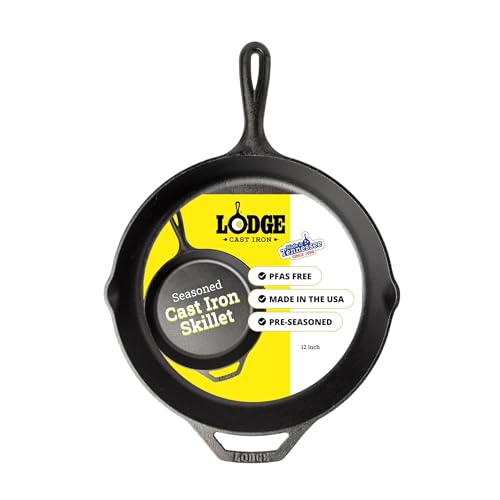
Lodge Pre-Seasoned Cast Iron Skillet 12 Inches — Best Overall
The 12-inch Lodge is the skillet the category is measured by: pre-seasoned from the foundry, PFAS-free, made in the USA, and sized for the way families actually cook — four chicken thighs, a full cornbread, a steakhouse sear for two. On a glass top it belongs on your largest burner, centred, and lifted with two hands and a mitt when full.
Strengths
- The do-everything 12-inch size for family cooking and oven finishing
- Pre-seasoned and PFAS-free — ready to cook, nothing to strip
- Lodge ecosystem: lids, holders and spares are everywhere
Trade-offs
- The heaviest single skillet here when loaded — the two-hand lift is mandatory
- Too wide for small glass-top burners; check your largest zone size
- Bare iron needs the standard dry-and-oil storage routine
| Size | 12 inches |
| Finish | Pre-seasoned cast iron, PFAS-free (per listing) |
| Compatibility | Oven, stove, grill and campfire (per listing) |
| Origin | Made in USA (per listing) |
Why 12 inches wins the top badge despite the weight warning: it is the size at which cast iron’s virtues fully express themselves. Searing needs space between pieces or the pan steams instead of browning; cornbread needs the full round; a whole chicken spatchcocked fits. On a glass top, that space must come from a burner that matches — most glass cooktops have one large zone, and this skillet is its natural partner. If your largest zone is notably smaller than the pan, the edges will run cool and the 10.25-inch pick below is the smarter buy.
The glass discipline for this pan is simple and absolute: it goes down flat, it cooks, it comes straight up. No sliding to the cool side, no shaking the pan back and forth over the glass the way chefs do over gas grates — use a spoon and tilt instead. Build that one habit and the biggest, heaviest skillet in this guide becomes a completely routine glass-top citizen, which is precisely why it headlines the list.
A word about pre-seasoning expectations, since this pan introduces many owners to iron: the factory seasoning is a starting surface, not a finished one. The first weeks reward fatty, forgiving cooking — fried eggs in butter, cornbread, seared meats — while delicate fish and eggs-alone wait until your own layers of seasoning have built over the foundry’s. Judge the pan at month three, not at breakfast one, and it will be the most non-stick surface you own that is not a coating.
Best for: Family cooking, searing and cornbread on a glass top with a large burner / Not suited for: Small glass cooktops, or anyone who cannot lift a full 12-inch skillet safely
Check on Amazon — check the current price on Amazon before ordering.

Lodge Pre-Seasoned Cast Iron Skillet 10.25 Inches — Best Everyday Size
If the 12-inch is the reference, the 10.25-inch is the reality for most kitchens: it matches the diameter of the standard large burner on most glass cooktops, heats evenly edge to edge, and stays light enough — by cast iron standards — for a confident one-hand-plus-helper-handle lift. For couples and small families, this is the skillet that will live on the stove.
Strengths
- Matches standard glass-top burner diameters for even heating
- Manageable weight makes the safe lift genuinely easy
- Same pre-seasoned, PFAS-free, USA-made specification as the 12-inch
Trade-offs
- Crowds four large chicken thighs — batch cooking for big families
- Less oven presence for full-size cornbread rounds
- Still bare iron: the seasoning routine applies
| Size | 10.25 inches |
| Finish | Pre-seasoned cast iron, PFAS-free (per listing) |
| Compatibility | Oven, stove, grill and campfire (per listing) |
| Origin | Made in USA (per listing) |
Size-to-burner matching is the most under-taught idea in glass-top cooking. A skillet much wider than its zone heats in a bullseye — fierce centre, lazy rim — and on glass, where the zone’s output is fixed by the element beneath, there is no flame to wrap around the pan and forgive the mismatch. The 10.25-inch on a typical large zone is the pairing where the whole base works, which is why eggs fry evenly and pancakes brown in rings instead of spots.
It is also the teaching skillet. New cast iron owners learn seasoning, heat management and the lift-don’t-slide discipline on a pan whose mistakes are recoverable and whose weight never surprises them mid-lift. If this guide could leave only one skillet in a glass-top kitchen, the honest choice for most households is this one — with the 12-inch added later for the meals that demand it.
One more practical virtue: at 10.25 inches the pan fits standard skillet lids and splatter screens, slides into ordinary ovens without handle drama, and stores in the drawer or cupboard space a smaller kitchen actually has. The flagship sizes earn the photographs, but this is the skillet that fits the life around the cooking — which is why, in household after household, it is the one that ends up seasoned darkest.
Best for: Most households, everyday cooking, and first cast iron purchases / Not suited for: Regular cooking for five or more
Check on Amazon — check the current price on Amazon before ordering.

Lodge Cast Iron Skillet with Silicone Handle Holder 12 Inches — Best for Handling Safety
This is the 12-inch Lodge in its most glass-top-friendly retail form: the same pre-seasoned skillet, bundled with a silicone handle holder that slides over the handle and stays there through stovetop work. On a glass cooktop — where a fumbled lift is the one accident that matters — a secure, heat-proof grip is not an accessory; it is the safety system.
Strengths
- Silicone handle holder gives a secure, insulated grip for lifts
- Full 12-inch cooking capacity with better handling than the bare handle
- Holder removes for oven use and washing
Trade-offs
- Silicone holders are for stovetop handling — oven work still needs mitts and care
- One more component to keep track of in the drawer
- Same loaded weight as any 12-inch skillet; the holder helps grip, not gravity
| Size | 12 inches |
| Included | Silicone hot handle holder (per listing) |
| Finish | Pre-seasoned cast iron |
| Use | Oven and stovetop safe pan (per listing) |
Think about how cast iron accidents actually happen on glass tops. It is rarely the cooking; it is the transition — the moment a full, hot, heavy skillet is lifted with a folded towel that slips, or a mitt that has gone smooth with age. A fitted silicone holder eliminates the improvised grip entirely: it is on the handle before the pan gets hot, it does not slide, and it makes the correct two-point lift (holder hand plus mitt on the helper handle) the path of least resistance.
Buy this version if the 12-inch’s capacity tempts you but its handling gives you pause — or if the skillet will be used by several cooks of different strengths, where standardising the grip protects everyone. The holder is not oven equipment: for the broiler or a hot oven finish, remove it and use proper mitts. Within its stovetop brief, it is the simplest safety upgrade in this entire guide.
Best for: 12-inch capacity with safer everyday handling on glass / Not suited for: Cooks who keep the holder on in the oven — it is a stovetop tool
Check on Amazon — check the current price on Amazon before ordering.

Lodge Pre-Seasoned Cast Iron Skillet 3-Piece Set (8, 10.25 & 12 inch) — Best Value Set
Glass cooktops have burners in several sizes, and this set is the answer to that geometry: the 8-inch for the small zone and single servings, the 10.25-inch for the everyday large zone, and the 12-inch for the biggest burner and the biggest meals. Buying the three as a verified set costs less than assembling them one by one and ends the size debate in a single purchase.
Strengths
- Every burner on the glass top gets its matched skillet
- Set pricing beats buying the three sizes separately
- One seasoning and care routine across the whole family of pans
Trade-offs
- Three skillets need storage — cast iron nests, but it is still iron
- You may use the 8-inch rarely if you rarely cook single servings
- A set duplicates nothing: households wanting two of one size should buy singles
| Contents | 8, 10.25 and 12 inch skillets (per listing) |
| Finish | Pre-seasoned cast iron |
| Compatibility | Oven, stove, grill and campfire (per listing) |
| Origin | Made in USA (per listing) |
The set logic is stronger on glass than on any other cooktop, because size-matching is a performance rule on glass rather than a preference. On gas, an oversized pan on a small burner merely wastes flame; on glass, it cooks in a bullseye and tempts the cook to slide the pan around chasing evenness — the exact habit glass owners must not build. Owning the matched size for each zone removes the temptation at the source.
There is also a household rhythm argument: the 8-inch fries the single egg and toasts the spices, the 10.25-inch carries weekday dinners, and the 12-inch appears for weekends and guests. Each pan seasons through its own work, and the set ages into a batterie that covers a lifetime of ordinary cooking. If your budget allows one cast iron purchase this year and your glass top has the standard multi-size layout, this is the purchase this guide would make.
Storage is the one planning task: three iron skillets nest by size, and nested with cloth protectors they occupy roughly the footprint of the largest pan plus a few inches of height. A deep drawer, a sturdy low cupboard or the oven itself (a time-honoured iron store, provided everyone in the household knows they live there) all work. Decide the home before the set arrives and the three pans become furniture rather than clutter.
Best for: New glass-top households equipping from scratch / Not suited for: Minimalists who know they will only ever use one size
Check on Amazon — check the current price on Amazon before ordering.

Lodge Pre-Seasoned Cast Iron Dual Handle Pan 12 Inches — Best for Oven-to-Table
The dual handle format quietly solves the glass-top handling problem from a different direction: with a loop handle on each side, every lift is a balanced two-hand lift, the pan cannot tip toward a weak wrist, and it presents at the table like a serving dish. The verified listing also states induction compatibility, which makes it the bridge pick for kitchens with both glass radiant and induction zones.
Strengths
- Two handles make every lift balanced and controlled
- Oven-to-table presentation without transferring food
- Stated induction compatibility broadens its cooktop range
Trade-offs
- No long handle means no one-hand tossing or swirling technique
- Both handles get hot — two mitts, always
- Takes two hands even for small adjustments on the zone
| Size | 12 inches |
| Handles | Dual handle design |
| Compatibility | Oven and stovetop safe; induction compatible (per listing) |
| Finish | Pre-seasoned, PFAS-free, naturally nonstick (per listing) |
Consider the dishes this pan was born for: the frittata finished under the broiler and served in its pan, the skillet cobbler, the shakshuka carried bubbling to the table, the cornbread that should never be unmoulded. On a glass top, its virtue is upstream of all that — the lift on and off the zone is the most controlled of any pick in this guide, because the weight hangs between two hands instead of cantilevering off one wrist.
The trade is technique: without a long handle there is no pan-tossing, no one-handed tilt-and-baste. Cooks whose style leans on those moves should choose a handled skillet and accept the lift discipline; cooks whose style is oven-finished and table-served will wonder why all pans are not made this way. It is also, incidentally, the easiest cast iron in this list to store, sliding into a low drawer or oven without a handle dictating the geometry.
For households with both a glass radiant top and an induction hob — a more common mixed kitchen than it used to be — this pan’s stated induction compatibility makes it the natural shared skillet, moving between the two surfaces without a thought. Its flat, full-contact base is exactly what induction asks for, and exactly what glass asks for; the two technologies agree about bases even when they agree about nothing else.
Best for: Oven-finished dishes, frittatas, and cooks who prefer two-hand lifts / Not suited for: Pan-tossing, one-handed cooking styles
Check on Amazon — check the current price on Amazon before ordering.

Lodge Pre-Seasoned Cast Iron Skillet 8 Inches — Best Compact
Every glass top has a small burner that big skillets waste, and the 8-inch Lodge is its partner: the lightest skillet in this guide, the quickest to heat, and the right size for the single-egg, two-sausage, leftover-reheating jobs that make up a surprising share of real cooking. Small is not a compromise here; it is a specialisation.
Strengths
- Lightest and most manoeuvrable skillet in the guide
- Perfect match for small glass-top burners
- Heats fast for small, quick jobs
Trade-offs
- Too small for family meals or serious searing batches
- Small portions can overcrowd and steam if you push capacity
- Easiest to justify as a second skillet rather than an only skillet
| Size | 8 inches |
| Finish | Pre-seasoned cast iron, PFAS-free (per listing) |
| Compatibility | Oven, stove, grill and campfire (per listing) |
| Origin | Made in USA (per listing) |
The 8-inch earns its keep in the margins of the day: the fried egg that should not require washing a 12-inch pan, the single grilled cheese, the portion of leftovers that reheats better in iron than in any microwave, the spices toasted for a curry. On glass, its light weight makes it the safest skillet in the guide for younger cooks learning cast iron and for anyone whose grip strength argues against the big pans.
It also makes an honest gift and a low-stakes first pan: if cast iron turns out not to be your material, an 8-inch Lodge has cost little and still fries an egg perfectly for decades. Pair it with the 10.25-inch as the classic two-skillet household — the combination this guide informally recommends most — and nearly every burner-and-meal pairing in a small kitchen is covered.
Best for: Singles, small jobs, small burners and first-time cast iron owners / Not suited for: Anyone needing one skillet to do everything
Check on Amazon — check the current price on Amazon before ordering.
Comparison Table
Size against burner diameter is the deciding relationship on glass, more than price, brand or any other specification. The table matches each pick to its zone and its job; when in doubt, the 10.25-inch is the default answer for most kitchens.
| Pick | Badge | Key Spec | Best For |
|---|---|---|---|
| Lodge Pre-Seasoned Cast Iron Skillet 12 Inches | Best Overall | 12in pre-seasoned skillet, made in USA | Family cooking, searing and cornbread on a glass top with a large burner |
| Lodge Pre-Seasoned Cast Iron Skillet 10.25 Inches | Best Everyday Size | 10.25in pre-seasoned skillet, burner-matched size | Most households, everyday cooking, and first cast iron purchases |
| Lodge Cast Iron Skillet with Silicone Handle Holder 12 Inches | Best for Handling Safety | 12in skillet plus silicone handle holder | 12-inch capacity with safer everyday handling on glass |
| Lodge Pre-Seasoned Cast Iron Skillet 3-Piece Set (8, 10.25 & 12 inch) | Best Value Set | 3-piece set: 8 / 10.25 / 12 inch | New glass-top households equipping from scratch |
| Lodge Pre-Seasoned Cast Iron Dual Handle Pan 12 Inches | Best for Oven-to-Table | 12in dual handle pan, induction compatible | Oven-finished dishes, frittatas, and cooks who prefer two-hand lifts |
| Lodge Pre-Seasoned Cast Iron Skillet 8 Inches | Best Compact | 8in pre-seasoned skillet, lightest pick | Singles, small jobs, small burners and first-time cast iron owners |
How to Choose the Best Cast Iron Skillet for Glass Cooktops
Begin under the pan. The base is the entire glass-top question: it should be flat (a pan that rocks will cook unevenly and can scratch as it settles), smooth to the touch (run a fingertip around the bottom edge and base; sharp casting flash or rough, gritty patches are what mark glass when a pan is set down hard or dragged), and sized to its burner. Traditional skillets with a raised heat ring concentrate contact on the ring — acceptable on glass if the ring is smooth, and another reason to inspect the individual pan when it arrives.
Size second. Match the skillet’s base diameter to the burner you will actually use: the pan can overhang the printed zone modestly, but a large overhang wastes heat at the rim and tempts sliding. Most glass tops offer one large zone in the 10- to 12-inch class and smaller zones below that, which is why this guide’s centre of gravity sits at 10.25 and 12 inches with an 8-inch for the small zone.
Handles third, because handling is safety. A long handle plus a helper handle is the classic arrangement and works beautifully with a fitted holder. Dual loop handles give the most controlled lift of all. What matters is that your grip plan — holder, mitts, two hands — is decided before the pan is hot, not improvised during the lift. Choose the configuration that makes your safest lift the easiest one.
Weight Limits and Your Glass Cooktop Warranty
Glass-ceramic cooktops are stronger than they look — they are engineered to carry cookware — but they have limits, and the limits are usually stated in the manual as a maximum weight per burner, with cast iron named specifically by many manufacturers. The rules behind the numbers are consistent: weight should arrive vertically and gently (set the pan down, never drop it the last inch), it should be distributed on a flat base, and the truly dangerous load is a full canner or stockpot, not a skillet. A loaded 12-inch skillet is well within what a sound glass top is built for; a skillet dropped from six inches is a different event entirely.
Warranty reality deserves one clear paragraph. Manufacturers generally warrant the glass against defects, not against impact damage, and some manuals phrase cast iron guidance cautiously (“use with care”) rather than prohibiting it. The practical reading: cast iron used with the disciplines in this guide is normal use on most glass tops; cast iron dropped, dragged or slammed is owner damage on all of them. If your cooktop is new, read its manual’s cookware page before your first sear — five minutes that aligns this guide’s advice with your specific appliance.
One more protection that costs almost nothing: keep both surfaces clean. A grain of sand, a crystal of salt or a fleck of burnt sugar trapped between pan and glass is a scratch waiting for pressure. A wipe of the glass and a glance at the pan base before they meet is the cheapest insurance in this entire article.
Seasoning and Care: The Glass-Top Schedule
Cast iron care advice usually assumes a gas stove and a devil-may-care attitude; glass-top ownership adjusts the routine in three specific places. First, dry the pan properly but not by leaving it indefinitely on a hot glass zone — a warm oven or a brief return to a low zone does the job, after which the pan comes off and the glass is left in peace. Second, keep the base as clean as the cooking surface: carbon build-up on the underside is both a scratch vector and a source of smoke, so the base gets the same brush-and-wipe attention as the interior, a step gas owners skip for years without consequence.
Third, manage seasoning with the glass in mind. A well-seasoned pan sheds food and wipes clean, which means less aggressive scrubbing over the sink and fewer chances to bang the pan against taps and racks — the unglamorous places where chips, dents and drops actually happen. Thin oil, hot oven, occasional re-seasoning when the surface looks dull or food starts to cling: the classic ritual, performed on schedule, is also the glass-protection ritual.
Storage completes the picture. Skillets store best nested with a cloth or pan protector between them, or hung — never stacked bare iron-on-iron in a deep drawer where retrieving the bottom pan means dragging the others. And never, as the mistakes section notes, stored on the cooktop itself, where the next cook’s first move is to slide your pan across the glass to reach a burner.
Glass-Safe Technique: The Daily Handling Routine
Lift, never slide. This is the whole law and the prophets. Sliding is how bases scratch glass — not through the iron itself, but through the grit and carbon flecks that every used pan base carries. Lift the pan fully clear, move it, set it down vertically. With mitts or a holder, every time, even for a two-inch adjustment.
Heat in stages. Cast iron on glass should come up to temperature gradually — start at medium, let the pan heat-soak, then go to your cooking setting. This protects the glass from thermal stress, protects the pan from warping forces over years, and improves cooking: a fully heat-soaked skillet sears evenly instead of scorching the first steak’s centre.
Cook without the shake. Gas-trained cooks shake pans constantly; on glass, stir, flip and tilt with utensils instead. The food does not care how it was moved, and the glass keeps its finish. Similarly, set lids and utensils on a trivet or rest, not on the glass beside the burner — the surface is a cooktop, not a counter.
Cool before cleaning either surface. Let the skillet cool on the (switched-off) zone or a trivet, and let the glass cool before wiping. Water on hot glass and cold pans on hot zones are stresses neither was designed to enjoy. Patience is a technique.
Bare Iron vs Enameled Cast Iron on Glass: The Honest Comparison
Enameled cast iron skillets — the French-style alternative — wrap the iron in a glass-smooth enamel skin, and on a glass cooktop that skin is the gentlest possible contact surface: no seasoning, no carbon flecks, nothing to rust. If minimizing every theoretical risk to the glass is your top priority and your budget stretches, an enameled skillet is a rational first choice, and this guide’s handling rules relax from “important” to “merely wise.”
Bare iron answers with its own virtues: it is nearly indestructible, it can be resurfaced and re-seasoned forever, it costs a fraction of enameled iron, and its cooking surface improves with age in a way enamel does not. Its glass-top cost is discipline — the lift, the clean base, the dry storage. Neither material is “better on glass” in the absolute; they trade money against mindfulness.
Why does this guide’s pick list run with bare Lodge iron? Because those are the skillets the verified product data for this batch supports at every size — and because with the handling routine above, bare iron’s glass risk is managed to the point where its durability and value dominate the decision for most kitchens. Households that know they will not maintain a routine should buy enamel and forgive themselves the premium; households that will, can save the money with a clear conscience.
How to Use a Cast Iron Skillet on a Glass Cooktop, Step by Step
Step 1 — Clean the meeting surfaces. Wipe the glass zone and glance over the skillet’s base. Remove any grit, salt or carbon flecks from both. This ten-second habit prevents most scratches attributed to “cast iron”.
Step 2 — Set the pan down vertically, centred. Place the skillet onto the zone in one gentle vertical motion, centred on the printed ring. No sliding into position — if it lands off-centre, lift and replace it.
Step 3 — Preheat gradually. Start at a medium setting and give the iron several minutes to heat-soak before raising the heat to cooking level. Food added to a properly soaked skillet releases cleanly and sears evenly.
Step 4 — Cook with utensils, not pan movement. Stir, flip and baste with tools. Keep the pan still on the glass; if you must move it to a cooler zone, lift it clear and set it down on the new zone.
Step 5 — Finish in the oven when the recipe calls for it. The skillet is oven-safe (per its listing): for frittatas, cornbread and thick steaks, the stovetop-to-oven transfer is cast iron’s signature move. Use two mitts for the transfer and remember the handle stays hot long after.
Step 6 — Lift off, cool, then clean. Move the pan to a trivet to cool. Wash it warm with water and a brush, dry it thoroughly — on a warm burner or in a warm oven — and wipe the thinnest film of oil over the surface before storing. Dry storage is what keeps iron immortal.
Step 7 — Wipe the glass last. Once the cooktop is cool, wipe the zone and check for any marks while they are fresh. Cooktop cleaner and a soft pad handle the day’s residue; sugar-based spills deserve immediate attention once the surface is safe to touch, because burnt sugar is the one common spill that can pit glass if left through repeated heat cycles.
Common Buying Mistakes
Sliding the pan. The single habit that scratches glass. It is never the iron alone — it is the grit under the iron, dragged under load. Lift, move, set down: three motions, no exceptions.
Dropping the last inch. Setting a heavy skillet down “almost” gently still lands it with impact. Lower it under control all the way to the glass, especially when it is full of food and oil.
Blasting a cold pan on maximum heat. Thermal shock stresses both the glass and the iron, and it cooks badly besides. Medium first, soak, then power — better sear, happier cooktop.
Using a pan far larger than the zone. Beyond wasted heat, an overhung pan tempts constant repositioning — sliding by another name. Match sizes, as the comparison table lays out.
Leaving burnt sugar or grit on the glass. The next pan grinds it in. Wipe the zone before every session; treat sugary spills as urgent once the surface cools enough to touch safely.
Storing the skillet wet or on the glass. A damp pan rusts; a pan stored on the cooktop invites someone to slide it aside. Dry it, oil it lightly, and store it in a cupboard or oven — not on the glass.
Assuming all cast iron is identical. A vintage pan with a machined-smooth base, a modern pre-seasoned skillet and a rough novelty casting are three different citizens on glass. Inspect the base of the specific pan in your hand — its smoothness, flatness and cleanliness decide its glass manners more than its brand does.
Final Recommendation
For most glass-top kitchens, buy the Lodge 10.25-inch first: it matches the standard large burner, handles like a tool rather than a weight, and cooks nearly everything. Add the 12-inch when family meals demand it — or take the 3-piece set and settle every size question at once. Choose the silicone-holder 12-inch if grip security is your concern, the dual handle pan if your cooking is oven-to-table, and the 8-inch as the small-burner specialist. Whichever you choose, the technique sections above are the other half of the purchase — the skillet is iron, but the glass safety is you.
Related guides: Best Cast Iron Skillets, Best Cookware For Glass Cooktops, Best Induction Cookware, Best Electric Cooktops and Best Cooktops.
Frequently Asked Questions
Will a cast iron skillet scratch my glass cooktop?
It can if it is dragged across the glass with grit or carbon trapped under the base — which is why the rule is lift, never slide, and wipe both surfaces before they meet. Used with that discipline, cast iron is a normal, manufacturer-accepted cookware choice on most glass cooktops, and the marks people blame on iron usually trace back to one dragged pan or one grain of trapped grit. Check your own manual for its specific guidance and weight limits.
Can cast iron crack a glass cooktop?
A sound glass top is engineered for cookware loads; cracking comes from impact — dropping a heavy pan — or extreme thermal shock, not from ordinary cooking weight. Set pans down under control, heat gradually, and the risk returns to the negligible level it occupies for any heavy cookware.
What size cast iron skillet is best for a glass top?
The one that matches your burner. For most glass cooktops that is the 10.25-inch on the standard large zone; the 12-inch suits tops with a genuinely large zone, and the 8-inch matches small burners for small jobs. A pan far wider than its zone heats unevenly and invites sliding.
Is enameled cast iron safer for glass than bare iron?
Its enamel surface is smoother and carries no carbon flecks, so it is the gentler contact — at a much higher price and with an enamel layer that can itself chip if dropped on a hard floor. Bare iron with lift-don’t-slide discipline is safe in practice; enamel is the choice for owners who prefer not to think about it.
Can I use cast iron on an induction glass cooktop?
Yes — cast iron is magnetic and is one of the classic induction materials, recognised by induction zones instantly. The same glass rules apply: flat base, lift to move, gradual handling. One pick in this guide, the Lodge dual handle pan, states induction compatibility in its verified listing; in practice all of these iron skillets are induction-suitable by material.
How do I stop my skillet rocking on the glass?
A rocking skillet has a warped base or debris beneath it. Check the base is clean, and test the pan on a flat surface such as a countertop or the cool glass itself: a slight rock in an old pan can sometimes be lived with on gas but matters on glass, where full contact is both a cooking and a safety requirement. A pan that rocks noticeably should be retired from glass duty to the grill or campfire, where its remaining virtues still apply.


