Disclosure: airfryerkitchensupply.com is reader-supported. When you buy through links on our site, we may earn an affiliate commission at no extra cost to you.
Where to Buy
Every pick in this guide to the best burner cooktops is sold on Amazon, and each one was matched to a live listing through our product database check before it earned a link. Use the links in this box and throughout the article to check price on Amazon, confirm the plug type and dimensions against your counter space, and read the current listing details before you buy. Portable burner cooktops are also stocked by big-box kitchen stores, but Amazon is where the model range, replacement-part availability and delivery options are widest for this category.
Shop the verified picks on Amazon: Duxtop LCD Portable Double Induction Cooktop 9620LS · CUSIMAX Double Burner 1800W Cast Iron Hot Plate · Waring Portable Double Burner WDB600 · Nuwave Double Pro Induction Cooktop · OVENTE Infrared Double Burner BGI302GB · COOKTRON Portable Double Induction Cooktop with Knob Control. Availability and configurations change, so check price on Amazon before you order.
If you are shopping for the best burner cooktops, you are almost certainly solving one of a handful of practical problems: a dorm room or studio with no real stove, an RV or rental kitchen that needs extra cooking capacity, a holiday meal that outgrows four burners, or a main range that has died and left you needing something that works tonight. Portable double burner cooktops answer all of those problems, and the good news is that the category is mature. The bad news is that listings blur together — cast iron plates, coil elements, infrared glass and induction all get sold under the same “hot plate” label while behaving very differently at the stove.
This guide separates the technologies first and the brands second. A cast iron plate burner holds heat like a skillet and tolerates any pan you own, but it is slow to respond. Induction is fast, precise and cool to the touch everywhere except under the pan, but it only works with magnetic cookware. Infrared glass sits in between. Below you will find six verified picks across those three families, chosen for dorms, RVs, small apartments, catering side-stations and everyday backup cooking, followed by the buying criteria, setup steps and mistakes that matter most with this type of appliance.
One expectation to set before the list: a portable burner is not a shrunken range. It runs on one wall outlet, and everything about its performance — boil speed, how two zones behave at once, which circuits it can share — follows from that single fact. The picks below were chosen to be excellent within that reality rather than to pretend it away, and the buying guide further down explains exactly how to plan meals, pans and power around it.
In this guide
Quick Picks
Six double burner cooktops, each one verified against a live Amazon listing, covering induction, cast iron plate and infrared designs for every budget. Start with the badge that matches your situation; the full reviews explain the trade-offs behind each one.
- Duxtop LCD Portable Double Induction Cooktop 9620LS — Best Overall: A dual induction unit with an LCD display and sensor-touch controls that boils fast, simmers gently and wipes clean in seconds — the most complete portable burner package for most kitchens. Check price on Amazon.
- CUSIMAX Double Burner 1800W Cast Iron Hot Plate — Best Budget: A straightforward 1800W cast iron double plate that works with every pan you own and asks for very little money or attention in return. Check price on Amazon.
- Waring Portable Double Burner WDB600 — Best Heavy-Duty: A commercial-grade cast iron double burner with 7.5-inch heavy-duty plates, built for caterers, canning days and stockpots that would bully a lighter unit. Check price on Amazon.
- Nuwave Double Pro Induction Cooktop — Best Precision Control: A double induction cooktop with an unusually wide 50°F–575°F temperature range and selectable wattage settings, aimed at cooks who work to exact temperatures. Check price on Amazon.
- OVENTE Infrared Double Burner BGI302GB — Best for Any Cookware (Infrared): An 1800W infrared glass double burner with dual controllers that heats any pan material and responds faster than cast iron plates. Check price on Amazon.
- COOKTRON Portable Double Induction Cooktop with Knob Control — Best Knob Control: An 1800W double induction cooktop that swaps touch panels for physical knobs and adds continuous low-power heating for steady, gentle simmers. Check price on Amazon.
How These Picks Were Chosen
We built the shortlist around the three heating technologies that dominate this category, because choosing the technology matters more than choosing the brand. Within each technology we looked for models with independent controls for each burner (a shared control is a hidden downgrade), enough total wattage to boil a real pot of water rather than merely keep soup warm, a housing that stays stable under a heavy Dutch oven, and a track record of the model being sold consistently rather than a one-off listing.
Every product named below was cross-checked against Amazon’s product data for this site before writing: the model name, burner configuration and headline specification in this article come from that verified listing data, checked on 2026-11-21. Where a specification could not be confirmed, we left it out rather than repeat a number from a secondary source. We also applied two standing rules for this site: no fixed prices (check price on Amazon for the current figure) and no fixed star ratings or review counts, because both change too often to print responsibly.
Finally, we weighted real-world constraints. A dorm burner must be light and simple. An RV burner must tolerate being stored in a cabinet and run on a standard outlet. A catering burner must survive a heavy stockpot. The six picks below are the models that best cover those distinct jobs without pretending one unit does everything.
We also deliberately excluded two kinds of listing. The first is the ultra-cheap single coil burner sold under a rotating cast of brand names: fine as a disposable travel gadget, but too flimsy and too uneven to recommend as anyone’s main cooking surface. The second is the oversized “commercial” unit that quietly requires a 240V circuit — a legitimate product, but not a plug-in burner cooktop in any sense a dorm or RV buyer means. Everything recommended here runs from a standard outlet and was verified as a current, orderable listing at the time of checking.
The 6 Best Burner Cooktops
Each review follows the same pattern: who the burner suits, three strengths, three honest trade-offs, a mini spec box drawn only from verified listing data, and a clear verdict. Badges match the Quick Picks list above so you can cross-reference quickly.

Duxtop LCD Portable Double Induction Cooktop 9620LS — Best Overall
The Duxtop 9620LS is the pick for buyers who want a portable cooktop that behaves like a real appliance rather than a camping accessory. Two induction zones share 1800 watts, the control panel is a proper LCD with sensor-touch inputs, and the glass surface stays cool outside the pan footprint, which matters in small kitchens where elbows and dish towels wander.
Strengths
- Fast, responsive induction heating with fine low-end control for sauces and melting
- LCD display and sensor-touch controls are easier to read and clean than dials
- Glass surface wipes clean and stays cool beyond the pan contact area
Trade-offs
- Only works with magnetic cookware — aluminium and copper pans without an induction base will not heat
- The two zones share 1800W, so running both at maximum means each gets less than full power
- Touch controls can be awkward with wet or greasy fingers mid-recipe
| Type | Portable double induction cooktop |
| Total power | 1800W (shared between zones) |
| Controls | LCD display, sensor touch |
| Model | 9620LS / BT-350D |
Induction’s advantage is control at both ends of the dial. At the top end, the Duxtop brings a pot to the boil noticeably faster than a plate burner because energy goes straight into the pan base instead of heating an element first. At the low end, it can hold a chocolate-melting simmer without the on-off surging that makes cheap plate burners scorch delicate sauces. For a dorm cook making ramen one night and a rental-kitchen cook holding a hollandaise the next, that range is the whole point.
The shared-power caveat is real but manageable: two zones drawing from one 1800W supply means a rolling boil on one side and a hard sear on the other is asking too much. Cook sequentially — boil first, then split — and it stops being a limitation in practice. Pan fit matters too: centre your cookware on the printed rings, use flat bases, and test older pans with a fridge magnet before assuming they are induction-ready.
Day to day, the detail owners appreciate most is the shutdown behaviour: remove the pan and the cooking stops, leaving a surface that is warm only where the pan sat. In a household with children, flatmates or a cat with counter privileges, that is a meaningful safety margin over a plate that glows with stored heat for twenty minutes after lunch. It is also why this style of unit has become the default recommendation for student housing, where the person cooking is rarely the only person in the room.
Best for: Most buyers wanting one portable cooktop for everyday cooking, dorms and small kitchens / Not suited for: Cooks whose favourite pans are non-magnetic aluminium or copper
Check on Amazon — check the current price on Amazon before ordering.

CUSIMAX Double Burner 1800W Cast Iron Hot Plate — Best Budget
The CUSIMAX double burner is the honest workhorse of this list. Two cast iron plates, simple dials, 1800 watts and compatibility with literally any cookware — glass, ceramic, aluminium, cast iron, stainless. If your priority is a backup burner that just works, this is the value benchmark the rest of the category is judged against.
Strengths
- Cast iron plates work with all cookware materials, no exceptions
- Simple independent dials are glove-friendly and foolproof
- Solid plate surface doubles as a gentle warming zone once switched off
Trade-offs
- Cast iron plates are slow to heat up and slow to cool down compared with induction
- Temperature response lags — overshooting a simmer is easy until you learn the dial
- Plate surfaces need a wipe-down routine to keep them looking tidy
| Type | Electric double burner, cast iron plates |
| Total power | 1800W |
| Cookware | Compatible with all cookware types |
| Controls | Independent dials per burner |
Cast iron plate burners reward a particular cooking style: set the dial, let the plate come up to temperature, and cook with the plate’s thermal mass rather than against it. The mass that makes the CUSIMAX slow to respond also makes it forgiving — a pot of stew does not surge and stall the way it can on a thin coil element. For keeping a buffet dish warm, holding a stockpot at a bare simmer, or frying on a pan that induction rejects, the plate design is genuinely better, not just cheaper.
Ownership is simple. Let the plates cool fully before cleaning, wipe spills once they have carbonised and brushed off, and avoid soaking the unit. Stored in a cupboard, it is the kind of appliance that comes out every holiday season for a decade. Buyers who mostly boil pasta water fast should look at the induction picks instead; buyers who want universal pan compatibility at the lowest sensible cost should stop here.
Best for: Budget buyers, buffet warming, and anyone whose pans are not induction-compatible / Not suited for: Cooks who need rapid temperature changes or fast boils
Check on Amazon — check the current price on Amazon before ordering.
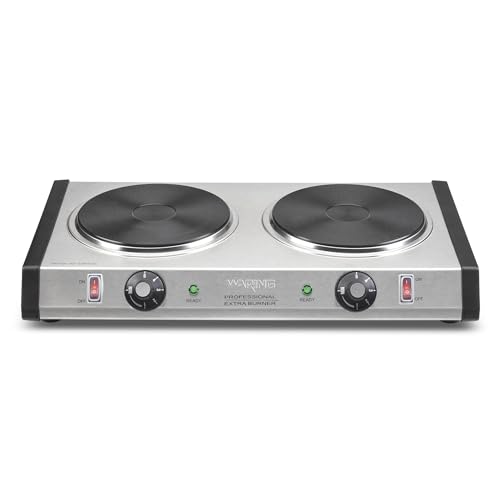
Waring Portable Double Burner WDB600 — Best Heavy-Duty
Waring builds equipment for professional kitchens, and the WDB600 shows it: two heavy-duty 7.5-inch cast iron plates on a chassis meant to be dragged between catering jobs, church halls and canning sessions. It runs on a standard 120V outlet, which keeps it usable anywhere, but everything about the build is a class above consumer hot plates.
Strengths
- Heavy-duty plates and chassis tolerate large, heavy stockpots
- Commercial build quality aimed at catering and repeated daily use
- Standard 120V plug — no special circuit required
Trade-offs
- Heavier and bulkier than consumer double burners; not a drawer-friendly dorm pick
- Cast iron plates share the slow heat-up and cool-down of the technology
- Priced like professional equipment rather than a casual backup
| Type | Portable double burner, cast iron plates |
| Plate size | 7.5-inch heavy-duty plates |
| Power supply | 120V |
| Intended use | Commercial kitchens and catering (per listing) |
The question this burner answers is not “how fast does it boil” but “will it still be working after its fiftieth event.” Caterers, food-truck support cooks and home canners processing batch after batch put sustained, heavy loads on a burner for hours. Consumer hot plates with thin housings flex, wobble and age quickly under that treatment. The Waring’s plates are sized for big pots and its frame is built to be carried, stacked in a van and run all afternoon.
At home, it earns its keep during canning season, maple syrup finishing, holiday overflow cooking and any job involving a pot you would hesitate to put on a lightweight unit. It is overkill as a dorm ramen burner, and its weight argues against daily cupboard-to-counter shuffling in a tiny kitchen. But as the heavy-duty end of this category, nothing else on this list is built to the same brief.
Best for: Caterers, canners and anyone running heavy stockpots for hours / Not suited for: Dorm rooms and buyers who need a light, easily stored unit
Check on Amazon — check the current price on Amazon before ordering.

Nuwave Double Pro Induction Cooktop — Best Precision Control
Most portable burners give you a dial numbered one to ten and leave the actual temperature to guesswork. The Nuwave Double Pro instead offers a stated range from 50°F to 575°F and three wattage settings (900W, 1500W, 1800W), which makes it the precision instrument of this group — and the selectable wattage is a quiet gift for RV and dorm circuits that cannot spare a full 1800 watts.
Strengths
- Wide, explicit temperature range suits candy, sous-vide-style holding and proofing tasks
- Selectable 900/1500/1800W settings protect weak dorm and RV circuits
- Induction response is immediate in both directions
Trade-offs
- Requires induction-compatible cookware, like all induction units
- More settings means a slightly longer learning curve than a simple dial
- Two zones still share the selected total wattage
| Type | Double induction countertop burner |
| Temperature range | 50°F–575°F (per listing) |
| Wattage settings | 900W / 1500W / 1800W selectable |
| Controls | Digital |
Temperature-specific cooking is where this unit separates itself. Holding chocolate at a steady tempering temperature, keeping a delicate custard below a simmer, or maintaining a low, even heat for a long braise are jobs that punish vague dials. A burner that works in degrees rather than arbitrary numbers removes the thermometer-juggling from those tasks, and the low end of the range is genuinely low — closer to a warming/proofing zone than a typical “low” setting.
The wattage selector deserves equal attention. Many dorms, older apartments and RVs have 15-amp circuits shared with everything else in the room. Dropping the cooktop to 900W or 1500W trades some boil speed for the ability to cook without tripping a breaker mid-dinner. If your cooking is mostly high-heat searing for a crowd, a plate burner may suit you better; if your cooking is measured in degrees, this is the one.
A practical way to think about the range: the bottom of it replaces a warming drawer and a proofing box, the middle covers every ordinary simmer and sauté, and the top end reaches the fierce heat a hard sear wants. Few portable burners honestly span all three territories. That breadth is also why this model suits cooking classes, demonstration counters and market stalls, where the same unit might hold a sauce at serving temperature all morning and then sear samples at noon.
Best for: Precision cooks, candy and sauce work, and weak-circuit dorms or RVs / Not suited for: Buyers who want a single dial and no menus to learn
Check on Amazon — check the current price on Amazon before ordering.
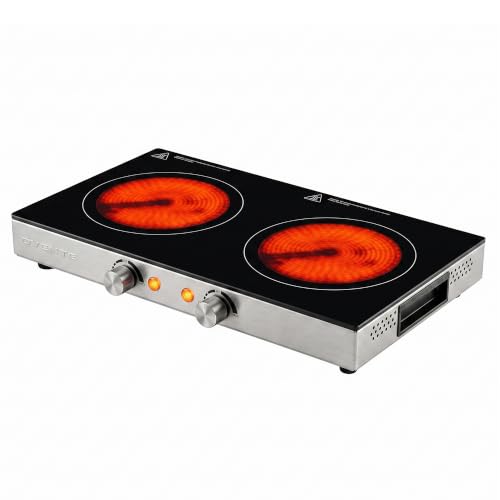
OVENTE Infrared Double Burner BGI302GB — Best for Any Cookware (Infrared)
Infrared is the middle path of this category: a radiant element under ceramic glass that heats any cookware — like a plate burner — but comes up to temperature faster and presents a flat, wipe-clean surface. The OVENTE BGI302GB pairs that technology with dual controllers and 1800 watts in a slim black glass unit that looks at home on a modern counter.
Strengths
- Works with all cookware, including aluminium, glass and copper
- Faster response than cast iron plate burners
- Flat ceramic glass surface is quick to wipe clean
Trade-offs
- The glass surface gets hot across the cooking zone and stays hot after cooking
- Radiant heat is still slower to adjust than induction
- Glass tops demand reasonable care with heavy cast iron cookware
| Type | Infrared double burner, ceramic glass |
| Total power | 1800W |
| Controls | Dual controllers, adjustable heating power |
| Cookware | Works with all cookware (per listing) |
Choose infrared when your pan collection is the immovable object: a beloved aluminium stockpot, a glass casserole, a copper jam pan. Induction rejects them all; a cast iron plate accepts them but heats with a lag. The OVENTE heats them with the even, radiant character of a glass-ceramic hob and trims much of the plate burner’s delay. Dual controllers mean the two zones genuinely cook independently — a simmer on one side is not hostage to a boil on the other.
Respect the surface. The glass will be hot wherever the element glows and remains hot after shutdown, so treat it like a radiant hob: no cold-water splashes on a hot top, no dragging rough cast iron bases across it, and let it cool before the cleaning wipe. Buyers disciplined about those habits get the most versatile non-induction burner in this roundup.
Best for: Mixed pan collections and buyers wanting a sleek, wipe-clean glass top / Not suited for: Households with small children reaching the counter, or rough handling habits
Check on Amazon — check the current price on Amazon before ordering.

COOKTRON Portable Double Induction Cooktop with Knob Control — Best Knob Control
Touch panels look clean until you try to adjust one with wet hands while a pot boils over. The COOKTRON answers with physical knobs on a double induction platform — twist to change power, no menus, no missed taps. Its continuous low-power heating is the other headline: instead of cycling on and off at low settings, it holds a steady gentle output.
Strengths
- Physical knobs work with wet or floury hands and give tactile feedback
- Continuous low-power heating keeps delicate simmers steady
- Two independently controlled induction zones at 1800W total
Trade-offs
- Induction-only: non-magnetic pans will not work
- Knobs and their recesses take slightly more cleaning effort than flat glass touch panels
- Shared 1800W ceiling applies when both zones run hard
| Type | Portable double induction cooktop |
| Total power | 1800W |
| Controls | Knob control, two independent zones |
| Low heat | Continuous low-power heating (per listing) |
The knob-versus-touch debate sounds cosmetic until you cook seriously on both. A knob lets you cut power by feel during a boil-over, bump a simmer without looking, and hand control to a less technical family member with zero explanation. COOKTRON’s implementation keeps induction’s speed and efficiency while restoring that immediacy, which is why this model is the one we would hand to a parent or grandparent upgrading a kitchenette.
Continuous low-power heating matters for the same recipes the Nuwave targets — sauces, custards, slow melts — approached from a different direction: rather than dialling a degree, you get an element that does not pulse. Pulsing is the hidden flaw of many budget induction units at low settings; food surges, rests, surges. A steady low output cooks more gently and predictably. For knob loyalists who still want induction performance, this is the natural pick.
Best for: Cooks who prefer physical knobs, and anyone simmering delicate dishes often / Not suited for: Buyers wanting a completely flat, wipe-over touch surface
Check on Amazon — check the current price on Amazon before ordering.
Comparison Table
The table below lines up the six picks by the specification that most affects daily use. Technology — induction, cast iron plate or infrared — should drive your choice before brand does.
| Pick | Badge | Key Spec | Best For |
|---|---|---|---|
| Duxtop LCD Portable Double Induction Cooktop 9620LS | Best Overall | 1800W dual induction, LCD touch controls | Most buyers wanting one portable cooktop for everyday cooking, dorms and small kitchens |
| CUSIMAX Double Burner 1800W Cast Iron Hot Plate | Best Budget | 1800W twin cast iron plates, all-cookware compatible | Budget buyers, buffet warming, and anyone whose pans are not induction-compatible |
| Waring Portable Double Burner WDB600 | Best Heavy-Duty | Twin 7.5-inch heavy-duty cast iron plates, 120V | Caterers, canners and anyone running heavy stockpots for hours |
| Nuwave Double Pro Induction Cooktop | Best Precision Control | 50°F–575°F range, 900/1500/1800W selectable | Precision cooks, candy and sauce work, and weak-circuit dorms or RVs |
| OVENTE Infrared Double Burner BGI302GB | Best for Any Cookware (Infrared) | 1800W infrared ceramic glass, dual controllers | Mixed pan collections and buyers wanting a sleek, wipe-clean glass top |
| COOKTRON Portable Double Induction Cooktop with Knob Control | Best Knob Control | 1800W dual induction with knobs, continuous low-power heat | Cooks who prefer physical knobs, and anyone simmering delicate dishes often |
How to Choose the Best Burner Cooktops for Your Situation
Start with the job, not the product. A burner bought as emergency backup for a broken range needs to handle your existing pans and a family-sized pot. A dorm burner needs to be light, simple and gentle on a shared circuit. An RV burner needs to store flat and tolerate movement. A catering burner needs a chassis that shrugs off heavy pots and long hours. Write down your job in one sentence and half the catalogue eliminates itself.
Next, choose your heating technology. Induction is fastest and most precise, keeps the surrounding surface cool, and is the easiest to clean, but demands magnetic cookware and shares its wattage between zones. Cast iron plate burners accept every pan, hold heat steadily and cost the least, but respond slowly in both directions. Infrared glass accepts every pan and responds faster than plates, at the cost of a hot glass surface that needs care. There is no universally best technology — only the one that fits your pans and your patience.
Then check the unglamorous specifications. Total wattage on a standard US circuit tops out around 1800W for a plug-in unit; two burners share that budget, so a “double 1800W” unit is not two full-power burners. Plate or zone diameter decides whether your big stockpot actually contacts the heat. And control style — dial, knob, touch or digital — decides whether adjusting the heat mid-recipe is a pleasure or a fight.
Burner Size, Wattage and Circuit Reality
Plug-in burner cooktops live within the limits of a normal wall outlet, and understanding that ceiling prevents the most common disappointment in this category. A single 1800W burner boils water briskly. Split 1800W across two active zones and each side behaves like a medium burner: fine for a sauce and a vegetable side, slow for two big pots at once. If your typical meal is one main pot plus one supporting pan, a shared-power double is perfectly adequate. If you regularly run two large pots hard, the honest answer is two separate single burners on two separate circuits — or accepting sequential cooking.
Diameter matters as much as wattage. A small plate under a wide stockpot wastes energy around the edges and heats unevenly; a plate much wider than the pan wastes energy into the room. Match your most-used pot’s base diameter to the burner’s plate or zone size. Heavy canning kettles and 16-quart stockpots belong on the heavy-duty pick in this guide, not on a lightweight dorm unit whose housing was never designed for that load.
Finally, respect the circuit. Dorms, older apartments and RVs often share a 15-amp circuit with lights, a fridge or a neighbour’s microwave. Models with selectable wattage let you trade speed for reliability. Never run a burner cooktop on an extension cord or power strip unless the cord is rated for the full load — a heavy-duty appliance deserves a direct wall connection.
Single vs Double Burner: Which Layout Actually Fits Your Cooking?
Every pick in this guide is a double burner, because for most households the second zone is what turns a hot plate into a cooking system: pasta in one pot, sauce in the other; rice resting while the stir-fry runs; a kettle held warm beside breakfast. If that picture matches your meals, a double is the right default and the only real question is technology.
There are two honest exceptions. The first is the truly minimal kitchen — a dorm room or bedsit where counter and storage space are measured in centimetres and meals are one-pot by design. There, a single burner is smaller, lighter and cheaper, and the second zone would mostly gather dust. The second exception is the serious two-pot cook: because a double burner shares one outlet’s power, two large pots at a hard boil will both be slow. Two separate single burners on two separate kitchen circuits deliver genuinely independent full power, at the cost of two plugs, two units to store and usually more money. Most people live happily between those extremes with one good double — but it is worth recognising which extreme, if either, is actually you.
Matching a Burner Cooktop to Your Cookware
Cookware compatibility is the fork in the road for this entire category. Induction requires a magnetic base: cast iron and most stainless steel work; aluminium, copper and glass do not, unless the pan has a bonded induction plate in its base. The fridge-magnet test settles any doubt in two seconds — if a magnet sticks firmly to the base, the pan will heat on induction.
Plate and infrared burners impose no material rules, but they do impose shape rules. Flat, heavy bases make full contact and heat evenly; warped or deeply ridged bases rock, waste energy and cook in hot spots. Cast iron cookware on a glass infrared top should be lifted, not slid, to protect the surface. And whatever the technology, a pan far smaller than the zone is fine, while a pan far larger than the plate will heat slowly and unevenly at the edges.
If your kitchen mixes both worlds — some induction-ready pans, some treasured non-magnetic pieces — the practical setups are either an infrared/plate unit that takes everything, or an induction unit plus the willingness to retire two pans. Decide before you buy, not after the first failed dinner.
Living With a Portable Burner: Daily Reality Checks
Noise and heat in the room. Induction units have cooling fans, and on high settings you will hear them — roughly the level of a quiet extractor fan. It is not intrusive, but in a studio flat where the kitchen is also the bedroom, it is part of the appliance’s character. Plate and infrared burners are silent, yet they radiate far more waste heat into the room, which you will feel in summer. Choose your compromise: a little fan noise, or a warmer room.
Counter space and storage. A double burner occupies roughly the footprint of a large chopping board, but it also needs clearance while cooking and a cupboard or shelf while not cooking. Measure the storage spot before buying, not after. Slim induction and infrared models slide into narrow gaps; cast iron plate units are thicker and heavier, and the Waring in this guide is effectively a permanent resident wherever it lands. In RVs, add one more test: does the unit fit the locker with its cord, and can it be wedged so it cannot slide while the vehicle moves?
Cleaning rhythm. Glass surfaces — induction and infrared — want a quick wipe after every use while they are warm-but-safe, which keeps them effortless. Cast iron plates want the opposite routine: infrequent, dry, and patient. Households that cook daily and hate chores tend to be happiest with glass; households that cook in big weekend batches tend to forgive plates everything. Neither is wrong, but mismatching the cleaning style to your habits is how a good burner ends up resented.
Longevity expectations. There is little to wear out on a plate burner beyond its thermostat, which is why cheap ones survive for years in rental kitchens. Induction and infrared electronics are more complex but also more protected, living sealed behind glass. Across the category, the realistic failure points are cords, knobs and control boards — another reason the heavy-duty and knob-controlled picks in this guide exist. Buy the build class that matches how often the burner will actually run.
How to Set Up and Use a Portable Burner Cooktop Safely
Step 1 — Choose the spot. Place the cooktop on a flat, heat-resistant, non-metal surface with clear space around it for air circulation. Keep it away from curtains, paper and the edge of the counter, and never under low cabinets where steam and heat collect.
Step 2 — Plug in directly. Connect the unit straight to a wall outlet, not a power strip or lightweight extension cord. Check that nothing else heavy — a microwave, kettle or space heater — is running on the same circuit, especially in dorms and RVs.
Step 3 — Match pan to burner. Centre a flat-based pan on the plate or zone, sized close to the burner’s diameter. For induction, confirm the pan is magnetic first. Start with the pan in place before switching on; an empty induction zone simply will not run, and an empty plate just wastes heat.
Step 4 — Heat in stages. Bring the burner up to temperature gradually rather than slamming to maximum, particularly with cast iron plates, which keep climbing after you stop. Learn your unit’s lag: plate burners need the dial turned down before the food reaches the simmer you want.
Step 5 — Cook with the residual heat. Plate and infrared burners stay hot after switch-off. Use that: finish sauces, keep sides warm, or start the cool-down while you plate up. Treat the surface as hot until it has fully cooled — because it is.
Step 6 — Clean and store correctly. Once cold, wipe plates or glass with a damp cloth; let burnt-on spills carbonise fully, then brush them off a plate burner rather than soaking it. Coil the cord loosely, store the unit upright in a dry cupboard, and keep heavy objects off a glass top in storage.
A note on first use. New plate and infrared burners often produce a faint odour and a wisp of smoke on their first one or two heat cycles as manufacturing coatings burn off. Run the unit empty at a medium setting for a few minutes in a ventilated room before its first real cooking session, let it cool, and the effect should not return. Induction units, having no exposed element, rarely need this step.
Common Buying Mistakes
Buying two burners and expecting range power. A plug-in double burner shares one outlet’s worth of electricity. Expecting two full-power burners leads to slow boils and disappointment; plan meals around one hard-working zone plus one supporting zone.
Ignoring cookware compatibility. Ordering an induction unit for a kitchen full of aluminium pans is the category’s most common return. Run the magnet test on your key pans before choosing a technology.
Running the unit on a power strip. High-wattage heating appliances and cheap extension leads are a bad combination. Plug directly into the wall, every time.
Overloading a light burner with a canning kettle. Weight limits are real. A full canner can exceed what a dorm-grade housing is built to carry; match heavy jobs to heavy-duty models.
Forgetting residual heat. Plate and infrared tops stay hot long after the dial says off. Burns happen when the cooktop is treated as counter space too soon — keep towels, packaging and hands off until it is cold.
Choosing by headline wattage alone. A well-controlled 1500W burner cooks better than a crude 1800W one. Controls, plate size and build quality decide daily satisfaction more than the last few watts.
Storing the unit dirty or damp. A plate burner put away with food residue on the plates, or a glass top stored under heavy pans, ages years in months. Thirty seconds of cleaning while the unit cools and a sensible storage spot are the cheapest longevity insurance in this category — and the step most often skipped precisely because the appliance is “only” a backup.
Final Recommendation
For most buyers, the Duxtop 9620LS is the burner cooktop to get: fast, precise, easy to clean and equally at home in a dorm, an RV or a full kitchen needing overflow capacity. If your pans are not induction-compatible and the budget is tight, the CUSIMAX cast iron double burner remains the dependable value answer, while the OVENTE infrared splits the difference with all-pan compatibility and faster response. Precision cooks should take the Nuwave Double Pro for its degree-based control and circuit-friendly wattage settings; knob loyalists should take the COOKTRON; and anyone running heavy pots for hours should step up to the Waring WDB600.
Exploring the wider cooktop category? Compare these portables with our guides to Best Double Induction Cooktops, Best Portable Induction Cooktops, Best 2 Burner Gas Cooktops and Best Electric Cooktops, or go back to the full category view in Best Cooktops.
Frequently Asked Questions
Can a portable burner cooktop replace a full stove?
For one or two people cooking simple meals, yes — a good double burner handles pasta, sauces, eggs, stir-fries and reheating comfortably, and many studio-apartment cooks use one as their only hob for years without feeling limited. For families regularly running three or four pots at once, it works better as a supplement, because a plug-in unit shares one outlet’s power across its zones and cannot match a hardwired range feeding every burner independently.
Why does my induction burner beep and refuse to start?
Almost always the pan: induction zones only run when they detect a magnetic pan of a suitable size sitting on the zone. Test the pan base with a fridge magnet. If the magnet does not stick, the pan will never work on induction, whatever the burner.
Is cast iron plate or induction better for simmering?
Both can simmer well, for different reasons. A cast iron plate simmers by thermal mass — steady, forgiving heat. Good induction simmers by precise low power, ideally continuous rather than pulsing. Cheap examples of either can surge; the picks in this guide were chosen partly for their low-end behaviour.
Can I use a burner cooktop in an RV?
Yes, and it is one of the most popular uses. Choose a model that stores flat, confirm your RV circuit can spare the wattage, and consider a selectable-wattage model so you can run at 900W or 1500W when the air conditioner is also drawing power. Secure the unit before driving, obviously.
How do I clean a cast iron plate burner?
Let it cool completely. Wipe away loose debris, and for burnt-on spills, run the plate on medium briefly to carbonise residue, let it cool again, then brush it off. Avoid soaking the unit or using heavy water on the plates; a light wipe is the routine that keeps plates healthy for years.
What size burner do I need for a large stockpot?
Match the plate or zone diameter to the pot base as closely as you can, and check the unit’s build class. A 12- to 16-quart stockpot full of water is heavy; that job belongs on a heavy-duty model like the Waring in this guide, not on the lightest dorm units.


