Disclosure: airfryerkitchensupply.com is reader-supported. When you buy through links on our site, we may earn an affiliate commission at no extra cost to you.
Where to buy
Every machine in this roundup is sold on Amazon, and each verified pick links to its listing so you can check the current price on Amazon before buying. We never print prices — they change too often to stay accurate — and every model below was matched by brand and model against Amazon’s product data feed for this site before it earned a link. One pick in this guide is covered without a link because its exact listing could not be confirmed in the feed at verification time; its review says so plainly.
- Breville Precision Brewer Glass BDC400 — check the current price on Amazon
- Breville Barista Express Espresso Machine (BES870XL) — check the current price on Amazon
- Breville Bambino Plus Espresso Machine (BES500) — check the current price on Amazon
- Breville Bambino Espresso Machine (BES450) — check the current price on Amazon
- Breville Grind Control Coffee Maker (BDC650) — check the current price on Amazon
- Breville Precision Brewer Thermal (BDC450) — sold on Amazon; we could not confirm a live listing match for this exact model in Amazon’s product feed at verification time, so this pick is covered without a link below, with no purchase link.
The best Breville coffee makers come from the Australian brand that dragged home coffee out of the appliance aisle and into café territory. Breville’s range splits into two great families: precision drip brewers that treat filter coffee with laboratory seriousness, and espresso machines that put genuine café technique — real portafilters, real steam — within a home cook’s reach. This guide covers both families together, because that is how Breville shoppers actually shop: the brand is the destination, and the first decision is which kind of coffee household you are.
Five of the six picks below carry verified Amazon listings through this site’s product feed. One — the thermal-carafe version of the Precision Brewer — is covered without a link: repeated attempts to confirm its exact listing in the feed during this batch were throttled by the listing’s rate limits, and this site does not attach purchase links it could not verify. Its review is written to the same depth, with guidance on confirming the exact model and listing before buying anywhere. We would rather show that seam than hide it.
What unifies the range is Breville’s obsession with temperature and control. The drip flagship brews six ways, including a mode that follows specialty-coffee standards and a cold brew setting; the espresso machines heat fast, dose consistently and steam milk to real microfoam. None of it is cheap, and none of it pretends to be: Breville sells to people who taste the difference and are willing to pay for the engineering that produces it. Read the badges by drink first — drip or espresso — and the range sorts itself.
In this guide
Quick Picks
Breville’s two families in six picks: the Precision Brewer in glass (verified) and thermal forms, the Grind Control, and the espresso line from the Barista Express to the two Bambinos.
- Breville Precision Brewer Glass BDC400 — Best Overall: Breville’s drip flagship: a 12-cup glass carafe machine that brews six ways — Gold, Fast, Strong, Iced, Cold Brew and a custom My Brew mode. — Check on Amazon
- Breville Barista Express Espresso Machine (BES870XL) — Best Espresso Machine: The home café benchmark: a manual espresso machine with a built-in grinder, dose-control grinding and a steam wand for true microfoam. — Check on Amazon
- Breville Bambino Plus Espresso Machine (BES500) — Best Compact Espresso: The small-footprint café: a compact semi-automatic with automatic milk texturing and near-instant heat-up, in brushed stainless steel. — Check on Amazon
- Breville Bambino Espresso Machine (BES450) — Best Espresso Value: The entry Bambino: the same fast-heating, compact espresso platform with a manual steam wand, at the friendliest tier in Breville espresso. — Check on Amazon
- Breville Grind Control Coffee Maker (BDC650) — Best Grind-and-Brew Drip: Breville’s grind-and-brew drip machine: whole beans ground per batch, adjustable grind and strength, and a thermal carafe. — Check on Amazon
- Breville Precision Brewer Thermal (BDC450) — Best Thermal Drip: The Precision Brewer’s thermal-carafe configuration — the same six-mode precision platform, ending in insulation instead of glass — covered without a link.
How These Picks Were Chosen
Selection began with Breville’s actual range architecture. We mapped the current line into its drip family — Precision Brewer glass and thermal, Grind Control — and its espresso family — Barista Express, Bambino Plus, Bambino — then verified each model against Amazon listing data feed for this site. Five models confirmed and carry links — the Grind Control only on a later spaced retry, after earlier attempts were rate-limited. One model did not confirm during this batch: the listed rate-limit responses on repeated spaced retries for its searches, so the thermal Precision Brewer is written unlinked with no ASIN and no link, exactly as this site’s rules require when verification cannot be completed. When the feed confirms it in a future pass, the pipeline can upgrade that pick; until then, no guessed link.
Within the verified set, the ordering logic is by household. The Precision Brewer Glass anchors the drip side as the most capable filter machine Breville makes for home use. The Barista Express anchors espresso as the best-selling, most complete starting point in home café. The two Bambinos then split the compact-espresso decision by milk automation: the Plus steams and textures milk automatically, the standard Bambino leaves the wand in your hands and the savings in your pocket. Each pick had to own a distinct job or it was cut, even within one brand.
As always, no prices and no star ratings or review counts appear in this guide — they change too often to print honestly. Specs in the mini spec boxes come only from verified listing data for linked picks; the unlinked pick carries no spec box at all, because we do not print specifications we could not verify in the feed. Where a model’s well-established design facts are discussed, the review language keeps to what the machine is, not to numbers we could not confirm.
The 6 Best Breville Coffee Makers
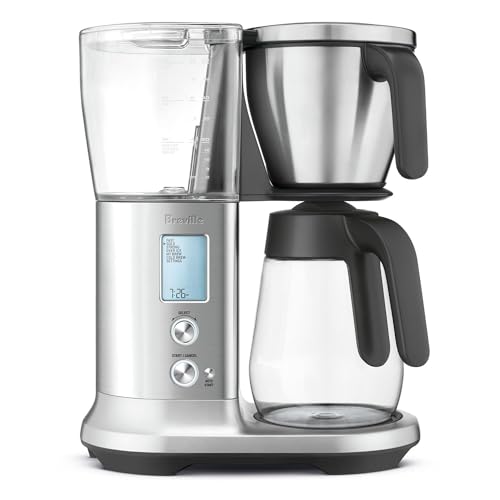
Breville Precision Brewer Glass BDC400 — Best Overall
The Precision Brewer is for filter-coffee drinkers who want café-standard drip without a kettle-and-scale ritual. Its six brewing modes include a Gold setting tuned to specialty-coffee standards for temperature and contact time, a genuine cold brew mode, and My Brew, which lets you set bloom, temperature and flow and save the result. It suits households that drink pots of filter coffee and like one variable to play with. It does not make espresso, and households wanting café milk drinks should start at the Barista Express below.
Strengths
- Six brew modes including standards-tuned Gold and true Cold Brew
- My Brew customization: bloom time, temperature and flow rate control
- 12-cup glass carafe capacity with precise thermal control
Trade-offs
- Glass carafe — the thermal version exists for slow drinkers (unlinked below)
- Premium drip pricing; casual drinkers will not use its range
- Large footprint for a drip machine
| Model | BDC400 Precision Brewer |
| Capacity | 12-cup glass carafe |
| Modes | Gold, Fast, Strong, Iced, Cold Brew, My Brew |
| Finish | Brushed stainless steel |
Most drip machines offer one opinion about coffee and enforce it forever. The Precision Brewer’s six modes are six genuinely different extractions: Fast for weekday pots, Strong for darker roasts and bigger crowds, Iced and Cold Brew for the two different cold drinks those words actually mean, Gold for the standards-based brew that shows what your beans can do, and My Brew for the drinker who has a specific idea and wants the machine to remember it. The bloom control in My Brew alone — letting fresh grounds degas before full flow — puts pour-over technique into a carafe machine, which is the entire Breville drip thesis in one feature.
Temperature precision is the invisible half of the proposition: the brewer holds its set point with the discipline that specialty standards demand, so the Gold mode’s promise is kept in the cup rather than on the box. Ownership is mainstream-simple — a glass carafe, a basket, a showerhead to keep clean, descaling on rhythm — with the standard glass caveat that a pot’s best life is its first hour. For filter households that have outgrown ordinary drip and refuse to go full manual, this is the most capable machine in its class and the correct flagship for this guide.
Breville Precision Brewer Glass BDC400 — Check on Amazon to check the current price on Amazon before buying; listings, bundles and included accessories change over time.
Best for: filter-coffee households that want standards-grade drip plus cold brew / Not suited for: espresso drinkers, or anyone who wants the simplest possible drip machine

Breville Barista Express Espresso Machine (BES870XL) — Best Espresso Machine
The Barista Express is the machine that taught a generation of home drinkers real espresso. It integrates a conical burr grinder with dose control, a 54mm portafilter, low-pressure pre-infusion and a proper steam wand, in brushed stainless steel. It suits drinkers who want the skill and the café result — espresso, lattes and cappuccinos made by hand, better every month as technique grows. It does not suit anyone who wants a button to do it: this is a manual machine, with a learning curve measured in weeks and a payoff measured in years.
Strengths
- Built-in grinder with dose control — fresh grounds, one footprint
- True manual espresso: portafilter, pre-infusion, real extraction control
- Steam wand produces genuine microfoam for latte art and café drinks
Trade-offs
- Learning curve: dialing in takes beans, time and patience
- Manual routine for every drink — no one-touch convenience
- Grinder is good, not endgame; hobbyists may outgrow it in years
| Model | BES870XL Barista Express |
| Type | Manual espresso machine with built-in grinder |
| Grinder | Conical burr, dose-control grinding |
| Milk system | Manual steam wand |
| Finish | Brushed stainless steel |
The Barista Express endures because its compromises are in the right places. The integrated grinder removes the second-appliance barrier that stops most households starting espresso, and dose control keeps the puck consistent while you learn the variables that matter — grind size, dose, tamp, time. Low-pressure pre-infusion wets the puck gently before full pressure, forgiving small distribution errors in a way that makes beginners’ shots drinkable while they improve. The steam wand is a real wand, not a frothing aid: with practice it produces the glossy microfoam that makes a flat white a flat white.
Judge it as a platform for skill. In month one it will make decent espresso and frustrating milk; by month three, most owners are making café drinks they would happily pay for, and the machine’s ceiling rises with them — which is precisely what an automatic cannot offer. The honest costs are time per drink and a counter that becomes a small workstation of tamper, knock box and cloths. For households where coffee is a hobby wearing a breakfast costume, no other pick in this guide is even a candidate. For households where coffee is breakfast, the bean-to-cup guides on this site are the correct door.
Breville Barista Express Espresso Machine (BES870XL) — Check on Amazon to check the current price on Amazon before buying; listings, bundles and included accessories change over time.
Best for: aspiring home baristas who want real technique and café results / Not suited for: anyone who wants espresso at one touch with no learning curve

Breville Bambino Plus Espresso Machine (BES500) — Best Compact Espresso
The Bambino Plus answers the Barista Express’s two objections — size and milk skill — in one compact machine. It heats in seconds, pulls shots from a 54mm portafilter like its bigger sibling, and textures milk automatically to selectable temperature and foam levels, so a cappuccino does not require a month of wand practice. It suits small kitchens, beginners who want café drinks now, and households where counter space is the binding constraint. You bring your own grinder — there is none built in — which is either a cost or an upgrade path, depending on what already lives in your kitchen.
Strengths
- Automatic milk texturing — café foam without wand technique
- Near-instant heat-up; espresso in the time a kettle boils
- Compact footprint that fits kitchens the Express cannot
Trade-offs
- No built-in grinder — budget for one or use pre-ground
- Smaller water tank and drip tray than the Express
- Automatic milk is excellent, but a skilled hand still beats it
| Model | BES500 Bambino Plus |
| Type | Semi-automatic espresso machine |
| Milk system | Automatic milk texturing |
| Finish | Brushed stainless steel |
| Format | Compact countertop |
The Bambino Plus is Breville’s argument that the espresso machine, not the drinker, should absorb the two hardest parts of café coffee at home: waiting for heat and texturing milk. Its thermojet-style fast heating makes the machine ready almost immediately — a genuine behavioral difference, because a machine that is ready in seconds gets used for one drink, while a machine that takes ten minutes gets used for occasions. The automatic milk system then steams and textures to your chosen settings and purges itself, producing the silky foam that beginners otherwise spend weeks chasing.
What it asks in return is a grinder. Paired with even a modest burr grinder, the Plus makes espresso of a standard that embarrasses machines costing far more in total, and the pairing lets you upgrade the grinder later without replacing the brewer — the separates advantage in miniature. In a small kitchen, or a household that wants café drinks without café homework, the Bambino Plus is the most efficient route Breville sells. It is not a lesser Barista Express; it is a different answer, aimed at drinkers who value the result over the ritual.
Breville Bambino Plus Espresso Machine (BES500) — Check on Amazon to check the current price on Amazon before buying; listings, bundles and included accessories change over time.
Best for: small kitchens and beginners who want café drinks without the learning curve / Not suited for: buyers who need an integrated grinder in one box
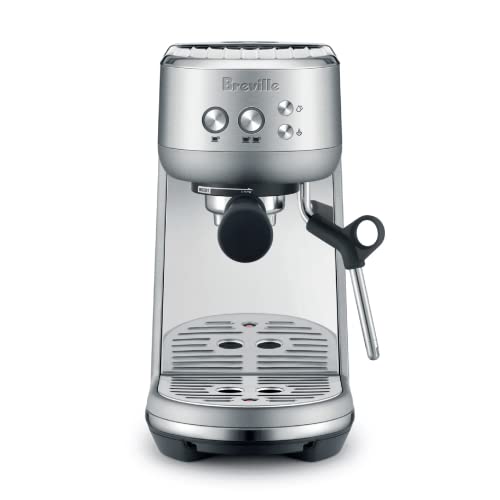
Breville Bambino Espresso Machine (BES450) — Best Espresso Value
The standard Bambino keeps the platform’s essentials — compact body, fast heat-up, 54mm portafilter espresso — and returns milk to a manual steam wand, which is exactly the right saving for beginners on a budget and for drinkers who want to learn the wand anyway. It suits first espresso machines, small counters and anyone pairing it with a grinder they already own. If milk drinks are your main order and you know you will not practice steaming, the Plus above is worth its premium; the wand is this machine’s tuition, and it must be paid in practice.
Strengths
- The compact, fast-heating Bambino platform at the entry tier
- Manual steam wand teaches real milk technique from day one
- Beginner-friendly design without toy-machine compromises
Trade-offs
- No built-in grinder and no automatic milk
- Manual wand results vary until technique develops
- Small tank and tray suit singles and couples best
| Model | BES450 Bambino |
| Type | Semi-automatic espresso machine |
| Milk system | Manual steam wand |
| Positioning | Beginner-friendly, compact |
| Finish | Brushed stainless steel |
Every range needs an honest front door, and the Bambino is Breville espresso’s. It refuses the two cheats of cheap espresso — pressurized-only shortcuts and toy construction — and instead gives the beginner the real platform in its simplest form: proper portafilter brewing, fast and stable heating, and a wand that will make exactly the milk your current skill produces. That honesty is why it works as a first machine. Nothing you learn on it has to be unlearned later, and its shots, with a decent grinder, are genuinely café-comparable.
The comparison with the Plus is the whole decision, so let the review make it cleanly: the Plus buys you automatic milk and a few refinements; the Bambino buys you the same espresso for less, with milk as a skill to grow into. Black-coffee espresso drinkers should take the Bambino and never look back. Milk drinkers should ask themselves one question — will I practice a wand for two weeks? — and let the answer choose. Either way, budget for the grinder neither machine includes; espresso is ground coffee under pressure, and the grinder is half the system.
Breville Bambino Espresso Machine (BES450) — Check on Amazon to check the current price on Amazon before buying; listings, bundles and included accessories change over time.
Best for: beginners and espresso-first drinkers on a sensible budget / Not suited for: milk-drink households unwilling to learn a steam wand

Breville Grind Control Coffee Maker (BDC650) — Best Grind-and-Brew Drip
The Grind Control occupies the niche between drip and bean-to-cup: it grinds whole beans fresh for each brew, in adjustable quantity, and brews anything from a single cup to a full thermal carafe of filter coffee. It suits drip households that want the freshness jump of grinding per pot without an espresso machine’s cost or ritual, and its thermal carafe suits households that drink a pot across the morning rather than in one sitting.
Strengths
- Grinds fresh for every batch — single cup to full carafe
- Thermal carafe keeps filter coffee hot without a warming plate
- Adjustable grind and strength controls for different beans
Trade-offs
- Thermal carafe size suits pots, not mugs — single-cup mode still brews through the carafe path
- Grinder adds noise and a cleaning step plain drip machines skip
- Filter coffee only — no espresso, no milk system
| Model | BDC650 Grind Control |
| Carafe | Thermal carafe |
| Grinder | Built-in grinder, adjustable grind |
| Controls | Adjustable strength settings |
| Finish | Brushed stainless steel |
The Grind Control’s idea is the freshness argument applied to drip: coffee stales fastest after grinding, so grind inside the machine, seconds before the water hits. Its execution is what earns the pick — the grind quantity calibrates to the brew size you selected, the burrs adjust for bean and taste, and the thermal carafe receives the finished coffee without a flavor-cooking hotplate. For a household that drinks filter coffee all morning, it collapses two appliances into one footprint and removes the stale-canister problem that quietly undermines most home drip.
The ownership trade is a grinder’s: burrs and the grind chute want regular brushing, oily beans are unkind to the mechanism, and a grind-and-brew will always be louder at dawn than a silent drip machine. None of that is hidden in this review. One buying note: this model’s listing was confirmed only on a later verification pass during this batch, after earlier API attempts were rate-limited — a reminder to confirm the exact BDC650 configuration and its included thermal carafe on the listing before buying, as bundles in this category change. The machine itself will do the rest.
Breville Grind Control Coffee Maker (BDC650) — Check on Amazon to check the current price on Amazon before buying; listings, bundles and included accessories change over time.
Best for: drip households wanting fresh-ground coffee without a separate grinder / Not suited for: espresso drinkers, or buyers who need a verified link before purchasing
Breville Precision Brewer Thermal (BDC450) — Best Thermal Drip
The thermal Precision Brewer is the glass flagship’s platform with the keeping problem solved: the same six brewing modes and temperature precision, dispensed into a double-wall thermal carafe instead of glass on a plate. It is the correct Precision Brewer for households that brew a pot and drink it across hours. This pick is not linked: its exact listing could not be confirmed in the feed during this batch’s rate-limited verification window, so no link is attached. Confirm the BDC450 model number and thermal carafe on any listing before buying.
Strengths
- Full Precision Brewer platform: six modes, precise temperature
- Thermal carafe — hours of heat with no stewed warming-plate flavor
- The slow-drinking household’s version of the flagship
Trade-offs
- Unlinked pick: listing not confirmed in the feed at verification time
- Thermal carafe hides the remaining level
- Flagship-tier pricing, like the glass version
Everything said about the glass Precision Brewer’s brewing applies here — the Gold mode’s standards-based extraction, the cold brew, the customizable My Brew — because the platform is shared. The difference is purely what happens after the brew, and for a large class of households it is the difference that matters most: coffee that stays hot by insulation keeps its brewed character for hours, while coffee that stays hot by plate slowly becomes a different, lesser drink. If your pot’s life is measured in hours, the thermal configuration is not an upgrade to the flagship; it is the flagship, correctly specified.
The capacity honesty from our drip guides applies: a 12-cup carafe is a household pot, and it brews its best at generous volumes. Pair that with thermal keeping and you have the natural machine for weekend houses, home offices and slow mornings. As with the Grind Control above, treat this review as a model guide rather than a listing: verify the exact model and carafe on the listing you buy from, check the current price on Amazon when a confirmed listing is available, and let the platform’s reputation — established by its verified glass sibling at the top of this guide — carry the decision.
This pick is covered without a link: search Amazon by the exact model name and number before buying, and confirm the seller, the model variant and the included accessories on the listing, because we did not attach a purchase link to an unverified listing.
Best for: slow-drinking households wanting flagship drip with thermal keeping / Not suited for: prompt drinkers (glass is fine) or anyone needing a verified link today
Comparison Table
| Pick | Badge | Key spec | Best for |
|---|---|---|---|
| Breville Precision Brewer Glass BDC400 | Best Overall | 6 brew modes incl. Gold & Cold Brew, My Brew custom | filter-coffee households that want standards-grade drip plus cold brew |
| Breville Barista Express Espresso Machine (BES870XL) | Best Espresso Machine | Built-in grinder, manual espresso, steam wand | aspiring home baristas who want real technique and café results |
| Breville Bambino Plus Espresso Machine (BES500) | Best Compact Espresso | Auto milk texturing, fast heat-up, compact | small kitchens and beginners who want café drinks without the learning curve |
| Breville Bambino Espresso Machine (BES450) | Best Espresso Value | Compact manual-wand espresso, entry tier | beginners and espresso-first drinkers on a sensible budget |
| Breville Grind Control Coffee Maker (BDC650) | Best Grind-and-Brew Drip | Grind-and-brew drip, thermal carafe, adjustable grind | drip households wanting fresh-ground coffee without a separate grinder |
| Breville Precision Brewer Thermal (BDC450) | Best Thermal Drip | Precision platform, thermal carafe — no link | slow-drinking households wanting flagship drip with thermal keeping |
Split the table by family first. The drip side (Precision Brewer glass and thermal, Grind Control) competes on extraction control and keeping: glass for prompt pots, thermal for slow ones, grind-and-brew for freshness. The espresso side (Barista Express, Bambino Plus, Bambino) competes on automation: full manual with integrated grinder, compact with automatic milk, or compact with a manual wand and an entry price. The unlinked pick is flagged in the table’s spirit if not its cells — its platform is proven; its listing simply was not confirmed in this batch’s verification window.
How to Choose the Best Breville Coffee Makers
Decide your drink before your machine, because Breville’s two families do not substitute for each other. Filter households — pots of black coffee, cold brew in summer, guests served from a carafe — belong on the drip side, choosing among the Precision Brewer’s glass or thermal keeping and the Grind Control’s fresh-ground convenience. Café households — espresso, lattes, cappuccinos — belong on the espresso side, and no drip machine’s ‘strong’ mode will change that. Breville sells both because both are real; the only wrong purchase is the family that does not match your mornings.
Within espresso — how much automation do you actually want?
The espresso trio is a clean automation ladder. The Bambino gives you real espresso and a manual wand at the entry tier: you are the automation. The Bambino Plus automates the milk — the hardest skill — while you still pull the shots. The Barista Express automates the grinding and dosing while returning milk and extraction to your hands, inside one integrated footprint. Notice that none of the three is ‘the automatic one’: Breville’s full automatics are the bean-to-cup machines covered in this site’s other guides. Breville espresso is for people who want a hand in the drink; choose your rung by which tasks you want that hand to do.
The grinder question, answered honestly
Two of the espresso picks include no grinder, so the budget conversation must include one. Espresso extraction is brutally sensitive to grind quality — a poor grinder makes a good machine look broken — so pairing a Bambino with the cheapest blade grinder available is false economy. A competent burr grinder is part of the Bambino system’s true price, and this guide would rather say so than let a reader discover it through a month of sour shots. The Barista Express’s integrated grinder exists precisely to remove that pairing problem for beginners; separates buyers accept it in exchange for an upgrade path.
Finally, water and upkeep scale with ambition. Precision drip and espresso machines both reward filtered water and rhythmic descaling, and espresso adds group-head and wand hygiene to the contract. None of it is heavy — minutes a week — but Breville ownership is participation, not pod-style abdication. Buy the machine whose participation you will enjoy; that, more than any spec in this guide, predicts whether it is still on your counter in five years.
Breville Drip vs Breville Espresso: Owning Both Families
A surprising number of Breville households end up owning one machine from each family, and the logic is sound enough to state plainly. The drip flagship serves the household’s volume drinking — morning pots, guests, cold brew — with push-button ease, while the espresso machine serves the ritual drinking: the after-dinner shot, the weekend flat white, the hobby itself. Each machine does the job it is engineered for instead of compromising toward the other, and the combined footprint is smaller than the resentment of forcing one machine to be both.
If budget forces one machine first, buy for the daily drink, not the aspirational one. The household that drinks drip six days a week and espresso on Sundays should own the Precision Brewer first and let Sunday be a café visit until the espresso machine’s turn comes. The reverse order produces the category’s saddest object: a beautiful espresso machine used twice a month, beside a drip machine nobody respects making the coffee everybody actually drinks. Sequence by habit, and both purchases will feel inevitable rather than indulgent.
A Note on the New Breville Luxe Brewer Line
Shoppers researching this guide will meet a newer name in Breville’s drip range: the Luxe Brewer, which appeared in this site’s product feed during this batch’s verification in both thermal and glass carafe configurations, with hot coffee and cold brew and customizable settings. It reads as Breville’s next-generation drip direction — a more intuitive interface on the precision platform, in finishes including brushed stainless and Damson Blue. We did not promote it into the six picks for one honest reason: this guide was built and verified around the established range, and a brand-new line deserves a full evaluation cycle rather than a borrowed verdict based on a listing.
The practical guidance is simple. If you are buying today and want the proven platform with the deepest owner knowledge behind it, the Precision Brewer picks above remain the recommendation — their behavior across years and beans is known. If the Luxe Brewer’s design and interface appeal to you, it comes from the same drip engineering culture, and its feed listings confirm it is a real, current Breville line rather than a rumor; judge it as a new model, with a new model’s normal caveat that long-term owner history is still being written. Either way, the family’s logic from the buying guide applies unchanged: choose by drink, by keeping style, and by the cleaning rhythm you will actually keep. New Breville lines also tend to hold their place in the range for years once launched, so a buyer who prefers the Luxe’s direction is not buying an experiment — they are buying the platform’s future, with the small, normal uncertainty that any first-generation purchase carries in any category of durable goods.
How to Set Up a Breville Coffee Maker — Drip and Espresso First Steps
Breville machines reward a deliberate first session in both families. These steps cover the shared foundations — water, first flush, calibration — and the first calibration that matters in each family, so your first week starts from the machine’s real standard.
- Flush before you brew. On any model, fill the tank with fresh water and run a full water-only cycle (drip) or several blank shots and steam purges (espresso) before the first real coffee. It clears the water path and teaches you the machine’s sounds while nothing is at stake.
- Set water hardness and use the filter. Breville machines track descaling by water settings; enter yours honestly at setup, and use the supplied filter where fitted. Precision heating elements are the first casualty of scale in both families.
- Drip: run the Gold mode first. On a Precision Brewer, brew your usual beans on Gold before touching My Brew. Gold is the reference extraction; customize from a known baseline instead of wandering among settings with no anchor.
- Espresso: dial in with one bean and patience. On Barista Express or Bambino, fix your dose, then adjust grind in small steps, timing shots and tasting each. Change one variable per round. Expect the first bag to be tuition; the second bag is where the machine starts showing off.
- Learn the milk system on day one. Automatic texturing (Bambino Plus): run the purge cycle and learn its settings with watery practice milk if you like. Manual wands: practice on water with a drop of dish soap — the classic training substitute — before spending milk on technique.
- Start the cleaning rhythm immediately. Backflush or group cleaning on espresso models per the manual’s schedule, showerhead wipes on drip, and a carafe that never sleeps with coffee in it. Week-one habits are the ones still protecting the machine in year five.
After setup, Breville ownership becomes a pleasant loop of small calibrations: a grind step when the beans change, a My Brew tweak when a new roast arrives, a descale when the machine asks. Resist the urge to adjust everything at once, forever. These machines are precise enough that single changes are legible in the cup — which is the entire pleasure of owning one.
Common Buying Mistakes
Pairing a Bambino with a bargain blade grinder
Blade-ground coffee cannot extract evenly under espresso pressure, and the machine will be blamed for sour, channelled shots. The Bambinos assume a burr grinder partner; budget for one as part of the system, or buy the Barista Express and let its integrated grinder carry the beginner phase.
Customizing My Brew before tasting Gold
The Precision Brewer’s custom mode is powerful and therefore an excellent way to get lost. Gold mode is the calibrated reference — brew it first, learn what your beans taste like at standard, and only then customize with a target in mind.
Judging espresso on the first bag of beans
Dialing in consumes beans and patience, and the first bag through any new espresso setup is partly tuition. Owners who expect café shots on day two blame good machines; owners who budget a learning bag discover what the machine actually does by week two.
Leaving milk on the wand ‘until later’
Milk bakes onto steam wands in minutes and into them in hours. Wipe and purge after every use — it is a five-second habit that separates café-standard home espresso from a hygiene project. Automatic systems purge themselves; manual wands make you the system.
Buying the family your mornings do not drink
An espresso machine in a drip household and a drip flagship in an espresso household are the same mistake in opposite directions. Audit a real week of your drinking before choosing the family; aspiration is a poor substitute for habit at these prices.
Final Recommendation
Breville’s range gives drip and espresso households each a flagship and a ladder. For filter coffee, the Precision Brewer Glass is the verified flagship — six modes, standards-grade extraction, cold brew — with its thermal configuration as the slow-drinking alternative — covered without a link until its listing confirms — and the Grind Control as the fresh-ground route. For espresso, the Barista Express remains the complete starting platform, the Bambino Plus the compact automatic-milk answer, and the Bambino the honest entry door.
Choose the family by your mornings, the model by your appetite for participation, and feed whichever you buy fresh beans, filtered water and a cleaning rhythm. Breville machines repay exactly that level of respect with coffee that justifies their reputation — and their price.
- Best Overall: Breville Precision Brewer Glass BDC400
- Best Espresso Machine: Breville Barista Express Espresso Machine (BES870XL)
- Best Compact Espresso: Breville Bambino Plus Espresso Machine (BES500)
- Best Espresso Value: Breville Bambino Espresso Machine (BES450)
- Best Grind-and-Brew Drip: Breville Grind Control Coffee Maker (BDC650)
Keep reading in this coffee makers series: Best Bonavita Coffee Makers Best Braun Coffee Makers Best Bean To Cup Coffee Makers Best Bean To Coffee Makers Best 12 Cup Coffee Makers
Frequently Asked Questions
Is Breville the same as Sage?
Yes — the same company sells its espresso and coffee machines under the Sage name in the UK and parts of Europe, and as Breville in Australia, the US and elsewhere. Model lineups correspond closely across the two badges. If you are researching a Breville model and find Sage reviews of a similarly numbered machine, you are almost certainly reading about the same platform.
Which Breville is best for a beginner?
It depends on the drink. For espresso beginners who want café drinks quickly, the Bambino Plus removes the hardest skill — milk — and heats almost instantly; pair it with a burr grinder. For beginners who want to learn the craft, the Bambino or Barista Express teaches real technique. For drip beginners, the Precision Brewer on its Gold mode is effectively a tutor: one button, standards-grade coffee.
Do Breville espresso machines need a separate grinder?
The Bambino and Bambino Plus do — neither has one built in, and espresso requires a capable burr grinder as part of the system. The Barista Express includes an integrated grinder with dose control, which is a major reason beginners choose it. When comparing prices, compare systems: Bambino plus grinder against the Express as a whole.
What is the Precision Brewer’s Gold mode?
Gold is Breville’s preset that brews to specialty coffee standards — the temperature, contact time and extraction parameters the Specialty Coffee Association defines for quality filter coffee. It is the mode to judge the machine and your beans by, and the baseline from which the My Brew custom mode lets you experiment with bloom, temperature and flow.
Why is one pick in this guide unlinked?
Because its exact Amazon listing could not be confirmed in this site’s product feed during this batch — repeated verification attempts were rate-limited by the listing — and this site never attaches a purchase link it has not verified. The Precision Brewer Thermal is covered in full as a model, with guidance to confirm the exact model number and configuration on any listing before buying. Its sibling in this guide, the Grind Control, was confirmed only on a later spaced retry, which is exactly how this process is supposed to work.
How long do Breville coffee makers last?
Breville’s coffee machines are built and priced as long-term appliances, and with filtered water, on-schedule descaling and basic hygiene — especially milk-system care on the espresso side — owners keep them for many years. The brand’s parts and accessory ecosystem is a practical plus. As with all heated-water machines, neglected scale is the most common cause of a premature end.


