Disclosure: airfryerkitchensupply.com is reader-supported. When you buy through links on our site, we may earn an affiliate commission at no extra cost to you.
Where to buy
Every machine in this roundup is sold on Amazon, and each verified pick links to its listing so you can check the current price on Amazon before buying. Prices are never printed in this guide — they move too often to stay truthful — and each model below was matched by brand and exact model number against Amazon’s product data feed for this site before it was given a link.
- De’Longhi Dinamica Espresso Machine, Black (ECAM35020B) — check the current price on Amazon
- De’Longhi Dinamica Plus Fully Automatic Espresso Machine — check the current price on Amazon
- De’Longhi Eletta Explore Espresso Machine — check the current price on Amazon
- Philips 4400 Series Fully Automatic Espresso Machine with LatteGo (EP4444/90) — check the current price on Amazon
- Philips 3300 Series Fully Automatic Espresso Machine with LatteGo (EP3341/50) — check the current price on Amazon
- Bosch Series 6 Fully Automatic Coffee and Espresso Machine — check the current price on Amazon
The best bean to cup coffee makers share one promise: whole beans go in, a finished drink comes out, and everything between — grinding, tamping, extraction, milk — happens inside the machine. If you searched the shorter phrase bean to coffee makers, you landed in the same place; bean-to-cup is simply the name the industry settled on for these fully automatic espresso machines, and this guide is the deeper cut of the category, built around the models that reward a closer look at profiles, cold drinks and long-term running costs.
Where our companion guide starts with the mainstream favorites, this one starts with a question: what do you get when you move one step beyond the obvious? The answer, across these six machines, is personalization that survives contact with a real household — user profiles that remember four different drinks exactly, cold-extraction technology that makes genuine cold brew from an espresso machine, touchscreens that behave like appliances rather than tablets, and milk systems designed around how people actually store and clean things. Every pick grinds fresh beans for every drink; none uses pods; all were verified against this site’s Amazon product feed.
One framing note that will save you money: bean-to-cup machines are not ranked on a single ladder. A machine with fifty recipes is not fifty times better than one with five — it is better for a household that drinks fifty ways and worse for one that wants a single button and no menus. Read the badges in this guide as job descriptions. The right machine is the one whose strengths overlap your actual habits, and whose cleaning routine you will still be performing, without resentment, three years from now.
In this guide
Quick Picks
Six bean-to-cup machines chosen for depth rather than familiarity — profiles, cold drinks, touchscreens and the two best current expressions of the LatteGo idea.
- De’Longhi Dinamica Espresso Machine, Black (ECAM35020B) — Best Overall: The segment’s benchmark all-rounder: automatic bean-to-cup brewing, a built-in steel burr grinder, a manual frother and genuinely easy cleanup. — Check on Amazon
- De’Longhi Dinamica Plus Fully Automatic Espresso Machine — Best for Personalization: Profiles done properly: personalized drinks for up to four users, 24+ recipes and an automatic milk steam wand with three frother modes. — Check on Amazon
- De’Longhi Eletta Explore Espresso Machine — Best for Hot and Cold Drinks: The cold-drink flagship: 50+ one-touch recipes including genuine cold extraction, hot and cold milk frothing and travel-mug-friendly design. — Check on Amazon
- Philips 4400 Series Fully Automatic Espresso Machine with LatteGo (EP4444/90) — Best Mid-Range LatteGo: The sweet-spot Philips: 12 hot and iced presets, LatteGo milk, SilentBrew quiet grinding and QuickStart in a black chrome finish. — Check on Amazon
- Philips 3300 Series Fully Automatic Espresso Machine with LatteGo (EP3341/50) — Best Value Bean-to-Cup: The current entry to LatteGo ownership: 5 hot and iced presets, a ceramic grinder and customizable strength and cup size without flagship cost. — Check on Amazon
- Bosch Series 6 Fully Automatic Coffee and Espresso Machine — Best Touchscreen Machine: The interface pick: a 3.7-inch touchscreen, 25 drinks, XL to-go sizes, instant start and combined cleaning and descaling programs. — Check on Amazon
How These Picks Were Chosen
Selection for this guide began with the full bean-to-cup field and one hard rule: a machine qualifies only if it grinds whole beans internally as part of making each drink. Every candidate was matched by brand and exact model against Amazon listing data feed attached to this site, and only confirmed listings carry Amazon links here. Models we could not match with confidence would have been covered without a link rather than linked on a guess — none of the six below needed that fallback.
To keep this guide from duplicating our bean to coffee roundup, we deliberately built it around the category’s second axis: depth features. The picks therefore emphasize user profiles (Dinamica Plus), cold extraction (Eletta Explore), the current mid-range of the LatteGo system (Philips 4400 and 3300), the touchscreen-and-capacity approach (Bosch Series 6) and the all-round automatic that anchors the segment (Dinamica). If a machine’s only distinction was being a slightly different trim of a pick in the companion guide, it was cut.
Ownership arithmetic was the third filter. Bean-to-cup machines consume filters, descaler and cleaning tablets for their entire lives, and brands differ sharply in how that ecosystem works — how the machine tracks it, what the consumables are, and whether the brew group rinses under your tap or cleans itself through programmed cycles. We favored machines whose maintenance story is transparent and largely self-managed, and we say plainly in each review where a brand locks you into its own consumables.
As with every guide on this site, you will find no printed prices and no star ratings or review counts here. Prices shift with bundles and seasons, and ratings shift daily; both would mislead more than they inform. Each linked pick invites you to check the current price on Amazon, and each spec box contains only details confirmed in the verified listing data for that model.
The 6 Best Bean to Cup Coffee Makers

De’Longhi Dinamica Espresso Machine, Black (ECAM35020B) — Best Overall
The Dinamica in black is the bean-to-cup machine for buyers who want the category’s core experience without paying for a touchscreen or a fifty-drink menu. Its steel burr grinder, one-touch hot and iced coffee and manual frother cover the drinks most people make, and its cleanup routine is the one owners consistently describe as painless. It suits black-coffee-first households that also steam milk a few times a week; daily latte households should budget for an automatic-milk model instead.
Strengths
- Built-in steel burr grinder with consistent, repeatable dosing
- One-touch hot and iced coffee from the same brew group
- Brew group and parts designed for easy, genuinely quick cleanup
Trade-offs
- Manual frother — you steam milk yourself, drink by drink
- No user profiles; settings are shared by the whole household
- Black finish shows dust and fingerprints more than steel rivals
| Type | Fully automatic bean-to-cup espresso machine |
| Grinder | Built-in steel burr grinder |
| Milk system | Manual frother (steam wand) |
| Drinks | One-touch hot and iced coffee, espresso |
| Color | Black |
The Dinamica’s longevity in De’Longhi’s range tells its own story: this is the platform the brand’s reputation in bean-to-cup was built on, refined rather than replaced. The steel burr grinder is the headline difference from cheaper automatics — steel holds an edge, grinds consistently as beans change, and gives the espresso a repeatability that makes dialing in a new bag a two-drink job rather than a weekend project. One-touch iced coffee, brewed hot over ice from the same group, is more than a gimmick in warm months; it is the feature that stops owners buying a second appliance every summer.
Cleanup is the other half of the Dinamica’s case, and De’Longhi’s own listing language — easy cleanup — is, for once, accurate. The brew group removes and rinses, the drip tray components are sensibly sized, and the machine’s descaling routine is guided rather than improvised. The manual frother is the honest limitation: it produces excellent milk in practiced hands and homework in unpracticed ones. If your household’s milk drinking is occasional or enthusiastic, that trade is well judged. If it is daily and reluctant, the LatteCrema and LatteGo machines in this guide and its companion exist precisely for you.
De’Longhi Dinamica Espresso Machine, Black (ECAM35020B) — Check on Amazon to check the current price on Amazon before buying; listings, bundles and included accessories change over time.
Best for: buyers who want the proven bean-to-cup core without flagship pricing / Not suited for: daily latte households that refuse to touch a steam wand

De’Longhi Dinamica Plus Fully Automatic Espresso Machine — Best for Personalization
The Dinamica Plus is the answer to the shared-machine problem. Four user profiles store each person’s drinks — strength, volume, milk texture across three frother modes — so the machine stops being a compromise and starts being four people’s machines in one housing. It suits households of three or more drinkers with fixed, different orders. Couples with identical tastes are paying for profiles they will never create.
Strengths
- Up to 4 user profiles with fully personalized drink settings
- 24+ recipes — breadth with structure, not just menu padding
- Automatic milk steam wand with 3 frother modes for texture choice
Trade-offs
- Premium tier within the De’Longhi range
- Profile setup takes an evening of deliberate configuration
- Automatic wand still needs a wipe and purge after milk use
| Type | Fully automatic bean-to-cup espresso machine |
| Profiles | Up to 4 user profiles |
| Recipes | 24+ recipes |
| Milk system | Automatic milk steam wand, 3 frother modes |
| Grinder | Built-in grinder |
Most bean-to-cup personalization is shallow: a strength button and a volume slider that reset when the next person walks up. The Dinamica Plus treats profiles as the product. Each of four users gets their own drink list, tuned once and recalled forever, including milk texture — because the difference between one person’s cappuccino and another’s is usually the foam, and the three frother modes let the machine respect that. For households where the morning queue involves negotiation, this ends it: everyone presses their own name.
The 24-plus recipe list earns its length the same way, by spanning genuinely different drinks rather than size variants, and the automatic steam wand bridges the gap between wand control and carafe convenience — milk is steamed automatically to the selected texture without a separate carafe to refrigerate. It still asks for the wand discipline of a purge and a wipe, which is the correct price for foam quality this good from an automatic. As a step up from the standard Dinamica, the Plus is not about better espresso; it is about a better-shared machine, and judged on that it is the strongest personalization play in this guide.
De’Longhi Dinamica Plus Fully Automatic Espresso Machine — Check on Amazon to check the current price on Amazon before buying; listings, bundles and included accessories change over time.
Best for: households of 3+ drinkers with different fixed orders / Not suited for: solo drinkers or couples who order identically

De’Longhi Eletta Explore Espresso Machine — Best for Hot and Cold Drinks
The Eletta Explore exists for the household whose coffee drinking changes with the weather. Its cold extraction technology brews actual cold brew — not hot coffee poured over ice — alongside the full hot menu and both hot and cold milk foam, which no other pick here attempts. It suits varied, adventurous drinkers and warm climates. Traditionalists who drink hot espresso twelve months a year are funding a cold laboratory they will never switch on.
Strengths
- 50+ one-touch recipes — the widest menu in this guide
- Cold extraction makes true cold brew, plus cold milk foam
- Hot and cold frother covers both drink families properly
Trade-offs
- Flagship pricing and a footprint to match
- Menu depth demands exploration time to get full value
- Cold drinks consume ice and time in ways hot drinks do not
| Type | Fully automatic bean-to-cup espresso machine |
| Recipes | 50+ one-touch recipes |
| Milk system | Hot & cold milk frother |
| Profiles | 4 user profiles |
| Extras | Cold extraction technology, travel mug support |
Cold coffee is where bean-to-cup machines historically gave up — the standard trick of brewing hot over ice produces a drink that is fine, and the Eletta Explore’s cold extraction exists because fine was not the brief. By extracting slowly with cold water under its own process, it produces cold brew with the smoothness that method is known for, from the same hopper and grinder as your morning espresso. Add cold foam — actual textured cold milk, not a splash of cold milk — and the machine covers the iced-latte format properly rather than approximately.
None of this breadth comes at the cost of the hot side: fifty-plus recipes include the full De’Longhi hot repertoire, four profiles keep a household’s preferences separate, and the travel-mug clearance acknowledges how coffee actually leaves modern houses. The Explore is the most expensive idea in this guide and also the most complete one. Buy it if your drinking genuinely spans hot and cold across the year; admire it and buy a Dinamica if it does not. That honesty is the review: this machine’s value is entirely a function of how much of its menu your household will really drink.
De’Longhi Eletta Explore Espresso Machine — Check on Amazon to check the current price on Amazon before buying; listings, bundles and included accessories change over time.
Best for: households that drink hot and cold coffee seriously all year / Not suited for: hot-espresso traditionalists who will never use cold extraction
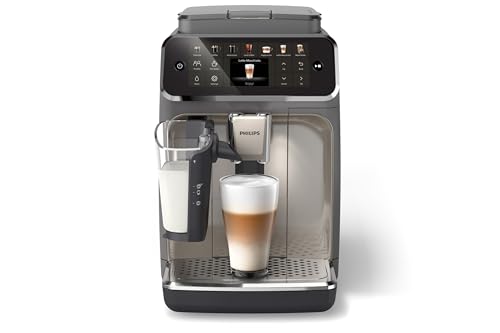
Philips 4400 Series Fully Automatic Espresso Machine with LatteGo (EP4444/90) — Best Mid-Range LatteGo
The 4400 is where Philips’ current line balances itself: meaningfully more menu and refinement than the 3300, meaningfully less flagship than the 5500. Twelve hot and iced presets cover real drinking, SilentBrew makes the grinder a better neighbor, and LatteGo keeps milk cleaning at the category’s easiest. It suits most two-to-four-person households precisely because it refuses extremes in either direction.
Strengths
- 12 hot and iced presets — a menu sized to real households
- LatteGo tube-free milk system, the easiest here to keep clean
- SilentBrew grinding and QuickStart improve the dawn routine
Trade-offs
- Ceramic grinder feel is softer than steel-burr rivals
- Mid-range plastics on touch points despite the chrome finish
- Profiles are lighter-weight than De’Longhi’s Dinamica Plus system
| Type | Fully automatic bean-to-cup espresso machine |
| Milk system | LatteGo milk system |
| Drinks | 12 hot and iced presets |
| Grinder | Integrated grinder with SilentBrew |
| Pressure | 15-bar (per listing) |
Philips’ generational progress is easiest to see in the 4400. The LatteGo system — two pieces, no tubes, rinses in seconds — remains the milk-cleaning benchmark, and around it the newer machine adds the two quality-of-life features owners of older models asked for: a grinder you can run while someone sleeps in the next room, and a start-up sequence that does not make the first cup a scheduling exercise. Twelve presets sounds modest next to fifty, until you list a real household’s week: espresso, coffee, americano, cappuccino, latte, an iced variant or two — the 4400’s menu maps onto actual habits with very little surplus.
The black chrome finish gives it more counter presence than its price tier suggests, and the integrated grinder’s SilentBrew treatment is not marketing garnish — in open-plan homes the grinder is the loudest appliance event of the morning, and quieting it changes whether the machine gets used at 6 a.m. or worked around. Against the Dinamica Plus it offers lighter personalization; against its own 5500 sibling it offers better value. For the household that wants current-generation Philips without flagship money, this is the configuration to buy.
Philips 4400 Series Fully Automatic Espresso Machine with LatteGo (EP4444/90) — Check on Amazon to check the current price on Amazon before buying; listings, bundles and included accessories change over time.
Best for: most households wanting current Philips refinement at a mid tier / Not suited for: profile-heavy households or steel-grinder traditionalists

Philips 3300 Series Fully Automatic Espresso Machine with LatteGo (EP3341/50) — Best Value Bean-to-Cup
The 3300 is the value pick because it protects the two things that matter — fresh ceramic-ground beans and the LatteGo milk system — while trimming menu size and finish. Five hot and iced presets with adjustable strength and cup size describe most people’s real rotation. It suits first-time bean-to-cup buyers and smaller households; large, varied households will outgrow its menu and profiles within a year.
Strengths
- LatteGo milk at the lowest tier in this guide
- Ceramic grinder — cool, quiet-running and long-lived
- Customizable coffee strength and cup size on every drink
Trade-offs
- Only 5 presets; adventurous drinkers will feel the ceiling
- Fewer profiles and conveniences than the 4400 and 5500
- Entry-tier materials and display
| Type | Fully automatic bean-to-cup espresso machine |
| Milk system | LatteGo milk system |
| Drinks | 5 hot and iced presets |
| Grinder | Ceramic grinder |
| Extras | Customizable strength and cup size, hot water |
Value picks in this category usually cheat on the milk system, because that is where the money is. The 3300’s significance is that it does not: you get the same tube-free LatteGo hygiene that defines the expensive Philips machines, attached to a simpler brewer with five presets and honest customization of strength and size. For a first bean-to-cup purchase — where the household is still learning whether it even likes owning one — that is exactly the right place to save: on menu breadth, not on the daily cleaning experience that decides whether the machine stays on the counter.
The ceramic grinder reinforces the value case in a quieter way. It is gentle on beans, runs without the heat transfer of steel, and is built for a long service life, which matters more at this tier than anywhere: a value machine that dies in year three was not a value machine. Keep expectations calibrated — the display, plastics and profile support are all entry-tier, and a household of four varied drinkers should step up to the 4400. For one or two drinkers with a settled rotation, the 3300 is the most rational bean-to-cup purchase in this guide.
Philips 3300 Series Fully Automatic Espresso Machine with LatteGo (EP3341/50) — Check on Amazon to check the current price on Amazon before buying; listings, bundles and included accessories change over time.
Best for: first-time buyers and small households wanting LatteGo on a budget tier / Not suited for: large households with wide-ranging tastes

Bosch Series 6 Fully Automatic Coffee and Espresso Machine — Best Touchscreen Machine
Bosch’s Series 6 suits buyers who judge appliances by their interface and their housekeeping. The large touchscreen makes its 25 drinks genuinely browsable, XL to-go options serve commuters, instant start removes the morning wait, and the combined cleaning-and-descaling program collapses two maintenance chores into one routine. It is a newer name in this category in the US market, so buyers who want a long local track record may lean European-specialist; buyers who want the most appliance-like ownership experience will find it here.
Strengths
- 3.7-inch touchscreen — the clearest interface in this guide
- 25 drinks including XL to-go sizes for commuters
- Combined cleaning and descaling program simplifies maintenance
Trade-offs
- Newer platform in the US bean-to-cup market
- Touchscreen-first design will not charm button traditionalists
- Stainless finish demands wiping to stay fingerprint-free
| Type | Fully automatic bean-to-cup coffee and espresso machine |
| Display | 3.7-inch touchscreen |
| Drinks | 25 drinks, XL to-go options |
| Grinder | Built-in grinder |
| Extras | Instant start, cup warmer, combined clean/descale |
Bosch approaches bean-to-cup as a home appliance company rather than a coffee company, and the Series 6 shows both the strengths of that perspective. The touchscreen is properly sized and legible, the drink list is organized like a menu rather than a settings tree, and details like the cup warmer and instant-start heating treat the machine as part of a kitchen that runs on schedules. Twenty-five drinks including XL to-go sizes recognize a real pattern: a growing share of home coffee leaves the house in a travel mug, and most rival machines make that an afterthought of spout height and volume limits.
The combined cleaning and descaling program is the other appliance-minded touch — one guided routine instead of two separate rituals on two separate schedules, managed by a machine that tracks its own water use. Add a built-in grinder and stainless presentation and the Series 6 makes a coherent case: slightly less espresso-romance than the Italian and Swiss specialists, slightly more everyday usability. For buyers whose priority is a machine the whole household — including its least technical member — can operate and maintain without a manual, it may be the most sensible pick in this entire guide.
Bosch Series 6 Fully Automatic Coffee and Espresso Machine — Check on Amazon to check the current price on Amazon before buying; listings, bundles and included accessories change over time.
Best for: interface-first buyers and commuters who use XL to-go drinks / Not suited for: buyers who want a long-established specialist brand lineage
Comparison Table
| Pick | Badge | Key spec | Best for |
|---|---|---|---|
| De’Longhi Dinamica Espresso Machine, Black (ECAM35020B) | Best Overall | Steel burr grinder, one-touch iced coffee, easy-clean brew group | buyers who want the proven bean-to-cup core without flagship pricing |
| De’Longhi Dinamica Plus Fully Automatic Espresso Machine | Best for Personalization | 4 profiles, 24+ recipes, 3-mode auto milk wand | households of 3+ drinkers with different fixed orders |
| De’Longhi Eletta Explore Espresso Machine | Best for Hot and Cold Drinks | Cold extraction, 50+ recipes, hot & cold frother | households that drink hot and cold coffee seriously all year |
| Philips 4400 Series Fully Automatic Espresso Machine with LatteGo (EP4444/90) | Best Mid-Range LatteGo | LatteGo, 12 presets, SilentBrew, QuickStart | most households wanting current Philips refinement at a mid tier |
| Philips 3300 Series Fully Automatic Espresso Machine with LatteGo (EP3341/50) | Best Value Bean-to-Cup | LatteGo at entry tier, ceramic grinder, 5 presets | first-time buyers and small households wanting LatteGo on a budget tier |
| Bosch Series 6 Fully Automatic Coffee and Espresso Machine | Best Touchscreen Machine | 3.7in touchscreen, 25 drinks, combined clean/descale | interface-first buyers and commuters who use XL to-go drinks |
Two axes organize this table. The first is personalization: the Dinamica Plus and Eletta Explore store profiles for four users, the Philips pair offer lighter profile support, and the Dinamica and Bosch prioritize a shared, simple interface. The second is temperature range: only the Eletta Explore makes true cold drinks, while the Philips 4400 and Dinamica handle iced drinks by brewing over ice. Choose your row by which axis your household actually lives on.
How to Choose the Best Bean to Cup Coffee Makers
Begin with the household census, not the drink menu. Count the drinkers, list each one’s default order, and note where the orders diverge. If everyone drinks the same thing, personalization features are decoration — buy the simpler machine (Dinamica, Philips 3300) and spend the difference on beans. If orders diverge in strength, size or milk texture, profiles stop being a luxury: the Dinamica Plus and Eletta Explore exist for you, and their premium is cheaper than a second machine or a daily argument with the settings menu.
Milk systems, compared honestly
Three milk philosophies appear in this guide. LatteGo (both Philips) mixes milk in a tube-free carafe that rinses in seconds and stores in the fridge — the hygiene champion. De’Longhi’s automatic wand (Dinamica Plus) steams to a chosen texture without a carafe, trading a wipe-and-purge habit for better foam control. The manual wand (Dinamica) gives full control and full responsibility. None is best in the abstract; the best one is the one whose cleaning step you will perform on a tired Tuesday in February. Be honest with yourself at this exact point in the buying process, because this decision, more than any spec, determines whether the machine is loved or resented in year two.
Cold drinks — real feature or brochure filler?
Bean-to-cup cold options come in three grades. Brewing hot over ice (Dinamica, Philips 4400/3300 iced presets) is quick and perfectly pleasant. Cold foam (Eletta Explore) upgrades iced lattes with real texture. True cold extraction (Eletta Explore again) is a different drink altogether — slow, smooth, low-acid cold brew. If your household drinks cold coffee weekly, the Explore’s premium buys something real. If cold coffee is a twice-a-summer event, the over-ice presets on cheaper machines cover it honestly, and the savings buy a great deal of ice.
Close with running costs. Every machine here consumes water filters and descaling or cleaning agents on its own schedule; brands differ in how available and how brand-locked those consumables are. None of it is expensive next to pod coffee, but it is forever, so glance at the ecosystem before you commit to the appliance. A machine whose filter you can buy anywhere, forever, is a machine with one less way to become an orphan.
What Bean-to-Cup Ownership Actually Costs You in Time
Forget money for a moment; the real currency of this category is minutes. A realistic week with any machine in this guide looks like this: a few seconds of automatic rinsing at switch-on and switch-off (the machine does it; you just leave it enabled), a same-day rinse of whatever touched milk, one emptying of the grounds bin and drip tray, and a top-up of beans and water. That is roughly ten minutes a week, plus a guided descale or filter change every month or two depending on your water. Households that describe bean-to-cup ownership as burdensome are almost always describing a skipped milk rinse that became a deep clean — the routine is light precisely as long as it is daily.
The corollary is that the cheapest machine to own is the one whose routine fits your habits, not the one with the smallest purchase price. If you know you will not rinse a milk carafe, buy the wand machine and accept the ritual, or buy LatteGo and make the rinse trivially easy. If you know a descale light will be ignored for months, prioritize machines with strong filtration that stretch the interval. This guide’s reviews flag these ownership shapes deliberately; match them to the household you actually are, not the one the brochure imagines.
Water, Noise and Counter Space: The Specs Nobody Puts in the Headline
Three ownership factors decide more long-term satisfaction than any drink menu, and none of them photograph well. The first is water. Every machine in this guide heats water through narrow passages, and the mineral content of your tap decides how hard those passages work. In soft-water areas, filtration is a taste upgrade; in hard-water areas it is life insurance for the boiler. Philips answers with AquaClean, De’Longhi and Bosch with their own filter and descale ecosystems, and every brand agrees on the underlying point even when their consumables differ: the machine that drinks filtered water and gets descaled on schedule is the machine still brewing in a decade. Check your water hardness before the machine arrives, not after its first warning light.
The second factor is noise, and specifically grinder noise at unsocial hours. A bean-to-cup machine’s grinder runs for a few seconds per drink, but those seconds happen at dawn, in kitchens that share walls with bedrooms. This is why Philips’ SilentBrew treatment on the 4400 and 5500 matters more than its modest billing, and why the placement of the machine — on a solid counter, away from a shared wall — is a legitimate part of the buying decision. If your household includes a light sleeper and a 6 a.m. coffee drinker, weight quiet grinding as heavily as any recipe count.
The third factor is the counter itself. These machines need clearance above for the bean hopper lid and the water tank — several models lift their tanks straight up — and depth for the drip tray to slide out and cups to sit under the spouts. Measure height to your lowest cabinet, depth to your backsplash, and the swing of nearby cabinet doors before ordering any pick in this guide. Flagships like the Eletta Explore and KitchenAid-class machines reward the space they take; in a small kitchen, the compact Dinamica and Philips 3300 footprints are not compromises but features.
How to Get the Best From a Bean-to-Cup Machine in the First Month
The first month with a bean-to-cup machine sets patterns that last for years: the beans you settle on, the grind setting you find, the cleaning rhythm you build. This sequence turns a new machine into a tuned household appliance instead of a gadget still being figured out in month six.
- Week one: pick one bean and stay with it. Choose a fresh medium roast and resist variety. You cannot learn a grinder while the input keeps changing; consistency this week is what makes every later adjustment meaningful.
- Dial the grind in small steps. Adjust one notch at a time, while the grinder runs, and taste at least two drinks before the next change. Aim for espresso that tastes balanced — neither sharp and thin nor bitter and drying — before touching any other setting.
- Set strength and volume per drinker. Program each person’s default order and save profiles where offered. The goal by end of week two: nobody touches a settings menu on a weekday morning.
- Build the milk habit immediately. Whatever system your machine uses, perform its rinse the same day, every day, starting with the very first milk drink. Habits formed in week one are the ones that survive year two.
- Week three: test the cold and long drinks. Try the iced preset, the long coffee and the hot water function, so the machine’s full repertoire is familiar before guests or summer arrive.
- Learn the maintenance screens. Find the filter status, descale countdown and cleaning programs now, while nothing is due. A warning light you have seen in the manual is information; one you have not is an alarm.
- Week four: schedule the consumables. Note which filter and descaler your machine uses and keep one set in the cupboard. Running out mid-descale is the most avoidable annoyance in this category.
After the first month, ownership should feel boring in the best way: beans in, drinks out, ten minutes of care a week. If it does not — if you are still fighting settings or dreading a cleaning task — the problem is almost always one unformed habit from the list above, not the machine. Go back to that step rather than shopping for a replacement.
Common Buying Mistakes
Confusing recipe count with coffee quality
Fifty recipes and five recipes can share near-identical espresso hardware. The menu is software; the grinder, brew group and boiler are the coffee. Judge machines by hardware and cleaning design first, then let menu breadth break ties between finalists.
Setting profiles once and never revisiting them
Beans change, seasons change, taste changes. A profile saved in January for a dark winter blend will be wrong for a lighter bag in June. Revisit grind and strength whenever the beans change — two minutes of adjustment protects weeks of mediocre cups.
Leaving beans in the hopper for weeks
A hopper is not storage. Beans stale in the open air of a warm machine, and oils build on the grinder path. Keep roughly a week’s beans in the hopper and the rest sealed in a cool cupboard; the last drink of the bag will taste like the first.
Running the machine on unfiltered hard water
Scale is the silent killer of every heated water appliance, and bean-to-cup machines concentrate the risk in small, expensive passages. Use the machine’s filter system or filtered water from the start — retrofitting good habits after the first scale warning is closing the gate late.
Buying for guests instead of the household
The dinner-party argument inflates tanks, menus and budgets. Guests drink what the household drinks, happily, a few times a year. Buy for the 350 ordinary mornings; the twelve extraordinary ones will manage.
Final Recommendation
The bean-to-cup category rewards buyers who know their household. If that is you and your household is typical — a few drinkers, milk most days, no appetite for fuss — the De’Longhi Dinamica is the anchor pick, with the Philips 4400 as the LatteGo-flavored alternative and the 3300 as its value form. If your household is a crowd of individuals, the Dinamica Plus’s profiles are worth real money. If your year has a cold-coffee season, only the Eletta Explore takes it seriously. And if your household runs on interfaces and travel mugs, the Bosch Series 6 is quietly the most modern appliance here.
Whichever direction you go, protect the purchase with the boring essentials: filtered water, fresh medium-roast beans in sensible quantities, and the same-day milk rinse performed without exception. Bean-to-cup machines repay exactly the care they are given — no more, but also no less.
- Best Overall: De’Longhi Dinamica Espresso Machine, Black (ECAM35020B)
- Best for Personalization: De’Longhi Dinamica Plus Fully Automatic Espresso Machine
- Best for Hot and Cold Drinks: De’Longhi Eletta Explore Espresso Machine
- Best Mid-Range LatteGo: Philips 4400 Series Fully Automatic Espresso Machine with LatteGo (EP4444/90)
- Best Value Bean-to-Cup: Philips 3300 Series Fully Automatic Espresso Machine with LatteGo (EP3341/50)
- Best Touchscreen Machine: Bosch Series 6 Fully Automatic Coffee and Espresso Machine
Keep reading in this coffee makers series: Best Bean To Coffee Makers Best Bean To Cup Espresso Coffee Machines Best Bean To Coffee Espresso Machines Best Breville Coffee Makers Best Braun Coffee Makers
Frequently Asked Questions
What does bean-to-cup actually mean?
It means the machine performs every step from whole bean to finished drink internally: grinding, dosing, tamping, brewing and, on most models, milk preparation. You supply beans, water and a button press. The term distinguishes these fully automatic machines from semi-automatics, where you grind and tamp yourself, and from pod machines, where the coffee arrives pre-ground and sealed.
Is a bean-to-cup machine worth it over a separate grinder and brewer?
For espresso-based drinks, the integrated machine wins on convenience and counter space, and its consistency is better than most beginners achieve manually. A separate grinder and semi-automatic machine wins on ultimate control and on upgrade paths — you can replace one half at a time. Households choose bean-to-cup when mornings matter more than hobbies; hobbyists choose separates when the process is part of the pleasure.
Which milk system is easiest to live with?
For pure ease, the LatteGo system on the Philips machines: it has no tubes, snaps apart and rinses in seconds. De’Longhi’s fridge-stored carafes are close behind, and its automatic wand trades a small wipe-and-purge habit for better foam texture. Manual wands are the most work per drink and the most control per drink. Match the system to the person who will clean it, not the person who will drink from it — they are often different people.
Can bean-to-cup machines make cold brew?
Most cannot — their iced drinks are hot coffee brewed over ice, which tastes brighter and thinner than cold brew. The De’Longhi Eletta Explore in this guide is the exception, with a dedicated cold extraction process that makes genuine cold brew. If cold brew is a weekly drink in your house, that distinction is worth shopping by; if it is occasional, over-ice drinks are honestly good enough.
How many drinks a day can these machines handle?
All six picks are built for household volumes — think a busy family’s worth of drinks spread across a day, including back-to-back rounds for guests. They are not café machines: continuous commercial service would overheat and outpace their bins and tanks. Within a home, capacity differences show up as refill frequency, which is why tank and bin sizes feature in the reviews.
Do bean-to-cup machines need special beans?
No special beans are required — any whole-bean coffee works — but fresh medium roasts behave best. Very oily dark roasts can coat grinders and sensors over time, and stale beans waste the machine’s entire reason to exist. Buy beans in quantities your household finishes within a few weeks, and the machine will do the rest.


