Disclosure: airfryerkitchensupply.com is reader-supported. When you buy through links on our site, we may earn an affiliate commission at no extra cost to you.
Where to buy
The fastest way to buy any faucet in this guide is through Amazon, where finish, hole configuration and included accessories are listed on each product page and stock changes daily. Start with our top pick for best brass kitchen faucets: Check on Amazon
- Kingston Brass Heritage Bridge Kitchen Faucet KS1277ALBS — Check on Amazon
- Kingston Brass Single-Handle Kitchen Faucet GSY7707ACLBS — Check on Amazon
- Kingston Brass Heritage Pull-Down Kitchen Faucet GS1273AL — Check on Amazon
- Kingston Brass Bridge Kitchen Faucet KS1272AXBS — Check on Amazon
- Kingston Brass Kitchen Faucet with Side Sprayer KS3277ALBS — Check on Amazon
- Kraus Oletto Pull-Down Kitchen Faucet KPF-2820SFACB — Check on Amazon
Finding the best brass kitchen faucets starts with an honest vocabulary lesson, because ‘brass’ on a faucet listing can mean three very different things. It can mean a faucet machined from solid brass and finished in brushed, polished or antique brass. It can mean a brass-bodied faucet wearing a completely different finish on top. And it can mean a warm brass tone — a champagne or gold-leaning coating over stainless or zinc that photographs like brass but will never behave like it. This guide separates those meanings instead of blurring them, because the faucet you live with for fifteen years should be bought on what it is, not on what the thumbnail suggests.
The second honest point is who actually makes brass kitchen faucets. The giant brands largely walked away from true brass finishes years ago in favour of stainless, chrome and matte black, so the genuine brass-finish category today belongs overwhelmingly to Kingston Brass, a specialist that still catalogues brushed brass, polished brass and antique brass across its Heritage and Restoration lines. The big names appear in this guide only where a brass-tone alternative genuinely earns its place, and each of those picks is labelled as a tone, not passed off as the real thing. If your kitchen design calls for real brass — the weight, the warmth, the way it deepens with touch — the six picks below are where that search realistically ends.
Brass also changes how you should think about the rest of the purchase. A brass finish has to be matched against cabinet hardware, lighting and appliance handles that were probably chosen years apart, and brass tones differ more between brands than almost any other finish family. It has to survive hard water without spotting into a map, and on unlacquered or lightly lacquered variants it will patina whether you planned for that or not. The buying guide further down works through matching, patina, water spots and hole counts in detail, because with brass the finish decision is the faucet decision — the mechanics underneath are well understood, and it is the surface you will look at ten thousand times.
In this guide
Quick Picks
Six brass faucets, six distinct jobs: a brushed-brass bridge as the all-round pick, a single-handle brushed brass for modern sinks, an antique-brass pull-down for traditional kitchens that still want a sprayer, a polished-brass bridge for period shine, a brushed-brass model with a separate side sprayer, and one honestly labelled brass-tone alternative from Kraus for buyers who want the look with contemporary pull-down engineering.
- Best Overall: Kingston Brass Heritage Bridge Kitchen Faucet KS1277ALBS — a solid-brass 8-inch bridge in brushed brass with a matching brass side sprayer — the classic brass faucet, done properly. Check on Amazon
- Best Single-Handle Brass: Kingston Brass Single-Handle Kitchen Faucet GSY7707ACLBS — brushed brass in a contemporary single-handle format for kitchens that want the finish without the period costume. Check on Amazon
- Best Antique Brass Pull-Down: Kingston Brass Heritage Pull-Down Kitchen Faucet GS1273AL — antique brass — the darkest, most aged brass tone — on a pull-down sprayer faucet for traditional kitchens that cook hard. Check on Amazon
- Best Polished Brass: Kingston Brass Bridge Kitchen Faucet KS1272AXBS — mirror-bright polished brass on the Heritage bridge pattern, with brass sprayer — the period-correct choice for classic schemes. Check on Amazon
- Best Brass with Side Sprayer: Kingston Brass Kitchen Faucet with Side Sprayer KS3277ALBS — brushed brass two-handle faucet with a dedicated side sprayer, sized generously for big sinks and serious rinsing. Check on Amazon
- Best Brass-Tone Modern: Kraus Oletto Pull-Down Kitchen Faucet KPF-2820SFACB — honestly labelled: a brass-tone (antique champagne bronze) finish on Kraus’s brass-bodied pull-down — modern engineering, warm colour. Check on Amazon
How These Picks Were Chosen
Every product in this guide was verified against Amazon’s catalogue: we searched by brand and model, matched the returned title to the faucet we intended to recommend, and only then attached a purchase link to that exact ASIN. Where a search returned a near-match in the wrong finish — and brass searches return wrong finishes constantly, because one model number often covers five finishes — the pick was re-checked against the finish in the Amazon title before it earned a link. Anything we could not match with confidence stayed out.
Beyond verification, picks were judged on the things that decide whether a brass faucet is still pleasing in year five: whether the body is genuinely brass rather than a brass-toned shell, whether the finish is lacquered (stable, wipe-clean, unchanging) or living (patinas, needs occasional polishing, rewards it), how the valve behaves, and whether the configuration — bridge, single-handle, pull-down, side sprayer — suits the sinks brass buyers actually own, which skew heavily toward farmhouse and traditional installations. Price was treated as positioning only: brass spans a wide band, and this guide describes tiers in words rather than printing prices that will drift.
One category note: unlacquered ‘living brass’ from heritage plumbing houses is the connoisseur’s version of this finish, and it exists mostly outside the Amazon catalogue this guide draws from. It is discussed honestly in the buying guide so you know what you are giving up — and what you are saving — by choosing the lacquered brass faucets that dominate the picks below.
A word on what was left out and why: several famous names catalogue finishes that photograph as brass — brushed golds, champagne tones, ‘vintage’ yellows — and a few of those faucets are excellent. They appear here only where they are labelled as tones, because a brass guide that blurs the line teaches its readers to blur it at the checkout, where the blur becomes a return. Equally, unlacquered living-brass faucets from heritage houses were left to the buying guide’s discussion: they are real brass in its most traditional form, but they sit outside the verified catalogue this programme draws from, and recommending what cannot be verified is how buying guides lose the right to be believed.
The 6 Best Brass Kitchen Faucets
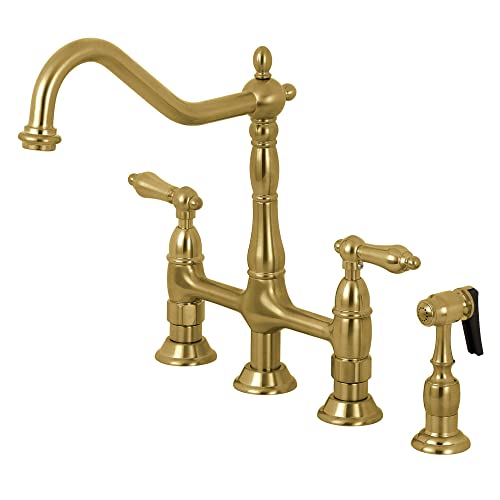
Kingston Brass Heritage Bridge Kitchen Faucet KS1277ALBS — Best Overall
The Heritage bridge in brushed brass is the faucet most brass shoppers are picturing when they start searching, whether they know it or not: two handles standing on the deck, an exposed horizontal bridge pipe joining them, a high gooseneck spout, and a separate brass sprayer sitting in its own hole. Brushed brass is the finish that makes the traditional shape work in a modern kitchen — warm without glare, forgiving of fingerprints, and close enough in tone to most brushed-gold cabinet hardware to sit comfortably beside it.
Strengths
- True brushed-brass finish on a solid-brass bridge body, not a tone over another metal
- Separate brass side sprayer gives a strong, simple rinse jet
- Two-handle control makes repeatable temperature mixes easy to find
Trade-offs
- Needs an 8-inch spread plus a sprayer hole — not a single-hole sink faucet
- No pull-down spray modes; the sprayer is a single honest jet
- Traditional styling will fight a minimalist kitchen rather than blend into it
| Configuration | 8-inch bridge, two-handle |
| Finish | Brushed brass |
| Sprayer | Matching brass side sprayer |
| Spout reach | 8 in (Heritage bridge pattern) |
Living with a bridge faucet is a different rhythm from a single-handle pull-down, and it suits cooks who set temperature deliberately rather than nudging a lever with a wrist. Each handle controls one supply, so repeatable mixes are easy to find by position, and the separate sprayer — solid brass here, not a plastic wand in a brass costume — delivers a strong, simple jet that many owners end up preferring for rinsing roasting pans. The trade is counter space and holes: this pattern needs an 8-inch spread plus a sprayer hole, which is exactly what older farmhouse sinks provide and exactly what a single-hole modern sink cannot.
Brushed brass also ages the most gracefully of the brass family. The soft, directional grain hides the micro-scratches that polished brass advertises, and because the Heritage finish is sealed, the colour you install is the colour you keep — no patina management, no polishing schedule, just a wipe with a soft cloth. For a kitchen being designed around brass as a permanent accent rather than a living surface, that stability is the point.
Best for: traditional and farmhouse kitchens wanting authentic brushed brass / Not suited for: single-hole sinks or buyers who want pull-down spray modes Check on Amazon

Kingston Brass Single-Handle Kitchen Faucet GSY7707ACLBS — Best Single-Handle Brass
Not every brass kitchen is a farmhouse kitchen. This single-handle Kingston in brushed brass exists for the growing number of designs that pair a warm metal with flat-panel cabinets, stone counters and otherwise contemporary lines — the finish does the talking and the silhouette stays quiet. One lever controls temperature and flow together, which is how most households actually cook: a nudge with the back of a hand while the other hand holds a colander.
Strengths
- Real brushed-brass finish in a modern single-handle silhouette
- One-lever control suits busy, one-handed kitchen work
- Simpler deck layout — fewer holes, easier cleaning around the base
Trade-offs
- No separate sprayer or pull-down wand in this pattern
- Less period character than the bridge models for traditional schemes
- Brass tone matching against other brands’ hardware still needs a sample check
| Configuration | Single-handle |
| Finish | Brushed brass |
The single-handle format also simplifies the deck: fewer holes to drill, fewer escutcheons to clean around, and a smaller visual footprint on the counter. What you give up versus the bridge models is the separate sprayer and the deliberate two-valve control; what you gain is speed and simplicity. Buyers cross-shopping this against brass-tone pull-downs from the big brands should note the distinction the Amazon title makes plain — this is a Kingston brass faucet in brushed brass, from the one manufacturer whose catalogue treats brass as a core finish rather than a seasonal colour.
Best for: modern kitchens that want real brass tone with one-lever control / Not suited for: buyers who need a sprayer or want a period bridge silhouette Check on Amazon

Kingston Brass Heritage Pull-Down Kitchen Faucet GS1273AL — Best Antique Brass Pull-Down
Antique brass is the finish for people who find brushed brass too bright and polished brass far too shiny: a browned, low-lustre surface that looks inherited rather than installed. Kingston’s Heritage pull-down puts that finish on the most useful modern format — a tall faucet whose spray head pulls down into the sink — which makes this the pick for traditional kitchens that are cooked in daily rather than photographed.
Strengths
- Antique brass is the rarest brass tone — and this pairs it with a pull-down sprayer
- Tall arc fills stockpots and reaches across wide farmhouse sinks
- Aged, low-lustre surface hides fingerprints better than polished brass
Trade-offs
- Tall body needs overhead cabinet clearance — measure before ordering
- Water spots show on the dark finish; expects a wipe-down habit
- Premium positioning within the brass range
| Configuration | Pull-down sprayer |
| Finish | Antique brass |
| Height | 18.75 in (Amazon listing dimensions) |
The combination matters more than it might seem. Most antique-brass faucets are bridges and two-handle patterns that assume a separate sprayer or none at all; a pull-down antique brass faucet is genuinely scarce, and it changes what the sink can do — filling stockpots on the counter, sweeping crumbs to the drain, rinsing the far corners of a wide farmhouse basin. The tall profile needs cabinet clearance above the sink, and antique brass will show water spots more visibly than brushed finishes, so a quick wipe-down habit is part of ownership. In return you get the most characterful brass tone in the catalogue on the hardest-working format.
Best for: traditional kitchens wanting aged brass character plus pull-down function / Not suited for: low-clearance sinks or buyers who want a maintenance-free bright finish Check on Amazon

Kingston Brass Bridge Kitchen Faucet KS1272AXBS — Best Polished Brass
Polished brass is brass with the volume turned up: a mirror-warm finish that reflects light, anchors a classic scheme, and makes no apology for being noticed. On the Heritage bridge pattern — exposed bridge pipe, cross-or-lever handles, separate brass sprayer — it is also the historically correct pairing, the combination that early twentieth-century kitchens actually used, which is why it reads as authentic in period renovations where brushed finishes can look like a compromise.
Strengths
- The period-correct brass finish — unmatched presence in classic schemes
- Bridge pattern with brass sprayer matches historic kitchen layouts
- Reflective warmth pairs beautifully with marble and white ceramic sinks
Trade-offs
- Highest-maintenance brass finish: fingerprints and spots show immediately
- Dulls unevenly if polishing is neglected
- The shine can overwhelm small or already-busy kitchens
| Configuration | Bridge, two-handle |
| Finish | Polished brass |
| Sprayer | Brass side sprayer |
Ownership is the honest trade. A polished surface shows every fingerprint, water spot and micro-scratch, and keeping it at full shine takes a soft cloth and two minutes a week; let it go and it dulls unevenly, which some owners embrace as patina and others experience as neglect. Decide which person you are before ordering, because polished brass is the highest-maintenance finish in this guide. For those who will keep it up, nothing else in the brass family has the same presence — it is the finish that makes guests ask about the faucet.
Best for: period and classic kitchens that want brass at full shine / Not suited for: anyone who will not wipe and occasionally polish a faucet Check on Amazon

Kingston Brass Kitchen Faucet with Side Sprayer KS3277ALBS — Best Brass with Side Sprayer
Some kitchens genuinely use a side sprayer every day — for rinsing sheet pans too big to manoeuvre under a spout, blasting a sink clean, or filling a bucket sitting on the floor — and for those kitchens a dedicated sprayer on its own hose beats a pull-down wand. This brushed-brass Kingston builds the whole faucet around that workflow, with two-handle control and a sprayer that parks in its own deck hole, always where your hand expects it.
Strengths
- Dedicated side sprayer on its own hose — always parked, always reachable
- Brushed brass hides the wear a hard-working faucet collects
- Side sprayers are cheap, standard replacements when hoses age
Trade-offs
- Needs the extra deck hole for the sprayer
- Generous scale overwhelms small sinks
- Two-handle mixing is slower than a single lever
| Configuration | Two-handle with side sprayer |
| Finish | Brushed brass |
| Dimensions | 13.06 x 14.06 x 9.44 in (Amazon listing) |
The dimensions in the listing tell the scale story: this is a substantial faucet for a substantial sink, and on a small basin it would look and feel oversized. Matched to the right sink, the separate sprayer has one more advantage owners rarely anticipate — when a sprayer hose eventually wears, a side sprayer is a cheap, standard replacement, while a pull-down wand is a model-specific part. Brushed brass keeps the maintenance low and the tone warm, making this the working end of the brass range: traditional looks, commercial habits.
Best for: large sinks where a separate sprayer earns its hole / Not suited for: small sinks or single-hole installations Check on Amazon

Kraus Oletto Pull-Down Kitchen Faucet KPF-2820SFACB — Best Brass-Tone Modern
This pick is included with its label facing outward: the finish is Kraus’s Spot Free Antique Champagne Bronze, a warm brass tone rather than a true brass finish. What sits underneath, though, is genuinely brass — the Oletto family is built on a brass body with a ceramic cartridge — and the format is the contemporary pull-down that Kingston’s traditional catalogue does not really offer. For buyers whose priority order is modern function first, warm colour second, this is the honest compromise.
Strengths
- Brass body and ceramic cartridge under a warm brass-tone finish
- Spot-free surface is the lowest-maintenance warm finish here
- Modern pull-down format the traditional brass catalogue lacks
Trade-offs
- A brass tone, not a true brass finish — will not patina or match exactly
- Champagne lean can clash with strongly yellow brass hardware
- Single-hole format does not suit bridge-style deck layouts
| Body | Brass body with ceramic cartridge (API features, stainless sibling) |
The spot-free treatment is the practical argument: the finish is engineered to resist the water spots and fingerprints that make polished brass a chore and antique brass a wipe-down habit, so the faucet keeps its warm tone with the least effort of any pick here. The colour itself sits between brushed brass and light bronze — close enough to blend with brushed-brass hardware in most lighting, different enough that a sample check against your exact handles is still wise. Judge it as what it is and it is an excellent faucet; mistake it for a true brass finish and the disappointment would be in the label, not the product.
Best for: buyers who want the brass look with a modern pull-down and spot-free finish / Not suited for: purists who want a genuine brass finish that ages Check on Amazon
Comparison Table
| Pick | Badge | Key spec | Best for |
|---|---|---|---|
| Kingston Brass Heritage Bridge Kitchen Faucet KS1277ALBS | Best Overall | 8-inch bridge, brushed brass, brass side sprayer | traditional and farmhouse kitchens wanting authentic brushed brass |
| Kingston Brass Single-Handle Kitchen Faucet GSY7707ACLBS | Best Single-Handle Brass | Single-handle, brushed brass | modern kitchens that want real brass tone with one-lever control |
| Kingston Brass Heritage Pull-Down Kitchen Faucet GS1273AL | Best Antique Brass Pull-Down | Antique brass, pull-down sprayer, 18.75 in tall (API dimensions) | traditional kitchens wanting aged brass character plus pull-down function |
| Kingston Brass Bridge Kitchen Faucet KS1272AXBS | Best Polished Brass | Bridge, polished brass, brass sprayer | period and classic kitchens that want brass at full shine |
| Kingston Brass Kitchen Faucet with Side Sprayer KS3277ALBS | Best Brass with Side Sprayer | Brushed brass, side sprayer, 13.06 x 14.06 x 9.44 in (API dimensions) | large sinks where a separate sprayer earns its hole |
| Kraus Oletto Pull-Down Kitchen Faucet KPF-2820SFACB | Best Brass-Tone Modern | Brass body, ceramic cartridge, brass-tone finish | buyers who want the brass look with a modern pull-down and spot-free finish |
Read the table with the finish column in mind: five of these six are true brass finishes from one specialist maker, spanning brushed, antique and polished, and the sixth is a clearly labelled brass tone on a modern body. Configuration splits the list just as sharply — bridges and side sprayers for traditional decks, single-handle and pull-down formats for contemporary ones — so the right first filter is your sink’s hole pattern, and the right second filter is how much patina and polishing you honestly want in your life.
How to Choose Brass Kitchen Faucets
Choosing a brass faucet is mostly choosing a finish behaviour, because the underlying formats — bridge, single-handle, pull-down — are shared with every other finish family. The sections below work through the decisions in the order they should be made: what ‘brass’ means on the listing in front of you, lacquered versus living surfaces, matching the tone to hardware you already own, then the mechanical questions of holes, sprayers and valves.
Solid brass, brass body, or brass tone?
These three phrases describe three different products. A solid-brass faucet is machined from brass throughout and wears a brass finish — the Kingston pattern, and the heaviest, longest-lived construction. A brass-bodied faucet has brass where it matters structurally but may wear any finish. A brass tone is a colour: a coating in a brass hue over whatever substrate, which can be excellent (the Kraus pick) but will never develop patina and may not match true brass beside it. None of the three is automatically the wrong buy; buying one while believing it is another is the mistake.
Lacquered brass versus living brass
Most brass faucets sold today are lacquered: a clear seal locks the colour, so brushed stays brushed and polished stays polished with nothing more than wiping. Living or unlacquered brass is left bare to oxidise where hands touch it, darkening into a unique patina over months. Living brass is beautiful and demanding — it is also mostly sold by heritage plumbing houses rather than the Amazon catalogue. Every pick in this guide is a sealed finish, chosen deliberately: the colour you install is the colour you keep, and the maintenance is a cloth, not a polishing ritual — except polished brass, which still asks for regular wiping to hold its shine.
Matching brass to the hardware you own
Brass is the hardest finish family to match across brands because there is no standard: one maker’s brushed brass is yellow, another’s is nearly bronze, and lighting shifts all of them. Work in this order: match the faucet to the hardware it sits closest to (usually cabinet pulls), accept a deliberate contrast with distant elements rather than a near-miss, and where possible compare physical samples in your own kitchen’s light — north-facing daylight and warm evening bulbs can make the same two pieces match at noon and clash at dinner.
Holes, spreads and sprayers
Brass skews traditional, so check the deck before falling for a silhouette. Bridges need an 8-inch spread between handle holes; side sprayers need their own fourth hole; single-handle and pull-down models typically fit one hole or cover three with a deck plate. Measure the spread centre-to-centre, count the holes including the sprayer and any soap dispenser you plan to keep, and check the space behind the sink — bridge handles and tall pull-downs both need room that tight counters against a backsplash sometimes do not have.
Valves and water quality
Under the finish, brass faucets use the same ceramic-disc and cartridge valves as every other family, and they reward the same care: ceramic discs shrug off the grit that wears rubber washers, which matters in brass because a dripping faucet stains its own finish with mineral deposits. Hard water is brass’s visible enemy — spots show on dark antique finishes and dull polished ones — so if your water is hard, brushed finishes and spot-free tones are the pragmatic choices, and a wipe after heavy use is worth more than any coating.
Brass and water spots: choosing by household habit
Every brass finish shows water differently, and the honest selector is your household’s actual behaviour. Polished brass shows spots instantly and completely; antique brass hides them in its mottling until they build; brushed brass splits the difference and is the default recommendation for family kitchens for exactly that reason. If the faucet will be wiped by whoever dries the dishes, any finish works. If it will be wiped weekly at best, brushed or antique is not a compromise — it is the correct engineering decision for your real life, and choosing it deliberately beats resenting a shinier finish for behaving like metal.
When the sink itself is brass-toned: composite and fireclay pairings
Brass faucets are often paired with the statement sinks — fireclay farmhouse basins, hammered-metal bar sinks, stone vessels — and the pairing rules differ from standard stainless. Against white fireclay, any brass tone works and the faucet becomes the room’s jewellery. Against a metal sink, match the family (brass with brass) or contrast completely (brass with black), because a near-metal mismatch across two large surfaces is the loudest error a sink wall can make. Against dark stone or composite, brushed and antique brass hold their own; polished brass can disappear into reflections and reads better against matte surfaces.
Brass faucets and resale staging
If the kitchen will be sold within a few years, brass remains a sound choice provided it is executed completely: faucet, hardware and lighting in one family, in brushed or antique tones that photograph warmly and read as intentional. A lone brass faucet amid chrome hardware stages as an unfinished thought. Staging logic and living logic agree here — brass is a scheme, not an accessory — and the homes that carry it best are the ones that commit to the scheme at whatever scale the budget allows.
Will Brass Go Out of Style? An Honest Word on Patina and Trends
Every brass buyer eventually hears the warning that brass is a trend and trends pass. The honest answer is that brass in kitchens is better understood as a cycle than a fad: it dominated early plumbing because the metal itself was the plumbing, retreated when chrome became the modern signal, and returned as kitchens warmed up again. A brass faucet installed today is not a bet that a magazine cover stays current; it is a metal that was in kitchens for a century before stainless existed, and a quality brass body will outlast several finish trends physically even if tastes rotate.
Patina deserves its own honest paragraph because marketing blurs it. On the sealed finishes in this guide, patina is not coming — the lacquer’s whole job is to prevent it — so if the idea of a faucet that visibly ages with your household is the romance that drew you to brass, you are shopping for unlacquered brass from a heritage maker, at heritage prices, with a polishing cloth in your future. If instead you want the warm colour to simply stay put while you cook, sealed brass is not the lesser choice; it is the correct one, and most buyers who live with both end up preferring it.
Resale and renovation logic point the same way. A brass faucet is a small, reversible layer of a kitchen — it unbolts in an afternoon — so the cost of being ‘wrong’ about the trend is one faucet, not a remodel. Buy the tone that suits the room and the way you actually maintain things, in the configuration your sink demands, and the trend question mostly dissolves.
Budget tiers in brass deserve their own honest paragraph, because brass pricing confuses people: the same finish name appears on faucets at wildly different tiers, and the difference is rarely the colour. It is the body underneath (solid brass versus plated alloy), the valve, and the depth of the maker’s parts catalogue. A household furnishing a five-year kitchen can rationally buy the tone tier and spend the savings on the sink; a household furnishing a twenty-year kitchen should buy the body and the valve, because the finish is the only part of a faucet that can be judged from a photograph — and the only part that does not decide whether it still works in year fifteen.
Finally, a note on brass and resale, since it surfaces in every consultation: brass is sometimes called a risky finish for resale because it is a stronger statement than chrome. The evidence of the last decade runs the other way — warm metals have broadened from a niche taste to a mainstream option, and a quality brass faucet reads to buyers as a deliberate, maintained kitchen rather than a dated one. The resale risk in faucets is never the finish family; it is a cheap faucet in any finish, announcing deferred maintenance at the room’s focal point. Buy the solid version of the tone you love and the question answers itself.
Brass also pairs with countertop materials in ways worth planning rather than discovering. Against white marble, brass is the classic warmth that keeps the stone from reading cold, and the pairing has centuries of precedent. Against black counters, brushed and antique brass glow — the dark field makes the metal the light source of the sink wall. Against wood counters, brass is at home but the tones must be sequenced: warm wood plus yellow brass can oversaturate, and a slightly aged or brushed tone restores the balance. Against stainless counters and appliances, brass works as the single warm accent, provided it is the only warm metal competing at that level.
For households renovating in stages — the realistic majority — brass has one more strategic virtue: it is a finish you can grow into. Start with the faucet, add cabinet hardware in the same family when the budget turns, then lighting, and the kitchen assembles itself around a coherent warm thread over two or three years. The reverse journey, retrofitting warmth into a chrome-and-steel room one piece at a time, fights itself at every step. Choosing the faucet in brass is therefore not just a faucet decision; it is the first move of the kitchen’s whole material story, and it should be made with the later moves in mind.
And a final maintenance truth that brass owners learn and chrome owners never have to: brass rewards being touched by its routine. The finishes in this guide are sealed, so the ritual is only wiping — but the households that thrive with brass are the ones whose kitchen rhythm already includes a cloth: cooks who wipe the counters as they plate, who dry the sink at night. Brass does not ask for a new personality. It asks for the one the kitchen already has, plus thirty seconds.
How to Install a Brass Kitchen Faucet (and Protect the Finish Doing It)
Brass installation follows the standard faucet sequence with one extra discipline: the finish you are installing is softer than chrome and shows tool marks, so every step below includes the small protections that keep a new brass faucet looking new. If your old faucet is a different hole pattern from the new one, confirm the match before you start — bridges in particular cannot improvise around a single-hole deck.
- Shut off both supply valves under the sink and open the old faucet to drain pressure; photograph the existing connections before touching them.
- Remove the old faucet and clean the deck completely — old plumber’s putty and mineral crust telegraph through new escutcheons and trap moisture against brass.
- Dry-fit the new faucet: confirm hole spread, handle swing clearance against the backsplash, and sprayer hose routing with nothing binding.
- Wrap every brass surface a wrench might touch in a cloth or use smooth-jaw tools; brass records every slip permanently.
- Set the faucet, tighten mounting nuts firmly by hand plus a quarter-turn with tools — over-torquing distorts seats and starts drips.
- Connect supply lines, open valves slowly, and flush the aerator by running water before first use to clear debris from the lines.
- Run every function — both handles, sprayer, swivel — and check under the sink with a dry paper towel at each joint; a slow weep shows on paper before it shows as a drip.
- Wipe the whole faucet dry with a soft cloth as the final step; starting its life dry and spotless sets the maintenance baseline.
For the first week, glance under the sink daily. Brass faucets rarely fail dramatically; they weep at a connection that needs another quarter-turn, and catching that in week one is the difference between a two-minute fix and a swollen cabinet floor. After that, care is simple: soft cloth, mild soap when needed, no abrasive pads and no vinegar soaks on the finish — the lacquer that keeps brass bright is also the layer harsh cleaners strip.
One brass-specific detail after installation: new lacquered brass sometimes carries a faint protective film from manufacture that dulls the first week’s shine. A single gentle wash with mild soap and a soft cloth after installation removes it and reveals the finish you actually bought — do not reach for polish or solvents, which can cloud the lacquer you are trying to reveal.
Common Buying Mistakes
Buying a tone while believing it is brass. Listings photograph warm finishes identically. Read the finish name and the body material as two separate facts: a champagne-bronze or brushed-gold coating can be a fine faucet, but it will not patina, may not match true brass hardware, and should be bought as the tone it is — like the clearly labelled Kraus pick in this guide — not as a discovery you make after installation.
Matching brass across brands from photos. Screens lie about brass more than any other finish. Two products that look identical online can sit a full shade apart on the counter. Order the faucet first, hold it against your cabinet hardware in your own light, and only then commit to matching accessories from other brands.
Choosing polished brass with a brushed-brass lifestyle. Polished brass is a weekly two-minute commitment, forever. Buyers who know they will not wipe a faucet should choose brushed or antique finishes, which forgive fingerprints and spots, instead of resenting the shiniest finish in the family for behaving exactly as polished metal does.
Ignoring the hole pattern until install day. Bridges need their spread, sprayers need their hole, and tall faucets need cabinet clearance. Measuring takes five minutes with the old faucet still working; discovering a mismatch takes a return, a replumb, or a deck plate you never wanted.
Cleaning brass with bathroom chemicals. The descalers and abrasive creams that keep chrome alive strip lacquer from brass and leave it blotchy. Mild soap, water and a soft cloth handle everything a kitchen faucet collects; save the chemistry for inside the aerator, removed and soaked separately.
Final Recommendation
If you want one answer: the Kingston Heritage bridge in brushed brass is the brass faucet most kitchens are actually asking for — real brass, the forgiving finish, the classic pattern, a proper sprayer. Modern kitchens should take the single-handle brushed brass or, if pull-down function outranks finish purity, the honestly labelled Kraus brass tone. Traditional kitchens that cook hard get the antique-brass pull-down; period renovations get polished brass and a polishing habit; big working sinks get the side-sprayer model.
Whichever you choose, decide the finish behaviour before the silhouette: lacquered stability or living patina, brushed forgiveness or polished shine. The configuration follows your sink’s holes, the tone follows your hardware, and the maintenance follows your honest habits. Get those three decisions right and brass stops being a risky style choice and becomes what it has been for a century — the warm, durable default.
One last filter before ordering: stand at your sink at the hour you cook most, hold the finish family in your mind against the light you actually have, and choose the brass that looks right then — not at noon in a showroom. Brass is bought for evenings, for warmth, for the long look across a finished kitchen. Chosen that way, it will not disappoint you.
- Best Overall — Kingston Brass Heritage Bridge Kitchen Faucet KS1277ALBS: Check on Amazon
- Best Single-Handle Brass — Kingston Brass Single-Handle Kitchen Faucet GSY7707ACLBS: Check on Amazon
- Best Antique Brass Pull-Down — Kingston Brass Heritage Pull-Down Kitchen Faucet GS1273AL: Check on Amazon
- Best Polished Brass — Kingston Brass Bridge Kitchen Faucet KS1272AXBS: Check on Amazon
- Best Brass with Side Sprayer — Kingston Brass Kitchen Faucet with Side Sprayer KS3277ALBS: Check on Amazon
- Best Brass-Tone Modern — Kraus Oletto Pull-Down Kitchen Faucet KPF-2820SFACB: Check on Amazon
Related guides in this series: Best Bridge Kitchen Faucets; Best Bronze Kitchen Faucets; Best Brushed Nickel Kitchen Faucets; Best Chrome Kitchen Faucets; Best Antique Kitchen Faucets.
Related guides
Frequently Asked Questions
Is a brass faucet solid brass or just brass-coloured?
Both exist, which is why the wording matters. The Kingston picks in this guide are brass faucets in brass finishes from a maker whose catalogue is built on brass. Some faucets from other brands are brass-bodied under another finish, and some are brass-toned coatings over other metals. Check the finish name and the body material as separate facts on the listing before buying.
Will my brass kitchen faucet change colour over time?
The sealed finishes in this guide are designed not to: lacquer locks the colour so brushed, antique and polished brass stay as installed with simple wiping. Unlacquered ‘living brass’ from heritage plumbing houses is the version that darkens and patinas with touch — beautiful, but a deliberate choice with a polishing routine attached, and mostly sold outside the Amazon catalogue.
Does brass match brushed gold or champagne bronze hardware?
Often closely, never guaranteed. Brass tones vary by brand more than any other finish family, and warm lighting exaggerates small differences. The reliable method is to hold the actual faucet against your actual hardware in your kitchen’s light. A deliberate contrast reads as design; a near-miss reads as a mistake.
Are brass faucets harder to maintain than chrome or stainless?
Brushed and antique brass are about equal to stainless: wipe spots, use mild soap, avoid abrasives. Polished brass is genuinely more work, showing fingerprints and water spots quickly and needing regular wiping to hold its shine. Spot-free brass-tone finishes, like the Kraus pick, are the lowest-effort way to keep a warm colour.
Can I install a bridge faucet on any sink?
No — a bridge needs an 8-inch spread between the handle holes, and models with side sprayers need a further hole for the sprayer. Count and measure your deck first. Single-handle and pull-down brass faucets fit the one-hole and three-hole layouts most modern sinks use, often with a deck plate to cover extra holes.
Do brass faucets work with hard water?
Yes, with a caveat: mineral deposits show more on dark antique brass and dull polished brass fastest, so brushed finishes are the pragmatic hard-water choice. A quick wipe after heavy use prevents most spotting, and cleaning the aerator separately keeps flow strong without exposing the finish to descaling chemicals.
Can brass faucets be used with a water softener or filtered water?
Yes — both are kind to brass. Softened water dramatically reduces the mineral spotting that dark and polished brass finishes show, and filtered drinking-water taps are available in matching brass tones from the same specialist makers if you want the set to coordinate. If your home has notably hard water and no softener, brushed brass remains the lowest-effort choice in the family.
Are brass faucets a good choice for a rental property?
For higher-end rentals, yes: brass reads as a deliberate, quality finish to tenants and photographs warmly in listings. Choose brushed brass for its forgiveness, keep the model details on file for parts, and avoid polished brass, whose upkeep depends on a tenant’s habits you cannot control.
Do brass faucets need special plumbing or valves underneath?
No. Brass faucets connect with the same standard supplies and shut-off valves as any other finish, and their internal valves are the same ceramic and cartridge technologies used across the industry. The finish changes nothing below the counter — all of brass’s special considerations live above it, in tone matching and surface care.


