Disclosure: airfryerkitchensupply.com is reader-supported. When you buy through links on our site, we may earn an affiliate commission at no extra cost to you.
Where to buy
Start here if you are shopping for the best blenders for shakes with ice: every pick in this guide was verified, and every specification quoted comes from the verified listing for that exact model.
Ice-capable blenders separate marketing from engineering quickly, so every pick here was verified and chosen only where the listing evidences ice work — crushing technologies, ice-crush programs, frozen-blending claims, or a crush program by name.
The six machines in this guide are: Ninja Professional Blender BL610, 1000W, 72 oz, KitchenAid K400 with Tamper KSB4028, Contour Silver, nutribullet Turbo Personal Blender, 1000W, CRANDDI K96 Professional Smoothie Blender, 1500W, 80 oz, Oster Extreme Mix 1600W, 8-cup glass jar, 10-point blade, Blend-N-Go, Ninja Blast Max Portable Blender BC251GY, cordless, 22 oz. Check the current price on Amazon for the model you choose, and check price on Amazon again before ordering if you are comparing configurations, because capacities, included accessories and finishes vary by listing.
Introduction: Ice Is the Ingredient That Breaks Blenders and Ruins Shakes
Shakes with ice are a specific mechanical challenge: the blender must fracture cubes into snow-fine particles while the shake is still thick, without melting the ice into watery slush or leaving tooth-rattling chunks. The best blenders for shakes with ice solve it three ways — blade systems designed to crush, programs that pulse ice before blending, and enough sustained power to finish the job in seconds rather than a heat-building minute.
This guide is deliberately narrower than a general smoothie guide. Every pick’s verified listing speaks to ice directly: Ninja’s Total Crushing technology, KitchenAid’s named Ice Crush program, a CRANDDI listed for ice crushing, a nutribullet credited with frozen blending, Oster’s 1600W glass-jar flagship, and Ninja’s portable Blast Max with its Auto-iQ Crush program for ice on the go.
Technique still matters as much as hardware, so the how-to section covers cube size, load order and timing. All ASINs are listing-verified and no prices or fixed scores appear — check the current price on Amazon for the exact configuration.
In this guide
Quick Picks
Best Overall — Ninja Professional Blender BL610, 1000W, 72 oz: Ninja’s BL610: 1000W Total Crushing technology in a 72 oz pitcher — the listing’s own words are crushing ice and blending smoothies and sauces. Check the current price on Amazon.
Best Ice Crush Program — KitchenAid K400 with Tamper KSB4028, Contour Silver: KitchenAid’s K400 lists Ice Crush first among its preset recipe programs, with a five-speed dial, Intelli-Speed control and a tamper — programmed ice fracturing plus manual control. Check the current price on Amazon.
Best Personal Ice Blender — nutribullet Turbo Personal Blender, 1000W: nutribullet’s Turbo: 1000W in a personal format whose listing says ‘Perfect for Shakes, Smoothies, Food Prep, and Frozen Blending’, with 32 oz and 24 oz class cups. Check the current price on Amazon.
Best High-Capacity Ice Crusher — CRANDDI K96 Professional Smoothie Blender, 1500W, 80 oz: CRANDDI’s K96: an 80 oz, 1500W professional smoothie blender whose listing names shakes and ice crushing, with stainless blades — café-scale ice throughput. Check the current price on Amazon.
Best Glass Jar for Ice — Oster Extreme Mix 1600W, 8-cup glass jar, 10-point blade, Blend-N-Go: Oster’s Extreme Mix: 1600W, a 10-point stainless blade and an 8-cup glass jar with Blend-N-Go — glass-jar ownership with flagship ice power. Check the current price on Amazon.
Best Portable for Ice — Ninja Blast Max Portable Blender BC251GY, cordless, 22 oz: Ninja’s Blast Max: a cordless 22 oz Twist & Go vessel with Auto-iQ Crush and Smoothie programs — its listing credits it with crushing ice away from any outlet. Check the current price on Amazon.
How These Picks Were Chosen
Ice evidence was the entry ticket: a crushing technology, an ice or frozen program, or an explicit ice-crushing claim in the verified listing. General-purpose blenders without ice evidence were excluded even when their brands are famous.
Second, shake texture: the machine must stop at thick. Programs with pulse phases, pulse buttons and speed control all appear here because they let ice finish fracturing before the shake over-thins.
Third, format spread — family jars, personal cups and a cordless portable — because ice shakes happen in kitchens, gyms and offices, not only at home counters.
The 6 Best Blenders for Shakes with Ice
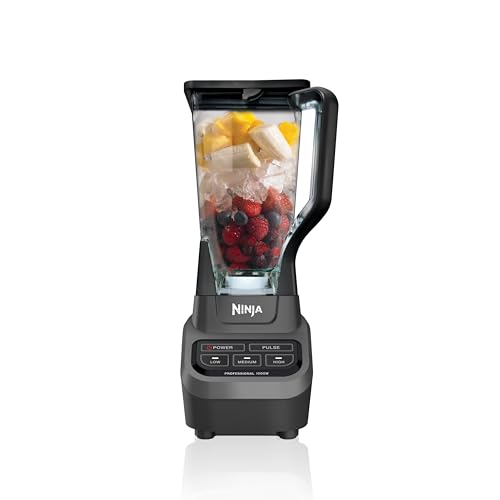
1. Ninja Professional Blender BL610, 1000W, 72 oz — Best Overall
Total Crushing’s stacked blade column is built for exactly this search: it engages the full height of an ice load instead of only the bottom layer, fracturing cubes through the whole 72 oz pitcher while the shake base thickens around the particles.
Strengths
- Total Crushing technology credited with ice crushing in the listing
- 72 oz pitcher for family ice-shake batches
- Dishwasher-safe parts for sticky shake cleanup
Trade-offs
- Stepped speeds need watchful stopping to keep shakes thick
- Large pitcher is oversized for one small shake
- Ice crushing at this power is assertively loud
| Specification | Detail |
|---|---|
| Power | 1000W |
| Pitcher | 72 oz |
| Technology | Total Crushing |
The technique is load order plus nerve: shake base first, ice on top, then run the machine decisively until the sound changes from rattling chunks to a uniform roar — that sound shift is the ice finishing. Stop there and the shake is thick with snow-fine ice.
For households whose shake is a dessert event for four or five, no personal cup competes with one pitcher batch.
Best for: families making iced shakes in full batches / Not suited for: solo users wanting blend-in-cup convenience
Check on Amazon — check the current price on Amazon before you buy.

2. KitchenAid K400 with Tamper KSB4028, Contour Silver — Best Ice Crush Program
A named Ice Crush program encodes the pulse-then-blend pattern ice needs: fracture first, then circulate. The K400 adds a variable dial for shake finishing and motor control that holds speed as the icy load thickens — the exact moment weaker blenders stall.
Strengths
- Dedicated Ice Crush preset program in the verified listing
- Intelli-Speed holds power as icy mixtures thicken
- Tamper included in this configuration for dense frozen loads
Trade-offs
- Programs need a cook’s eye for the final thickness call
- Mid-size platform: batch scale is family, not party
- Confirm the tamper on the exact colour listing you order
| Specification | Detail |
|---|---|
| Programs | Ice Crush, Icy Drinks, Smoothie |
| Controls | 5-speed variable dial |
| Motor | Intelli-Speed Motor Control |
Run Ice Crush to fracture, then finish on the dial: a few seconds at medium pulls the particles through the shake base evenly. That two-stage method produces the café texture — thick, cold, uniform — that single-speed blending misses.
It doubles as the household’s smoothie and sauce blender, which keeps its counter claim honest beyond shake duty.
Best for: households wanting a programmed ice start with manual finish control / Not suited for: maximum-volume party batches
Check on Amazon — check the current price on Amazon before you buy.
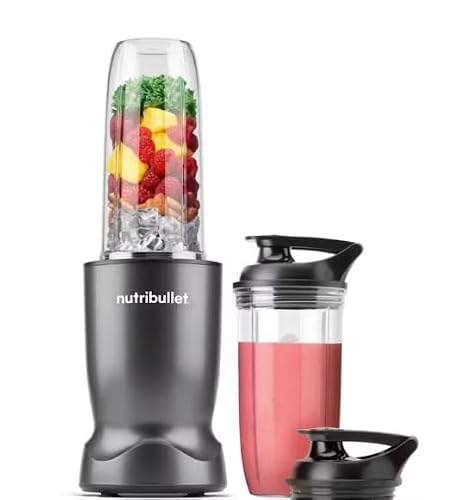
3. nutribullet Turbo Personal Blender, 1000W — Best Personal Ice Blender
Personal blenders often fear ice; the Turbo’s listing claims frozen blending outright. Its 1000W motor in a 32 oz cup concentrates power on a single serving’s worth of ice — the physics of small batches working in your favour.
Strengths
- Frozen blending claimed explicitly in the verified listing
- 1000W concentrated in single-serving cups
- Cups double as the serving and travel vessel
Trade-offs
- Single servings only — family shakes mean sequential cups
- Cups need adequate liquid to circulate an ice load
- No jar format for non-shake blending jobs
| Specification | Detail |
|---|---|
| Power | 1000 Watt |
| Cups | 32 Ounce Cup, 24 oz class cups |
| Listing note | Perfect for shakes and frozen blending |
For the gym-bag and desk-drawer shake — protein, milk, a handful of cubes — the Turbo is the frictionless answer: blend in the cup, drink from the cup, rinse the cup. Ice emerges fine because the batch is small and the power density is high.
Respect the liquid rule: a splash more milk than you think, so the vortex can pull cubes down instead of rattling them on top.
Best for: solo ice-shake drinkers wanting cup convenience with real power / Not suited for: family-batch blending
Check on Amazon — check the current price on Amazon before you buy.

4. CRANDDI K96 Professional Smoothie Blender, 1500W, 80 oz — Best High-Capacity Ice Crusher
When ice shakes are a volume business — a big household, a juice-bar habit at home — the K96’s 80 oz jar and 1500W motor chew through cube loads that would take family jars two rounds, with stainless steel blades built for the work.
Strengths
- Listing names ice crushing and shakes directly
- 80 oz jar is the largest capacity in this guide
- 1500W sustains power through full ice loads
Trade-offs
- Commercial scale is overkill for a nightly single shake
- Large jar needs storage and sink space to match
- Manual control: thickness discipline is entirely yours
| Specification | Detail |
|---|---|
| Capacity | 80 oz |
| Power | 1500W |
| Blades | Stainless steel |
| Positioning | Professional smoothie blender |
The K96’s virtue is indifference: a full load of cubes and frozen base barely changes its note. For smoothie-bar-style mornings feeding a household of shake drinkers, that headroom is the product.
Blend decisively and briefly — at this power, the line between thick and thin is a few seconds, and the machine will cross it without asking.
Best for: high-volume households and café-style shake routines / Not suited for: small kitchens and single small servings
Check on Amazon — check the current price on Amazon before you buy.
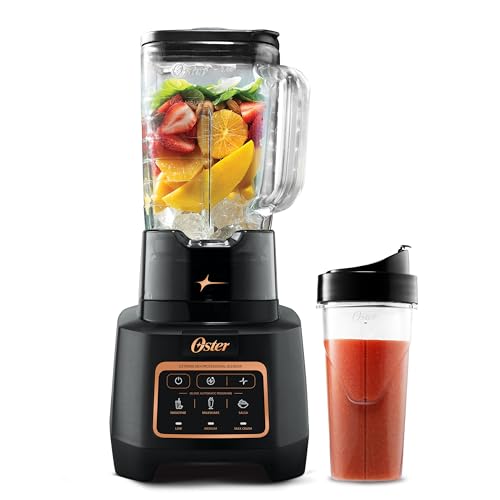
5. Oster Extreme Mix 1600W, 8-cup glass jar, 10-point blade, Blend-N-Go — Best Glass Jar for Ice
Glass and ice are natural partners for shake households that hate stained plastic: the Extreme Mix pairs an 8-cup glass jar with 1600W and a ten-point blade, plus iBlend technology and a Blend-N-Go option for single servings.
Strengths
- 8-cup glass jar resists shake staining and odours
- 1600W is the strongest motor in this guide
- 10-point stainless blade engages ice loads broadly
Trade-offs
- Glass jar is heavy — and full of ice, heavier
- Power this high thins shakes fast without attention
- Blend-N-Go configuration varies; verify the listing
| Specification | Detail |
|---|---|
| Power | 1600-Watt |
| Jar | 8-Cup Glass Jar |
| Blade | 10-Point Stainless Steel Blade |
| Technology | iBlend Technology |
The ten-point blade’s spread matters for ice: more contact points fracture cubes earlier in the cycle, shortening the blend and keeping the shake colder and thicker. Short, decisive blends are the Extreme Mix technique.
Choose it if glass-jar ownership matters to you and your ice loads are family-size; it is the only pick here that refuses the plastic-versus-power trade.
Best for: glass-jar households with family-size ice loads / Not suited for: users wanting a named ice program to manage timing
Check on Amazon — check the current price on Amazon before you buy.
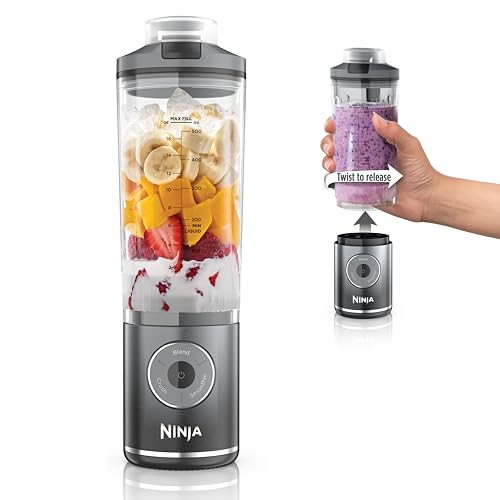
6. Ninja Blast Max Portable Blender BC251GY, cordless, 22 oz — Best Portable for Ice
Portable blenders are usually ice-shy; the Blast Max’s listing names a Crush program and describes ice-crushing Auto-iQ behaviour in a removable 22 oz vessel you twist off and carry. For office and gym shakes with real ice, it is the credible cordless option.
Strengths
- Auto-iQ Crush program for ice in a cordless format
- 22 oz Twist & Go removable vessel
- Cordless USB-class freedom for desk, gym and travel
Trade-offs
- 22 oz is one serving — there is no batch mode
- Cordless power still bows to very large or dense cube loads
- Battery discipline: a dead portable blends nothing
| Specification | Detail |
|---|---|
| Vessel | 22-oz Twist & Go removable vessel |
| Programs | Auto-iQ Crush & Smoothie |
| Format | Cordless portable |
Use standard cubes, not the giant spheres from craft ice trays, and give the Crush program a liquid base to work in. Within those honest limits, the Blast Max makes a real iced shake where no outlet exists.
It is the specialist second blender for people whose shake happens at work or post-workout — and a legitimate only blender for minimalists who travel light.
Best for: cordless ice shakes at the gym, office or on travel / Not suited for: family batches and maximum ice loads
Check on Amazon — check the current price on Amazon before you buy.
Comparison Table
| Pick | Badge | Key spec | Best for |
|---|---|---|---|
| Ninja Professional Blender BL610, 1000W, 72 oz | Best Overall | 1000W Total Crushing, 72 oz | families making iced shakes in full batches |
| KitchenAid K400 with Tamper KSB4028, Contour Silver | Best Ice Crush Program | Ice Crush program, 5-speed dial | households wanting a programmed ice start with manual finish control |
| nutribullet Turbo Personal Blender, 1000W | Best Personal Ice Blender | 1000W personal, frozen blending | solo ice-shake drinkers wanting cup convenience with real power |
| CRANDDI K96 Professional Smoothie Blender, 1500W, 80 oz | Best High-Capacity Ice Crusher | 80 oz, 1500W, ice crushing | high-volume households and café-style shake routines |
| Oster Extreme Mix 1600W, 8-cup glass jar, 10-point blade, Blend-N-Go | Best Glass Jar for Ice | 1600W, 8-cup glass jar | glass-jar households with family-size ice loads |
| Ninja Blast Max Portable Blender BC251GY, cordless, 22 oz | Best Portable for Ice | 22 oz cordless, Crush program | cordless ice shakes at the gym, office or on travel |
Ice Science: Cube Size, Hardness and Melt
Not all ice is the same material in the blender. Standard freezer cubes — roughly an inch, freshly made — fracture predictably. Ice that has lived in a frost-free freezer for weeks sublimates into harder, drier, oddly-shaped pieces that resist fracture and rattle longer. Ice from a dispenser arrives pre-cracked and blends fastest of all. Knowing your ice explains most ‘my blender got worse’ mysteries: the machine did not change, the ice did.
Melt is the second variable. Every second of blending converts friction into heat and ice into water, which is why the fracture-first technique in the how-to exists: crack the load with pulses while the mixture is coldest, then spend your continuous seconds only on distribution. A shake blended in twenty decisive seconds carries measurably more of its ice as texture than the same shake blended for a wandering minute.
Frozen Fruit vs Ice: Building the Shake Base
Ice is not the only route to a frozen shake, and the best shakes use both frozen fruit and ice in balance. Frozen fruit contributes flavour, sweetness and body as it breaks down; ice contributes pure cold structure and the characteristic fine crunch. An all-ice shake tastes diluted as it melts, while an all-fruit shake can turn gummy — the ratio between them is the house recipe worth writing down once you find it.
Banana deserves its own note: frozen banana blends into a soft-serve body that no other fruit matches, and it is the base that lets an iced shake stay thick with less actual ice. Households that keep a banana stash in the freezer need less ice, less power and less time for the same texture — a systems advantage no wattage can buy.
Protein Ice Shakes and the Post-Workout Window
The iced protein shake is the daily driver behind many of these purchases, and it has its own technique: liquid and powder first, blended smooth for five seconds, then ice added and fractured. Adding powder after the ice coats the cubes and guarantees clumps; adding it to the liquid first guarantees a smooth base that the ice then chills and bodies.
Personal and portable picks dominate this use for a structural reason — the shake is consumed within minutes, by one person, often away from the kitchen. The nutribullet Turbo’s frozen-blending claim and the Blast Max’s Crush program are aimed at exactly this ritual, and both earn their places by respecting its scale instead of upselling a family jar.
The Physics of the Fracture: What Happens in the First Five Seconds
An ice blend begins as an impact problem: cubes are whole, hard and tumbling, and the blades’ first job is to crack them into fragments small enough to circulate. This is why the opening pulses matter — each pulse repositions the load and presents fresh cube faces to the blades, while a continuous run can let whole cubes surf the vortex intact, rattling above the action. The sound tells the story: sharp, irregular rattling is fracture in progress.
Once fragments dominate, the physics flips to circulation: the vortex pulls particles down continuously, the blades mill them finer with each pass, and the sound smooths into the uniform roar this guide keeps citing as the stop signal. Everything after that point is friction spending your ice as meltwater. The entire technique of iced shakes is respecting that two-phase structure — fracture deliberately, circulate briefly, stop.
Blade systems differ in how they manage phase one: stacked crushing columns engage cubes at several heights; wide multi-point blades sweep a larger circle; cup blenders rely on small loads where every cube is near the blades. All three are legitimate engineering answers, which is why this guide can recommend across formats without contradiction.
Cube Craft: Making Ice Your Blender Loves
Home ice is a controllable ingredient. Standard trays filled with cold water produce cubes of predictable size and hardness; filling with hot water — the old Mpemba curiosity — can produce clearer ice but changes little for blending. What matters practically is turnover: cubes used within days are at their most fracture-friendly, while month-old freezer-burned ice is harder, drier and louder work for any machine.
Size discipline is the second lever: if your freezer makes oversized cubes, knock them down before blending — a sealed bag and two strikes with a rolling pin turns boulders into blender food. Crushed ice from a dispenser is the luxury option, pre-fractured and ready to circulate, and it lets even mid-power machines produce café-fine iced shakes.
Flavoured ice is the craft move: coffee cubes for coffee shakes, juice cubes for fruit shakes, milk cubes for protein shakes. They chill and thicken without diluting, which solves the iced shake’s central tension — cold versus flavour — at the ingredient level instead of the machine level.
Iced Coffee Shakes and Café Imitations
The café blended coffee is an iced shake in a suit: coffee, milk, sweetener and ice, engineered to a frappé texture. Home versions fail on two points — weak coffee that disappears under dilution, and blending that runs past the window into cold soup. Brew the coffee double-strength, chill it completely, sweeten it while warm so the sugar dissolves, and freeze some of it into cubes if the drink is a household staple.
The blend itself is the standard technique with café timing: base and coffee cubes in, fracture pulses, then a short continuous run to the roar. Xanthan-style thickeners are the cafés’ secret and entirely optional at home; a frozen banana quarter or a spoon of nut butter gives body with ingredients a home kitchen already respects.
Matcha and chai follow the same architecture with their own discipline — powders go onto the liquid first, per the powder rule, and spices bloom best when mixed into the warm base before chilling. The machine does not care which café you are imitating; the ratio and the stopping point are the recipe.
Frozen Fruit Shakes: When the Fruit Is the Ice
A frozen-fruit shake replaces some or all cubes with fruit frozen solid, and the texture shifts: less crystalline crunch, more body, and flavour that intensifies instead of diluting as the drink sits. The technique adjusts accordingly — the load is denser than ice, so liquid ratios rise slightly, and the fracture phase benefits from a minute of patience: let the frozen fruit sit in the liquid for two minutes to take the rock-hard edge off before blending.
Machines with crushing systems handle fruit-ice interchangeably; gentler machines prefer the fruit route in small pieces. Berry seeds are the texture tax of this style — high-performance vortices mill them finer, and drinkers who hate seeds should strain or choose seedless bases, a preference no blender purchase fully abolishes.
The freezer system that supports this style is the same one from the smoothie guide: portioned fruit, frozen flat, ready to become either a smoothie or an iced shake depending on the liquid ratio and the stopping point. One stash, two drinks, no waste.
Batch Iced Shakes for a Crowd
Party iced shakes are a timing production: the drink peaks for five minutes, so the workflow — not the recipe — is the craft. Pre-chill the glasses, pre-measure the bases into pitchers, and blend to order in full-jar batches rather than continuously topping up a melting pitcher. The BL610 and K96-class machines in this guide exist for this rhythm: one decisive batch, served immediately, then the next.
Flavour sequencing protects both taste and washing: lightest flavours first, coffee and chocolate last, with a ten-second water rinse between batches rather than a full wash. A toppings station — the texture elements added by the drinker, not the blender — keeps the line moving and the shakes’ bodies intact.
Estimate ice generously: a crowd batch programme consumes roughly a tray per four servings at standard ratios, and running out of ice mid-party is the one failure no blender can compensate for. The machine is rarely the bottleneck; the freezer is.
Protecting the Machine: Ice Loads and Longevity
Ice-rated machines are built for ice, but longevity still follows load discipline: respect the max-fill line with frozen loads, keep liquid in every ice blend so the vortex can form, and never run a dry jar of cubes hoping the blades will sort it out — that rattling stalemate is the hardest wear a home blender knows. Standard cubes, fractured in pulses, are a normal duty cycle; oversized frozen blocks are an abuse case wearing an ingredient’s clothes.
Blade assemblies loosen and gaskets age fastest under frozen work, so the periodic checks matter: a gasket that weeps after ice season wants replacing, and a jar that smells of last month’s shake wants the deep soak from the care sections. None of this is burdensome — it is the five-minute-a-month tax on a machine that does the loudest job in the kitchen.
Bought at the right class for your load — the core advice of this guide — an ice blender should serve for years of summers. Bought under-classed, it will die doing exactly what you asked of it. Match the machine to the ice, and both of you will be fine.
Iced Shakes vs Slushies vs Smoothies: Drawing the Lines
These three drinks share machines and differ in intent, and confusing them produces most disappointing blends. A smoothie is fruit and liquid blended to drinkable uniformity, ice optional. An iced shake is a thick, dairy-or-banana-bodied drink in which ice is a structural ingredient, fractured fine and stopped early. A slushie is ice itself as the main ingredient, flavoured liquid as the mortar — which is why it has its own guide with its own ratio.
The practical consequence is a stopping map: smoothies run longest, slushies stop at the uniform vortex, iced shakes stop earliest of all relative to their load, because their body is the most perishable. A cook who internalises the map can drive any machine in this guide across all three drinks; a cook who blends everything for a minute gets one drink — the thin one — in three flavours.
When you are ready to go deeper on the ice-dominant end, the slushie guide is the natural next read, and its machines overlap this one deliberately: the same crushing hardware, aimed at a higher ice ratio.
Iced Shakes Around the World, Briefly
The iced shake has passports: the American diner shake thickened with ice cream and given an icy edge; the Southeast Asian blended fruit shakes where ice is half the glass and the fruit is at tropical ripeness; the Middle Eastern yogurt-based blends where ice and salt play against each other. Each tradition tunes the same variables — base body, ice ratio, stopping point — to its climate and its fruit.
Your blender does not care which tradition tonight belongs to; the technique map is constant. What changes is the ratio card: diner shakes lean on the frozen base, fruit shakes lean on the ice, yogurt shakes need the briefest blend of all because their body thins fastest. Write three cards and you own three cuisines.
The pleasure of the format is exactly this portability: one machine, one skill, and a world of cold drinks that each taste like somewhere else.
Sweetness at Freezing Point
Cold mutes sweetness perception significantly — a shake base that tastes balanced warm will taste flat at serving temperature, and the correction is not simply more sugar but smarter sweetness: riper fruit, a date or two blended into the base, sweeteners added while the base is warm enough to dissolve them fully. Granulated sugar added to a cold blend can survive as grit; syrups and warm-dissolved sweeteners integrate invisibly.
Taste the base with a spoon of crushed ice stirred in — the taster’s trick from the slushie guide — to judge it at something like serving conditions. The ten seconds that takes is the difference between a shake that sings and one that merely refreshes.
Salt, again, is the quiet amplifier: a pinch in a chocolate or coffee iced shake deepens flavour more than another spoon of sweetener would, and it costs the texture nothing.
The Glass, the Straw and the Serve
An iced shake’s serve is part of its texture: a frosted glass slows the melt, a wide straw respects the body — a shake that cannot climb its straw is a spoon drink wearing a straw’s costume, which is a legitimate style if chosen rather than suffered — and a cold spoon stands by for the final third, when every shake becomes a race between drinking and melting.
Garnish belongs to the top and the last moment: crumbs, shavings, a cherry — added at service, never blended in, because texture contrast is the garnish’s entire job. The diner tradition of the extra steel cup beside the glass — the blender’s surplus — is worth reviving at home: it makes the batch feel abundant and gives the cook the honest extra half-serving the jar always contains.
Serve immediately is this guide’s refrain for a reason: the iced shake is the most perishable drink in the repertoire, perfect for five minutes and merely good for fifteen. Make it when the drinkers are seated, not before.
Ice Shakes for Athletes and Other Serious Drinkers
The post-training iced shake is a specification drink: cold for palatability, thick for satisfaction, protein-complete, and ready in the minutes when appetite is highest. Its technique is the powder rule plus the fracture sequence, and its machine requirement is reliability under daily frozen loads — the duty cycle the Turbo and the crushing Ninjas are built for.
Serious drinkers standardise ruthlessly: one base recipe, ice from the same tray, the same program or pulse count, a result that can be reproduced half-asleep. Variation is for weekends. The weekday shake is infrastructure, and infrastructure is judged on uptime — which is why this use case should weight proven crushing systems and simple controls over novelty.
Hydration honesty belongs here too: an iced shake is food and fluid together, but it does not replace water around training. Drink both, in the order your coach prefers, and let the shake be the reward rather than the remedy.
Knowing When to Stop: A Manifesto in One Section
Every failure in this guide’s territory — thin shakes, melted slush, separated smoothies — is at root a failure to stop, and every success is a stop executed on time. The machine cannot know your texture; programs approximate it, sounds announce it, but the decision belongs to the cook. This is not a burden. It is the entire craft, and it takes about five blends to learn.
So the final instruction of the shakes-with-ice guide is a practice: make five shakes in your first week, identical but for the stopping point, and taste what ten seconds does. No review, including this one, can teach your palate what that afternoon will. The blender you bought on evidence will then be driven by knowledge — and that combination is the whole game.
Cold, Thick, and On Time: The Closing Standard
An iced shake asks for three virtues at once — cold, thick, and ready when the drinker is — and every section of this guide has really been about holding those three together. The machine supplies the fracture; the ratio supplies the body; the stopping point protects both from the melt that starts the second the blades do. None of the three can be bought separately, which is why the guide ranked whole systems — motor, blades, vessel, controls — instead of crowning a wattage.
So here is the closing standard to hold your purchase to, six months from now, on an ordinary evening: the cubes are standard, the base is cold, the blend stops at the roar, and the shake that lands on the table is cold, thick and on time. Make the first one tonight, and stop at the roar.
The Winter Case for an Ice Blender
Ice blenders are filed mentally under summer, but their winter résumé is longer than expected: iced coffee shakes become peppermint versions in December; frozen-fruit shakes carry the household’s vitamin morale through the months when fresh fruit is a rumour; and the same crushing hardware that fractures cubes also processes the frozen berries, frozen bananas and ice for holiday punches and celebration drinks. A machine bought for July that works in January is not seasonal equipment — it is infrastructure with a peak season.
Winter also changes technique at the margins: kitchen-cold ingredients start colder, freezers run harder, and ice comes out of the tray at its most fracture-resistant, which is when the pulse-first discipline earns its keep most visibly. Give January cubes their two minutes in the liquid, exactly as the frozen-fruit section prescribes, and the machine will not know the season changed. The drinker will — pleasantly.
How to Choose a Blender for Shakes with Ice
Demand ice evidence
Look for the words in the listing: crushing technology, an Ice Crush or Crush program, frozen blending, ice crushing. Every pick here carries one of those claims in its verified title. A blender silent on ice is a blender guessing at ice.
Power density beats power alone
A 1000W personal cup can out-crush a mid-power big jar on a single serving, because the load is small and close to the blades. Judge watts against vessel size — and remember family batches genuinely need the 1000W-plus jar class.
Thickness control is the shake feature
Ice fracturing takes seconds longer than shake thinning allows. Programs with pulse phases, pulse buttons, or a dial you can stop mid-vortex are what separate shake blenders from smoothie blenders with ice ambitions.
Cube discipline at home
Standard freezer cubes fracture best. Giant craft cubes and rock-hard deep-frozen blocks punish any home blender; if your ice is oversized, crack it in a bag with a rolling pin first — chefs do exactly this.
How to Blend Ice into a Shake Without Watering It Down
Ice technique is timing technique. These steps keep particles snow-fine and shakes thick on any pick in this guide.
Start with a cold, liquid base
Cold milk or base liquid, plus soft ingredients, goes in first. A cold start keeps ice frozen through the blend instead of melting against warm ingredients.
Add ice last, in one layer
Cubes on top get pulled down progressively by the vortex. Ice dumped first jams at the blades and forces the stop-start cycle that melts as it goes.
Fracture first, blend second
Use the ice program or three to four short pulses to crack cubes, then one continuous run of ten to twenty seconds to distribute particles through the shake.
Listen for the sound change
Rattling means chunks remain; a uniform roar means the ice is snow. Stop at the roar — every second after it is thickness leaving and melt arriving.
Serve immediately, in cold glasses
Iced shakes separate as they sit. Pour at once into chilled glasses and treat leftovers as a new, thinner drink — because that is what they will be.
Common Buying Mistakes
Using oversized craft ice cubes
Home blenders fracture standard cubes; giant spheres stall blades and chip patience. Match cube to machine.
Blending longer ‘to be safe’
With ice, longer is thinner and warmer. The blend ends at the sound change, not at your comfort.
No liquid with the ice
Dry ice loads cannot circulate. Even thick shakes need enough liquid base for a vortex to form.
Refreezing a melted shake blend
Texture never recovers; the ice crystals regrow coarse. Make the batch you will drink, at the size you will drink it.
Ignoring the max-fill line with ice loads
Ice expands the working volume as it fractures. Respect the line or wear the shake.
Final Recommendation
If you want the shortest possible shortlist, start with these three: Ninja Professional Blender BL610, 1000W, 72 oz, KitchenAid K400 with Tamper KSB4028, Contour Silver, nutribullet Turbo Personal Blender, 1000W. Each links to its Amazon listing, where you can check the current price on Amazon and confirm the exact configuration before deciding.
The BL610 is the family default: Total Crushing in a 72 oz pitcher built for exactly this job. The K400 adds the finesse option — a named Ice Crush program with dial control — and the nutribullet Turbo concentrates 1000W into the solo cup format.
Volume households should look at the CRANDDI K96, glass-jar loyalists at the Oster Extreme Mix, and portable shake drinkers at the Blast Max, the rare cordless with a named Crush program. Check the current price on Amazon, keep your cubes standard, and stop at the roar.
Keep exploring the cluster: Best Blenders For Shakes And Smoothies Best Blenders For Slushies Best Blenders For Salsa Best Air Fryers Ovens Best Blenders For Sauces
Frequently Asked Questions
Why does my blender leave ice chunks in shakes?
Usually load order or geometry: ice at the bottom jams, ice without liquid cannot circulate, or the blade system only engages the bottom layer. Load ice last over liquid, pulse to fracture, then blend — or choose a crushing-technology design like the picks here.
How many watts do I need to crush ice in a shake?
For family jars, the 1000W class with crushing blades is the comfortable zone. Personal cups achieve the same result at similar wattage because batches are smaller. Below that, keep ice loads modest and cubes standard.
Does crushing ice dull blender blades?
Home blender blades fracture ice by impact and are typically blunt-edged by design; normal ice use is within their brief on ice-rated models. What damages machines is oversized, rock-hard loads run dry — not standard cubes in a shake.
How do I keep an iced shake thick?
Cold ingredients, frozen fruit as part of the base, ice added last, fracture pulses, then a short final blend stopped at the uniform-roar moment. Thickness is lost to time and melt, so speed is the ingredient.
Can a portable blender really handle ice?
The Blast Max in this guide lists an Auto-iQ Crush program and ice-crushing behaviour — with standard cubes and a liquid base, yes for single servings. Most portables without a named crush program should stay ice-light.
Is it better to use crushed ice from the fridge dispenser?
Pre-crushed ice blends fastest and finest, and any of these machines will distribute it beautifully. Whole standard cubes give a slightly icier body. Either beats oversized craft cubes for shake work.


