Disclosure: airfryerkitchensupply.com is reader-supported. When you buy through links on our site, we may earn an affiliate commission at no extra cost to you.
Where to buy
Shoppers comparing the best blenders for protein smoothies will find every pick in this guide on Amazon. A protein smoothie is a meal in a glass — powder plus frozen fruit, greens, oats and seeds — and it needs more from a blender than a shake does: sustained power, real capacity and cycles that handle fibrous loads. Every pick below was chosen for that fuller job, and all are sold on Amazon, where you can confirm pitcher and cup configurations before buying.
The six machines in this guide are: nutribullet SmartSense Blender Combo NBF50700, Ninja Professional Plus DUO BN751, Vitamix Propel Series 510, Breville Fresh & Furious BBL620, nutribullet Full-Size Blender Combo NBF50500, Ninja Compact Kitchen System AMZ493BRN. Check the current price on Amazon for the model you choose, and check price on Amazon again before ordering if you are comparing configurations, because jar sizes, included cups and colors vary by listing.
Introduction: A Smoothie Is a Meal, and Meals Are Harder to Blend
The best blenders for protein smoothies are graded on a harder test than shakes. A protein smoothie carries everything a shake does — powder, liquid, ice — and then adds the ingredients that defeat weak machines: fibrous greens, frozen mango and berries with seeds, oats, chia, nut butter. The goal is a drink with a meal’s substance and a milkshake’s texture, with no leaf flecks, no seed grit and no chalk. That is the standard applied to every pick here.
Capacity joins power as a deciding factor, because smoothies are bigger than shakes. Fruit, greens and liquid for one generous serving can fill a small cup before the powder goes in, which is why this guide leans toward full-size pitchers and combos rather than the cup-only machines of the shake guide. Every product was verified by brand and model before earning its link.
Expect the picks to divide by philosophy: smart automation that senses the load, programmed systems that cover cups and pitchers, premium manual control in a compact footprint, and honest mid-range machines that simply work. Your cooking personality, not the spec sheet, should make the final call among them.
Smoothie drinkers should also know what this guide assumes about frequency: a protein smoothie is typically a daily or near-daily meal, thicker and more ingredient-heavy than any other blended drink in the cluster. Machines were therefore judged as meal equipment, not drink accessories — sized for a meal, powered for a meal, and cleaned like something that will be used again tomorrow morning.
In this guide
Quick Picks
Six machines for the full smoothie workload — greens, seeds, frozen fruit and powder — spanning smart, programmed, premium and value philosophies.
- nutribullet SmartSense Blender Combo NBF50700 — Best Overall: 1400 watts and a smart auto cycle that adjusts speed, time and function mid-blend — the smoothie practically supervises itself. Check the current price on Amazon.
- Ninja Professional Plus DUO BN751 — Best System Pick: Pitcher plus two 24 oz cups with Auto-iQ: the household system where smoothies and shakes share one base. Check the current price on Amazon.
- Vitamix Propel Series 510 — Best Premium Compact: A 48 oz premium Vitamix with three programs and variable speed — compact footprint, uncompromised smoothie texture. Check the current price on Amazon.
- Breville Fresh & Furious BBL620 — Best Countertop Value: High-torque motor, multiple speeds and an auto-clean function — the straightforward countertop smoothie workhorse. Check the current price on Amazon.
- nutribullet Full-Size Blender Combo NBF50500 — Best Combo Pick: A 1200W pitcher-and-tumbler combo for households that split between big smoothie rounds and solo cups. Check the current price on Amazon.
- Ninja Compact Kitchen System AMZ493BRN — Best Versatile Pick: 1200 watts, a 72 oz pitcher and a 40 oz processor bowl — the smoothie machine that also does the prep work. Check the current price on Amazon.
How These Picks Were Chosen
Candidates for this list had to prove themselves against the fibrous test: leafy greens reduced without flecks, berry seeds broken down rather than left gritty, frozen fruit fully incorporated, and powder hydrated inside a thick load. Machines that only manage soft, liquid blends were excluded regardless of reputation.
Verification followed the standing rule: every product was searched by brand and model and title-matched before its ASIN was used. Spec boxes quote only those verified listings, and no performance figure appears here that a listing did not state.
We balanced the list across formats — smart combo, pitcher-plus-cup system, compact premium, classic countertop, value combo and processor hybrid — because smoothie households differ more than shake drinkers do. The badges name each machine’s home turf plainly.
Seed and fiber performance was tested as a first-class criterion here, not a footnote, because protein smoothies are where home blenders most often disappoint: the spinach fleck, the raspberry seed, the oat that survives. Picks that could not plausibly finish those ingredients were cut early, which is why this list skews stronger and larger than the shake list despite the similar names.
The 6 Best Blenders for Protein Smoothies — Reviewed in Detail

nutribullet SmartSense Blender Combo NBF50700 — Best Overall
The nutribullet SmartSense Combo takes Best Overall because protein smoothies are variable loads — today’s is spinach and mango, tomorrow’s is kale and frozen cherries — and its smart auto cycle adjusts speed, time and function as the blend develops, compensating for exactly that variability at 1400 watts.
Strengths
- 1400 watts is the strongest motor in this guide
- Smart auto cycle adapts to fibrous and frozen loads mid-blend
- Combo format covers big smoothies and smaller servings
Trade-offs
- Adaptive automation gives the user less direct say in the cycle
- Combo footprint is substantial on the counter
- Those with one fixed recipe may never need its flexibility
| Specification | Detail (as listed) |
|---|---|
| Motor | 1400 watts |
| Cycle | Smart auto cycle adjusts speed, time and function |
Greens are where the adaptive cycle shows its worth: fibrous leaves need an initial tearing phase at one speed and a polishing phase at another, and a cycle that transitions on the load’s behavior rather than a timer produces noticeably fewer flecks. Berry seeds similarly get the extended high-speed attention they need without you programming it.
If your smoothies are a rotating cast rather than a fixed recipe, this is the machine that keeps texture constant while ingredients change. That consistency across variety is a genuinely premium outcome, delivered without premium fuss.
SmartSense ownership note: let the machine learn your recipes by actually using the auto cycle rather than overriding it — its adjustments are the product. Smoothie makers who fight the automation with constant manual intervention get neither the program’s consistency nor their own control. Commit to the cycle for a week of varied smoothies and judge the texture range it delivers across all of them, not on a single glass.
Best for: Varied-recipe smoothie makers who want adaptive automation / Not suited for: Single-recipe users who prefer a simple fixed cycle
Check on Amazon — check the current price on Amazon at the listing.

Ninja Professional Plus DUO BN751 — Best System Pick
The Ninja BN751 DUO is the household system pick: the 72 oz pitcher takes the big family smoothie with room to spare, the two 24 oz cups handle solo protein smoothies, and three Auto-iQ programs run both with the same programmed pulse-and-blend intelligence.
Strengths
- Pitcher and cups cover every household smoothie scenario
- 1400 peak watts power through greens and frozen loads in both vessels
- Auto-iQ programs deliver repeatable texture without supervision
Trade-offs
- System size and parts count are the largest commitment here
- Peak-watt figure describes burst rather than continuous power
- Solo users may find the pitcher permanently in the cupboard
| Specification | Detail (as listed) |
|---|---|
| Motor | 1400 peak watts |
| Pitcher | 72 oz |
| Extras | (2) 24-oz single-serve cups |
| Programs | 3 Auto-iQ programs |
In the pitcher, a full smoothie load — greens, frozen fruit, oats, powder, liquid — circulates under the stacked blades and comes out uniform, which is the family test: the last glass matches the first. In the cups, the same extraction logic handles the solo version of the recipe without scaling compromises.
Buy the DUO when smoothies are a household institution rather than a personal habit. It is the one purchase in this guide that ends every format argument at the breakfast table.
DUO smoothie practice: blend family smoothies in the pitcher with the greens-and-liquid stage first, even though the program tempts you to load everything at once. The Auto-iQ pattern handles a staged load beautifully, and the two-stage habit costs twenty seconds while buying visibly smoother greens — the trade every experienced smoothie maker eventually adopts regardless of machine.
Best for: Households blending smoothies for multiple people and formats / Not suited for: Solo minimalists in compact kitchens
Check on Amazon — check the current price on Amazon at the listing.

Vitamix Propel Series 510 — Best Premium Compact
The Vitamix Propel 510 is the premium compact answer: a 48 oz container — the right size for one or two generous smoothies — with three programs, pulse and true variable speed, delivering the seed-and-greens texture resolution Vitamix is known for, in a footprint smaller kitchens can house.
Strengths
- Premium texture: greens and berry seeds reduced genuinely smooth
- 48 oz container is honestly sized for one-to-two servings
- Three programs plus variable speed cover automatic and manual styles
Trade-offs
- Premium tier commitment for a compact machine
- 48 oz will not serve a family’s smoothie round in one blend
- No single-serve cup system for grab-and-go days
| Specification | Detail (as listed) |
|---|---|
| Container | 48 oz |
| Programs | 3 blending programs plus pulse |
| Controls | Variable speed |
| Cleaning | Self-cleaning |
Texture snobs should start here. The Propel’s vortex is strong and sustained, and fibrous loads get the continuous high-speed attention that turns spinach into silk and raspberry seeds into background. Protein powder inside a thick smoothie disappears completely — no chalk layer, no grit at the bottom of the glass.
The 48 oz size is a feature, not a compromise, for its audience: smaller loads blend better in a right-sized container than rattling in a 72 oz pitcher. If your smoothie serves one or two, this is arguably the best-proportioned machine in the guide.
Propel 510 technique for seeds: extend the final high-speed stage beyond the program when berry seeds are in the recipe, because seeds yield to duration at full speed rather than to any special setting. The compact container’s vortex is intense for its size, and seeds that survive in bigger, lazier pitchers often disappear here — a case where the right-sized vessel outperforms the flagship format.
Best for: One-to-two-serving smoothie makers wanting premium texture / Not suited for: Large families blending big rounds
Check on Amazon — check the current price on Amazon at the listing.
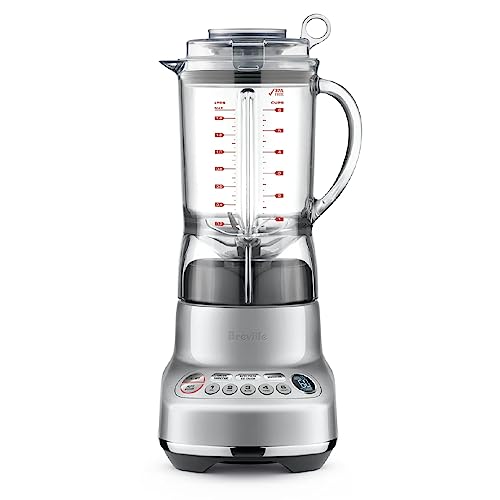
Breville Fresh & Furious BBL620 — Best Countertop Value
The Breville Fresh & Furious BBL620 is the classic countertop answer: a high-torque motor, multiple speed settings and an auto-clean function, in a straightforward full-size blender that treats a protein smoothie as its home recipe rather than a stretch goal.
Strengths
- High-torque motor suited to thick, fibrous smoothie loads
- Multiple speeds give manual control over greens-to-smooth stages
- Auto-clean function simplifies the post-smoothie wash-up
Trade-offs
- Fewer smart or programmed features than the Ninja and nutribullet systems
- No personal cup option for solo grab-and-go smoothies
- Listing detail is sparser than rivals — buy it for the fundamentals
| Specification | Detail (as listed) |
|---|---|
| Motor | High-torque motor (as listed) |
| Controls | Multiple speed settings |
| Cleaning | Auto-clean function |
Torque is the right word for smoothies: a thick, fibrous load resists the blades continuously, and a motor that holds its speed under that resistance produces even texture without the stall-and-surge pattern lighter machines fall into. The Fresh & Furious is built around that quality, and smoothie loads are where it shows.
Choose it if you distrust automation fads and want a well-made countertop blender that does the fundamentals — power, control, easy cleaning — properly. Generations of smoothie drinkers were served by exactly this formula.
Fresh & Furious users should exploit the speed range deliberately: start fibrous loads at a middle speed to tear greens without flinging them dry onto the walls, then finish high. The auto-clean function also earns its keep with smoothies specifically — green and berry pigments stain faster than shake residue, and a prompt auto-clean keeps the jar from carrying yesterday’s color into today’s drink.
Best for: Traditionalists wanting a strong, simple countertop smoothie blender / Not suited for: Users who want programmed cycles or cup systems
Check on Amazon — check the current price on Amazon at the listing.

nutribullet Full-Size Blender Combo NBF50500 — Best Combo Pick
The nutribullet Full-Size Blender Combo splits the smoothie week sensibly: a 64 oz, 1200W pitcher for the shared smoothie round, and a 24 oz tumbler cup for the solo protein smoothie, both dishwasher-safe and both strong enough for frozen fruit and greens at their scale.
Strengths
- 64 oz pitcher plus tumbler cup covers shared and solo smoothies
- 1200 watts handle frozen and fibrous loads in both formats
- Dishwasher-safe parts keep a two-vessel system practical
Trade-offs
- Pitcher is mid-sized — true family rounds may need two cycles
- Fewer programs than the Auto-iQ and SmartSense systems
- Counter space must house both vessels to get the system’s benefit
| Specification | Detail (as listed) |
|---|---|
| Motor | 1200 watts |
| Pitcher | 64 oz |
| Extras | 24-oz tumbler cup |
| Cleaning | Dishwasher safe |
The combo logic shines in real weeks: weekday solo smoothies happen in the tumbler with ninety seconds of total effort, and weekend batches happen in the pitcher without a second appliance. Powder behavior is good in both, provided you load liquid first — the tumbler’s extraction geometry is particularly kind to powder.
It is the value-conscious way to own both formats. If the DUO system is more machine than your household needs, this is the same idea at a gentler scale.
Combo smoothie rhythm: the tumbler is not just the solo vessel, it is the test kitchen. Trial a new recipe at tumbler scale before committing a pitcher to it — smoothie ingredients are too expensive to experiment with at 64 oz. Once a combination earns promotion, the pitcher version scales it faithfully, and the household’s recipe book grows without waste.
Best for: Mostly-solo smoothie drinkers who also blend for others sometimes / Not suited for: Households needing maximum single-batch volume
Check on Amazon — check the current price on Amazon at the listing.

Ninja Compact Kitchen System AMZ493BRN — Best Versatile Pick
The Ninja Compact Kitchen System AMZ493BRN adds a dimension no other pick here has: alongside its 72 oz pitcher and 18 oz cup, a 40 oz processor bowl handles the prep around the smoothie — chopping nuts for toppings, processing oats, making the nut butter you then blend in.
Strengths
- 72 oz pitcher, 18 oz cup and 40 oz processor bowl in one system
- 1200 watts with Auto-iQ across three listed functions
- Processor bowl extends the machine into smoothie-adjacent prep
Trade-offs
- Most parts to store and wash of any pick here
- The 18 oz cup is the smallest solo vessel in this guide
- Households that never food-process pay for unused range
| Specification | Detail (as listed) |
|---|---|
| Motor | 1200 watts |
| Pitcher | 72 oz |
| Extras | 40-oz processor bowl, 18-oz cup |
| Programs | Auto-iQ, 3 functions as listed |
Smoothie enthusiasts often become ingredient preppers: frozen packs portioned, oats ground, toppings chopped, nut butters made. The processor bowl absorbs that work into the same base, which is why this system suits the smoothie-as-lifestyle user better than a drinks-only machine.
As a smoothie blender itself it is fully credible — Auto-iQ cycles, real power, family pitcher — with the prep range as the differentiator. Buy it when your blender’s job description keeps growing.
Compact Kitchen System owners get a prep dividend worth using: grind oats to flour in the processor bowl for the smoothest oat smoothies, and chop nuts there for toppings that give a smoothie bowl its contrast. The system’s three vessels divide the smoothie workflow — prep, batch, solo — more completely than any other pick in this guide, provided your counter can host the family.
Best for: Smoothie enthusiasts who also prep ingredients and toppings / Not suited for: Drinks-only users who want minimal parts
Check on Amazon — check the current price on Amazon at the listing.
Comparison Table
Power is table stakes here; the real separators are format, automation style and how each machine handles fibrous loads. Match the philosophy to your recipe habits.
| Pick | Badge | Key spec | Best for |
|---|---|---|---|
| nutribullet SmartSense Blender Combo NBF50700 | Best Overall | 1400 watts | Varied-recipe smoothie makers who want adaptive automation |
| Ninja Professional Plus DUO BN751 | Best System Pick | 1400 peak watts | Households blending smoothies for multiple people and formats |
| Vitamix Propel Series 510 | Best Premium Compact | 48 oz | One-to-two-serving smoothie makers wanting premium texture |
| Breville Fresh & Furious BBL620 | Best Countertop Value | High-torque motor (as listed) | Traditionalists wanting a strong, simple countertop smoothie blender |
| nutribullet Full-Size Blender Combo NBF50500 | Best Combo Pick | 1200 watts | Mostly-solo smoothie drinkers who also blend for others sometimes |
| Ninja Compact Kitchen System AMZ493BRN | Best Versatile Pick | 1200 watts | Smoothie enthusiasts who also prep ingredients and toppings |
How to Choose the Best Blenders for Protein Smoothies
Begin with your thickest, most fibrous regular recipe and buy for that, because a machine that handles kale, frozen mango, oats and powder together will handle everything simpler without thought. Then choose format by household: pitchers for shared rounds, combos for mixed solo-and-shared weeks, compact premium containers for one or two servings done perfectly.
Finally, pick your control philosophy honestly. Adaptive smart cycles suit variable recipes; fixed programs suit stable ones; manual variable speed suits cooks who enjoy the craft. None is objectively best — the right one is the one whose texture you stop thinking about within a week.
Greens, Seeds and Fiber: The Smoothie Texture Tests
Greens fail in two ways: flecks, from insufficient sustained speed, and stringiness, from fibrous varieties like kale stems that need either longer blending or removal before blending. The practical fixes are to blend greens with the liquid first for thirty seconds before adding frozen ingredients, and to strip the toughest stems. Every pick in this guide can then finish the job to a smooth standard.
Seeds divide by size: chia and flax hydrate and soften, disappearing into body; berry seeds must be fractured by sustained high speed, which the stronger machines here do well. If seed grit is your personal texture enemy, bias toward the premium or smart picks and extend the final polish stage rather than adding liquid.
Budget Tiers for Protein Smoothie Blenders, in Plain Terms
The value tier buys honest pitcher power for standard smoothies — fruit, powder, soft greens — with manual control. The mid tier buys systems and programs: cups plus pitchers, Auto-iQ cycles, easier fibrous performance. The premium tier buys texture resolution and adaptation: greens and seeds reduced to true smoothness, cycles that adjust themselves, and compact containers proportioned for quality over quantity.
Smoothie households blend often and thick; the cost-per-blend math rewards the tier that matches your most fibrous recipe, not your simplest one.
Building a Balanced Protein Smoothie
A smoothie that keeps you full follows a rough architecture: a protein base (powder, Greek yogurt or both), a fruit for flavor and body, a green or vegetable for volume, a fat for satiety (nut butter, seeds, avocado), and liquid to the texture you like. Blenders in this guide handle the full architecture; the recipe discipline is yours. Portion the fat deliberately — it is the easiest component to double by accident.
Freeze your fruit and greens in portioned packs and the morning build becomes assembly rather than cooking: pack, liquid, powder, blend. The machines above were chosen partly for how they treat exactly those rock-hard frozen packs.
Smoothie Bowls and Spoonable Protein Blends
The smoothie bowl is the protein smoothie’s thick extreme: minimal liquid, maximum frozen fruit, blended to a soft-serve body and eaten with toppings. It is the hardest format for circulation — the load barely flows — and it separates this guide’s picks honestly. Compact strong containers and tamper-friendly designs manage it; big lazy pitchers dome and stall. If bowls are your goal, weight the Propel and the compact end of this list, and blend in small, patient batches.
Liquid discipline is the bowl skill: add liquid by the spoonful, not the splash, and stop the moment the load turns over. Every extra spoon is texture you cannot recover. Toppings — chopped nuts, seeds, fresh fruit — are not decoration on a bowl; they are the textural contrast the format exists for, so prep them while the base blends.
Freezing Smoothie Packs: The Fifteen-Minute Week
Portion each smoothie — fruit, greens, oats, seeds — into freezer bags or containers on one weekly session, and the daily smoothie becomes: pack, liquid, powder, blend. Packs freeze the ingredients at their peak, eliminate the morning measuring entirely, and make the grocery list write itself. Every machine in this guide was chosen partly for how it treats a rock-hard frozen pack, because that is the real daily load of an organized smoothie household.
Label packs with the recipe name and the liquid to add, because frozen packs are anonymous by design. A month of unlabeled green bags is a month of surprise smoothies — amusing once, corrosive to the habit thereafter.
Protein Smoothies for Families: Scaling Without Tears
Family smoothie making fails on texture inequality: the first glass is perfect, the last is the dregs. Pitcher discipline fixes it — blend the full batch, then stir the pitcher once with a long spoon before pouring all glasses in quick succession. The stir re-unifies any settling, and simultaneous pouring keeps the distribution honest.
For mixed-age households, blend the base batch mild and finish individual glasses: extra fruit in one, a spoon of nut butter in another, the powder in only the glasses that want it. The systems in this guide — pitcher plus cups — are built for exactly that base-plus-finish workflow, which is why they dominate the family end of this list.
Troubleshooting Bitter, Bland and Separating Smoothies
Bitterness usually comes from greens out of balance — too much kale or spinach against too little fruit — or from certain powders reacting with citrus over time. Fix the ratio, not the machine: increase the sweet fruit fraction, add banana for masking body, and drink citrus-containing smoothies fresh. Blandness is the opposite fault and takes the opposite medicine: a tart element — berries, citrus, a spoon of yogurt — wakes a flat smoothie more effectively than sweetener.
Separation in the glass means the emulsion needs body: oats, chia, yogurt or a longer final blend all tighten it. A smoothie that separates after ten minutes is not a failure — it is a drink asking to be stirred — but building body in from the start is the more satisfying craft.
Smoothie Ingredients That Fight the Blender — and How to Win
A short rogue’s gallery: raw carrots and beets, which need either cooking, fine grating or the strongest machines here; frozen whole strawberries, whose size stalls small cups; medjool dates, which should be pitted, halved and soaked briefly if your machine is mid-powered; and raw kale stems, which no home blender fully forgives — strip them. Ginger and turmeric roots blend best grated or in coin slices rather than chunks, distributing their intensity instead of leaving a single fiery pocket.
None of these ingredients is banned; each simply has a preparation price, and paying it in prep rather than in blending time produces better texture and a happier motor. The strongest picks in this guide forgive more of these shortcuts than the value picks do, which is a fair summary of what the money buys in this category.
Liquid Choices and What They Do to Texture
The liquid is a smoothie ingredient, not a solvent. Dairy milk adds body and a neutral base; yogurt adds body plus tang and thickens without ice; coconut water drinks light and hydrating but thin; nut milks vary from watery to rich by brand; juice adds sweetness that can swamp a powder’s flavor; plain water is the honest baseline that lets fruit and powder speak. Choosing the liquid is choosing the smoothie’s weight class before the blades ever turn.
A useful calibration: build your standard recipe once with water to learn its true structure, then swap liquids to taste the difference each makes. Most households discover their preference in two experiments and then stop thinking about it — which is the goal of every system in this guide, human and mechanical alike.
Kids, Guests and the Smoothie as Diplomacy
Protein smoothies in family life are often a negotiation: the adult recipe hides greens and seeds inside fruit sweetness for younger drinkers, with the powder added only to the glasses that want it. The pitcher-plus-cup systems here run that diplomacy natively — base batch in the pitcher, finishes in the cups — and the texture standard matters doubly, because a child who detects a fleck will detect it forever.
For guests, the smoothie round is a performance the big pitchers handle gracefully: one dramatic batch, glasses poured together, the machine rinsed in thirty seconds by program or auto-clean. Buy for your daily reality, but it is fair to count these social performances among the returns on a system purchase.
When a Smoothie Is Too Much: Scaling Down Gracefully
Not every day wants the full meal smoothie, and the recipes scale down better than the machines do — a half recipe in a big pitcher blends worse than a full one, because the vortex needs its working volume. That is the practical argument for the combo formats in this guide: the cup or compact container takes the small day, the pitcher takes the big one, and texture stays constant across appetites.
Appetite honesty also protects the habit: a smoothie sized to hunger gets finished and enjoyed, while a heroic daily litre becomes a chore by Thursday. The right-sized vessel, used at its right size, is this entire category’s quiet thesis.
Reading Smoothie Labels on Machines: Programs Decoded
Program names across brands — smoothie cycles, green smoothie settings, extraction programs — describe pulse-and-ramp patterns rather than different physics. What varies meaningfully is whether the pattern includes an initial gentle phase for greens and powder, how long the high-speed polish runs, and whether the machine adapts mid-cycle. The reviews in this guide translate each pick’s program story into those plain terms, because the pattern, not the name, is what touches your drink.
Manual machines are not lesser for lacking programs; they hand the pattern to you. Cooks who enjoy the craft often produce better smoothies on a good variable dial than distracted users produce on automation. Choose the interface that matches the attention you will actually pay at blending time.
Smoothie Prep for One vs Many: A Tale of Two Counters
The solo smoothie maker’s counter is a study in staging: powder by the base, a cup ready, frozen packs portioned, liquid in the refrigerator door. The family smoothie counter is a production line: pitcher centered, glasses ranked, ingredients in batch order. Both systems work, and the machines in this guide were chosen to serve whichever counter you run — but the staging matters as much as the machine, because a smoothie routine that requires hunting for components at dawn is a routine in decline.
Spend one session arranging your counter for your format and the habit’s daily cost drops permanently. It is the cheapest performance upgrade in this entire guide, and it is available before the new machine even arrives.
The Honest Limits of Home Smoothie Making
A closing honesty note: no home blender fully replicates a commercial smoothie bar’s high-horsepower texture on the most extreme recipes — the spoonable bowl with no liquid, the seed-heavy blend with no flecks at all. The picks here approach that standard closely enough that the difference stops mattering for home purposes, but the cook who chases the final two percent should know it is technique — staging, duration, ratios — that closes most of the remaining gap, not another purchase.
That is, in the end, this guide’s consistent message across the whole protein cluster: buy a machine honestly matched to your recipes, then invest in method. The smoothie you make in month three with the same machine will be visibly better than month one’s, and that improvement is yours, not the appliance’s.
One Last Thing: The Recipe Book Is the Real Appliance
Months from now, the most valuable smoothie equipment you own will not be the machine — it will be the short list of proven recipes taped inside a cupboard door: the green one that actually tastes good, the berry one the kids request, the coffee one for deadline mornings, each with its liquid amount and program noted. The machines in this guide make that book possible by being consistent enough to write recipes against. Start the book with your first good smoothie, add to it without mercy for failures, and the appliance on the counter becomes what it should be: the reliable executor of a repertoire that is entirely yours.
A Final Word on the Daily Meal in a Glass
The protein smoothie asks more of a blender than any other everyday drink, and it gives more back: a meal’s worth of fruit, greens, seeds and protein in a glass that takes two minutes to make. The six machines in this guide each clear that bar with a different philosophy, and the reader who matches philosophy to habit — automation for the variable cook, system for the household, compact premium for the perfectionist pair, honest mid-range strength for everyone else — will be served by their choice for years. Blend the greens first, freeze the packs, write the recipes down, and let the machine do the rest.
Before You Buy: A Ten-Second Checklist
Run this checklist against your thickest real recipe: Can the vessel hold it with working headroom? Can the motor and cycle finish its greens, seeds and frozen fruit without a second attempt? Can you clean it at the busiest moment of your morning? Does its format match who actually drinks — one, two, or a tableful? Five honest yes answers identify your pick in this guide more reliably than any ranking, because a protein smoothie is a meal you will make hundreds of times, and the machine that fits the meal is the machine that lasts.
How to Blend a Protein Smoothie with Perfect Texture
The two-stage method — greens and liquid first, everything else second — is the single biggest texture upgrade available to any smoothie maker, on any machine in this guide.
- Add liquid and leafy greens first and blend for a full stage until the liquid runs uniformly green with no visible flecks.
- Add the protein powder onto the green liquid and pulse twice to hydrate it without foam.
- Add soft ingredients: banana, yogurt, avocado, nut butter.
- Add oats or seeds now if using, so they get maximum time in the moving liquid.
- Add frozen fruit and ice last, keeping total volume within the pitcher’s working range.
- Run the smoothie program or a sustained high blend, letting the vortex pull the frozen load down steadily.
- Watch for the surface to move as one glossy mass; flecks or chunks mean the stage needs more time, not more speed changes.
- Stop, taste, and adjust once: liquid for thickness, fruit for sweetness, a squeeze of citrus for brightness.
- Pour immediately and rinse the pitcher — green residue dries into a stubborn film.
- Note the winning ratios for your favorite combination; smoothies reward a small personal recipe book.
If a smoothie separates in the glass, it usually needs body, not blending: a spoon of oats, chia or yogurt in the build holds the emulsion. If it tastes flat, acid is the missing note — citrus or a tart fruit wakes up both greens and powder.
Common Buying Mistakes
Adding greens last. Greens dropped onto a finished smoothie never break down properly. They need the first stage alone with liquid — sequencing is the whole trick.
Overloading frozen fruit in a mid-power machine. A pitcher packed with rock-hard fruit stalls circulation. Blend in the frozen load in two additions, letting the first pull down before adding the second.
Judging smoothies by the shake standard. A smoothie is thicker and more fibrous than a shake; machines and recipes borrowed from shake logic disappoint. Buy and build for the meal, not the drink.
Skipping the taste-and-adjust step. Powders vary in sweetness and greens vary in bite. One adjustment pass — acid, fruit or liquid — turns a dutiful smoothie into one you look forward to.
Letting green residue dry in the pitcher. Dried greens stain and cling. Rinse at once; use the auto-clean or self-clean cycles where fitted for the full wash.
Final Recommendation
The decision, distilled: the nutribullet SmartSense for adaptive power across changing recipes, the Ninja BN751 DUO for household system coverage, the Vitamix Propel 510 for premium texture in a compact size, the Breville Fresh & Furious for classic countertop strength, the nutribullet Combo for the solo-plus-shared week, and the Ninja Compact Kitchen System for smoothie-plus-prep versatility. Each earns its place among the best blenders for protein smoothies on a different, honestly stated strength.
Round out the comparison with the sibling guides: Best Blenders For Protein, Best Blenders For Protein Shakes, Best Blenders For Protein Shakes With Ice, Best Blenders For Making Green Smoothies, Best Blenders For Athletes.
Start here: nutribullet SmartSense Blender Combo NBF50700, Ninja Professional Plus DUO BN751, Vitamix Propel Series 510. Check the current price on Amazon for each before you decide.
Best Blenders For Protein Best Blenders For Protein Shakes Best Blenders For Protein Shakes With Ice Best Blenders For Making Green Smoothies Best Blenders For Athletes
Frequently Asked Questions
What makes a smoothie blender different from a shake blender?
Load and volume. Smoothies add fibrous greens, seeds, oats and large frozen fruit to the powder base, and servings run bigger. That demands sustained power, larger vessels and cycles that handle fiber — which is why this guide favors pitchers, combos and smart systems over the cup-only machines of the shake guide.
How do I get greens completely smooth with no flecks?
Blend greens alone with the liquid first, for a full stage, before adding anything frozen. Strip the toughest kale stems, use tender leaves where you can, and give the final blend enough sustained time. The premium and smart picks in this guide reduce greens furthest, but the two-stage method improves every machine’s result.
Can these blenders break down berry seeds?
The stronger machines here — the smart, premium and system picks — fracture raspberry and blackberry seeds to a barely noticeable level at sustained high speed. Complete seed elimination is beyond any blender; if seeds are your texture dealbreaker, strain or choose seedless fruits for your base recipes.
How thick can a protein smoothie be before I need a tamper?
Spoonable, soft-serve thickness is tamper territory: the load stops circulating and forms a dome. Among these picks, the compact premium container handles thick loads best by proportion; for routinely spoonable smoothies, consider the tamper-equipped machines in the sibling ice guide as well.
Is it better to use fresh or frozen fruit in protein smoothies?
Frozen fruit does three jobs at once — flavor, body and chilling — and eliminates the need for ice that waters the drink down. Fresh fruit plus ice is the flexible alternative when frozen stocks run out. Most daily smoothie makers land on frozen for the base and fresh for finishing flavors.
How do I keep protein smoothies from tasting chalky?
Hydrate the powder in the liquid stage before frozen ingredients arrive, keep the powder-to-liquid ratio sane, and add a fat — nut butter, yogurt or avocado — which rounds the texture noticeably. Chalkiness is rarely the powder’s fault alone; it is usually sequencing and ratio.


