Disclosure: airfryerkitchensupply.com is reader-supported. When you buy through links on our site, we may earn an affiliate commission at no extra cost to you.
Where to buy
Shoppers comparing the best blenders for making green smoothies will find every pick in this guide on Amazon. Green smoothies are the toughest everyday test in blending: leaf fibers, stems and seeds that weaker machines leave as confetti in your glass. The six machines below were chosen because they finish greens, not just chop them, and all are listed on Amazon where you can verify the exact container and cup set.
The six machines in this guide are: Vitamix 5200 Professional-Grade Blender, Vitamix Propel Series 510, Blendtec Total Blender Classic, nutribullet Pro+ N12-1001MK, Ninja Nutri-Blender Pro BN401, KitchenAid K400 Variable Speed Blender with Tamper. Check the current price on Amazon for the model you choose, and check price on Amazon again before ordering if you are comparing configurations, because jar sizes, included cups and colors vary by listing.
Introduction: The Fiber Problem, and How Blenders Actually Solve It
Looking for the best blenders for making green smoothies is really looking for a fiber solution. Spinach is forgiving, but kale stems, chard ribs, celery strings, ginger skin and berry seeds are engineered by nature to resist being eaten, and a blender defeats them only one way: by circulating them through fast blades over and over until the pieces are too small to feel. Machines that chop-and-stir produce green-flecked drinks. Machines that vortex produce green silk. That difference — not wattage, not jar size — is what this guide is buying.
The second green smoothie truth is that time is an ingredient. Even the best machine needs a sustained cycle: greens must be pulled down, cut, re-presented and cut again, typically over forty-five to ninety seconds, before a kale smoothie turns genuinely smooth. Blenders differ in whether they can run those cycles gracefully — steady speed under load, no stalling, no walking, no thermal drama — and in whether their jars keep the last leaves circulating instead of plastered to the walls above the blend line.
Our six picks cover the realistic budgets and habits of green smoothie drinkers: two premium vortex machines in different sizes, a wide-jar alternative philosophy, two personal blenders for the solo daily habit, and a preset-led mid-tier option. Every one was verified, matched by brand and model to its listing. We print no fixed prices — check the current price on Amazon, and check price on Amazon for the configuration you want, since cup and container sets vary.
In this guide
Quick Picks
Greens reward circulation and sustained speed. These six deliver both at different sizes and tiers — two premium, one wide-jar, two personal, one preset-led.
- Vitamix 5200 Professional-Grade Blender — Best Overall: The green smoothie reference: a variable-speed vortex that reduces kale and stems to silk in a 64 oz container. Check the current price on Amazon.
- Vitamix Propel Series 510 — Best Compact Premium: The same Vitamix philosophy in a 48 oz container with three programs — the apartment-friendly premium pick. Check the current price on Amazon.
- Blendtec Total Blender Classic — Best Wide-Jar Leaf Power: Ten speeds, six cycles and a wide FourSide jar that keeps leafy loads turning over. Check the current price on Amazon.
- nutribullet Pro+ N12-1001MK — Best Personal Blender: A 1200-watt personal blender that blends a genuinely smooth green drink straight into its travel cup. Check the current price on Amazon.
- Ninja Nutri-Blender Pro BN401 — Best Personal Blender with Programs: 1100 peak watts and Auto-iQ programs in a personal format — press, walk away, drink. Check the current price on Amazon.
- KitchenAid K400 Variable Speed Blender with Tamper — Best Mid-Tier with Presets: A Smoothie preset and variable dial at a mid tier, with a tamper for thick green blends. Check the current price on Amazon.
How These Picks Were Chosen
Selection started with the hardest green test we could fairly set: raw kale with stems, frozen mango, ginger and liquid — a combination that exposes weak circulation instantly. Picks had to emerge from that test with a drink that pours smooth, not merely green. That single filter eliminated most budget blenders and all chopper-style personal cups, however cheerful their marketing.
We then balanced formats. Green smoothies are a daily habit for most buyers, and daily habits live or die on friction: personal-cup machines for solo drinkers, mid-size containers for couples, full pitchers for families blending breakfast for everyone. This list deliberately spans those formats instead of crowning six near-identical pitchers.
Verification followed the program rule: Amazon listing data search by brand and model, title matched to the intended product, ASIN taken from the listing response, and spec boxes limited to facts in those returned titles. Where a machine’s green reputation rests on design rather than a listed spec, we describe the design and let you judge — we do not invent numbers.
The 6 Best Blenders for Making Green Smoothies — Reviewed in Detail

Vitamix 5200 Professional-Grade Blender — Best Overall
The Vitamix 5200 remains the green smoothie benchmark because its tapered container and variable speed produce the most complete fiber reduction in this guide. Start slow to pull the leaves under, ramp to high, and the vortex does the rest: kale stems, chard ribs and ginger all finish as texture, not pieces.
Strengths
- Most complete leaf-and-stem reduction here
- Variable speed lets you start gently and finish hard
- Self-cleaning cycle handles green residue in seconds
Trade-offs
- Premium tier positioning
- No presets — the cycle is yours to run
- Tall profile needs storage clearance
| Specification | Detail (as listed) |
|---|---|
| Container | 64 oz |
| Controls | Variable speed with high-speed switch |
| Blades | Stainless steel |
| Cleaning | Self-cleaning cycle |
What owners notice first is what is missing: no flecks. A 5200 green smoothie pours as a uniform liquid, and the mouthfeel difference versus crush-first machines is not subtle — it is the difference between drinking a smoothie and drinking a salad’s apology. Seeds from raspberries and blackberries are reduced further here than anywhere else on this list too, because the vortex keeps re-presenting them to the blades for the full cycle.
Technique still helps. Add liquid first, greens second, frozen ingredients last; run at least a full minute once the vortex forms; and do not fear the machine’s full speed — that sustained top end is exactly what you paid for. Clean-up is the self-cleaning cycle with warm water and a drop of soap, which matters because green residue dries like paint.
Best for: daily green smoothie drinkers who want genuinely smooth results from tough greens / Not suited for: buyers who want one-button personal convenience
Check on Amazon — check the current price on Amazon at the listing.

Vitamix Propel Series 510 — Best Compact Premium
The Propel 510 packages the Vitamix approach in a 48 oz container with three programs and pulse — the premium pick for smaller households and smaller kitchens. The narrower container suits one-to-three serving green smoothies better than a big pitcher does, keeping the vortex tight at realistic volumes.
Strengths
- 48 oz container sized for daily small batches
- Three programs plus pulse for repeatable green cycles
- Self-cleaning, variable speed — the full Vitamix toolkit
Trade-offs
- Premium tier, smaller jar — families will outgrow it
- Programs help, but tough greens still reward a manual long cycle
- Less headroom for big frozen additions
| Specification | Detail (as listed) |
|---|---|
| Container | 48 oz |
| Programs | 3 blending programs plus pulse |
| Controls | Variable speed |
| Cleaning | Self-cleaning |
Container size is an underrated green smoothie variable. In an oversized pitcher, a single serving sloshes thinly, the vortex struggles to form, and leaves ride the walls. The 510’s 48 oz container keeps a two-serving green smoothie deep enough to circulate properly, which is why smaller Vitamix containers so often outperform bigger rivals on weekday breakfasts despite identical blending philosophy.
The three programs earn their place as a starting pattern — run the program, then extend manually for kale-heavy recipes until the surface is glossy and uniform. If your household is one to three people and green smoothies are a daily ritual rather than a weekend project, this is arguably the sweetest spot in the entire Vitamix line for the job.
Best for: small households wanting premium green texture in a right-sized container / Not suited for: families blending breakfast for four or more
Check on Amazon — check the current price on Amazon at the listing.

Blendtec Total Blender Classic — Best Wide-Jar Leaf Power
The Blendtec Total Blender Classic offers the other credible route to smooth greens: a wide FourSide jar, ten speeds and six preprogrammed cycles. Instead of a tight vortex, it uses jar width and blade power to keep a leafy load tumbling, and for big green batches that approach has real merit.
Strengths
- Wide jar keeps large leafy loads circulating
- Ten speeds and six cycles give control plus automation
- Strong choice for family-size green batches
Trade-offs
- Fine fiber finish a shade behind the Vitamix pair on stems
- Wide jar is clumsy for single servings
- Premium tier positioning
| Specification | Detail (as listed) |
|---|---|
| Jar | FourSide jar (75 oz total capacity as listed) |
| Speeds | 10 speeds with pulse |
| Programs | 6 preprogrammed cycles |
Greens are bulky before they are liquid — a jar full of kale is mostly air — and wide jars swallow that bulk gracefully where narrow jars need packing and tamping. The Total Classic collapses a heaping leafy load quickly, and its programmed cycles give new green smoothie makers a reliable baseline while they learn ratios. For households blending a big green batch for several people, that capacity-first design is genuinely the more convenient tool.
The honest gap is the last five percent of texture. On the toughest stems and seeds, the Vitamix vortex finishes finer; the Blendtec finishes very good. Most drinkers will never run the two side by side and will be entirely happy. If you blend for a crowd, choose the Blendtec without regret; if you blend for one perfectionist, reread the two reviews above.
Best for: families making large green smoothie batches / Not suited for: solo drinkers chasing the finest possible finish
Check on Amazon — check the current price on Amazon at the listing.

nutribullet Pro+ N12-1001MK — Best Personal Blender
The nutribullet Pro+ is the personal-format green answer: 1200 watts driving a sealed cup, with 32 oz and 24 oz to-go cups and a pulse button. Personal cups are naturally good at greens for small servings because the contents have nowhere to hide — everything in the cup is near the blades.
Strengths
- Cup format forces full circulation of small green blends
- 1200 watts is serious personal-blender power
- Blend in the cup you drink from — minimal washing
Trade-offs
- Single-serving scale only
- Toughest stems may need a second cycle
- No pitcher option on this base
| Specification | Detail (as listed) |
|---|---|
| Motor | 1200 watts |
| Cups | 32 oz and 24 oz to-go cups with travel lids |
| Controls | Pulse button |
| Cleaning | Dishwasher safe |
For the solo daily green smoothie, friction is the enemy and the Pro+ removes nearly all of it: load the cup, blend, swap the blade for a travel lid, leave. The 32 oz cup is large enough for a proper kale-fruit-liquid build, and the 1200-watt motor handles frozen fruit alongside the greens without the stalling that plagues weaker personal machines. Results on spinach and softer greens are excellent; kale stems benefit from a pause, a shake, and a short second cycle.
Know its ceiling. This is a one-person, one-drink tool, and heavy daily use of the toughest ingredients will always favor a full-size vortex machine over years. As the engine of a personal weekday habit, though, it is exactly right — and habits, not specs, are what make green smoothies work.
Best for: solo drinkers building a daily green smoothie habit / Not suited for: households blending for several people
Check on Amazon — check the current price on Amazon at the listing.
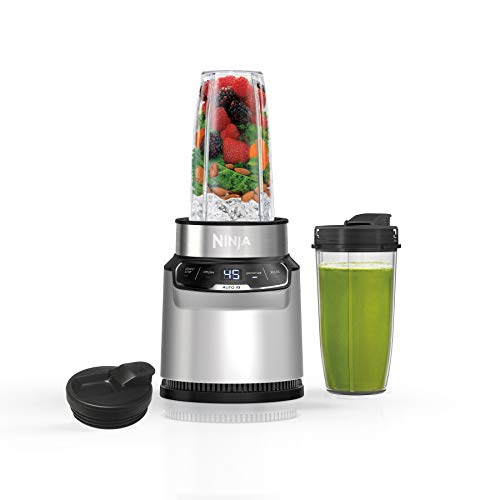
Ninja Nutri-Blender Pro BN401 — Best Personal Blender with Programs
The Ninja Nutri-Blender Pro BN401 brings Auto-iQ to the personal green brief: 1100 peak watts and two Auto-iQ programs across a pair of 24 oz cups. The programs pulse and pause automatically, which suits greens — the pauses let leaves settle back into the blade zone between attacks.
Strengths
- Auto-iQ pulse-pause pattern suits leafy loads
- Two 24 oz cups cover drinker plus partner or next-day prep
- 1100 peak watts handles frozen fruit with greens
Trade-offs
- 24 oz ceiling per drink
- Program timing is fixed; kale stems may need a rerun
- Personal format only — no batch option
| Specification | Detail (as listed) |
|---|---|
| Motor | 1100 peak watts |
| Cups | (2) 24-oz to-go cups |
| Programs | 2 Auto-iQ programs |
| Cleaning | Dishwasher safe |
The pulse-pause logic deserves respect. Continuous running in a small cup can centrifuge leaves against the wall, where they spin untouched; timed pauses drop them back into the blades. For green smoothies specifically, that makes the BN401’s automation more than convenience — it is a texture technique built into the button, and beginners get better greens from it than from holding a button and hoping.
Pair it with sensible loading: liquid to cover the blades, greens packed in the middle, frozen fruit on top to weigh the load down. Run the program twice for stem-heavy kale. Within the personal format, this and the nutribullet above are the two credible green machines; choose between them on cup size and whether you prefer programs or manual pulse control.
Best for: program lovers who want hands-off personal green smoothies / Not suited for: batch blending or the very toughest daily stem loads
Check on Amazon — check the current price on Amazon at the listing.

KitchenAid K400 Variable Speed Blender with Tamper — Best Mid-Tier with Presets
The KitchenAid K400 closes the list as the mid-tier full-size option: a Smoothie preset among its named programs, a five-speed variable dial with automatic motor adjustment, and a tamper included as listed — a genuinely useful tool when a thick green blend needs encouragement.
Strengths
- Named Smoothie preset plus a true variable dial
- Tamper included — helps thick, leaf-heavy loads
- Motor adjusts to resistance automatically
Trade-offs
- Fiber finish behind the premium vortex machines
- Mid-size format only
- Preset results depend on sensible ratios
| Specification | Detail (as listed) |
|---|---|
| Controls | 5-speed variable dial with Intelli-Speed Motor Control |
| Programs | Ice Crush, Icy Drinks, Smoothie presets |
| Accessory | Tamper included (as listed) |
The K400’s green smoothie style is assisted rather than automatic. The preset gives you a tuned starting cycle; the dial lets you extend it for kale; and the tamper lets you push a stubborn, under-liquided load down without stopping the machine — the exact intervention thick green blends most often need. Owners who like to participate in the blend will find this the most engaging machine on the list.
Its results sit honestly in the mid tier: spinach and soft greens disappear completely, kale finishes smooth with a full cycle and enough liquid, and only the stemmiest, driest loads reveal the gap to the Vitamix pair. At its tier, with its control set, that is a fair and useful trade.
Best for: hands-on blenders who want presets, a dial and a tamper in one mid-tier machine / Not suited for: set-and-forget users wanting premium fiber erasure
Check on Amazon — check the current price on Amazon at the listing.
Comparison Table
Read this table by format: the two Vitamix machines win on fiber finish, the Blendtec on batch size, the personal pair on daily friction, and the KitchenAid on assisted control. Your household size should narrow the field before texture does.
| Pick | Badge | Key spec | Best for |
|---|---|---|---|
| Vitamix 5200 Professional-Grade Blender | Best Overall | 64 oz | daily green smoothie drinkers who want genuinely smooth results from tough greens |
| Vitamix Propel Series 510 | Best Compact Premium | 48 oz | small households wanting premium green texture in a right-sized container |
| Blendtec Total Blender Classic | Best Wide-Jar Leaf Power | FourSide jar (75 oz total capacity as listed) | families making large green smoothie batches |
| nutribullet Pro+ N12-1001MK | Best Personal Blender | 1200 watts | solo drinkers building a daily green smoothie habit |
| Ninja Nutri-Blender Pro BN401 | Best Personal Blender with Programs | 1100 peak watts | program lovers who want hands-off personal green smoothies |
| KitchenAid K400 Variable Speed Blender with Tamper | Best Mid-Tier with Presets | 5-speed variable dial with Intelli-Speed Motor Control | hands-on blenders who want presets, a dial and a tamper in one mid-tier machine |
How to Choose the Best Blenders for Making Green Smoothies
Put circulation at the top of your list and wattage second. Green smoothness is produced by repeated cutting, so jar geometry and sustained speed matter more than a peak power figure. Tapered containers that vortex, wide jars that tumble, and personal cups that confine — all three can work. Shallow, wide, low-speed jars that merely stir cannot, whatever the box claims. If a machine cannot describe how ingredients return to the blades, it will leave your kale in pieces.
Match format to the habit you are building. A daily solo green smoothie is best served by a personal machine you will actually use on a tired Tuesday; a family breakfast round needs a 48–64 oz container; a household that batch-preps needs the wide jar. The most common green smoothie mistake is buying a magnificent pitcher that is annoying for one serving, then quietly stopping. Choose the format that fits the routine, then the best machine within it.
Finally, consider your greens. Spinach, romaine and herbs forgive almost everything. Kale with stems, chard, collards and celery do not: they demand the top of this list or patient technique on the middle of it. Be honest about which greens you buy, because the machine that is ‘fine for greens’ in a review usually means spinach — and your shopping bag is the real specification.
Ratios and Technique for Greens That Blend Smooth
A reliable green smoothie architecture is: liquid first to cover the blades, greens second, soft fruit third, frozen ingredients last as a weight that presses the load down. Liquid quantity is the lever beginners underuse — a dry green blend cannot circulate, and no motor fixes a mixture that will not move. Start with more liquid than looks right; you can thicken next time, but you cannot rescue a stalled jar without opening it anyway.
Blend in stages for the toughest loads. Thirty seconds to collapse the greens into the liquid, then a full high-speed cycle to finish the fibers. That two-stage pattern produces smoother results on mid-tier machines than one long blast, because the first stage guarantees everything is in circulation before the finishing speed begins. Add citrus or ginger at the end of your experiments, not the start: they brighten a smoothie that is already smooth, but they cannot make a gritty one taste intentional.
Temperature and freshness close the guide. Frozen fruit keeps the drink cold without diluting it, and cold green smoothies taste markedly fresher than room-temperature ones. Drink promptly: blended greens oxidize, flavors flatten, and the texture you worked for loosens within the hour. The best green smoothie machine is partly the one whose cleaning routine is short enough that you blend fresh daily — which is why self-cleaning cycles and blend-in-cup formats keep appearing in this guide’s badges.
A Green Smoothie Formula You Can Vary Every Day
Daily habits survive on structure with variation inside it, and green smoothies are no exception. The formula that sustains most long-term drinkers has five slots: a liquid, a green, a fruit for body, a fruit or citrus for brightness, and an optional extra — ginger, herbs, seeds, or a spoon of something creamy. Hold the slots constant and rotate the contents, and you get a different smoothie every day from a method you never have to rethink. The machine’s job in this system is consistency: the same cycle, the same texture, so the only variable you taste is the ingredient you changed.
Ratios inside the formula matter more than any specific recipe. A workable architecture is roughly two parts liquid-and-soft ingredients to one part greens by loose volume, with frozen fruit as a minority that chills and thickens. Beginners should err toward more fruit and milder greens — spinach, romaine, cucumber — and let the palate migrate toward kale, chard and herbs over weeks, because the habit that survives is the one that tastes good in week one. Sweetness should come from the fruit slot first; a smoothie that needs sweetener to be drinkable is a formula problem, not a sweetener opportunity.
Keep a short rotation list on the fridge — five or six combinations your household has actually approved — and shop to the list. That small piece of paper does more for a green smoothie practice than any upgrade in this guide, because the mornings that kill habits are the mornings of indecision in front of an open fridge. The blender you choose from this list will handle any combination on that paper. Your job is only to keep the paper honest.
Green Smoothies for Beginners: Easing Into Strong Flavors
The most common green smoothie failure is ambition on day one: a fistful of raw kale, ginger like a thumb, no fruit worth mentioning, and a resulting glass that tastes like a lawn with intentions. The drinker concludes they do not like green smoothies, when in fact they do not like that smoothie — a distinction worth an entire section, because the category’s dropout rate is a recipe problem disguised as a taste problem. Beginners should start where the flavor is forgiving: spinach disappears into fruit almost completely, mango and pineapple mask nearly anything green, and citrus brightness makes the whole glass taste deliberate rather than virtuous.
Texture matters even more for beginners than flavor. A gritty first green smoothie confirms every prejudice; a silky one — even a sweet, mild one — creates the willingness to try a stronger second. This is where the machines in this guide earn their badges for new drinkers specifically: run the full cycle, use enough liquid, and do not serve a beginner a smoothie you have not checked with a spoon. As the weeks pass, shift the greens stronger and the fruit lighter in small steps. Palates genuinely adapt — flavors that read as aggressive in week one read as fresh in week six — but only if the drinker is still drinking in week six.
One more beginner discipline: make it daily and small rather than heroic and occasional. A modest glass every morning builds the palate, the routine and the shopping habit simultaneously, and it gives the blender the regular use that keeps seals supple and skills sharp. The goal of the first month is not nutrition optimization; it is a practice that survives contact with real mornings. Optimization is month three’s hobby, and by then it will feel like play instead of penance.
Prep, Freezing and the Honest Truth About Batching Greens
Green smoothies resist batching more honestly than most drinks, and this guide will not pretend otherwise: a blended green smoothie begins oxidizing and separating within the hour, and by the next day it is a shadow of itself — drinkable, safe when refrigerated, but duller in flavor and looser in texture. The prep strategy that actually works is to batch the ingredients, not the drink. Washed greens portioned into freezer bags with the day’s fruit — smoothie packs — turn the morning process into: add liquid, add pack, blend. Five minutes of weekend prep buys a week of ninety-second mornings, with none of the quality loss of a stored drink.
Freezing greens deserves its own note, because it changes both texture and flavor in the drinker’s favor. Frozen kale and spinach blend smoother than fresh in most machines — the freezing ruptures cell walls that the blades would otherwise have to chase — and they chill the drink without diluting it. Wash, dry thoroughly, and freeze greens loose before bagging so they pour instead of clumping. Fresh herbs freeze less gracefully for smoothies and are better added fresh in small quantities; ginger freezes beautifully, peeled and portioned, and grates or blends straight from frozen.
If life genuinely requires a made-ahead drink — a commute, a shift — mitigate rather than apologize: blend it as late as possible, fill the container to the very top to minimize the air in contact with the surface, refrigerate immediately, and add a squeeze of citrus to the recipe, which slows the dulling. Then be honest with yourself about the trade you made. The machines in this guide will give you the best possible version of a stored smoothie; they cannot make it a fresh one, and the daily ninety-second habit, supported by freezer packs, remains the recommendation this guide actually believes in.
The Green Pantry: Keeping the Habit Supplied
A green smoothie practice consumes a surprising amount of produce, and the households that sustain it treat supply as a system rather than a shopping mood. The system’s base is the freezer: greens washed and frozen in portions, fruit bought ripe and cheap in season and frozen the same day, ginger peeled and portioned, and a reserve of frozen banana — the great sweetener and thickener — that never quite runs out. With that base stocked, a green smoothie is never more than one fresh item away, and the fresh item — citrus, cucumber, an apple — is the kind of thing a household buys anyway.
The fresh layer rotates weekly and should be bought with the rotation list, not with optimism. The optimistic shopper buys three kinds of greens, uses one, and composts two, then concludes that green smoothies are wasteful. The systematic shopper buys the greens the rotation actually uses, in the quantity the week actually drinks, and lets the freezer absorb the surplus the day it arrives rather than the day it wilts. Wilting greens are not a moral failure; they are a scheduling signal, and the freezer is the answer the schedule is asking for.
Liquids and extras form the pantry’s third layer, and they are where flavor variety hides. A household that stocks only water makes one smoothie with different costumes; a household that also keeps coconut water, a milk or plant milk it likes, citrus in quantity, and a small bench of extras — seeds, herbs, a good salt, vanilla — makes a repertoire. None of this needs to be exotic or expensive. It needs to be present, because a green smoothie improvised from an empty pantry is the smoothie that ends practices.
Finally, audit the system monthly with the only metric that matters: mornings used. If the packs are not being consumed, the formula has drifted from the household’s taste and should be adjusted before the supply is. The machines in this guide will blend anything the pantry provides, at the texture the badges promise. The pantry’s job is to make sure that on an ordinary, tired, rainy morning, everything the blender needs is already in the house. Habits are logistics wearing a health halo, and logistics can be designed.
Green Smoothies and the Rest of the Day: Pairing and Timing
A green smoothie does not exist in isolation; it lands in a day of eating, and where it lands changes what it should be. As a breakfast, it wants company — the smoothie alone is light, and most people find that a smoothie plus something small and protein-bearing carries the morning better than a heroic double smoothie that tries to be the entire meal. As a post-exercise drink, it wants the fruit share raised and the liquid generous, because its job there is fluid and quick energy with the greens riding along. As an afternoon bridge, it wants to be smaller and brighter — more citrus, more herb, less banana — because its job is refreshment, not sustenance.
Timing also affects the making, not just the eating. A smoothie blended the minute before drinking is a different — better — drink than one blended an hour ahead, for the oxidation reasons this guide has already covered, which means the habit should be designed around the blend happening at the point of consumption. That is the practical argument for the personal-format picks in this guide: a machine that lives where the drinker is, that blends in the vessel that travels, collapses the gap between making and drinking to nearly nothing. For office and gym routines, that collapse is worth more than any texture increment a flagship pitcher could offer.
One caution belongs in any honest timing discussion: a green smoothie is a food, and like any food it should be sipped and savored rather than bolted. Drinking it slowly, over ten or fifteen minutes, makes it more satisfying and easier on digestion than the same glass emptied in ninety seconds — and it makes the flavor nuances you tuned the recipe for actually perceptible. The machines in this guide can produce a smoothie faster than anyone can properly drink one. Let the drinking set the pace, and let the practice be a pause in the day rather than another task inside it.
When a Green Smoothie Is Not the Answer
An honest guide ends its enthusiasm with boundaries. A green smoothie is a poor tool when the eater needs to chew for satisfaction — some people simply do not register a drink as a meal, and no recipe adjustment changes that psychology; those eaters are better served by a salad built from the same ingredients, and there is no failure in it. It is also a poor tool when it becomes a vehicle for so much fruit sugar that the greens are decoration, because the drink has then quietly changed categories while keeping the virtuous name. The formula section of this guide exists to prevent exactly that drift: greens with a job, fruit with a limit, brightness from citrus rather than sweetness from a fourth banana.
And a smoothie practice should bend around real life rather than break against it. Travel weeks, illness, a broken routine, a household in upheaval — the practice that survives is the one that can shrink to three mornings a week without guilt and regrow when life settles. The freezer packs wait patiently; the machine does not keep score. What this guide has tried to build is not a streak to protect but a system to return to, and the measure of the system is not the perfect week. It is the ordinary month, in an ordinary kitchen, where the greens got drunk most days and nobody made a ceremony of the days they did not.
One Last Glass: The Recipe This Guide Blends at Home
Every guide should be willing to be cooked from, so here is the house green smoothie that the method in this article produces, stated plainly. Liquid first — a generous cup of water or your preferred base. Greens second — two honest handfuls of kale with the thickest stems stripped, or spinach if the week has been long. Fruit third — a banana for body and an orange, peeled, for brightness. Frozen mango last, a handful, to chill and thicken. Blend in the two stages this guide teaches: thirty seconds to collapse, then a full minute at high speed until the surface turns glossy. Taste it standing at the counter. It should be bright first, green second, and sweet only in the background — and if it is not, the next batch changes exactly one thing.
That recipe is a starting point with a method attached, not a commandment. Swap the mango for pineapple, the orange for grapefruit, the kale for chard, and the method carries the variation without complaint — which is the entire argument of this guide in a single glass. The machine provides the circulation; the formula provides the structure; the cook provides the judgment, one small change at a time. Make it tomorrow morning, exactly as written, and then make it yours.
How to Make a Green Smoothie With No Flecks, Step by Step
This method assumes raw leafy greens, including stems, and works on every pick in this guide with the timing adjusted to your machine’s strength.
- Pour liquid in first — water, milk or your preferred base — enough to cover the blades and reach roughly a third of the load’s final volume.
- Add greens next and pack them down into the liquid. If your recipe includes citrus juice or soft ingredients, add them now as well.
- Add soft fruit, then frozen fruit or ice last, on top, to weight the greens down toward the blades.
- Start low for 20–30 seconds until the greens collapse and the mixture moves as one. On program machines, run the smoothie program once at this stage.
- Run high for 45–90 seconds until the surface is glossy, the color is uniform, and no flecks circle in the vortex. Kale and chard want the long end of that range.
- Pour a spoonful and check: if you can feel fiber between your fingers, blend another 30 seconds. Serve immediately, rinse the jar at once, and run the self-clean cycle if fitted.
If a particular green keeps defeating your machine, change the green’s form before you change the machine: strip the thickest kale stems, chop celery across its strings, or blend greens with the liquid alone for the first stage before adding fruit. Those three adjustments rescue more green smoothies than any upgrade does.
Common Buying Mistakes
Under-liquiding the blend. A green smoothie that cannot circulate cannot get smooth. Add liquid until the vortex forms, then adjust next time
Stopping at ‘looks blended’. Greens look done thirty seconds before they are done. The flecks you skip checking for are the ones in the glass
Buying for spinach, blending kale. Soft greens forgive weak machines; stemmy greens expose them. Match the machine to the toughest green in your bag
Choosing a giant pitcher for one daily drink. Small loads in big jars circulate poorly and wash slowly. Format fit beats flagship status for a daily habit
Letting the jar sit. Green residue dries hard and stains. Rinse immediately or run the self-clean cycle while the smoothie is still in your hand
Final Recommendation
The Vitamix 5200 is the best blender for making green smoothies for most people: nothing else here finishes tough fibers as completely, and its self-cleaning cycle sustains the daily habit. Smaller households should take the Propel 510 for the same philosophy in a right-sized container; families should take the Blendtec Total Classic; solo drinkers should choose between the nutribullet Pro+ for manual control and the Ninja BN401 for programs; and hands-on mid-tier buyers should take the KitchenAid K400.
Verify the container and cup configuration at the listing, and check the current price on Amazon before you order. Keep exploring the cluster: best blenders for making drinks for the all-round picture, best blenders for making smoothies for the broader smoothie guide, and best blenders for making nut milk if plant milks are the other half of your routine.
Start here: Vitamix 5200 Professional-Grade Blender, Vitamix Propel Series 510, Blendtec Total Blender Classic. Check the current price on Amazon for each before you decide.
Best Blenders For Making Drinks Best Blenders For Making Frozen Drinks Best Blenders For Making Nut Milk Best Blenders For Making Hummus
Frequently Asked Questions
What makes a blender good for green smoothies specifically?
Sustained circulation at high speed. Greens must be cut dozens of times, so jar geometry that keeps leaves returning to the blades — a vortex container, a tumbling wide jar, or a confining personal cup — matters more than any single power figure.
Can a personal blender really make a smooth green smoothie?
Yes, for one serving. The nutribullet Pro+ and Ninja BN401 in this guide handle spinach easily and kale well with a full or repeated cycle. The format fails only at batch size, not at greens.
How do I stop kale tasting gritty?
More liquid, a two-stage blend, and more time at high speed. Also strip the thickest central stems for the toughest bunches. Grit is uncut fiber, and uncut fiber is a circulation or time problem, not a recipe problem.
Should I blend greens with liquid first?
For mid-tier and personal machines, yes — a greens-and-liquid first stage guarantees circulation before fruit thickens the load. Premium vortex machines can take everything at once, but the staged method never hurts.
Do green smoothies destroy nutrients because of blending?
Blending keeps the fiber in the drink, unlike juicing. Some oxidation begins once ingredients are cut, which is a practical reason to drink green smoothies fresh rather than storing them — a freshness point, not a reason to avoid blending.
How long do I need to blend kale smoothies?
Plan on 60–90 seconds of effective high-speed blending after the vortex forms on a premium machine, and up to two cycles on personal or mid-tier machines. Judge by texture — glossy, uniform, no visible flecks — not by the clock alone.

