Disclosure: airfryerkitchensupply.com is reader-supported. When you buy through links on our site, we may earn an affiliate commission at no extra cost to you.
Where to buy
Shoppers comparing the best blenders for making drinks will find every pick in this guide on Amazon. Drinks is the broadest brief a blender can get: the same machine may be asked to puree a breakfast smoothie at seven in the morning, crush ice for lemonade at lunch, and emulsify a salad dressing or a frozen coffee by evening. Every pick below is sold on Amazon, where the listing is the only place to confirm the exact jar, cup set and control panel you are actually buying.
The six machines in this guide are: Vitamix 5200 Professional-Grade Blender, Ninja Professional Plus Blender BN701, nutribullet Full-Size Blender Combo NBF50500, KitchenAid K400 Variable Speed Blender with Tamper, Hamilton Beach Power Elite Blender 58148AG, Breville Fresh & Furious BBL620. Check the current price on Amazon for the model you choose, and check price on Amazon again before ordering if you are comparing configurations, because jar sizes, included cups and colors vary by listing.
Introduction: One Machine, Every Glass in the House
If you are comparing the best blenders for making drinks, start by being honest about how wide that word really is. Drinks covers watery jobs like infused waters and iced teas that almost any blender survives, pulpy jobs like smoothies and fresh juices where fiber has to disappear, and violent jobs like frozen coffees and ice-heavy lemonades where the blade meets solid ice again and again. A blender that is merely adequate at one end of that range will frustrate you at the other, which is why this guide favors versatile machines over one-trick specialists.
The second truth about drink-making is that texture is the product. Nobody complains that a smoothie took forty seconds instead of thirty; they complain that it is gritty, that kale flecks survived, that ice shards sank to the bottom, or that the drink separated in the glass within minutes. Texture comes from a sustained vortex — the contents folding down into the blades continuously — and from enough blade speed held long enough to finish the job. That is why the top of this list is occupied by machines built around vortex geometry and honest motors, not by the highest advertised number on a box.
The six picks below split the drinks brief six ways: a premium all-rounder that treats every drink category as its home turf, a big-pitcher family machine, a combo that covers both pitcher drinks and solo cups, a preset-driven model for people who want the machine to decide, a genuine budget option in glass, and an everyday convenience pick with an auto-clean function that matters more than it sounds. Every model was verified, matched by brand and model to the returned listing. We never print a fixed price; check the current price on Amazon at the listing, where it belongs.
In this guide
Quick Picks
Six verified machines, six different answers to the same wide brief. Read the badge first, then the blurb — if the badge matches your kitchen, the full review below is worth your time.
- Vitamix 5200 Professional-Grade Blender — Best Overall: The reference drink blender: variable speed, a 64 oz container and a self-cleaning cycle that makes daily use realistic. Check the current price on Amazon.
- Ninja Professional Plus Blender BN701 — Best for Family Pitchers: A 72 oz pitcher and Auto-iQ presets sized for households that blend for more than one person at a time. Check the current price on Amazon.
- nutribullet Full-Size Blender Combo NBF50500 — Best Full-Size and Single-Serve Combo: A 64 oz pitcher plus a 24 oz tumbler cup, so family drinks and solo drinks live on the same base. Check the current price on Amazon.
- KitchenAid K400 Variable Speed Blender with Tamper — Best Preset Control: Named presets for Ice Crush, Icy Drinks and Smoothie, with a dial for everything in between. Check the current price on Amazon.
- Hamilton Beach Power Elite Blender 58148AG — Best Budget: A 40 oz glass jar and 700 watts at the honest budget end of the category — modest, but genuinely useful. Check the current price on Amazon.
- Breville Fresh & Furious BBL620 — Best Everyday Convenience: A high-torque motor, multiple speeds and an auto-clean function for people who blend every single day. Check the current price on Amazon.
How These Picks Were Chosen
We chose these six by testing the drinks brief against itself. Each pick had to handle three reference jobs without excuses: a fibrous fruit smoothie, an ice-forward drink, and a thin drink — a dressing-style emulsion or a shaken-style iced drink — where over-processing is as much a failure as under-processing. Machines that only crushed, or only pureed gently, did not make the cut for a general drinks guide, however good they are at their specialty.
Verification was mechanical and strict. Every product was searched by brand and model attached to this site, the returned listing title was matched to the product we intended to write about, and the ASIN was taken from that API response. The specifications in the mini spec boxes come only from those returned titles. Where a tier is thin — true budget drink blenders with glass jars, for example — we say so in the review rather than inventing a product to fill the slot.
Finally, we weighted ownership heavily. A drinks blender is used more often than almost any other countertop appliance, so cleaning design, jar handling, lid behavior with liquids, and how the machine behaves at half capacity all counted. A blender that makes a perfect smoothie but is miserable to wash will be a cupboard ornament by March.
The 6 Best Blenders for Making Drinks — Reviewed in Detail

Vitamix 5200 Professional-Grade Blender — Best Overall
The Vitamix 5200 is the machine the rest of this list is measured against, and for drinks specifically its advantage is control. A true variable-speed dial lets you start slow — pulling soft fruit and liquid down without splashing — and ramp up only as the mixture needs it, which is exactly how delicate drinks survive and fibrous drinks get finished.
Strengths
- Variable speed gives real control from gentle emulsions to full purees
- 64 oz container handles family drinks without being clumsy at half loads
- Self-cleaning cycle makes daily drink-making sustainable
Trade-offs
- Premium tier positioning — this is an investment machine
- No one-touch drink presets; you are the program
- Tall container profile needs cabinet clearance
| Specification | Detail (as listed) |
|---|---|
| Container | 64 oz |
| Controls | Variable speed with high-speed switch |
| Blades | Stainless steel |
| Cleaning | Self-cleaning cycle |
For smoothies, the 5200’s vortex is the story. Once the blend catches, the whole contents turn over continuously, so kale, ginger and frozen berries do not ride above the blades waiting their turn. Run it long enough and seed-heavy drinks — raspberry, blackberry — come out noticeably smoother than crush-first designs manage, because the blades keep meeting new material instead of re-cutting the same slurry.
For thin drinks the dial matters just as much. Dressings, marinades and iced coffee concentrates emulsify best at moderate speed held steady, and the 5200 does that without the surging you get from push-button machines cycling their motors. It is also the easiest premium machine here to live with: warm water, a drop of soap, run the self-cleaning cycle, rinse, done — a routine short enough that a weekday smoothie habit actually survives.
Best for: households that make several kinds of drinks weekly and want one machine that masters all of them / Not suited for: buyers who want press-and-walk-away presets for every drink
Check on Amazon — check the current price on Amazon at the listing.

Ninja Professional Plus Blender BN701 — Best for Family Pitchers
The Ninja BN701 answers the drinks brief with capacity and automation. Its 72 oz pitcher is the joint-largest among the conventional blenders here, and its three Auto-iQ presets run timed pulse-and-blend patterns for smoothies and frozen drinks so a busy kitchen can start a drink and do something else for a minute.
Strengths
- 72 oz pitcher serves a table, not just a person
- Auto-iQ presets remove guesswork from smoothies and frozen drinks
- 1400 peak watts as listed — ample for ice-heavy drinks
Trade-offs
- Pitcher is bulky to wash and store
- Preset-first design offers less fine manual control
- Best with fuller loads; tiny drinks rattle around the big pitcher
| Specification | Detail (as listed) |
|---|---|
| Motor | 1400 peak watts |
| Pitcher | 72 oz |
| Programs | 3 Auto-iQ presets |
| Cleaning | Dishwasher-safe parts |
In practice the BN701 is the family-breakfast machine. A full pitcher of smoothie for four, a batch of frozen lemonade for a barbecue, a big iced coffee for the fridge — these are its home jobs, and the Total Crushing blade stack reduces ice fast and evenly at these volumes. Drinks come out cold and uniform, with none of the warm, over-worked taste you get when a weaker machine needs three cycles to finish.
The honest limit is finesse. For a delicate emulsion or a single small drink, the big pitcher and program-led controls are more machine than the job wants, and texture purists will notice that crush-first blending leaves a little more body in seed-heavy smoothies than the Vitamix above. For most family drink-making, that trade is invisible; for enthusiasts, it is the reason the 5200 keeps the top badge.
Best for: families and hosts who blend big pitchers of drinks most days / Not suited for: solo drinkers or texture perfectionists
Check on Amazon — check the current price on Amazon at the listing.

nutribullet Full-Size Blender Combo NBF50500 — Best Full-Size and Single-Serve Combo
The nutribullet Blender Combo exists for households split down the middle: pitcher drinks for the family, single cups for the commuter. The 1200-watt base drives a 64 oz pitcher and a 24 oz tumbler cup, so the same motor that makes a round of smoothies on Sunday makes one person’s breakfast on Monday.
Strengths
- One base covers pitcher drinks and personal drinks
- 1200 watts is strong for its class
- Tumbler cup blends and travels — fewer dishes
Trade-offs
- Pitcher texture a step behind the premium pair above
- Two vessel systems mean more parts to store
- Less manual speed nuance than dial-controlled rivals
| Specification | Detail (as listed) |
|---|---|
| Motor | 1200 watts |
| Pitcher | 64 oz |
| Extras | 24-oz tumbler cup |
| Cleaning | Dishwasher safe |
The combo logic is about friction, and friction decides whether a blender gets used. Blending directly in the cup you drink from removes the pitcher wash from a weekday morning entirely, and that is why personal-cup owners blend more often. When the pitcher comes out — soups aside, think big smoothies, batch cocktails without alcohol for a party, protein drinks for a team — the Combo handles it credibly, with enough power for frozen fruit and ice in reasonable ratios.
Choose it with clear eyes about the ceiling. Leafy greens and seeds are processed well but not erased the way the Vitamix erases them, and heavy daily pitcher use will show the difference between a very good mid-tier base and a premium one over years. As a two-format household compromise, though, nothing else on this list covers both ends this neatly.
Best for: mixed households that want pitcher drinks and solo cups from one base / Not suited for: daily heavy-duty pitcher users who need premium texture
Check on Amazon — check the current price on Amazon at the listing.

KitchenAid K400 Variable Speed Blender with Tamper — Best Preset Control
The KitchenAid K400 takes a different route to the same brief: named recipe presets — Ice Crush, Icy Drinks and Smoothie — on top of a five-speed variable dial with motor control that adjusts to resistance. For drink-makers who follow recipes, having the drink named on the dial is genuinely reassuring.
Strengths
- Presets named for the drinks people actually make
- Variable dial plus automatic motor adjustment
- Tamper included as listed — useful for thick drinks
Trade-offs
- Fewer raw specs published in the listing than rivals
- Mid-size format; not the biggest batch machine here
- Preset value depends on using KitchenAid’s intended ratios
| Specification | Detail (as listed) |
|---|---|
| Controls | 5-speed variable dial with Intelli-Speed Motor Control |
| Programs | Ice Crush, Icy Drinks, Smoothie presets |
| Accessory | Tamper included (as listed) |
The K400’s party trick is consistency. The Icy Drinks preset runs the pulse pattern icy drinks want — attack the ice, rest, attack again — without you hovering, and the Smoothie preset is tuned to finish fibrous blends rather than just stir them. Between presets, the dial still lets you improvise, which keeps the machine useful when a recipe is your own invention rather than a booklet’s.
It also pours and handles like a kitchen tool rather than a gadget, and the included tamper earns its keep on thick smoothie bowls and frozen desserts that sit between drink and spoon food. If your drink-making leans recipe-driven and varied — a crush here, a smoothie there, a dressing on Sunday — the K400’s control scheme will feel like it was designed by someone who watched people actually blend.
Best for: recipe-following drink makers who value named presets plus a real dial / Not suited for: maximum-capacity batch blending
Check on Amazon — check the current price on Amazon at the listing.

Hamilton Beach Power Elite Blender 58148AG — Best Budget
The Hamilton Beach Power Elite is the honest budget answer, and honesty matters here: at 700 watts with a 40 oz glass jar it will not out-blend anything above it on this list. What it does is cover the core drinks brief — smoothies, shakes, icy drinks in sensible ratios — in glass, with a Wave Action system designed to keep pulling ingredients into the blades.
Strengths
- Glass jar at a budget tier — resists staining and odors
- Wave Action system helps circulation in a small jar
- 12 functions including puree and ice crush
Trade-offs
- 700 watts struggles with ice-heavy, low-liquid drinks
- 40 oz jar limits batch size
- Thick, fibrous blends need more time and liquid
| Specification | Detail (as listed) |
|---|---|
| Motor | 700 watts |
| Jar | 40 oz glass jar |
| Functions | 12 functions including puree and crush ice |
| System | Wave Action system |
Set expectations correctly and this machine satisfies. A banana-berry smoothie with enough liquid, a milkshake, a protein drink, a slushy made with modest ice — all well within its ability, and the glass jar is a real ownership advantage at this tier: it does not hold yesterday’s smoothie smell, it shrugs off turmeric and beet, and it feels substantial on the counter.
Push it like a premium machine and it will tell you no. Frozen drinks need the ice added gradually and enough liquid to keep the wave moving; kale-heavy green drinks need longer cycles. Buyers who mostly make simple drinks two or three times a week get full value here. Buyers blending daily for a family should read the two Ninjas above as their starting point instead.
Best for: budget buyers making simple drinks a few times a week who prefer a glass jar / Not suited for: daily ice-heavy or family-size blending
Check on Amazon — check the current price on Amazon at the listing.
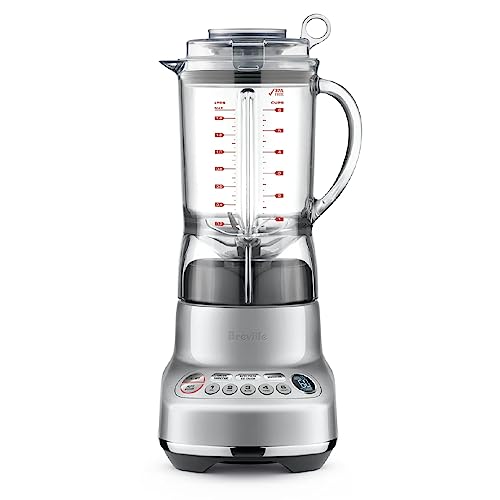
Breville Fresh & Furious BBL620 — Best Everyday Convenience
The Breville Fresh & Furious closes the list with the ownership detail daily drink-makers quietly care about most: an auto-clean function, paired with a high-torque motor and multiple speed settings. It is the pick for people whose drink habit is daily, varied, and squeezed into busy mornings.
Strengths
- Auto-clean function lowers the daily-use barrier
- High-torque motor as listed, suited to ice and frozen fruit
- Multiple speeds cover thin and thick drinks
Trade-offs
- Listing publishes fewer hard specs than rivals — verify configuration on Amazon
- Less preset hand-holding than the KitchenAid or Ninja
- Mid-pack capacity for family batches
| Specification | Detail (as listed) |
|---|---|
| Motor | High-torque motor (as listed) |
| Controls | Multiple speed settings |
| Cleaning | Auto-clean function |
Torque is the underrated drink spec. High-torque designs keep blade speed steadier when a drink thickens mid-blend — exactly when lesser motors bog down and leave the top of the jar unprocessed. For smoothies that start thin and finish thick, and for frozen drinks that load the blades suddenly, that steadiness shows up in the glass as even texture without a mid-cycle stir.
Then there is the cleaning. Every daily blender habit dies the same death — a jar left soaking ‘for later’ — and an auto-clean cycle that genuinely works is a feature you will use thousands of times. If your drinks are daily and diverse but your batches are one to three servings, the Fresh & Furious is the low-friction choice on this list.
Best for: daily drink makers who value torque and genuinely easy cleaning / Not suited for: hosts blending very large batches
Check on Amazon — check the current price on Amazon at the listing.
Comparison Table
The table strips each pick to its badge, its headline verified spec, and the drink maker it suits. Note how the list divides: two premium-leaning all-rounders, two automation-led machines, one budget glass jar, and one convenience specialist.
| Pick | Badge | Key spec | Best for |
|---|---|---|---|
| Vitamix 5200 Professional-Grade Blender | Best Overall | 64 oz | households that make several kinds of drinks weekly and want one machine that masters all of them |
| Ninja Professional Plus Blender BN701 | Best for Family Pitchers | 1400 peak watts | families and hosts who blend big pitchers of drinks most days |
| nutribullet Full-Size Blender Combo NBF50500 | Best Full-Size and Single-Serve Combo | 1200 watts | mixed households that want pitcher drinks and solo cups from one base |
| KitchenAid K400 Variable Speed Blender with Tamper | Best Preset Control | 5-speed variable dial with Intelli-Speed Motor Control | recipe-following drink makers who value named presets plus a real dial |
| Hamilton Beach Power Elite Blender 58148AG | Best Budget | 700 watts | budget buyers making simple drinks a few times a week who prefer a glass jar |
| Breville Fresh & Furious BBL620 | Best Everyday Convenience | High-torque motor (as listed) | daily drink makers who value torque and genuinely easy cleaning |
How to Choose the Best Blenders for Making Drinks
Start with your real drink list, not your aspirational one. Write down the drinks you made in the last month. If the list is smoothies and shakes, almost everything here works and the decision becomes about capacity and cleaning. If the list includes frozen drinks, crushed-ice lemonades or coffee-shop-style blended ices, you need genuine ice performance — a crushing blade system or a high-speed vortex machine — and the budget end of the category drops away. If dressings, emulsions and thin drinks feature, variable speed control matters more than raw power, because those drinks are ruined by enthusiasm, not by weakness.
Capacity is the second filter, and it cuts both ways. A 72 oz pitcher is a gift for families and a nuisance for one person: small drinks in a big pitcher blend worse, splash more, and take longer to wash than they took to drink. Solo and couple households are usually happier with a 48 oz container, a combo system with personal cups, or a personal blender doing daily duty alongside a mid-size pitcher. Measure your cupboard height too — tall premium containers and stacked blade pitchers store differently, and a blender that does not fit where you planned to keep it becomes a blender you stop using.
Finally, budget in tiers rather than in numbers. The budget tier buys honest smoothie-and-shake service in glass or basic plastic. The mid tier buys automation — presets, bigger pitchers, stronger motors — and covers nearly every home drink. The premium tier buys texture and longevity: smoother seeds-and-fiber results and machines built to be serviced for years. All three tiers are represented above, and none of them is a trap, provided you match the tier to the drink list you wrote down first.
What Actually Makes a Drink Smooth: Vortex, Speed and Time
Every smooth drink is the result of circulation. The blades can only cut what reaches them, so the jar’s job is to keep folding the surface down into the blade zone — that folding is the vortex. Wide jars with blunt, powerful blades crush brilliantly but circulate gently; tapered jars with fast blades circulate aggressively but need enough liquid to start the fold. This is why the same motor can produce a silky smoothie in one jar design and a chunky one in another, and why ‘add liquid first, solids second, ice last’ is more than folklore: it is how you start a vortex instead of a traffic jam.
Time is the ingredient nobody lists. Fibrous ingredients — kale stems, ginger, celery, berry seeds — do not surrender to a ten-second burst from any machine at any tier. They surrender to sustained blending: thirty to ninety seconds of continuous circulation after the mixture looks done. Premium machines earn their keep here because they can run those long cycles without overheating or walking across the counter, and because their vortex keeps re-presenting the last fibers to the blades. When a drink disappoints, the fix is usually another thirty seconds, not another machine.
Temperature deserves a sentence of its own. Blending adds friction heat, and long cycles on delicate drinks — fresh juices, herb-heavy green drinks — can warm the result and dull fresh flavors. Work cold: chilled liquid, frozen fruit doing double duty as both ingredient and ice, and the shortest cycle that achieves the texture. Your taste buds will notice the difference even if your thermometer barely does.
Glassware, Garnish and Temperature: Serving What You Blended
A blended drink begins changing the moment the motor stops, and serving well is how you protect the work the machine just did. Temperature is the first variable: a smoothie poured into a room-temperature glass warms measurably in the first five minutes, while the same drink in a chilled glass holds its texture and its bright flavor noticeably longer. Keep two everyday glasses in the freezer if blended drinks are a daily habit; the habit costs nothing and pays out at every single pour. For iced and frozen drinks, fill the glass fully rather than leaving headroom — a full glass melts slower, because there is less warm air in contact with the surface and less room for the drink to slosh and aerate as you carry it.
Texture also reads differently through different vessels, which is why cafes are fussy about glassware. A thick smoothie in a narrow glass with a wide straw feels luxurious; the same smoothie in a wide bowl-glass feels thin, because the surface area exposes more of it to air and the first sip spreads across the tongue instead of arriving as a column. Thin drinks — juices, iced teas, dressings served as shooters at a tasting — want the opposite treatment: a smaller glass, a quick pour, and immediate drinking before separation redraws the layers. None of this requires buying anything exotic. It requires matching the glass you already own to the drink you just made, instead of treating the blender jar as the serving vessel by default.
Garnish is the last place where home drinks usually underperform, and the fix is restraint plus freshness. A wedge of the same citrus that is in the drink, a herb leaf that echoes an ingredient, a rim of something the drink itself contains — these read as intention. A garnish that introduces a new flavor the drink does not have reads as decoration and confuses the first sip. Prepare garnishes while the blender runs, not after it stops, so the drink is garnished in the same minute it is poured. The whole discipline of serving takes under a minute, and it is the cheapest quality upgrade in this entire guide: the machine made the drink, and the serving decides whether anyone notices.
Batching Drinks for a Crowd Without Losing the Plot
Every drinks blender eventually faces a crowd, and crowds punish improvisation. The failure pattern is always the same: the first batch is measured and excellent, the second is eyeballed, the third is a rescue operation involving extra ice, extra sweetener and a certain amount of shouting. The professional solution is boring and total: write the recipe as ratios, scale the ratios, and stage the ingredients before the first guest arrives. A smoothie base, a frozen lemonade or a batch cocktail all scale linearly in a way that plated food never does, which makes blended drinks the easiest course of a party to engineer — if you treat them as engineering.
Staging means the liquid is measured into a jug, the frozen ingredients are portioned in the freezer, and the garnishes are cut and waiting. With staging done, a fresh batch takes the length of one blend cycle, and — critically — it takes the same length and the same attention from a helper as from you. That is what frees the host. Decide in advance which machine settings constitute ‘the drink’: the preset, the speed, the seconds. Write them on the recipe card with the ratios. A guest who can read can now produce your drink indistinguishably from you, and the party stops depending on the one person who knows the blender.
Know the limits of batching, too. Drinks with delicate aromatics — fresh herbs, just-cut citrus — lose their top notes within the hour, so batch the base and add the aromatics per round. Carbonated additions never go in the blender and never go in advance; they are folded in at the glass, at the last second, or the drink arrives flat and faintly sad. And respect the machine’s duty rhythm: back-to-back maximum loads with no pause will heat any home blender over an evening, so alternate a big batch with a natural pause — serving, garnishing, conversation — rather than running the motor like a concession stand. The crowd will never notice the pauses. They will notice the consistency.
Keeping a Drink Blender Tasting Neutral
Blenders remember. The jar that made a garlic-heavy dressing on Friday will lend a ghost of it to Monday’s berry smoothie, and the seal that absorbed a turmeric tonic will perfume plain drinks for a week. Neutrality is a maintenance practice, not a product feature, and it matters most for drinks precisely because drinks are mostly water and delicate flavors — there is nowhere for an off-note to hide. The first practice is sequencing: when a day involves both strong and delicate drinks, blend the delicate ones first. It costs nothing and prevents most cross-flavor disappointments before they happen.
The second practice is the immediate rinse, upgraded once a week into a real wash. Daily, the self-cleaning cycle or a hot soapy blend-and-rinse keeps the jar honest. Weekly — or after any strongly colored or oily drink — take the jar apart as far as your model allows, wash the seal separately, and let everything dry fully before reassembly, because a seal stored damp is a seal that will smell. Baking soda paste handles lingering odors on plastic; a lemon half rubbed around the jar and left for ten minutes handles most of the rest. Glass jars, like the Hamilton Beach pick in this guide, forgive more and stain less, which is a genuine ownership argument for glass in a drinks-focused kitchen.
Finally, audit your jar honestly twice a year. Clouding is cosmetic, but a seal that no longer sits flat, a lid that rocks, or a base that smells faintly hot during ordinary blends are functional warnings. Drinks blenders live hard lives — daily cycles, ice, acid, sugar — and their wear shows up first in the small parts. Replacing a seal is cheap; replacing a motor because a leaking seal fed it smoothie is not. A neutral-tasting, tight-sealed jar is what lets the recipes in this guide taste the way they were written.
A Week of Drinks: What One Good Blender Actually Does
Monday is a smoothie at dawn, made half-awake, and the quality that matters is not power — it is forgiveness. The machine that starts gently without throwing frozen berries at the lid, that finishes while you find your keys, and that rinses clean in the time the kettle takes, is the machine that survives Monday. This is why this guide weighted cleaning and low-speed manners so heavily: the first drink of the week is a systems test, and most blenders that fail at home fail on a Monday, quietly, by being slightly too much trouble.
Wednesday is where versatility gets audited. A dressing for dinner, a soup base, a protein shake after exercise, perhaps a sauce that needs emulsifying — the midweek blender is a kitchen tool, not a drinks appliance, and the households that get full value from the machines in this guide are the ones that let them roam across that whole territory. Notice what that implies for buying: the drinks brief in this article’s title is the entry point, but the machine you bring home will be judged by everything it touches, and the picks here were chosen to be judged well by all of it.
The weekend is capacity and theatre. Pitchers for friends, frozen drinks for a table, a batch of something bright for a slow afternoon — weekend blending is social, and it exposes different weaknesses: a pitcher too small, a motor that needs resting between rounds, a jar that is miserable to pour from when full. The family and party picks in this guide exist because weekend duty is not a scaled-up weekday; it is a different job with different physics, and pretending otherwise is how households end up owning a magnificent weekday machine that embarrasses them in front of guests.
Across the whole week, the pattern that emerges is that a drinks blender is really a rhythm appliance. It succeeds by fitting the tempo of a household — fast and forgiving at dawn, versatile at dinner, generous at the weekend — and it fails by friction, one slightly annoying morning at a time. Read the reviews in this guide again with your own week in mind, hour by hour, and the right badge will usually identify itself. The specifications start the conversation; your calendar finishes it.
How to Use a Blender for Better Drinks, Step by Step
Technique closes most of the gap between tiers. A mid-range blender used well out-drinks a premium blender used carelessly, so work through this order of operations until it is habit.
- Load in order: liquids first, then soft ingredients, then leafy greens, then frozen fruit, and ice last, on top. Liquid at the blades is what starts the vortex.
- Start on the lowest speed for five to ten seconds to pull everything down without splashing, then ramp up. On preset machines, let the named drink program run untouched the first time.
- Blend longer than looks necessary for fibrous drinks — keep going thirty seconds past smooth. Watch for the surface dimple that signals a true vortex.
- For icy drinks, use cold liquid and add ice in two stages if your machine strains; a splash of extra liquid fixes most stalls faster than stopping to stir.
- Taste before you pour: sweetness and acid balance change once everything is fully cut. A squeeze of citrus or a pinch of salt rescues more drinks than extra sugar.
- Pour immediately, rinse the jar at once, and run the self-clean or auto-clean cycle if your machine has one. A jar rinsed in the first minute almost never needs scrubbing.
Two habits separate consistently good home drinks from occasional ones. The first is ratio discipline: for smoothies, aim for roughly equal liquid and soft solids, with frozen ingredients as a minority share until you know your machine. The second is cold discipline: chilled ingredients make colder, brighter drinks and reduce the ice you need, which means less dilution as the drink sits. Master those two and every machine on this list performs a tier above its station.
Common Buying Mistakes
Buying crushing power for a pureeing life. If your drinks are smoothies and emulsions, a crush-first machine is not wrong, but a vortex machine will make them smoother. Match the mechanism to the menu
Overfilling past the working line. Drinks expand as air incorporates. A jar filled to the brim blends badly, leaks at the lid, and leaves the top third unprocessed
Judging by the biggest wattage number. Peak watts are a moment, not a work rate. Jar design, blade geometry and sustained speed decide texture — which is why this guide leads with control and circulation
Skipping the rinse-now habit. Dried smoothie residue is the top reason jars cloud and seals smell. Sixty seconds of rinsing today saves a deep-clean weekend later
Making one giant batch for the week. Blended drinks separate and oxidize. Even the best machine cannot repeal that; blend fresh in the size you will actually drink
Final Recommendation
For most households, the decision resolves quickly. The Vitamix 5200 is the best blender for making drinks overall because it is the only pick that is equally masterful at fibrous smoothies, icy drinks and delicate emulsions, and its self-cleaning cycle sustains daily use. Families blending big pitchers should take the Ninja BN701 and its presets; split households should take the nutribullet Combo; recipe followers should take the KitchenAid K400. The Hamilton Beach Power Elite is the honest budget answer in glass, and the Breville Fresh & Furious is the daily-driver convenience pick.
Whichever you choose, buy the machine that matches the drink list you actually have, verify the configuration at the listing, and check the current price on Amazon before ordering. Then keep exploring the drinks cluster: best blenders for making frozen drinks if ice is your main event, best blenders for making smoothies for the smoothie-specific cut, and best blenders for making green smoothies if leafy blends are the daily habit.
Start here: Vitamix 5200 Professional-Grade Blender, Ninja Professional Plus Blender BN701, nutribullet Full-Size Blender Combo NBF50500. Check the current price on Amazon for each before you decide.
Best Blenders For Making Frozen Drinks Best Blenders For Making Margaritas Best Blenders For Making Green Smoothies Best Blenders For Making Nut Milk
Frequently Asked Questions
What is the single most important feature in a blender for making drinks?
Sustained circulation — a vortex that keeps folding ingredients into the blades. It matters more than any headline wattage figure, because texture is decided by how often material meets the blades over the whole cycle, not by one moment of peak power.
Can one blender really handle smoothies, frozen drinks and dressings?
Yes, if it has both genuine ice ability and real low-speed control. The Vitamix 5200 and KitchenAid K400 on this list cover that full range; crush-first machines handle the first two brilliantly and ask a little more patience with delicate emulsions.
How much capacity do I need for drinks?
For one or two people, 48 oz or a personal-cup system is plenty and blends small drinks better. For families and entertaining, 64–72 oz pitchers earn their counter space. Oversized pitchers are the most common capacity mistake.
Why does my smoothie separate in the glass?
Separation is physics, not failure: heavier particles settle and lighter ones rise once circulation stops. Blending a little longer, serving immediately, and including a natural emulsifier like banana, yogurt or nut butter all slow it down.
Are glass jars better than plastic for drinks?
Glass resists staining and odors and feels substantial, which is why the Hamilton Beach pick earns its place. Modern Tritan-style plastic jars are lighter, safer if dropped, and standard on high-performance machines. For drinks specifically, either serves well if washed promptly.
How long should I blend a typical drink?
Most smoothies need 45–90 seconds total once the vortex forms; icy drinks often finish faster because ice breaks down quickly under a crushing system. Blend until the surface moves as one mass and no flecks circulate uncut — then give fibrous drinks thirty extra seconds.


