Disclosure: airfryerkitchensupply.com is reader-supported. When you buy through links on our site, we may earn an affiliate commission at no extra cost to you.
Where to buy
Shoppers comparing the best blenders for making margaritas will find every pick in this guide on Amazon. Margaritas are frozen drinks with a standard: the texture should be smooth enough to sip, consistent from the first glass to the last, and repeatable when the pitcher empties and the party is still going. Every machine below is sold on Amazon, where you can confirm reservoir size, jar capacity and program settings before buying.
The six machines in this guide are: Margaritaville Key West Frozen Concoction Maker, Margaritaville Bali Frozen Concoction Maker, Ninja Professional Plus Blender BN701, Waring Blade Blender BB300, Blendtec Classic 575, Margaritaville Bahamas Frozen Concoction Maker DM0500. Check the current price on Amazon for the model you choose, and check price on Amazon again before ordering if you are comparing configurations, because jar sizes, included cups and colors vary by listing.
Introduction: Consistency Is the Whole Game
Shopping for the best blenders for making margaritas is shopping for consistency under party conditions. A margarita is a specific frozen drink — tart, strong-flavored, and served in rounds — and its texture standard is unforgiving: ice reduced to a smooth, sippable slush with no crunchy shards and no watery melt pooling at the top of the glass. The first pitcher is easy. The fourth pitcher, made by a different guest while you are at the grill, is the test this guide is built around.
Two machine philosophies compete for the job. Dedicated frozen concoction makers shave ice from a reservoir and mix it with the liquid ingredients to programmed settings, producing bar-style texture with almost no operator skill. Conventional blenders crush or vortex the ice and liquid together, demanding a little more technique but earning their keep the other six days of the week as all-round kitchen machines. Neither philosophy is wrong; they suit different households, and this list deliberately crowns winners in both camps.
Our six picks span the margarita maker’s real options: two dedicated Margaritaville machines plus their compact sibling, the strongest conventional pitcher blender for the job, a commercial bar blender built for service, and a premium texture-control option. Every model was verified by brand and model, matched to its listing title. We print no fixed prices — check the current price on Amazon, and check price on Amazon for the exact configuration, because reservoir and jar sizes define these machines.
In this guide
Quick Picks
Party-proof texture first, versatility second. The dedicated machines lead on repeatability; the conventional blenders lead on everyday usefulness. Your hosting style decides which badge matters.
- Margaritaville Key West Frozen Concoction Maker — Best Overall: Shaved ice, an XL reservoir and four programmed drink settings — bar texture, guest-proof operation. Check the current price on Amazon.
- Margaritaville Bali Frozen Concoction Maker — Best Self-Dispensing Party Pick: A 60 oz jar with a self-dispensing lever: the pitcher that pours like a bar tap for a crowd. Check the current price on Amazon.
- Ninja Professional Plus Blender BN701 — Best Conventional Blender: Auto-iQ frozen programs in a 72 oz pitcher — the best margarita from a machine that also does everything else. Check the current price on Amazon.
- Waring Blade Blender BB300 — Best Bar-Duty Pick: A 1.5 HP bar blender with toggle controls, built for round after round of service. Check the current price on Amazon.
- Blendtec Classic 575 — Best Texture Control: Programmed cycles and a wide jar for makers who want to tune texture batch by batch. Check the current price on Amazon.
- Margaritaville Bahamas Frozen Concoction Maker DM0500 — Best Compact Dedicated Maker: The compact dedicated maker at 36 oz — bar-style texture for small gatherings and small counters. Check the current price on Amazon.
How These Picks Were Chosen
The selection test was repetition: three consecutive batches, made back to back, judged on whether batch three matched batch one in texture and dilution. That test favors shavers and programmed machines, and it should — margarita making is a repeatability sport. Machines that needed a skilled operator’s constant correction scored lower here than they would in a general frozen drinks guide, deliberately.
We also weighed the morning after. Margarita machines live a double life of sticky citrus, salt and sugar, so cleaning design counted: reservoirs and jars that rinse clean, self-cleaning cycles where fitted, and dishwasher-safe parts where listed. A machine that is wonderful at nine in the evening and dreadful at nine the next morning will not survive the summer.
Verification followed the program standard: Amazon listing data search by brand and model, listing title matched to the intended product, ASIN from the listing response, spec boxes limited to listed facts. Where a dedicated machine’s advantage is its mechanism — shaving rather than crushing — we describe the mechanism plainly rather than dressing it in numbers the listing does not provide.
The 6 Best Blenders for Making Margaritas — Reviewed in Detail
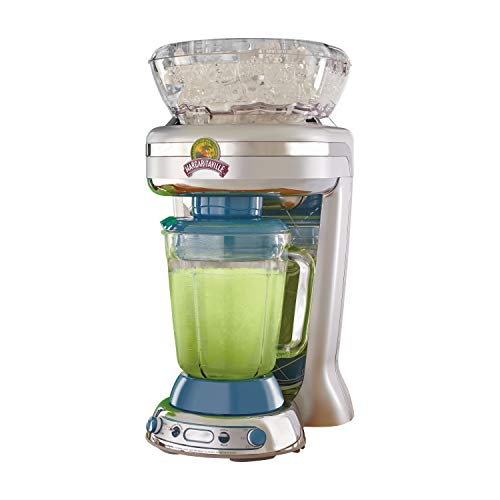
Margaritaville Key West Frozen Concoction Maker — Best Overall
The Margaritaville Key West takes the top badge because it removes the operator from the texture equation. Ice sits in an XL reservoir, the machine shaves it to a fine, bar-style consistency and mixes it with your liquid ingredients to one of four programmed drink settings — so the margaritas taste the same whoever presses the button.
Strengths
- Shaved ice gives the smoothest, most bar-like texture here
- XL reservoir supports continuous party service
- Four programmed settings standardize every batch
Trade-offs
- A dedicated specialist — it will not make soup or smoothies
- Counter footprint is a commitment
- Best results still depend on correct liquid ratios in the jar
| Specification | Detail (as listed) |
|---|---|
| Programs | 4 programmed drink settings |
| Reservoir | XL ice reservoir |
| Jar | Easy Pour Jar |
The shaving mechanism is the whole argument. Crushed ice is a collection of shards in assorted sizes; shaved ice is closer to snow, and snow suspends in liquid evenly, sips smoothly, and melts at a predictable rate that keeps the drink’s balance intact from first glass to last. In a party setting that predictability compounds: the reservoir holds ice for multiple batches, the program holds the ratio, and the host is free to be a host instead of a technician with a tamper.
Its limits are the limits of any specialist. It occupies counter or cupboard space for one job, however beloved, and households that make frozen drinks twice a year will not amortize it. Households with a standing Friday margarita ritual will wonder how they managed without it — which is exactly the dividing line this badge is drawn on.
Best for: regular hosts who want bar-style margaritas with zero technique required / Not suited for: occasional frozen drink makers or one-machine kitchens
Check on Amazon — check the current price on Amazon at the listing.
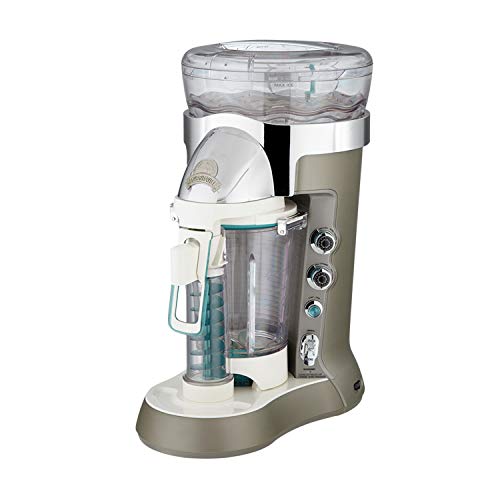
Margaritaville Bali Frozen Concoction Maker — Best Self-Dispensing Party Pick
The Margaritaville Bali adds the party trick that matters most at a crowd: a self-dispensing lever on a 60 oz jar. Guests serve themselves, the texture stays consistent because the machine made it, and the host stops being the bottleneck between the pitcher and the glasses.
Strengths
- Self-dispensing lever — guests pour their own
- 60 oz jar serves a round in one batch
- Automated mixing keeps texture uniform
Trade-offs
- Another dedicated specialist on the counter
- Dispensing suits slush texture; very thick blends pour slowly
- More parts to wash after the party
| Specification | Detail (as listed) |
|---|---|
| Jar | 60 oz |
| Serving | Self-dispensing lever |
Think about how margaritas actually fail at parties: not in the blending, but in the serving. A pitcher passed hand to hand warms, separates and spills; a dispensing jar stays put, stays mixed and pours a consistent glass each time. The Bali is engineered around that observation, and for gatherings of eight or more it changes the evening’s logistics more than any wattage figure could.
As with its Key West sibling, buy it as a deliberate specialist. It is the right second machine for a household that entertains, and the wrong only machine for a household that cooks. Judged purely on margarita service — the brief on this page — its dispensing design earns it a badge no conventional blender can contest.
Best for: crowd hosts who want self-serve margarita service / Not suited for: small gatherings or minimalist kitchens
Check on Amazon — check the current price on Amazon at the listing.

Ninja Professional Plus Blender BN701 — Best Conventional Blender
The Ninja BN701 is the best conventional blender for margaritas, and for many households the best answer overall: a 72 oz pitcher, Auto-iQ programs that run the frozen pulse pattern for you, and Total Crushing blades that reduce ice evenly through the full height of the load. On weeknights it goes back to being the family blender.
Strengths
- Auto-iQ automates the margarita pulse pattern
- 72 oz pitcher makes a full round at once
- One machine for margaritas and everything else
Trade-offs
- Crushed texture has slightly more body than shaved ice
- Preset-led; fine texture tuning is limited
- Big pitcher to wash after small rounds
| Specification | Detail (as listed) |
|---|---|
| Motor | 1400 peak watts |
| Pitcher | 72 oz |
| Programs | 3 Auto-iQ presets |
| Cleaning | Dishwasher-safe parts |
The BN701’s margarita method is pleasingly dull: liquid ingredients and ice in the pitcher, frozen program selected, sixty seconds of not thinking about it. The stacked blades prevent the classic margarita failure — a slushy bottom layer under floating cubes — by cutting at several heights simultaneously, and the result is a uniform, sippable pitcher that pours evenly for four to six glasses. For a household that wants margaritas monthly and smoothies daily, this is the rational flagship.
Texture connoisseurs will notice the difference against the shavers above: a hint more crystal body, a fraction faster melt. It is the difference between excellent and bar-programmed, and most palates at most parties will never register it. Buy the Ninja for the kitchen you have; buy the Margaritaville for the parties you throw.
Best for: households wanting one excellent machine for margaritas and daily blending / Not suited for: texture purists chasing true bar shave
Check on Amazon — check the current price on Amazon at the listing.

Waring Blade Blender BB300 — Best Bar-Duty Pick
The Waring BB300 is the service professional: a 1.5 horsepower motor, a 48 oz copolyester jar, and two-speed toggle controls with pulse, in an NSF-certified bar blender. It makes margaritas the way bars do — fast, loud, consistent and without a single menu to scroll.
Strengths
- 1.5 HP motor built for continuous rounds
- Toggle controls work with wet, salty hands
- NSF-certified listing signals commercial durability
Trade-offs
- Two speeds — texture tuning is coarse
- Bar manners: volume over refinement
- No presets or programs of any kind
| Specification | Detail (as listed) |
|---|---|
| Motor | 1.5 horsepower |
| Jar | 48 oz copolyester jar |
| Controls | 2-speed toggle with pulse |
| Certification | NSF certified (as listed) |
There is a margarita workflow the Waring owns: measured ingredients, ice, high speed, thirty seconds, pour, repeat — twenty times an evening if asked. The toggle switch is the interface that workflow deserves, operable by feel, immune to sticky fingers, and identical every time. Home hosts running a serious taco night or a pool party will find that the BB300 simply never becomes the evening’s problem.
What it will not do is finesse. A delicate frozen drink that wants a gentle finish, or a smoothie that wants a long vortex, is outside its two-speed vocabulary. As a dedicated margarita-and-frozen workhorse — especially a second machine for a home bar — it is superbly fit for purpose.
Best for: home bars and heavy party service / Not suited for: quiet kitchens or texture tinkerers
Check on Amazon — check the current price on Amazon at the listing.

Blendtec Classic 575 — Best Texture Control
The Blendtec Classic 575 is the margarita pick for makers who like control: four preprogrammed cycles for a reliable baseline, five speeds for adjustment, and a wide WildSide+ jar that keeps a full, icy load circulating instead of stalling against the walls.
Strengths
- Programmed cycles plus manual speeds — baseline and control
- Wide jar circulates full icy loads reliably
- Self-cleaning cycle dissolves the sticky aftermath
Trade-offs
- Premium tier positioning
- Fine-crush texture; coarse slush needs short manual cycles
- Wide jar is overkill for two-glass rounds
| Specification | Detail (as listed) |
|---|---|
| Jar | WildSide+ jar (90 oz total capacity as listed) |
| Speeds | 5 speeds |
| Programs | 4 preprogrammed cycles |
| Cleaning | Self-cleaning |
The Blendtec’s margarita personality is consistency with a tuning knob. Run the programmed cycle for the house standard; shorten it when you want more crystal body for a rustic serve, or repeat it when a sweeter, denser batch needs extra fining. The wide jar’s circulation means those adjustments actually apply to the whole load rather than the bottom third — the quiet technical reason its results are so repeatable.
Cleanup deserves its sentence: margarita residue is sugar, citrus and salt, a combination that dries into cement, and a self-cleaning cycle run before the party ends is the difference between a machine that is ready next Friday and one that is still soaking. For the maker who hosts often and likes a say in the texture, this is the connoisseur’s conventional choice.
Best for: hosts who want programmed consistency plus manual tuning / Not suited for: two-glass households
Check on Amazon — check the current price on Amazon at the listing.
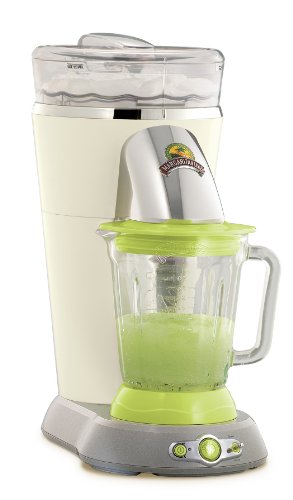
Margaritaville Bahamas Frozen Concoction Maker DM0500 — Best Compact Dedicated Maker
The Margaritaville Bahamas DM0500 is the compact dedicated option at 36 oz: the same shave-and-mix philosophy as its larger siblings, sized for small gatherings, small counters and households where margarita night means four glasses, not forty.
Strengths
- Dedicated shaved-ice texture in a compact format
- 36 oz capacity suits small rounds honestly
- Simpler commitment than the XL machines
Trade-offs
- Small capacity — parties outgrow it quickly
- Still a single-purpose machine
- Fewer settings than the Key West
| Specification | Detail (as listed) |
|---|---|
| Capacity | 36 oz |
Scale honesty is this machine’s virtue. Most margarita making is not a fiesta for twenty; it is two couples and a taco recipe, and a 36 oz batch made fresh twice beats a giant batch melting once. The Bahamas delivers the family’s signature shaved texture at that scale, in a footprint a small kitchen can actually house, without asking you to pretend you entertain more than you do.
If your gatherings grow, you will outgrow it — that is the trade, stated plainly. But as a first dedicated machine, or the margarita solution for an apartment or a camper-adjacent lifestyle, it matches the brief better than its bigger siblings match most people’s real lives.
Best for: small households wanting dedicated texture without the big footprint / Not suited for: regular large-party hosts
Check on Amazon — check the current price on Amazon at the listing.
Comparison Table
The table divides on one axis: shaved versus crushed. The three Margaritaville machines shave for bar texture; the Ninja, Waring and Blendtec crush or circulate for versatility and control. Decide which side of that line your kitchen lives on.
| Pick | Badge | Key spec | Best for |
|---|---|---|---|
| Margaritaville Key West Frozen Concoction Maker | Best Overall | 4 programmed drink settings | regular hosts who want bar-style margaritas with zero technique required |
| Margaritaville Bali Frozen Concoction Maker | Best Self-Dispensing Party Pick | 60 oz | crowd hosts who want self-serve margarita service |
| Ninja Professional Plus Blender BN701 | Best Conventional Blender | 1400 peak watts | households wanting one excellent machine for margaritas and daily blending |
| Waring Blade Blender BB300 | Best Bar-Duty Pick | 1.5 horsepower | home bars and heavy party service |
| Blendtec Classic 575 | Best Texture Control | WildSide+ jar (90 oz total capacity as listed) | hosts who want programmed consistency plus manual tuning |
| Margaritaville Bahamas Frozen Concoction Maker DM0500 | Best Compact Dedicated Maker | 36 oz | small households wanting dedicated texture without the big footprint |
How to Choose the Best Blenders for Making Margaritas
Start with frequency and crowd size, because they decide the philosophy. Monthly-or-more margaritas for groups argue for a dedicated shaver — the texture is better, the operation is guest-proof, and the machine will earn its footprint. Occasional margaritas in a kitchen that blends daily argue for the strongest conventional pitcher you can justify, because a specialist that sits idle eleven months a year is a cupboard tax. There is no universal winner; there is only the honest answer for your calendar.
Capacity second, and be realistic in both directions. A 72 oz pitcher or a 60 oz dispensing jar serves a round of six; a 36–48 oz jar serves two to four and forces fresh second batches, which many hosts secretly prefer because fresh texture beats held texture. Oversizing wastes counter space and makes small rounds badly — big jars blend small loads poorly — while undersizing a true party machine creates a queue at the blender, the saddest location at any gathering.
Finally, interrogate the cleanup before the first party, not after it. Margarita residue is adhesive. Reservoirs, dispensing levers and stacked blades all add parts; self-cleaning cycles and dishwasher-safe components subtract labor. The best margarita machine is the one that is clean and ready when the next invitation goes out, and that quality is decided by design details most buyers never read. Read them here, in the reviews, before the season starts.
Texture, Dilution and the Two-Minute Rule
A margarita’s texture is a race against its own melting. Shaved ice melts slowest in the glass because its crystals are uniform and the drink starts colder and more evenly chilled; irregular crushed ice includes tiny shards that melt instantly — watering the first sips — and boulders that outlast the drink. This is why mechanism matters more than power for this specific drink, and why two machines with identical wattage can serve margaritas that taste like different recipes.
Ratios are the second lever, and the discipline is to measure like a bartender even at home. A consistent liquid-to-ice ratio is what programmed settings actually protect; free-poured batches drift sweeter, weaker or icier across an evening as the maker relaxes. Pick a house ratio, write it on a card near the machine, and let guests operate the equipment without improvising the recipe. Consistency is a system, not a talent.
The two-minute rule closes the guide: a margarita should go from machine to glass within about two minutes of blending. Held slush separates, melts from the outside in, and loses the bright top notes that make the drink worth making. Blend in rounds sized to the glasses in hand, serve immediately, and let the machine’s speed — every pick here is fast — work for you instead of against a melting pitcher.
Frozen or On the Rocks: When the Blender Is the Wrong Tool
An honest margarita guide admits that some margaritas should never meet a blender. The classic on-the-rocks serve — shaken, strained over fresh ice — preserves a bright, spirit-forward clarity that freezing necessarily softens, because a frozen margarita is a diluted, aerated slush by design. Neither is superior; they are different drinks sharing a name and a rim. The frozen version wins on texture, refreshment and crowd service; the rocks version wins on intensity and on evenings when the drink is the event rather than the accompaniment. A household that loves both should own the tools for both, and a shaker is a considerably smaller investment than any machine in this guide.
The blender also loses, honestly, at very small scale. A single frozen margarita in a 72 oz pitcher is a sad production — the load too small to circulate, the washing larger than the drinking. For one or two drinks, the compact dedicated machine in this guide exists precisely for that scale, and failing that, a rocks serve or a small shaken-and-blended improvisation serves better than a flagship pitcher pressed into miniature service. Matching the tool to the round size is the same discipline this whole cluster teaches, from nut milk batches to hummus jars: capacity honesty is a quality feature.
Where the blender wins without argument is the gathering: six or more drinks, a warm evening, food that wants cold and tart beside it. There, the frozen serve’s consistency, speed and self-serve potential — the qualities this guide’s top picks were chosen for — turn the margarita from a bartending performance into a piece of hospitality infrastructure. Choose the serve per occasion, and let this guide’s machines do the occasions they were built for supremely well.
Building a Home Margarita Station That Runs Itself
The difference between a host who enjoys their own party and one who works it is a station, set up before the doorbell rings. A margarita station needs five zones in arm’s reach of the machine: the ice (hard, dry, plentiful, in a container that drains), the liquids (pre-measured into a jug in the house ratio, chilled), the salt and rims (a shallow dish, cut citrus for wetting rims), the glasses (chilled if the freezer allows), and the discard (a small bowl for spent garnish and drips, because a station without a discard plan becomes a sticky archaeology by round three). Lay it out once, in that order, and every round after the first runs on muscle memory.
The house ratio card is the station’s brain. Write the recipe as parts, the machine setting beside it, and tape the card where the operator stands. That card is what lets a guest run the station indistinguishably from you — the entire promise of the programmed and dedicated machines in this guide — and it prevents the ratio drift that quietly ruins late-evening batches. Include the rescue instructions on the card too: too thick, add a splash of the liquid jug; too thin, a handful of ice and a short pulse. A station that can be rescued by its operator is a station that never needs its host.
Stock the station with margin. Ice is the ingredient parties run out of, and a frozen drink station without ice is a sculpture. Plan generously, keep the reserve bags unopened in the freezer until needed, and remember that the serving ice and the blending ice have different standards — the bucket can hold the glasses’ ice while the blender gets the hard, dry reserve. With the station built, the machines in this guide do what they were chosen to do: make the same excellent round at nine in the evening as at midnight, while you are somewhere else being a person at your own party.
Lighter and Non-Alcoholic Frozen Rounds That Still Taste Finished
A frozen drinks station earns its keep when everyone at the table can drink from it, and the non-alcoholic frozen round is where most home attempts quietly fail — not from lack of ingredients, but from lack of structure. A satisfying frozen drink needs the same architecture whatever is in it: acid for brightness, a sweet element for balance, a bitter or herbal note for length, and a texture that sips like a finished drink rather than a child’s slush. Lime, a good cordial or shrub, a pinch of salt and plenty of ice will build that architecture reliably, and the machines in this guide treat these rounds identically to any other — the mechanism does not know or care what the liquid is.
Lighter versions of the classic follow the same principle: reduce the sweet element gradually rather than all at once, and compensate with acid and salt, which restore the perception of balance that sugar was providing. A frozen round that tastes thin is usually under-acided, not under-sweetened — a squeeze more citrus fixes more than a spoon more syrup. Fresh fruit versions need the same discipline in reverse: ripe fruit brings its own sugar, so the added sweetener should shrink accordingly, and the tasting spoon, not the recipe card, has the final word on the first batch of a new fruit.
Serve these rounds with the same ceremony as any other — salted rims where they suit, chilled glasses, a garnish with intention — because the drinker’s experience of being served well is part of the recipe. The station, the ratios and the texture discipline in this guide were never really about one specific drink. They are about a household that can produce a cold, balanced, consistent frozen round for anyone who sits down, and that is a better definition of the best margarita setup than any single machine could be.
Salt, Citrus and Glassware: The Supporting Cast
The rim is the first taste of every margarita, and it deserves the same discipline as the blend. Salt should be coarse enough to arrive as distinct crystals rather than a salty paste, applied to the outside of the rim only — salt falling into the drink seasons it unpredictably — and applied to a rim wetted with citrus, not water, because the citrus is both glue and flavor. Rim only half the glass for guests whose preference you do not know; it is the oldest hospitality trick in the frozen drinks world, and it costs one second per glass. A sugared rim is a different drink’s business and should be a deliberate choice, not a default.
Citrus quality is the invisible ingredient. A frozen margarita is mostly ice and citrus by volume, which means the citrus is not a garnish on the recipe — it is the recipe. Fresh juice, squeezed the day it is used, has a brightness that bottled juice has permanently lost, and in a drink with nowhere to hide, that difference is the whole difference between a margarita that tastes made and one that tastes assembled. If fresh citrus for a crowd sounds like labor, that is because it is — about ten minutes of it, with a simple press, for an entire evening’s worth of unmistakable quality.
Glassware for frozen serves is a temperature decision before it is an aesthetic one. A thick-walled glass, chilled, holds a frozen drink’s texture measurably longer than a thin warm one, and a stem gives the hand somewhere to hold that is not the bowl. The classic shapes exist because they work: a wide bowl for aroma and salt, a stem for temperature, a capacity that matches one honest serving from the batch sizes in this guide. Plastic at a pool party is a safety decision and a correct one; the drink loses a little ceremony and keeps all of its texture, which is the right trade outdoors.
Taken together, the supporting cast is where a household’s margaritas become recognizably theirs: the house rim, the fresh citrus, the cold glass. The machines in this guide guarantee the center of the drink — texture and consistency — with a reliability no hand technique matches. The rim, the juice and the glass are the signature around that guarantee, and they are entirely, pleasantly within the host’s control.
Reading a Frozen Drink Menu Like a Blender Buyer
There is a field exercise that teaches more about frozen drink machines than any specification sheet: sit in a good bar, watch the frozen station for twenty minutes, and notice what the professionals actually do. They work from pre-measured batches. They use one machine, hard, all night, and it is chosen for durability and consistency rather than novelty. They taste the first batch of a shift and adjust once. And they rinse between unlike drinks without being asked, because cross-flavored frozen drinks are the mark of a station that has stopped caring. Every one of those behaviors maps directly onto the advice in this guide, because home hosting at its best is professional practice at a smaller scale.
Notice, too, what the bar machine is not doing: it is not being admired. Nobody at a bar cares about the blender’s design language, its color, or its screen. They care that the drink arrives consistent, cold and fast, forty times in a row. Home buyers understandably weigh appearance more — the machine lives in a kitchen, not behind a bar — but the exercise recalibrates the priorities usefully. The badges in this guide were assigned in the bar’s order: texture consistency first, service capacity second, durability third, and everything else after. A machine that wins in that order will be forgiven its looks by August.
Bring one more professional habit home: the shift note. Bars pass information between shifts in writing because memory drifts; a household’s margarita station benefits from the same discipline in miniature — the ratio card, the note about the ice that ran out, the adjustment that fixed batch three. It takes thirty seconds at the end of the evening and it is the entire difference between a station that improves every party and one that restarts from zero each time, relearning the same lessons at the same guests’ expense.
The Morning After: Resetting the Station
Every margarita station has a morning after, and the households that host repeatedly are the ones that treat the reset as part of the event rather than as its punishment. The work is short when it is done in the right order: machine parts rinsed and washed before sugar and citrus dry into adhesive — the self-cleaning cycles and dishwasher-safe parts in this guide exist for exactly this hour — reservoir and dispensing parts checked for the sticky residue that hides in mechanisms, glasses soaked rather than scrubbed, and the counter wiped before the salt sets into the grout of the evening’s memory. Twenty unhurried minutes, ideally shared, returns the kitchen to neutral.
Close the loop with the station note while the evening is still legible: the ratio as actually made, the batch that ran thin and why, the ice that ran out, the guest who asked for the recipe. That note, read before the next party’s shopping, is the difference between a station that compounds and one that merely repeats. Then restock the freezer’s ice and call the practice what it is — a household system for making people welcome, in which the machine is one well-chosen part. The next invitation is where the system proves itself, and it will.
The House Ratio Card, Filled In
This guide has mentioned the house ratio card often enough that it owes you a filled-in example of the thinking, without pretending there is one universal recipe. A household’s card should record four things: the liquid build in parts, the ice form and quantity per batch, the machine and setting that constitute ‘the drink’, and the rescue rules. Writing it forces the decisions that make a station consistent — how tart the house likes it, how strong the fruit note sits, whether the texture target is bar-smooth or rustic — and once written, the card absorbs all future arguments, because the argument has already happened, once, in daylight, with tasting spoons.
Review the card once a season. Palates drift, a new machine changes the texture baseline, a new favorite fruit enters the rotation, and the card should drift deliberately with them rather than being quietly abandoned. The card is not a relic; it is a living one-page document that represents the household’s current best answer to the question this entire article asks. Keep it honest, keep it visible, and let every guest who runs the station leave it exactly as good as they found it.
How to Make a Round of Margaritas That Pours Evenly
This sequence assumes a frozen margarita batch in any machine from this guide. Salt rims and garnishes are your table’s business; this is about the blend itself.
- Chill the liquid ingredients and, if you can, the jar. Cold inputs are dilution you do not have to drink later.
- For dedicated machines: fill the ice reservoir with hard, dry ice, and put measured liquid ingredients in the jar. For blenders: liquids in first, ice last, below the working line.
- Run the programmed margarita or frozen setting once, untouched. On manual machines, pulse three times, then run steady 30–45 seconds until the sound evens out.
- Check the pour: the mixture should ribbon off a spoon, not chunk or run. Too thick, a splash of liquid and five seconds more; too thin, a handful of ice and a short pulse.
- Serve the entire batch immediately into prepared glasses. Do not top up a melting pitcher with fresh blend — make a fresh round instead.
- Rinse the jar and reservoir parts at once, or run the self-cleaning cycle, before the sugar sets. Tomorrow-you is a guest at every party too.
If you are hosting a long evening, stage like a bar: liquids pre-measured in a jug, ice hard and waiting, glasses ready. The machines in this guide can each produce a round in about a minute; with staging, the bottleneck becomes conversation, which is exactly where a party’s bottleneck belongs.
Common Buying Mistakes
Making one giant batch for the whole evening. Held margaritas melt and separate. Rounds made fresh beat volume every time — the machines here are fast enough
Using wet ice from a drink bucket. Surface melt is dilution in the glass. Blend with hard freezer ice and keep the bucket for bottles
Free-pouring ratios as the night goes on. Batch three should taste like batch one. Measure, write the house ratio down, and let the program hold it
Judging a dedicated machine as a failed blender. Shavers are specialists. Their margarita texture is the point; their inability to make soup is the known price
Skipping the rinse until morning. Sugar and citrus dry into adhesive. A two-minute rinse at midnight saves a twenty-minute scrub at noon
Final Recommendation
The Margaritaville Key West is the best blender for making margaritas for most hosts: shaved texture, an XL reservoir and programmed settings make every round taste like the first. Crowd hosts should take the self-dispensing Bali; households wanting one machine for everything should take the Ninja BN701; home bars should take the Waring BB300; tuning-minded makers should take the Blendtec 575; and small households should take the compact Bahamas.
Confirm reservoir and jar sizes at the listing, and check the current price on Amazon before ordering. For the broader frozen picture, see best blenders for making frozen drinks for the full frozen guide, best blenders for making drinks for the all-round ranking, and best blenders for making green smoothies for the morning-after machine.
Start here: Margaritaville Key West Frozen Concoction Maker, Margaritaville Bali Frozen Concoction Maker, Ninja Professional Plus Blender BN701. Check the current price on Amazon for each before you decide.
Best Blenders For Making Frozen Drinks Best Blenders For Making Drinks Best Blenders For Making Green Smoothies Best Blenders For Making Nut Milk
Frequently Asked Questions
What makes a margarita blender different from a regular blender?
Repeatability of frozen texture. Dedicated machines shave ice to a uniform, bar-style consistency and hold the ice-to-liquid ratio with programmed settings; strong conventional blenders crush evenly and add everyday versatility. Both can excel — they optimize different things.
Is shaved ice really better than crushed ice for margaritas?
For smoothness and slow, even melting, yes: uniform fine crystals sip smoothly and dilute predictably. Crushed ice gives a slightly heartier slush that many people enjoy. It is a texture preference with a consistency edge to shaving, not a quality verdict.
How many margaritas does a 72 oz pitcher make?
As a working guide, a full 72 oz pitcher pours roughly six standard servings, allowing for the expansion that blending adds. Smaller jars in this guide pour two to four, which suits fresh-round service better than most hosts expect.
Can I use a regular smoothie blender for frozen margaritas?
If it has genuine ice-crushing ability and a pitcher of useful size — the Ninja BN701 and Blendtec 575 here qualify — yes, with excellent results. Personal-cup blenders are the wrong tool: too small, and sealed cups should never be used for this kind of service.
Why do my margaritas taste weaker as the party goes on?
Usually dilution drift: wet ice, held batches melting, and free-poured ratios loosening. Hard ice, fresh rounds and a measured house ratio fix all three.
Do dedicated margarita machines do anything else?
Most make the wider family of frozen drinks — daiquiri-style and colada-style blends and frozen lemonades — since the mechanism is the same. They do not blend smoothies, soups or sauces; buy them as frozen-drink specialists.


