Disclosure: airfryerkitchensupply.com is reader-supported. When you buy through links on our site, we may earn an affiliate commission at no extra cost to you.
Where to buy
Shoppers comparing the best blenders for protein shakes with ice will find every pick in this guide on Amazon. Ice changes everything about a protein shake: it must be shattered fine enough to drink through a straw, without leaving the powder gritty or the motor strained. Every pick below is a full-size pitcher machine with verified ice-crushing credentials, and all are sold on Amazon, where you can confirm pitcher size and program lists before buying.
The six machines in this guide are: Ninja Professional Plus Blender BN701, Ninja Professional Blender 2.0 BR201AMZ, Vitamix Propel Series 750, Blendtec Classic 575, KitchenAid K400 Variable Speed Blender with Tamper, Ninja Professional Blender BL610. Check the current price on Amazon for the model you choose, and check price on Amazon again before ordering if you are comparing configurations, because jar sizes, included cups and colors vary by listing.
Introduction: Ice Is the Ingredient That Grades the Blender
Among the best blenders for protein shakes with ice, the powder is not the test — the ice is. Anyone can stir powder into milk; turning a cup of hard cubes plus powder plus frozen fruit into a shake with a milkshake’s texture takes real crushing power, a blade assembly that works the whole pitcher, and a jar that keeps shards circulating until none survive. This guide is built around that single demanding job.
Ice also stresses a blender differently from every other load. It is impact work, not shearing work: blades must fracture cubes on contact, repeatedly, while the forming slush tries to pack around them. Machines that excel use stacked blades, dedicated crush programs, or high sustained power in wide pitchers — the three strategies represented in this list. Every pick was verified by brand and model before it earned a link.
One honesty note before the picks: ice texture is a spectrum. These machines produce the fine, drinkable crush a protein shake wants. If your goal is shaved-ice desserts, that is a different appliance category; if your goal is a cold, smooth, straw-friendly shake with zero crunchy surprises, you are in the right guide.
Consider also what ice does for the drink beyond cold: it is structure. A properly crushed ice load gives a protein shake the body that separates it from flavored milk — thickness you can feel through the straw, and a slower melt that keeps the last sip closer to the first. That is why this guide treats ice as an ingredient with a technique, not as frozen water to be tolerated.
In this guide
Quick Picks
Six pitcher machines that treat ice as a starting ingredient rather than an obstacle — from a dedicated Crush program to a preset literally named Ice Crush.
- Ninja Professional Plus Blender BN701 — Best Overall: 1400 peak watts, stacked Total Crushing blades and a 72 oz pitcher — the most complete ice-and-protein package here. Check the current price on Amazon.
- Ninja Professional Blender 2.0 BR201AMZ — Best Crush Program: A named Auto-iQ Crush program built for exactly this drink, with 1200 watts and four speeds behind it. Check the current price on Amazon.
- Vitamix Propel Series 750 — Best Premium Pick: The premium route: 64 oz of Vitamix control and power that turns ice to snow-fine texture inside a protein shake. Check the current price on Amazon.
- Blendtec Classic 575 — Best Wide-Jar Pick: The wide WildSide+ jar keeps ice and slush circulating instead of packing, with four preprogrammed cycles. Check the current price on Amazon.
- KitchenAid K400 Variable Speed Blender with Tamper — Best Ice Crush Preset: A dedicated Ice Crush preset alongside Icy Drinks and Smoothie programs, with a tamper for thick, icy blends. Check the current price on Amazon.
- Ninja Professional Blender BL610 — Best Value Pick: The value classic: 1000 watts of Total Crushing in a 72 oz pitcher that has made icy shakes affordable for years. Check the current price on Amazon.
How These Picks Were Chosen
Selection for this list required demonstrated ice design: a crush program, a stacked or otherwise ice-oriented blade assembly, or the sustained power and jar geometry to improvise the job manually. Generic smoothie blenders without an ice story were excluded, however good they are at soft loads.
Each product was verified — brand-and-model search, title matched — before its ASIN was used, and the spec boxes draw only on those verified listings. Programs and features are described as the listings describe them.
We also weighted pitcher format deliberately. Ice shakes are often made for two, made thick, or made with a full tray of cubes; pitcher headroom and the ability to work a large icy load without packing are practical necessities, which is why this list is pitcher-only while its sibling shake guide is cup-first.
Durability under ice duty was weighed explicitly. Ice is impact work, and machines built for it — reinforced blade assemblies, pitchers specified for crushing, programs that stage the violence — age better under a daily iced-shake habit. Every pick here presents its ice credentials in its own listing, which is why this guide can recommend them for the job without crossing its fingers.
The 6 Best Blenders for Protein Shakes with Ice — Reviewed in Detail

Ninja Professional Plus Blender BN701 — Best Overall
The Ninja BN701 is the most complete ice-shake machine here: 1400 peak watts drive a stacked blade assembly that fractures cubes at several heights in the 72 oz pitcher, so the load becomes slush evenly instead of layering — powder at the bottom, icebergs at the top.
Strengths
- Stacked Total Crushing blades attack ice through the full pitcher height
- 1400 peak watts sustain crushing as the load turns to slush
- 72 oz pitcher handles double shakes and full ice trays
Trade-offs
- Stacked blades demand careful handling when washing
- Auto-iQ presets still benefit from a scrape-and-check on very thick shakes
- A big pitcher for a small solo shake means more washing that day
| Specification | Detail (as listed) |
|---|---|
| Motor | 1400 peak watts |
| Pitcher | 72 oz |
| Programs | 3 Auto-iQ presets |
| Cleaning | Dishwasher-safe parts |
The BN701’s ice rhythm is to let the machine work in stages: the presets pulse the load into fracture, then run it into a vortex. Powder loaded under the liquid hydrates during those early pulses, so by the time the ice is snow, the powder is gone too — the two problems solve each other in the same cycle.
For households making iced protein shakes for two or more, this is the obvious anchor pick. Solo drinkers should weigh the washing tradeoff honestly against the cup-based machines in the sibling guide.
BN701 ice practice: for the finest texture, run the crush sequence twice on a full tray load rather than once — the second pass catches the survivors of the first, and the total time is still under what a lesser machine needs for one mediocre pass. The stacked blades also make this the pick for ice-plus-frozen-fruit combination loads, the double-hard recipe that stalls single-blade pitchers.
Best for: Households making iced protein shakes in pitcher quantities / Not suited for: Solo drinkers who hate washing a pitcher daily
Check on Amazon — check the current price on Amazon at the listing.

Ninja Professional Blender 2.0 BR201AMZ — Best Crush Program
The Ninja BR201AMZ is the specialist: its Auto-iQ Crush program exists for smoothies and frozen drinks, which is to say, for exactly the drink this guide is about. Behind the program sit 1200 watts, Total Crushing blades and four speeds in a 72 oz pitcher.
Strengths
- Named Crush program tuned for ice-forward drinks
- 1200 watts with four manual speeds as backup control
- 72 oz pitcher and dishwasher-safe parts suit daily use
Trade-offs
- Program-first design gives less fine manual control than a variable dial
- Like all Ninjas here, the blade assembly needs careful handling
- Thick, low-liquid shakes may still need one scrape-down
| Specification | Detail (as listed) |
|---|---|
| Motor | 1200 watts |
| Pitcher | 72 oz |
| Programs | Auto-iQ Crush program, 4 speeds |
| Cleaning | Dishwasher safe |
A dedicated crush program matters because ice wants a specific violence: hard initial pulses to fracture, brief pauses to let pieces fall, then sustained speed to polish. Doing that by hand on a basic dial is possible but inconsistent; the BR201 encodes it, and the shake texture shows the difference in the last few shards — the ones lesser cycles leave behind.
Choose this one if iced shakes and frozen drinks are your blender’s primary employment. Specialists beat generalists at their specialty, and crushing is this machine’s.
The BR201’s Crush program has a subtle virtue: it is repeatable under distraction. Iced shakes are often made mid-conversation or mid-breakfast-chaos, and a program that fractures, settles and polishes without your choreography produces the same texture on a chaotic morning as on a calm one. That boring consistency is what daily drinkers actually buy.
Best for: Iced-shake and frozen-drink specialists / Not suited for: Users who want granular manual speed control above all
Check on Amazon — check the current price on Amazon at the listing.

Vitamix Propel Series 750 — Best Premium Pick
The Vitamix Propel 750 is the premium route to the same drink: a 64 oz container, true variable speed, pulse, and four programs, delivering the finest ice texture in this guide — cubes reduced toward snow, fully incorporated, with the powder vanished into the body of the shake.
Strengths
- Finest ice texture here — truly snow-like incorporation
- Variable speed plus four programs and pulse give total control
- Self-cleaning program makes protein residue cleanup trivial
Trade-offs
- Premium tier commitment for a shake-focused job
- Low-profile 64 oz container still needs counter and cabinet planning
- Power this refined is more than a powder-and-water drinker needs
| Specification | Detail (as listed) |
|---|---|
| Container | 64 oz |
| Programs | 4 blending programs plus pulse |
| Controls | Variable speed |
| Cleaning | Self-cleaning program |
What the premium buys is texture resolution. In the Propel, you can run ice from coarse crush to fine snow by extending the run, and the shake’s body follows: thicker, colder, more uniform. Protein powder disappears completely because the vortex is strong and sustained, pulling the surface down continuously.
It is also the best long-term citizen of this list for cooks whose blending extends beyond shakes — soups, nut work, frozen desserts all live in the same container. Buy it as a kitchen cornerstone that happens to make a superlative iced shake.
Propel 750 technique for snow texture: start the ice on a low program stage to fracture without flinging, then finish at high speed and hold it — the snow forms in the hold, not the fracture. Its self-cleaning program also matters for protein duty specifically, because powder residue plus ice melt makes a film that a thirty-second self-clean cycle removes before it sets.
Best for: Buyers wanting the finest texture and a do-everything premium machine / Not suited for: Budget-focused shake drinkers
Check on Amazon — check the current price on Amazon at the listing.

Blendtec Classic 575 — Best Wide-Jar Pick
The Blendtec Classic 575 attacks ice with jar geometry: the wide WildSide+ jar lets cubes and slush slide and tumble instead of packing into a cone, while five speeds and four preprogrammed cycles drive the work. Ice that keeps moving keeps breaking — that is the whole theory, and it works.
Strengths
- Wide jar keeps icy loads circulating rather than packing
- Four preprogrammed cycles offer repeatable one-touch routines
- Generous jar capacity suits big, ice-heavy batches
Trade-offs
- Wide jar is less precise for small single shakes
- Cycles are general-purpose rather than ice-specific programs
- A powerful, loud machine at full cry, like all its peers
| Specification | Detail (as listed) |
|---|---|
| Jar | WildSide+ jar (90 oz total capacity as listed) |
| Speeds | 5 speeds |
| Programs | 4 preprogrammed cycles |
| Cleaning | Self-cleaning |
Watch an icy load in a narrow pitcher and you will see the failure mode: a packed dome of shards riding above the blades while the bottom over-blends. The WildSide+ shape interrupts that dome constantly. For protein shakes, the payoff is even texture without stopping to excavate the pitcher.
This is the batch maker’s ice pick — the machine for the household that blends a pitcher’s worth of iced shakes after a group workout, or freezes smoothie packs and blends them rock-hard on demand.
Blendtec batch tip: the WildSide+ jar’s circulation means ice loads can be larger than instinct suggests, but leave genuine headroom — an icy load expands its working volume as it slushes. For protein shakes for a group, blend the full pitcher, pour, and let latecomers’ glasses wait in the pitcher rather than blending twice; the texture holds for the few minutes a round of servings takes.
Best for: Batch makers blending icy shakes for several people / Not suited for: Single small-shake minimalists
Check on Amazon — check the current price on Amazon at the listing.

KitchenAid K400 Variable Speed Blender with Tamper — Best Ice Crush Preset
The KitchenAid K400 makes its ice case with a named preset — Ice Crush — sitting alongside Icy Drinks and Smoothie programs, a five-speed variable dial with Intelli-Speed motor control, and a tamper in the box for the thick end of the iced-shake spectrum.
Strengths
- Dedicated Ice Crush preset plus Icy Drinks and Smoothie programs
- Intelli-Speed control holds blade speed steady as load resistance changes
- Included tamper manages thick, low-liquid icy blends
Trade-offs
- Smaller working capacity than the 72 oz Ninjas for group batches
- Preset names promise a result that still depends on sensible loading order
- Dial-and-preset interface is less automated than Auto-iQ systems
| Specification | Detail (as listed) |
|---|---|
| Controls | 5-speed variable dial with Intelli-Speed Motor Control |
| Programs | Ice Crush, Icy Drinks, Smoothie presets |
| Accessory | Tamper included (as listed) |
Intelli-Speed deserves a plain explanation: as ice fractures and the load’s resistance changes mid-blend, the motor control works to keep the blades at the speed you selected rather than bogging or racing. For iced shakes, whose resistance changes more in thirty seconds than any other drink’s, that steadiness is a real texture advantage.
The tamper completes the package for thick shakes — the spoonable, soft-serve-consistency protein blends that defeat machines without one. If thick is your style, weigh this pick heavily.
K400 thick-shake method: build the shake at drinkable consistency first, confirm the flavor, then add the final ice and use the Ice Crush preset plus tamper to push it to spoonable. Working in that order protects the flavor balance — thickening a shake you have not tasted is how over-sweet, over-thick experiments happen.
Best for: Thick-shake lovers who want a crush preset and a tamper / Not suited for: Big-batch households needing maximum pitcher volume
Check on Amazon — check the current price on Amazon at the listing.
Ninja Professional Blender BL610 — Best Value Pick
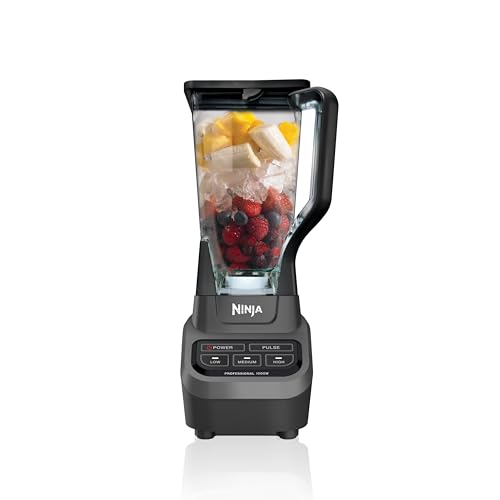
The Ninja BL610 is the value institution of ice blending: 1000 watts, Total Crushing stacked blades and a 72 oz pitcher, at the most accessible commitment in this guide. It has made icy protein shakes in more kitchens than the rest of this list combined, and the design endures because it works.
Strengths
- Proven stacked-blade ice crushing at a value commitment
- 72 oz pitcher covers family and double batches
- Simple controls and dishwasher-safe parts keep it easy to own
Trade-offs
- No programmed crush cycle — you run the rhythm manually
- 1000 watts is the least here; full trays of hard cubes take a little longer
- Blade stack care applies, as with its Ninja siblings
| Specification | Detail (as listed) |
|---|---|
| Motor | 1000 watts |
| Pitcher | 72 oz |
| Technology | Total Crushing blade stack |
| Cleaning | Dishwasher-safe parts |
Manual rhythm on the BL610 is easy to learn: pulse hard several times to fracture, rest a breath, run at high until the sound smooths. Thirty extra seconds of attention buys texture close to the programmed machines, and the savings buy a lot of protein powder.
Choose it if you want the ice job done properly without paying for automation or premium refinement. It is the honest floor of this category — everything above it adds convenience, capacity or finesse, not a different outcome.
BL610 longevity advice for daily ice users: let the pitcher dry fully between uses and inspect the blade assembly periodically, because ice duty is the hardest routine work in home blending and small wear shows here first. The design’s long production history means replacement pitchers and parts are among the easiest in this guide to source — a real ownership advantage for a daily ice habit.
Best for: Value buyers who want real ice performance in a big pitcher / Not suited for: Users who want a dedicated crush program to run the cycle
Check on Amazon — check the current price on Amazon at the listing.
Comparison Table
All six crush ice credibly; the differences are automation, jar strategy and batch size. Programs run the rhythm for you; the value pick asks you to run it — and rewards you for learning.
| Pick | Badge | Key spec | Best for |
|---|---|---|---|
| Ninja Professional Plus Blender BN701 | Best Overall | 1400 peak watts | Households making iced protein shakes in pitcher quantities |
| Ninja Professional Blender 2.0 BR201AMZ | Best Crush Program | 1200 watts | Iced-shake and frozen-drink specialists |
| Vitamix Propel Series 750 | Best Premium Pick | 64 oz | Buyers wanting the finest texture and a do-everything premium machine |
| Blendtec Classic 575 | Best Wide-Jar Pick | WildSide+ jar (90 oz total capacity as listed) | Batch makers blending icy shakes for several people |
| KitchenAid K400 Variable Speed Blender with Tamper | Best Ice Crush Preset | 5-speed variable dial with Intelli-Speed Motor Control | Thick-shake lovers who want a crush preset and a tamper |
| Ninja Professional Blender BL610 | Best Value Pick | 1000 watts | Value buyers who want real ice performance in a big pitcher |
How to Choose the Best Blenders for Protein Shakes with Ice
Rank your priorities in this order: crushing design first (stacked blades, a crush program, or premium sustained power), pitcher size second (doubles and full trays need 64 to 72 oz), and automation third. A machine with a great program but a small pitcher will frustrate a two-shake household more than a manual machine with room to work.
Also consider your ice itself. Standard freezer cubes are the baseline load; large, hard, fresh-from-a-deep-freeze cubes are harder; crushed or nugget ice is easier on every machine. If your freezer produces boulders, bias toward the stronger, stacked-blade or premium picks in this guide.
Ice Technique: Fracture, Settle, Polish
Every great iced shake follows the same three-act structure, whether a program runs it or you do. Fracture: short hard pulses that crack cubes without yet trying to blend. Settle: brief pauses that let shards fall into the blade path and powder finish wetting. Polish: a sustained run that turns fractured ice into a uniform snow-slush body. Skipping the settle act is why manual attempts leave shards — the ice never re-enters the blades.
Loading order supports the acts: liquid and powder at the bottom, soft ingredients in the middle, ice on top where the first pulses can fracture it against the forming liquid rather than against dry powder. Add ice in two handfuls rather than one packed mass if your pitcher allows mid-cycle additions.
Budget Tiers for Ice-Capable Blenders, in Plain Terms
The value tier — the BL610’s territory — buys genuine crushing with manual rhythm. The mid tier buys the program: crush cycles, more power, steadier motors. The premium tier buys texture resolution and refinement, the ability to dial ice from coarse to snow inside the same shake. All three tiers make a good iced protein shake; they differ in how much of the craft the machine performs for you.
Ice is also a wear item: it is the hardest routine load in home blending. Buying one tier up for an ice-daily household is not indulgence, it is matching the machine’s duty rating to the job’s severity.
Ice, Frozen Fruit and the Texture Ladder
Ice and frozen fruit are cousins, not twins. Ice adds cold and body without flavor or sugar; frozen fruit adds all three. A shake built on ice alone leans on the powder for everything and can taste thin; a shake built on frozen fruit alone can overwhelm the powder and the budget. The balanced iced shake uses both: fruit for flavor and body, a modest hand of ice for temperature and thickness.
Texture follows ratio: more ice and less liquid gives a spoonable, soft-serve shake that wants a tamper-friendly machine like the K400; more liquid gives a drinkable shake any pick here handles. Decide your target texture first, then let it steer both the recipe and the machine choice.
Ice Quality: The Variable Nobody Controls but Everybody Should
Freezer ice varies more than blenders do. Fresh cubes from a fast-freezing tray are hard and clear; old cubes from a slow freezer are softer, aerated and covered in absorbed odors. Hard fresh cubes give the cleanest crush and the coldest shake; old cubes crush easily but can carry freezer taste into a delicately flavored drink. If your iced shakes taste faintly of the freezer, new ice — not a new blender — is the first fix.
Cube size matters too: standard tray cubes are the design load for every pick here. Oversized craft cubes and spheres should be cracked before blending even in the strongest machines, both for texture and for the machine’s sake. Nugget and crushed ice sit at the easy end — any pick here turns them to slush almost instantly.
Frozen Fruit vs Ice: Building the Cold Load
Think of the cold load as a budget to allocate between ice and frozen fruit. Ice contributes cold and body without calories or flavor; frozen fruit contributes all three plus natural sweetness that lets the powder’s flavor lead. A shake that tastes watery usually spent too much of its budget on ice; a shake that overwhelms the protein flavor spent too much on fruit. Most drinkers settle near an even split, adjusted by the fruit’s intensity — berries punch above their weight, banana spends its budget on body.
Temperature follows the same budget: a shake built mostly on frozen fruit stays cold through fruit solids, while an ice-built shake stays cold through meltwater that gradually thins it. For a shake drunk slowly at a desk, fruit-heavy holds its texture longer; for a shake drunk immediately post-workout, ice-heavy drinks coldest and fastest.
Glassware, Straws and Serving the Iced Shake Well
A chilled glass is not pretension — it is insulation that keeps the crush from melting at the edges while you drink. Wide straws suit fine-crush shakes; spoon-straws suit the thickest tamper-made versions. Serve immediately, because an iced protein shake is a texture with a half-life: the emulsion is tightest in the first minutes, and separation, while harmless and stir-able, is the drink visibly aging.
For two-person rounds from one pitcher, pour both glasses at once rather than sequentially — the second pour from a rested pitcher is always thinner than the first. Small rituals, but the iced shake is a ritual drink, and these are the details its drinkers actually notice.
What to Do When the Shake Is Too Thick, Too Thin or Too Loud
Too thick: add liquid in a stream while the machine runs at low speed — a stream integrates where a dumped splash separates. Too thin: add frozen fruit or a few more cubes and re-run the crush briefly; adding powder to thicken a finished shake usually makes it chalky instead. Too loud: blend on a folded towel to damp the counter resonance, and remember that the fracture stage is the loud thirty seconds — it ends, and the polish stage is far quieter.
Each fix is a one-variable change, which keeps your recipe knowledge cumulative. Iced shakes reward the cook who keeps mental notes; the drink is simple enough that two or three deliberate experiments usually perfect a household’s version permanently.
Protein Ice Cream and Nice-Cream Territory
Push the iced shake further — less liquid, more frozen fruit, a tamper’s patience — and you arrive at protein soft-serve and banana-based nice cream, the dessert end of this guide’s map. The K400’s tamper and the premium Propel manage this register best; the stacked-blade Ninjas handle it in pulses with scraping. It is worth knowing the territory exists, because a machine bought for shakes that can also produce a credible protein dessert on a Friday night has quietly doubled its value.
The technique transfers directly: fracture the frozen load first, keep liquid to the minimum that lets the mass turn over, and stop while the texture is glossy. Overshoot the liquid and you have made a shake — which, in this guide’s world, is a forgiving failure mode.
Coffee, Tea and the Morning Iced Protein
Iced coffee protein shakes are a growing morning category with their own blending logic: cold coffee as the liquid base, powder, ice, and often a banana for body. The coffee’s bitterness wants the powder’s sweetness and a fat note — a spoon of nut butter or a splash of cream-style addition — to round it. Matcha versions follow the same architecture with green tea’s grassiness balanced by vanilla-leaning powders and fruit kept neutral.
Blend these cold from the start; hot coffee over ice in the pitcher melts the load before it crushes and produces a thin, lukewarm result no machine can rescue. Cold-brew concentrate, kept in the refrigerator for exactly this purpose, is the morning system’s best friend.
Electrolyte and Recovery-Day Variations
Not every iced protein drink is a workout drink: on rest days and hot days, the same machines produce lighter iced blends — coconut-water bases, citrus, melon, cucumber-mint styles with a modest scoop — that drink like refreshments rather than meals. The value of owning a capable ice blender is partly this range: one machine spans the recovery shake and the afternoon cooler without a recipe feeling like a compromise.
Keep the light recipes’ ice ratio higher and their liquid leaner; they are built on the crush itself for body. The crush programs and stacked blades in this guide shine here, because a watery base gives the blades nothing to hide behind — texture comes from the ice work alone.
Maintaining an Ice Blender: Jars, Seals and Blade Care
Ice duty writes its wear on three places: the pitcher’s interior, which micro-scratches over time and eventually clouds; the gasket, which hardens and should be inspected for a proper seal; and the blade assembly, whose mounting takes the impact load. None of this is cause for alarm — it is the normal cost of the hardest routine job in blending — but a yearly once-over, and prompt replacement of a tired gasket, keeps an ice blender performing like the one you reviewed.
Storage helps: a pitcher stored dry and unsealed ages its gasket slower than one stored latched and damp. Small habits, again — this category of machine rewards owners who treat maintenance as part of the recipe rather than an interruption of it.
Two Glasses, One Pitcher: Serving Iced Shakes for Pairs
Iced shakes for two from one pitcher succeed when the batch is built as a true double — double liquid, double powder, frozen load added in two stages — rather than a single recipe stretched with extra ice, which produces the classic failure: two glasses of cold, thin disappointment. The 64 and 72 oz pitchers in this guide exist for honest doubles; use their capacity as intended.
Pour both glasses immediately and together, stir the pitcher once before pouring, and accept that the pair routine takes one minute longer than the solo one. Couples and training partners who adopt the honest-double method keep the shared ritual; those who stretch singles abandon it, usually blaming the blender for a ratio decision.
Altitude, Freezers and Other Edge Cases
Two environmental notes for completeness. Very cold home freezers — the deep-chest kind — produce harder ice that deserves a brief temper on the counter before blending, even in the strongest picks here; five minutes takes the dangerous edge off the cubes without meaningfully melting them. And households blending at altitude will notice marginally more foam in protein drinks, a quirk of lower pressure that the stand-for-a-minute habit handles without any change of machine.
Neither case changes the shortlist. They change technique at the margins, which is where this guide has consistently located most of blending success: the machine sets the ceiling, and the method decides how close to it your daily drink lands.
The Iced Shake as Dessert: Evening Variations
The same equipment closes the day as well as it opens it: an evening iced protein blend — cocoa-leaning powder, ice, a banana, a spoon of nut butter — lands in dessert territory while staying inside the routine’s ingredients. The crush quality that defines this guide is what makes the evening version read as a treat rather than a repeat: texture is the difference between a drink and a dessert course, and texture is precisely what these six machines sell.
Serve the evening version in a glass with the good straw, not the travel cup. Ritual signals matter, and the household that plates its protein nicely keeps the habit years longer than the one that treats every serving as fuel. The blender does not care; the drinker does.
One Last Thing: Cold Is a Craft
It is easy to forget, reading a buying guide, that the iced protein shake is a small craft object: temperature, texture and flavor balanced in a glass, made in ninety seconds by a person half awake. The machines in this guide raise the floor of that craft — the worst shake they produce is decent — but the ceiling is set by the maker’s attention to ice, order and ratio. Learn your machine’s crush, write down your winning build, and the drink becomes one of the day’s reliable pleasures rather than a nutritional obligation with ice in it.
A Final Word on the Crush
Everything in this guide reduces to a few seconds of violence at the start of a blend: cubes meeting blades, fracture, slush, silk. The six machines perform those seconds differently — by stack, by program, by jar, by dial — but they all perform them credibly, which is more than most blenders on the market can claim. Pick the performance style that suits your kitchen, learn its rhythm in the first week, and the iced protein shake becomes what it should be: the coldest, smoothest ninety seconds of your morning, repeated without thought for years.
How to Blend Protein Shakes with Ice Without Shards or Grit
The fracture-settle-polish method, written out for manual machines and useful even when a program runs the cycle.
- Add liquid and protein powder first and blend briefly on low to hydrate the powder before any ice arrives.
- Add soft ingredients — banana, yogurt, nut butter — and give the mix two pulses.
- Add half the ice and pulse hard three to five times to fracture it into the liquid.
- Pause ten seconds to let shards settle into the blade path.
- Add the remaining ice and frozen fruit, then pulse again to fracture.
- Run a sustained high blend, watching the surface: the load should fold and churn as one mass.
- Stop and inspect with a spoon: look for surviving shards and any powder pockets on the walls.
- If shards remain, pulse twice more rather than running long — impact, not duration, kills shards.
- For very thick shakes, use the tamper in short pushes while the machine runs, where one is provided.
- Serve immediately in a chilled glass if you have one; iced shakes separate as they warm and sit.
If your shakes consistently lean gritty, the powder step is the culprit — extend the initial low blend. If they lean shardy, the fracture step is — add pulses, not minutes. Diagnose by texture and the fix is always one step, not a new machine.
Common Buying Mistakes
Adding all the ice at once to a dry pitcher. A packed mass of cubes over powder cannot fracture or circulate. Liquid and powder first, ice in stages.
Running one long blend to kill shards. Duration polishes; impact fractures. Shards survive long runs by riding above the blades — pulse them down instead.
Underfilling the liquid. Too little liquid makes a pack that stalls circulation. Iced shakes need enough liquid body to carry the crush.
Ignoring the settle pause. Shards need a breath to fall back into the blades. Skipping the pause is the most common cause of crunchy surprises.
Using boulder ice in a value machine. Oversized deep-frozen cubes punish lighter motors. Crack them first or let them temper for a few minutes.
Final Recommendation
The shortlist resolves by style: the Ninja BN701 for the complete household package, the BR201 for its dedicated Crush program, the Vitamix Propel 750 for premium texture, the Blendtec 575 for batch circulation, the KitchenAid K400 for presets plus a tamper, and the BL610 for honest value. Each stands among the best blenders for protein shakes with ice because each has a real ice strategy, not just a strong motor and a hope.
Compare the neighboring protein guides before deciding: Best Blenders For Protein Shakes, Best Blenders For Protein, Best Blenders For Protein Smoothies, Best Blenders For Crushing Ice, Best Blenders For Blending Ice.
Start here: Ninja Professional Plus Blender BN701, Ninja Professional Blender 2.0 BR201AMZ, Vitamix Propel Series 750. Check the current price on Amazon for each before you decide.
Best Blenders For Protein Shakes Best Blenders For Protein Best Blenders For Protein Smoothies Best Blenders For Crushing Ice Best Blenders For Blending Ice
Frequently Asked Questions
How fine can a blender crush ice for a protein shake?
The machines in this guide reduce cubes to a fine, drinkable slush or snow-like texture that passes a straw without crunching. That is the shake standard. Perfectly uniform shaved ice for desserts is a different appliance’s job, but for shakes, these six leave nothing you would call a shard.
Does crushing ice dull blender blades?
Blender blades are typically designed to work by impact and high-speed contact rather than a knife edge, and ice is within their intended loads — every pick here is built and programmed for it. Extremely hard, oversized cubes used daily will wear any machine faster, which is why this guide matches machine duty to ice habits.
Why does my iced shake separate into layers?
Separation happens as ice melts and the emulsion rests: the watery melt sinks, the body floats. Drinking promptly is the real fix. Blending a touch thicker, using some frozen fruit for body, and serving in a chilled glass all slow the process down noticeably.
Should I use crushed ice instead of cubes?
If your machine offers bagged or fridge crushed ice, it blends faster and more evenly, and lighter machines handle it far better. Cubes give you more chilling per volume and a thicker result in strong machines. Match the ice to the machine: cubes for the stacked-blade and premium picks, crushed for anything lighter.
Can I add protein powder after the ice is crushed?
You can, but the texture usually suffers: powder added to finished slush tends to coat shards rather than hydrate. Hydrating the powder in liquid first, as the method in this guide describes, gives the smoothest result. If you must add late, sprinkle it in while the machine runs at low speed.
How much ice belongs in a protein shake?
For a single serving, a modest handful to about a cup of cubes is the usual working range, adjusted for how much frozen fruit you also use. More ice wants more liquid or a stronger machine; let thickness, not habit, set the amount — and write down the ratio once you love it.


