Disclosure: airfryerkitchensupply.com is reader-supported. When you buy through links on our site, we may earn an affiliate commission at no extra cost to you.
Where to buy
Shoppers comparing the best blenders for making hot sauce will find every pick in this guide on Amazon. Hot sauce blending has two non-negotiables: the machine must puree pepper skins and seeds completely, and it must handle warm ingredients and chile fumes without drama. Every pick below is sold on Amazon, where you can confirm jar material and capacity before buying — both matter more for this job than for almost any other.
The six machines in this guide are: Vitamix 5200 Professional-Grade Blender, Vitamix Ascent X5, Oster Pro 1200 Blender, Blendtec Classic 575, Waring Blade Blender BB300, Breville Super Q BBL920. Check the current price on Amazon for the model you choose, and check price on Amazon again before ordering if you are comparing configurations, because jar sizes, included cups and colors vary by listing.
Introduction: Pepper Skins, Seeds, Steam and Fumes: A Blender Brief Like No Other
Choosing the best blenders for making hot sauce starts with what hot sauce actually is: a suspension of chile skins, seeds, pulp and aromatics in vinegar or brine that must pour smooth, stay emulsified in the bottle, and taste the same in the last spoonful as the first. Skins are the enemy. A blender that leaves pepper skin flecks produces a sauce that looks rustic and separates early; a blender that fully cuts skins and most seeds produces the glossy, unified sauce that keeps. That finishing ability — sustained high-speed circulation — is the first filter in this guide.
Heat and vapor are the second filter, in both senses. Many hot sauces are blended warm — peppers simmered in vinegar, or a fermented mash bottled after blending — and warm liquid expands and vents steam under a sealed lid. Add capsaicin vapor, which is genuinely unpleasant to breathe at close range, and hot sauce technique becomes a safety topic as much as a texture one: vent the lid, blend in a ventilated space, keep your face away when you open the jar, and never seal-blend a steaming liquid. The machines below were chosen partly for how their jars, lids and capacities suit that reality.
Our six picks span the sauce maker’s range: two premium Vitamix machines for the smoothest finish, a glass-jar Oster for makers who worry about staining and odor retention, a wide-jar Blendtec for batch makers, a bar-duty Waring built for relentless service, and a powerful, quieter Breville for apartment sauce makers. All were verified by brand and model. We print no fixed prices; check the current price on Amazon at the listing.
In this guide
Quick Picks
Six machines judged on skin-and-seed finishing, warm-blend handling, jar material and batch size. If you make sauce twice a year, the mid-list picks suffice; if you bottle for friends every season, start at the top.
- Vitamix 5200 Professional-Grade Blender — Best Overall: Variable speed and a deep vortex that finishes pepper skins and seeds — the sauce maker’s reference machine. Check the current price on Amazon.
- Vitamix Ascent X5 — Best with Programs: Ten programs and a 48 oz container with container recognition — repeatable sauce cycles in a right-sized jar. Check the current price on Amazon.
- Oster Pro 1200 Blender — Best Glass Jar: A glass jar that shrugs off chile stains and odors, with dual-direction blades and a smoothie cup for small test batches. Check the current price on Amazon.
- Blendtec Classic 575 — Best for Big Batches: A wide jar and programmed cycles for makers who blend sauce by the quart. Check the current price on Amazon.
- Waring Blade Blender BB300 — Best Bar-Duty Build: A 1.5 HP bar blender with simple toggle controls and an NSF-certified listing — built for relentless batches. Check the current price on Amazon.
- Breville Super Q BBL920 — Best Quiet Power: 68 oz of capacity with noise-suppression technology for makers blending in shared living spaces. Check the current price on Amazon.
How These Picks Were Chosen
The selection test was a cooked chile blend: simmered peppers with skins and seeds, vinegar, garlic and salt, blended warm. Picks had to finish the skins — not merely chop them — and had to do it without the mixture climbing out of the jar or stalling as it thickened. That test is unkind to crush-first designs and to small personal cups, which is why neither appears here: hot sauce is a full-jar, sustained-speed job.
Jar material earned explicit weight. Chile pigments and oils stain and scent plastic over time, so we included a glass option and a stainless-adjacent bar option alongside the premium plastic jars, and we say plainly in the reviews which makers should care. Capacity mattered too: sauce making is batch work, and a 48–68 oz working range suits both test batches and bottling days.
Verification followed the standard rule for this program: Amazon listing data search by brand and model, listing title matched, ASIN taken from the response, spec boxes limited to listed facts. Safety guidance in this article follows ordinary kitchen practice — venting, ventilation, and respect for capsaicin vapor — and deliberately avoids any canning or preservation instruction, which belongs to tested food-preservation sources, not a blender guide.
The 6 Best Blenders for Making Hot Sauce — Reviewed in Detail

Vitamix 5200 Professional-Grade Blender — Best Overall
The Vitamix 5200 is the hot sauce reference for the same reason it leads so many guides: sustained vortex finishing. Pepper skins that survive thirty seconds in lesser machines keep circulating here until they are cut into the sauce itself, and the variable dial lets you start a warm blend slowly — essential when steam needs somewhere to go.
Strengths
- Finest skin-and-seed finishing in this guide
- Variable speed for safe, slow starts on warm blends
- Self-cleaning cycle strips chile oils efficiently
Trade-offs
- Premium tier positioning
- Plastic container will eventually hold chile color — dedicate a jar if you bottle often
- No presets; cycle control is manual
| Specification | Detail (as listed) |
|---|---|
| Container | 64 oz |
| Controls | Variable speed with high-speed switch |
| Blades | Stainless steel |
| Cleaning | Self-cleaning cycle |
Sauce texture is where the 5200 separates itself. A fermented-style mash or a cooked pepper blend emerges glossy and unified, with skins reduced to body rather than flecks, and that unity is what keeps a bottled sauce from separating into pulp and vinegar within the week. Seeds are reduced further than rivals manage, though a maker chasing a perfectly seedless sauce should still strain — no blender in this guide repeals that step, and we will not pretend otherwise.
For warm blending, work the dial like a dimmer, not a switch: lowest speed until the surface moves, then climb gradually, lid vented, towel in hand rather than face over the jar. The 5200 rewards that technique with the smoothest home hot sauce most makers will ever produce. If you bottle seriously, consider dedicating its container to sauce — chile pigment is forever, and a pink-tinged smoothie jar is a badge of honor you may not want.
Best for: serious sauce makers who bottle regularly and want the smoothest finish / Not suited for: occasional makers who cannot justify a premium, sauce-dedicated setup
Check on Amazon — check the current price on Amazon at the listing.

Vitamix Ascent X5 — Best with Programs
The Vitamix Ascent X5 brings the premium finish into a 48 oz container with ten programs, pulse and container recognition. For sauce makers who work in test batches — tweaking heat and acid in small runs before committing a harvest — that right-sized, program-led format is arguably better than the bigger reference machine.
Strengths
- 48 oz container suits test batches and small harvests
- Ten programs make sauce cycles repeatable
- SELF-DETECT container recognition as listed
Trade-offs
- Smaller ceiling for bottling-day volume
- Premium tier positioning
- Program reliance may frustrate fully manual makers
| Specification | Detail (as listed) |
|---|---|
| Container | 48 oz |
| Programs | 10 programs plus pulse |
| Controls | Variable speed |
| Features | SELF-DETECT container recognition, self-cleaning program |
Repeatability is the X5’s sauce argument. Hot sauce making is recipe development: this week’s batch teaches you next week’s ratios, and a machine that runs the same cycle the same way lets you attribute differences to ingredients rather than to your thumb. Dial in a program-and-extend routine for your standard pepper blend, write it down, and your sauce becomes consistent across the season — the quality that separates a hobby sauce from one friends request by name.
The 48 oz container also vents and handles more manageably on warm blends than a brimful big jar, and cleanup via the self-cleaning program handles chile oil film well. Bottling-day makers producing gallons should look at the Blendtec or Waring below; developers of recipes should start here.
Best for: recipe developers making repeatable test batches of sauce / Not suited for: high-volume bottling days
Check on Amazon — check the current price on Amazon at the listing.
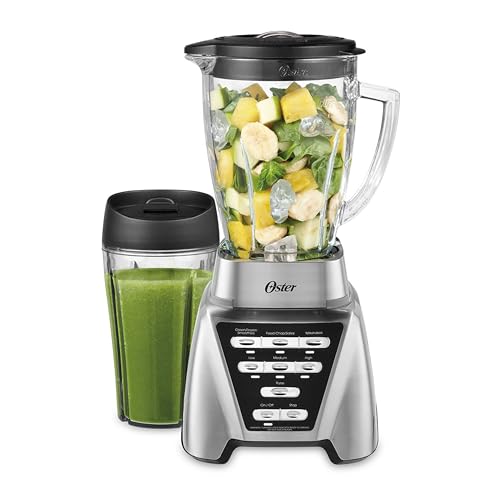
Oster Pro 1200 Blender — Best Glass Jar
The Oster Pro 1200 earns its place on a material: glass. Its glass jar will not absorb chile odor or hold red pigment the way plastic does, which matters to makers who use one blender for sauce on Saturday and smoothies on Sunday. Dual-direction blade technology and seven speeds round out a sensible mid-tier sauce tool.
Strengths
- Glass jar resists chile staining and odor retention
- Dual-direction blades help thick pepper blends circulate
- 24 oz smoothie cup suits micro test batches
Trade-offs
- Finishing power a tier below the Vitamix pair
- Glass is heavier and breakable — care with warm blends and cold counters
- Smaller effective batch comfort than the big jars here
| Specification | Detail (as listed) |
|---|---|
| Jar | Glass jar |
| Speeds | 7 speeds |
| Blade | Dual-direction blade technology |
| Extras | 24 oz smoothie cup included |
Staining is not vanity; it is information. A jar that smells of last month’s habaneros will lend that note to a mild sauce, and pigment build-up makes it hard to judge a new sauce’s true color. Glass solves both, rinses clean with hot soapy water, and lets you see the blend’s consistency through the wall — a small, real advantage when you are judging whether skins have finished. The dual-direction blade action helps here too, reversing to pull down the pepper mass that one-way blades leave riding high.
Respect its tier. The Pro 1200 finishes cooked pepper blends respectably, especially with adequate vinegar, but raw, seed-heavy, low-liquid mashes will ask for longer cycles and a strain afterward. For the one-blender household that makes sauce seasonally, that is the right compromise; for a dedicated sauce kitchen, it is the second machine, not the first.
Best for: one-blender households that make sauce seasonally and hate stained jars / Not suited for: makers finishing raw, seed-heavy mashes to a seedless standard
Check on Amazon — check the current price on Amazon at the listing.

Blendtec Classic 575 — Best for Big Batches
The Blendtec Classic 575 is the batch maker’s pick: a wide WildSide+ jar, five speeds and four preprogrammed cycles. Sauce days are volume days — a harvest does not arrive in 24 oz portions — and the wide jar takes a full pepper load, collapses it quickly, and keeps a thick blend turning over.
Strengths
- Wide jar swallows full harvest batches
- Preprogrammed cycles standardize big blends
- Self-cleaning handles oily residue well
Trade-offs
- Skin finishing a shade behind the Vitamix vortex on the toughest peppers
- Wide jar awkward for small test batches
- Premium tier positioning
| Specification | Detail (as listed) |
|---|---|
| Jar | WildSide+ jar (90 oz total capacity as listed) |
| Speeds | 5 speeds |
| Programs | 4 preprogrammed cycles |
| Cleaning | Self-cleaning |
The wide jar’s sauce virtue is the collapse. Peppers, onions and garlic start bulky and airy; the WildSide+ geometry folds that bulk down without the repeated stopping and tamping a narrow jar demands at volume, and the programmed cycles then hold a steady finishing pattern. For a maker processing a market haul into a dozen bottles, those saved interventions across every batch add up to an hour and a great deal of patience.
Finish quality is very good rather than ultimate: cooked skins reduce well, seeds reduce adequately, and a final strain remains advisable for a polished sauce. If your sauce style is generous and rustic — farmhouse rather than factory — the Blendtec’s batch manners may suit you better than the reference machine’s finesse.
Best for: harvest-scale sauce makers blending big batches / Not suited for: small-batch perfectionists
Check on Amazon — check the current price on Amazon at the listing.

Waring Blade Blender BB300 — Best Bar-Duty Build
The Waring BB300 is the bar-duty option: a 1.5 horsepower motor, a 48 oz copolyester jar, two-speed toggle controls with pulse, and an NSF-certified listing. It is built for environments where the blender runs all day and nobody has time for menus — which describes a serious bottling day surprisingly well.
Strengths
- 1.5 HP motor built for relentless service
- Dead-simple toggle controls — nothing to misconfigure
- NSF-certified listing signals commercial intent
Trade-offs
- Two speeds only — finishing finesse is limited
- Commercial manner: function over refinement
- Not the quietest housemate
| Specification | Detail (as listed) |
|---|---|
| Motor | 1.5 horsepower |
| Jar | 48 oz copolyester jar |
| Controls | 2-speed toggle with pulse |
| Certification | NSF certified (as listed) |
There is a sauce-making style the Waring suits perfectly: cooked peppers, adequate liquid, blend hard, strain, bottle, repeat. In that workflow, ultimate in-jar finishing matters less because the strainer is already in the plan, and what matters is a motor and jar that shrug off batch after batch without thermal sulking. The toggle control is a feature here, not a lack — gloves, wet hands and vinegar splashes do not negotiate well with touch panels.
Its limits are real: raw skins and seeds get less refinement than the Vitamix pair delivers, and delicate emulsified sauces that want low-speed control are outside its two-speed vocabulary. As a production tool for cooked sauces at volume, though, it is the most honest machine on this list.
Best for: high-volume cooked-sauce production with a strain step planned / Not suited for: raw-mash finishing or delicate emulsions
Check on Amazon — check the current price on Amazon at the listing.

Breville Super Q BBL920 — Best Quiet Power
The Breville Super Q closes the list for the apartment sauce maker: 68 oz of capacity with noise-suppression technology as listed. Hot sauce blending is loud and long, and in shared living spaces the noise budget is a real constraint on when — and whether — sauce gets made.
Strengths
- 68 oz capacity covers family-scale batches
- Noise-suppression technology as listed — kinder to shared homes
- Premium power for skin finishing
Trade-offs
- Premium tier positioning
- Large footprint for small kitchens
- Fewer sauce-specific listings details than rivals — verify configuration on Amazon
| Specification | Detail (as listed) |
|---|---|
| Capacity | 68 oz |
| Feature | Noise-suppression technology (as listed) |
Do not underestimate the social physics of sauce making. A two-minute full-speed blend at dawn will end a household’s enthusiasm for your hobby; a machine designed to suppress noise lets sauce happen at civilized hours, which means it happens more often and gets better. The Super Q pairs that consideration with genuine capacity and power, so the compromise is in price and footprint, not in the sauce.
On texture, expect premium-class results: cooked pepper skins finish well with a full cycle, and the big jar handles a family batch — a few pounds of peppers — in one run. Makers in detached kitchens with no noise concerns can save the premium and take the Waring or Blendtec; makers blending under a sleeping toddler’s room should take this one seriously.
Best for: apartment and shared-home sauce makers who need capacity without the roar / Not suited for: budget buyers or tiny counters
Check on Amazon — check the current price on Amazon at the listing.
Comparison Table
Jar material and finishing style divide this table: glass for the stain-conscious, premium vortex jars for finish, a wide jar and a bar jar for volume, and a quiet premium jar for shared homes. Match the machine to your sauce workflow — especially whether you strain.
| Pick | Badge | Key spec | Best for |
|---|---|---|---|
| Vitamix 5200 Professional-Grade Blender | Best Overall | 64 oz | serious sauce makers who bottle regularly and want the smoothest finish |
| Vitamix Ascent X5 | Best with Programs | 48 oz | recipe developers making repeatable test batches of sauce |
| Oster Pro 1200 Blender | Best Glass Jar | Glass jar | one-blender households that make sauce seasonally and hate stained jars |
| Blendtec Classic 575 | Best for Big Batches | WildSide+ jar (90 oz total capacity as listed) | harvest-scale sauce makers blending big batches |
| Waring Blade Blender BB300 | Best Bar-Duty Build | 1.5 horsepower | high-volume cooked-sauce production with a strain step planned |
| Breville Super Q BBL920 | Best Quiet Power | 68 oz | apartment and shared-home sauce makers who need capacity without the roar |
How to Choose the Best Blenders for Making Hot Sauce
Decide whether you strain. This single workflow choice halves the field. Makers who strain after blending — the classic cooked-sauce method — can prioritize power, capacity and durability, because the strainer guarantees the finish; the Waring and Blendtec shine there. Makers who want the blender itself to deliver a bottle-ready sauce, skins and all, need the finest sustained vortex they can afford, which means the Vitamix pair. Be honest about your actual process, including the steps you skip when tired, because the machine must fit the process you really follow.
Weigh jar material against your blending household. A dedicated sauce jar can be plastic without consequence — many serious makers keep one — but a shared household blender that must return to baby food and smoothies argues strongly for glass or for dedicating a container. Chile oil and pigment are persistent; no cleaning cycle fully reverses a season of habanero work in a plastic jar. Budget for a second container if the premium route tempts you and your household blends mild food daily.
Size for your harvest, not your hopes. A gardener with four pepper plants makes quarts, not gallons: a 48 oz container and program repeatability serve better than a cavernous jar. A maker buying peppers by the case needs width, power and either programmed cycles or bar-duty simplicity. And whatever the size, confirm the lid vents or can be safely cracked for warm blends — a sealed jar of steaming sauce is a mess and a hazard, and no sauce is worth either.
Blending Hot Sauce Safely: Steam, Vapor and Common Sense
Treat capsaicin vapor with respect. Blending peppers aerosolizes a little of what makes them hot, and opening a jar of freshly blended mash at face height can deliver a coughing fit that ruins an afternoon. Blend in a ventilated space — a window open or a range hood running — let the jar sit for a minute after the cycle ends so the vapor settles, and open it turned away from you, at arm’s length. Gloves for handling cut peppers, and never touch your eyes mid-session, are the rest of the discipline. None of this is exotic; it is the same respect you would give any strong kitchen chemical, applied to one that grows in the garden.
Steam is the second hazard, and it is mechanical. Warm liquid expands as it blends, and a sealed, brimful jar of simmered peppers can push its lid off mid-cycle. Blend warm sauces in batches no more than about half the jar, start on the lowest speed, keep the lid’s vent open or the lid slightly cracked under a folded towel, and climb speed gradually as the surface settles. If a recipe wants a large warm batch, two half batches are faster than one spill — and considerably faster than the cleanup.
A boundary worth stating plainly: this guide covers blending, not preserving. Shelf stability, acid levels and bottling safety are food-preservation questions with tested, official answers elsewhere, and a blender article is not the place to improvise them. Blend brilliantly, refrigerate honestly, and take preservation guidance from tested preservation sources.
Cooked, Fermented and Fresh: How Sauce Style Changes the Blend
Hot sauce is not one food, and the blender’s job changes with the style. Cooked sauces — peppers simmered in vinegar with aromatics — arrive at the blender soft, cooperative and forgiving: skins are already tender, the mixture is liquid enough to circulate, and the blender’s task is finishing and emulsifying. These are the sauces where even the mid-tier picks in this guide produce polished results, and where batch volume matters more than ultimate finesse, because a cooked sauce is usually a preserving-day event.
Fermented sauces make different demands. A fermented pepper mash has been softened by time and acidity, but it often arrives thicker, with skins that have toughened in their own way and seeds fully intact, and the blender must both finish the texture and wake the emulsion back into unity. This is the style where the premium vortex machines justify themselves most clearly, because the difference between chopped skins and cut skins is the difference between a sauce that holds together in the bottle and one that weeps vinegar within the week. Blend fermented mashes in smaller, well-liquided batches and give them the longest finishing cycles in your repertoire.
Fresh, uncooked sauces — the pico-adjacent, salsa-verde family — invert the problem entirely: here the cook often wants texture, not silk, and the blender’s job is restraint. Short pulses, low speeds, and a willingness to stop while pieces remain are the skills, which is why variable-speed machines serve this style better than program-driven ones. A guide that crowned only finishing power would mislead fresh-sauce makers; the honest advice is that the same machine can do both, provided its low end is as honest as its high end — a quality the two Vitamix picks in this guide demonstrate every time they start a warm blend gently.
Judging a Sauce: Body, Shine and the Spoon Test
Sauce makers need a judging language, because ‘blend until smooth’ is not one. The first test is the spoon test: dip a spoon, lift it, and watch the back. A finished sauce coats the spoon in an even film that holds for a few seconds before sliding; an under-blended sauce runs off in streaks, leaving flecks standing on the metal like a map of everything the blades missed. The second test is the swirl: a spoon dragged through the sauce in the jar should leave a trail that closes slowly and evenly. A trail that snaps shut means the sauce is thin; a trail that stands open like a trench means it is too thick to bottle gracefully and wants a measured addition of its own liquid.
Shine is the third signal, and the one beginners overlook. A properly finished pepper sauce has a gloss — the look of an emulsion holding — while an under-finished one looks matte and slightly granular even when it pours smoothly. That gloss is the visual signature of skins and pulp cut fine enough to stay suspended, and it predicts shelf behavior: glossy sauces hold together in the bottle; matte ones separate and need shaking within days. Judge shine in daylight or under a bright light, against a white spoon if you have one, because kitchen lighting flatters matte sauces into looking finished.
Finally, judge heat and seasoning last and separately, because texture work changes perception. A sauce tasted mid-process — warm, aerated, straight off the blades — reads hotter and sharper than the same sauce rested and chilled. Finish the texture, rest the sauce, then season it in small additions with a clean spoon each time. Makers who keep a one-line notebook per batch — peppers, liquid, blend time, adjustment — find their sauces converging on excellent within a single season, because judging is a skill and notes are how skills compound.
Bottling Day: A Workflow That Respects the Batch
Bottling day is where home sauce making turns from cooking into small-scale production, and the blender is only one station in a line that should be set up before the first pepper is touched. Lay the line out in order: washing and prep at the sink, the cooking or ferment station, the blender with its towel and ventilation ready, a straining station if your style uses one, and a filling station with clean bottles, a funnel and labels already written. Walking a hot, capsaicin-laden batch back and forth across a kitchen is how spills, burns and cross-contamination happen; a line laid out once prevents all three.
Work the batches in a rhythm the machine can sustain. Alternate blending with the natural pauses of the line — straining, filling, labeling — rather than running load after load without rest, because sustained full-speed work on thick, warm mixtures is the hardest duty a home blender ever sees. The bar-duty and wide-jar picks in this guide exist precisely for this rhythm at volume. Keep a bowl of clean water and a dedicated towel at the blender station for the inevitable drips, and treat every surface the sauce touches as seasoned until it has been washed: capsaicin transfers from a jar rim to a hand to an eye with an efficiency that only needs to be learned once, the hard way, by someone who was warned.
Close the day properly. Label every bottle with the pepper, the date and a heat note in language your future self will understand; a mystery bottle is a hazard wearing a gift’s clothing. Wash the blender immediately — chile oil left overnight in a jar becomes a semi-permanent resident — and if the jar is plastic and now carries the season’s color, accept it as the dedication this guide discussed and keep that jar for sauce. Bottling day done this way is satisfying rather than chaotic, and the sauce that comes out of an orderly line is, not coincidentally, usually the best sauce of the year.
A Pepper Primer: How Chile Choice Changes the Blending Brief
Peppers are not interchangeable heat units, and the variety you choose changes what the blender must do. Thin-walled, mild-to-medium peppers — the jalapeño and serrano family — blend easily and forgive almost everything: their skins are tender, their flesh is generous, and even mid-tier machines finish them well. These are the right peppers for a maker’s first season, because they let technique, not equipment, be the variable being learned. Their sauces are also the most versatile at the table, which is a second, quieter reason to start there.
Thick-walled peppers — the bell-adjacent, fleshy varieties and many ripe red chiles — bring body and sweetness and a different mechanical problem: more flesh per pepper means a thicker mash that circulates reluctantly and needs the liquid discipline and batch sizing this guide has emphasized. Their skins, especially when the peppers are roasted, can separate into distinct flecks if under-blended, which is why roasted-pepper sauces are the spoon test’s most honest examination. A premium vortex machine earns its price on exactly this pepper class.
The very hot, thin-fleshed peppers — the habanero and ghost end of the shelf — invert the problem again: there is little flesh, intense heat, and a sauce that is usually built on a base of other ingredients — carrot, onion, fruit, vinegar — with the peppers as the fire rather than the body. Here the blender’s job is to completely disperse a small quantity of very potent material through a larger base, evenly, so that no spoonful is a trap. That is a circulation test, not a power test, and it is also where the vapor discipline in this guide stops being advice and becomes the difference between a good afternoon and a memorable one.
Dried peppers, rehydrated, deserve the final word: they produce some of the deepest, most complex sauces a home maker can bottle, and they are the most demanding blending brief of all, because rehydrated skins are leathery and determined. They want a long soak in hot liquid, a generous proportion of that liquid in the jar, the longest finishing cycles in this guide, and a strain that the maker should plan rather than resent. Choose your pepper class knowing which brief you are handing the machine — the picks here cover all of them, but they cover them in the order this primer has implied: forgiving at the top of the list’s intentions, exacting at the extremes.
From One Bottle to a House Style: Developing Your Sauce Over a Season
Every sauce maker this guide is written for is somewhere on a path from a first, cautious bottle to a house style — a sauce that friends identify blind and request by name. The path is shorter than it looks, and it is paved with the notebook habit this guide keeps recommending. A house style is not a secret recipe; it is a set of settled decisions — a pepper or blend of peppers, a vinegar character, a salt level, a texture standard, a heat position — each settled by a batch that taught you something and a note that preserved the lesson. Makers who skip the notes re-decide everything every season and call the resulting variety a style. It is not; it is amnesia with good peppers.
The blender’s role in developing a style is consistency of execution, which is why the program-led and premium picks in this guide matter to this process beyond their texture. When the machine runs the same cycle the same way, the variable in each batch is the recipe, and the notebook’s lessons are clean. When the machine’s performance wanders — a tired motor, a dull blade, a jar that circulates differently as it ages — the lessons blur, and a maker can spend a season chasing a texture that was equipment drift wearing a recipe’s clothes. Maintain the machine, and the style has a stable instrument to develop on.
Expect the style to settle in about a season of regular batches, and expect it to keep a door open: one experimental batch per round of production, clearly labeled as an experiment, judged without mercy at the spoon test. The experiments that fail teach the boundaries; the one that succeeds becomes next season’s variation, and occasionally — this is the joy of the practice — the new house standard. The sauce in the bottle at the end of that process is something no shop sells: a record of your peppers, your machine, your palate and your patience, in a form you can pour.
Sharing Sauce Safely: Gifts, Labels and Honest Heat Notes
Hot sauce is the most gifted food in this cluster, and gifting it well is a small craft of its own. Label every gifted bottle with the pepper blend, the date it was made, and a heat note written for the recipient rather than for your own pride — ‘medium for you, hot for civilians’ is a more useful label than a string of flame icons, because heat perception is personal and your regulars will calibrate to your scale within a bottle or two. Include the storage note your recipe’s guidance calls for, plainly, on the label or a card; a gift that needs instructions it does not carry is a liability dressed as a present.
Share the sauce you have made more than once. The experimental batch is for your own table and your own notebook; the gift bottle should be the recipe that has already survived your spoon test, your rest test and your next-day test, because a gifted sauce is your house style’s ambassador. Makers who follow that rule find their sauce requested rather than merely accepted — and a waiting list for next season’s bottling day is the surest sign that the machine, the peppers and the maker have become a practice worth the name.
How to Blend a Smooth Hot Sauce, Step by Step
This method assumes peppers already cooked or fermented by your recipe, and it protects both the sauce’s texture and the cook. Adjust quantities to your recipe; the technique is the constant.
- Ventilate first: open a window or start the range hood, put on gloves if you are handling cut fresh peppers, and keep a folded towel by the blender.
- Load liquid first — vinegar or brine from the recipe — then the peppers and aromatics, filling the jar no more than half full for warm blends.
- Seat the lid with its vent open (or the lid slightly cracked under the towel for warm batches) and start on the lowest speed until the surface moves steadily.
- Climb gradually to high and blend 60–120 seconds, until the sauce looks glossy and uniform and no skin flecks circle in the vortex.
- Stop, wait a full minute for vapor to settle, then open the lid away from your face. Check texture on a spoon: flecks mean another 30 seconds; a polished finish means you are done.
- Strain now if your style demands a seedless sauce, bottle or refrigerate per your recipe’s tested guidance, then run the self-clean cycle or hot soapy wash immediately — chile oil sets fast.
Taste only after the blend, with a clean spoon and a small amount: capsaicin coats equipment, and a tasting spoon dipped twice will lie to you about both heat and salt. Adjust acid and salt in small additions, re-blending briefly — remembering that the sauce’s heat perception will settle as it rests, so bottle the sauce you will want next week, not the one that impresses you today.
Common Buying Mistakes
Sealing a steaming blend. Warm liquid expands. A sealed, full jar can blow its lid and paint the kitchen in capsaicin. Half-fill, vent, start slow
Opening the jar at face height. Freshly blended peppers release irritating vapor. Wait a minute, open away from you, and keep the hood running
Expecting any blender to make straining unnecessary. Blenders reduce seeds; they do not remove them. A seedless sauce still needs a strain, whatever the marketing implies
Saucing in the household’s only plastic jar. Chile pigment and odor are effectively permanent in plastic. Dedicate a jar or choose glass
Judging heat mid-blend. Capsaicin builds and equipment carries it. Taste once, at the end, with a clean spoon, and season conservatively
Final Recommendation
The Vitamix 5200 is the best blender for making hot sauce for most makers: the finest skin-and-seed finish, the control to start warm blends safely, and a self-cleaning cycle that handles chile oil. Recipe developers should take the Ascent X5 for repeatable small batches; stain-conscious households should take the glass-jar Oster Pro 1200; harvest-scale makers should choose between the Blendtec 575 for programmed batches and the Waring BB300 for bar-duty production; and apartment makers should take the quieter Breville Super Q.
Confirm jar material and capacity at the listing, and check the current price on Amazon before ordering. For neighboring briefs, see best blenders for making hummus for the other thick-blend test, best blenders for making drinks for the all-round guide, and best blenders for making green smoothies if your blender must do daily duty too.
Start here: Vitamix 5200 Professional-Grade Blender, Vitamix Ascent X5, Oster Pro 1200 Blender. Check the current price on Amazon for each before you decide.
Best Blenders For Making Hummus Best Blenders For Making Drinks Best Blenders For Making Green Smoothies Best Blenders For Making Nut Butter
Frequently Asked Questions
Can a blender really make hot sauce smooth, skins and all?
A premium vortex blender comes very close on cooked peppers: skins are cut into the sauce until they contribute body rather than flecks. Raw, thick-skinned peppers and a demand for absolute smoothness still justify a strain after blending, on any machine.
Is it safe to blend hot sauce while it is warm?
Yes, with technique: half-fill the jar, vent the lid, start on the lowest speed, and climb gradually. The danger is a sealed, full jar of steaming liquid, which can force the lid off. Never blend a steaming sauce in a sealed personal cup.
Will hot sauce ruin my blender jar?
It will mark a plastic one: chile pigment and odor persist in plastic despite thorough washing. It will not damage the machine mechanically. Glass jars resist both, and many makers dedicate one container to sauce season.
Why does my hot sauce separate in the bottle?
Usually under-blending: skins and pulp that were chopped rather than fully cut settle out of suspension. A longer finishing cycle helps, as does straining. Shaking before use is normal even for well-made sauce.
How do I protect myself from chile fumes while blending?
Ventilate the room, let the finished blend rest a minute before opening, open the lid away from your face, wear gloves when handling cut peppers, and never touch your eyes during a sauce session.
What size blender do I need for hot sauce?
A 48 oz container suits most home makers, including test batches and modest harvests. If you process peppers by the case, step up to the wide-jar or 68 oz options in this guide rather than blending endless small batches.


