Disclosure: airfryerkitchensupply.com is reader-supported. When you buy through links on our site, we may earn an affiliate commission at no extra cost to you.
Where to buy
Here is where to buy the best blenders for indian cooking recommended in this guide. Indian cooking asks more of a blender than smoothies ever will: wet masala pastes ground fine without added water, dry spice blends, coconut chutneys, idli and dosa batters, and tamarind and tomato purees — often in small, dense batches. Every pick below was verified against Amazon catalog data for the exact model named, including the 110-volt mixer grinder built for North American kitchens. Check price on Amazon, and for the mixer grinder, confirm the listing is the 110-volt USA/Canada version before you order.
- Preethi Eco Plus Mixer Grinder, 110-Volt for USA/Canada — Best Overall for Indian Cooking. Check the current price on Amazon before you order, because blender pricing and bundle contents change often.
- Vitamix 5200 Professional-Grade Blender, 64 oz — Best for Batters and Big Pastes. Check the current price on Amazon before you order, because blender pricing and bundle contents change often.
- Ninja Kitchen System Pro BL770, 1500W — Best Blender-Processor Combo. Check the current price on Amazon before you order, because blender pricing and bundle contents change often.
- Blendtec Total Blender Classic, FourSide Jar — Best for Dry Grinding Volume. Check the current price on Amazon before you order, because blender pricing and bundle contents change often.
- KitchenAid K400 Variable Speed Blender with Tamper — Best for Smooth Masala Pastes. Check the current price on Amazon before you order, because blender pricing and bundle contents change often.
- Cuisinart Smart Power Duet Blender & Food Processor BFP-703BCP1 — Best Budget Combo. Check the current price on Amazon before you order, because blender pricing and bundle contents change often.
If you are comparing the best blenders for indian cooking, you already know that a smoothie blender’s report card does not transfer. Indian kitchens ask a blender to grind — soaked lentils and rice into flowing idli batter, whole spices into masala powder, coconut with green chili and ginger into chutney, onions and tomatoes into a paste smooth enough to disappear into a curry. These are small, dense, often nearly dry loads, and they punish the design assumptions of a Western drink blender: a big jar where a small batch smears uselessly across the floor, blades tuned for liquid vortexes, and no provision for the stop-grind-scrape rhythm that real grinding requires.
The appliance Indian kitchens actually evolved for this work is the mixer grinder: a powerful motor with multiple small jars, each shaped for a task — a wet jar, a dry jar, a tiny chutney jar — run in short bursts with the jar shaken between them. This guide leads with a verified 110-volt mixer grinder built for USA and Canada, because for a dedicated Indian kitchen it is simply the right tool. Around it, we have gathered the Western blenders whose torque, small-batch ability or processor bowls genuinely serve Indian cooking styles, for households whose blending is split between cuisines.
Every pick was verified, model by model — including the voltage question, which is not a detail: a 220-volt mixer grinder bought for an Indian kitchen in North America is an expensive paperweight. We will be plain about which machines grind dry spices well, which are batter specialists, which are chutney compromises, and which jobs none of these should attempt. If your kitchen runs on masalas and batters, this guide is written for your counter, not adapted to it.
In this guide
Quick Picks
Six verified routes into Indian grinding and batter work — from a purpose-built 110V mixer grinder with task-sized jars to professional blenders that handle batters and pastes at volume.
- Best Overall for Indian Cooking: Preethi Eco Plus Mixer Grinder, 110-Volt for USA/Canada — the purpose-built tool: a mixer grinder made for Indian cooking and wired for North America — multiple task-sized jars for chutneys, dry masalas and wet grinding, in short-burst rhythm. Check price on Amazon.
- Best for Batters and Big Pastes: Vitamix 5200 Professional-Grade Blender, 64 oz — the Western blender that Indian cooks actually adopt: variable speed and a tamper for grinding idli-dosa batter and masala pastes at family volume, silky and hands-on. Check price on Amazon.
- Best Blender-Processor Combo: Ninja Kitchen System Pro BL770, 1500W — a 1500W system whose 8-cup processor bowl handles the chopping and coarse grinding of Indian prep — onions, ginger-garlic, falafel-style mixes — while the pitcher purees. Check price on Amazon.
- Best for Dry Grinding Volume: Blendtec Total Blender Classic, FourSide Jar — a blunt, high-impact blade and ten speeds that mill whole spices and grind larger dry batches — plus the capacity for big wet pastes when the vortex takes hold. Check price on Amazon.
- Best for Smooth Masala Pastes: KitchenAid K400 Variable Speed Blender with Tamper — a tamper and a 5-speed dial in a mid-size jar: the Western pick for wet masala pastes and coconut chutney at family-meal scale, ground smooth without flooding them with water. Check price on Amazon.
- Best Budget Combo: Cuisinart Smart Power Duet Blender & Food Processor BFP-703BCP1 — a budget-tier duet: a 48 oz glass jar blender plus a 3-cup processor attachment for the chopping and small grinding jobs, at a fraction of the premium picks’ cost. Check price on Amazon.
How These Picks Were Chosen
We verified every pick against Amazon’s catalog for the exact model — and in the mixer grinder’s case, for the exact voltage version, because the same product family is sold in 220-volt form for other markets and only the 110-volt USA/Canada version belongs in a North American kitchen. We then judged candidates against Indian cooking’s actual job list: wet grinding with minimal water, dry spice grinding, chutney at small scale, batter at family scale, and the chopping prep that surrounds them.
That job list eliminated most Western blenders, including several excellent smoothie machines whose big jars and liquid-tuned blades cannot hold a small, dense load. The survivors each own a defensible part of the cuisine: the Preethi owns the cuisine itself; the Vitamix owns batters and volume pastes; the Ninja system owns prep breadth; the Blendtec owns dry grinding at volume; the K400 owns wet pastes at meal scale; and the Cuisinart owns budget coverage of the small jobs.
We have been deliberately plain about boundaries — which picks do not make batter, which do not grind dry spices finely, which chutneys come out coarse — because Indian cooking punishes vague recommendations faster than any cuisine we cover. A machine bought for the wrong job here does not merely underperform; it leaves a cook mid-recipe with a paste that will not grind, which is the worst outcome a guide can cause.
We also considered the diaspora kitchen’s reality: ingredients vary by continent — coconut arrives frozen or desiccated where it was once fresh, lentils differ, chilies differ — and the right machine is the one forgiving of that variation. Torque headroom, small jars and burst control forgive; fixed programs and giant jars do not. That forgiveness, as much as any single grinding result, is why the ranking leads with the cuisine’s own tool and the most controllable Western blender.
The 6 Best Blenders for Indian Cooking
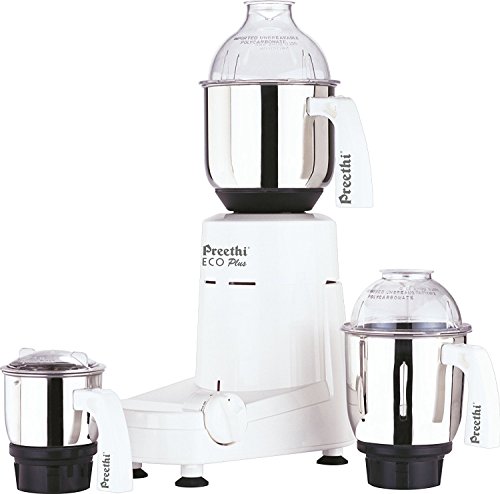
1. Preethi Eco Plus Mixer Grinder, 110-Volt for USA/Canada — Best Overall for Indian Cooking
The Preethi Eco Plus is the only pick in this guide designed from the motor out for Indian cooking, and it shows in the format: instead of one large jar, a mixer grinder gives you several small jars because Indian grinding is small-batch work — a chutney jar for a cup of coconut chutney, a dry jar for garam masala, a larger wet jar for batter and pastes. The jars’ small floors keep dense, low-liquid loads in the blade path, which is precisely where big Western jars fail. And this is the 110-volt version built for use in the USA and Canada, so it plugs into a North American kitchen without converters or regrets.
Strengths
- Purpose-built for Indian grinding: multiple small jars matched to chutney, dry and wet jobs
- 110-volt version made for USA/Canada — no converter needed
- Small jar floors keep dense, low-liquid loads in the blades where big jars fail
Trade-offs
- Not a drink blender — smoothies and large liquid batches belong to other machines
- Short-burst grinding rhythm with rests is a technique to learn
- Utilitarian finish and sound compared with Western countertop blenders
| Voltage | 110-volt for use in USA/Canada |
| Format | Mixer grinder with multiple task jars |
| Role | Wet grinding, dry grinding, chutney |
| Brand line | Preethi mixer grinders |
The workflow is its own technique: grind in short bursts, shake or scrape the jar between them, and let the motor rest — a rhythm Indian cooks know in their hands. Within that rhythm, the Eco Plus handles the category’s core jobs as its native language: coconut chutney with minimal water, onion-tomato masala ground fine, dry spice blends, and soaked dal and rice ground toward batter. It is not a smoothie machine and does not pretend to be; the jars are sized for cooking, not drinks, and the sound is purposeful rather than polished. For a kitchen whose blending is primarily Indian, this is not the alternative pick — it is the correct one, and everything else in this guide is a compromise measured against it.
A note for first-time mixer grinder owners: the jars arrive sharp, the lids seal tight, and the first week smells faintly of new motor — all normal. Run the chutney jar with coconut and water once before trusting it with a recipe, learn each jar’s sound at its correct load, and the machine will settle into the kitchen’s daily rhythm faster than any appliance you own.
Best for: Indian kitchens in North America whose grinding is a daily cooking function / Not suited for: smoothie-first households or buyers wanting one big multi-purpose jar
Check on Amazon — check price on Amazon for the current bundle and jar configuration.

2. Vitamix 5200 Professional-Grade Blender, 64 oz — Best for Batters and Big Pastes
Among Western blenders, the Vitamix 5200 has the deepest adoption in Indian kitchens, and the reason is its variable-speed control. Batter grinding is a speed story: start soaked rice and urad dal slowly so the load turns over, then climb the dial as the batter loosens and begins to flow, using the tamper to keep the thick mass moving. The result — a smooth, flowing batter at family scale — is the standard against which other blenders are judged in this cuisine, and the same control serves wet masala pastes, which the 5200 grinds genuinely fine.
Strengths
- Variable speed plus tamper grinds flowing, smooth batters at family scale
- Wet masala pastes come out genuinely fine, not merely chopped
- One machine also covers smoothies, soups and frozen work for mixed-cuisine homes
Trade-offs
- Small chutney quantities are inefficient in the 64 oz container
- Dry spice grinding needs volume and patience in a wet jar
- Premium pricing, and batter batches need tamper attention
| Container | 64 oz, tall profile |
| Controls | Variable speed dial + high-speed switch |
| Blades | Stainless steel |
| Accessory | Tamper included |
Volume is the 5200’s advantage over the mixer grinder: a weekend batch of dosa batter for a family, or a large quantity of tomato-onion masala for freezing, happens in one run instead of several small jars. The honest limits are at the small and dry ends: a half-cup of chutney smears in the big container, and dry spice grinding in a wet container works only in larger quantities and with patience. Many serious Indian kitchens therefore run both systems — mixer grinder for daily small grinding, Vitamix for batters and volume — and if you can only choose one and your cooking leans large-batch, this is the Western pick that earns its place.
Batter veterans adjust one variable seasonally: in winter kitchens, batter ground in the 5200 may need a touch more water and a warmer fermenting spot; in summer, less of both. The blender’s consistency is what makes those small seasonal adjustments visible at all — a machine that grinds the same way every time turns fermentation into a learnable craft rather than a lottery.
Best for: households grinding batters and pastes in family-size batches / Not suited for: daily small chutney grinding or dry-spice specialists
Check on Amazon — check price on Amazon for the current bundle and jar configuration.

3. Ninja Kitchen System Pro BL770, 1500W — Best Blender-Processor Combo
Indian prep is full of jobs that are neither blending nor grinding: onions chopped evenly for a base, ginger-garlic paste in quantity, spice-and-herb mixtures, dough for flatbreads. The BL770’s 8-cup processor bowl takes that whole class of work with its S-blade, while the 72 oz pitcher handles tomato purees, tamarind soaking liquid and drink duties. For a mixed-cuisine household that cooks Indian food several times a week alongside everything else, this system covers the widest ground of any pick here.
Strengths
- Processor bowl excels at onion, ginger-garlic and base prep at volume
- 1500W pitcher purees tomato, tamarind and sauces smoothly
- One system spans Indian prep plus the household’s general blending
Trade-offs
- Not a batter machine and not a fine dry grinder
- Chutney texture is fresher and coarser than mixer-grinder output
- Many parts to wash and store
| Power | 1500W |
| Pitcher | 72 oz |
| Processor bowl | 8-cup |
| Extras | (2) 16-oz travel cups |
Be clear about what the processor bowl is not: it chops and coarse-grinds beautifully, but it will not produce a flowing idli batter or a fine dry masala — those need the mixer grinder’s jars or the Vitamix’s vortex. Where the Ninja shines is the everyday middle: masala bases started in the bowl and finished in the pitcher, chutneys of the chunkier, fresher style, and the sheer breadth of a system that also makes the household’s smoothies. As a one-purchase answer for a kitchen that cooks Indian food within a broader repertoire, it is the most versatile compromise in the guide — chosen with its boundaries understood.
The BL770’s processor bowl has an under-sung Indian talent: breadcrumb-fine grinding of roasted spice-and-dal mixtures for podi-style powders, where a coarse, even texture is the goal rather than a flaw. Not every powder in this cuisine wants to be fine, and the bowl’s chop-grind sits exactly on the coarse rung that jar grinders overshoot.
Best for: mixed-cuisine households cooking Indian food within a broad repertoire / Not suited for: batter purists or fine dry-masala grinding
Check on Amazon — check price on Amazon for the current bundle and jar configuration.

4. Blendtec Total Blender Classic, FourSide Jar — Best for Dry Grinding Volume
Dry grinding is where the Blendtec’s blunt winged blade stops being a curiosity and becomes an argument: it mills by impact, and whole spices — coriander, cumin, dried chilies, rice for flour — fracture against it effectively at the volumes the FourSide jar wants. Ten speeds and six cycles let you run a grind, let it settle, and run again, the jar-scale version of the mixer grinder’s burst rhythm. For households that make masala blends in quantity to store, this is the Western machine with the most natural dry-grinding talent.
Strengths
- Impact blade mills whole spices and dry batches effectively
- Ten speeds allow a grind-settle-grind rhythm at jar scale
- Large jar suits stored masala blends and big pastes; blade is safe to clean
Trade-offs
- Small chutneys spread too thin in the big jar
- Wet batters need volume and vortex cooperation
- Professional noise, especially on dry loads
| Jar | FourSide jar (75 oz* marked capacity) |
| Speeds | 10 speeds + pulse |
| Programs | Six preprogrammed cycles |
| Blade | Blunt winged blade |
Wet work follows the Blendtec pattern: generous batches of masala paste or batter grind well once the vortex forms, while small or very dry wet loads need liquid coaxing and pulse work. The blunt blade cleans safely — a real virtue after grinding turmeric and chili — and the machine’s general power covers smoothies and frozen work for the rest of the household. It will not match the Preethi’s small-jar chutney finesse or the Vitamix’s batter control, but as a single Western machine tilted toward dry grinding and volume, it has a clear and defensible niche in an Indian kitchen.
For dry grinding in the Blendtec, work in the morning’s cool kitchen if you can and chill the jar’s contents between cycles in warm weather — spice aromatics are volatile, and every degree of friction heat is flavor leaving the jar as scent. The scent is lovely; it is also your masala, departing. Cool jars keep it in the food.
Best for: households grinding spice blends and dry batches in quantity / Not suited for: small daily chutneys or quiet kitchens
Check on Amazon — check price on Amazon for the current bundle and jar configuration.

5. KitchenAid K400 Variable Speed Blender with Tamper — Best for Smooth Masala Pastes
Wet pastes are the K400’s Indian-cooking case. A masala paste fails in most blenders because it is too thick to circulate and the cook must choose between chunks and a watery paste; the K400’s tamper breaks that dilemma by physically keeping the paste in the blades, while the 5-speed dial and Intelli-Speed motor control hold grinding speed as the load thickens. Coconut chutney for a family meal, onion-tomato-ginger pastes, and green chutneys all come out smooth at this scale with the water kept where it belongs — minimal.
Strengths
- Tamper keeps thick masala pastes circulating without excess water
- Intelli-Speed holds grinding speed as pastes thicken
- Mid-size jar suits family-meal quantities of chutney and paste
Trade-offs
- Not built for large batter batches
- Dry grinding is occasional and small-scale only
- Presets are drink-focused and irrelevant to this cuisine
| Controls | 5-speed variable dial + presets |
| Programs | Ice Crush, Icy Drinks, Smoothie |
| Motor control | Intelli-Speed |
| Accessory | Tamper included |
Scale and dry work bound the recommendation: this is a family-meal paste machine, not a weekend batter producer, and dry spice grinding is a small-quantity, pulse-and-shake affair rather than a specialty. Within its brief, though, the K400 does the most common Indian blender job — the wet paste — better than any mid-range rival we verified, and it remains a fully capable smoothie and frozen-drink machine for the rest of the week. For households whose Indian cooking centers on curries and chutneys rather than batters, it is the balanced Western choice.
Green chutney is the K400’s audition piece: herbs, chilies, lemon and a little water, tampered into a paste that stays vivid because the grinding is fast and the water minimal. Machines that force extra water for circulation give you a pale, thin chutney that browns quickly; this one’s tamper is why its chutneys keep their color to the table.
Best for: curry-and-chutney households wanting smooth wet pastes at meal scale / Not suited for: batter production or dry-masala specialization
Check on Amazon — check price on Amazon for the current bundle and jar configuration.

6. Cuisinart Smart Power Duet Blender & Food Processor BFP-703BCP1 — Best Budget Combo
The Smart Power Duet is the budget way to cover Indian prep’s two halves: the 3-cup processor attachment handles the chopping class — onions, ginger, garlic, green chilies, herbs for chutneys — at exactly the small scale those jobs come in, while the 48 oz glass jar blender purees tomatoes, soaks-and-blends tamarind, and makes the household’s drinks. The 500W motor and 7-speed control with ice crush are modest specifications, and the machine is honest about it: this is meal-scale help, not production equipment.
Strengths
- 3-cup processor covers small chopping and chutney jobs at their natural scale
- 48 oz glass jar for purees and bases; glass resists turmeric staining better than plastic
- Budget tier pricing for a two-format system
Trade-offs
- 500W is meal-scale power — no batters, no fine dry grinding
- Thick pastes need scrape-and-pulse patience
- Attachment system means more parts to store
| Power | 500W |
| Jar | 48 oz glass jar |
| Processor | 3-cup food processor attachment |
| Controls | 7-speed with ice crush |
Expectations set correctly, the Duet serves a small household or a beginner Indian kitchen genuinely well: ginger-garlic paste in the processor, a curry base pureed in the jar, a green chutney pulsed in the small bowl where a big blender would lose it. It will not grind a fine dry masala or a flowing batter, and thick pastes need the scrape-and-pulse patience of all budget machines. What it offers is coverage — the right small tool for small jobs — at a budget tier, in glass and brushed chrome that look respectable doing it. As a first step into equipping an Indian kitchen in North America, it is a rational place to start.
The Duet’s 3-cup processor is the right size for the ginger-garlic paste a small household actually uses in a week — which matters, because that paste is best fresh, and big-batch tools tempt cooks into month-old jars. Small tools enforce fresh habits; in a cuisine built on fresh-ground flavor, that enforcement is a feature disguised as a limitation.
Best for: small households and new Indian kitchens wanting coverage on a budget / Not suited for: batter making, dry masalas or family-volume production
Check on Amazon — check price on Amazon for the current bundle and jar configuration.
Comparison Table
| Pick | Badge | Key spec | Best for |
|---|---|---|---|
| Preethi Eco Plus Mixer Grinder, 110-Volt for USA/Canada | Best Overall for Indian Cooking | 110V mixer grinder, multiple task jars | Indian kitchens in North America whose grinding is a daily cooking function |
| Vitamix 5200 Professional-Grade Blender, 64 oz | Best for Batters and Big Pastes | 64 oz, variable speed, tamper included | households grinding batters and pastes in family-size batches |
| Ninja Kitchen System Pro BL770, 1500W | Best Blender-Processor Combo | 1500W, 72 oz pitcher + 8-cup processor bowl | mixed-cuisine households cooking Indian food within a broad repertoire |
| Blendtec Total Blender Classic, FourSide Jar | Best for Dry Grinding Volume | FourSide jar, 10 speeds, impact blade | households grinding spice blends and dry batches in quantity |
| KitchenAid K400 Variable Speed Blender with Tamper | Best for Smooth Masala Pastes | 5-speed dial, tamper included, Intelli-Speed | curry-and-chutney households wanting smooth wet pastes at meal scale |
| Cuisinart Smart Power Duet Blender & Food Processor BFP-703BCP1 | Best Budget Combo | 500W, 48 oz glass jar + 3-cup processor | small households and new Indian kitchens wanting coverage on a budget |
Read the table by job, not by brand. Daily grinding and chutney point to the Preethi; weekend batter points to the Vitamix; prep breadth points to the Ninja; stored spice blends point to the Blendtec; curry pastes point to the K400; and a first, budget kitchen points to the Cuisinart. Many established Indian kitchens in North America eventually run the first pick plus one of the others — the table is a map of that division of labor.
A Week in an Indian Kitchen: Where Each Pick Actually Gets Used
Monday’s sambar needs a wet paste and a coconut-heavy kuzhambu grind by the weekend; the week’s rhythm is small jars, daily. This is the Preethi’s home ground — chutney in the morning, a masala ground at lunch, spices for the week on Sunday — and it is why Indian kitchens that own one describe it the way other kitchens describe a stove: not as an appliance but as infrastructure. No other pick in this guide can be infrastructure for this cuisine, because none of them was designed around its daily grain.
The weekend tells the other half of the story: a family batch of dosa batter, a freezer stash of curry base, guests. Here the Vitamix’s volume earns its counter space in the same kitchen, and the two machines divide the week between them without rivalry — small and daily to the mixer grinder, large and weekly to the jar blender. Households choosing one machine should ask which half of that week they actually live.
The remaining picks fill the mixed-cuisine week: the Ninja processing the onions and ginger-garlic that start everything, the K400 smoothing the curry pastes that define Friday’s dinner, the Blendtec milling the month’s garam masala in one session, the Cuisinart covering a small kitchen’s beginnings. There is no failed pick in this guide — there are only picks matched or mismatched to a household’s actual week, and we have tried to make the matching unmistakable.
Mixer Grinder vs Western Blender: Two Tools, Two Design Logics
The mixer grinder evolved around grinding: a strong motor geared for torque in short bursts, and several small jars whose narrow floors keep a cup of chutney or a handful of spices in the blade path. It assumes loads are small, dense and often dry, and that the cook will shake the jar and grind again. Every part of that design is a response to Indian cooking’s actual demands, which is why the format has no real Western equivalent.
The Western blender evolved around liquids: one large jar, a vortex that needs volume and moisture to form, and blades tuned to circulate drinks. It is magnificent at what it assumes — and its assumptions fail precisely where Indian grinding begins: small, dry, dense. The Western picks in this guide are the exceptions that bend their logic toward grinding with torque, tampers, processor bowls or impact blades, and each one’s review marks where the bend reaches its limit.
The practical conclusion most experienced cooks reach is division of labor. If Indian cooking is your kitchen’s center, the mixer grinder is the primary tool and a Western blender is the supplement for batters, drinks and volume. If Indian cooking is one cuisine among several in your house, a torque-rich Western pick covers the pastes and prep, and the mixer grinder joins later when the daily chutney habit proves it has earned a second machine’s shelf space.
The Core Jobs: Batter, Chutney, Dry Masala and Wet Paste, Machine by Machine
Batter is the most demanding job: soaked rice and lentils must grind smooth and flowing without heating, at a volume that feeds a family for days. The Vitamix 5200 is the Western specialist — variable speed, tamper, capacity — while the mixer grinder handles smaller, fresher batches in its wet jar. Processor bowls and budget machines should not be asked to do this job; the result is gritty batter and a strained motor.
Chutney is the most frequent job and the smallest: a cup or two of coconut, herbs or tomato, ground with minimal water. Small jars win — the Preethi’s chutney jar first, the Cuisinart’s 3-cup processor for fresher, coarser styles, the K400’s tamper jar at family-meal scale. Big jars lose small chutneys against their walls regardless of motor power, which is why this guide keeps returning to jar size as a specification that matters.
Dry masala wants impact and dryness: whole spices ground in a completely dry jar, in bursts, cooled between them so the aromatics survive. The Blendtec’s impact blade and the Preethi’s dry jar are the picks; wet-jar Western blenders manage only larger quantities. Wet paste — the curry base — wants the opposite: sustained grinding of a thick, moist load, where tampers and torque rule and the K400 and Vitamix lead. Know which of the four jobs dominates your cooking, and the right machine is rarely in doubt.
Voltage, Jars and Other Practicalities for North American Indian Kitchens
Voltage first, because it is the expensive mistake: mixer grinders are sold worldwide in 220-240 volt versions for India and other markets, and those models do not belong in a North American kitchen. The Preethi pick in this guide is the 110-volt version made for use in the USA and Canada — verify that exact wording on the listing when you order, because the same storefronts carry both, and a converter is a poor foundation for a daily appliance.
Jar hygiene is the second practicality: grinding jars must be bone-dry for dry masalas — a teaspoon of water turns powder into paste and dulls the grind — while wet jars should be seasoned to the cuisine and expected to carry turmeric’s color proudly. Glass resists staining better than plastic, steel jars of the mixer-grinder type shrug it off entirely, and every jar in this guide should be washed and dried promptly after chili and turmeric work if you care about the next smoothie.
Finally, respect the burst rhythm. Grinding motors — mixer grinders especially, but Western machines on dry loads too — are built for bursts with rests, not continuous minutes. Thirty seconds on, a shake and a breath, thirty seconds more: this is not a limitation to resent but the technique the tools were designed around, and cooks who adopt it get finer grinds and longer-lived motors than cooks who hold the button and hope.
Soaking, Tempering and Other Prep That Decides Grinding Results
Grinding begins the night before. Lentils and rice for batter must soak until they crush between fingers without resistance; under-soaked dal is the leading cause of gritty batter in excellent machines. Coconut grates or chops more kindly at room temperature than straight from the freezer. Whole spices grind finer when they are completely dry and cool — toast them for flavor if the recipe asks, then let them cool fully before the jar, because warm spices grind gummy and lose their aroma to the jar’s heat.
Tempering — blooming spices in hot oil or ghee — is the step that makes ground work taste finished, and it interacts with your grinding choices: a coarser home-ground masala blooms differently from a fine one, and many cooks grind deliberately coarse for tempering blends and fine for finishing blends. owning a machine with real control, whether the mixer grinder’s bursts or the Vitamix’s dial, lets you grind to the tempering, not just to a generic fineness.
Finally, grind in the order the kitchen cleans easiest: dry spices before wet pastes, mild before fierce, and rinse — do not soap-scrub — between compatible jobs. A jar that ground cumin can ground coriander without a wash; a jar that ground green chili should meet water before it meets coconut. These small sequences are the unglamorous craft that separates kitchens whose machines serve the food from kitchens whose food tastes faintly of the last job.
How to Grind a Smooth Wet Masala Paste (and Adapt It to Chutney and Batter)
One rhythm — load small, grind in bursts, scrape, rest — underlies nearly all Indian grinding. This sequence is written for a masala paste and adapts by load size to chutneys and, in the Vitamix or mixer grinder’s wet jar, to batters.
- Prepare the load: chop onions, tomatoes, ginger and chilies into small, even pieces; grinding is not chopping, and even pieces grind evenly. For chutney, grate coconut or cut it small; for batter, soak rice and dal until they crush easily between fingers.
- Load the smallest jar that holds the batch comfortably. Add the barest minimum of liquid — a tablespoon of water or a piece of tomato — only if the load will not catch at all.
- Grind in bursts of twenty to thirty seconds. Between bursts, open the jar, scrape the walls down with a spatula, and shake or stir the load so the coarse pieces move to the center.
- Watch the texture, not the clock: a masala paste is done when it falls from the spatula in a single ribbon with no visible pieces; a chutney is done at the texture your recipe wants, coarse or fine; a batter is done when a spoonful flows slowly and feels smooth between your fingers.
- Rest the motor a minute between burst rounds on big or dry loads. Heat is the enemy of both the motor and the aromatics you are grinding.
- Taste and store properly: pastes for the week refrigerate well in a clean jar; masalas go into an airtight container away from light; batter ferments at room temperature as your recipe directs — the grinder’s job ends where fermentation’s begins.
Keep a small grinding notebook for your household’s staples — jar, load, bursts, liquid — for the first month. Indian grinding rewards this memory work more than any other blender cuisine, because the variables are yours: your coconut, your chilies, your soak times. Two recorded successes turn every future batch into a repetition.
For batter makers, one closing habit: after grinding, rinse the jar immediately and run the self-clean or a soap-water blend before the batter film dries — fermented batter residue is this cuisine’s most stubborn cleanup, and thirty seconds now saves thirty minutes of soaking later.
Common Buying Mistakes
**Mistake 1: Buying a 220-volt mixer grinder for a North American kitchen.** The same models are sold for multiple markets. Confirm the listing is the 110-volt USA/Canada version, as our Preethi pick is, before ordering — this mistake cannot be fixed with enthusiasm, only with a return label.
**Mistake 2: Grinding small chutneys in a giant jar.** A cup of chutney in a 72 oz pitcher coats the walls and never meets the blades. Jar size, not motor power, decides small-grind success; use the small jar, the processor bowl, or the mixer grinder.
**Mistake 3: Adding water to make grinding ‘easier.’** Excess water makes a thin, splattering paste that cooks differently and tastes diluted. Grind in bursts with scraping; add liquid by the teaspoon only when the load truly will not catch.
**Mistake 4: Running the motor continuously on dry or dense loads.** Grinding is burst work. Continuous running overheats motors and cooks the aromatics out of your spices. Thirty seconds, a shake, a breath — the rhythm exists for reasons.
**Mistake 5: Expecting a food processor to make batter or fine masala.** Processors chop; they do not grind flowing batter or fine paste. Match the tool to the job using the job map in this guide, and no recipe will strand you mid-grind.
Final Recommendation
If Indian cooking is the center of your kitchen, buy the Preethi Eco Plus first — the 110-volt mixer grinder is the cuisine’s own tool, and its jars will do daily work no Western jar can match. Add or choose the Vitamix 5200 when batters and volume pastes dominate, the Ninja BL770 when prep breadth across cuisines matters most, the Blendtec when dry spice blends are made in quantity, the K400 when curry pastes at meal scale are the main job, and the Cuisinart Duet when a first kitchen needs honest coverage on a budget.
Whichever you choose, learn the burst rhythm and keep your jars matched to your batch sizes, and the machine will disappear into your cooking the way good tools do. Check price on Amazon for the exact model — and for the mixer grinder, confirm the 110-volt USA/Canada version one more time at checkout. Your masalas, chutneys and batters will repay the care.
The shortlist, if you are deciding today: Preethi Eco Plus Mixer Grinder, 110-Volt for USA/Canada (Best Overall for Indian Cooking), Vitamix 5200 Professional-Grade Blender, 64 oz (Best for Batters and Big Pastes), Ninja Kitchen System Pro BL770, 1500W (Best Blender-Processor Combo). Each links to its Amazon listing — check price on Amazon and confirm the configuration before you order.
Keep exploring this cluster: Best Blenders For Hummus Best Blenders For Ice And Frozen Fruit Best Blenders And Food Processors Best Blenders For Beans Best Blenders For Blending Ice
Frequently Asked Questions
What is a mixer grinder, and why do Indian kitchens use it instead of a blender?
A mixer grinder is a motor base with several small jars designed for grinding — wet pastes, dry spices, chutneys — in short bursts. Indian cooking’s loads are small and dense rather than large and liquid, so the small-jar, high-torque format succeeds where a big drink jar cannot hold the load in its blades. The Preethi pick here is the 110-volt version for North America.
Can a Vitamix really make idli and dosa batter?
Yes — it is the most adopted Western blender for batter in Indian kitchens. Soak rice and dal thoroughly, grind with the variable speed starting low and the tamper keeping the mass moving, and the batter comes out smooth and flowing at family scale. Small batches are better made in a mixer grinder’s wet jar.
Which pick is best for coconut chutney?
The Preethi’s small chutney jar, ground with minimal water, is the specialist answer. At family-meal scale the KitchenAid K400 with its tamper also produces smooth coconut chutney; big-jar machines without tampers are the ones to avoid for this job.
Can these machines grind dry spices like garam masala?
The Blendtec (impact blade, at volume) and the Preethi’s dry jar are the real dry grinders here. Other picks manage small quantities with pulse-and-shake patience. Whichever you use, the jar must be completely dry and the grinding done in bursts so the spices’ aromatics are not cooked by friction heat.
Is the 110-volt warning really important?
It is the most important practical note in this guide. Mixer grinders are manufactured for many markets; a 220-volt unit in a North American kitchen needs a heavy converter and still lives a compromised life. Buy the version made for use in the USA and Canada, and verify the wording on the listing at checkout.
What if I cook Indian food only a few times a month?
Then a versatile Western pick — the Ninja system for prep breadth or the K400 for pastes — serves you better than a dedicated mixer grinder, because the same machine covers your smoothies and other cooking. The mixer grinder earns its shelf when grinding becomes a weekly or daily habit.

