Disclosure: airfryerkitchensupply.com is reader-supported. When you buy through links on our site, we may earn an affiliate commission at no extra cost to you.
Where to buy
Here is where to buy the best blenders for ice and frozen fruit recommended in this guide. Each linked model was matched against Amazon catalog data for the exact pitcher and program configuration named. Ice plus frozen fruit is the classic blender stress test — hard cubes and rock-solid fruit in the same load — so confirm the jar size and blade system on the listing, and check price on Amazon before you order.
- Ninja Professional Plus Blender BN701, 1400W Peak — Best Overall. Check the current price on Amazon before you order, because blender pricing and bundle contents change often.
- Vitamix 5200 Professional-Grade Blender, 64 oz — Best for Silkiest Texture. Check the current price on Amazon before you order, because blender pricing and bundle contents change often.
- Blendtec Classic 575 Blender, WildSide+ Jar — Best Programmed Cycles. Check the current price on Amazon before you order, because blender pricing and bundle contents change often.
- KitchenAid K400 Variable Speed Blender with Tamper — Best for Frozen Drinks. Check the current price on Amazon before you order, because blender pricing and bundle contents change often.
- Ninja Professional Blender BL610, 1000W — Best Value Workhorse. Check the current price on Amazon before you order, because blender pricing and bundle contents change often.
- nutribullet Full-Size Blender Combo NBF50500, 1200W — Best for Single Servings Too. Check the current price on Amazon before you order, because blender pricing and bundle contents change often.
If you are comparing the best blenders for ice and frozen fruit, you already know the failure mode you are trying to escape: a blender that sounds busy, smells faintly warm, and delivers a smoothie with a layer of uncrushed cubes at the bottom and frozen strawberry boulders riding on top. Ice and frozen fruit fail together for a specific reason — both are hard, both are irregular, and both would rather bounce around the jar than stay in the blade path. The machines in this guide solve that problem with stacked crushing blades, vortex jars, tampers or programmed cycles that alternate the forces until nothing solid survives.
Frozen fruit adds a wrinkle that plain ice crushing does not. A frozen mango chunk is dense and fibrous; a frozen banana is soft but gummy; frozen berries are small enough to hide in corners. A blender that turns ice to snow can still leave berry skins and mango fibers in the drink, and a personal blender that handles a banana can be helpless against a full load of ice. That is why this guide favors full-size machines with real crushing systems and jars big enough for the mixture to circulate — circulation is what feeds every hard piece through the blades repeatedly.
Every pick below was verified model-by-model, and each takes a different route to the same result: Ninja’s stacked Total Crushing blades, Vitamix’s variable-speed vortex and tamper, Blendtec’s blunt winged blade and cycles, KitchenAid’s ice-crush preset, and a full-size nutribullet combo for people who split their blending between family pitchers and single cups. None of them needs fresh fruit to make a proper frozen drink, and all of them will also handle the fresh-fruit and leafy-green blends you make the rest of the week.
In this guide
Quick Picks
Six full-size answers to the hardest everyday load in blending — from a 1400W Auto-iQ Ninja that runs the whole crush cycle hands-off to a Vitamix that gives you manual control over every second of it.
- Best Overall: Ninja Professional Plus Blender BN701, 1400W Peak — 1400 peak watts, a 72 oz pitcher and three Auto-iQ presets that pulse, pause and spin in the exact rhythm that breaks down ice and frozen fruit without your help. Check price on Amazon.
- Best for Silkiest Texture: Vitamix 5200 Professional-Grade Blender, 64 oz — the texture champion: a tall narrow container, a tamper and full variable speed that together reduce ice and frozen fruit to a completely uniform, seed-smooth blend. Check price on Amazon.
- Best Programmed Cycles: Blendtec Classic 575 Blender, WildSide+ Jar — a blunt winged blade and a five-sided WildSide+ jar that drags ice and frozen fruit into the vortex by jar geometry alone — no tamper, four programmed cycles. Check price on Amazon.
- Best for Frozen Drinks: KitchenAid K400 Variable Speed Blender with Tamper — the mid-range pick with a dedicated Ice Crush preset, an Icy Drinks program and a tamper — a combination aimed squarely at frozen drinks and fruit blends. Check price on Amazon.
- Best Value Workhorse: Ninja Professional Blender BL610, 1000W — the proven budget-friendly route to crushed ice and frozen fruit smoothies: 1000W, Total Crushing stacked blades and a full 72 oz pitcher, with no programs to learn. Check price on Amazon.
- Best for Single Servings Too: nutribullet Full-Size Blender Combo NBF50500, 1200W — a 1200W combo that covers both ends of frozen blending: a 64 oz pitcher for family frozen drinks and a 24 oz tumbler for one person’s ice-and-fruit smoothie. Check price on Amazon.
How These Picks Were Chosen
We verified every pick against Amazon’s catalog, matching the exact model and pitcher configuration, because blender families reuse names across machines with very different blades and programs. We then required three things of every pick: a blade system designed to engage hard pieces throughout the jar (stacked columns, vortex jars, tampers or impact blades), enough motor to sustain a full frozen load without thermal drama, and a jar big enough for the mixture to circulate — the mechanism that actually finishes the job.
We left personal bullet blenders out of the main list on purpose. A compact cup blender can be excellent for a banana and a handful of berries, but a full load of ice plus frozen fruit is where small motors and small cups run out of circulation room, and the result is the half-crushed disappointment this guide exists to prevent. The one combo pick keeps a personal cup but pairs it with a full-size 1200W pitcher base, which is the honest way to offer both formats.
Finally, we weighted finished texture and workflow, not just raw crushing. Any strong blender can break ice eventually; the differences are whether it does so evenly, whether the fruit fibers and seeds disappear, and whether you have to supervise with a spatula. The reviews call out those differences pick by pick, including where a cheaper machine’s result is honestly good enough.
We also scored the unglamorous details that decide whether a frozen-blend machine gets used daily: whether the jar pours without dribbling down its own side, whether the lid seals against a full, surging load, whether the base stays planted when the vortex gets violent, and how the parts behave in a real dishwasher rack. A blender that crushes beautifully but leaks, walks and stains will be quietly retired by its owner within a year, and a guide that ignores that is only reviewing the first week of ownership.
The 6 Best Blenders for Ice and Frozen Fruit

1. Ninja Professional Plus Blender BN701, 1400W Peak — Best Overall
The BN701 is the easiest recommendation in this category because it was designed around this exact load. The stacked Total Crushing blade column cuts at several heights in the 72 oz pitcher at once, so ice cubes and frozen fruit cannot hide above or below the blades, and the Auto-iQ frozen-drink program alternates pulses and pauses that let hard pieces settle back into the blades between bursts. Load liquid first, then greens, then frozen ingredients, press the preset, and walk away — the program finishes with a consistently pourable result.
Strengths
- Auto-iQ frozen-drink program automates the pulse-pause rhythm ice and frozen fruit need
- Stacked Total Crushing blades cut through the whole pitcher height at once
- 1400 peak watts handle full 72 oz loads of ice and frozen fruit without stalling
Trade-offs
- Plastic pitcher rather than glass or premium copolyester
- Razor-sharp blade column needs careful handling when washing
- Leafy-green smoothness is a step below the Vitamix picks
| Power | 1400 peak watts |
| Pitcher | 72 oz |
| Programs | 3 Auto-iQ presets (smoothies, frozen drinks, ice cream) |
| Cleaning | Dishwasher-safe parts |
Peak power is rated at 1400 watts, and in practice the machine feels unstressed by a full pitcher of ice and frozen mango, the load that makes mid-range blenders whine and stall. The three Auto-iQ presets cover smoothies, frozen drinks and ice cream, so the same base handles breakfast and dessert. Trade-offs are the familiar Ninja ones: the pitcher is plastic, the blade assembly is sharp and demands care in the sink, and the finished texture on leafy greens is very good rather than Vitamix-smooth. For frozen drinks and fruit smoothies specifically, most households will never notice the difference — except in the price tier, where the Ninja sits far below the premium pair.
A note on the pitcher: at 72 oz it invites overfilling, and frozen loads expand as they aerate — keep frozen batches at or below the max line and the Auto-iQ programs perform exactly as designed. Owners who respect that line report the machine’s party trick: a full pitcher of frozen margarita base, poured smooth, with the next batch blending while the first is served.
Best for: most households wanting hands-off frozen drinks and fruit smoothies at family size / Not suited for: buyers who insist on glass jars or professional-grade build
Check on Amazon — check price on Amazon for the current bundle and jar configuration.

2. Vitamix 5200 Professional-Grade Blender, 64 oz — Best for Silkiest Texture
Where the Ninja wins on automation, the Vitamix 5200 wins on finish. Its tall, narrow 64 oz container creates a tight vortex that keeps ice and frozen fruit circulating through the blade zone, the variable-speed dial lets you start slow so hard pieces are drawn down instead of launched, and the tamper pushes down the frozen raft that forms on top in the first seconds. The result is the smoothest frozen-fruit texture in this guide — berry seeds pulverized, mango fibers gone, ice reduced to a uniform slush rather than a mix of snow and shards.
Strengths
- Finest finished texture in the guide: seeds, fibers and ice fully uniform
- Tamper and variable speed give total control over hard, dry loads
- One machine also covers hot soups, nut butters and frozen desserts
Trade-offs
- Premium tier price
- Manual operation — no preset programs to run the cycle for you
- Tall container can be a tight fit under low wall cabinets
| Container | 64 oz, tall profile |
| Controls | Variable speed dial + high-speed switch |
| Blades | Stainless steel |
| Cleaning | Self-cleaning with warm water and soap |
That finish comes with a manual workflow: you are the program, riding the dial and the tamper for sixty to ninety seconds. Owners tend to love this control, and it is also why the 5200 handles everything from frozen drinks to hot soup to nut butter with the same jar. The container is tall enough to challenge low cabinets, the machine is loud at full speed, and the price sits firmly in the premium tier. But if your frozen drinks are daily and your standard is cafe texture — no grit, no shards, no seed crunch — this is the blender that sets that standard, and it has done so for years.
The 5200’s party piece for this category is the frozen-fruit soft serve it makes as a by-product of its smoothie power: frozen mango or banana, run with the tamper for under a minute, emerges as dessert. Few owners buy it for that; most discover it in the first month and count it among the reasons the premium stopped feeling like a premium.
Best for: daily smoothie makers who judge a blender by finished texture above all / Not suited for: anyone who wants to press one button and walk away
Check on Amazon — check price on Amazon for the current bundle and jar configuration.

3. Blendtec Classic 575 Blender, WildSide+ Jar — Best Programmed Cycles
The Classic 575 approaches ice and frozen fruit with physics instead of accessories. The WildSide+ jar adds a fifth side that interrupts the swirl and throws the mixture back into the center, and the thick blunt blade — which you can touch safely — smashes ice and frozen fruit by impact rather than slicing. Four preprogrammed cycles, including smoothie and ice-crush style routines, run speed patterns that repeatedly collapse the frozen mass into the blade. Load it, pick a cycle, and the jar does the circulation work a tamper does in a Vitamix.
Strengths
- WildSide+ jar geometry circulates hard loads without a tamper
- Blunt blade crushes by impact and is safe to handle and easy to clean
- Large marked capacity suits double batches and entertaining
Trade-offs
- Small single servings are less efficient in the big jar
- Dry loads bounce briefly before the vortex catches
- Loud at full power, like all professional machines
| Jar | WildSide+ jar, 90 oz* marked capacity |
| Speeds | 5 speeds |
| Programs | Four preprogrammed blending cycles |
| Cleaning | Self-cleaning cycle |
Capacity is the quiet advantage here: the WildSide+ jar is marked to 90 oz*, so a double batch of frozen drinks for a table of guests is realistic, and the low, wide jar stores more easily than tall pitchers. The blunt blade also means the jar rinses clean without the finger-risk of stacked sharp blades. On the downside, the first seconds of a very dry frozen load can still bounce before the vortex forms, small single servings spread thin in the big jar, and Blendtec’s professional power comes with professional volume. For households whose frozen blending is social — pitchers, not cups — the 575 is purpose-built.
Blendtec jars are unusually friendly to frozen loads at the sink: no sharp column to unthread, no gasket traps under a blade stack — the blunt blade rinses where it sits. For households blending frozen fruit daily, that minute saved every morning compounds into one of the strongest ownership arguments in this guide, quieter than power but felt more often.
Best for: entertainers and families blending pitcher-size frozen drinks by program / Not suited for: solo users making one small smoothie at a time
Check on Amazon — check price on Amazon for the current bundle and jar configuration.

4. KitchenAid K400 Variable Speed Blender with Tamper — Best for Frozen Drinks
KitchenAid built the K400’s preset list for this exact guide: Ice Crush, Icy Drinks and Smoothie are the three programs, and the machine adds a tamper for the loads that need physical help. The ribbed jar and asymmetric blade are designed to fold the mixture downward, and Intelli-Speed motor control holds blade speed steady as ice and frozen fruit fight back. For a household that wants frozen-drink competence without entering the premium tier, this is the most targeted mid-range option we verified.
Strengths
- Dedicated Ice Crush and Icy Drinks presets target this exact job
- Tamper included for stubborn frozen corners
- Intelli-Speed holds blade speed as hard loads resist
Trade-offs
- Capacity is household-sized rather than party-sized
- Plain-ice crushing is slower than the professional picks
- Presets are drink-focused; less versatile for thick dips
| Controls | 5-speed variable dial + presets |
| Programs | Ice Crush, Icy Drinks, Smoothie |
| Motor control | Intelli-Speed |
| Accessory | Tamper included |
In use, the Icy Drinks preset is the one to live on: it pulses to crack the big pieces, then sustains speed to smooth the result, and the tamper handles the frozen corners the vortex misses. The 5-speed dial gives manual control for everything else, and the build feels a class above typical mid-range plastic — stable, weighty, and easy to wipe down. Capacity is family-adequate rather than party-sized, and a full load of plain ice takes the preset longer than the professional machines take. For smoothies and frozen cocktails at normal household scale, that is a fair trade for the price tier.
The K400’s dial deserves credit for frozen-fruit finesse: fibrous loads like pineapple and mango benefit from a slower start that lets the blade engage pieces whole before speed shears them, and the dial gives you that start without a program’s permission. It is a small control with an outsized effect on the exact fruits this category is named for.
Best for: frozen-drink fans who want presets and a tamper at a mid-range tier / Not suited for: high-volume entertaining or buyers needing the largest pitcher
Check on Amazon — check price on Amazon for the current bundle and jar configuration.
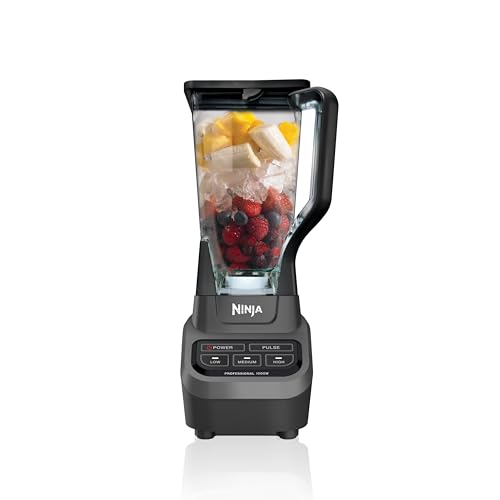
5. Ninja Professional Blender BL610, 1000W — Best Value Workhorse
The BL610 has been the default answer to ‘which blender crushes ice without costing a fortune’ for years, and the formula is simple: a 1000W motor, a stacked blade column that cuts at multiple heights, and a big 72 oz pitcher. Ice cubes and frozen fruit get pulled through the column repeatedly until the drink pours smooth. There are no Auto-iQ programs here — three speeds and a pulse button — which some buyers will count as a feature: nothing to configure, nothing to update, just blend.
Strengths
- Total Crushing stacked blades handle ice and frozen fruit convincingly
- Full 72 oz pitcher at a budget-friendly tier
- Simple three-speed-plus-pulse controls anyone can run
Trade-offs
- No programmed cycles — timing is up to you
- Blade column is very sharp to wash by hand
- Finish on greens and seeds is good, not premium-smooth
| Power | 1000W |
| Pitcher | 72 oz |
| Controls | 3 speeds + pulse |
| Cleaning | Dishwasher-safe parts |
Against its bigger BN701 sibling, the BL610 gives up the presets and some power headroom, and very leafy or seedy blends finish a touch less refined than the premium machines produce. What it keeps is the essential crushing performance at a friendlier tier, plus dishwasher-safe parts that make daily use realistic. The blade column is sharp and needs the same sink care as all Ninja assemblies, and the plastic pitcher will eventually show smoothie scratches. For frozen fruit smoothies, margarita nights and family breakfast batches, this remains the value benchmark in the category.
Longevity tip for BL610 owners: the blade column’s performance depends on its gasket staying clean and seated — rinse it immediately after frozen blends, dry it before reassembly, and the crushing performance that made this model famous stays consistent for years. Neglected gaskets, not weak motors, are behind most ‘my Ninja got worse’ stories.
Best for: value shoppers who want real ice-crushing in a full-size pitcher / Not suited for: buyers who want automated programs or glass construction
Check on Amazon — check price on Amazon for the current bundle and jar configuration.

6. nutribullet Full-Size Blender Combo NBF50500, 1200W — Best for Single Servings Too
Most households blend frozen drinks at two scales — a pitcher for the family and a single cup for the weekday smoothie — and the nutribullet Combo is built for exactly that split. The 64 oz pitcher and 1200W base handle ice and frozen fruit at batch scale, while the 24 oz tumbler with its extractor blade turns a handful of ice and frozen berries into a personal smoothie you can carry out the door. If your frozen blending is mostly solo with occasional family duty, this format fits your actual routine better than a pitcher-only machine.
Strengths
- Pitcher plus personal tumbler covers family and solo frozen blending
- Narrow cup keeps ice and frozen fruit in the blade path for smooth singles
- 1200W base gives the pitcher real crushing ability
Trade-offs
- Single-serve capacity is one modest smoothie at a time
- Big-pitcher ice work is solid rather than class-leading
- Plastic vessels throughout the system
| Power | 1200W |
| Pitcher | 64 oz |
| Cup | 24 oz tumbler included |
| Cleaning | Dishwasher safe |
The extractor-blade cups are genuinely good at frozen fruit for one: the narrow cup keeps everything in the blade path, so a modest motor load still produces a smooth drink. In the big pitcher, performance is solid mid-pack — fine for smoothies and frozen drinks, a step behind the Ninja pair on a maximum load of plain ice. The trade-offs are capacity ceiling in the cup, a base that wants the cup locked precisely, and a brand ecosystem built around plastic vessels. As a two-format household system at a mid tier, though, it solves a real problem the other picks ignore.
The tumbler’s hidden talent is portion discipline: a 24 oz cup makes exactly a generous smoothie, no more, which quietly ends the era of pitcher-scale leftovers oxidizing in the fridge. For weight-conscious or routine-driven households, that built-in portioning is a feature no specification sheet lists and owners consistently mention.
Best for: households splitting frozen blending between solo cups and family pitchers / Not suited for: party-scale frozen drinks or buyers wanting a single premium jar
Check on Amazon — check price on Amazon for the current bundle and jar configuration.
Comparison Table
| Pick | Badge | Key spec | Best for |
|---|---|---|---|
| Ninja Professional Plus Blender BN701, 1400W Peak | Best Overall | 1400 peak W, 72 oz pitcher, 3 Auto-iQ presets | most households wanting hands-off frozen drinks and fruit smoothies at family size |
| Vitamix 5200 Professional-Grade Blender, 64 oz | Best for Silkiest Texture | 64 oz container, variable speed, tamper included | daily smoothie makers who judge a blender by finished texture above all |
| Blendtec Classic 575 Blender, WildSide+ Jar | Best Programmed Cycles | WildSide+ jar, 4 cycles, blunt winged blade | entertainers and families blending pitcher-size frozen drinks by program |
| KitchenAid K400 Variable Speed Blender with Tamper | Best for Frozen Drinks | Ice Crush + Icy Drinks presets, tamper included | frozen-drink fans who want presets and a tamper at a mid-range tier |
| Ninja Professional Blender BL610, 1000W | Best Value Workhorse | 1000W, 72 oz pitcher, Total Crushing blades | value shoppers who want real ice-crushing in a full-size pitcher |
| nutribullet Full-Size Blender Combo NBF50500, 1200W | Best for Single Servings Too | 1200W, 64 oz pitcher + 24 oz tumbler | households splitting frozen blending between solo cups and family pitchers |
The pattern in the table is automation versus control. Ninja’s BN701 and the Blendtec 575 run the crush cycle for you; the Vitamix 5200 hands you the dial and tamper and rewards you with the finest texture; the K400 splits the difference with presets plus a tamper; the BL610 strips everything back to power and price; and the nutribullet Combo trades peak performance for a second, personal format. Choose by how you blend, not just by wattage.
Frozen Fruit, Up Close: Why Strawberries, Mango and Banana Behave Differently
Frozen strawberries are the seed problem: dozens of tiny seeds that a weak blend leaves intact, turning a smooth drink gritty at the last sip. Defeating them takes sustained high blade speed — the vortex machines and the long Auto-iQ cycles in this guide — because seeds are only pulverized by repeated passes, not by one heroic burst. If strawberry smoothies are your staple, weight the texture specialists (Vitamix, and the programmed Ninja and Blendtec) over raw crushing power.
Frozen mango is the fiber problem: dense, sweet and stringy when under-blended, it can leave threads that no amount of liquid hides. Mango wants impact first — to break the chunks — then sustained speed to shear the fibers. Stacked-blade Ninjas break it fastest; the tamper machines finish it finest. Frozen banana is the opposite personality: it blends easily but turns gummy and coats the jar, which is why banana-heavy loads benefit from being added after the vortex forms rather than packed at the bottom.
Frozen berries and cherries are the hiders: small, hard and numerous, they lodge in corners and under blade assemblies. Corner design — ribbed jars, square jars, tamper circuits — decides whether they are retrieved. Understanding which frozen fruit dominates your routine tells you which mechanism to buy, which is a more useful question than which motor is biggest.
How Ice and Frozen Fruit Break a Blender (and How the Good Ones Survive)
A blender jar is a chaotic place. The blades spin a vortex, the vortex throws material outward and upward, and hard pieces — ice cubes, frozen strawberries — get flung to the walls and ride above the blade zone in a frozen raft. Weak systems never retrieve that raft: the liquid at the bottom gets smoother and warmer while the top stays chunky. Every design in this guide is, at heart, a raft-retrieval system: stacked blades cut at raft height, tampers push the raft down, square jars collapse the vortex so the raft falls, and pulse programs let gravity reset the load between bursts.
Frozen fruit adds density differences to the chaos. Ice floats in the blend; frozen mango sinks; banana turns gluey and coats the jar. A good frozen-blend machine keeps all three moving, which is why jar circulation matters more than any single specification. When you read a spec sheet, translate it into circulation terms: blade coverage, jar shape, program patterns and tamper provision tell you more about your smoothie than a wattage number alone.
Motor load is the third factor. Crushing is impact work — each cube is a small collision — and motors that bog down on impact lose the vortex entirely. Sustained torque under impact, plus a base heavy enough not to walk across the counter, separates machines built for this job from drink blenders that merely tolerate it. If a blender dances or smells hot on your first frozen load, it is telling you the truth about its design brief.
Loading Order and Ratios for Perfect Frozen Blends
Order decides outcomes. Liquids go in first so the vortex can form; soft and leafy ingredients go next; frozen fruit and ice go in last, on top, where the forming vortex pulls them down gradually instead of packing them around the blade. Loading ice first is the most common home mistake — it bridges over the blades and guarantees an air pocket.
Ratio is the second lever. A frozen smoothie needs enough liquid to circulate but not so much that it becomes juice: as a working rule, start with liquid covering the blades and roughly one part liquid to two parts frozen ingredients by volume, then adjust by the spoonful. Thick cafe-style bowls use less; pourable drinks use more. Every pick in this guide handles the middle of that range comfortably; the tamper and program picks handle the thick end best.
Piece size is the third lever, and it is free. Frozen fruit cut small — halves, not wholes — and standard cubes instead of giant tray ice reduce the impact load dramatically. Two minutes spent portioning frozen fruit into blend-ready pieces when you freeze it will make a mid-range blender perform like a class above, and will make a premium blender’s job effortless.
How to Choose Between Programs, Tampers and Stacked Blades
Choose programs if you value repeatability and multitasking. Auto-iQ and Blendtec-style cycles encode the pulse-pause-sustain rhythm that frozen loads need, and they deliver the same result on a tired Tuesday as on a fresh Saturday. The cost is flexibility: a program cannot know your mango was extra fibrous today.
Choose a tamper and manual control if you value texture and range. The Vitamix approach handles the thickest, driest loads — smoothie bowls, frozen desserts, nut butters — because you can physically manage the mixture. The cost is attention: you stand there for ninety seconds, which some cooks enjoy and others resent.
Choose stacked blades if you value simplicity and price. Ninja’s column design needs no technique and no supervision beyond choosing a speed, and at the BL610’s tier it is remarkable value. The costs are a sharp assembly to wash and a texture ceiling on the finest work. None of these is the ‘right’ answer in the abstract — the right answer is the one that matches the blends you actually make and the patience you actually have.
Freezing Your Own Fruit for Better Blends (and When to Buy Frozen)
Home-frozen fruit, done properly, out-blends most bagged fruit: spread ripe pieces on a tray so they freeze individually, then bag them flat. Individually frozen pieces pour like gravel, portion exactly and present the blender with uniform work. The classic home mistake — freezing a solid block of fruit in a container — recreates the giant-ice problem in fruit form and makes every machine in this guide work twice as hard for a worse result.
Buy bagged frozen fruit for the staples where industry does it better: wild blueberries, mango chunks and pineapple are picked and frozen at a consistency home freezing rarely matches, and they are the backbone of most smoothie routines. Freeze your own for the gluts — the case of peaches, the garden berries, the bananas turning on the counter — where the alternative is waste.
Either way, label bags with the fruit and the date, and keep a simple rotation. Frozen fruit does not spoil quickly, but it does dry and absorb freezer flavors over months, and a nine-month-old bag of strawberries will make a nine-month-old-tasting smoothie in the finest blender on this page. Fresh stock is a blending specification, just like wattage.
How to Blend Ice and Frozen Fruit Without Chunks: A Reliable Method
This sequence works in every pick in the guide and fixes most frozen-blend failures, which are loading and timing problems rather than machine problems.
- Chill your expectations about order: liquid first (about a cup for a full pitcher), then yogurt or soft fruit, then leafy greens if using, then frozen fruit, then ice on the very top.
- Start on low or with pulses for the first 15-20 seconds. This cracks the largest pieces and lets them settle into the forming vortex instead of bouncing.
- Move to high speed — or start the frozen-drink program — and let the machine run a full 45-60 seconds. Frozen blends look done before they are; the last twenty seconds remove the grit.
- If a frozen raft forms on top, stop and use the tamper if you have one, or pulse twice to collapse it. Do not add liquid reflexively; collapse first, judge second.
- Check texture by stopping the machine and stirring once with a long spoon. If you find survivors, they will be at the corners — another 15 seconds at high speed usually finishes them.
- Serve immediately. Frozen blends separate and melt from the moment the blades stop, and the perfect texture you just made has a short, delicious window.
If your results are inconsistent from day to day, standardize the frozen side: freeze fruit in flat, portioned bags so piece size and quantity are constant, and use the same ice format for a week. Consistency in inputs makes any of these machines look dramatically better, because you stop re-solving a new puzzle every morning.
If you blend frozen drinks for a group, work in identical batches rather than one giant one, and hold finished batches no longer than a few minutes — frozen blends are at their peak inside a short window, and two fresh batches beat one melting pitcher every time, in texture and in temperature.
Common Buying Mistakes
**Mistake 1: Loading ice and frozen fruit first.** Hard ingredients packed around the blade create an air pocket and a bouncing raft. Liquid first, frozen last — the vortex can only pull down what starts above it.
**Mistake 2: Judging by sound at twenty seconds.** A frozen blend sounds finished long before it is smooth. The grit disappears in the final stretch of the run; cutting cycles short is the main cause of ‘my blender leaves chunks.’
**Mistake 3: Buying on wattage alone.** Wattage without blade coverage or jar circulation gives you a loud machine that still leaves shards. Look for the system — blades, jar shape, programs or tamper — not just the number.
**Mistake 4: Overfilling the pitcher.** A jar filled to the brim cannot form a vortex, and frozen loads expand as they aerate. Keep frozen loads at or below the max line, and blend two batches for a crowd instead of forcing one.
**Mistake 5: Using giant novelty ice and whole frozen fruit.** Oversized cubes and whole frozen peaches multiply the impact load. Standard cubes and halved fruit make every blender in this guide perform visibly better.
Final Recommendation
Start with the BN701 if you want the simplest path to great frozen drinks: load it correctly, press the frozen-drink preset, and pour. Choose the Vitamix 5200 if texture is your religion and you enjoy driving the machine yourself. The Blendtec 575 suits entertainers who blend by the pitcher and prefer programs with a tamper-free jar, the K400 is the mid-range frozen-drink specialist with a tamper in the box, the BL610 is the value workhorse that has earned its reputation, and the nutribullet Combo is the right shape for households split between solo cups and family pitchers.
Whichever machine you pick, use the loading order and full run times from the how-to section for your first week. Most ‘bad blender’ stories are actually bad-sequence stories, and these six machines — fed in the right order and given their full minute — will all produce frozen drinks with nothing left to chew. Check price on Amazon for the exact bundle, and confirm the pitcher and any cups match the configuration described here.
One last consideration before you decide: think about your freezer as part of the machine. The households that get the most from these blenders keep a standing inventory — a bag of mixed berries, a bag of mango, banana coins, a tray of standard cubes — so the blender is never waiting on ingredients and never facing a solid block of anything. That inventory habit, more than any single specification above, is what separates the kitchens where frozen smoothies are a daily pleasure from the kitchens where a good blender gathers dust. Stock the freezer, pick the machine whose mechanism matches your favorite fruit’s personality — seeds, fiber or hiding — and the combination will take care of itself for years.
The shortlist, if you are deciding today: Ninja Professional Plus Blender BN701, 1400W Peak (Best Overall), Vitamix 5200 Professional-Grade Blender, 64 oz (Best for Silkiest Texture), Blendtec Classic 575 Blender, WildSide+ Jar (Best Programmed Cycles). Each links to its Amazon listing — check price on Amazon and confirm the configuration before you order.
Keep exploring this cluster: Best Blenders For Hummus Best Blenders For Ice No Chunks Best Blenders For Ice Drinks Best Blenders For Blending Ice Best Blenders For Banana Ice Cream
Related guides
Frequently Asked Questions
What wattage do I need for ice and frozen fruit?
For a full-size pitcher, look for a strong motor paired with a real crushing system rather than a wattage number alone. The picks here range from 1000W to 1400 peak watts and all handle full frozen loads; below that class, blade design and jar circulation usually fail before the motor does.
Why does my smoothie still have ice chunks at the bottom?
Chunks at the bottom usually mean the load bridged over the blades at the start — ice loaded first or too little liquid to form a vortex. Load liquid first and frozen ingredients last, pulse to settle, then run a full high-speed finish.
Can I blend frozen fruit without any liquid?
Only tamper-equipped or very strong machines manage near-dry frozen loads, and even they prefer a few spoonfuls of liquid or yogurt to start circulation. For smoothie bowls, use a tamper machine and add liquid by the tablespoon.
Are stacked Ninja blades better than a single bottom blade?
For ice and frozen fruit in a big pitcher, stacked blades cut at several heights and retrieve pieces a bottom blade misses, which is why Ninjas crush so effectively. Bottom-blade professional machines compensate with vortex strength and tampers. Both systems work; they ask different things of you.
Should I thaw frozen fruit before blending?
No — frozen is the point: it gives the drink its body and chill. If your current blender struggles, letting fruit sit out for five minutes softens the edges enough to help, but with any pick in this guide you can blend straight from the freezer.
How long should a frozen smoothie take to blend?
About sixty to ninety seconds total, including the low-speed start. If yours takes much longer, the load is too big, the pieces are too large, or the liquid ratio is off — all fixable without a new machine.


