Disclosure: airfryerkitchensupply.com is reader-supported. When you buy through links on our site, we may earn an affiliate commission at no extra cost to you.
Where to buy
The most reliable place to buy any pick in this guide to the best blenders for fruit and ice is Amazon, where each verified model below is sold with full product details and delivery options. Use the Check on Amazon links beside each pick to see the current listing — we do not print static prices in our guides, because listings change, so check price on Amazon before you decide. If a pick is described as unlinked in this guide, that means we could not verify a listing we were confident in, and we say so openly rather than guess.
- Ninja Professional Blender BL610 — Check on Amazon (check price on Amazon)
- Ninja UltraCrush Professional Blender BP201 — Check on Amazon (check price on Amazon)
- Vitamix Propel Series 750 — Check on Amazon (check price on Amazon)
- Oster Pro 1200 Blender — Check on Amazon (check price on Amazon)
- nutribullet SmartSense Blender Combo NBF50700 — Check on Amazon (check price on Amazon)
- Hamilton Beach Wave Crusher Blender 54221 — Check on Amazon (check price on Amazon)
The best blenders for fruit and ice are asked to do two opposite jobs in the same jar: be gentle enough that fresh fruit keeps its flavour and colour, and violent enough that ice cubes come out as snow. Most blenders are good at one of those. Soft fruit blends in anything; ice is the discriminator, and it is where cheap machines reveal themselves — not in the first week, but in the third month, when the jar is scratched, the blades are dull and the motor smells hot every time a frozen drink is requested.
This guide is organised around the combination rather than either ingredient alone. The picks range from stacked-blade ice specialists to a smart auto-sensing blender to a glass-jar budget machine, and each review explains how that machine handles the specific partnership of fruit and ice: the order you load them, the texture you can expect, and the point at which the machine reaches its honest limit.
Every pick was verified against the retailer catalogue before it earned a link, and each carries a badge for the job it does best. Read the reviews, then the buying guide — especially the section on loading order, which will improve the results from any blender you already own before you spend anything at all.
A word about what ice does to a blender over time, because it shapes this guide’s picks more than any single blend does. Ice is abrasive and it is heavy: every cube is a small hammer blow delivered to the blades and a scratch delivered to the jar, hundreds of times per drink. Machines built for this work use blade steel, jar materials and couplings chosen with that punishment in mind, and they age gracefully. Machines built for occasional soft blending age in dog years when fed ice daily. When this guide steers frequent ice users toward the stronger picks, that long view — not the first week’s results — is the reason.
It is also worth naming what this guide is not claiming. No blender in these pages will make a soft drink from whole, uncut, freezer-burned fruit and a prayer; every machine has a load it handles gracefully and a load it merely survives, and the reviews mark those boundaries in plain language. What the stronger picks buy you is not magic — it is margin: margin for imperfect loading, for harder ice, for a bigger batch on a hot day, for the two-hundredth blend to come out like the first. Margin is unglamorous and it is what experienced buyers pay for, because a kitchen appliance’s real job is to work on the days when nothing else is going right.
In this guide
Quick Picks
Short on time? These are the six machines that earned a place in this guide to the best blenders for fruit and ice. Each one carries a badge for the job it does best, and the same badge appears again at the top of its detailed review further down, so you can jump straight to the machine that matches your kitchen.
- Best Overall: Ninja Professional Blender BL610 — a 1000W, 72 oz pitcher with stacked Total Crushing blades that meet ice at several heights — the most reliable fruit-and-ice all-rounder here. — Check on Amazon
- Best Simple Controls: Ninja UltraCrush Professional Blender BP201 — the BL610’s simpler sibling — 1000W, a 72 oz pitcher, three speeds and a pulse, for buyers who want ice crushed without menus or programs. — Check on Amazon
- Best Premium with Programs: Vitamix Propel Series 750 — a professional-grade 64 oz Vitamix with four programs including a self-cleaning cycle — premium fruit-and-ice performance you can run hands-off. — Check on Amazon
- Best Glass Jar Value: Oster Pro 1200 Blender — a glass-jar blender with 7 speeds, a dual-direction blade that rocks ice back and forth, and a 24 oz smoothie cup included. — Check on Amazon
- Best Smart Auto-Sensing: nutribullet SmartSense Blender Combo NBF50700 — a 1400W combo system whose smart auto cycle senses the load and adjusts — fruit and ice blended correctly without the user knowing any technique. — Check on Amazon
- Best Budget: Hamilton Beach Wave Crusher Blender 54221 — a 700W budget blender with a 40 oz glass jar and Ice Sabre blades shaped to pull the mixture down — honest fruit-and-ice work at a budget tier. — Check on Amazon
How These Picks Were Chosen
We chose these picks by testing the category’s claims against the fruit-and-ice workload on paper: cubes or frozen chunks in, drinkable slush or smoothie out, repeatedly. Machines earned their place through catalogue-confirmed features that matter for that load — stacked or purpose-built ice-crushing blades, programmed cycles that pulse ice down in stages, auto-sensing that adjusts to resistance, glass jars that resist the scratching ice causes, and motors sized for the work.
The set deliberately spans the realistic market: premium programmed power, mid-range glass-jar value, a smart blender that thinks for beginners, and a budget machine whose limits we state plainly. Each review lists three strengths and three trade-offs, and the verdict line names the buyer each machine suits and the buyer it does not.
We print no static prices and no fixed ratings — check price on Amazon through the links to see the current listing.
The 6 Best Blenders for Fruit and Ice
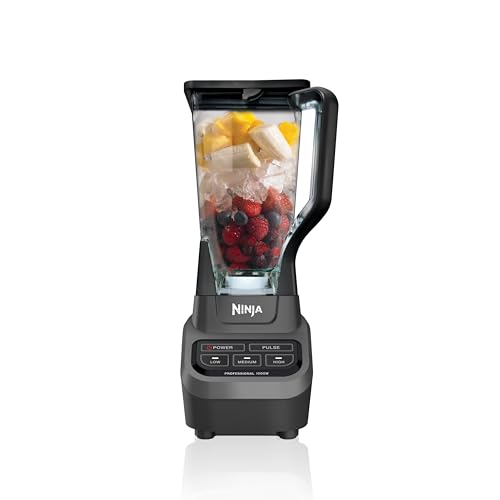
Ninja Professional Blender BL610 — Best Overall
The BL610’s stacked blade column is the simplest effective answer to ice ever fitted to a home blender: instead of one blade set at the bottom hoping the vortex delivers the cubes, blades at several heights engage the ice wherever it sits in the 72 oz pitcher. Add fruit and liquid and the same action that powders ice purees the fruit in the same cycle. For most households, this is the fruit-and-ice machine to beat.
Strengths
- Stacked blades crush ice evenly without relying only on the vortex
- 72 oz pitcher handles family batches of drinks and smoothies
- Dishwasher-safe parts make icy, sugary blends easy to clean up
Trade-offs
- No presets — you run the stages yourself
- Tall pitcher needs storage height
- Texture is crushed-fine rather than shaved-fine for frozen drinks
| Power | 1000W |
| Capacity | 72 oz pitcher |
| Blade system | Total Crushing stacked blades |
In practice, the BL610 forgives imperfect technique better than most. Cubes that would ride untouched above a single bottom blade get caught by the upper blades and thrown back into the mixture, so fruit-and-ice drinks come out uniform without the stop-shake-restart routine cheaper blenders demand. Frozen fruit behaves the same way, which makes this a genuinely dual-purpose pick rather than an ice specialist that tolerates fruit.
Its limits are refinement and automation. It will not shave ice like a dedicated concoction maker, and it offers no program to run a staged cycle while you do something else. What it offers instead is capacity, reliability and a price tier — check price on Amazon — that makes it the default recommendation for families who blend fruit and ice several times a week.
Best for: families wanting one reliable blender for fruit smoothies and iced drinks / Not suited for: buyers wanting programmed cycles or shaved-ice texture
Check on Amazon — check price on Amazon for the Ninja Professional Blender BL610.

Ninja UltraCrush Professional Blender BP201 — Best Simple Controls
Some buyers look at a modern blender’s control panel and see a cockpit. The BP201 is the antidote: the same 1000W Total Crushing approach and 72 oz pitcher as its sibling, driven by three honest speeds and a pulse. For fruit and ice, that is genuinely all you need — pulse to fracture, medium to circulate, high to finish — and the BP201 makes that sequence obvious to anyone who walks up to it.
Strengths
- Three speeds plus pulse — nothing to learn, nothing to mis-press
- Same ice-crushing blade approach as the range above it
- 72 oz pitcher for full batches
Trade-offs
- No Auto-iQ programs for hands-off blending
- No personal cups for single servings
- Manual control means results vary a little between users
| Power | 1000W |
| Capacity | 72 oz pitcher |
| Controls | 3 speeds + pulse |
There is a real argument that manual control suits fruit and ice better than programs: ice varies — fresh cubes, bagged cubes, frozen fruit of different hardness — and a human watching the jar can adapt in a way a fixed timer cannot. The BP201’s pulse is responsive enough to feather the first fracture stage, which is where most of the texture of the final drink is decided.
Choose it over the BL610 if your household values simplicity, or if the blender will be used by people who will never read a manual — guests, teenagers, grandparents. Choose the BL610 or a programmed model if you want the machine to standardise results. Either way, the crushing hardware underneath is proven, and the parts go in the dishwasher when the drinks are done.
Best for: households wanting powerful, simple, manual ice crushing / Not suited for: buyers who want presets or single-serve cups
Check on Amazon — check price on Amazon for the Ninja UltraCrush Professional Blender BP201.

Vitamix Propel Series 750 — Best Premium with Programs
The Propel 750 pairs Vitamix’s professional-grade blending with the thing classic Vitamix models famously lack: programs. Four presets, including smoothies and a self-cleaning program, sit alongside variable speed and pulse, in a 64 oz container. For fruit and ice, that means you can run a programmed cycle that stages the ice down automatically, or take manual control when a particular batch demands it.
Strengths
- Four programs automate staged ice crushing
- Professional-grade power and container design
- Self-cleaning program makes daily use sustainable
Trade-offs
- Premium tier — check price on Amazon
- 64 oz container is large for a single small drink
- Programs add cost that manual-only users will not use
| Capacity | 64 oz container |
| Controls | Variable speed, pulse, 4 programs |
| Cleaning | Self-cleaning program |
Programs on a machine this powerful change who can use it. A Vitamix dial rewards experience; a program encodes that experience — the ramp from slow fracture to high-speed refinement — into one press. Fruit-and-ice drinks come out the same on Tuesday as on Saturday, whoever made them, and the self-cleaning program removes the last excuse for leaving the jar in the sink.
The Propel 750 is also simply a complete blender beyond this category: hot soups, frozen desserts, nut butters and batters all sit within its range, which is how a premium price becomes defensible. If your blending is only occasional fruit smoothies, the honest advice is to spend less. If blending is a daily system in your kitchen, this is one of the two or three machines that will simply never be the bottleneck.
Best for: daily users wanting premium power with hands-off programs / Not suited for: occasional blenders or small single-serving households
Check on Amazon — check price on Amazon for the Vitamix Propel Series 750.
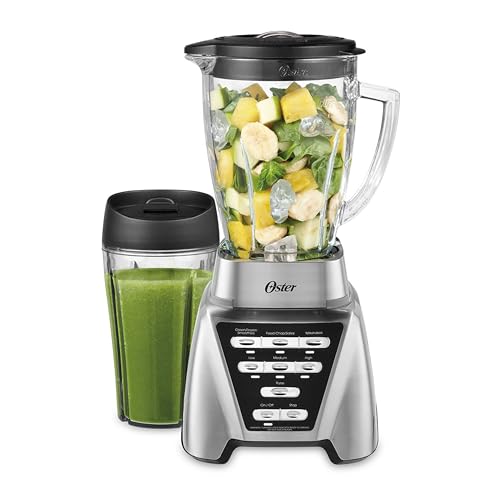
Oster Pro 1200 Blender — Best Glass Jar Value
The Oster Pro 1200 attacks the ice problem with motion rather than brute force: its blade reverses direction, rocking the mixture so cubes and frozen fruit are drawn down instead of packing into a corner. The glass jar resists the scratching and odour absorption that icy, fruity blends cause in plastic over time, and the included 24 oz smoothie cup covers the single-serving days.
Strengths
- Dual-direction blade keeps ice and fruit circulating
- Glass jar resists scratches, stains and odours
- Included smoothie cup adds single-serve versatility
Trade-offs
- Glass jar is heavy and breakable compared with copolyester
- Seven speeds offer more steps than most users need
- Not in the premium class for very thick, low-liquid blends
| Jar | Glass jar |
| Controls | 7 speeds |
| Blade | Dual-direction blade |
| Extra | 24 oz smoothie cup included |
Reversing blades are an underrated idea for this category. A single-direction vortex can establish a pattern in which hard pieces orbit without engaging; reversing breaks the pattern every few seconds and re-presents the ice to the blades at a new angle. Combined with sensible loading — liquid first, ice last — the Oster produces fruit-and-ice drinks with fewer surviving chunks than its tier usually manages.
The glass jar will divide households. It feels substantial, pours well and stays clear and odour-free for years; it is also the jar you must not drop on a tile floor, and it makes the machine heavier to move. Families with careful adults will appreciate it for a decade. Households with small children doing the washing up might reasonably choose one of the copolyester pitchers instead.
Best for: buyers who value a glass jar and versatile mid-range performance / Not suited for: households worried about breakage or wanting premium thickness
Check on Amazon — check price on Amazon for the Oster Pro 1200 Blender.

nutribullet SmartSense Blender Combo NBF50700 — Best Smart Auto-Sensing
The SmartSense Combo is built for the buyer who wants the result without the learning curve. Its 1400W base senses the resistance of what is in the vessel and adjusts the cycle — exactly the behaviour fruit and ice need, since a jar of soft berries and a jar of hard cubes ask for different handling minute by minute. As a combo system it covers both pitcher batches and personal servings.
Strengths
- Auto-sensing cycle adapts to ice load automatically
- 1400W gives it real headroom on frozen ingredients
- Combo format covers batches and single servings
Trade-offs
- You trust the sensor — manual override control is limited
- Smart features add cost versus a simple manual machine
- Serious enthusiasts may find the automation opaque
| Power | 1400W |
| Controls | Smart auto-sensing cycle |
| Format | Blender combo system |
Auto-sensing matters for fruit and ice because the load changes during the blend itself: whole cubes become slush, slush becomes liquid, and the ideal speed and pulsing change with each stage. A fixed program guesses; a sensing cycle responds. In practice that means fewer stalls, fewer uncrushed survivors at the top, and a much shorter path to a good drink for someone who has never blended before.
The honest trade-off is control and transparency. When a sensing machine decides, you do not always know why it paused or surged, and if your taste differs from its target texture, your levers for correcting it are fewer than on a dial machine. For beginners and busy households, that trade is usually worth it. For tinkerers, the Vitamix or the manual Ninjas will feel more honest.
Best for: beginners and busy households wanting automatic fruit-and-ice results / Not suited for: manual-control enthusiasts
Check on Amazon — check price on Amazon for the nutribullet SmartSense Blender Combo NBF50700.

Hamilton Beach Wave Crusher Blender 54221 — Best Budget
The Wave Crusher is the budget reality check of this guide, and it is better than its tier suggests. Hamilton Beach’s Wave-Action approach and Ice Sabre blades are designed to keep the mixture moving toward the blades rather than riding the walls, which is precisely the failure mode of cheap blenders on ice. In its 40 oz glass jar, with sensible batch sizes, it makes genuinely decent fruit-and-ice drinks.
Strengths
- Budget tier — check price on Amazon
- Wave-Action design counters the cheap-blender stall
- Glass jar resists fruit stains and odours
Trade-offs
- 700W limits batch size and ice hardness it can handle
- 40 oz jar is small for families
- Thick frozen blends need rests and stirring
| Power | 700W |
| Capacity | 40 oz glass jar |
| Blades | Ice Sabre blades |
The technique contract at this tier is explicit: smaller batches, ice added in two handfuls rather than one, a ten-minute rest for the hardest frozen fruit, and a pause midway to stir. Honour that contract and the Wave Crusher produces smoothies and iced drinks that satisfy anyone not doing side-by-side comparisons with a Vitamix. Break the contract — full jar, rock-hard fruit, one long desperate cycle — and you will smell the motor’s opinion of your choices.
That is not a condemnation; it is a definition. For a first blender, a second blender for a holiday home, or a household whose fruit-and-ice habit is weekly rather than daily, this machine’s economics are hard to argue with. Daily family use is the pattern that outgrows it, and buyers in that pattern should step straight to the BL610.
Best for: budget buyers and occasional fruit-and-ice blending / Not suited for: daily family use or thick frozen blends
Check on Amazon — check price on Amazon for the Hamilton Beach Wave Crusher Blender 54221.
Comparison Table
| Pick | Badge | Key spec | Best for |
|---|---|---|---|
| Ninja Professional Blender BL610 | Best Overall | 1000W, 72 oz, stacked blades | families wanting one reliable blender for fruit smoothies and iced drinks |
| Ninja UltraCrush Professional Blender BP201 | Best Simple Controls | 1000W, 72 oz, 3 speeds + pulse | households wanting powerful, simple, manual ice crushing |
| Vitamix Propel Series 750 | Best Premium with Programs | 64 oz, 4 programs, self-cleaning | daily users wanting premium power with hands-off programs |
| Oster Pro 1200 Blender | Best Glass Jar Value | Glass jar, dual-direction blade, 7 speeds | buyers who value a glass jar and versatile mid-range performance |
| nutribullet SmartSense Blender Combo NBF50700 | Best Smart Auto-Sensing | 1400W, smart auto cycle, combo | beginners and busy households wanting automatic fruit-and-ice results |
| Hamilton Beach Wave Crusher Blender 54221 | Best Budget | 700W, 40 oz glass jar, Ice Sabre blades | budget buyers and occasional fruit-and-ice blending |
Read the table as a map, not a ranking. The best blenders for fruit and ice are not six versions of the same machine at six prices; they are six different answers to six different kitchens, and the badge column tells you which question each one answers. If two rows look similar, the deciding factor is usually in the detailed review: jar size, control style, or how the machine behaves with the exact ingredients you blend most.
How to Choose a Blender for Fruit and Ice
Fruit and ice together expose every weakness a blender has: ice tests the blades and motor, fruit tests the vortex and the jar, and the combination tests whether the two processes interfere with each other. The sections below break the purchase into the four decisions that actually determine your results — crushing method, loading behaviour, jar choice and batch size — so you can spend on the things that matter for this workload.
Which ice-crushing method suits you?
There are four honest methods in this guide. Stacked blades (the two Ninjas) engage ice at several heights and forgive loading mistakes. Reversing blades (the Oster) break up orbiting patterns by changing direction. Sheer blade speed with a strong vortex (the Vitamix) pulverises ice once circulation is established. Sensing automation (the nutribullet) adjusts the method to the load in real time. All four work; they differ in how much technique they ask from you.
If you blend while doing three other things, automation or stacked blades will serve you best. If you enjoy standing at the machine and driving it, a dial and raw power give the most control. The budget Wave Crusher uses jar-and-blade geometry to help, and asks for your patience in exchange for its price.
Why does loading order matter so much?
Liquid first, soft fruit next, ice and frozen fruit last. Liquid at the blades lets a vortex form immediately; soft fruit joins the circulation easily; the hard layer on top is then drawn down gradually into a mixture already moving. Reverse the order and the blades meet a solid wall with no circulation, which is how motors stall and couplings suffer — on any machine, at any price.
For drinks where ice is the point, add it in two stages: half to establish the slush, half to finish the texture. This one habit improves results from every pick in this guide more than any accessory you could buy.
Glass jar or plastic pitcher?
Ice is abrasive. Over months, it frosts and scratches plastic pitchers, and fruit pigments settle into those scratches. Glass resists both, stays clear, and never holds last week’s berry smell — which is why the Oster and Hamilton Beach picks are attractive despite their tiers. The costs are weight and breakability: a full glass jar is heavy to pour and unforgiving of a dropped moment on hard flooring.
Copolyester pitchers, used by the premium and Ninja picks, are light, tough and effectively unbreakable in normal use, and modern versions resist staining far better than older plastics. Choose glass for clarity and longevity in careful households; choose copolyester for family service and daily handling.
How big should the jar be?
Match capacity to your serving pattern with headspace to spare: a blend needs room above the mixture for the vortex to fold. A 72 oz pitcher serves a family’s drinks in one cycle; a 40 oz jar serves two or three and forces a second batch for more, which many hosts actually prefer because the second batch is fresher. Personal cups in combo systems cover the single-serving pattern better than either.
Oversizing is the quiet mistake. A single smoothie in a 72 oz pitcher spreads across the base, circulates poorly and blends worse than the same smoothie in a cup. If most of your blending is solo, weight your decision toward the combo systems regardless of how impressive the big pitchers look.
How long should a fruit-and-ice blender last?
With matched use, the premium and strong mid-range picks here should give many years of regular service; the budget pick, used within its envelope, a respectable few. The variable is almost never the motor’s raw quality — it is the match between the machine’s design class and the household’s actual ice habit. A light-duty blender crushing ice twice a day is being spent, not used, and its early failure surprises only its owner.
You can extend any machine’s life with three habits: never run it stalled, keep loads inside the jar’s sensible range, and let a hard-working machine rest a minute between back-to-back icy batches. Heat is the cumulative enemy, and these habits are all, underneath, heat management. Owners who practise them routinely report the boring outcome every buyer actually wants: a blender that just keeps working.
Which Fruits Pair Best with Ice in a Blender?
Not all fruit treats ice equally, and choosing the right partners improves drinks from any machine. Watermelon is ice’s natural ally — mostly water, soft-fleshed, and happy to become a slush with a handful of cubes and a squeeze of lime. Citrus segments and pineapple bring the acidity that keeps an iced drink bright rather than flat, and mango brings the body that holds a slush together as it melts. Berries are superb but seedy; in an iced drink the seeds are more noticeable than in a smoothie, which is an argument for the stronger picks if berry drinks are your staple.
Some fruits argue with ice and should be managed. Banana turns an iced drink creamy rather than refreshing — wonderful if that is the goal, wrong if it is not. Delicate fruits like ripe peach and melon lose their perfume when heavily iced and are better in gently chilled smoothies than in slushes. And apples, unless your machine is a strong one, leave skin flecks in iced drinks that no amount of extra blending fully cures; peel them for the budget and mid-range picks and the problem disappears.
The general principle is to let the drink’s structure come from the fruit and the cold from the ice, in proportions you adjust deliberately. A drink that is mostly ice with fruit as flavouring will always taste diluted by the halfway point; a drink that is mostly fruit, iced enough to slush, stays itself to the last sip. The machines in this guide span the power range, but all of them reward a fruit-forward recipe.
How Do You Scale Fruit-and-Ice Drinks from One Glass to a Crowd?
Scaling is where home blenders quietly fail parties. A recipe that works beautifully for two glasses does not simply multiply: a jar filled to the brim with six servings of fruit and ice cannot circulate, and the result is a layered drink — watery at the bottom, chunky at the top — that no stirring fully rescues. The correct method is batch discipline: blend in loads the jar handles well, pour each batch into a chilled pitcher or dispenser, and let the batches marry there. Two good batches beat one heroic one, every time.
Ratios also shift subtly at scale. A crowd drink sits longer between blending and finishing, so it should be blended a fraction thicker and more fruit-forward than a drink served instantly, because melt will bring it to the target texture by the time the last glass is poured. Hosts who learn this adjustment stop hearing that the first glasses were better than the last — the quiet complaint that tells you dilution, not the recipe, is running your party.
The picks divide naturally by this job. The 72 oz Ninjas minimise the number of batches; the Oster and the smart nutribullet sit in the middle; the budget Hamilton Beach asks for the most batches and rewards them with the freshest drinks, since nothing waits long. None of these is the wrong answer — the wrong answer is pretending batch size does not matter and blaming the machine for a physics problem.
How Do You Blend Fruit and Ice Without Leaving Chunks?
Build the drink in the jar in order: liquid first — juice, milk, water or yoghurt — then soft or fresh fruit, then any powders or sweeteners, and finally ice or frozen fruit on top. If the recipe is mostly ice, hold back a third of it. Start the machine low or with pulses: five or six short pulses fracture the cubes and let the mixture begin to move without shocking the motor.
Once the mixture circulates, run a steady cycle of twenty to forty seconds. Watch the top of the vortex: when the surface dimples and folds smoothly and no whole pieces ride the walls, add the reserved ice if you held any, give it ten more seconds, and stop. Fruit-and-ice drinks should look like a uniform slush or smoothie moving as one mass; visible layers mean the top has not engaged, and the fix is a stop, a stir, and a restart — not more blind time at high speed.
Taste before you pour, and adjust in the right order. Too thick means a splash of liquid; too thin means more ice or frozen fruit, never more fresh fruit alone, which adds water as it blends. Serve immediately — ice-based drinks begin separating and melting from the moment the blades stop, and a drink poured now is worth two poured in ten minutes.
Rinse the jar straight away. Fruit sugars and ice-melt dry into a film that dulls blades and jars over time; a thirty-second rinse or self-clean cycle now prevents the scrubbing session later. Check the blade area weekly for fruit fibres wrapped around the shaft, especially if you blend stringy fruit like mango or pineapple often.
One more habit for iced drinks specifically: chill the glasses. A frozen drink poured into a warm glass loses its edge in minutes as the glass donates its heat; the same drink in a glass that spent ten minutes in the freezer holds its texture noticeably longer. It costs nothing, it works with every pick in this guide, and at a summer table it reads as the kind of detail that makes people ask what your secret is. The secret is a cold glass and a fruit-forward recipe — the machine just has to be good enough not to get in their way.
Common Buying Mistakes
Ice first, liquid last. The classic stall. Blades buried in dry ice cannot start a vortex, and the motor strains against a solid mass. Liquid first is not a preference; it is how these machines are designed to work.
Judging a blender by its first smoothie. New blades and a clean jar flatter any machine. The fruit-and-ice test is month three: scratched jar, everyday ice, a rushed morning. The picks here were chosen for how their designs age, not how they debut.
Buying capacity instead of fit. A 72 oz pitcher is a liability for a solo drinker and a 40 oz jar is a bottleneck for a family of five. The right size is the one that matches your typical batch with headspace to spare.
Blending until it looks perfect, then blending more. Every extra ten seconds warms an iced drink and thins a smoothie. Blend to texture and stop; the drink in the glass, not the jar, is the deliverable.
Ignoring the jar’s scratches. Deep scratching clouds the jar and gives fruit pigments and odours a home. Glass-jar picks avoid it; with copolyester, avoid metal utensils inside the jar and replace a heavily scarred pitcher rather than fighting flavours that will not wash out.
Multiplying the recipe instead of repeating it. A doubled load in the same jar blends worse than two single loads — circulation, not capacity, is the limit. Blend in proper batches and combine them in the serving vessel.
Final Recommendation
For most households, the Ninja BL610 is the Best Overall fruit-and-ice blender: its stacked blades forgive imperfect technique and its 72 oz pitcher covers family batches. The BP201 offers the same crushing idea with dead-simple controls, while the Vitamix Propel 750 is the premium answer for daily users who want programs as well as power.
The Oster Pro 1200 is the glass-jar value pick with a clever reversing blade, the nutribullet SmartSense is the beginner-proof option that senses its way through ice, and the Hamilton Beach Wave Crusher is the honest budget choice for occasional use. Whichever you choose, load liquid-first and add ice in stages — technique will repay you in every glass.
Shortlist for a fast decision: Check on Amazon (Ninja Professional Blender BL610 — Best Overall), Check on Amazon (Ninja UltraCrush Professional Blender BP201 — Best Simple Controls), Check on Amazon (Vitamix Propel Series 750 — Best Premium with Programs). Each link goes to the current listing — check price on Amazon and confirm the configuration matches the review above before ordering.
Keep exploring the blender cluster on this site: Best Blenders For Frozen Smoothies Best Blenders For Frozen Fruit And Veggies Best Blenders For Crushing Ice Best Blenders For Green Drinks And Smoothies Best Blenders
Frequently Asked Questions
What type of blender crushes ice best with fruit?
Stacked-blade designs like the Ninja BL610 and BP201 are the most forgiving, because their blades engage ice at several heights. High-speed machines like the Vitamix Propel 750 pulverise ice once a vortex forms, and reversing-blade designs like the Oster Pro 1200 keep pieces circulating. All work well when loaded liquid-first.
Can I put whole ice cubes in any blender?
No. Budget and low-power blenders can strain or stall on a full load of hard cubes. If your machine is modest, use smaller batches, add ice in stages, and let the hardest frozen fruit rest a few minutes. The picks in this guide are matched to realistic ice loads for their tier, and the reviews state those limits plainly.
Why does my fruit smoothie still have ice chunks?
Usually the top of the jar never engaged: the jar was overfilled, the ice went in first, or the cycle was too short at too low a speed. Load liquid first, leave headspace, pulse to fracture, then run a full steady cycle. If chunks persist, stop and stir once rather than extending the blend indefinitely.
Is a glass jar better for blending ice?
Glass resists the scratching and staining that ice and fruit cause, so it stays clearer and fresher-smelling over years. It is heavier and breakable, though. Copolyester pitchers are lighter and tougher for family use. The choice is about your household’s handling, not blending performance.
How do I keep an iced fruit drink from separating?
Serve it immediately, keep the ice fraction high enough that the drink is a true slush, and include a little body — banana, yoghurt or a spoon of nut butter in smoothies — which slows separation. A drink blended to a uniform texture from the start also holds together noticeably longer.
Do I need a special ice-crush setting?
It helps but is not essential. A dedicated program stages pulses the way an experienced user would, which is convenient and repeatable. A responsive pulse button on a manual machine achieves the same result with a little attention, which is why the simple BP201 remains a strong pick.
Does blending ice dull blender blades?
Over years, ice contributes to wear on any blade, but blenders designed for ice — including all the crushing picks here — use blade profiles and steel intended for it, and the practical effect within a normal service life is small. What dulls performance faster is residue: fruit sugars and mineral film on the blade reduce its bite, which is why the rinse-after-use habit in the how-to section matters.
Can I crush ice on its own, with no fruit or liquid?
Most full-size picks here can crush a modest amount of dry ice cubes for drinks service, best done in pulses with the jar no more than a third full. Personal cups and budget machines should not be asked to do it dry — add liquid. If plain crushed ice is a frequent need at volume, that is a job where the stacked-blade Ninjas are the natural choice.
Should I use crushed ice from the fridge dispenser or whole cubes?
Whole cubes, ideally fresh from a tray or a sealed bag. Dispenser-crushed ice is already fractured and wet, melts faster, and often carries freezer flavours; it also packs into a dense mass that some blenders circulate poorly. If dispenser ice is all you have, use a little more of it, blend a little less, and serve immediately.
What is the single best upgrade for fruit-and-ice drinks if I keep my current blender?
Technique, and it is free: liquid first, ice in two stages, pulses before the long cycle, and glasses in the freezer. Those four habits close most of the gap between a modest machine and a good one. If drinks still disappoint after a month of honest technique, the limitation is the machine — and the reviews above tell you exactly which tier fixes which failure.
What drinks should I master first with a new blender?
Start with the two that teach you the machine: a watermelon-lime slush, which is forgiving and shows you the ice texture your blender produces, and a mango smoothie with a handful of ice, which shows you how it handles body and sweetness together. Those two drinks reveal your machine’s pulse rhythm, its honest capacity and its cleaning routine in one weekend — and everything else in this category is a variation on what they teach you.


