Disclosure: airfryerkitchensupply.com is reader-supported. When you buy through links on our site, we may earn an affiliate commission at no extra cost to you.
Where to buy
Here is where to buy the best blenders for hummus recommended in this guide. Every linked model below was matched against Amazon catalog data before it earned a place here. Hummus is a torque test, not a speed test: a dense chickpea paste stalls weak motors and rides up the walls of wide jars, so check the exact jar, tamper and processor-bowl configuration on the listing, and check price on Amazon on the day you buy.
- Vitamix 5200 Professional-Grade Blender, 64 oz — Best Overall. Check the current price on Amazon before you order, because blender pricing and bundle contents change often.
- Ninja Kitchen System Pro BL770, 1500W — Best with a Food Processor Bowl. Check the current price on Amazon before you order, because blender pricing and bundle contents change often.
- Vitamix Propel Series 750, 64 oz — Best with Programs. Check the current price on Amazon before you order, because blender pricing and bundle contents change often.
- Blendtec Total Blender Classic, FourSide Jar — Best for Big Batches. Check the current price on Amazon before you order, because blender pricing and bundle contents change often.
- KitchenAid K400 Variable Speed Blender with Tamper — Best Mid-Range with Tamper. Check the current price on Amazon before you order, because blender pricing and bundle contents change often.
- Oster Pro 1200 Blender with Glass Jar — Best Budget. Check the current price on Amazon before you order, because blender pricing and bundle contents change often.
If you are comparing the best blenders for hummus, you are shopping for one of the hardest jobs a countertop blender ever faces. Hummus starts as whole chickpeas, tahini, lemon juice, garlic and just a splash of liquid — a paste so thick that it barely pours. In a weak machine the blades carve a hollow pocket, spin in air, and leave chickpea gravel around the edges while the motor strains and heats up. The blenders that make genuinely silky, deli-style hummus share three traits: a motor with real low-speed torque, a jar shape or tamper that keeps pushing the paste back into the blades, and enough patience built into their controls to run for two or three minutes without drama.
That is why this guide does not simply recycle a smoothie list. A blender that liquefies frozen strawberries can still fail at hummus, because a smoothie has liquid to circulate and a hummus batch does not — at least not at the start. As the chickpeas break down they release starch and the mixture loosens, but the first ninety seconds are pure resistance. Machines with a tamper, a food-processor bowl, or a well-shaped narrow jar bottom handle that phase far better than tall, wide pitchers designed for drinks.
We also want to be honest about the alternative: a food processor is the traditional hummus tool, and two picks below include processor bowls for exactly that reason. But a strong blender produces a smoother, whipped texture that most processors cannot match, because the blade speed emulsifies the tahini and olive oil into the paste instead of merely chopping it. If hummus night is weekly in your house — or you also make nut butters, pesto and thick dips — one of these six machines will earn its counter space. If you make hummus twice a year, the budget pick here still beats struggling with an underpowered drink blender.
In this guide
Quick Picks
Six machines, six different routes to smooth hummus — from a professional-grade jar blender that powers through the thickest paste to a blender-processor combo that handles the job with a bowl and an S-blade.
- Best Overall: Vitamix 5200 Professional-Grade Blender, 64 oz — the long-running professional standard: variable speed, a tall narrow 64 oz container and the torque to turn chickpeas and tahini into a whipped, scoopable paste without stalling. Check price on Amazon.
- Best with a Food Processor Bowl: Ninja Kitchen System Pro BL770, 1500W — a 1500W system that gives you both tools in one box: an 8-cup processor bowl that chops chickpeas evenly, plus a 72 oz pitcher for finishing the paste silky. Check price on Amazon.
- Best with Programs: Vitamix Propel Series 750, 64 oz — Vitamix power with four programs and a self-cleaning cycle: run the dips-style program, tamper the corners down, and let the machine manage the speed curve for you. Check price on Amazon.
- Best for Big Batches: Blendtec Total Blender Classic, FourSide Jar — ten speeds and six preprogrammed cycles in a wide FourSide jar that pulls a double or triple batch of hummus down into the blade without a tamper. Check price on Amazon.
- Best Mid-Range with Tamper: KitchenAid K400 Variable Speed Blender with Tamper — a mid-range blender that includes the accessory hummus actually needs — a tamper — plus a 5-speed dial and motor control that holds speed as the paste thickens. Check price on Amazon.
- Best Budget: Oster Pro 1200 Blender with Glass Jar — the budget route to real hummus: a glass jar, seven speeds and a dual-direction blade that reverses to pull stubborn chickpeas back into the cutting path. Check price on Amazon.
How These Picks Were Chosen
Every pick in this guide was verified against Amazon’s catalog for the exact model, jar and bundle named, because blender lineups reuse names across very different machines. We then filtered for the four things hummus actually demands: low-speed torque that does not stall in a dense paste, a way to keep the paste moving — a tamper, a processor bowl, a reversing blade or a vortex jar — enough jar capacity for at least a double batch of chickpeas, and controls that let you run long enough for the emulsion to turn silky.
We deliberately excluded personal bullet blenders and low-watt drink machines. They are fine appliances, but a 250-700W personal blender asked to puree chickpeas with minimal liquid will cavitate, overheat or leave grit, and recommending one for hummus would be setting you up to fail. Where a pick has a weakness for this job — a wide jar, drink-focused presets, a smaller batch size — we say so in its review rather than hiding it, and the verdict lines tell you plainly who should skip each machine.
A final note on method: hummus texture is technique-sensitive, so the how-to section in this guide is part of the recommendation. The same blender can produce gravel or silk depending on chickpea softness, liquid pacing and run time. Buy the machine whose workflow matches how you actually cook — tamper, programs, processor bowl or budget scrape-and-pulse — and use the method section to get the best from it.
We also considered ownership reality: hummus is a sticky, garlicky, tahini-rich food that tests seals, stains jars and punishes weak gaskets. Machines with simple jar geometry, self-cleaning cycles or dishwasher-safe parts scored credit, because a blender that is annoying to clean after hummus quietly stops being used for hummus. The best machine in this guide is partly the one you will still be happily scraping chickpeas out of in year three — which is another reason the rankings favor proven designs over novelty.
The 6 Best Blenders for Hummus

1. Vitamix 5200 Professional-Grade Blender, 64 oz — Best Overall
The Vitamix 5200 is the blender experienced hummus makers recommend first, and the reason is control. Its variable-speed dial lets you start a thick batch slowly, so the chickpeas tumble into the blades instead of being flung to the walls, then climb the dial as the paste loosens and starts to flow. The tall, narrow 64 oz container is the right geometry for hummus: ingredients fall back toward the blade instead of spreading out across a wide floor, and the included tamper lets you press the corners down while the machine runs — the single most useful accessory for any thick blend.
Strengths
- Variable speed gives true low-speed torque for the dense first phase of a hummus batch
- Tall narrow container and tamper keep thick paste circulating into the blades
- Handles double batches and equally dense jobs like nut butter without stalling
Trade-offs
- Premium tier pricing, and the tall container may not fit under low cabinets
- Fully manual controls — no preset cycles, so results depend on your timing
- Loud at high speed, like every professional-grade blender
| Container | 64 oz, tall profile |
| Controls | Variable speed dial + high-speed switch |
| Blades | Stainless steel |
| Cleaning | Self-cleaning cycle with warm water and soap |
In practice, the 5200 turns a double batch of chickpeas, tahini and ice water into hummus with a texture closer to whipped feta than to a chopped dip, because the blades keep shearing the paste for the full run instead of cavitating. Run it for two full minutes, rest, then run again with a spoonful more ice water and you get the glossy finish restaurants get. The same machine handles the rest of a mezze spread — muhammara, romesco, nut butters, and hot soups — which is how it justifies a premium-tier price over years of use. It is loud, tall under some cabinets, and entirely manual: there are no programs, so you are the program. For hummus specifically, that manual control is the advantage.
Ownership notes: the 5200’s container is dishwasher-tolerant on the top rack for many owners, but hand-rinsing plus the self-clean routine keeps the jar clearest longest. The tamper is not dishwasher-critical — rinse it and it lives in a drawer. Expect the base to outlast several jars’ worth of hummus; this is the pick whose cost-per-batch falls every single week you own it.
Best for: weekly hummus makers who want the smoothest texture and one machine for every thick blend / Not suited for: buyers who want one-button programs or the lowest possible price
Check on Amazon — check price on Amazon for the current bundle and jar configuration.

2. Ninja Kitchen System Pro BL770, 1500W — Best with a Food Processor Bowl
The Ninja BL770 answers the blender-versus-processor question by including both. Start hummus in the 8-cup processor bowl, where the S-blade chops chickpeas and garlic evenly without needing much liquid, then either finish in the bowl for a rustic texture or move the mixture to the 72 oz pitcher and let the stacked blade column pull it into a smoother puree. The 1500W motor has no trouble with either stage, and the two 16 oz travel cups cover smoothies the rest of the week.
Strengths
- Processor bowl chops chickpeas evenly with very little liquid — the classic hummus method
- 1500W motor and stacked blades power through both processing and blending stages
- Versatile system: pitcher, processor bowl and two travel cups in one purchase
Trade-offs
- No tamper, so the thickest pitcher batches need spatula pauses
- More parts to wash and store than a single-container blender
- Finished texture is very good rather than whipped-smooth like the Vitamix picks
| Power | 1500W |
| Pitcher | 72 oz |
| Processor bowl | 8-cup |
| Extras | (2) 16-oz travel cups |
For households that make hummus in the processor style — slightly textured, very fast — this system may be the most practical pick in the guide. The bowl also handles falafel mix, breadcrumbs, dough and salsa, so the counter space earns its keep beyond one recipe. The trade-off is texture ceiling: the pitcher relies on stacked blades and no tamper, so an ultra-thick, low-liquid batch can still leave pockets that need a spatula pause. Add ice water a tablespoon at a time and it gets there. Cleanup involves more parts than a single-jar blender, and the plastic pitcher is not the tool for hot soup blending.
A practical tip for this system: freeze leftover hummus flat in bags rather than in tubs — it thaws faster and the processor bowl re-whips a thawed batch to serving texture in seconds. The bowl’s wide floor also makes it the best tool here for folding chunky additions — olives, roasted peppers, herbs — into a finished smooth hummus without breaking them down.
Best for: cooks who want the food-processor method and the blender method in one system / Not suited for: perfectionists chasing the absolute silkiest, whipped texture from a single jar
Check on Amazon — check price on Amazon for the current bundle and jar configuration.

3. Vitamix Propel Series 750, 64 oz — Best with Programs
The Propel Series 750 takes the same professional formula as the 5200 — a 64 oz container, variable speed, pulse and a tamper-friendly design — and adds four preset programs plus a self-cleaning program. For hummus, the programs matter because they ramp speed up and down in a pattern that keeps a thick paste moving: the mixture gets folded rather than simply spun. If you like the Vitamix result but do not want to babysit a dial for three minutes, this is the version built for you.
Strengths
- Four programs automate the speed ramps that keep thick pastes circulating
- Low-profile 64 oz container fits under more cabinets and scrapes clean easily
- Same professional torque and tamper workflow as the 5200, with a self-cleaning program
Trade-offs
- Costs more than the 5200 for what is mainly a convenience upgrade
- Wide container is less efficient for tiny single-dip batches
- Still loud at full speed despite the premium positioning
| Container | 64 oz, low profile |
| Programs | 4 programs + self-cleaning program |
| Controls | Variable speed + pulse |
| Use cases | Smoothies, soups, dips and spreads |
Texture-wise the 750 matches the 5200 on hummus, nut butter and frozen desserts, and the wider low-profile 64 oz container fits under more cabinets and is easier to scrape clean with a spatula — a small thing that matters with a paste that clings. The program set also covers smoothies and hot soups, so the machine is a genuine all-rounder rather than a one-recipe purchase. You pay a premium over the 5200 for the convenience, and the wider container is slightly less eager with very small batches than the tall 5200 jar. For double batches of hummus, neither limitation shows up in the bowl.
The programs repay a small experiment: run your standard recipe once on the dips-style program and once manually, side by side, and note which texture your household prefers. Most owners settle within two batches and never think about it again — which is precisely the convenience the premium over the 5200 is buying, delivered in the form of your own evenings back.
Best for: buyers who want Vitamix hummus texture with push-button convenience / Not suited for: minimalists who prefer the simpler, cheaper manual 5200
Check on Amazon — check price on Amazon for the current bundle and jar configuration.

4. Blendtec Total Blender Classic, FourSide Jar — Best for Big Batches
Blendtec takes the opposite design route to Vitamix: instead of a tamper, the FourSide jar uses a square cross-section and a blunt, winged blade that creates a vortex strong enough to drag thick mixtures down on their own. For hummus that means you can load a big batch — this jar is made for volume — select a cycle, and let the machine’s speed changes fold the paste over the blade. Ten speeds and six preprogrammed cycles give you repeatable results once you find the cycle your recipe likes.
Strengths
- Wide FourSide jar and vortex design handle double and triple hummus batches
- Six preprogrammed cycles make repeatable results easy once dialed in
- Blunt safety blade is easy to clean around and doubles for grinding tasks
Trade-offs
- Very stiff, dry batches may need pulse and added liquid to start flowing
- Small batches spread thin in the large jar and blend less evenly
- Noise level is firmly in the professional category
| Jar | FourSide jar (75 oz* marked capacity) |
| Speeds | 10 speeds + pulse |
| Programs | Six preprogrammed cycles |
| Blade | Blunt winged blade, no tamper needed |
The honest caveat is the first minute: a very dry, stiff batch can still ride above the blade in the wide jar until enough chickpea starch releases and the mixture loosens, so keep the ice water ready and use pulse to collapse air pockets. Once flowing, the Total Classic produces smooth hummus at a scale the narrower jars cannot match, which makes it the pick for meal-prep households and anyone feeding a crowd. The blunt blade is also forgiving to clean — no sharp edges under the blade assembly — and the machine doubles as a capable grain mill and frozen-drink blender. It is not the quietest tool in the kitchen, and small batches spread too thin in the big jar.
For the smoothest Blendtec hummus, work in the machine’s rhythm: run a cycle, let the paste rest sixty seconds so air escapes and starch settles, then run a shorter second cycle. The rest is not superstition — it collapses the foam the first cycle whips in, and the second pass shears a denser, glossier paste. Meal preppers making triple batches will find this two-cycle habit transformative.
Best for: meal preppers and big households making large batches at once / Not suited for: solo cooks making small amounts or anyone needing tamper-level control
Check on Amazon — check price on Amazon for the current bundle and jar configuration.

5. KitchenAid K400 Variable Speed Blender with Tamper — Best Mid-Range with Tamper
The K400 earns its place here for one headline reason: it ships with a tamper, which most mid-range blenders skip. That tool transforms hummus making in a standard jar, letting you push chickpeas from the corners into the vortex while the machine runs. The 5-speed variable dial and Intelli-Speed motor control help too — the motor senses resistance and holds its speed as the paste thickens instead of bogging down, which is exactly the behavior a dense blend needs.
Strengths
- Tamper included — the key hummus accessory most mid-range rivals omit
- Intelli-Speed control holds blade speed as the paste thickens
- Ribbed jar and asymmetric blade fold ingredients toward the blade
Trade-offs
- Preset programs target drinks, not dips, so hummus is a manual job
- Smaller working capacity than the 64-72 oz picks for very large batches
- Thickest low-liquid batches still need patience and gradual liquid
| Controls | 5-speed variable dial + presets |
| Programs | Ice Crush, Icy Drinks, Smoothie |
| Motor control | Intelli-Speed |
| Accessory | Tamper included |
KitchenAid tunes this blender around a ribbed jar and an asymmetric blade that folds ingredients downward, and for hummus-sized batches — one to two cans of chickpeas — the system works well: start on low with the tamper active, add ice water gradually, and finish with a minute at higher speed for smoothness. It will not match the Vitamix pair on a triple batch or on nut butter, and its preset programs are drink-focused rather than dip-focused. But as a mid-tier purchase that also crushes ice and makes smoothies properly, it is the easiest recommendation for normal family quantities.
KitchenAid’s jar deserves a mention for hummus households: its shape scrapes clean with a spatula more completely than most, and with a paste this clingy, the difference between a jar that releases its hummus and one that keeps a quarter-cup hostage is a difference you feel at every serving. Less waste, easier washing, better yield from the same chickpeas.
Best for: families making one-to-two-can batches who want a tamper without premium pricing / Not suited for: high-volume meal preppers who need a 64 oz-plus working jar
Check on Amazon — check price on Amazon for the current bundle and jar configuration.
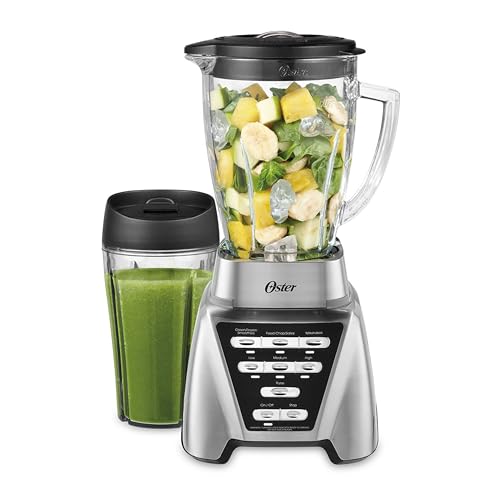
6. Oster Pro 1200 Blender with Glass Jar — Best Budget
The Oster Pro 1200 is the honest budget answer for hummus. Its dual-direction blade technology reverses the blade during programmed settings, which helps a thick mixture that has climbed the jar walls fall back into the cut zone — a poor man’s version of the tamper trick. The glass jar is a genuine plus for hummus duty: it does not hold onto garlic and tahini odors the way plastic can, and it shrugs off the staining spices that often travel with a mezze menu.
Strengths
- Dual-direction blade reverses to pull thick mixtures back into the blades
- Glass jar resists garlic, tahini and spice odors and stains
- Seven speeds plus smart settings cover dips, smoothies and salsas at a budget tier
Trade-offs
- Needs smaller batches, softer chickpeas and scrape pauses for best texture
- Finished smoothness sits a step below the professional picks
- Less torque headroom for nut butter and other very dense jobs
| Jar | Glass jar |
| Speeds | 7 speeds with Smart Settings |
| Blade | Dual Direction Blade Technology |
| Extras | 24 oz smoothie cup included |
Set expectations correctly and this blender delivers. Work in single-can batches, soak or thoroughly soften the chickpeas, keep a little more liquid in the recipe than the premium picks need, and use the pulse-and-scrape rhythm: blend twenty seconds, scrape, repeat. The result is a slightly rustic but completely satisfying hummus, and the included 24 oz smoothie cup covers breakfast. What you give up is the whipped, ultra-smooth ceiling and the torque reserve for nut butters or double batches. As a first blender for a hummus fan on a budget — or a glass-jar loyalist — it is a sensible, durable place to start.
Two habits double this blender’s hummus quality. First, warm the chickpeas: warm legumes blend smoother than cold ones in any machine, and the effect is largest in budget motors. Second, blend the tahini base with an ice cube or two — the cold keeps the emulsion tight while the modest power takes its time. Neither habit costs anything; together they close most of the visible gap to the mid-tier picks.
Best for: budget buyers and glass-jar fans making single batches / Not suited for: anyone chasing whipped restaurant texture or double batches
Check on Amazon — check price on Amazon for the current bundle and jar configuration.
Comparison Table
| Pick | Badge | Key spec | Best for |
|---|---|---|---|
| Vitamix 5200 Professional-Grade Blender, 64 oz | Best Overall | 64 oz container, variable speed, tamper included | weekly hummus makers who want the smoothest texture and one machine for every thick blend |
| Ninja Kitchen System Pro BL770, 1500W | Best with a Food Processor Bowl | 1500W, 72 oz pitcher + 8-cup processor bowl | cooks who want the food-processor method and the blender method in one system |
| Vitamix Propel Series 750, 64 oz | Best with Programs | 64 oz low-profile container, 4 programs | buyers who want Vitamix hummus texture with push-button convenience |
| Blendtec Total Blender Classic, FourSide Jar | Best for Big Batches | FourSide jar, 10 speeds, 6 cycles | meal preppers and big households making large batches at once |
| KitchenAid K400 Variable Speed Blender with Tamper | Best Mid-Range with Tamper | 5-speed dial, tamper included, Intelli-Speed | families making one-to-two-can batches who want a tamper without premium pricing |
| Oster Pro 1200 Blender with Glass Jar | Best Budget | Glass jar, 7 speeds, dual-direction blade | budget buyers and glass-jar fans making single batches |
Read the table with batch size in mind. The two Vitamix models and the Blendtec are built for double batches and daily thick-blend work; the Ninja wins on versatility, the KitchenAid on tamper value at a mid tier, and the Oster on price of entry with a glass jar. If your hummus is a weekly ritual, buy from the top half of the table; if it is a monthly treat, the bottom half will serve you honestly.
The Texture Ladder: From Rustic to Whipped, and Which Pick Climbs Where
Hummus texture is not one target but a ladder, and different households happily live on different rungs. The bottom rung is rustic: visible chickpea character, a spoon-standing body, the style of a village recipe pounded rather than pureed. The middle rung is smooth: no grit, a clean scoop, the supermarket-premium texture. The top rung is whipped: glossy, aerated, almost mousse-like, the texture of a good restaurant plate with a swoosh in the middle. Knowing your rung prevents both overspending and disappointment.
The picks map onto the ladder honestly. The Oster Pro 1200, worked patiently, reaches the rustic-to-smooth boundary and pleases most palates. The Ninja system and the KitchenAid K400 live comfortably on the smooth rung, with the Ninja’s processor method giving a slightly heartier body and the K400’s tamper work pushing toward the top of smooth. The Blendtec climbs by batch size — smooth at scale. The two Vitamix machines own the whipped rung, because sustained high-speed shearing with tamper control is what whips air and emulsion into the paste.
Two technique levers move any machine up a rung: chickpea softness, which we cannot overstate, and the whipped tahini base — blending tahini, lemon and ice water alone first, until it pales, builds the emulsion the chickpeas will join. A cook who masters those two levers on a mid-tier machine will out-produce a careless cook on a premium one, which is why this guide spends as much ink on method as on motors.
What Makes a Blender Good at Hummus?
Torque at low speed matters more than headline wattage. Hummus resists most in its first minute, when whole chickpeas and tahini form a stiff paste. A motor that can turn the blade slowly and forcefully — rather than only spinning fast in liquid — breaks the chickpeas down instead of bouncing them around. This is why professional blenders with true variable speed dominate this category: you start low, let the paste form, and raise speed only when the mixture begins to flow.
Circulation is the second requirement. In a smoothie, liquid carries ingredients past the blade hundreds of times. In hummus, nothing carries anything — the paste has to be physically pushed, folded or vortexed into the blade path. Tampers push, processor bowls chop from above with an S-blade, reversing blades drop the mixture back down, and square jars create a vortex that drags the surface into the center. Every pick in this guide has at least one of those mechanisms; a plain tall pitcher with none of them is where hummus goes to fail.
Jar size and shape set your batch limits. Narrow jars concentrate a small batch over the blade; wide jars need volume to work but reward you with big-batch capacity. As a rule, a standard batch from two cans of chickpeas suits 48-64 oz containers best. Finally, consider run time: silky hummus needs two to four minutes of total blending, so a machine that overheats or shuts down on long thick runs will strand you halfway to smooth.
Blender vs Food Processor for Hummus: Which Texture Do You Want?
The food processor is the traditional tool, and it makes hummus with a pleasant, slightly coarse body — the style many people grew up with. Its S-blade chops and folds, and because the bowl is wide and shallow, you can add chickpeas gradually and scrape easily. The Ninja BL770 in this guide includes a processor bowl precisely because this method is legitimately good, especially for rustic hummus, falafel mix and chunky dips.
A strong blender makes a different product: smoother, lighter, almost whipped, because sustained blade speed emulsifies the tahini and oil into the chickpea puree instead of just cutting it. If your reference point is a good restaurant or deli hummus with a glossy swirl on top, that is blender hummus. The cost is workflow: blenders demand more attention to liquid pacing and circulation, which is why the tamper-equipped and program-equipped picks exist.
The practical answer for most kitchens is to choose based on the rest of your cooking. If you also make smoothies, frozen drinks and soups, a blender covers hummus plus everything else. If your cooking leans toward doughs, slicing and chopping, a system with a processor bowl covers more ground. What you should not do is buy a weak version of either and expect technique to save it — dense paste exposes underpowered motors immediately.
Budget Tiers for a Hummus Blender, Without the Guesswork
At the budget tier, represented here by the Oster Pro 1200, you get a real countertop blender with a glass jar and enough power for single batches. The compromises are texture ceiling and patience: softer chickpeas, a touch more liquid, and scrape breaks are part of the deal. For occasional hummus, that trade is entirely reasonable.
The mid tier — the KitchenAid K400 and the Ninja BL770 system — is where hummus stops being a struggle. You gain a tamper or a processor bowl, motors that hold speed under load, and jars sized for family batches. Most households should shop here first: the improvement per dollar is largest at this step, and these machines also handle smoothies and ice properly.
The premium tier — Vitamix and Blendtec — buys torque, longevity and texture. The difference shows up in the last ten percent of smoothness and in year five of weekly use. If hummus is a signature dish in your house, or you also mill, grind and make nut butters, the premium tier pays for itself in results. If not, it is a luxury, and this guide’s mid-tier picks will not embarrass you.
Chickpea Choices: Canned, Dried, and the Baking Soda Question
Canned chickpeas are the realistic default, and their quality varies more than the label suggests: firmer, younger-tasting chickpeas need the full simmer treatment, while softer ones may blend acceptably straight from the can with a short warm-up. Dried chickpeas, soaked overnight and cooked until they slump, give the deepest flavor and the best texture per dollar — and they let you control the salt from the start. If hummus is weekly in your house, a rotating pot of dried chickpeas is the single cheapest quality upgrade available.
Baking soda deserves its reputation in this context. A pinch in the simmering water raises the pH, softens the skins and breaks the chickpeas down faster, which translates directly into smoother hummus in any blender. Rinse after simmering if you are sensitive to the taste, and do not skip the step because a recipe written for a food processor omitted it — blender hummus lives and dies by chickpea softness.
Reserve the chickpea cooking liquid — aquafaba — before you reach for water. A spoonful or two in the blend adds body and helps the emulsion, and it is already seasoned with the chickpeas’ own flavor. Between soft chickpeas, whipped tahini and aquafaba as your liquid, even the budget pick in this guide produces hummus that tastes like it came from a more expensive kitchen.
How to Make Silky Hummus in a Blender, Step by Step
Technique matters as much as the machine. This method works with every pick in the guide; tamper owners can skip the scrape pauses, and processor-bowl owners can do steps 2-4 in the bowl before finishing in the pitcher.
- Start with soft chickpeas. Canned chickpeas work, but simmer them for 15-20 minutes with a pinch of baking soda until they are falling apart — this single step improves texture more than any blender upgrade.
- Blend the flavor base first. Tahini, lemon juice, garlic, salt and two or three tablespoons of ice water go in alone; run the machine until the tahini whips pale and fluffy, about a minute.
- Add half the chickpeas and blend at low-to-medium speed, using the tamper or pausing to scrape, until a rough paste forms and starts to move on its own.
- Add the remaining chickpeas and continue blending, drizzling in ice water a tablespoon at a time only as needed to keep the paste circulating.
- Run at medium-high for a full two minutes once the mixture flows. This long finish is where the emulsion turns glossy and the texture turns silky.
- Rest the hummus for ten minutes, then taste and adjust salt, lemon and water. It thickens as it sits, so finish it slightly looser than you want to serve it.
- Serve with a swirl of olive oil and toppings, and refrigerate leftovers promptly; the flavor deepens by the next day.
If your hummus comes out gritty, the fix is almost never a new blender: it is softer chickpeas, more total blend time, or slightly more liquid added earlier. If it comes out thin, you added water too fast — next batch, add it by the tablespoon after the paste has formed. Write down what you changed; hummus rewards cooks who keep notes for exactly two batches, after which the method becomes habit.
One more professional habit worth stealing: chill the finished hummus for at least an hour before serving when time allows. The flavors marry, the lemon settles, and the texture sets to its final body — and if it sets firmer than you like, a spoonful of ice water whisked in by hand restores the swoosh without waking the blender again.
Common Buying Mistakes
**Mistake 1: Buying a personal bullet blender for hummus.** Small personal blenders are built for liquid drinks. Asked to puree chickpeas, they cavitate, strain and leave grit. If a listing leads with protein shakes and travel cups, it is not a hummus machine, whatever the marketing implies.
**Mistake 2: Adding all the liquid at the start.** Flooding the jar floats the chickpeas above the blade and gives you chickpea soup with chunks. The paste must form first; liquid is added by the spoonful to keep it moving, not to make it pourable.
**Mistake 3: Blending for thirty seconds and judging the machine.** Hummus needs minutes, not seconds. Most gritty results are simply under-blended. Give any capable machine a full two-minute finish before deciding it cannot do the job.
**Mistake 4: Ignoring the tamper question.** If the blender you are eyeing has no tamper, no processor bowl, no reversing blade and no vortex jar design, ask yourself how the paste will reach the blade. If the answer is ‘shaking the jar,’ choose a different blender.
**Mistake 5: Using rock-hard chickpeas straight from the can and blaming the motor.** Even premium blenders work better with softened chickpeas. A short simmer with baking soda is free, takes fifteen minutes, and upgrades every batch regardless of which pick you own.
Final Recommendation
For most readers, the decision narrows quickly. Buy the Vitamix 5200 if hummus is a weekly ritual and you want the smoothest texture with full manual control. Buy the Propel 750 if you want that same texture with programs doing the speed management. Choose the Ninja BL770 if your kitchen needs a processor as much as a blender, the Blendtec Total Classic if you cook in big batches, the KitchenAid K400 if you want a tamper at a mid-tier price, and the Oster Pro 1200 if budget rules and your batches are small.
Whichever you choose, pair it with the method in this guide — soft chickpeas, whipped tahini base, patient liquid, long finish — and the gap between machines narrows while the gap between your hummus and the store-bought tub widens. Check price on Amazon for the exact configuration you want, since jar and bundle options change, and confirm the tamper or bowl is in the box for the tamper- and system-based picks.
The shortlist, if you are deciding today: Vitamix 5200 Professional-Grade Blender, 64 oz (Best Overall), Ninja Kitchen System Pro BL770, 1500W (Best with a Food Processor Bowl), Vitamix Propel Series 750, 64 oz (Best with Programs). Each links to its Amazon listing — check price on Amazon and confirm the configuration before you order.
Keep exploring this cluster: Best Blenders For Ice And Frozen Fruit Best Blenders For Indian Cooking Best Blenders For Blending Ice Best Blenders And Food Processors Best Blenders For Beans
Frequently Asked Questions
Can a regular blender make hummus, or do I need a high-end one?
A regular mid-range countertop blender can make good hummus if it has enough power to sustain a thick blend and you use good technique — softened chickpeas, liquid added gradually, and scrape or tamper help. High-end machines make the job faster and the texture smoother, but the mid-tier picks in this guide produce hummus most people would happily serve to guests.
Why does my hummus come out gritty even in a strong blender?
Grittiness usually comes from firm chickpeas or too little total blend time. Simmer canned chickpeas with a pinch of baking soda until they slump, and give the blend a full two minutes at the end. Skins are a smaller factor than softness; thorough cooking matters more than peeling.
How much liquid should I add to blender hummus?
Start with just a few tablespoons of ice water in the tahini base, then add more a tablespoon at a time only to keep the paste circulating. The exact amount depends on your chickpeas and tahini, but the principle is constant: the paste should be thick and slowly moving, never soupy.
Is a tamper really necessary for hummus?
It is not strictly necessary, but it is the single biggest convenience for jar blenders because it replaces stop-and-scrape pauses. Alternatives exist — processor bowls, reversing blades and vortex jars all solve the same circulation problem differently — which is why this guide includes one pick built around each approach.
Can these blenders make other thick dips and spreads?
Yes. The same traits that suit hummus — torque, circulation help and capacity — suit baba ganoush, muhammara, white bean dip, pesto, cashew queso and nut butters. The premium picks handle nut butters most comfortably; mid-tier and budget picks do better with dips that include some liquid.
How do I clean a blender after hummus?
Rinse the jar immediately, then run it with warm water and a drop of dish soap for thirty seconds — several picks here have a dedicated self-cleaning program. Hummus residue dries like cement, so the worst cleaning strategy is leaving the jar in the sink until morning.

