Disclosure: airfryerkitchensupply.com is reader-supported. When you buy through links on our site, we may earn an affiliate commission at no extra cost to you.
Where to buy
Our shortlist of the best blenders for herbalists is below — every pick verified against the manufacturer’s listed specifications, with full reviews further down the page.
Herbalists ask unusual things of a blender: small batches of dried leaves and flowers one day, fibrous roots and barks the next, then fresh-leaf preparations where too much heat or oxidation ruins the batch. The picks below were chosen for grinding fineness, small-batch control and jar materials that do not hold onto strong plant flavours. Every linked model was verified against Amazon’s catalogue; use the links to check price on Amazon.
- Vitamix 5200 Professional-Grade Blender (Best Overall for Herbal Work): Check price on Amazon
- AMPOIA 2000W Blender with Grinder Cup (Best with Dedicated Grinder Cup): Check price on Amazon
- nutribullet Pro+ Personal Blender (Best for Small Batches): Check price on Amazon
- Blendtec Classic 575 (Best for Fresh-Leaf Volume): Check price on Amazon
- Ninja Nutri-Blender Pro BN401 (Best Auto-Program Small Batch): Check price on Amazon
- Hamilton Beach Power Elite Blender (58148AG) (Best Budget Glass Jar): Check price on Amazon
Finding the best blenders for herbalists is a different problem from finding a smoothie machine. Herbal work is mostly small-batch work: a few tablespoons of dried leaf reduced to an even powder, a handful of roots that fight back, fresh leaves that need to be broken down without being cooked by blade friction. A big smoothie blender can be brilliant at two of those jobs and hopeless at the third, because a small amount of dried material in a large jar just rides the walls and never meets the blades. This guide is built around how herbalists actually work — grind, macerate, emulsify, strain — and what each step demands from the machine.
One boundary up front: this guide covers equipment performance only — how finely, evenly and controllably a blender processes plant material. It makes no claims about the properties of any herb or preparation; what you make and why is your practice, and questions about the plants themselves belong with your training and references, not a blender review.
The market reality is that no blender is sold ‘for herbalists’, so the shortlist borrows from three neighbouring worlds: high-performance blenders with genuine dry-grinding ability, personal blenders whose small cups suit small batches, and one machine with a dedicated grinder cup. The right pick depends on whether your practice is mostly dried material, mostly fresh, or a balance of both.
In this guide
Quick Picks
Six verified machines matched to herbal workflows — dry grinding, small-batch powders, fresh-leaf processing and mixed practices.
- Best Overall for Herbal Work: Vitamix 5200 Professional-Grade Blender — The strongest all-round herbal workstation: genuinely fine dry grinding in small loads, controlled low speeds for fresh material, and a container that handles everything from leaf powders to fibrous root decoction bases. — Check price on Amazon
- Best with Dedicated Grinder Cup: AMPOIA 2000W Blender with Grinder Cup — A 2000W pure-copper motor with a separate 28 oz grinder cup — the grinder format is exactly right for dried herbs, roots and seeds in realistic herbal batch sizes. — Check price on Amazon
- Best for Small Batches: nutribullet Pro+ Personal Blender — 1200W in a personal format with a pulse button and 32 oz and 24 oz cups — small fresh batches and modest dry loads processed right in the cup you store them in. — Check price on Amazon
- Best for Fresh-Leaf Volume: Blendtec Classic 575 — A big WildSide+ jar and preprogrammed cycles that turn harvest-day quantities of fresh leaves into smooth green preparations without constant tamping. — Check price on Amazon
- Best Auto-Program Small Batch: Ninja Nutri-Blender Pro BN401 — 1100 peak watts with Auto-iQ programs in two 24 oz cups — set-and-forget small batches for practitioners who value repeatability over manual control. — Check price on Amazon
- Best Budget Glass Jar: Hamilton Beach Power Elite Blender (58148AG) — A 700W machine with a 40 oz glass jar — glass is the herbalist’s friend: no flavour carryover, no staining from pigments, and honest performance at a budget tier. — Check price on Amazon
How These Picks Were Chosen
Picks were verified against Amazon’s catalogue data through the site’s verification system, and then filtered through an herbal workflow lens rather than a smoothie lens. The criteria, in order: can it process small batches without losing the load in the jar; can it grind dried material evenly without cooking it; does it offer the speed control fresh material needs; and is the jar material compatible with strong flavours and pigments. Machines that only make sense as big smoothie blenders were cut even when their power numbers were impressive.
We also checked the failure modes herbalists actually report: flavour carryover in plastic, powder so fine it aerosolises and is lost, heat buildup in long grinds, and blades dulled or chipped by roots. Every pick below is recommended for a named workflow with its limits stated, because in herbal work the wrong machine does not just underperform — it wastes material you may have grown or gathered yourself. No health or medicinal claims are made for any preparation mentioned; this guide is strictly about equipment performance.
Every pick below earned its place against those filters. The shortlist of the best blenders for herbalists opens with the Vitamix 5200 Professional-Grade Blender and continues through five more machines, each matched to a specific need rather than ranked by a single score.
The 6 Best blenders for herbalists

Vitamix 5200 Professional-Grade Blender — Best Overall for Herbal Work
The 5200 earns the top spot for herbalists because of its dial. Dry grinding wants full speed in short bursts; fresh-leaf work wants low, controllable speed that breaks cell walls without whipping in air and heat. A continuous dial covers both ends of that range in one machine. It suits practitioners who do a bit of everything. It does not suit someone who only ever grinds two tablespoons of leaf at a time — that user should look at the small-cup picks below.
Strengths
- Continuous variable speed gives real control for both dry bursts and gentle fresh processing
- Strong vortex pulls small dry loads down into the blades better than most full-size jars
- Tamper lets you work fibrous material without stopping to scrape
Trade-offs
- Full-size jar still has a minimum practical load for dry grinding
- Premium tier pricing
- Friction heat builds on long runs, so dry roots need pulsed bursts, not one long blend
| Spec | Detail |
|---|---|
| Container | 64 oz |
| Controls | Variable speed dial + high-speed switch |
| Blade | Stainless steel |
| Cleaning | Self-cleaning cycle |
For dried leaves and flowers, the technique that matters is pulsing: short high-speed bursts with a shake of the jar between them. The 5200’s vortex is strong enough that a modest handful of dried leaf keeps circulating instead of plastering itself to the walls, and the result is a notably even powder for a countertop machine. Roots and barks should be cut small first — no home blender is a mill, and asking one to behave like one is how blades and motors suffer.
For fresh preparations, run low and slow. A dial machine lets you hold the speed where leaves are being torn and folded rather than liquefied and aerated, which keeps green preparations darker and less foamy. The tamper earns its keep with fibrous fresh material like lemongrass or ginger that bridges over the blades. Across a mixed practice, this is the single machine that asks the fewest compromises.
Best for: herbalists with a mixed dried-and-fresh practice who want one serious machine / Not suited for: practitioners who only ever process a few tablespoons at a time
Check the current price on Amazon

AMPOIA 2000W Blender with Grinder Cup — Best with Dedicated Grinder Cup
The grinder cup is why this machine is on an herbalist’s list at all. A small, dedicated dry cup keeps a few tablespoons of material in constant blade contact instead of lost in a big pitcher, which is the whole game for dried herbs. It suits dry-material-heavy practices. It does not suit buyers who need the refinement and parts support of the big legacy brands.
Strengths
- Dedicated grinder cup is the right geometry for small dry batches
- Copper motor handles repeated grinding bursts without fading
- Full-size pitcher included for fresh preparations and larger work
Trade-offs
- Newer brand with a thinner long-term parts ecosystem
- Grinder cup is for dry ingredients only — wet pastes belong in the pitcher
- Very high blade speed means heat builds fast in the small cup; pulse, don’t run
| Spec | Detail |
|---|---|
| Motor | 2000W, pure copper |
| Containers | 70 oz pitcher + 28 oz grinder cup |
| Blade | 6-leaf stainless |
Geometry beats power in dry grinding. In a 70 oz pitcher, two tablespoons of dried leaf is a rounding error; in a 28 oz grinder cup it is a working load that the blades keep meeting. The AMPOIA’s cup produces noticeably more even powders from leaf, seed and chopped root than big-jar attempts, and the small batch size matches how herbalists actually prepare material — fresh, in modest quantities, as needed.
Discipline matters with a fast grinder: use five-to-ten-second bursts, let the cup settle, and check fineness between bursts. Continuous running heats the cup and the material, which dulls volatile aromatics in dried leaf and can cake resinous material onto the walls. Worked in bursts, it is the most practical dry-grinding setup on this page for the money tier it sits in.
Best for: dried-herb, seed and root grinding in small, frequent batches / Not suited for: wet grinding in the small cup or buyers wanting a legacy-brand parts network
Check the current price on Amazon

nutribullet Pro+ Personal Blender — Best for Small Batches
Personal blenders are the natural home of small-batch herbal work. The Pro+ adds a pulse button — rare in this format — which is the control that makes dry-ish and fresh small batches come out even instead of half-powdered, half-whole. It suits solo practitioners and anyone whose batches are a cup or less. It does not suit fibrous roots or large fresh-leaf sessions.
Strengths
- Cup-size batches match real herbal quantities with almost no waste
- Pulse control prevents the over-processing that ruins small loads
- Blend-and-store in the same cup means fewer transfers and less material lost to jar walls
Trade-offs
- Extractor blades are for soft and moderately dry material, not hard roots or bark
- Not a hot-liquid machine
- Cups are plastic and will hold strong flavours over time — dedicate one to pungent material
| Spec | Detail |
|---|---|
| Power | 1200W |
| Cups | 32 oz and 24 oz |
| Controls | Pulse button |
Loss is the hidden cost in small-batch herbal work: every transfer between vessels leaves material behind. Blending in the storage cup removes a whole transfer, and at tablespoon scale that can be a meaningful share of the batch. The Pro+’s power is generous for the format, so fresh leaves, soft roots like fresh ginger or turmeric, and soaked material break down quickly at low total volume.
For dried material, treat it as a light-duty grinder: small amounts of leaf and soft seed, pulsed, work well; hard roots and bark will punish the extractor blade and shorten its life. Pairing this cup machine for daily small work with occasional access to a full-size grinder for the hard jobs is a combination many practitioners settle on happily.
Best for: solo practitioners making cup-size fresh batches and light dry grinds / Not suited for: hard roots, bark, or hot preparations
Check the current price on Amazon

Blendtec Classic 575 — Best for Fresh-Leaf Volume
When the garden produces a glut — a basket of fresh leaves that must be processed today — batch size flips from liability to asset. The Classic 575’s wide jar and blunt blade fold large volumes of leaf down quickly. It suits growers and community herbalists processing fresh material in quantity. It does not suit tiny dry batches, which disappear into the big jar.
Strengths
- Wide jar geometry handles bulky fresh leaves without bridging
- Blunt blade bruises and tears leaf effectively and never dulls
- Cycles give repeatable results across large batches
Trade-offs
- Too much jar for tablespoon-scale dry work
- Loud at full power
- Less low-speed finesse than a dial machine for delicate fresh work
| Spec | Detail |
|---|---|
| Jar | WildSide+ jar (90 oz total volume class) |
| Controls | 5 speeds |
| Programs | Four preprogrammed cycles |
| Cleaning | Self-cleaning |
Fresh leaves are mostly water and air; the processing challenge is volume collapse. The WildSide jar’s fifth side creates a deeper vortex that keeps pulling the leaf mass down, so a full jar of fresh nettle, lemon balm or basil reduces in seconds rather than needing constant stops to push it down. For pesto-style and fresh-juice preparations at harvest scale, that throughput is the difference between an afternoon of processing and an hour.
The blunt blade is a genuine herbal advantage in one specific way: it does not need sharpening, ever, and fibrous stems do not chip it. The trade-off is that the finest dry powders are beyond this jar — keep it for fresh volume, and let a grinder-format machine handle the dried stores. Self-cleaning matters here too, because fresh green residue left to dry is stubborn.
Best for: growers processing fresh leaves in harvest-size batches / Not suited for: small dry batches or quiet kitchens
Check the current price on Amazon
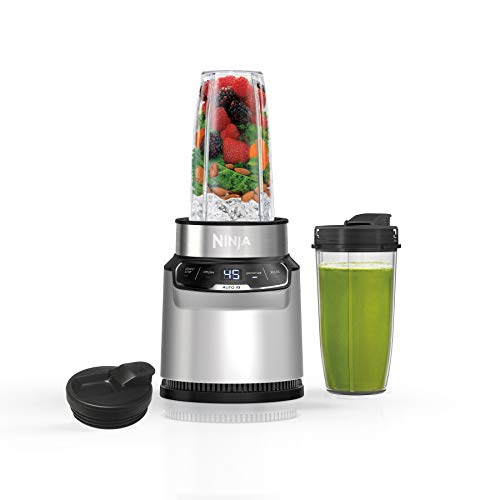
Ninja Nutri-Blender Pro BN401 — Best Auto-Program Small Batch
The BN401 trades the nutribullet’s pulse button for programmed cycles that pulse on their own — genuinely useful when a preparation needs a specific pattern of bursts and rests. It suits practitioners who make the same small preparations repeatedly. It does not suit tinkerers who want to improvise speeds mid-blend.
Strengths
- Auto-iQ pulsing patterns suit repeatable small preparations
- Two cups let you keep a pungent-material cup separate
- Strong ice and frozen performance covers frozen-herb storage preparations
Trade-offs
- Programs are fixed; no true manual low-speed control
- Extractor format is not for hard dry roots
- Plastic cups retain strong flavours over time
| Spec | Detail |
|---|---|
| Power | 1100 peak watts |
| Programs | 2 Auto-iQ |
| Cups | Two 24 oz to-go cups |
Repeatability is an underrated herbal virtue. When a preparation works, being able to reproduce the exact cycle next month matters, and programmed pulsing gives you that without standing over the machine counting bursts. The two-cup setup solves the flavour-carryover problem practically: dedicate one cup to strong aromatics — garlic-heavy or resinous preparations — and keep the other neutral.
Like all extractor-format machines, its limits are hard, dry, dense materials and anything hot. Within its lane — fresh leaves, soft ingredients, frozen preparations, light dry leaf in small amounts — it is fast, tidy and consistent, and the cups go straight into the dishwasher, which matters when you process several small batches in a session.
Best for: repeatable small preparations and two-cup flavour separation / Not suited for: manual-control blending or hard dry material
Check the current price on Amazon

Hamilton Beach Power Elite Blender (58148AG) — Best Budget Glass Jar
Budget blenders rarely make specialist lists, but the Power Elite’s glass jar solves the herbalist’s flavour-carryover problem at the lowest tier on this page. It suits beginners and anyone dedicating a machine to strong-flavoured work. It does not suit hard dry grinding or fibrous roots — 700W has honest limits.
Strengths
- Glass jar washes completely clean of pigments and strong flavours
- Wave Action system keeps modest loads circulating without a tamper
- Budget tier makes it a sensible dedicated second machine
Trade-offs
- 700W struggles with hard, fibrous or very dry loads
- Smaller jar limits fresh-leaf volume sessions
- Not built for heavy daily grinding duty
| Spec | Detail |
|---|---|
| Power | 700W |
| Jar | 40 oz glass |
| Functions | 12, including puree and crush ice |
Flavour discipline is real herbal practice: a jar that smells of yesterday’s garlic-and-herb preparation will season today’s delicate one. Plastic holds those compounds in microscopic scratches; glass releases them with hot soapy water. For practitioners who make strongly flavoured preparations, a cheap glass-jar machine dedicated to that work protects the results of a better machine — and this is the budget pick that does it credibly.
Keep its workload honest: fresh leaves, soft ingredients, liquids and light purees are its lane, and the Wave Action jar shape genuinely helps those loads circulate. Ask it to powder hard roots and you will get noise, heat and a short-lived motor. Used within its design, it is the most useful budget machine an herbalist can own.
Best for: beginners and as a dedicated strong-flavour machine / Not suited for: hard dry grinding or high-volume work
Check the current price on Amazon
Comparison Table
| Pick | Badge | Key spec | Best for |
|---|---|---|---|
| Vitamix 5200 Professional-Grade Blender | Best Overall for Herbal Work | 64 oz container, variable speed dial for fine control | herbalists with a mixed dried-and-fresh practice who want one serious machine |
| AMPOIA 2000W Blender with Grinder Cup | Best with Dedicated Grinder Cup | 2000W copper motor, 70 oz pitcher + 28 oz grinder cup | dried-herb, seed and root grinding in small, frequent batches |
| nutribullet Pro+ Personal Blender | Best for Small Batches | 1200W, pulse, 32 oz + 24 oz cups | solo practitioners making cup-size fresh batches and light dry grinds |
| Blendtec Classic 575 | Best for Fresh-Leaf Volume | WildSide+ jar, 5 speeds, 4 preprogrammed cycles | growers processing fresh leaves in harvest-size batches |
| Ninja Nutri-Blender Pro BN401 | Best Auto-Program Small Batch | 1100 peak watts, 2 Auto-iQ programs, (2) 24 oz cups | repeatable small preparations and two-cup flavour separation |
| Hamilton Beach Power Elite Blender (58148AG) | Best Budget Glass Jar | 700W, 40 oz glass jar, Wave Action system | beginners and as a dedicated strong-flavour machine |
The pattern to notice: format follows material. Dried material wants small cups and grinder geometry; fresh volume wants a wide jar; mixed practices want a controllable dial. Most herbalists end up with one primary machine from this list plus, eventually, a dedicated grinder-format backup.
How to Choose the Best Blenders for Herbalists
Start by auditing your own practice honestly. Weigh what you process in a typical month: if it is mostly dried leaf, seed and root, grinder geometry and burst control matter most, and a full-size smoothie jar is the least useful shape you can buy. If it is mostly fresh material in season, jar volume and a vortex that collapses leaf mass matter more. Most practitioners are seasonal — fresh-heavy in summer, dry-heavy in winter — which is why the controllable full-size machine tops this list and the grinder cup is a close second.
Jar material is the second decision. Glass releases flavours and pigments completely and is the safest choice for strong preparations; high-grade plastic is lighter and tougher but will eventually hold odours, so plan to dedicate cups or jars to pungent work. Stainless steel, where available, is the professional answer for both grinding and storage neutrality, though it is rare in home blenders.
Finally, speed control style. A continuous dial lets you find the exact speed where fresh leaves tear instead of foam, and to pulse dry material by feel. Programs give repeatability. Neither is universally better — but herbalists who improvise preparations tend to prefer dials, and those who reproduce set recipes tend to prefer programs.
Dry Grinding Technique: Fineness Without Heat
Heat is the enemy of dried plant material: it drives off the volatile aromatics that make dried leaf worth using. The technique is therefore always bursts — five to ten seconds at high speed, then a pause, a shake or tap of the container to redistribute, and a check. Three or four bursts usually reach a fine, even powder; one heroic sixty-second run reaches a warm, dull one. If the container feels warm to the touch, stop and let everything cool before continuing.
Load size matters as much as technique. Too little material in a big jar never meets the blades; too much in a small cup packs and cakes. As a rule, fill a grinder cup about a third full of loose dried material. Cut roots and barks to pea-size pieces first, and expect to sieve: pass the grind through a mesh, return the coarse fraction for another burst, and you will get a uniformity no single pass delivers.
Fresh Herbs, Oxidation and Speed Control
Fresh-leaf preparations degrade by oxidation and heat, both of which blending accelerates. Work cold where you can — chilled liquid, even chilled jar — keep the blend as short as the texture allows, and prefer the lowest speed that keeps the mass moving. A dial machine earns its keep here: the difference between tearing leaves at moderate speed and liquefying them at maximum is visible in the colour and foam of the result within minutes.
Process fresh material promptly after harvest or purchase, in batches matched to the jar, and transfer finished preparations to storage containers right away rather than letting them sit aerated in the blender jar. These are equipment-handling points, not claims about any plant: whatever you prepare, gentler and faster handling preserves it better.
How to Grind Dried Herbs Evenly in a Blender
This is the core dry-grinding workflow that works across the grinder-cup and full-size picks on this page.
- Start fully dry. Material should be crisp-dry; any residual moisture turns powder into paste and cakes the jar walls. If in doubt, give leaves a short rest in a low, dry place before grinding.
- Cut dense material small. Roots, barks and thick stems go in as pea-size pieces. Blenders powder; they do not chip — asking them to chip is how blades suffer.
- Load a third full. Fill the grinder cup or jar about one-third with loose material so it can circulate and fall back into the blades.
- Burst, shake, check. Run five-to-ten-second bursts at high speed, tapping or shaking the container between bursts to knock material off the walls and lid back into the grind.
- Sieve and return the coarse fraction. Tip the grind through a mesh sieve; return what stays behind for one or two more bursts and combine. This gives an even powder no single pass can match.
- Rest before opening. Let the container sit for half a minute so the finest dust settles — opening immediately puffs your finest fraction into the air and onto the counter.
- Clean dry first. Brush the cup out thoroughly before any water touches it; a dry brush-out recovers material and keeps residue from turning to paste in the corners.
Keep a small notebook with your grinds: material, load size, number of bursts, result. Herbal materials vary enormously — a feathery leaf and a dense seed want different treatment — and two sessions of notes will teach you your machine’s behaviour faster than any guide. Store ground material promptly in closed containers away from light and heat, labelled with the date it was ground.
Matching the Machine to the Materia: Leaves, Flowers, Seeds, Roots
Different plant materials are different mechanical problems, and a thoughtful herbalist buys for the hardest material they process regularly. Leaves and flowers are light and bulky: they need circulation and blade contact, which small cups and strong vortexes provide. Seeds are small and hard: they need sustained high speed in a confined space, which is grinder geometry. Roots and barks are dense and fibrous: they need to arrive pre-cut and then be worked in bursts, and they punish any machine whose blade or motor is marginal. Fresh material is mostly a volume-and-oxidation problem, solved by wide jars and speed control.
In practice, most herbalists discover their practice is lopsided — perhaps seventy percent dried leaf and seed, thirty percent fresh in season — and the wise purchase follows the seventy. That is why this guide’s top spots go to a controllable full-size machine and a grinder-cup machine rather than to the biggest smoothie blenders: they cover the dried majority properly and handle the fresh minority competently, instead of the reverse. Audit your last season’s work before you buy, and let the audit, not the advertising, set the shortlist.
Texture Targets: Powders, Flakes and Pastes
Herbal preparations live at three textures, and each texture has a machine behaviour that produces it. Fine powders want confinement and bursts: the material must keep meeting the blades, and heat must never build. Flakes and coarse cuts — for teas and baths where the material must stay recognisable and strainable — want the opposite: a few pulses at moderate speed in a chopper-format vessel, stopping while structure remains. Pastes and butters of soft material want sustained moderate speed with a tamper or a small vessel, so the mass folds instead of flying.
The common error is asking one setting to do all three. A powder run will obliterate material meant for flakes; a chopper’s pulses will never reach powder. When a preparation matters, choose the texture first and the technique second, and accept that a serious practice eventually justifies two formats — typically a grinder-format machine for the dry textures and a controllable blender for the wet ones. That pairing, not any single flagship, is what most experienced herbalists actually work with.
Cleaning and Cross-Contamination Between Preparations
Herbal work raises the stakes on cleaning beyond ordinary kitchen hygiene, because preparations are often potent-flavoured and sometimes intended for different people or purposes. The working rule is a full clean between different materials, not between batches of the same material: brush out, wash hot with soap, dry completely. Resinous and oily materials deserve a first wipe with a dry cloth to lift the bulk before water, which otherwise spreads the resin into a film that survives casual washing.
Material choice helps: glass and steel return to true neutral, which is why they recur in this guide’s picks. Plastic vessels should be audited by nose before a delicate preparation — if yesterday’s strong material is detectable, it will be in today’s batch. Many practitioners solve this permanently by dedicating vessels: one cup for the pungent shelf, one for the delicate shelf, labelled without shame. It is a two-minute system that removes a whole category of doubt from the work.
Building an Herbal Workstation Around the Blender
The blender is the centre of the herbal workstation, but the supporting tools decide how well it performs. A fine mesh sieve and a coarser one turn good grinds into even grinds. A small brush dedicated to the grinder cup recovers material that fingers cannot. A kitchen scale makes batches reproducible — and reproducibility is what turns experiments into a practice. Dark glass jars for storage, a funnel that fits them, and labels with dates complete a setup that costs little and professionalises everything.
Arrange the station so the workflow flows: drying and storage on one side, grinding in the middle, sieving and bottling on the other. Keep the blender’s vents clear in its permanent spot, and keep water away from the grinding side — dry work and wet work interleaved is how powder becomes paste on the jar walls. None of this requires a dedicated room; a single shelf and a tray accomplish it. What it requires is the decision that herbal work is a craft with a station, not a scramble with a smoothie machine.
Sourcing and Storing Material: The Blender’s Upstream Half
A blender can only process what it is given, and herbal material varies more than any grocery ingredient. Dried material from a good supplier arrives consistently dry and clean; home-dried material varies with the weather of its drying week. Before grinding, spread material and inspect it — the blender will faithfully powder whatever is there, including the stem you meant to remove and the grit you did not see. A minute of sorting is the cheapest quality control in the entire process.
Storage discipline protects the work after grinding: whole dried material keeps best and longest, ground material declines fastest, so grind in the small batches this guide keeps recommending and store grounds in small, full, dark containers with the air pressed out by fullness rather than by equipment. Label with material and grind date. The herbalists who get consistent results month after month are not using different machines — they are running this unglamorous upstream and downstream discipline around an ordinary good machine.
When a Blender Is Not Enough: Mills, Mortars and Honest Limits
Every tool in this guide has a material it should not meet. Very hard roots, mineral-hard seeds and large volumes of bark belong to a dedicated mill or grinder built for them; forcing them through a blender costs blades and motors and still produces an inferior grind. The mortar and pestle, meanwhile, remains unbeaten for tiny quantities of delicate material where the blender’s minimum load is the whole problem — a teaspoon of something precious is hand work, and pretending otherwise wastes it.
Knowing these boundaries makes the blender better at its real job. The mature herbal workstation is a small parliament of tools: mill for the hardest, mortar for the smallest, blender for the great middle — powders of leaf and seed, fresh preparations, emulsions and volume. This guide’s picks were chosen to be excellent citizens of that middle, and their reviews state their edges plainly so your parliament has no weak members pretending to be strong ones.
Record-Keeping: The Herbalist’s Second Most Important Tool
After the blender itself, the notebook is the herbalist’s most valuable equipment. Record the material, its source and dryness, the load size, the vessel, the burst pattern, and the result — powder fineness, time taken, any heat noticed. Within a season, those notes become a personal manual no book can sell you, because they describe your materials in your machine in your kitchen. Without them, every session restarts the learning curve, and good results stay accidents instead of becoming a practice.
The notebook also protects the work’s integrity: when a preparation delights you, you can reproduce it exactly; when one disappoints, you can find the variable that changed. Herbalists working with materials they gathered or grew — materials that cannot simply be reordered — cannot afford unrepeatable successes. Grind small, note everything, and let the records compound. It is the least technological advice in this guide and, over a year, the most valuable.
Seasonal Rhythm: Aligning the Machine’s Work with the Year
Herbal work has a calendar, and the blender’s duties follow it. Spring is fresh and delicate — small batches, gentle speeds, the chopper and cup formats earning their place. Summer is volume: harvests that must be processed the day they are cut, when the wide jar and the strong vortex matter most. Autumn is preservation — drying, then the first big grinds as material comes off the racks. Winter is the grinder’s season, when the dried stores are worked in small, frequent batches and the full-size machine rests comparatively.
Planning purchases and maintenance around that calendar is quietly effective: service the machine and stock spare gaskets before the summer volume, not during it; buy the grinder-format tool before the winter grinding season, when you will immediately learn it on real work. The herbalists who feel their equipment is always ready are not luckier — they are simply running their kitchen on the same calendar as their plants.
Cost of Ownership for the Working Herbalist
Price an herbal blender the way a practitioner should: across the materials it will process, not across the months it will sit. A machine that powders evenly wastes less of material you may have grown for a season or bought at apothecary prices; a machine that grinds unevenly taxes every batch with the coarse fraction you re-grind, discard or accept as inconsistency. Over a year of regular work, that yield difference routinely exceeds the price gap between a mid-tier machine and a good one — the expensive blender is, on the ledger that matters, often the cheaper tool.
The same accounting favours durability in the parts that touch material: blades that stay true, cups that do not craze and hold residues, gaskets that seal so fine powder stays in the vessel instead of dusting the motor housing. Budget for one spare cup or gasket set at purchase if your practice is daily. None of this argues for buying the flagship by default; it argues for costing the work honestly, in grams and seasons, the way herbalists cost everything else they practice with.
Common Buying Mistakes
Grinding in one long run. Continuous running heats the material and the cup, dulling aromatics and caking resinous powders. Bursts with pauses produce finer, better-preserved results.
Putting tablespoon loads in a full-size jar. The material rides the walls and barely meets the blades. Small loads belong in small cups — geometry matters more than wattage.
Blending material that is not fully dry. Slightly damp herbs smear instead of powdering and leave a stubborn film. When in doubt, wait another day.
Using one plastic jar for everything. Strong flavours migrate between preparations through scratched plastic. Dedicate a cup or choose glass for pungent work.
Skipping the sieve. Unsieved grinds are a mix of dust and chunks, which makes measuring and even extraction guesswork. Thirty seconds with a mesh fixes it.
Final Recommendation
For a mixed practice, start with the Vitamix 5200: its dial covers delicate fresh work and determined dry grinding in one machine. If your practice is mostly dried material, the AMPOIA’s dedicated grinder cup is the most practical format on this page, and the nutribullet Pro+ covers daily small batches beautifully. Harvest-scale fresh work belongs to the Blendtec 575, and the Hamilton Beach Power Elite is the budget glass-jar machine to dedicate to strong flavours.
Related guides in this series: Best Blenders For Herbs focuses on everyday culinary herb work, Best Blenders For Grinding goes deeper on dry grinding generally, Best Blenders For Grinding Coffee covers the seed-and-bean end of the spectrum, and Best Blenders For Indian Cooking looks at spice-heavy kitchens.
Start with the Vitamix 5200 Professional-Grade Blender if you want one machine that covers the brief without second-guessing. Its combination of dial control, vortex strength and jar neutrality is what a mixed herbal practice actually needs.
The closest alternative is the AMPOIA 2000W Blender with Grinder Cup: A 2000W pure-copper motor with a separate 28 oz grinder cup — the grinder format is exactly right for dried herbs, roots and seeds in realistic herbal batch sizes.
Frequently Asked Questions
Can a blender really grind dried herbs to powder?
Yes, with the right format and technique. Small grinder cups and strong full-size machines both powder dried leaf well when you work in short bursts and sieve between passes. Hard roots and bark must be cut small first, and very hard material belongs in a dedicated mill rather than any blender. Evenness comes from the sieve-and-return step, not from longer blending.
Will blending damage my herbs with heat?
It can if you run the machine continuously. Blade friction warms small dry loads quickly, which is why this guide insists on five-to-ten-second bursts with pauses. Fresh material is less heat-sensitive in short blends but oxidises faster the longer and faster you run it, so keep fresh blends brief and at the lowest effective speed.
Glass or plastic jars for herbal work?
Glass is easier to keep flavour-neutral and releases pigments completely, which matters when you alternate between strong and delicate preparations. Plastic is lighter and survives drops, but will hold odours over time; if you use plastic, dedicate one cup or jar to pungent material. Either way, brush the container out dry before washing to recover material and prevent pasty residue.
How much dried herb should I grind at once?
About a third of the container’s volume in loose material is the working range. Less than that in a big jar will not circulate; more than that in a small cup packs down and grinds unevenly. Grinding in modest batches also means your stored powder is fresher, since ground material loses quality faster than whole dried material kept in the dark.
Do I need a separate grinder if I own a high-performance blender?
Not necessarily, but many herbalists end up preferring one for small dry batches because the geometry suits tablespoon quantities and the big blender stays free for fresh work. The AMPOIA in this guide splits the difference by including a grinder cup with a full-size pitcher. If your dry grinding is occasional and modest, a strong dial blender plus a sieve covers it.
Can I blend fresh herbs for storage preparations?
Yes — fresh leaves blended with oil or liquid and then frozen in small portions is a common storage workflow, and the wide-jar Blendtec or the dial-controlled Vitamix both handle it well. Work quickly, keep blends as short and cool as the texture allows, and transfer to storage containers promptly. This guide covers the equipment side only; follow your own training and references for preparation specifics.


