Disclosure: airfryerkitchensupply.com is reader-supported. When you buy through links on our site, we may earn an affiliate commission at no extra cost to you.
Where to buy
Our shortlist of the best blenders for heavy daily use is below — every pick verified against the manufacturer’s listed specifications, with full reviews further down the page.
Heavy daily use is the harshest brief a countertop blender can get: multiple full-power cycles a day, frozen fruit and ice in most of them, and no patience for a machine that fades after a year. Every pick below was chosen for motor durability, drive construction and container toughness first, and features second. All six are sold on Amazon; use the links to check price on Amazon before you buy.
- Vitamix 5200 Professional-Grade Blender (Best Overall): Check price on Amazon
- Blendtec Total Blender Classic (Best for Hands-Off Daily Cycles): Check price on Amazon
- Nuwave Infinity Commercial Blender (Best Commercial-Grade Durability): Check price on Amazon
- CRANDDI K85 Commercial Blender (Best Quiet Heavy-Duty Pick): Check price on Amazon
- Ninja Professional Plus Blender BN701 (Best Value for Daily Use): Check price on Amazon
- Oster Extreme Mix Blender (8-Cup Glass Jar, 1600W) (Best Glass Jar for Daily Use): Check price on Amazon
If you are shopping for the best blenders for heavy daily use, you are not really shopping for blending power — almost every full-size machine on this page can crush ice on day one. You are shopping for what is still true on day seven hundred: a motor that does not smell hot after back-to-back batches, a drive socket that has not rounded off, a container that has not clouded or cracked at the handle, and controls that still click the way they did when the machine was new. Heavy use punishes weak parts in a predictable order, and this guide is organised around that order.
The honest market picture: true heavy-duty home blenders cluster in the mid-range and premium tiers. The budget tier is full of machines that blend well but are built around lighter motors and plastic drive components that are simply not designed for three or four full-power cycles every day. We have included one budget-leaning pick that survives daily use better than its peers, but if your blender genuinely never gets a day off, the premium machines in this list are cheaper per year of service than replacing a light machine twice.
Throughout this guide, ‘heavy daily use’ means at least two full-size batches a day, most days of the year, including frozen ingredients. If your routine is one smoothie each morning, several picks here are more machine than you need, and the buying guide further down will steer you to the right level.
In this guide
Quick Picks
Six machines that can take daily punishment, ranked by how well their motors, drives and containers hold up over years of constant work rather than by first-week performance.
- Best Overall: Vitamix 5200 Professional-Grade Blender — The benchmark heavy-use home blender: a simple variable-speed dial, a high-speed switch, and a design that has been in continuous production because the drive train and motor cooling genuinely survive daily full-power work. — Check price on Amazon
- Best for Hands-Off Daily Cycles: Blendtec Total Blender Classic — Six preprogrammed cycles and 10 speeds in a machine built around commercial duty — press one button, walk away, and get the same result on the five-hundredth morning as the first. — Check price on Amazon
- Best Commercial-Grade Durability: Nuwave Infinity Commercial Blender — A 2.5HP copper motor, laser-cut blades and NSF certification — the closest thing on this list to café equipment, for homes that blend like cafés. — Check price on Amazon
- Best Quiet Heavy-Duty Pick: CRANDDI K85 Commercial Blender — 1500W and an 80 oz jar under a removable soundproof cover — heavy daily blending that does not wake the house at 6 a.m. — Check price on Amazon
- Best Value for Daily Use: Ninja Professional Plus Blender BN701 — 1400 peak watts, a 72 oz pitcher and Auto-iQ presets at a mid-range tier — the strongest value pick that can still take a daily smoothie-and-ice routine. — Check price on Amazon
- Best Glass Jar for Daily Use: Oster Extreme Mix Blender (8-Cup Glass Jar, 1600W) — A 1600W motor driving a 10-point blade in an 8-cup glass jar — glass never clouds, never holds odours, and shrugs off the daily scrubbing that dulls plastic. — Check price on Amazon
How These Picks Were Chosen
Every pick had to pass three filters. First, verified identity: each machine’s model and configuration were confirmed against Amazon’s catalogue data through the site’s product-verification system, so the wattages, jar sizes and programs quoted here are the manufacturer’s listed specifications, not guesses. Second, duty design: we favoured metal drive components, serious motor cooling, and containers built for repetition over machines that are merely powerful once. Third, daily-life realism: a heavy-use blender is cleaned daily, heard daily and stored daily, so cleaning effort, noise and footprint all counted.
We also weighted product-line maturity. A blender you use twice a day will eventually need a gasket, a lid or a jar, and brands with long, stable product lines keep those parts available. Several powerful newcomers were cut for exactly that reason: fine first-year machines, poor bets for year five. Where a pick is a value-tier machine, the review says plainly what its realistic service life looks like under heavy use, so you can choose with open eyes.
Every pick below earned its place against those filters. The shortlist of the best blenders for heavy daily use opens with the Vitamix 5200 Professional-Grade Blender and continues through five more machines, each matched to a specific need rather than ranked by a single score.
The 6 Best blenders for heavy daily use

Vitamix 5200 Professional-Grade Blender — Best Overall
The 5200 is the machine heavy users keep coming back to, and the reason is boring in the best way: there is very little on it to break. A mechanical variable-speed dial, a two-position high-speed switch, a metal drive system and a motor with serious cooling capacity. It suits households blending two to four times a day and small juice-bar-style setups at home. It does not suit buyers who want preset programs or a low-profile jar that fits under every cabinet.
Strengths
- Motor cooling handles back-to-back batches without the hot smell lighter machines develop
- Simple mechanical controls with nothing digital to fail after years of daily use
- Container and tamper design move thick, frozen loads without constant stopping and scraping
Trade-offs
- Tall classic container may not fit under low wall cabinets with the lid on
- No preset programs — you control speed and time manually
- Loud at full speed, like every high-power machine in this class
| Spec | Detail |
|---|---|
| Container | 64 oz |
| Controls | Variable speed dial + high-speed switch |
| Blade | Stainless steel |
| Cleaning | Self-cleaning cycle with warm water and a drop of soap |
What heavy use actually tests is heat management. A blender motor working through frozen fruit converts most of its energy into heat in the windings and the blade bearing. The 5200’s cooling fan and duty cycle are sized for sustained work, so a morning smoothie, a midday soup and an evening nut butter do not stack up into thermal shutdowns. Owners who blend daily for years consistently report the same experience: the machine simply keeps its original performance instead of slowly getting weaker.
The tall, narrow 64 oz container is also a durability choice. The vortex it creates pulls ingredients down into the blades, which means less time spent running the motor against a stalled, cavitated load — the exact condition that overheats lesser machines. For heavy daily use, that efficiency is not about texture; it is about how many hard minutes the motor logs per batch.
Best for: households blending several times a day, every day, for years / Not suited for: buyers who want one-touch preset programs or a squat jar for low cabinets
Check the current price on Amazon

Blendtec Total Blender Classic — Best for Hands-Off Daily Cycles
Blendtec built its name in commercial smoothie bars, and the Total Blender Classic carries that DNA into a home footprint. It suits heavy users who value repeatability: the same green smoothie, made by different family members, at the same quality, with one button. It does not suit cooks who like to nudge speed continuously by feel — the control style here is cycles and speed steps rather than a free-spinning dial.
Strengths
- Preprogrammed cycles make daily routines repeatable with zero technique
- Blunt safety blade design is famously durable and never needs sharpening
- Commercial heritage shows in the motor and jar construction
Trade-offs
- Square jar corners can hold onto thick mixtures until you scrape them down
- Very loud at full power, even by high-performance standards
- Touchpad-style controls are less tactile than a mechanical dial
| Spec | Detail |
|---|---|
| Jar | FourSide jar (75 oz total volume class) |
| Controls | 10 speeds + pulse |
| Programs | Six preprogrammed cycles |
For heavy daily use, the cycle programs are a durability feature, not a convenience gimmick. A well-designed cycle ramps speed up and down so the motor is not slammed from zero to maximum against a frozen load dozens of times a day, and it stops the blend at a consistent point instead of relying on a distracted user to notice doneness. Less overspeed time per batch means less cumulative heat and bearing wear across thousands of batches.
The FourSide jar’s blunt blade pushes ingredients rather than slicing them, which is why Blendtec blades do not dull the way thin sharp blades do. In a heavy-use kitchen that matters: a dulling blade makes the motor work longer per batch, and longer batches are what age a blender. This machine’s texture on nut butters and very thick doughs is slightly less silky than the very best dial machines, but for daily smoothies, soups and frozen drinks it is relentlessly consistent.
Best for: families who run the same daily blends and want one-button repeatability / Not suited for: cooks who prefer continuous manual speed control
Check the current price on Amazon

Nuwave Infinity Commercial Blender — Best Commercial-Grade Durability
The Infinity is the pick for households whose ‘daily use’ looks like a small business: protein shakes for a whole family, frozen drinks for constant guests, meal-prep batches every weekend. NSF certification signals components and cleanability assessed for commercial food service. It does not suit small kitchens — it is a big, serious machine that earns its counter space only if it works hard.
Strengths
- Copper-motor construction rated for commercial-style workloads
- Laser-cut blades hold an edge through constant ice crushing
- Self-cleaning cycle keeps a heavy-use jar from building up residue films
Trade-offs
- Large footprint demands permanent counter space
- Commercial power comes with commercial noise
- Overkill for one smoothie a day
| Spec | Detail |
|---|---|
| Motor | 2.5 HP, copper |
| Blades | Laser-cut stainless |
| Controls | 10 speeds |
| Certification | NSF certified |
| Cleaning | Self-cleaning function |
Copper windings are the detail to notice. In motor terms, copper handles sustained current and heat better than the aluminium windings used in cheaper machines, which is precisely the stress profile of heavy daily use. Combined with a self-cleaning program that owners actually run — because it is one button — the jar stays clearer and the blade assembly stays freer of the sticky buildup that adds drag to every blend.
The honest limitation is size and sound. This is not a machine you pull out of a cupboard twice a day; it lives on the counter, and at full speed the whole kitchen knows about it. But for the household that has already burned out one mid-range blender, stepping up to a commercial-certified machine is usually the point where the replacement cycle stops.
Best for: very high-volume households and home users who have already worn out a mid-range blender / Not suited for: small kitchens or light, occasional blending
Check the current price on Amazon

CRANDDI K85 Commercial Blender — Best Quiet Heavy-Duty Pick
Noise is the hidden tax of heavy daily use: a machine the whole household hates hearing will quietly get used less, or get someone in trouble at dawn. The K85 wraps a commercial-strength 1500W, 80 oz platform in a sound enclosure. It suits early risers, apartment dwellers and open-plan homes. It does not suit minimalists — the enclosure is one more large part to store and wipe down.
Strengths
- Soundproof cover takes the edge off daily full-power blending
- 80 oz jar handles family-size batches in one cycle
- Commercial positioning means parts and jar are built for repetition
Trade-offs
- Enclosure adds bulk and one more surface to clean
- Lesser-known brand means a smaller owner community for tips and parts
- Big jar is awkward for single small smoothies
| Spec | Detail |
|---|---|
| Power | 1500W |
| Jar | 80 oz |
| Included | Tamper, removable soundproof cover |
Under the cover, the fundamentals are right for heavy use: a strong motor, a tamper for thick loads so the motor is not left screaming against an air pocket, and a jar sized so a family of five blends once instead of twice. Halving the number of daily cycles is itself a durability win — two batches a day instead of four doubles the calendar life of any machine.
The enclosure’s foam and shell do need basic care: a quick wipe after splashes and occasional airing so it never holds moisture. Owners who treat it like part of the machine rather than an accessory report it stays neutral-smelling. If your household blends mostly at midday, the quieter design matters less and the simpler machines above may serve you better.
Best for: early-morning daily blenders in shared or open-plan homes / Not suited for: buyers who want the smallest possible footprint
Check the current price on Amazon

Ninja Professional Plus Blender BN701 — Best Value for Daily Use
The BN701 is the value end of heavy daily use, and it earns the spot with stacked-blade Total Crushing performance that does not ask the motor to grind through frozen loads slowly. It suits daily smoothie and frozen-drink households on a mid-range budget. It does not suit daily hot soup making or decade-long expectations — this is a strong few-years machine, not a buy-it-for-life machine.
Strengths
- Stacked blades clear frozen loads fast, shortening hard motor time per batch
- Auto-iQ presets keep daily results consistent across users
- Dishwasher-safe pitcher parts make daily cleanup realistic
Trade-offs
- Plastic pitcher and drive are not in the premium machines’ longevity class
- Stacked blade column needs care when washing by hand
- Not designed for blending boiling liquids
| Spec | Detail |
|---|---|
| Power | 1400 peak watts |
| Pitcher | 72 oz |
| Programs | 3 Auto-iQ presets |
| Cleaning | Dishwasher-safe parts |
Speed of work is the BN701’s durability argument. Because the blade column engages the full height of the pitcher, frozen fruit and ice are processed quickly instead of rattling around while the motor strains. Short, decisive blends are far kinder to a mid-range motor than long, grinding ones, which is why this Ninja survives daily smoothie routines that kill cheaper blenders with similar wattage claims.
Set expectations honestly: with genuinely heavy use — several batches daily, lots of ice — this tier of machine is a consumable with a multi-year life, not a lifetime appliance. Many households do the maths and prefer exactly that. If you are blending hot liquids daily or want a ten-year machine, move up this list rather than expecting the value pick to be something it is not.
Best for: daily smoothie and frozen-drink households on a mid-range budget / Not suited for: daily hot-liquid blending or buyers wanting a decade-plus machine
Check the current price on Amazon
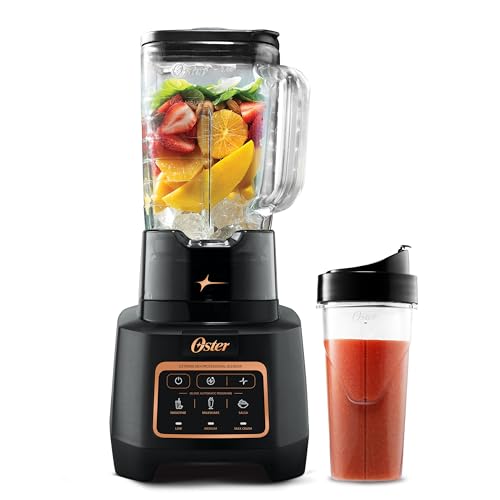
Oster Extreme Mix Blender (8-Cup Glass Jar, 1600W) — Best Glass Jar for Daily Use
Daily use destroys plastic jars cosmetically long before it destroys them structurally: clouding, scratches and lingering smells. This Oster pairs serious power with a big glass jar. It suits daily blenders who wash the jar constantly and blend strongly flavoured foods. It does not suit anyone clumsy — a glass jar this size is heavy, and dropping it is a real cost.
Strengths
- Glass jar stays clear and odour-free through years of daily washing
- 1600W motor and 10-point blade handle daily ice and frozen fruit confidently
- Oster’s long parts ecosystem makes gaskets and jars easy to replace
Trade-offs
- Glass jar is heavy to lift and pour when full
- Glass and boiling liquids still demand the usual thermal-shock care
- Less refined texture on nut butters than the premium dial machines
| Spec | Detail |
|---|---|
| Power | 1600W |
| Jar | 8-cup glass |
| Blade | 10-point stainless steel |
| Programs | iBlend technology |
The jar is the story here. In heavy daily use the container is a wear part: plastic scratches microscopically with every scrub, and those scratches hold pigment and odour. Glass simply does not have that failure mode, so a daily turmeric smoothie or tomato soup habit does not permanently stain your equipment. The trade is weight and fragility, and for many daily users that trade is worth it.
Oster’s other heavy-use asset is boring but valuable: longevity of the product line. Gaskets, lids and replacement jars for Oster patterns stay available for years, so the small parts that actually wear out — the sealing gasket above all — can be refreshed instead of forcing a whole new machine. For a daily driver, that parts support matters as much as wattage.
Best for: daily users who hate cloudy, stained plastic jars / Not suited for: anyone who finds a full 8-cup glass jar too heavy to handle safely
Check the current price on Amazon
Comparison Table
| Pick | Badge | Key spec | Best for |
|---|---|---|---|
| Vitamix 5200 Professional-Grade Blender | Best Overall | 64 oz container, variable speed + high-speed switch | households blending several times a day, every day, for years |
| Blendtec Total Blender Classic | Best for Hands-Off Daily Cycles | FourSide jar, 10 speeds + pulse, 6 preprogrammed cycles | families who run the same daily blends and want one-button repeatability |
| Nuwave Infinity Commercial Blender | Best Commercial-Grade Durability | 2.5HP copper motor, NSF certified, 10 speeds | very high-volume households and home users who have already worn out a mid-range blender |
| CRANDDI K85 Commercial Blender | Best Quiet Heavy-Duty Pick | 1500W, 80 oz jar, removable soundproof cover | early-morning daily blenders in shared or open-plan homes |
| Ninja Professional Plus Blender BN701 | Best Value for Daily Use | 1400 peak watts, 72 oz pitcher, 3 Auto-iQ presets | daily smoothie and frozen-drink households on a mid-range budget |
| Oster Extreme Mix Blender (8-Cup Glass Jar, 1600W) | Best Glass Jar for Daily Use | 1600W, 8-cup glass jar, 10-point blade | daily users who hate cloudy, stained plastic jars |
Read the Key spec column as a durability shorthand: motor construction and jar material predict heavy-use lifespan better than program counts. The two premium dial machines and the commercial picks are built for a decade-scale routine; the value picks trade some of that lifespan for a much lower tier.
How to Choose the Best Blenders for Heavy Daily Use
Start with the drive system, not the wattage. Wattage sells blenders; drive construction keeps them alive. Look for metal drive sockets and blade assemblies, and be suspicious of any machine whose marketing leads with peak watts but never mentions the drive. Peak wattage is a momentary figure; heavy daily use is an endurance event.
Next, motor cooling and duty cycle. Machines designed for heavy use move a lot of air through the base and can run batch after batch. If a manufacturer warns about resting the motor between ordinary smoothie batches, that machine is telling you it is not a heavy-use machine. Thermal cut-outs that trigger during normal use are the clearest sign you have bought below your workload.
Finally, the jar. For daily use, jar size should match your real batch: blending a single smoothie in a huge jar wastes cycles and wears the machine for nothing, while blending family batches in a small jar doubles your daily cycles. Glass resists staining and scratching; high-grade copolyester is lighter and survives drops. Pick your failure mode honestly.
Motor Power, Torque and Why Cooling Matters More Than Speed
Two motors with the same wattage can age very differently. Torque — the ability to keep the blade turning under load — decides whether a frozen load is processed in forty seconds or fought for two minutes. Those extra hard seconds are where windings heat up and bearings wear. High-torque machines with variable speed let you start thick loads slowly, get them moving, then finish fast, which is the kindest possible duty cycle for the motor.
Cooling is the other half. A heavy-use blender should feel like it exhales: strong airflow from the base during and briefly after a blend. Keep those vents unobstructed, never run the machine pushed back against a wall or under a low shelf that traps hot air, and give a machine that has just done three hard batches a few minutes before the fourth. These small habits are the difference between a five-year and a ten-year motor.
Budget Tiers for a Daily-Driver Blender
Think in cost per year, not cost per purchase. The budget tier of blenders can absolutely blend daily — for a while. If a light machine lasts eighteen months of twice-daily use, it may cost more per year than a premium machine that lasts a decade, and it will spend its last months getting weaker and louder. The mid-range tier is the honest sweet spot for one or two smoothies a day. The premium and commercial tiers earn their keep when blending is a multi-batch, multi-person daily routine.
Also budget for the wear parts: a replacement gasket once in a while, possibly a jar over a decade. Machines with healthy parts ecosystems make those refreshes cheap; machines without them turn a minor wear item into a full replacement. That hidden cost belongs in any honest tier comparison.
How to Set Up a Heavy-Duty Blender Routine That Lasts
A heavy-use blender lasts longest when the daily routine around it is deliberate. This is the setup and care pattern that keeps high-power machines performing like new.
- Give it a permanent, ventilated home. Park the base where its vents are clear on all sides and it does not need to be moved daily — constant plugging, unplugging and carrying is how bases get dropped and cords get damaged.
- Load in the kind order: liquids, soft, frozen last. Liquid first creates the vortex; frozen ingredients on top get pulled down gradually instead of shocking the drive at start-up.
- Start low, then climb. Begin every hard batch at low speed for a few seconds, then raise speed. This single habit removes most of the start-up shock that wears drive sockets.
- Use the tamper instead of longer blending. If a thick load cavitates, tamp it back into the blades rather than letting the motor scream against an air pocket — air-pocket running is pure heat with no work done.
- Rinse immediately, deep-clean weekly. A 30-second rinse after each use prevents the dried film that forces harsh scrubbing later; once a week, run the self-clean cycle or a warm-water blend and inspect the gasket.
- Inspect the wear parts monthly. Check the gasket for flattening or cracks, the drive socket for rounding, and the blade assembly for new play or wobble. Catching a worn gasket early prevents the leak that kills motor bearings.
Keep a simple log if the machine is shared: who blended what is overkill, but noting the first day a new noise or smell appears makes warranty conversations and troubleshooting vastly easier. Heavy-use machines rarely fail silently — they get slightly louder, slightly hotter or slightly weaker first. Acting on the first small change is what turns a cheap part swap into a non-event instead of a dead motor.
What Heavy Daily Use Actually Wears Out, Part by Part
Understanding the wear order helps you maintain the right things. First to go, on almost every blender, is the gasket: a soft ring crushed and heated thousands of times until it flattens, after which the jar weeps at the base. Second is the drive socket or coupling, whose corners round a fraction with every start-up shock until one day it spins without gripping. Third is the blade bearing, which develops play after years of load cycles and announces itself with a new rattle. The motor itself is usually last — which is why the smart maintenance order is gasket, drive, bearing, in that sequence, at the first sign of change.
Notice that all three early wear parts are cheap and, on the machines in this guide, replaceable. That is not an accident of the shortlist: it is the shortlist. A heavy-use blender should be a machine whose predictable wear items can be refreshed at kitchen-table cost, returning it to full service. When a blender’s design makes a worn gasket a whole-machine replacement, its true cost of heavy use is the purchase price multiplied by the number of times you will re-buy it. Judge accordingly, and keep a spare gasket in the drawer from day one — the week the jar starts weeping is the wrong week to discover shipping times.
Duty Cycles and Rest: How Professionals Pace a Blender
Commercial operators think in duty cycles: work, rest, work. A blender that runs three hard batches back-to-back accumulates heat in the motor housing faster than its fan can shed it, and heat is cumulative across the session, not per batch. The professional habit is trivially simple — interleave the blending with the rest of the prep. Blend the smoothie while the toast is down; make the soup base while the pan heats. The machine gets its micro-rests without the cook losing a minute, and the motor never stacks three thermal climbs in a row.
There is a second pacing trick for genuinely continuous work, such as a weekend of batch cooking: alternate load types. A hard frozen batch followed by an easy liquid batch asks very different things of the motor, and the easy batch functions as a moving cool-down. What ages a motor fastest is repetition of its hardest job with no variation. Households that adopt these two pacing habits routinely report machines that feel new at ages where identical models, run in punishing bursts, have already been replaced.
Noise, Vibration and the Counter It Lives On
A heavy-use blender is a daily sound in the home, and its acoustic footprint decides whether it gets used at 6 a.m. or exiled. Three factors dominate: the machine’s own design, the surface it stands on, and the load. A blender on a hollow countertop or a thin stone slab drums its vibration into the furniture; the same machine on a dense surface, or on a folded towel or silicone mat, loses a surprising share of its roar. The enclosure-equipped CRANDDI in this guide solves it structurally, but placement and decoupling solve it surprisingly far for the other picks.
Vibration is also a diagnostic. A blender that walks across the counter is telling you the load is unbalanced, the feet are worn, or the blade assembly has developed play. Heavy users should treat new vibration the way drivers treat a new engine note — as information, not atmosphere. Check the feet, check the drive socket, check the bearing. Caught early, each is a small part; ignored, vibration loosens everything else in the base, and the machine ages in months instead of years.
When to Repair, When to Replace: A Heavy User’s Rule
The repair-versus-replace decision is easy once you price the wear parts honestly. Gasket weeping, a rounded drive socket, a tired blade assembly: repair, always — these are the machine’s designed service points, and a premium blender after those refreshes is effectively reset. A motor that smells hot on easy loads, a base with electrical faults, or a cracked housing: replace, and replace up a tier if your workload caused it, because the same workload will consume the same machine again on the same schedule.
Keep the purchase paperwork and note the date the machine entered service. Heavy users who track service life per machine make strikingly better second purchases: they know whether their household is a two-year or a ten-year workload, and they buy the tier that matches the evidence instead of the hope. That single record — dates, workload, what wore out — is the most valuable document in a heavy-use kitchen, and it takes thirty seconds a year to maintain.
Counter Space, Storage and the Daily-Use Reality Check
A blender used twice a day does not live in a cupboard; it lives on the counter, and that simple fact should shape the purchase. Measure the space under your wall cabinets before falling for a tall-jar machine — the Vitamix 5200’s classic container is the usual casualty of that oversight, while low-profile designs like the Propel class exist precisely because of it. If the machine must be moved daily, weight and cord length stop being specifications and become daily frictions, and daily frictions are what quietly end heavy-use habits.
There is also a household-politics dimension worth one honest paragraph: a machine that is loud, ugly or in the way will be campaigned against by everyone who did not choose it. The picks in this guide were partly chosen to survive that politics — enclosures, lower profiles, finishes that wipe clean. Heavy daily use is a household routine, not a solo hobby, and the machine that the household tolerates is the machine that is still blending in year three.
A Realistic First-Year Ownership Timeline
Month one is calibration: you learn the machine’s sounds, your jar’s real working volumes, and which of your recipes need the tamper. Month three is the first gasket check and, for most owners, the moment the routine becomes invisible — the machine is simply how breakfast happens. Somewhere in the first year comes the first genuinely hard test: a holiday week of guests, a new fitness regime, a baby arriving — some surge that doubles the workload for a while. Machines bought at the right tier absorb the surge; machines bought optimistically reveal their tier exactly then.
By month twelve, a heavy user knows things no review can tell them: their true batches-per-day, their hardest regular load, their household’s noise tolerance at 6 a.m. That knowledge is the real product of the first year, and it makes the eventual second purchase — years later, at the wear-parts stage — an evidence-based decision. Keep the small log suggested earlier in this guide, and the timeline becomes a record instead of an impression.
Warranties and What They Tell You About Duty Design
A warranty is a manufacturer’s own bet on its machine, and for heavy users it is reading material. Long coverage on the motor and drive, offered without theatrical conditions, signals a design the maker expects to survive real work. Short coverage with long lists of exclusions signals the opposite, whatever the wattage claims say. Read the warranty of any blender you are considering for daily duty the way you would read a contract you are about to sign — because you are.
Two practical corollaries follow. First, register the machine and keep the receipt where your future self can find it; heavy users are the people most likely to need the paperwork and, experience says, the least likely to have filed it. Second, understand what voids coverage in your pattern of use — commercial use of a domestic machine is the classic trap for the home juice-bar enthusiast. If your ‘heavy daily use’ is drifting commercial, buy the commercial machine, whose warranty was written for your life.
The Sound of Health: Learning Your Machine’s Normal
Every blender in this guide has a healthy voice: a rising whine as speed climbs, a settled roar under load, a clean spin-down. Heavy users should learn that voice in the first week, deliberately, the way you learn a car’s engine note. Deviations are the earliest diagnostics you will ever get — a new grinding undertone suggests the bearing, a new rattle suggests play somewhere, a laboured note on a familiar load suggests the drive is slipping or the blade is dragging on residue you cannot see.
Acting on a changed voice within the week, rather than within the season, is the cheapest maintenance philosophy there is. Most catastrophic blender failures in heavy-use homes were audible, in hindsight, for a month. The machine was telling its owner something; the owner had not yet learned to listen. Learn to listen, and your blender’s service life stops being luck and becomes management.
Common Buying Mistakes
Buying peak wattage instead of duty design. A big peak-watt number with a plastic drive and weak cooling is a sprinter; heavy daily use is a marathon. Check the drive materials and the manufacturer’s own rest-time warnings before the wattage.
Running every batch at maximum speed from zero. Slamming a frozen load at full speed dozens of times a day is the fastest way to round a drive socket. Start low, climb fast — same smoothie, far less wear.
Letting residue dry in the jar every day. Dried-on film forces abrasive scrubbing, which scratches plastic jars and dulls your cleaning patience. A quick rinse takes thirty seconds and preserves both the jar and the habit.
Ignoring the gasket until it leaks. The gasket is a consumable. A slow leak down the blade shaft reaches the bearing and then the motor. Replacing a gasket is trivial; replacing a motor is a new blender.
Buying a jar size that doubles your cycles. If the family needs four smoothies and your jar makes two, you have doubled the machine’s lifetime workload. Size the jar to the real batch.
Final Recommendation
For most heavy-use households, the Vitamix 5200 is the answer: it is the machine least likely to make you shop for blenders again. If your household runs on repeatable one-button routines, the Blendtec Total Blender Classic matches it with cycles instead of a dial. If you have already worn out a mid-range machine, skip a tier and go commercial with the Nuwave Infinity or the quiet CRANDDI K85. On a mid-range budget with daily smoothies, the Ninja BN701 is the honest value pick, and if stained plastic jars are your pet hate, the glass-jar Oster Extreme Mix solves that specific problem well.
Round out your research with our sibling guides: Best Blenders For Grinding for dry-ingredient power, Best Blenders For Ice And Frozen Fruit for frozen-drink specialists, Best Blenders For Healthy Smoothies for a nutrition-focused shortlist, and Best Blenders For Hot Soup if your daily routine includes hot batches.
Start with the Vitamix 5200 Professional-Grade Blender if you want one machine that covers the brief without second-guessing. It is the pick on this page with the longest track record of exactly the workload you are planning.
The closest alternative is the Blendtec Total Blender Classic: Six preprogrammed cycles and 10 speeds in a machine built around commercial duty — press one button, walk away, and get the same result on the five-hundredth morning as the first.
Frequently Asked Questions
How long should a blender last with heavy daily use?
A premium or commercial-grade machine should give you many years of twice-daily service, and a decade is realistic with gasket changes and sane loading habits. Mid-range machines under the same workload typically last a few years. The biggest variables are how often you blend frozen loads at full shock, whether residue is left to dry in the jar, and whether vents stay clear.
Is a higher wattage always better for daily blending?
No. Wattage without torque, cooling and a metal drive just makes heat faster. For daily use, judge a machine by its drive construction, how it handles back-to-back batches, and whether the manufacturer designs it for sustained work. Several 1400–1600W machines on this page are excellent, but they earn their place with build quality, not the number alone.
Can I blend hot soup in these machines every day?
The Vitamix, Blendtec and commercial picks here are designed for hot blending and friction-heated soups. The Ninja BN701’s pitcher is not designed for boiling liquids, so daily soup makers should choose from the hot-rated picks. Whatever the machine, vent the lid, start on low speed, and never fill a hot batch past the manufacturer’s hot-fill line.
How do I know my blender is starting to wear out?
The early signs are a new burning smell during ordinary batches, a change in pitch or a grinding note from the base, the jar rocking more than it used to, and blends taking noticeably longer to reach the same texture. Check the gasket and drive socket first — both are cheap wear parts whose failure mimics motor failure.
Should I buy a sound enclosure or a quieter model?
If you blend early in a shared home, yes — noise is the number one reason heavy-use blenders get exiled to a cupboard and used less. The CRANDDI K85 builds the enclosure in. For other machines, blending on a folded towel to decouple counter vibration and keeping batches decisive and short both help more than most people expect.
What daily habit extends a blender’s life the most?
Starting hard loads on low speed and rinsing the jar immediately after use. The first protects the drive and motor from shock and heat; the second protects the jar and gasket from the dried film and harsh scrubbing that age them. Together they take under a minute a day.

