Disclosure: airfryerkitchensupply.com is reader-supported. When you buy through links on our site, we may earn an affiliate commission at no extra cost to you.
Where to buy
The most reliable place to buy any pick in this guide to the best blenders for grains and seeds is Amazon, where each verified model below is sold with full product details and delivery options. Use the Check on Amazon links beside each pick to see the current listing — we do not print static prices in our guides, because listings change, so check price on Amazon before you decide. If a pick is described as unlinked in this guide, that means we could not verify a listing we were confident in, and we say so openly rather than guess.
- Preethi Eco Plus Mixer Grinder — Check on Amazon (check price on Amazon)
- Vitamix 5200 Professional-Grade Blender — Check on Amazon (check price on Amazon)
- AMPOIA 2000W Blender with Grinder Cup — Check on Amazon (check price on Amazon)
- Blendtec Classic 575 Blender — Check on Amazon (check price on Amazon)
- nutribullet Pro 900 — Check on Amazon (check price on Amazon)
- KitchenAid K400 Variable Speed Blender with Tamper — Check on Amazon (check price on Amazon)
The best blenders for grains and seeds are asked to do something most blenders are never designed for: dry milling. Grinding rice, oats, wheat berries, flax, chia, sesame and spices into flour or meal is a different physical job from blending a smoothie — there is no liquid to circulate the load, the particles must be struck repeatedly until they fracture finer and finer, and heat builds quickly enough to damage both flavour and nutrients if the machine is run carelessly. Many ordinary blenders survive dry milling occasionally; few do it well, and fewer still do it weekly without complaint.
This guide is honest about that landscape. The strongest route is a high-performance blender with the power and container design to mill in short bursts; the most purpose-built route is a mixer grinder designed for dry jars, a format perfected in Indian kitchens where fresh flour and spice grinding are daily work; and the convenient route is a blender that ships with a dedicated grinder cup.
Every linked pick was verified against the retailer catalogue before it earned a link. Read the reviews for which milling jobs each machine genuinely handles, then the buying guide and how-to: with dry work, technique — batch size, burst length, resting — is not a refinement, it is the difference between flour and a burnt-smelling disappointment.
A little history explains this category’s odd shape. In much of the world, grinding grains and spices at home never stopped: the mixer grinder is as standard in an Indian kitchen as the kettle is elsewhere, and small dry jars are its native format. In North America, home milling faded when flour became cheap and universal, and the modern blender inherited the job by default when interest in fresh flour, seed nutrition and spice blending returned. The picks below respect both lineages — the purpose-built dry tradition and the high-performance blender pressed into milling service — because each is genuinely better at part of the work.
In this guide
Quick Picks
Short on time? These are the six machines that earned a place in this guide to the best blenders for grains and seeds. Each one carries a badge for the job it does best, and the same badge appears again at the top of its detailed review further down, so you can jump straight to the machine that matches your kitchen.
- Best for Dry Grinding: Preethi Eco Plus Mixer Grinder — a mixer grinder built in the Indian tradition of dry-jar grinding — the most purpose-designed machine here for grains, seeds and spices, in a 110V version for USA and Canada. — Check on Amazon
- Best Overall Dual-Purpose: Vitamix 5200 Professional-Grade Blender — the high-performance all-rounder that also mills — grain flours and seed meals in the standard container, in short bursts, alongside everything else it does. — Check on Amazon
- Best with Dedicated Grinder Cup: AMPOIA 2000W Blender with Grinder Cup — a 2000W blender that ships with a 28 oz grinder cup alongside its 70 oz pitcher — dry milling in a vessel sized for it, straight from the box. — Check on Amazon
- Best for Bigger Flour Batches: Blendtec Classic 575 Blender — professional-grade power with a big WildSide+ jar — the pick for larger dry batches, milled in bursts, from a machine that also does everything wet. — Check on Amazon
- Best for Small Seed Lots and Smoothies: nutribullet Pro 900 — a 900W personal extractor — flax, chia and seed meals in single-recipe lots, and the seed smoothies that use them, from one small machine. — Check on Amazon
- Best for Batters and Seed Smoothies: KitchenAid K400 Variable Speed Blender with Tamper — a mid-range blender with a tamper and presets — best here for the wet side of grains and seeds: batters, oat smoothies and seed-thickened blends. — Check on Amazon
How These Picks Were Chosen
We chose these picks against the dry-milling workload: grains to flour, seeds to meal, spices to powder, in home quantities, repeatedly. Catalogue-confirmed features drove selection — a mixer grinder built for dry jars, a blender sold with a dedicated grinder cup, high-performance machines whose power and containers are known to mill, and personal blenders whose milling role is real but limited to small seed lots. Each pick’s review states the size of job it can honestly claim.
We applied one strict rule to this category: no pick is credited with a dedicated dry container or milling accessory unless the listing itself confirms it.
Check price on Amazon through the links to see the current listing before you decide.
The 6 Best Blenders for Grains and Seeds
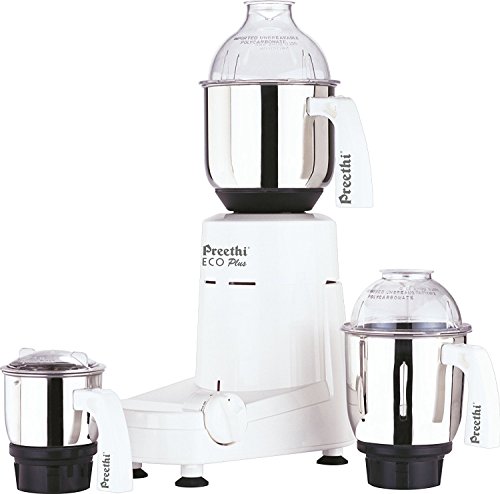
Preethi Eco Plus Mixer Grinder — Best for Dry Grinding
If dry grinding is the main job, buy the machine designed for it. Mixer grinders like the Preethi Eco Plus are the standard appliance in kitchens where rice flour, spice powders and seed meals are made fresh weekly, and their small dry jars are shaped for exactly the circulation pattern milling needs. This is the 110-volt version made for USA and Canada, so it plugs into a normal North American kitchen without converters.
Strengths
- Purpose-built dry jars mill grains and spices finer than a big blender jar
- Small batches — the natural size for seeds and spices — are its home ground
- 110V version made for USA/Canada use
Trade-offs
- A mixer grinder is not a smoothie machine — wet blending is secondary
- Jar sizes are modest; bulk flour production is slow
- A different appliance tradition, with a learning curve for new users
| Type | Mixer grinder |
| Voltage | 110V for USA/Canada |
| Best work | Dry grinding — grains, seeds, spices |
The dry jar is the whole argument. In a large blender container, a small load of flax or cumin spreads across the base and the blades pass under it; in a small dry jar, the load stays in the blades’ path and circulates as a dense cloud of particles, each pass fracturing them finer. That geometry, plus a motor and blade profile designed for dry resistance, is why this format produces spice powders and seed meals that big blenders genuinely struggle to match at small scale.
The trade is scope. The Eco Plus will make your flours, masalas and seed meals beautifully and then look at a frozen smoothie with indifference. Buy it as the dry specialist alongside whatever wet blender you own — the pairing covers both worlds better than one compromised machine — and confirm the jar set in the current listing before ordering, since configurations vary.
Best for: home millers grinding grains, seeds and spices weekly / Not suited for: buyers wanting one machine mainly for smoothies
Check on Amazon — check price on Amazon for the Preethi Eco Plus Mixer Grinder.

Vitamix 5200 Professional-Grade Blender — Best Overall Dual-Purpose
For households that want one machine for both worlds, the 5200 is the answer: professional-grade power that, used with dry-milling technique, turns wheat berries, rice and oats into flour and flax or sunflower seeds into meal, in the same 64 oz container that makes the morning smoothie. Variable speed matters here — milling is driven in controlled bursts, not one long blast — and the 5200’s dial gives exactly that control.
Strengths
- Power and control for both wet blending and dry milling
- One machine covers flour, seed meal and the whole wet workload
- Self-cleaning cycle for the wet work; dry work brushes out
Trade-offs
- Standard container mills well but a dedicated dry container is the ideal — see the note below this guide’s reviews
- Large container needs a minimum dry batch to circulate
- Premium tier — check price on Amazon
| Capacity | 64 oz container |
| Controls | Variable speed, high-speed switch |
| Cleaning | Self-cleaning (wet work) |
Technique makes the 5200 a mill. Work in batches of one to two cups, start at variable speed and climb to high for bursts of thirty to forty-five seconds, then rest and shake or stir the container so the coarse particles return to the blades. Two or three bursts produce a respectable whole-grain flour; seeds, being oily, want shorter bursts and rests so they become meal rather than butter — unless butter is what you are making, which this machine also does superbly.
One verification note, stated plainly: Vitamix is known for a dedicated dry grains container, but when we checked the catalogue for this guide, the search returned third-party compatible containers rather than a genuine listing we could confirm, so this guide does not link one. The standard container milling described above is real and effective; if a genuine dry container matters to you, verify the current listing carefully before buying any container that claims compatibility.
Best for: households wanting one premium machine for milling and blending / Not suited for: dedicated millers who grind daily at volume
Check on Amazon — check price on Amazon for the Vitamix 5200 Professional-Grade Blender.

AMPOIA 2000W Blender with Grinder Cup — Best with Dedicated Grinder Cup
The AMPOIA’s proposition is completeness: a high-power 2000W blender with a pure copper motor, a big 70 oz pitcher for wet work, and — the detail that earns it this badge — a 28 oz grinder included for dry work. Seeds, spices and small grain lots mill in the grinder cup, whose size suits the job, while the pitcher covers smoothies and batches. For buyers who want both vessels without a second appliance, it is a tidy answer.
Strengths
- Dedicated 28 oz grinder cup included for dry milling
- 2000W and high blade speed for fast fracture of grains
- 70 oz pitcher covers the wet workload in the same purchase
Trade-offs
- Lesser-known brand — judge it on specification and listing details
- Grinder cup size caps dry batches at small-lot scale
- Power figures are headline numbers; technique still governs results
| Power | 2000W, pure copper motor |
| Vessels | 70 oz pitcher + 28 oz grinder |
| Blade speed | 32000 RPM (per listing) |
A bundled grinder cup solves the circulation problem the way the Preethi’s dry jar does: a small vessel keeps a small dry load in the blades’ path. Flax, chia, sesame and spice blends — the lots home users actually mill most — are exactly grinder-cup sized, and grains in cup-scale batches for a recipe mill respectably with the burst-and-rest technique from the how-to section.
The brand caveat is real and we state it rather than hide it: AMPOIA does not carry the decades-long track record of the Vitamix or the mixer-grinder tradition of the Preethi. What it offers is a strong specification and the right vessel combination at its tier — check price on Amazon. For a buyer whose milling is weekly and small-scale, that combination is the practical sweet spot.
Best for: buyers wanting a blender plus grinder cup in one purchase / Not suited for: brand-loyal buyers or bulk flour producers
Check on Amazon — check price on Amazon for the AMPOIA 2000W Blender with Grinder Cup.

Blendtec Classic 575 Blender — Best for Bigger Flour Batches
When the milling job is a few cups of flour for a baking day rather than a spoon of spice, batch geometry flips: a bigger, powerful jar keeps a larger dry load circulating, and the Classic 575’s professional-grade power and WildSide+ jar handle those batches in bursts. It is the same premium machine recommended elsewhere in this programme for frozen work, here earning its place on dry capacity.
Strengths
- Handles larger dry batches than the small-jar specialists
- Professional-grade power fractures hard grains reliably
- One premium machine for dry and wet workloads
Trade-offs
- Small seed lots spread too thin in the big jar
- Premium tier pricing
- Dry milling in bursts requires the user to manage rests
| Capacity | 90 oz WildSide+ jar (total capacity marking) |
| Controls | 5 speeds, 4 preprogrammed cycles |
| Cleaning | Self-cleaning cycle (wet work) |
Dry milling at batch scale is a rhythm: load two to three cups, run a high-speed burst, rest while the jar cools and the flour settles, shake the coarse fraction back down, repeat until the texture passes the pinch test — a flour that feels uniform between finger and thumb, with no gritty survivors. The 575’s power makes each burst count, and its jar shape keeps a multi-cup load folding rather than packing into corners.
Do not ask it to mill a tablespoon of cumin; that is the Preethi’s or the grinder cup’s job, and in the big jar the seeds will simply orbit. Matched to its scale — baking-day flours, big oatmeal batches, seed meals by the cup — the Blendtec is a genuine dual-purpose asset, and its self-cleaning cycle keeps the wet side of its life as easy as the dry side is capable.
Best for: bakers milling flour in multi-cup batches / Not suited for: small-lot spice and seed grinding
Check on Amazon — check price on Amazon for the Blendtec Classic 575 Blender.

nutribullet Pro 900 — Best for Small Seed Lots and Smoothies
The Pro 900’s milling role is specific and real: small lots. A few tablespoons of flax or chia for the week’s smoothies, a spice blend for one recipe, seeds ground fresh where freshness matters most — the personal extractor’s small cup keeps those lots in the blades’ path the way a dry jar does, and 900W is ample power at that scale. It then blends the smoothie those seeds were ground for.
Strengths
- Small cup geometry suits tablespoon-scale seed lots
- 900W is strong power at personal scale
- Grinds and then blends the smoothie in one system
Trade-offs
- Not a flour machine — grain milling beyond tiny lots is beyond it
- Oily seeds become butter quickly; short pulses are essential
- Personal format only, with personal capacity limits
| Power | 900W |
| Format | Personal extractor blender |
| Best work | Small seed lots and smoothies |
Freshness is the argument for small-lot grinding: ground flax and chia begin losing their delicate qualities to air quickly, so grinding a few days’ worth at a time in a machine like this beats buying a bag of pre-ground meal that sits for months. Short pulses — two or three seconds at a time, shaking between — keep oily seeds as meal rather than letting friction turn them into paste.
Be clear about the boundary: this is a seed and smoothie machine, not a grain mill. A cup of wheat berries is a job for the picks above it, and asking the Pro 900 to do it will produce coarse meal, a hot motor and a short life. Within its honest envelope — seeds in small lots, and the smoothies built on them — it is the most convenient pick in this guide.
Best for: smoothie drinkers grinding seeds fresh in small lots / Not suited for: grain flour milling at any scale
Check on Amazon — check price on Amazon for the nutribullet Pro 900.

KitchenAid K400 Variable Speed Blender with Tamper — Best for Batters and Seed Smoothies
Not every grain-and-seed job is dry. Dosa and pancake batters from soaked grains, oat-based smoothies, and seed-thickened drinks are wet milling — grains broken down in liquid — and the K400’s tamper, 5-speed dial and preset programs suit that work at a mid-range tier. The tamper keeps a thick batter folding onto the blades in a way thinner mixtures do not need and thick ones cannot do without.
Strengths
- Tamper manages thick grain batters properly
- Dial plus presets cover soaked-grain and smoothie work
- Mid-range tier — check price on Amazon
Trade-offs
- Not a dry mill — flour from dry grain belongs to the picks above
- Capacity suits household, not bulk, batter batches
- Tamper work means attending the machine
| Controls | 5-speed dial + preset programs |
| Accessory | Tamper included |
| Best work | Wet milling — batters and oat smoothies |
Soaked grains blend on different rules: overnight soaking softens rice, lentils and oats until a good mid-range blender can reduce them to a smooth batter, provided the mixture keeps circulating — which is where the tamper earns its place, pressing the thick surface layer down in short pushes while the dial climbs. The result, a pourable batter with no grit, is a staple job in many kitchens and one this machine does with real competence.
Position it honestly in the set: if your grain work is dry flour, buy the Preethi or a premium dual-purpose machine; if your grain work is batters, soaked blends and seed smoothies, the K400 does it at half the commitment and adds a capable everyday blender besides. Many households discover the wet jobs were the ones they actually had.
Best for: batter makers and oat-smoothie drinkers at a mid tier / Not suited for: dry flour milling
Check on Amazon — check price on Amazon for the KitchenAid K400 Variable Speed Blender with Tamper.
Comparison Table
| Pick | Badge | Key spec | Best for |
|---|---|---|---|
| Preethi Eco Plus Mixer Grinder | Best for Dry Grinding | Mixer grinder, dry jars, 110V | home millers grinding grains, seeds and spices weekly |
| Vitamix 5200 Professional-Grade Blender | Best Overall Dual-Purpose | 64 oz, variable speed, dual-purpose | households wanting one premium machine for milling and blending |
| AMPOIA 2000W Blender with Grinder Cup | Best with Dedicated Grinder Cup | 2000W, 70 oz pitcher + 28 oz grinder | buyers wanting a blender plus grinder cup in one purchase |
| Blendtec Classic 575 Blender | Best for Bigger Flour Batches | WildSide+ jar, professional-grade power | bakers milling flour in multi-cup batches |
| nutribullet Pro 900 | Best for Small Seed Lots and Smoothies | 900W, personal format, small lots | smoothie drinkers grinding seeds fresh in small lots |
| KitchenAid K400 Variable Speed Blender with Tamper | Best for Batters and Seed Smoothies | Tamper, 5-speed dial, presets | batter makers and oat-smoothie drinkers at a mid tier |
Read the table as a map, not a ranking. The best blenders for grains and seeds are not six versions of the same machine at six prices; they are six different answers to six different kitchens, and the badge column tells you which question each one answers. If two rows look similar, the deciding factor is usually in the detailed review: jar size, control style, or how the machine behaves with the exact ingredients you blend most.
How to Choose a Blender for Grains and Seeds
Dry milling punishes guesswork, so this guide separates the decisions clearly: which format mills what, how batch size interacts with jar size, how to manage heat, and when the honest answer is a different appliance altogether. Read these sections before choosing, because in this category the wrong format cannot be rescued by power.
Dry milling and wet blending are different jobs
Wet blending circulates ingredients in liquid; the vortex does half the work. Dry milling has no vortex — particles must be thrown against blades and jar walls repeatedly, fracturing finer with each pass, in a load that stays dense enough to keep engaging. That is why small dry jars and grinder cups outperform big smoothie pitchers at small lots, and why a machine’s smoothie reputation tells you almost nothing about its milling.
Wet milling — soaked grains for batter, oats in smoothies — is the middle ground, and it is ordinary blender work with a thickness problem, solved by tampers and patience. Decide which of the three jobs you actually have before you decide which machine to buy; this guide’s badges are organised around exactly that distinction.
Batch size must match the vessel
Every milling vessel has a working window. Too little in a big jar and the load spreads below the blades’ effective path; too much in a small jar and the load packs, heats and stops fracturing. As working rules: tablespoons-to-a-cup lots belong in dry jars, grinder cups and personal cups; one-to-three cup flour batches belong in high-performance blender containers; beyond that, mill in successive batches rather than forcing one giant load.
Successive batches are not a failure of the machine. Even commercial home milling is batch work, and two rested batches produce better flour — finer, cooler, more uniform — than one overloaded run that overheats halfway.
Heat is the enemy of flour and seed quality
Friction heat builds fast in dry loads. It dulls the flavour of fresh flour, can turn oily seeds from meal to butter mid-batch, and in spices it drives off the aromatic compounds you ground them for. The management is simple and non-negotiable: bursts of thirty to forty-five seconds, rests between them, and a jar that is merely warm — never hot — to the touch. If it is hot, you have already gone too far for that batch.
This is also why milling rewards patience over power. A slightly longer schedule of bursts and rests in a mid-power dry jar will beat a scorched single blast in a powerful machine, every time, in the flour that reaches the bowl.
When should you buy a dedicated mill instead?
If you will mill flour in quantity every week — a bread household working through kilograms of grain — be honest that even the best blender-based route is a compromise, and a dedicated grain mill or a mixer grinder as your primary tool is the correct purchase. The Preethi in this guide is the closest pick to that dedicated answer for seeds and spices; for true bulk flour, treat this guide as your smoothie-and-small-lot solution and budget separately for milling.
Most households, though, mill in recipe quantities: flour for a bake, seeds for the week, spices for a dish. For that pattern, the picks here are not compromises at all — they are the right-sized tools, and a dedicated mill would be the over-purchase.
Which grains and seeds mill best at home?
Ranked by friendliness: oats are the easiest grain in any of these machines, rolling into flour or meal with minimal fuss; rice follows, milling cleanly to a flour suited to batters and baking blends; soft wheat and rye berries mill well in the premium machines and the dry jar; hard winter wheat and corn for cornmeal are the sternest test and belong to the strongest picks, in rested batches. Among seeds, sesame, sunflower and pumpkin mill readily, flax and chia mill readily but turn oily fastest, and poppy seeds — tiny and hard — reward the small-vessel picks where they cannot escape the blades.
Spices sit at the easy end of the work and the high end of the reward: a tablespoon of cumin or coriander ground fresh outperforms a jar of pre-ground so completely that many buyers who came for flour stay for the spices. If you are new to milling, start there — the learning curve is gentle and the payoff is immediate at the table.
What Can You Actually Make with Home-Milled Grains and Seeds?
The case for milling is easiest to make in the kitchen, not the specification sheet. Fresh whole-grain flour turns a pancake breakfast into something with actual flavour and substance; oat flour milled in thirty seconds becomes baking stock you control; a seed meal ground the same morning carries a freshness into smoothies and porridge that a bag opened last month cannot match. Spice blends ground per dish — a garam masala, a taco seasoning, a dukkah of seeds and spices — are the kind of small luxury that changes how a home kitchen feels to cook in.
There is also a control argument. Milling your own means choosing the grain itself — the variety of wheat, the rice, the seed — and the fineness of the grind, and blending flours to your own formula rather than a manufacturer’s. Bakers who mill describe the same discovery coffee people make with fresh beans: the ingredient they thought they knew was a shadow of the fresh version. That discovery, not any specification, is what keeps milling households milling.
Start small, is the practical advice threaded through this guide. One grain you use weekly, one seed, one spice blend — milled with the burst technique, stored properly, used fresh. The habit either takes root or it does not, and if it takes root, the question of a bigger or more dedicated machine answers itself with experience behind it. Every pick in this guide can start that journey; the Preethi and the premium dual-purpose machines can also finish it.
How Do You Store and Use What You Mill?
Milled grains and seeds begin changing the moment they are ground — that is the price of the freshness that made you mill them — so storage is part of the craft. Whole-grain flours go into airtight containers, away from heat and light, and are used within weeks; the fridge or freezer extends their life considerably for households that mill in larger batches. Seed meals are more delicate still and are best within days, which is precisely why this guide favours small, frequent lots in small vessels over heroic bulk sessions.
Using the output well is the other half. Fresh flour behaves slightly differently from aged commercial flour — it can absorb liquid a little differently and carries more flavour — so bakers new to milling should start by substituting part of a familiar recipe’s flour rather than converting a whole bake at once. Seed meals fold into smoothies, porridge, yoghurt and baking with no technique at all; their only rule is freshness. Spice blends, ground per dish or in small jars for the week, will quietly reorganise how your cooking tastes.
Keep the feedback loop short: mill, use, note, adjust. The log suggested in the how-to section, the pinch test for fineness, the sniff test for a spice blend’s brightness — these small judgements are what turn a new appliance into a kitchen skill. A season of that loop and the household’s flour, seeds and spices will simply be better than they were, in a way visitors notice at the table without knowing why.
How Do You Mill Grains and Seeds at Home Without Ruining the Texture?
Start with dry, sound ingredients and a completely dry vessel — even a little moisture turns flour to paste on the jar walls and seeds to clumps. Measure a batch inside your vessel’s window: a cup or two for a big blender container, a few tablespoons to a cup for a dry jar or grinder cup. If you are milling several batches, line them up so the machine’s rests happen while you weigh the next batch, not while you stand idle.
Mill in bursts. Run thirty to forty-five seconds at high speed, stop, let the load settle for half a minute, and shake or stir the container so coarse particles return to the blades’ path. Seeds and spices want shorter bursts — their oils release fast — while hard grains tolerate the longer end of the range. After two or three bursts, check the texture: flour should feel uniform between finger and thumb, seed meal should look even with no whole survivors.
Rest before you repeat. If the jar feels hot, wait several minutes; milling the next batch into a hot jar compounds the problem and flavours suffer. Sift if your recipe demands fineness — a quick pass through a sieve, with the coarse fraction returned for one more burst, gives a uniform flour that no single-pass home method matches — and store ground grains and seeds in airtight containers, using seed meals promptly since their oils are at their best fresh.
Clean dry, not wet: brush the vessel out, wipe the blade area, and only wash when you are switching to wet work, drying everything fully before the next dry batch. A jar stored with moisture in the seal will greet your next flour with a musty note you will not enjoy identifying.
Keep a simple milling log for your first month: grain or seed, batch size, number of bursts, and how the result performed. Milling has more variables than blending — moisture in the grain, batch temperature, desired fineness — and a log converts your first month’s inconsistency into a personal reference that makes every later batch predictable. Home millers who do this converge on their settings quickly; those who rely on memory re-learn the same lessons each season.
Common Buying Mistakes
Running one long blast until it looks fine. Heat, not time, is what a long blast adds. The flour scorches subtly, seeds turn to butter, spices lose aroma. Bursts and rests are the method, not a suggestion.
Milling a tablespoon in a 64 oz jar. The load vanishes under the blades’ path and orbits untouched. Small lots belong in small vessels — dry jars, grinder cups, personal cups — which is why this guide’s formats differ so much.
Adding oil or liquid to ‘help it along’. Liquid turns milling into paste-making. If a seed butter is the goal, commit to it as a separate job with a machine built for it; if meal is the goal, keep everything dry and pulse short.
Storing ground seeds for months. Whole seeds keep; ground seeds fade. Mill in the small, fresh lots this guide’s personal and dry-jar picks are built for, and your smoothies and bakes will taste like it.
Assuming a smoothie reputation means milling ability. Wet and dry work test different things. Judge a milling pick by its vessel geometry and dry design — the reasons the Preethi and the grinder-cup AMPOIA sit alongside the famous names here.
Milling a month of flour in one session. Freshness is the entire point of home milling, and a month-old whole-grain flour has surrendered much of it. Mill in the small, frequent batches your vessel sizes are built for.
Final Recommendation
If dry grinding is your main job, buy the specialist: the Preethi Eco Plus, whose dry jars mill grains, seeds and spices at home scale better than any big blender. If you want one premium machine for both worlds, the Vitamix 5200 mills respectably in bursts and blends everything else; for bigger flour batches, the Blendtec Classic 575’s jar and power suit baking-day scale.
The AMPOIA is the tidy one-box answer with its included grinder cup, the nutribullet Pro 900 owns the small-seed-lot niche, and the KitchenAid K400 covers the wet side — batters and oat smoothies — at a mid tier. Match the format to your real milling pattern, work in bursts, respect the heat, and fresh flour and seed meal will become one of your kitchen’s quiet advantages.
Shortlist for a fast decision: Check on Amazon (Preethi Eco Plus Mixer Grinder — Best for Dry Grinding), Check on Amazon (Vitamix 5200 Professional-Grade Blender — Best Overall Dual-Purpose), Check on Amazon (AMPOIA 2000W Blender with Grinder Cup — Best with Dedicated Grinder Cup). Each link goes to the current listing — check price on Amazon and confirm the configuration matches the review above before ordering.
Keep exploring the blender cluster on this site: Best Blenders For Crushing Nuts And Seeds Best Blenders For Dosa Batter Best Blenders For Fruits And Vegetables Best Blenders For Gains Best Blenders
Frequently Asked Questions
Can a regular blender grind grains into flour?
A high-performance blender can, in batches of one to two cups, using short high-speed bursts with rests between them. Ordinary mid-range blenders produce coarse meal at best and strain their motors doing it. For regular small-lot grinding, a mixer grinder with dry jars or a blender with a dedicated grinder cup — both in this guide — is the more suitable tool.
Why did my seeds turn into butter instead of meal?
Heat and time. Oily seeds like flax, sesame and sunflower release their oils under sustained friction and bind into a paste. Use shorter pulses, rest between them, and mill smaller lots in a small vessel. If the batch has only just turned, you have not failed — you have made seed butter, which the stronger picks here do deliberately very well.
How fine can home-milled flour get?
Fine enough for most home baking — pancakes, flatbreads, muffins and blended-flour breads — especially with a sift-and-return pass for the coarse fraction. It will not match the silkiness of commercially roller-milled white flour, and whole-grain character is the point: fresh, flavourful and slightly rustic.
Is a dry grains container worth it for a Vitamix?
A dedicated dry container is designed to push dry ingredients back into the blades and generally mills finer with less heat than a standard wet container. However, when we verified listings for this guide, the catalogue search returned third-party compatible containers rather than a genuine listing we could confirm, so we have not linked one. If you buy one, verify carefully that it is the genuine article for your model.
How long does home-milled flour keep?
Whole-grain flour contains the grain’s oils, so it keeps best airtight, cool and used within a few weeks; many home millers refrigerate or freeze it for longer storage. Seed meals are best within days. This is the practical reason small, fresh batches beat bulk milling for home users.
Can I grind spices in these machines?
Yes — spices are the easiest dry job and the small-vessel picks excel at them: the Preethi’s dry jar, the AMPOIA’s grinder cup and the nutribullet’s cup all handle tablespoon lots that a big jar cannot. Grind in short pulses and let the dust settle before opening the lid, both for your nose and for the spice’s sake.
Can I mill coffee beans in these machines?
You can, and the small-vessel picks do it respectably for coarse and medium grinds, but a blender or grinder cup will not match a burr grinder’s uniformity for espresso or careful pour-over. For a household that drinks coffee casually, milling beans in the grinder cup is a reasonable convenience; for a household that cares about extraction, it is a job for dedicated equipment.
Do I need to dry grains before milling?
Grains and seeds should be dry to the touch and stored dry; surface moisture turns flour gummy and clumps seed meal. You do not need to dehydrate sound, properly stored ingredients — just do not wash them immediately before milling, and let any ingredient that has been refrigerated come to room dryness so condensation does not dampen the batch.
Can I mill gluten-free flours at home with these picks?
Yes — rice, oat (certified gluten-free if that matters to your household), buckwheat, sorghum and chickpea all mill at home with the machines and technique in this guide. If cross-contact matters for medical reasons, dedicate a vessel to gluten-free milling and clean thoroughly between uses; the dry jars and grinder cups in this guide make that dedication practical.


