Disclosure: airfryerkitchensupply.com is reader-supported. When you buy through links on our site, we may earn an affiliate commission at no extra cost to you.
Where to buy
The most reliable place to buy any pick in this guide to the best blenders for fruits and vegetables is Amazon, where each verified model below is sold with full product details and delivery options. Use the Check on Amazon links beside each pick to see the current listing — we do not print static prices in our guides, because listings change, so check price on Amazon before you decide. If a pick is described as unlinked in this guide, that means we could not verify a listing we were confident in, and we say so openly rather than guess.
- Vitamix Propel Series 510 — Check on Amazon (check price on Amazon)
- Ninja Professional Plus DUO BN751 — Check on Amazon (check price on Amazon)
- Breville Fresh & Furious BBL620 — Check on Amazon (check price on Amazon)
- KitchenAid Pure Power Blender KSB2078 — Check on Amazon (check price on Amazon)
- Cuisinart Velocity Ultra Blender Food Processor BFP-650P1 — Check on Amazon (check price on Amazon)
- BLACK+DECKER BL2010BG Blender — Check on Amazon (check price on Amazon)
The best blenders for fruits and vegetables face a harder brief than the smoothie stereotype suggests. Fruit is easy; vegetables are not. Raw carrot, beet, celery, kale stems and ginger resist blades in ways a strawberry never will, and a blender that makes a lovely berry smoothie can leave a green blend gritty, stringy and separated. If your goal is genuinely smooth whole-produce drinks — the kind where the fibre is incorporated rather than strained out — the machine’s power, jar design and controls matter enormously.
This guide selects for that whole-produce workload: hard roots, leafy greens, fibrous fruit and everything between. The picks range from a programmed Vitamix to a blender-processor combo to an honest budget glass-jar machine, and each review is frank about where that machine’s vegetable ability ends — because a guide that claims a budget blender liquefies raw beet the way a Vitamix does is not a guide, it is an advertisement.
Every pick was verified against the retailer catalogue before it earned a link. Read the reviews for the per-machine truth, then the buying guide for the preparation techniques — chopping size, liquid ratios, blend order — that close half the gap between a cheap machine and an expensive one before you spend anything.
One honest observation shapes this whole guide: most people blend far more fruit than vegetables, whatever they intended when they bought the machine. The vegetable capability matters anyway, for two reasons. First, the drinks people credit with changing their habits — the green drinks, the root-based morning blends — are vegetable drinks, and a machine that fails at them quietly retires the ambition. Second, vegetable performance is the truest test of a blender’s engineering: a machine that liquefies a carrot will never be embarrassed by a strawberry. Buy for the hardest ingredient you genuinely use, and everything else in your kitchen becomes easy.
A final piece of framing before the picks: produce blending rewards households that think in systems rather than recipes. The machine is one component; the others are a fridge and freezer stocked for blending, a prep habit on shopping day, two or three base formulas the household trusts, and a jar that is always clean when it is needed. This guide can only sell you the machine — but it has been written, deliberately, to fit the system: formats matched to serving patterns, cleaning treated as a first-order feature, and limits stated so the system you build on a pick does not collapse the first time it meets a raw beet.
In this guide
Quick Picks
Short on time? These are the six machines that earned a place in this guide to the best blenders for fruits and vegetables. Each one carries a badge for the job it does best, and the same badge appears again at the top of its detailed review further down, so you can jump straight to the machine that matches your kitchen.
- Best Overall: Vitamix Propel Series 510 — a professional-grade Vitamix in a 48 oz container with three programs — the sweet spot of size and power for daily whole-produce blending. — Check on Amazon
- Best for Households with Cups: Ninja Professional Plus DUO BN751 — a 1400W-peak system with a 72 oz pitcher for family produce batches and two 24 oz cups for personal green drinks, driven by Auto-iQ programs. — Check on Amazon
- Best Mid-Range All-Rounder: Breville Fresh & Furious BBL620 — Breville’s mid-range countertop blender, designed around even blending of fruit and vegetables with a blade-and-bowl system built to keep produce moving. — Check on Amazon
- Best Power with Personal Jars: KitchenAid Pure Power Blender KSB2078 — a 1700W-peak KitchenAid with a 68 oz pitcher and two personal jars — the highest headline power in this guide, in both batch and single formats. — Check on Amazon
- Best Blender-Processor Combo: Cuisinart Velocity Ultra Blender Food Processor BFP-650P1 — a 1 HP system that blends and food-processes, with travel cups — for cooks whose vegetable work is as much chopping and prep as it is drinks. — Check on Amazon
- Best Budget: BLACK+DECKER BL2010BG Blender — a budget blender with a 6-cup glass jar and 10 speeds — fine for fruit and soft vegetables, honest about its limits with the hard stuff. — Check on Amazon
How These Picks Were Chosen
We chose these picks against a produce checklist: leafy greens without grit, hard vegetables without chunks, fibrous fruit without strings, and enough capacity for the volume whole-produce blending involves, since vegetables are bulky before they are blended. Catalogue-confirmed features drove selection — programmed cycles, included personal cups for small green batches, processor bowls for vegetable prep, peak power figures, and jar sizes matched to realistic loads.
The set mixes philosophies on purpose: automation for households where anyone blends, a processor combo for cooks who prep vegetables as much as they blend them, and a budget machine for soft-produce users whose vegetable ambitions stop at spinach and cucumber. Each review names three strengths and three trade-offs, and the verdict line is explicit about who should buy and who should not.
No static prices and no fixed ratings are printed anywhere; check price on Amazon through the links for the current listing.
The 6 Best Blenders for Fruits and Vegetables

Vitamix Propel Series 510 — Best Overall
The Propel 510 is the Vitamix sized for real kitchens: a 48 oz container that suits one to three generous produce drinks without the storage height of the big jars, three programs including smoothies, plus variable speed and pulse for manual control. For fruits and vegetables, that combination is close to ideal — enough power to liquefy kale stems and carrot, in a jar small enough to circulate a single serving properly.
Strengths
- Professional-grade power liquefies greens and hard vegetables
- 48 oz container circulates single and double servings well
- Three programs plus full manual control
Trade-offs
- Premium tier — check price on Amazon
- 48 oz is small for big family batches
- No tamper-driven thick blends at the extreme low-liquid end
| Capacity | 48 oz container |
| Controls | Variable speed, pulse, 3 programs |
| Cleaning | Self-cleaning |
Whole-produce blending is where the gap between professional-grade machines and the rest is widest, and it shows in the glass: greens come out as a uniform liquid rather than a suspension of flecks, carrot and beet lose their grit, and ginger disappears instead of surviving as string. The 510 achieves that with blade speed and container geometry, and the programs mean a household member who has never used one still gets that result.
The 48 oz size deserves a defence, because buyers often read smaller as lesser. Produce drinks are usually made in one-to-three serving quantities, and a right-sized container blends those quantities better than a cavernous one — the mixture stays deep enough to circulate. Only households routinely blending for four or more should step up in size, and for them the guide’s larger picks exist.
Best for: daily whole-produce drinkers in one-to-three person households / Not suited for: large families blending big batches at once
Check on Amazon — check price on Amazon for the Vitamix Propel Series 510.

Ninja Professional Plus DUO BN751 — Best for Households with Cups
The BN751 DUO answers the split life of a produce-blending household: a big pitcher when the whole family wants smoothies, and two 24 oz travel cups when individuals want their own green drink to go. Its 1400W peak power and Auto-iQ programs handle fruit easily and vegetables respectably, with the programs doing the pulsing work that leafy loads need to start circulating.
Strengths
- Pitcher plus two cups covers family and personal patterns
- Auto-iQ programs automate the pulse stages greens need
- Strong performance on fruit and moderate vegetables
Trade-offs
- Hard roots like raw beet and carrot blend less silky than in a Vitamix
- Many parts to wash and store
- Peak wattage figure flatters sustained power
| Power | 1400W peak |
| Vessels | 72 oz pitcher + (2) 24 oz cups |
| Controls | 3 Auto-iQ programs |
For most households’ actual produce — spinach, kale leaves, cucumber, celery, apples, citrus, frozen fruit — the BN751’s results are genuinely good, and the cup system encourages the daily habit that is the real point of owning it. Greens should be packed with liquid and given the program’s full run; add the cup’s fill discipline and the texture is smooth enough that vegetable-sceptical family members drink it without comment.
The honest boundary is the hardest produce. Raw beet, thick carrot coins and heavy ginger loads come out drinkable but perceptibly less refined than from the Propel 510, and no program fully compensates. If your blends lean on roots daily, buy the Vitamix. If your produce is leaves, fruit and softer vegetables with roots as guests, the DUO’s format and price tier — check price on Amazon — make it the household favourite here.
Best for: families mixing batch smoothies with personal green drinks / Not suited for: daily raw-root and hard-vegetable specialists
Check on Amazon — check price on Amazon for the Ninja Professional Plus DUO BN751.
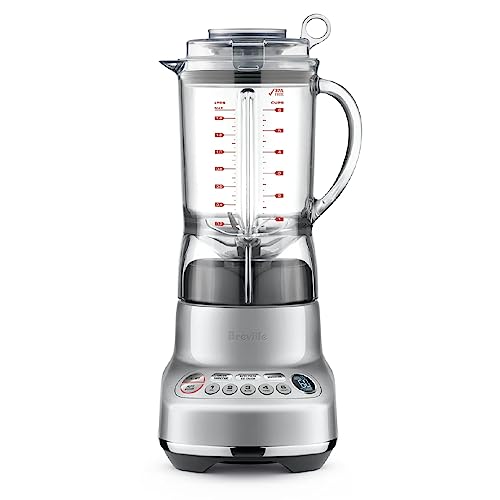
Breville Fresh & Furious BBL620 — Best Mid-Range All-Rounder
Breville’s Fresh & Furious occupies the thoughtful middle of this guide: a countertop blender from a maker that sweats the details of how ingredients move in a jar. Its blade and bowl design aims at the classic produce problem — ingredients riding the walls while the centre over-blends — and its control set is built for one-touch everyday jobs like green smoothies as much as for manual work.
Strengths
- Even-circulation design suits mixed produce loads
- Approachable controls for everyday household use
- Mid-range tier with premium design thinking
Trade-offs
- Not a high-performance machine for the hardest roots
- Fewer specialist programs than the programmed picks
- Serious daily whole-produce users will eventually outgrow it
| Maker | Breville |
| Model | Fresh & Furious BBL620 |
| Class | Mid-range countertop blender |
What the Fresh & Furious gets right for produce is consistency across a mixed load. A jar containing banana, kale, apple and cucumber contains four textures that want four treatments; a blender whose circulation is even delivers one texture in the glass, which is the difference between a drink and a chore. Breville’s domestic design polish — controls that make sense at 7am, a jar that pours without drama — supports the daily habit as much as the mechanics do.
Its ceiling is the same as every mid-range machine’s: the hardest, driest vegetable loads, blended daily, will show the gap to the professional tier in both texture and longevity. As the main blender for a household whose produce blending is enthusiastic but not extreme, it is a well-judged middle path — and a clear step up from budget machines on greens.
Best for: households wanting refined everyday produce blending at a mid tier / Not suited for: extreme whole-produce users blending hard roots daily
Check on Amazon — check price on Amazon for the Breville Fresh & Furious BBL620.

KitchenAid Pure Power Blender KSB2078 — Best Power with Personal Jars
The Pure Power is KitchenAid’s answer to the DUO format with a bigger headline number: 1700W peak driving a 68 oz pitcher for family produce batches and two personal jars for individual drinks. For fruits and vegetables, that format flexibility matters — greens for one blend best in a small vessel, weekend batches need the pitcher — and the power headroom handles frozen fruit and firm vegetables without drama.
Strengths
- Highest peak power figure in this guide
- Pitcher plus two personal jars covers both serving patterns
- KitchenAid build and design suit a permanent counter spot
Trade-offs
- Peak watts are a headline, not a guarantee of texture
- Personal jars add parts to store and wash
- Root-vegetable refinement still trails the professional tier
| Power | 1700W peak |
| Vessels | 68 oz pitcher + 2 personal jars |
| Maker | KitchenAid |
Judge this machine on its format and its results rather than its number. The personal jars are the everyday heroes: a green drink for one, blended in the jar it travels in, with the greens packed against liquid so they liquefy instead of floating. The pitcher then handles the family pattern competently, including frozen fruit and the softer vegetables, at volumes the Propel 510’s container cannot.
Against the BN751, the choice is brand ecosystem and design preference as much as specification — both are strong household systems with the same honest boundary at the hardest produce. Against the Vitamix, the boundary is texture on roots and greens at the daily, years-long scale. Within the household envelope, the Pure Power is a complete and likeable answer.
Best for: households wanting maximum format flexibility and power headroom / Not suited for: buyers who equate headline watts with professional texture
Check on Amazon — check price on Amazon for the KitchenAid Pure Power Blender KSB2078.

Cuisinart Velocity Ultra Blender Food Processor BFP-650P1 — Best Blender-Processor Combo
Some produce households do not just drink their vegetables; they prep them. The Velocity Ultra pairs a 1 HP blender with a food processor attachment and travel cups, so the same base that makes a fruit smoothie also slices, chops and processes vegetables for cooking. If your counter cannot hold two appliances and your produce use spans drinks and dinner, this combo earns its place on versatility alone.
Strengths
- Blender plus food processor covers drinks and vegetable prep
- 1 HP motor handles everyday produce blending
- Travel cups included for personal servings
Trade-offs
- Jack of two trades — the blender side trails dedicated premium blenders on greens
- Processor attachments add washing and storage
- Not the pick for daily hard-root liquefying
| Power | 1 HP |
| Format | Blender + food processor combo |
| Extras | Travel cups included |
The case for the combo is a workflow case. A household that blends fruit smoothies, chops onions and peppers for dinner, and processes vegetables for soups gets daily value from both halves, and one base on the counter instead of two machines in cupboards. The blender half is a competent everyday performer — fruit fully, greens well with liquid and time, softer vegetables without complaint.
The case against is specialisation. Neither half matches the best dedicated machine at its job, and buyers whose produce life is primarily serious green drinks should buy the Propel 510 and a knife. Buy the Cuisinart when prep versatility is genuinely your pattern, and it will feel like the smartest counter decision you made; buy it hoping it is secretly a Vitamix, and it is not.
Best for: cooks who prep vegetables as much as they blend them / Not suited for: dedicated green-drink specialists
Check on Amazon — check price on Amazon for the Cuisinart Velocity Ultra Blender Food Processor BFP-650P1.

BLACK+DECKER BL2010BG Blender — Best Budget
The BL2010BG is this guide’s budget pick, and its role is specific: fruit smoothies, soft vegetables like spinach, cucumber and tomato, milkshakes and everyday blending in a 6-cup glass jar at a budget tier. Ten speeds give more control than most budget machines, and the glass jar resists the staining that berry-heavy use guarantees. What it is not is a hard-vegetable machine, and this review will not pretend otherwise.
Strengths
- Budget tier — check price on Amazon
- Glass jar resists fruit staining and odours
- 10 speeds offer unusual control at this tier
Trade-offs
- Hard vegetables stay chunky — raw carrot and beet are beyond it
- Small motor strains on thick or frozen-heavy loads
- Built for occasional, not daily heavy, use
| Capacity | 6-cup glass jar |
| Controls | 10 speeds |
| Class | Budget countertop blender |
Within its envelope, the BLACK+DECKER is a sensible machine. Spinach disappears into a fruit smoothie, cucumber and soft produce blend cleanly, and the speed range lets you start slow and finish fast in the way produce prefers. The preparation techniques in this guide’s how-to section — small pieces, enough liquid, greens first with the liquid — were practically written for machines at this tier, and they extend its ability considerably.
The boundary is hard produce and volume. If your ambition is a daily carrot-beet-ginger drink, save toward the Propel 510 rather than burning out a budget motor proving a point. If your produce life is fruit-led with soft vegetables in support, this pick delivers it at the lowest cost in the guide, in a jar that will still look clear in two years.
Best for: budget buyers blending fruit and soft vegetables / Not suited for: hard-vegetable and daily heavy users
Check on Amazon — check price on Amazon for the BLACK+DECKER BL2010BG Blender.
Comparison Table
| Pick | Badge | Key spec | Best for |
|---|---|---|---|
| Vitamix Propel Series 510 | Best Overall | 48 oz, 3 programs, professional-grade | daily whole-produce drinkers in one-to-three person households |
| Ninja Professional Plus DUO BN751 | Best for Households with Cups | 1400W peak, 72 oz + 2 cups, Auto-iQ | families mixing batch smoothies with personal green drinks |
| Breville Fresh & Furious BBL620 | Best Mid-Range All-Rounder | Breville BBL620, even-blend design | households wanting refined everyday produce blending at a mid tier |
| KitchenAid Pure Power Blender KSB2078 | Best Power with Personal Jars | 1700W peak, 68 oz + 2 personal jars | households wanting maximum format flexibility and power headroom |
| Cuisinart Velocity Ultra Blender Food Processor BFP-650P1 | Best Blender-Processor Combo | 1 HP, blender + processor, travel cups | cooks who prep vegetables as much as they blend them |
| BLACK+DECKER BL2010BG Blender | Best Budget | 6-cup glass jar, 10 speeds, budget tier | budget buyers blending fruit and soft vegetables |
Read the table as a map, not a ranking. The best blenders for fruits and vegetables are not six versions of the same machine at six prices; they are six different answers to six different kitchens, and the badge column tells you which question each one answers. If two rows look similar, the deciding factor is usually in the detailed review: jar size, control style, or how the machine behaves with the exact ingredients you blend most.
How to Choose a Blender for Fruits and Vegetables
Fruits and vegetables ask different things of a blender, and buying for both means understanding the vegetable half of the brief: fibre, hardness and volume. The sections below cover what actually determines produce performance — blade speed versus torque, preparation, liquid strategy and format — so you can tell whether a machine’s marketing matches your shopping basket.
Why are vegetables harder to blend than fruit?
Fruit is mostly water held in soft cells that rupture easily. Vegetables add three difficulties: hard dense tissue in roots like carrot and beet, long fibres in celery, ginger and kale stems that wrap and resist, and leaves that float and hide from blades. A blender conquers them with a combination of blade speed, sustained circulation and time — which is why professional-grade machines separate themselves on produce more than on any other workload.
Preparation closes much of the gap on lesser machines. Pieces under an inch, roots cut smaller than leaves, frozen fruit used as part of the liquid strategy — these habits let a mid-range machine produce drinks that would defeat it with whole ingredients. The how-to section below turns that into a routine.
How much capacity does produce need?
Vegetables are bulky before blending and compact after: a jar that looks full of kale and apple becomes a modest amount of drink. That argues for a larger jar than your finished volume suggests — but circulation argues back, because a half-empty large jar blends a small load badly. The practical answers in this guide are the right-sized 48 oz Vitamix for one-to-three servings, and pitcher-plus-cup systems for households whose serving count swings between one and five.
If you batch-prep produce drinks for several days, favour the big pitchers; the drinks keep a day or two refrigerated, though fresh is always better. If you blend to order, favour the format that makes a single serving well, because that is the blend you will actually make daily.
Do you need a food processor as well?
Blenders liquefy; processors chop, slice and shred. A household whose vegetable life is drinks needs only a blender. A household that also preps vegetables for cooking at volume — slaws, salsas with texture, grated roots — gets real value from the Cuisinart combo’s second function, and saves a second appliance’s cost and cupboard space.
Do not buy the combo as a compromise if drinks are the main job, though. A dedicated blender at the same total spend will make better green drinks, and a knife handles occasional chopping. The combo wins when both jobs are weekly realities.
What about juicing instead?
Juicers and blenders answer different questions. A juicer separates juice from fibre, giving a thin drink and a pile of pulp; a blender keeps the whole produce in the glass, fibre included, which is more filling and wastes nothing. For fruits and vegetables as food — the premise of this guide — blending is the more complete method, and it is why every pick here is a blender.
If you strongly prefer juice texture, that is a different purchase and a different guide. But many people who think they want a juicer actually want smooth produce drinks without grit, and that is precisely the problem the top picks in this guide solve.
What about frozen vegetables in the mix?
Frozen vegetables deserve a place in this guide because they change the economics of produce blending: peas, spinach portions, corn and mixed vegetables freeze well, keep for months, and blend from frozen in the stronger machines — a companion guide in this cluster covers frozen produce in depth. For this guide’s picks, the practical rule is that any machine rated here for hard fresh vegetables will handle their frozen equivalents with a little more liquid and time, while the budget pick should meet frozen vegetables only in cooked-then-cooled form, in soups.
There is also a flavour argument. Frozen spinach and peas are harvested and frozen quickly, and in a blended drink they are frequently better than the tired fresh equivalent that spent a week in a crisper drawer. Households that keep a freezer produce shelf blend more vegetables, more often, with less waste — and the machine that supports that pattern earns its counter space every week.
How Do You Build a Produce Drink That People Actually Finish?
The graveyard of home blending is full of virtuous drinks nobody finished. Building a produce drink people complete is a design problem with known solutions. Start with a sweet, familiar base — apple, mango, pineapple or orange — that carries the glass. Add the vegetables in a ratio the base can support, roughly one part assertive vegetable to two parts base while palates adjust. Add brightness with citrus and warmth with ginger, the two cheapest flavour upgrades in the category. And blend it completely smooth, because texture, more than flavour, is what makes a produce drink feel like a punishment.
Temperature is the silent variable. A produce drink served properly cold tastes fresher, sweeter and less vegetal than the identical drink at room temperature, which is why experienced blenders keep frozen fruit in every recipe even in summer — it is doing flavour work, not just chilling. Serve in a glass you would use for juice, not a jar that signals medicine, and the drink’s reception changes again. None of this is deception; it is the ordinary craft of making healthy food enjoyable, and it is why some households’ blenders run daily for years while others gather dust by March.
Finally, rotate. The household that drinks the same green blend every day burns out on it; the household with three or four rotations — a green, a root-and-citrus, a berry-and-beet, a tropical — keeps the habit interesting for seasons. Every full-size pick in this guide handles that rotation; the personal-cup systems make the rotation easier to execute solo. Variety, in produce blending as in eating generally, is what sustainability actually looks like.
How Do You Get Children and Sceptics to Drink Their Vegetables?
This guide is about machines, but the hardest produce problem in most houses is not mechanical. It is the person — often small, sometimes not — who regards a vegetable drink with deep suspicion. The machines here solve the texture half of that problem completely: a drink with no flecks, no strings and no grit gives the sceptic nothing to object to on physical grounds. What remains is flavour strategy, and it is a strategy, not a trick: begin with drinks where fruit leads and vegetables support, serve them cold in an ordinary glass, and let familiarity do over weeks what argument cannot do in an evening.
Involvement helps more than concealment. A child who chose the mango, pressed the button on the BN701 or the SmartSense, and watched the colour change has a stake in the glass that no amount of parental enthusiasm can manufacture. The cup-format picks are quietly excellent here — a personal drink, made by its drinker, in their cup, is an easier yes than a family pitcher poured by someone else.
And keep the long view. Palates adjust to vegetable flavours gradually and genuinely; the drink that needs mango to hide spinach this spring may carry kale comfortably by autumn. The blender’s job in that progression is simply to never be the reason a drink fails — which is the standard this guide’s picks, at their stated tiers and limits, were chosen to meet.
How Do You Blend Tough Vegetables and Fibrous Fruit Smoothly?
Prepare produce like the machine matters less than the pieces: wash everything, cut hard vegetables — carrot, beet, celery — into pieces under an inch, tear leafy greens, and peel only what needs peeling, since skins carry flavour and nutrients but also resistance. Ginger should be sliced across its fibres into thin coins so the fibres start short. Frozen fruit can go in as it is; it doubles as your chilling element.
Load in circulation order: liquid first, then leafy greens so they are dragged under immediately, then soft fruit, then hard pieces last on top where the forming vortex pulls them down gradually. Start at low speed for ten seconds to establish the mass rotating, then climb to high and give produce blends more time than fruit-only ones — forty-five to ninety seconds is normal for a fully smooth green drink, and under-blending is the main cause of grit.
Use liquid as a tool, not a fixed recipe quantity. Start with enough to cover the blades and reach halfway up the greens; add splashes if circulation stalls. Citrus juice earns a special mention: a squeeze of lemon or lime brightens green flavours and slows the browning of apple and avocado in the glass, so produce drinks taste as fresh as they look.
Serve or store promptly, and clean the jar immediately — vegetable fibres dry onto blades and seals with real determination. A self-clean cycle or a hot rinse now is thirty seconds; the same residue tomorrow is a scrubbing brush and a bad mood. If you blend greens daily, a weekly check for fibre wound around the blade shaft keeps performance where it started.
A storage habit that protects both produce and machine: wash and prep vegetables when they come home, not when you blend. Carrots peeled and cut, celery sliced, greens washed and spun, all in containers in the fridge, turn a morning blend into a two-minute assembly — and a blender used for two-minute assemblies gets used daily. The households whose produce wilts in the drawer are not less disciplined; they are doing their prep at the wrong end of the week.
Common Buying Mistakes
Putting whole vegetables in a budget blender. Piece size is destiny at the lower tiers. A budget machine given inch-sized pieces of soft produce performs respectably; given a whole carrot, it performs a short, loud tragedy. Cut small and the tier gap narrows.
Blending greens dry on top. Leaves loaded last, on top of everything, float above the vortex and survive as flecks. Greens go in early, against the liquid, so they are pulled under and liquefied before the hard pieces arrive.
Under-blending to ‘keep it raw and chunky’. Grit in a green drink is not texture, it is unfinished work. Produce blends need their full high-speed time; the smooth result tastes better and keeps better than a half-blended one.
Expecting a blender to juice. A blender keeps fibre in the drink by design. If you strain a blended drink through cloth chasing juice, you bought the wrong machine category — and you are discarding the most filling part of the produce.
Skipping the acid. Green drinks without citrus taste flat and brown quickly. A squeeze of lemon is the cheapest quality upgrade in this entire guide, and it costs no equipment at all.
Serving the first produce drink at full strength. A glass that is half kale to a palate expecting juice ends the experiment for months. Start fruit-led, increase the vegetable share over weeks, and let the habit form before the ambition arrives.
Final Recommendation
For daily whole-produce blending, the Vitamix Propel 510 is our Best Overall: professional-grade liquefying power in a right-sized 48 oz container with programs for the whole household. Families should take the Ninja BN751 DUO or the KitchenAid Pure Power for their pitcher-and-cup flexibility, and cooks who prep as much as they blend should take the Cuisinart combo.
The Breville Fresh & Furious is the refined mid-range middle path, and the BLACK+DECKER is the honest budget pick for fruit and soft vegetables only. Whichever you choose, cut hard produce small, load greens against the liquid, and give the blend its full time — technique and machine together are what make a green drink smooth.
Shortlist for a fast decision: Check on Amazon (Vitamix Propel Series 510 — Best Overall), Check on Amazon (Ninja Professional Plus DUO BN751 — Best for Households with Cups), Check on Amazon (Breville Fresh & Furious BBL620 — Best Mid-Range All-Rounder). Each link goes to the current listing — check price on Amazon and confirm the configuration matches the review above before ordering.
Keep exploring the blender cluster on this site: Best Blenders For Fruits And Vegetables Frozen Best Blenders For Green Drinks And Smoothies Best Blenders For Frozen Fruit And Veggies Best Blenders For Frozen Smoothies Best Blenders
Frequently Asked Questions
Can a blender really liquefy raw carrot and beet?
A professional-grade blender like the Vitamix Propel 510 can, given small pieces, enough liquid and a full high-speed cycle — the result is a smooth drink, not a puree with grit. Mid-range machines manage smaller amounts respectably. Budget blenders cannot do it well, and this guide says so rather than letting you find out with a burnt-out motor.
Blender or juicer for vegetables — which is healthier?
They are different rather than better or worse. Blending keeps the whole vegetable, fibre included, so the drink is more filling and nothing is wasted. Juicing removes fibre and gives a thinner, faster-absorbing drink. For produce as food and for the smoothies this guide is about, blending is the practical choice.
How do I stop green smoothies tasting grassy?
Balance is the fix: a sweet fruit base such as mango, pineapple or banana, a squeeze of citrus, and a thumb of ginger will carry a large handful of greens. Also blend fully — half-blended greens taste harsher than liquefied ones — and drink the smoothie fresh and cold.
What order should vegetables go into the blender?
Liquid first, leafy greens next so they are pulled under, then soft fruit, then hard pieces last. Start low to get the mass rotating, then blend at high speed for forty-five to ninety seconds. That order and timing solve most grit and chunk problems on any machine.
Can I blend vegetables for soup in these machines?
Yes — the Vitamix-class picks can even heat soup through friction blending, and all the full-size picks puree cooked vegetables for soup easily. Raw hard vegetables for soup should be cut small and given enough liquid, exactly as for drinks. The Cuisinart combo additionally processes vegetables for chunkier soup prep.
How long do blended produce drinks keep?
Best fresh, acceptable for a day refrigerated in a full, sealed container — fill it to the top to limit air, add citrus to slow browning, and shake before drinking. Texture and flavour fade noticeably after the first day, so batch sizes in this guide assume drinking within that window.
Can these blenders handle leafy herbs like parsley and coriander?
Yes, with a caveat about quantity and liquid. A handful of soft herbs liquefies into a drink in any of the stronger picks; in budget machines, herbs are best blended as part of a sauce or dressing with enough liquid, or chopped by knife and stirred in. Woody stems — thick parsley stalks, rosemary — should be removed before blending in any machine.
What is the best first vegetable drink for a sceptical household?
Start where the vegetables hide best: a base of mango, pineapple and orange with a large handful of baby spinach, ginger and lime. Spinach is the mildest green, the tropical fruit carries the flavour, and the colour — a bright, appetising green — does half the persuading. Introduce carrot, beet and kale once the habit and the trust are established.
Can I blend hot vegetables, like cooked soup ingredients?
Yes — cooked vegetables are far easier to blend than raw, and every full-size pick here purees them readily. Two cautions: vent the lid or use the manufacturer’s hot-blending guidance, because steam pressure in a sealed jar is real; and fill conservatively, since hot liquids expand and move more violently than cold ones. The Vitamix-class picks can also heat soup from raw ingredients by friction, as their reviews note.
Do I need to peel fruits and vegetables before blending?
Only where the peel is inedible, bitter or waxed heavily — citrus rind, banana skin, mango skin and tough beet skin come off; apple, pear, carrot and cucumber skins can stay, especially in the stronger picks, and they carry flavour and nutrients. In budget machines, peel more generously: skins are fibre, and fibre is exactly what a small motor cannot finish.
How do I choose between two picks that both seem right?
Decide by the hardest ingredient you use weekly, then by format, then by cleaning — in that order. If both machines handle your hardest ingredient, the one whose format matches your serving pattern will be used more; if both match, the one that cleans fastest will be loved longer. Price, checked on Amazon at the time of ordering, is the legitimate final tiebreaker — not the first one. Buyers who decide in that order rarely return a blender, because each step removes the failures that actually cause returns: wrong capability, wrong size, and a cleaning routine that quietly kills the habit.

