Disclosure: airfryerkitchensupply.com is reader-supported. When you buy through links on our site, we may earn an affiliate commission at no extra cost to you.
Key Takeaways
- The best automated robotic vacuums sit on a spectrum of automation: the cheapest wander and bump, LiDAR models map your rooms and clean in rows, and self-emptying models add weeks of hands-free running — each step up is a real capability, not a badge.
- Every robot here was verified against Amazon’s catalog data before receiving a link; suction figures, runtimes, and capacities quoted are the listings’ own stated numbers.
- Suction numbers (Pa) are not comparable across brands — treat them as within-brand shorthand, and judge cleaning by navigation, brushes, and bin design instead.
- A robot vacuum maintains floors; it does not replace a full-size vacuum for stairs, upholstery, or the monthly deep clean.
- The best automation is the one your home allows: thresholds, rugs, cables, and pet toys decide how hands-free any robot can be.
Where to buy
All six robots below are sold on Amazon and were verified against the catalog data returned for each model before this guide was published. Robot vacuum lineups change constantly and prices move with them, so this page prints no prices — use the links to check the current price, and confirm the model suffix in the listing matches the review, because several of these robots have near-identical siblings.
- Lefant Robot Vacuum Cleaner M210 (Best Simple and Slim): Check the current price on Amazon
- eufy C10 Robot Vacuum with Self Emptying (Best Slim Self-Emptying): Check the current price on Amazon
- iRobot Roomba 105 Vac Robot Vacuum (Best Brand-Name Navigation): Check the current price on Amazon
- Roborock Q7 L5 Robot Vacuum and Mop (Best Vacuum-Mop Combo): Check the current price on Amazon
- ILIFE A30 Pro Robot Vacuum and Mop (Best Long Hands-Free Run): Check the current price on Amazon
- Shark AV2501AE AI Robot Vacuum with XL Self-Empty Base (Best for Pet Hair): Check the current price on Amazon
Introduction
The best automated robotic vacuums are bought on a promise — floors that stay clean without you — and the category’s whole history is the story of that promise being kept at different levels. At the entry level, a robot wanders, bumps, and eventually covers the floor: genuinely useful, genuinely random. In the middle, LiDAR mapping turns wandering into a plan: rooms are mapped, cleaned in neat rows, and revisited on a schedule you set. At the top, self-emptying docks stretch the promise from days to weeks — the robot cleans, returns, empties itself into a sealed base, and asks nothing of you until the base is full.
This guide’s six picks are arranged along that spectrum deliberately, because ‘automated’ means different things to different households. A small hard-floor apartment with a cat needs a different robot from a carpeted family house with a shedding dog, and both differ from the home that wants mopping in the same pass. What unites the picks is verification: each was matched against Amazon’s catalog data by brand and model before receiving a link, and the numbers in their spec boxes — suction in pascals as the listings state them, runtimes, self-emptying capacities — are the manufacturers’ stated figures, labeled as such.
Two honesty notes before the picks. First, suction figures in pascals are marketing’s favorite incomparable number: test methods differ by brand, so an 8,000 Pa robot from one maker is not thereby stronger than a 7,000 Pa robot from another. Navigation quality, brush design, and how a robot handles edges and hair matter more, and the reviews weight them accordingly. Second, no robot vacuum deep-cleans. It maintains — daily, tirelessly, and that maintenance is transformative — but stairs, sofas, and the grit ground into a rug’s base still belong to a full-size machine. Buy the robot for the 95 percent of floor care that is repetition, and it will be the best appliance decision you make this year.
In this guide
Quick Picks
Lefant Robot Vacuum Cleaner M210 — Best Simple and Slim. A slim, quiet bump-navigation robot with 120 minutes of runtime and self-charging — the honest entry point for small, hard-floor homes and pet hair maintenance. Check price on Amazon
eufy C10 Robot Vacuum with Self Emptying — Best Slim Self-Emptying. A 2.85-inch slim LiDAR robot that empties itself for a stated 8 weeks — mapping intelligence and hands-free depth in a body that fits under low furniture. Check price on Amazon
iRobot Roomba 105 Vac Robot Vacuum — Best Brand-Name Navigation. iRobot’s LiDAR Roomba with a stated 7,000 Pa suction, cleaning in neat rows — the established brand’s mapping robot with a charging base. Check price on Amazon
Roborock Q7 L5 Robot Vacuum and Mop — Best Vacuum-Mop Combo. A LiDAR vacuum-mop hybrid with a stated 8,000 Pa suction, a dual anti-tangle system, and multi-level mapping — for mostly-hard-floor homes. Check price on Amazon
ILIFE A30 Pro Robot Vacuum and Mop — Best Long Hands-Free Run. A LiDAR robot with a stated 10,000 Pa suction and a 280-day self-emptying station using five dust bags — the longest hands-free claim in this guide. Check price on Amazon
Shark AV2501AE AI Robot Vacuum with XL Self-Empty Base — Best for Pet Hair. Shark’s LiDAR robot with an XL HEPA self-empty base holding a stated 60 days of debris, bagless, built for pet hair and Alexa-controlled scheduling. Check price on Amazon
How These Picks Were Chosen
Each pick was verified through Amazon’s catalog data: searched by brand and model, matched against the returned listing title, and linked only on a confirmed match using the ASIN from that response. Stated specifications come from those listings. A self-emptying eufy model sold as a renewed unit was excluded under this site’s rule that renewed items are labeled or left out; it is left out.
Screening then ran on automation substance. Navigation came first: LiDAR mapping earned priority because it is the dividing line between a robot that cleans your home and a robot that samples it, but one deliberate exception was kept — the Lefant M210 — as the honest representative of the simple, slim, bump-navigation class that suits small hard-floor homes at the lowest cost. Second, hands-free depth: self-emptying capacity in days or weeks, as the listings state it, because that figure is the real measure of automation. Third, the hair question — anti-tangle brushes and pet-hair positioning — because pet hair is the workload most buyers actually have. Fourth, height: slim bodies that fit under sofas clean floor that upright vacuums never reach.
Mopping was treated as a bonus, never a headline. One pick vacuums and mops in the same pass and is badged for it; the rest vacuum only, and this guide’s position is that a vacuum-only robot that vacuums excellently beats a hybrid that does both indifferently — unless your floors are mostly hard and your standard is maintenance rather than restoration, in which case the hybrid’s case is real and is made in its review.
The 6 Best Automated Robotic Vacuums
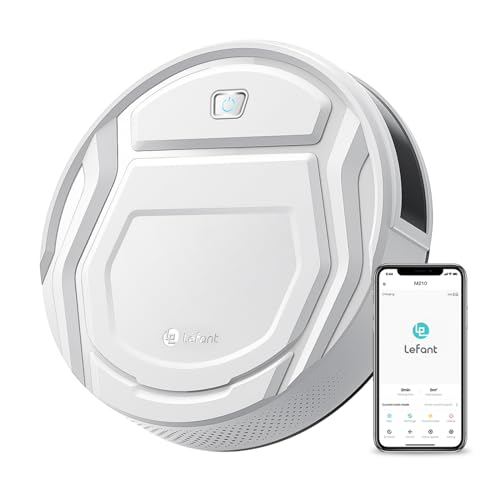
Lefant Robot Vacuum Cleaner M210 — Best Simple and Slim
The M210 is the robot for the buyer who is suspicious of the whole category’s prices and wants the core promise — a machine that keeps hard floors presentable every day — without paying for mapping computers. It is slim, so it slides under sofas and bed frames where dust actually lives; it runs a stated 120 minutes per charge; and when the battery fades it finds its dock and charges itself, which is the one piece of automation no robot at any price may skip. Wi-Fi, app, and Alexa control are all present, so scheduling — the feature that turns a gadget into a service — is fully available.
What it does not have is a map. The M210 navigates by contact and sensors, covering a home the way a diligent wanderer does: eventually, unevenly, and better in small, simple floor plans than in sprawling ones. In a studio or a two-room apartment with hard floors, that limitation barely matters and the price difference buys a year of nothing else needed. In a five-room house, it matters daily.
Strengths
- Slim body cleans under furniture that uprights never reach
- 120-minute runtime with automatic self-charging and scheduling
- The accessible entry point of this guide — full daily maintenance for small homes
Trade-offs
- No mapping: coverage is random, so large or complex homes get uneven results
- No self-emptying — the small onboard bin needs frequent emptying, especially with pets
- Suction is positioned for hard floors and daily pet hair, not deep carpet work
| Spec | Verified detail |
|---|---|
| Runtime | 120 minutes (per listing) |
| Navigation | Bump / random with sensors (listing class) |
| Control | Wi-Fi, app, Alexa |
| Return | Automatic self-charging |
| Positioning | Pet hair, hard floor, daily cleaning (per listing) |
Set this robot up for success and it over-delivers: run it daily on a schedule rather than weekly on demand, because daily passes over hard floors keep pet hair from ever becoming a visible event; clear the floor of cables and small toys, which are the true enemies of simple navigation; and empty the bin on a rhythm — with a shedding pet, every few days — before it packs down and quietly stops picking up.
The M210 is also the guide’s answer for second spaces: a rental, a workshop flat, a holiday home, a single floor of a larger house. Not every floor deserves the flagship, and the flagship’s price buys several of these.
Best for: small hard-floor homes, first-time robot buyers, and pet-hair maintenance / Not suited for: large multi-room homes wanting mapped, room-by-room cleaning

eufy C10 Robot Vacuum with Self Emptying — Best Slim Self-Emptying
The C10 attacks the two complaints that kill robot vacuums — ‘it got stuck under the sofa’ is impossible when the robot is 2.85 inches tall, and ‘I still have to empty it constantly’ ends when the dock holds a stated eight weeks of debris. Between those poles it carries the modern core specification: LiDAR navigation with smart mapping, so it cleans rooms in planned rows rather than by wandering, and an edge expansion brush that reaches out for the skirting-board line where dust collects and ordinary brushes pass by.
Carpet detection completes the picture for mixed-floor homes: the robot knows when it has climbed onto carpet and can respond accordingly rather than treating every surface as the same problem. A disclosure on data: this model’s catalog title arrived truncated in the source feed, so this review relies only on the specification elements the data contains — height, self-emptying period, navigation type, edge brush, carpet detection — which are, fortunately, the elements that define the product.
Strengths
- 2.85-inch height fits under low sofas and beds that stop taller robots
- Eight weeks of stated self-emptying — genuine hands-free running
- LiDAR mapping plus an edge brush for the skirting line
Trade-offs
- Self-emptying docks consume bags or bins on a cycle — a running cost to budget
- Slim bodies carry smaller onboard bins; the dock makes this painless but not free
- Truncated source data means a few secondary specs should be confirmed on the listing
| Spec | Verified detail |
|---|---|
| Height | 2.85 inches (per listing) |
| Self-emptying | 8 weeks hands free (per listing) |
| Navigation | LiDAR smart mapping |
| Extras | Edge expansion brush, carpet detection (per listing) |
The C10’s natural home is the apartment or house with low modern furniture and a resident who wants the robot to disappear from their attention entirely. Eight weeks between interventions changes the psychology of ownership: the robot stops being a pet you maintain and becomes a utility, like the dishwasher — present in its effects, absent from your thoughts.
Choose it over the Roomba below if under-furniture clearance is your binding constraint, and over the ILIFE A30 Pro if eight weeks of hands-free is enough and the slimmer body matters more than the longer stated hands-free period.
Best for: low-furniture homes wanting mapped cleaning with weeks of hands-free running / Not suited for: buyers who want every secondary spec documented before ordering

iRobot Roomba 105 Vac Robot Vacuum — Best Brand-Name Navigation
Roomba is the name the category is known by, and the 105 Vac is iRobot’s statement of the modern basics: LiDAR navigation that maps the home and cleans in neat rows, multi-surface cleaning that moves between hard floors and carpet without ceremony, and a stated 7,000 Pa of power-lifting suction — a figure this guide reports as the listing states it, while reminding readers that pascal ratings are not cross-brand comparable. What iRobot sells beyond the hardware is maturity: an app ecosystem, a parts pipeline, and a decade of knowing where robots get stuck.
This configuration pairs the robot with a charging base rather than a self-emptying dock, and that is the honest trade in its price band. You gain the mapping and the brand; you keep the job of emptying the bin. For a smaller home without heavy pet hair, that job is a weekly thirty seconds. For a large shedding household, it is the reason the self-emptying picks exist.
Strengths
- LiDAR mapping with neat-row cleaning from the category’s founding brand
- Multi-surface cleaning across hard floors and carpet
- Mature app, parts, and support ecosystem
Trade-offs
- No self-emptying in this configuration — the bin is yours to empty
- Brand premium is real; equivalent navigation exists for less
- Suction figure is a stated rating, not a cross-brand measurement
| Spec | Verified detail |
|---|---|
| Suction | 7,000 Pa power-lifting suction (per listing) |
| Navigation | LiDAR, multi-surface, cleans in neat rows |
| Base | Charging base (no self-emptying in this configuration) |
The Roomba’s row-cleaning deserves its reputation for one specific reason: it is legible. You can watch a mapping robot work a room in stripes and trust the coverage; you cannot watch a random-navigation robot and know anything. For buyers whose skepticism about the category is really about coverage — ‘but does it actually clean everywhere?’ — a LiDAR Roomba is the persuasive answer, and the map it builds in the app, room by room, is the receipt.
Choose the 105 Vac when brand support and mapping are the priorities and the home’s debris load is modest. Choose the self-emptying picks when the debris load — pets, children, acreage — makes the bin the bottleneck.
Best for: buyers who want mapped, row-by-row cleaning from the established brand / Not suited for: heavy-shedding homes that need self-emptying

Roborock Q7 L5 Robot Vacuum and Mop — Best Vacuum-Mop Combo
The Q7 L5 is the guide’s hybrid: a robot that vacuums and mops in the same pass, built for the homes — increasingly the majority — where most of the floor is hard. Its stated 8,000 Pa suction is the highest figure in this guide, reported as listed and subject to the usual warning about cross-brand comparisons. The specification that deserves more attention is the dual anti-tangle system: hair wrapping around a brush roll is the maintenance chore that hybrid and vacuum-only owners alike dread, and a brush design that resists it is worth more in a pet household than another thousand pascals.
LiDAR navigation with multi-level mapping suits houses as well as flats — the robot can hold maps for more than one floor, for owners willing to carry it between them — and the self-charging return keeps the automation loop closed. As an upgrade path, the listing positions it above the Q5 Pro line, which tells existing Roborock owners where it sits.
Strengths
- Vacuums and mops in one pass — the hard-floor household’s shortcut
- Dual anti-tangle brushes cut the hair-clearing chore
- Multi-level LiDAR mapping for multi-floor homes
Trade-offs
- Mopping is maintenance mopping — it will not restore a neglected floor
- No self-emptying dock in this configuration
- Hybrid tanks and pads add a small care routine of their own
| Spec | Verified detail |
|---|---|
| Suction | 8,000 Pa (per listing) |
| Functions | Vacuum and mop combo |
| Brushes | Dual anti-tangle system (per listing) |
| Navigation | LiDAR, multi-level mapping |
| Return | Self-charging |
Judge the mopping by the right standard. A robot mop drags a damp pad with light pressure; it lifts the daily film of footprints, paw marks, and kitchen mist that makes hard floors look tired by Friday, and it does it often enough that the floor never accumulates a Saturday project. It does not scrub grout or lift dried sauce, and no robot mop at any price in this category does. Bought as a maintenance system, the Q7 L5 is excellent; bought as a floor-restoration machine, nothing is.
Choose it if your home is mostly hard floors and your standard is ‘always presentable’. Choose a vacuum-only pick if carpets dominate — the mop hardware becomes luggage — and add the self-emptying question separately, since this configuration keeps bin duty with you.
Best for: mostly-hard-floor homes wanting vacuum and maintenance mop in one pass / Not suited for: carpet-dominant homes or anyone expecting scrubbing from a robot mop

ILIFE A30 Pro Robot Vacuum and Mop — Best Long Hands-Free Run
The A30 Pro’s headline is a number about your time, not the robot’s power: a stated 280 days of self-emptying capacity, delivered through five dust bags in its station. Even discounted for the difference between a manufacturer’s test home and your home — a large dog will spend that budget faster — the proposition is the category’s logical endpoint: a robot you interact with a few times a year. The supporting specification is complete: LiDAR navigation, a stated 150-minute runtime for large floor plans, vacuum and mop functions, and a stated 10,000 Pa suction figure, reported as listed.
ILIFE built its name on simple, affordable robots, and the A30 Pro is the brand reaching up-market without abandoning value positioning. That heritage cuts both ways, and the review below is candid about it — but on the verified specification, this is the most automation per intervention available in this guide.
Strengths
- 280-day stated self-emptying — the longest hands-free run here
- LiDAR mapping plus a 150-minute runtime for large homes
- Vacuum and mop functions in the same robot
Trade-offs
- Dust bags are a consumable — the 280 days arrive via five bags that will eventually need replacing
- Manufacturer hands-free periods assume average debris; heavy pet homes will cycle faster
- Brand ecosystem and app maturity trail iRobot and Roborock
| Spec | Verified detail |
|---|---|
| Suction | 10,000 Pa (per listing) |
| Self-emptying | 280-day, with 5 dust bags (per listing) |
| Navigation | LiDAR |
| Runtime | 150 minutes (per listing) |
| Functions | Vacuum and mop |
Do the consumables arithmetic before falling for the headline, because it is still favorable arithmetic. Five bags across a stated 280 days means the station’s running cost is a bag every month or two — trivial money against the labor it replaces, but a cost a buyer should know exists, stated here because the listing itself names the bag count. Robots that hide their consumables are the ones to distrust; this one prints them.
Choose the A30 Pro when the household’s scarcest resource is attention: big floor plan, shedding pets, busy people. It is the pick most likely to still be running, unthought-about, a year after purchase — which is the entire point of the category.
Best for: large, busy, pet-owning homes that want maximum hands-free time / Not suited for: buyers who prefer the mature apps of the biggest brands

Shark AV2501AE AI Robot Vacuum with XL Self-Empty Base — Best for Pet Hair
Shark’s entry is the pet household’s specialist. The robot itself is a LiDAR navigator for carpet and hard floors, positioned by its listing squarely at pet hair; the base is the differentiator — an XL self-empty base with HEPA filtration as the listing describes it, holding a stated 60 days of debris, and bagless. Bagless matters to a specific and numerous buyer: the one who objects to a lifetime subscription of proprietary bags. Here the base empties into a bin you empty into the trash, and the running cost of the automation is zero.
The HEPA wording is reported exactly as the listing gives it — the base is described as an XL HEPA self-empty base — because filtration terms have precise meanings and this guide keeps them at the listing’s own level of claim. For a pet home, the practical translation is that the debris path is sealed and filtered at the base rather than puffed back into the room at emptying time, which is when ordinary robots return their dust to the air.
Strengths
- Bagless XL base: 60 days of stated capacity with no bag subscription
- HEPA-described filtration at the base suits pet and dust-sensitive homes
- LiDAR navigation with a pet-hair brief across carpets and hard floors
Trade-offs
- 60 days is shorter than the ILIFE’s stated run — the bagless trade
- The base is XL in fact as well as name; it needs its floor corner
- Shark’s mapping app is capable but less polished than Roborock’s
| Spec | Verified detail |
|---|---|
| Self-empty base | XL HEPA self-empty base, bagless (per listing) |
| Capacity | 60-day capacity (per listing) |
| Navigation | LiDAR |
| Positioning | Pet hair, carpet and hard floor (per listing) |
| Control | Wi-Fi, Alexa |
Pet hair is a system problem — volume, tangling, and the dust that travels with it — and this pick is the guide’s most complete answer to the system rather than to any single part. The robot handles the floor daily, the base swallows the evidence for two months at a time, and the filtration claim addresses the air. Households whose robot will live or die by a shedding dog should start here and argue themselves elsewhere only on price or app preference.
One placement note that applies to every self-emptying pick and this one doubly: the base needs a permanent corner with clearance in front for the robot to dock and a wall behind it. Give the XL base its corner proudly — it is doing the work of a cupboard of supplies you no longer buy.
Best for: pet households wanting self-emptying without bag costs / Not suited for: small homes where the XL base has no corner to call its own
Comparison Table
| Pick | Badge | Key spec | Best for | Where |
|---|---|---|---|---|
| Lefant Robot Vacuum Cleaner M210 | Best Simple and Slim | 120 mins runtime; slim; self-charging; Wi-Fi/App/Alexa | small hard-floor homes, first-time robot buyers, and pet-hair maintenance | Check price |
| eufy C10 Robot Vacuum with Self Emptying | Best Slim Self-Emptying | 2.85″ slim; LiDAR mapping; 8 weeks self-emptying | low-furniture homes wanting mapped cleaning with weeks of hands-free running | Check price |
| iRobot Roomba 105 Vac Robot Vacuum | Best Brand-Name Navigation | 7,000 Pa stated suction; LiDAR; neat rows | buyers who want mapped, row-by-row cleaning from the established brand | Check price |
| Roborock Q7 L5 Robot Vacuum and Mop | Best Vacuum-Mop Combo | 8,000 Pa stated; vacuum + mop; dual anti-tangle; LiDAR | mostly-hard-floor homes wanting vacuum and maintenance mop in one pass | Check price |
| ILIFE A30 Pro Robot Vacuum and Mop | Best Long Hands-Free Run | 10,000 Pa stated; 280-day self-empty; LiDAR; 150 mins | large, busy, pet-owning homes that want maximum hands-free time | Check price |
| Shark AV2501AE AI Robot Vacuum with XL Self-Empty Base | Best for Pet Hair | XL HEPA self-empty base; 60-day capacity; bagless; LiDAR | pet households wanting self-emptying without bag costs | Check price |
How to Choose an Automated Robotic Vacuum
Choose by floor plan first. A small, simple, mostly-hard-floor home is honestly served by a slim random-navigation robot like the Lefant M210 — mapping is wasted on two rooms. Anything larger, carpeted, or multi-room earns LiDAR: the map is what turns cleaning from sampling into coverage, enables room selection and no-go zones, and produces the neat rows that let you verify the work. Multi-floor homes should note which robots hold multi-level maps, and everyone should measure their lowest furniture clearance against robot heights — the gap under your sofa is either cleanable floor or a dust archive, and the robot’s height decides which.
Choose by debris second. The question is not how much dirt your home makes but how often you are willing to touch the robot. Light debris and no pets: any bin will do. Pets, children, or acreage: self-emptying stops being a luxury and becomes the feature that determines whether the robot is still in daily service in month six — because the number one killer of robot vacuums is not breakdown, it is an owner who got tired of emptying a tiny bin and stopped running it. Match the stated hands-free period — 60 days, 8 weeks, 280 days across this guide — to your household’s production, with a discount for optimism.
Finally, choose by ecosystem and consumables. The app is the remote control for the robot’s whole life; the major brands’ apps are a genuine advantage. Consumables — bags where the base uses them, filters, brushes, mop pads — are the real price of the robot spread over years; the listings in this guide state their arrangements, from the ILIFE’s five bags to the Shark’s bagless base, and a buyer should read them as part of the price, because they are.
Navigation Explained: Bump, Camera, and LiDAR
Random or bump navigation is the original method: the robot drives until it meets an obstacle, turns, and repeats, with cliff and wall sensors keeping it safe. Given enough time it covers a simple room surprisingly well, and its robots are slimmer and cheaper because they carry no mapping computer. Its failures are structural — it cannot know where it has been, cannot return to a missed spot, cannot respect a room boundary, and wastes battery re-covering the same ground.
Camera-based navigation watches the ceiling and walls to locate itself; LiDAR spins a laser to measure the room directly. LiDAR is the current standard at the serious end of the category — four of this guide’s six picks use it — because it works in the dark, maps precisely, and supports the features buyers actually use after week one: room-by-room cleaning, no-go zones for the pet bowls and the cable nest, and multi-level maps. When a listing says a robot cleans ‘in neat rows’, as the Roomba 105’s does, that is LiDAR’s signature and your evidence of coverage.
The practical verdict: navigation is the one specification in this category that is not marketing. Suction figures inflate, runtimes assume ideal floors, but a robot either knows where your rooms are or it does not — and everything about owning it follows from that.
How to Set Up and Live With a Robot Vacuum
The first run is a mapping exercise, so prepare the home as you intend to keep it: doors in their usual positions, floors in their usual state of clutter — which should be honest but not hostile. Walk the robot’s world at its height and remove its natural predators: charging cables, shoelaces, socks, pet toys with strings, and anything small and precious that a brush roll can ingest. Decide the dock’s permanent home — against a wall, with clear space in front and at the sides, near an outlet — because the robot’s entire geography is anchored to that point.
- Run the mapping pass with doors open to every room the robot should know
- Set no-go zones for pet bowls, cable nests, and delicate furniture immediately
- Schedule daily or near-daily runs — robots maintain best little and often
- Empty bins and check brush rolls on the rhythm your debris dictates, not the manual’s optimism
- Clean the sensors and cliff detectors monthly with a dry cloth
- Keep firmware and the app updated; navigation genuinely improves over a robot’s life
Living with the robot is a rhythm of small mercies: a floor that never reaches ‘must vacuum’ because it was vacuumed yesterday by someone else, a schedule that runs while the house is empty, and a weekly five minutes of bin and brush attention that replaces the hour the upright used to take. Households that keep that rhythm keep their robots for years. Households that treat the robot as a set-and-forget appliance discover that automation rewards a little stewardship — a truth this guide states plainly because the picks deserve owners who will let them succeed.
Robot Vacuums and Pets: A Realistic Brief
Pets are the reason most robots are bought and the load most robots are judged by, so the expectations deserve precision. A robot vacuum is superb at pet hair maintenance: daily passes lift hair from hard floors before it tumbleweeds, and regular carpet passes keep hair from working deep into pile. It is not a substitute for the monthly upright session that extracts what has been ground in, and it will not save a rug that has been a dog bed for a year. Anti-tangle brush designs — the Roborock’s dual system in this guide — reduce the hair-wrapping chore, and self-emptying bases sized in months suit the volume pets produce.
The pet-specific hazards are management, not mystery. A robot that meets a pet accident will distribute it, so pets in training argue for schedules that run when you are home, or for the camera-equipped end of the market that this brief’s picks do not cover. Water bowls need no-go zones or a raised station. And the robot itself becomes furniture to the animal within a week — cats ride them, dogs ignore them — which is the household’s signal that the automation has been accepted into the pack.
Battery Life, Runtimes, and What the Numbers Mean
Runtime figures in this category — 120 minutes for the Lefant, a stated 150 for the ILIFE — are measured on hard floors at standard suction, and a carpeted home at maximum power will see substantially less. The saving grace is that runtime matters less than it appears to: every pick in this guide recharges and resumes or returns to its dock when low, so a large home is cleaned in sessions rather than in one heroic pass. What runtime really decides is how many sessions a full clean takes, and therefore how the robot’s day should be scheduled — a robot that needs three sessions to cover a house should start early, not at bedtime.
Battery longevity follows the usual lithium rules: a robot that lives on its dock, runs regularly, and is not stored flat for months will hold its capacity for years. The households that kill robot batteries are the ones that buy in enthusiasm, unplug the dock in a tidy-up, and rediscover the robot a season later. If the category has a single ownership secret, it is that the dock is furniture — permanent, plugged in, and unremarkable — and the robot is a utility that happens to move.
Common Buying Mistakes
- Comparing suction pascals across brands as if they were measured the same way
- Buying random navigation for a large home and blaming the robot for geometry
- Skipping self-emptying in a heavy-shedding home, then abandoning the robot over its tiny bin
- Expecting robot mopping to restore floors rather than maintain them
- Leaving cables, socks, and string toys on the floor for the first run
- Placing the dock in a cramped corner the robot cannot reliably dock with
- Never cleaning sensors or brush rolls, then concluding the robot ‘got worse’
The category’s deepest mistake is buying the robot for the home you wish you had — tidier, smaller, pet-free — rather than the one whose floors it will actually meet. Every pick in this guide will succeed in the right home and disappoint in the wrong one, and the reviews have tried to draw those homes precisely.
Final Recommendation
The recommendations resolve by household. Small hard-floor homes and first-time buyers: the Lefant M210, honestly scoped and slim enough to clean where dust lives. Low furniture and a wish to forget the robot exists: the eufy C10, with its 2.85-inch body and eight stated weeks of self-emptying. Buyers who want the established brand’s mapping and support: the Roomba 105 Vac, accepting the bin as their job. Mostly hard floors that want mopping in the same pass: the Roborock Q7 L5. Maximum hands-free time for a big, busy, shedding household: the ILIFE A30 Pro and its 280 stated days. And pet homes that refuse bag subscriptions: the Shark AV2501AE, bagless and filtered at the base.
Whichever robot you choose, prepare its world, schedule it daily, and give it its five minutes a week. Automation is a partnership, and these six are the partners this guide verified. The neighboring briefs below cover the upright machines that remain the robot’s necessary complement:
Lefant Robot Vacuum Cleaner M210 (Best Simple and Slim): Check the current price on Amazon
eufy C10 Robot Vacuum with Self Emptying (Best Slim Self-Emptying): Check the current price on Amazon
iRobot Roomba 105 Vac Robot Vacuum (Best Brand-Name Navigation): Check the current price on Amazon
Roborock Q7 L5 Robot Vacuum and Mop (Best Vacuum-Mop Combo): Check the current price on Amazon
ILIFE A30 Pro Robot Vacuum and Mop (Best Long Hands-Free Run): Check the current price on Amazon
Shark AV2501AE AI Robot Vacuum with XL Self-Empty Base (Best for Pet Hair): Check the current price on Amazon
Best Robotic Vacuums For Under $500 Best Inexpensive Robotic Vacuums Best Ilife Robotic Vacuums Best Robot Vacuums For Dog Hair Best Robot Vacuums Mops
Frequently Asked Questions
Do robot vacuums really clean well enough to replace a normal vacuum?
They replace the frequency, not the machine. A robot running daily keeps floors at a standard most households otherwise reach only on cleaning day, and for hard floors and surface carpet dirt that is most of floor care. What it cannot do is stairs, upholstery, edges above floor level, or the deep extraction a full-size vacuum gives carpet monthly. The realistic household owns both and uses the upright a fraction as often.
Is LiDAR navigation worth paying for?
In any home beyond a couple of simple rooms, yes — it is the dividing line between sampled cleaning and verified coverage, and it unlocks room selection, no-go zones, and multi-level maps. In a small studio or two-room flat, a slim random-navigation robot like the Lefant M210 covers the space adequately and the money saved is real. Match the navigation to the floor plan, not to the brochure.
How often do self-emptying robots actually need attention?
On the listings’ stated figures in this guide: about 60 days for the Shark’s bagless XL base, 8 weeks for the eufy C10, and a stated 280 days across five bags for the ILIFE A30 Pro. Treat manufacturer periods as best-case averages — a large shedding dog spends a debris budget faster than a single adult in a flat — and budget for the consumables each system uses, which the reviews state.
Are pascal (Pa) suction ratings comparable between brands?
No. There is no single enforced test method behind the figures, so one brand’s 8,000 Pa is not demonstrably stronger than another’s 7,000 Pa. This guide reports each robot’s figure as its listing states it, and weights navigation, brush design, and anti-tangle features more heavily in its judgments — those are the specifications that predict cleaning in a real home.
Can a robot vacuum handle pet hair without constant untangling?
It can handle the volume well — daily runs are the secret — and modern brush designs reduce the tangling substantially; the Roborock Q7 L5’s dual anti-tangle system in this guide exists for exactly this. Some brush maintenance remains a weekly minutes-long job in heavy-shedding homes. Self-emptying bases matter as much as brushes for pet owners, because hair fills bins faster than any other debris.
Will a robot vacuum fall down the stairs or damage furniture?
Cliff sensors are universal in this category and reliably stop robots at stair edges — every pick here is a modern design with sensor protection. Furniture contact depends on navigation: LiDAR robots slow and steer around obstacles they have mapped, while bump-navigation robots make gentle contact by design. Delicate items on the floor — cables, toys, anything chewable or spillable — should be lifted regardless of the robot’s price.


