Disclosure: airfryerkitchensupply.com is reader-supported. When you buy through links on our site, we may earn an affiliate commission at no extra cost to you.
Where to buy
The best asia karaoke mixers come from a different tradition than Western living-room karaoke: in Asia, karaoke is KTV — a serious social ritual with private rooms, big song libraries, powerful sound and singers who expect their voices to be treated well. The mixers and mixing amplifiers in that tradition, built by specialists like Singtronic and IDOLpro for the Asian and Asian-American KTV market, are a class above the toy karaoke boxes sold elsewhere: real mixing amplifiers with multiple microphone inputs, key control, echo and reverb tuned for voices, optical and HDMI connections for modern TVs, and enough clean power for a room full of people. All six picks below were verified against their Amazon listings, so you can check the current price on Amazon from each review.
- Singtronic KA-1000Pro 2000W Professional Karaoke Mixing Amplifier — Best Overall. Check the current price on Amazon.
- Singtronic KA-3000ProII 3000W Karaoke Mixing Amplifier — Best Premium. Check the current price on Amazon.
- IDOLpro IP-4000 3000W Console Mixing Amplifier — Best for Recording and Control. Check the current price on Amazon.
- Rockville SINGMIX 5 V2 Bluetooth Karaoke Amplifier Mixer — Best Value Amplifier. Check the current price on Amazon.
- Sound Town Wireless Microphone Karaoke Mixer System (SWM16-MAX) — Best for Smart TV and Soundbar. Check the current price on Amazon.
- Rybozen Wireless Microphone Karaoke Mixer System — Best Budget Portable. Check the current price on Amazon.
The best asia karaoke mixers exist because Asia takes karaoke more seriously than anywhere else on earth. In the KTV culture that runs from Taipei and Seoul to Ho Chi Minh City and the big Asian-American communities in California and Texas, karaoke is not a party novelty — it is the default social evening, and the equipment reflects it. The heart of a KTV system is the mixing amplifier: one box that takes the music from a karaoke player or TV, takes two to five microphones, adds the echo and key control that make ordinary voices sound like singers, and drives real speakers hard enough to fill a room. That is the category this guide ranks.
Shopping for these boxes from outside the tradition is confusing, because the specialist brands — Singtronic and IDOLpro above all — are household names in the KTV market and nearly invisible outside it, while the listings mix them with generic karaoke gadgets that share none of their capability. This guide sorts that out. The top picks are genuine KTV mixing amplifiers for a dedicated room or a serious living room. The lower picks are the bridge products: a value amplifier-mixer with modern TV connections, and two wireless mixer systems that turn an existing TV and soundbar into a karaoke setup with no amplifier at all. Whichever rung matches your room, every pick here treats the singer’s voice as the main event, which is the whole philosophy of the category.
In this guide
Quick Picks
Best Overall: Singtronic KA-1000Pro 2000W Professional Karaoke Mixing Amplifier — The complete modern KTV amp: optical TV input, Bluetooth both ways, microphone mixing with EQ and a sound enhancer — the box a KTV room is built around. Check on Amazon
Best Premium: Singtronic KA-3000ProII 3000W Karaoke Mixing Amplifier — The flagship treatment: HDMI ARC for the TV, an 8-band EQ for the room, USB recording for the singers, and power for a big room’s worth of celebration. Check on Amazon
Best for Recording and Control: IDOLpro IP-4000 3000W Console Mixing Amplifier — The other great name in KTV, in console form: recording, HDMI ARC, optical and Bluetooth, with the hands-on control layout hosts prefer. Check on Amazon
Best Value Amplifier: Rockville SINGMIX 5 V2 Bluetooth Karaoke Amplifier Mixer — Five mic inputs, optical for the TV, Bluetooth, two-zone speaker selection — the value route into genuine amplifier-based karaoke. Check on Amazon
Best for Smart TV and Soundbar: Sound Town Wireless Microphone Karaoke Mixer System (SWM16-MAX) — No amp, no speakers to buy: this mixer system sits between your TV and your soundbar, adds two wireless voices, and karaoke exists. Check on Amazon
Best Budget Portable: Rybozen Wireless Microphone Karaoke Mixer System — Two wireless mics and a small mixer box that connects to almost anything — the portable, budget way into real karaoke. Check on Amazon
How These Picks Were Chosen
We judged these products the way a KTV operator would. Voice handling came first: how many microphones, how good the echo and reverb sound, whether there is key control to move a song into a singer’s range, and whether the mic channels have their own tone controls. Music connection came second, and here the modern standard is unforgiving — a current KTV box must take sound from a smart TV or karaoke player digitally, by optical or HDMI ARC, because that is where the song libraries live now. Power and speaker matching third: a mixing amplifier is only as good as its match to the room, so we favored honest capability across room sizes rather than headline wattage claims, which in this category are marketing numbers best treated as size classes rather than measurements.
Every product was verified — searched by brand and model, the returned title matched to the exact unit — before receiving its Amazon link, following this program’s standing rule. We deliberately included the two wireless TV mixer systems at the foot of the list, because for many households they are the right answer: not everyone needs a KTV amplifier, and a guide that only ranked the heavy iron would fail the apartment singer entirely. What unites all six is that they come from, or are built for, the Asian karaoke tradition of voice-first sound — the thing the keyword is actually asking for.
One more judgment ran through the selection: honesty about who the singer is. KTV equipment is bought for other people’s voices as much as for your own — the guest who sings once a year, the grandfather whose songs are from another era, the teenager who performs like the room is an arena. Systems that only flatter a strong singer fail the tradition. Every pick here was favored for the processing and forgiveness that make an ordinary voice sound cared for: echo that supports rather than exposes, microphone channels that treat a quiet singer gently, and enough headroom that an enthusiastic one does not distort. The best karaoke mixer is the one that makes the shyest person at the party take the microphone by the end of the night.
The 6 Best Asia Karaoke Mixers
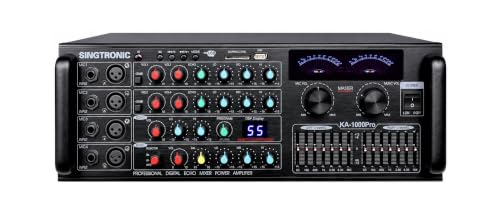
Singtronic KA-1000Pro 2000W Professional Karaoke Mixing Amplifier — Best Overall
Singtronic is one of the defining brands of the Asian-American KTV market, and the KA-1000Pro shows why: it is a professional karaoke mixing amplifier designed around how KTV is actually done in 2026. The music arrives digitally from a smart TV or karaoke player over its optical input, microphones plug into proper mic channels with their own processing, Bluetooth works in both directions — stream backing tracks in, or send the mix out — and USB playback covers the MP3 library on a stick that every karaoke household owns. The BBE sound enhancer, a processing stage long favored in this market, adds clarity and presence to voices that helps amateur singers more than any single other feature.
Strengths
- Optical input connects a modern smart TV’s karaoke apps the clean digital way
- Bluetooth send and receive plus USB playback cover every music source a household has
- Built by a KTV specialist — mic handling, echo and EQ are the design’s center, not an afterthought
Trade-offs
- It is an amplifier, so it needs passive speakers — budget and space for the pair
- Power class suits living rooms and home KTV rooms, not halls
- The feature set rewards an hour of setup learning; it is not a plug-and-play toy
Key specs: Professional karaoke mixing amplifier with optical input, Bluetooth send/receive, USB/MP3 playback, EQ and BBE sound enhancer
Set up properly, this is the box that makes a home feel like the KTV rooms of Taipei or Garden Grove: the TV runs the karaoke app, its sound returns over optical, two or three singers pass the microphones, and the person running the amp rides the music-versus-voice balance like a KJ. The honest way to buy it is as a system decision — this amplifier, a decent pair of karaoke speakers, and wired or wireless microphones — and judged as a system it delivers the authentic experience the search promises, with headroom for the loud Saturday nights and the processing to make the quiet singers sound brave. For most households serious about Asian-style karaoke, this is the correct first purchase and the last one they will need for years.
Best for: households building a real home KTV setup around a TV and a pair of speakers / Not suited for: anyone who wants karaoke from a soundbar with no additional boxes or speakers
Check on Amazon — check the current price on Amazon before you buy.

Singtronic KA-3000ProII 3000W Karaoke Mixing Amplifier — Best Premium
The KA-3000ProII is the step up for households where karaoke is not an activity but an institution — the big family gatherings, the holiday marathons, the singers who take their performances seriously enough to record them. It adds the connections and control the KA-1000Pro leaves out: HDMI ARC, so the TV connection is a single cable that also carries the TV’s own audio smarts; an 8-band equalizer to tune the system to a real room rather than a spec sheet; and USB recording, so a great performance can be captured straight from the mixer — the feature that turns a karaoke night into keepsakes. Its higher power class is aimed at larger rooms and larger speakers.
Strengths
- HDMI ARC plus optical covers every modern TV connection scenario with one cable
- USB recording captures performances directly — a beloved KTV feature
- 8-band EQ and the bigger power class suit large rooms and demanding speakers
Trade-offs
- Premium size, weight and budget — this is furniture-grade audio equipment
- Overkill for apartments and small rooms, where its little sibling is the smarter buy
- More control means a longer setup session to get the room tuned properly
Key specs: Professional karaoke mixing amplifier console with HDMI ARC, 8-band EQ, USB recording, Bluetooth and optical input
The buyer for this box knows who they are: the family whose karaoke nights run twenty people, the singer who practices, the host whose living room is a KTV room that occasionally hosts a couch. For them the recording feature alone can justify the step up — in KTV culture, playing back a performance is half the fun, and recording from the mixer captures the voice with its echo and the music in balance, exactly as the room heard it. Pair it with speakers that can use its power, give the EQ an honest half hour with a familiar song, and this is a system that will anchor a decade of gatherings. Buy it for the room and the ritual you actually have, and it will never feel like too much.
Best for: large rooms, big karaoke families and hosts who want recording and full control / Not suited for: small rooms, casual singers, or anyone whose speakers can not use the extra capability
Check on Amazon — check the current price on Amazon before you buy.
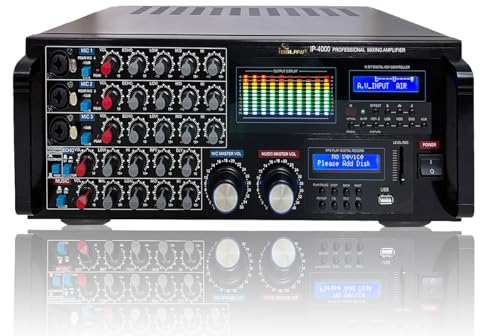
IDOLpro IP-4000 3000W Console Mixing Amplifier — Best for Recording and Control
IDOLpro is the other specialist name that KTV buyers cross-shop against Singtronic, and the IP-4000 is its console-style flagship: a professional mixing amplifier with recording, Bluetooth, HDMI with ARC and optical inputs, laid out like a small console rather than a receiver. That layout is its argument — for the host who runs the night, having the microphone channels, music channel and effects under their hands in a performance-friendly arrangement is worth more than a remote-control-driven box. It belongs to the same power class as the big Singtronic, aimed at real rooms and real speakers, and it carries the feature KTV singers ask for by name: recording the session.
Strengths
- Console-style layout suits hosts who actively mix the night
- Recording, HDMI ARC, optical and Bluetooth — the full modern connection set
- From a KTV specialist brand with a deep following in the Asian-American market
Trade-offs
- Console format takes more shelf depth than a receiver-style amp
- Like all true KTV amps, it needs passive speakers and a real setup session
- Two flagship-class boxes in this guide means choosing between it and the Singtronic flagship is about layout preference, not quality
Key specs: Professional console mixing amplifier with recording, Bluetooth, HDMI/ARC and optical connections
Choose between this and the KA-3000ProII the way you would choose between two great cameras: by the handling. If the person running karaoke likes faders and sections laid out in front of them — the KJ style, riding mic levels through the night — the IP-4000’s console format is home. Its recording path and digital TV connections match the flagship standard, and its voice processing carries the IDOLpro house sound that its loyalists swear by. In a market where the big two specialists both build excellent flagship amps, the honest advice is to pick the layout your host prefers and spend the remaining budget on the speakers, which will make more difference than the badge on the amplifier.
Best for: hosts who mix actively through the night and want recording in a console format / Not suited for: anyone wanting the slimmest possible receiver-style installation
Check on Amazon — check the current price on Amazon before you buy.

Rockville SINGMIX 5 V2 Bluetooth Karaoke Amplifier Mixer — Best Value Amplifier
Rockville’s SINGMIX 5 V2 is the bridge between the KTV flagships and the living room: a karaoke amplifier mixer that keeps the features households actually use — five microphone inputs for group singing, optical and coaxial digital inputs for the TV, Bluetooth and USB/SD playback for the music — and adds a party trick the flagships would approve of, A/B zone selection, so the system can drive speakers in two areas or let you switch between pairs. It comes from a generalist audio brand rather than a KTV specialist, and the sensible way to read it is as the value entry into real amplifier karaoke: proper connections, proper mic count, honest capability, without the flagship processing suite.
Strengths
- Five mic inputs — the group-singing count that living-room karaoke actually needs
- Optical and coaxial inputs handle the TV properly, the way the specialists do
- A/B zone selection is a genuinely useful party feature at this level
Trade-offs
- Voice processing is workmanlike rather than the specialists’ polished house sound
- Generalist brand — the KTV-specific tuning touches are fewer
- Still an amplifier: speakers are a separate purchase and decision
Key specs: Karaoke amplifier mixer receiver with optical and coaxial inputs, USB/SD, 5 mic inputs and A/B zone selection
The SINGMIX makes the most sense in the household that sings often, hosts groups, and would rather put the savings toward better speakers — which is, objectively, where sound quality lives. Five microphones around a room changes karaoke’s social physics compared with the usual two: nobody waits, duets become trios, and the shy singers join a chorus instead of taking a solo. Set the TV up over optical, keep a simple laminated card with the echo setting that flatters your room, and this amp will run years of parties without being the thing anyone thinks about — which for a value pick is the highest available praise.
Best for: group-singing households that want a real amp and would rather spend the difference on speakers / Not suited for: solo purists chasing the finest voice processing, or soundbar-only setups
Check on Amazon — check the current price on Amazon before you buy.
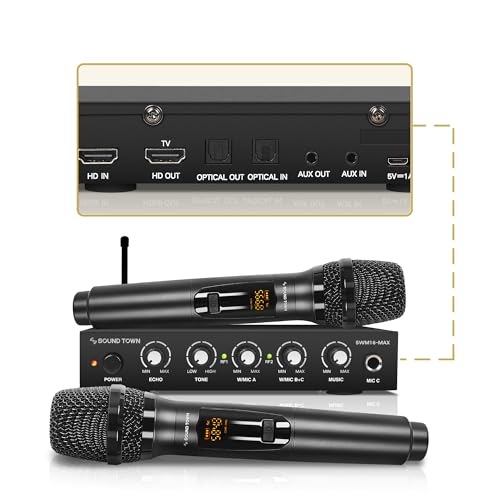
Sound Town Wireless Microphone Karaoke Mixer System (SWM16-MAX) — Best for Smart TV and Soundbar
Not every household can — or should — build an amplifier system, and the Sound Town SWM16-MAX is the answer for the modern living room as it actually exists: a smart TV and a soundbar. This wireless microphone karaoke mixer system connects between the TV and the soundbar using HDMI audio return or optical, takes the TV’s karaoke app audio, mixes in two wireless handheld microphones with echo, and passes the combined sound to the soundbar you already own. It is the KTV idea translated for the soundbar era: the voice-first mixing philosophy, without a single new speaker or amplifier entering the house.
Strengths
- Works with the TV and soundbar you already own — no amplifier or speakers to buy
- HDMI ARC and optical connections keep the TV audio digital and simple
- Wireless microphones mean no cable trip hazards across the living room
Trade-offs
- Your sound ceiling is your soundbar’s — it will not match a real speaker system
- Two microphones is the limit; the big group nights belong to the amplifier picks
- Voice processing is simpler than the KTV flagships’ — good echo, less polish
Key specs: Wireless microphone karaoke mixer system with HD audio return channel, optical (Toslink) and AUX connections, supporting smart TV, media box, PC, Bluetooth and soundbar setups
The setup is an evening’s small project: TV audio out to the mixer system, mixer out to the soundbar, microphones paired, echo set to taste. From then on, any karaoke app or YouTube karaoke library on the TV becomes a sing-along with real microphones and balanced voices, which is ninety percent of the KTV experience at a fraction of the footprint. This is also the renter’s and the apartment’s pick — nothing to mount, nothing heavy to move, and the whole system can live in a drawer between parties. Households that discover they sing every week can graduate to an amplifier later with no regret; households that sing monthly will find this was the right size all along.
Best for: apartment and soundbar households, renters, and casual-but-regular karaoke nights / Not suited for: anyone building a dedicated KTV room or needing more than two microphones
Check on Amazon — check the current price on Amazon before you buy.

Rybozen Wireless Microphone Karaoke Mixer System — Best Budget Portable
The Rybozen system is where many households start, and its design explains its popularity: a compact mixer box and two wireless handheld microphones that connect, by HDMI or AUX, to a smart TV, a PC, a powered speaker or an existing amplifier. It asks for nothing you do not already have and travels anywhere — the listing’s own suggested venues, from home karaoke to church and weddings, tell the story of a genuinely portable system. The echo control gives voices the karaoke lift, the wireless mics keep the floor clear, and the whole kit packs into a small bag, which makes it the pick for karaoke that happens in different places rather than in one dedicated room.
Strengths
- Connects to nearly anything — TV, PC, powered speaker or amp — by HDMI or AUX
- Fully portable: the whole system travels in a small bag
- Dual wireless microphones included, so the box price is the whole price
Trade-offs
- Sound quality rides on whatever it is plugged into — a TV speaker will sound like a TV speaker
- Basic voice processing compared with the KTV specialist amplifiers
- Battery discipline is part of ownership — wireless mics need charging or fresh cells before a party
Key specs: Wireless microphone karaoke mixer system with dual handheld wireless microphones, supporting HDMI and AUX connections for TV, PC, speaker and amplifier
Judge this system by the job it is for: making karaoke happen, easily, in the rooms life actually provides. Plugged into a decent powered speaker it sounds genuinely good; plugged into a TV alone it sounds like a TV, but the singing is still fun, the voices are still balanced against the music, and the party still works — which is more than a phone app and a Bluetooth speaker ever manages. It is also the natural gift and gateway pick: the household that sings monthly on a Rybozen and loves it is the household that will one day build the KTV room around a Singtronic. Every tradition needs its doorway, and this is this one’s.
Best for: beginners, portable karaoke, gatherings and anyone testing whether karaoke sticks / Not suited for: dedicated rooms, big groups, or singers who want flagship voice polish
Check on Amazon — check the current price on Amazon before you buy.
Comparison Table
| Pick | Badge | Key spec | Best for |
|---|---|---|---|
| Singtronic KA-1000Pro 2000W Professional Karaoke Mixing Amplifier | Best Overall | Professional karaoke mixing amplifier with optical input, Bluetooth send/receive, USB/MP3 playback, EQ and BBE sound enhancer | A serious home KTV setup for a living room or dedicated karaoke room |
| Singtronic KA-3000ProII 3000W Karaoke Mixing Amplifier | Best Premium | Professional karaoke mixing amplifier console with HDMI ARC, 8-band EQ, USB recording, Bluetooth and optical input | Large rooms, serious KTV hosts and singers who record their sessions |
| IDOLpro IP-4000 3000W Console Mixing Amplifier | Best for Recording and Control | Professional console mixing amplifier with recording, Bluetooth, HDMI/ARC and optical connections | KTV hosts who want console-style control and recording in one unit |
| Rockville SINGMIX 5 V2 Bluetooth Karaoke Amplifier Mixer | Best Value Amplifier | Karaoke amplifier mixer receiver with optical and coaxial inputs, USB/SD, 5 mic inputs and A/B zone selection | Households that want a real karaoke amp with modern connections at a value-first budget |
| Sound Town Wireless Microphone Karaoke Mixer System (SWM16-MAX) | Best for Smart TV and Soundbar | Wireless microphone karaoke mixer system with HD audio return channel, optical (Toslink) and AUX connections, supporting smart TV, media box, PC, Bluetooth and soundbar setups | Karaoke without an amplifier — TV plus soundbar households |
| Rybozen Wireless Microphone Karaoke Mixer System | Best Budget Portable | Wireless microphone karaoke mixer system with dual handheld wireless microphones, supporting HDMI and AUX connections for TV, PC, speaker and amplifier | The lowest-friction start: karaoke at home, church, weddings and gatherings, anywhere |
How to Choose the Best Asia Karaoke Mixers for Your Room and Singers
The first decision is architectural: amplifier or overlay? An amplifier system — the Singtronic, IDOLpro and Rockville picks — means passive speakers, a fixed place in the room, and sound quality with a ceiling far above any soundbar. An overlay system — the Sound Town and Rybozen picks — means your existing TV and speaker do the heavy lifting and the mixer only adds voices. Choose the amplifier if karaoke is a weekly ritual, if your room seats a crowd, or if singers in the house care how they sound. Choose the overlay if karaoke is a monthly joy, if the room is small or rented, or if the budget must stay in one small box. Neither answer is the lesser one; the wrong answer is the system whose size does not match the ritual.
The second decision is the music source, because it dictates connections. Modern KTV runs on smart TV apps and streaming karaoke libraries, so the TV’s audio must reach the mixer digitally — optical or HDMI ARC — and every pick in this guide offers at least one of those, which is deliberate. Households with a dedicated karaoke player or a laptop library should check for the analog and USB paths as well; the flagship amplifiers cover those too. The third decision is microphone count, and it is a social question disguised as a spec: two mics suit couples and small families, while the big Asian karaoke night — the one with aunties duetting and kids chorusing — wants four or five inputs, which only the amplifiers here provide.
Finally, budget honestly for the whole system, not the box. An amplifier without speakers is a promise, not a product: reserve a real share of the budget for a pair of karaoke speakers, which are voiced differently from hi-fi speakers — tougher, more forward in the vocal range, built to be sung over at volume. Microphones matter next; the wireless sets included with the overlay systems are conveniences, while amplifier buyers should plan on decent wired or wireless mics as a line item. A balanced system — good amp, good speakers, decent mics — beats a flagship amp driving bargain speakers every night of the week.
Echo, Reverb and Key Control: The Three Voice Tools That Define KTV
Echo is the sound of karaoke itself — the repeating, decaying repeat of the voice that makes a bathroom singer sound like a stage singer. In the KTV tradition it is applied generously, and every system here has it; the skill is dosing it. Too little and voices sound exposed and dry; too much and words blur into soup. The test is a familiar song sung at party volume: the echo should be obvious in the pauses and invisible during the lines. Reverb is echo’s smoother cousin — the sense of a room around the voice — and the flagship amplifiers blend the two, which is a large part of why their voices sound expensive. Set the blend once for your room and write the setting down; rooms do not change, and neither should the setting.
Key control is the feature outsiders underestimate and KTV singers consider non-negotiable. It moves the song’s pitch up or down in semitones without changing its tempo, so a song recorded for a high voice becomes singable for a low one. On systems and players that offer it, it lives on the music side rather than the microphone side — check your karaoke app or player for it, and learn the household’s common adjustments: many singers live permanently at minus two. A host who can offer a struggling singer a key change instead of a song change is a host whose karaoke nights include everyone, and that inclusiveness is the entire social point of the tradition.
Speakers and Microphones: Completing an Amplifier System
Karaoke speakers are a distinct species. They are built to project vocals clearly at party volume for hours, to survive the occasional dropped microphone’s feedback squeal without complaint, and to present the singer’s voice forward in the mix rather than wrapping it in hi-fi warmth. When pairing with the amplifiers in this guide, match the speaker’s power handling to the amplifier’s class with headroom to spare, and favor the karaoke-market speakers the same specialist ecosystem sells — they are voiced for exactly these amps. Placement matters as much as purchase: speakers at ear height when standing, angled slightly toward the singing area, and never directly behind the microphones, which is where feedback is born.
Microphones divide into the wired faithful and the wireless convenient. Wired dynamic mics are the KTV room standard — indestructible, feedback-resistant, always ready — and a pair of decent ones is the highest-value accessory an amplifier buyer can add. Wireless systems trade a little of that bulletproofing for freedom of movement, which matters in rooms where singers perform rather than stand. Either way, buy microphones with the singer in mind: a mic that feels good in the hand, with a switch the singer controls, will be used more and feared less than a technically finer mic that feels like equipment. In karaoke, confidence is a sound quality.
Running the Night: KJ Habits That Make Any System Sound Better
The KJ — the person running the karaoke system — is the invisible performer of every great KTV night, and their habits matter more than any model number. The first habit is the sound check with a real song, sung by a real volunteer, before the room fills: levels set against a recording alone will be wrong in both directions once voices and bodies arrive. The second habit is riding the balance song by song rather than setting it once — a ballad wants the voice well on top, a group anthem wants the music up and the microphones blended into the chorus, and the KJ who adjusts between songs is doing the job the equipment was bought to enable.
The third habit is queue kindness: alternating strong and shy singers, slipping a group song in when energy dips, and having a key change ready when a singer is straining — two semitones down has saved more performances than any microphone. The fourth habit is technical invisibility: spare batteries charged, a wired microphone ready as the wireless backup, the next song loading while the current one plays. Guests should experience a night of singing, not a night of watching someone troubleshoot, and the difference is entirely in these preparations.
Finally, the KJ protects the equipment without protecting it from the party. Microphones will be swung, drinks will be near speakers, someone will shout into a channel set for a whisperer. A hand on the master volume during the wild moments and a calm word about the dropped-mic rule at the start of the night prevent nearly all of it. The systems in this guide are built for real rooms and real celebrations; the KJ’s job is simply to meet them halfway.
How to Set Up a Home KTV System, Step by Step
From boxes to the first song, in the order that avoids the usual troubleshooting spiral. Written for the amplifier picks; the overlay systems follow the same logic with fewer cables.
- Place the speakers first: ear height for a standing singer, angled toward the singing area, clear of the wall behind the microphones. Speaker placement decided now prevents feedback problems later.
- Connect the speakers to the mixing amplifier with proper speaker cable, keeping left and right consistent and the runs as short as the room allows.
- Connect the TV or karaoke player to the amplifier digitally — HDMI ARC if both support it, optical otherwise — and set the TV’s audio output to that path. Play a song and confirm music alone sounds right before any microphone is connected.
- Plug in the microphones, one at a time, with all levels down. Raise each mic channel slowly while speaking and then singing at real party volume, stopping well before any hint of feedback ringing.
- Set the echo: sing a familiar line, and adjust until the repeats are clear in the pauses but do not blur the words. Then blend in reverb, if your amp separates them, until the voice sounds placed in a room rather than pasted on.
- Balance music against voice with a song everyone knows. The singer should be clearly on top; if the room is shouting requests over the music, the music is too loud, and if the singer sounds lonely, it is too quiet.
- Run one full song as a dress rehearsal, with a second person at the amp making small adjustments. Write down the final settings — KTV hosts keep a settings card for exactly this reason.
- Charge or check the microphone batteries, put the song library on the TV’s home screen, and declare the room open. The first song of the night belongs to the host; tradition is tradition.
Common Buying Mistakes
Buying an amplifier and driving hi-fi speakers at party volume. Karaoke is hard duty — sustained loud vocals, feedback squeals, dropped-mic thumps. Home hi-fi speakers are not built for it and can be damaged by it. Karaoke speakers exist for this duty and are voiced for voices besides.
Running the TV’s sound through an analog cable when a digital path exists. The TV is the music library now. Optical or HDMI ARC gives the mixer the clean digital feed; a headphone-jack cable adds hiss, hum and a volume mismatch that no knob fully cures. Every pick in this guide offers a digital path — use it.
Setting echo by talking instead of singing. Echo that sounds subtle under speech blooms under a sustained sung note. Always set voice effects with an actual song at actual volume, ideally with the household’s most enthusiastic singer as the test instrument.
Judging a system in an empty, silent room at low volume. Karaoke happens loud, in a full room, over laughter. A system balanced for silence will be buried at the party. Set levels at party volume with people-shaped absorption in the room — or accept one adjustment round when the guests arrive.
Chasing headline wattage numbers. Karaoke amplifier wattage claims are marketing size classes, not laboratory measurements, and they vary wildly between brands. Room size, speaker match and voice processing decide real performance. Buy the class that fits your room from a brand the KTV market trusts.
Final Recommendation
For the household building a true home KTV, the Singtronic KA-1000Pro is the balanced answer — modern connections, specialist voice handling and a power class matched to real living rooms — and the KA-3000ProII is its flagship sibling for big rooms and recording singers, with the IDOLpro IP-4000 as the console-format alternative at the same level. The Rockville SINGMIX 5 V2 is the value route into amplifier karaoke, especially for big groups of singers. And for the soundbar living room, the Sound Town system brings the KTV idea home with no new speakers, while the Rybozen remains the portable, budget doorway into the whole tradition.
Sound for gatherings is a theme across this program’s mixer guides: Best And Easy Photo And Sound Mixers covers the small boards for narration and event sound, Best Affordable Sound Mixers stays at the friendly end of live sound, Best 8 Channel Mixers With Echo And Eq explores the echo-equipped boards singers also love, and Best Analog Mixers For Live Sound is the next step when karaoke nights grow into events. Whichever rung you start on, remember the tradition’s priority: the singer is the main event, the equipment is there to make them brave — set the echo kindly, keep the key control ready, and the room will sing.
Ready to start? The three picks most readers should look at first are Singtronic KA-1000Pro 2000W Professional Karaoke Mixing Amplifier, Singtronic KA-3000ProII 3000W Karaoke Mixing Amplifier and IDOLpro IP-4000 3000W Console Mixing Amplifier — check the current price on Amazon for each and choose by the badge that matches your need.
Frequently Asked Questions
What makes a karaoke mixer ‘Asian style’ or KTV grade?
It comes from the KTV tradition: a mixing amplifier built voice-first, with multiple microphone inputs, generous echo and reverb tuned for singing, key-control-friendly music handling, and enough power for a room — rather than a novelty box with one mic and a speaker. The specialist brands, Singtronic and IDOLpro above all, build for the Asian and Asian-American KTV market where karaoke is a central social ritual, and their equipment reflects decades of that specific feedback.
Do I need separate speakers with a karaoke mixing amplifier?
Yes. The Singtronic, IDOLpro and Rockville picks are amplifiers: they power passive speakers, which are a separate purchase, and they contain no speaker of their own. Budget for a pair of karaoke speakers — they are voiced and built for loud singing duty in a way hi-fi speakers are not. If you do not want speakers at all, the Sound Town and Rybozen systems in this guide are designed to work through your existing soundbar or powered speaker instead.
How do I connect a smart TV to a karaoke amplifier?
Digitally. If the amplifier and TV both support HDMI ARC, one HDMI cable carries the TV’s audio to the amp. Otherwise, an optical (Toslink) cable does the same job. Set the TV’s sound output to the external path, run your karaoke app or streaming library on the TV, and the amplifier handles the music from there while the microphones mix on top. Avoid the TV’s headphone jack — it is the hiss-prone, level-mismatched path of last resort.
What is key control and do I need it?
Key control shifts a song’s pitch up or down without changing its speed, so songs sit in each singer’s comfortable range. In KTV culture it is considered essential hospitality — it is how a host keeps every guest singing. It usually lives in the karaoke player or app rather than the amplifier, so check your music source for it. If your household sings from an app without key control, choosing songs in singable keys matters more, and the singers will quietly thank the host who keeps a list.
Can I record our karaoke sessions?
With the flagship amplifiers, yes — the Singtronic KA-3000ProII and the IDOLpro IP-4000 both offer USB recording that captures the mixed performance: voice with its echo, music in balance, exactly as the room heard it. It is one of the most-loved features in the tradition, because playback is half the party. The smaller systems do not record on their own; a phone recording of the room is the casual alternative there.
Wired or wireless microphones for home KTV?
Wired dynamic microphones are the room standard for a reason: they never need charging, resist feedback well and survive drops. Wireless microphones suit performers who move, rooms where cables would cross walkways, and the overlay systems in this guide, which include them. Many serious home setups own both — wired for the main two positions, wireless for the roaming singer. What matters most is that the mics feel good in the hand; a confident singer sounds better on any microphone.
What songs and apps work with these systems?
Any source the TV or player can play. In practice, households sing from karaoke apps and streaming video libraries on the smart TV — the TV sends its audio to the mixer or amplifier over HDMI ARC or optical, and the microphones mix on top. Dedicated karaoke players with their own song libraries connect the same way and often add the key control and scoring features the apps vary on. The mixer does not care where the music comes from; its job begins where the music and the voices meet.


