Disclosure: airfryerkitchensupply.com is reader-supported. When you buy through links on our site, we may earn an affiliate commission at no extra cost to you.
Where to buy
Every pick in this guide to best and cheapest single serve coffee makers is sold through Amazon, and each name below links to its live listing so you can check the current price on Amazon and confirm the exact configuration before you buy. Listings in this category change often, so use the links rather than searching the model name alone, which can surface older versions and third-party bundles.
- Elite Gourmet 14 oz Single-Serve Coffee Maker — Best Overall Cheap Single Serve. Check the current price on Amazon.
- Mixpresso Single Serve Coffee Maker — Best with Travel Mug Included. Check the current price on Amazon.
- Hamilton Beach The Scoop Single Serve — Best Pod-Free Value. Check the current price on Amazon.
- Tastyle Mini Single Serve Coffee Maker — Best Cheap Pods-or-Grounds. Check the current price on Amazon.
- Keurig K-Mini Single Serve Coffee Maker — Best Compact Name Brand. Check the current price on Amazon.
- AeroPress Original Coffee Press — Cheapest No-Electric Option. Check the current price on Amazon.
The best and cheapest single serve coffee makers solve a specific equation: one person, one cup, minimum money, both for the machine and for every cup after it. That second half is where most cheap single-serve shopping goes wrong. A bargain pod machine looks like the answer until the pods turn a cheap appliance into the most expensive coffee habit in the kitchen, one plastic cup at a time.
So this guide is built on a rule: five of the six picks brew loose grounds, which cost a fraction of pods per cup, and the one pod machine included, the Keurig K-Mini, is here honestly as the compact name-brand benchmark for buyers who have weighed the pod cost and accept it. The grounds picks span a 600W mini brewer, a travel-mug bundle, a scoop-filter machine with no consumables at all, a pods-or-grounds flexible mini, and a manual press that needs no electricity. All were verified feed.
If you are a solo drinker in a dorm, a small apartment, an office, or an RV, this is your category, and the good news is that cheap here does not mean miserable. It means simple, and simple, fresh coffee is a perfectly good morning.
In this guide
Quick Picks
Best Overall Cheap Single Serve — Elite Gourmet 14 oz Single-Serve Coffee Maker: Elite Gourmet’s little single-serve is one of the cheapest electric coffee makers worth owning: a 600W brewer that makes a 14 oz cup from loose grounds in its reusable filter, with one-touch operation and a footprint small enough for a dorm shelf or an RV counter. Check the current price on Amazon.
Best with Travel Mug Included — Mixpresso Single Serve Coffee Maker: The Mixpresso is the no-nonsense budget single-serve: grounds only, a reusable filter, one-touch brewing, and a 14 oz travel mug in the box so the whole setup is ready for a commute the day it arrives. Check the current price on Amazon.
Best Pod-Free Value — Hamilton Beach The Scoop Single Serve: The Scoop is the pod-free answer: its filter is a stainless scoop you fill with your own grounds, so there is nothing proprietary to buy, ever. Check the current price on Amazon.
Best Cheap Pods-or-Grounds — Tastyle Mini Single Serve Coffee Maker: The Tastyle Mini covers both worlds at a budget tier: it takes K-Cup pods and loose grounds, brews 6 to 14 oz, and makes hot or iced coffee, in a mini body aimed at travel, RVs, dorms, and desks. Check the current price on Amazon.
Best Compact Name Brand — Keurig K-Mini Single Serve Coffee Maker: The K-Mini is the smallest, simplest Keurig: add water for one cup, insert any K-Cup pod, and brew 6 to 12 oz, with cord storage that makes it a genuine grab-and-go appliance. Check the current price on Amazon.
Cheapest No-Electric Option — AeroPress Original Coffee Press: The AeroPress is the manual alternative that made a generation of coffee drinkers question why they owned a machine at all. Check the current price on Amazon.
How These Picks Were Chosen
Every machine in this guide had to pass the same three filters. First, it had to be a real, currently listed product whose details could be verified against Amazon’s catalog feed; machines that could not be verified were not linked, full stop. Second, it had to serve the specific promise of best and cheapest single serve coffee makers, not merely be a good coffee maker in the abstract, which removed several famous names whose strengths lie elsewhere. Third, its trade-offs had to be survivable for its intended buyer, because a guide that hides weaknesses is advertising, not advice.
Within those filters, the picks were ranked by the quality that matters most for this brief, then stress-tested against the everyday questions owners actually ask: How does it behave on a rushed Tuesday? What does it cost to run for a year? What breaks, and can it be replaced? What does the second cup taste like? The badges in the Quick Picks are the compressed answers to those questions, and the full reviews below exist so you can audit them. Where two machines were close, the tie went to the one with the simpler ownership story, because daily appliances are kept or discarded on exactly that basis.
A final note on what this guide does not do. It does not print prices, because prices in this category move constantly and a printed figure would mislead you within weeks; each pick links to its live listing so you can check the current price on Amazon yourself. It avoids volatile figures for the same reason. What it prints instead is verified product information, honest strengths and weaknesses, and verdicts written to be useful even when they argue against a purchase.
The 6 Best And cheapest single serve coffee makers

Elite Gourmet 14 oz Single-Serve Coffee Maker — Best Overall Cheap Single Serve
Elite Gourmet’s little single-serve is one of the cheapest electric coffee makers worth owning: a 600W brewer that makes a 14 oz cup from loose grounds in its reusable filter, with one-touch operation and a footprint small enough for a dorm shelf or an RV counter. It asks almost nothing of the user and almost nothing of the budget.
Who it suits is easy to state: this machine is built for students, RVers, and anyone needing the cheapest personal brewer. Just as clearly, it is a poor match if you are households or coffee hobbyists. Neither fact is a criticism. The category is wide precisely because households are different, and this pick makes no attempt to be the answer for everyone. What it attempts, and achieves, is to be the complete answer for its particular drinker.
Strengths
- Among the lowest-cost electric brewers available
- Reusable filter means no ongoing pod spend
- Tiny footprint, simple one-touch use
Trade-offs
- 600W brew is slower than bigger machines
- One 14 oz cup per cycle, no reservoir
- Minimal features and basic build
| Specification | Detail |
|---|---|
| Capacity | 14 oz per brew |
| Format | Single serve, grounds only |
| Key feature | 600W compact brewer |
| Extras | Reusable filter included |
At the very bottom of the price ladder, most machines are effectively disposable, with weak heaters and bitter, thin output. This one earns its place by keeping the fundamentals intact: enough power to brew hot, a basket that holds a real dose, and a fast cycle that suits a single commuter cup. It will not produce cafe nuance, and it makes exactly one cup at a time, but as a personal brewer for a bedroom, office, or small apartment, it delivers the core promise, hot coffee from your own grounds, at close to the lowest cost of entry in this guide.
For shoppers whose search started with best and cheapest single serve coffee makers, this pick earns its place by answering the brief directly rather than approximately. It does not ask you to change your household, your schedule, or your taste to suit the machine; it fits the routine that sent you looking in the first place. That fit, more than any single feature, is what separates the machines people keep for years from the ones quietly replaced within a season, and it is why this one survived the cut while better-known names did not.
Ownership is undemanding in the ways that matter. The water path descaless like any drip machine, with a vinegar or descaler cycle on a monthly rhythm in hard-water homes, and the removable parts rinse clean in the sink. Keep the filter fresh, keep the carafe washed rather than merely rinsed, and the machine will hold its performance for years. None of the picks in this guide requires proprietary cleaning products, and that is a deliberate selection criterion, not an accident.
Best for: students, RVers, and anyone needing the cheapest personal brewer / Not suited for: households or coffee hobbyists.
Check on Amazon to see the live listing and check the current price before you decide.

Mixpresso Single Serve Coffee Maker — Best with Travel Mug Included
The Mixpresso is the no-nonsense budget single-serve: grounds only, a reusable filter, one-touch brewing, and a 14 oz travel mug in the box so the whole setup is ready for a commute the day it arrives. There are no pods, no apps, and no settings to learn. It is built for one job, a fast personal cup at the lowest sensible tier.
Who it suits is easy to state: this machine is built for commuters, students, and desk setups on a tight budget. Just as clearly, it is a poor match if you are pod loyalists or multi-cup households. Neither fact is a criticism. The category is wide precisely because households are different, and this pick makes no attempt to be the answer for everyone. What it attempts, and achieves, is to be the complete answer for its particular drinker.
Strengths
- Travel mug included, ready to use out of the box
- Reusable filter, grounds only, no pod costs
- One-touch operation, compact footprint
Trade-offs
- One cup at a time, modest water capacity
- No pod compatibility at all
- Basic materials reflect the budget tier
| Specification | Detail |
|---|---|
| Capacity | 14 oz travel mug included |
| Format | Single serve, grounds only |
| Key feature | Reusable filter basket |
| Extras | One-touch brewing |
Cheap single-serve machines live or die on whether the cup tastes like coffee or like hot water that met coffee briefly. The Mixpresso does respectably here because the reusable basket holds a proper dose and the brew cycle is not rushed. The included travel mug matters more than it sounds: it is sized to the machine, fits the drip tray height, and removes the one accessory purchase that usually follows a budget buy. Dorm rooms, first apartments, workshop benches, and office desks are its natural habitat, anywhere a personal cup matters more than a shared pot.
Considered against the specific promise of best and cheapest single serve coffee makers, this is one of the picks that understands the assignment. Plenty of machines are good in the abstract and wrong for this brief in particular, too big, too locked-in, too slow, or too expensive to run. This one was chosen because its strengths land exactly where this category’s buyers feel the difference daily, in the cup, in the routine, and in the running cost that follows the purchase home.
Day to day, living with this machine is mostly about two small habits: fresh water in, and a quick rinse of the brew basket out. Coffee oils are the enemy of every brewer in this guide, turning sweet cups stale-tasting if they are allowed to build up on baskets and carafe walls. A minute of rinsing after the morning pot prevents the problem entirely. Descaling follows the standard rhythm for the category, and replacement parts, where they exist, are standard rather than exotic.
Best for: commuters, students, and desk setups on a tight budget / Not suited for: pod loyalists or multi-cup households.
Check on Amazon for the live listing, current configuration, and today’s price.

Hamilton Beach The Scoop Single Serve — Best Pod-Free Value
The Scoop is the pod-free answer: its filter is a stainless scoop you fill with your own grounds, so there is nothing proprietary to buy, ever. It brews 8 to 14 oz in minutes, adjusts for a mug or a travel tumbler, and offers regular and bold settings. It is the cheapest possible route out of the pod ecosystem because the consumable is just coffee.
Who it suits is easy to state: this machine is built for pod-weary drinkers who want the lowest running cost per cup. Just as clearly, it is a poor match if you are anyone who values zero-effort mornings above all. Neither fact is a criticism. The category is wide precisely because households are different, and this pick makes no attempt to be the answer for everyone. What it attempts, and achieves, is to be the complete answer for its particular drinker.
Strengths
- No pods to buy; uses any loose grounds
- Brews in minutes, mug or travel tumbler sizes
- Bold setting and adjustable cup rest
Trade-offs
- Scoop-and-rinse routine for every cup
- Single cup at a time, small reservoir logic
- Grounds quality depends on your coffee and dose
| Specification | Detail |
|---|---|
| Capacity | 8 to 14 oz per brew |
| Format | Single serve, grounds only |
| Key feature | Built-in stainless scoop filter |
| Extras | Regular / Bold settings |
Every pod machine rents you your own coffee habit back, one plastic cup at a time. The Scoop ends that arrangement with a mesh scoop that rinses clean in seconds. The honest trade is a little more effort per cup: you scoop, you brew, you rinse. In exchange, any coffee in the house works, grind and dose are yours to adjust, and a weak cup is fixed by adding grounds rather than buying a different pod variety. For offices, dorms, and rental kitchens where pods pile up in the trash, it is a small machine with an outsized effect on both cost and waste.
There is a temptation, shopping for best and cheapest single serve coffee makers, to treat every well-reviewed machine as interchangeable. This pick is the counter-argument. Its design choices point in one clear direction, and if that direction matches your household, it will feel less like a compromise than any rival at its tier. If it does not match, the verdict line below says so plainly, because a guide that recommends everything to everyone is not a guide at all.
Maintenance deserves a plain statement here: this machine rewards the same basic care as every pick in the guide and punishes neglect the same way too. Descale before the brew slows, not after; wash the carafe with soap weekly rather than relying on a rinse; and store the machine with its lid open so it dries fully. Follow that short list and there is very little to go wrong, which is precisely what a daily appliance should offer.
Best for: pod-weary drinkers who want the lowest running cost per cup / Not suited for: anyone who values zero-effort mornings above all.
Check on Amazon to confirm the exact model and check the current price on the live listing.
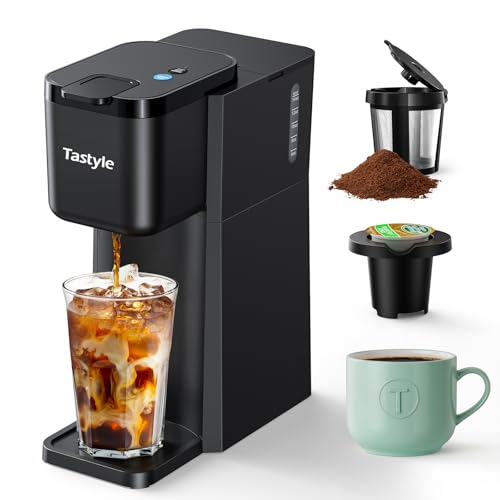
Tastyle Mini Single Serve Coffee Maker — Best Cheap Pods-or-Grounds
The Tastyle Mini covers both worlds at a budget tier: it takes K-Cup pods and loose grounds, brews 6 to 14 oz, and makes hot or iced coffee, in a mini body aimed at travel, RVs, dorms, and desks. A recipe book in the box nudges new owners past plain black coffee, which is a thoughtful touch in a category that usually ships a machine and nothing else.
Who it suits is easy to state: this machine is built for travelers and dorm residents wanting one flexible cheap brewer. Just as clearly, it is a poor match if you are heavy daily use in a family kitchen. Neither fact is a criticism. The category is wide precisely because households are different, and this pick makes no attempt to be the answer for everyone. What it attempts, and achieves, is to be the complete answer for its particular drinker.
Strengths
- Pods and grounds, hot and iced, in one mini machine
- 6 to 14 oz brew sizes for mugs and travel cups
- Compact enough for RV, dorm, and desk use
Trade-offs
- Budget construction and small water capacity
- Slower than full-size single-serve machines
- Jack-of-all-trades rather than best at any one format
| Specification | Detail |
|---|---|
| Capacity | 6 to 14 oz per brew |
| Format | Single serve, K-Cup pods or grounds |
| Key feature | Hot and iced brewing |
| Extras | Recipe book included |
Flexibility is the whole argument for this machine. A traveler can run a pod at a rental and grounds at home; a dorm resident can make iced coffee in August and hot coffee in January without a second appliance. Brew sizes cover a small mug through a tall travel cup, and the mini footprint genuinely fits the spaces it advertises. It is not built like a premium countertop machine, and heavy daily multi-cup use will expose its budget origins, but as one inexpensive brewer that refuses to lock you into a single format, it is hard to beat.
What keeps this machine on a best and cheapest single serve coffee makers shortlist, when so many rivals fell off it, is the absence of a deal-breaking weakness for its intended buyer. It may not lead the field on every measure, and the trade-offs below are stated without softening, but for the household described in its verdict it strings together the right strengths in the right order. That is a rarer quality in this category than marketing departments would like you to believe.
One ownership note worth making explicit is that this machine uses standard, widely available consumables, so there is no supply chain between you and your morning coffee. Filters, where it uses them, are the common sizes stocked everywhere, and the coffee itself can come from any roaster or grocery shelf. That independence is easy to overlook at purchase time and deeply appreciated in year two, when a proprietary format’s true cost has had time to make itself felt.
Best for: travelers and dorm residents wanting one flexible cheap brewer / Not suited for: heavy daily use in a family kitchen.
Check on Amazon for current availability and the live price on Amazon.

Keurig K-Mini Single Serve Coffee Maker — Best Compact Name Brand
The K-Mini is the smallest, simplest Keurig: add water for one cup, insert any K-Cup pod, and brew 6 to 12 oz, with cord storage that makes it a genuine grab-and-go appliance. It is included here honestly, as the compact name-brand benchmark in the cheapest single-serve class, for buyers whose priority is pod convenience in the least possible counter space.
Who it suits is easy to state: this machine is built for committed pod users with almost no counter space. Just as clearly, it is a poor match if you are anyone trying to cut per-cup cost or plastic waste. Neither fact is a criticism. The category is wide precisely because households are different, and this pick makes no attempt to be the answer for everyone. What it attempts, and achieves, is to be the complete answer for its particular drinker.
Strengths
- Extremely compact with cord storage
- One-cup reservoir, nothing stale or wasted
- Huge K-Cup variety available everywhere
Trade-offs
- Pods only; no grounds option
- Highest running cost per cup in this guide
- Plastic waste with every brew
| Specification | Detail |
|---|---|
| Capacity | 6 to 12 oz per brew |
| Format | Single serve, K-Cup pods |
| Key feature | Cord storage, travel-friendly size |
| Extras | One-cup reservoir design |
Judged purely as a small appliance, the K-Mini is well judged: it heats fast, the one-cup reservoir removes stale-water worries, and it disappears into a cabinet or a suitcase-adjacent corner when not in use. The costs are the familiar pod costs, in money per cup and in plastic per week, and there is no grounds basket to escape them. Buy it with open eyes if your household is committed to pods and space is the binding constraint; choose the grounds-capable rivals in this guide if running cost matters more than the logo.
Shoppers comparing options for best and cheapest single serve coffee makers will notice this pick recurring in conversations for a reason that has little to do with advertising: owners tend to keep it. Machines get replaced when a daily irritation compounds, a slow brew, a fragile carafe, a consumable that costs too much, and this design has systematically removed the irritations relevant to its class. Longevity of satisfaction, not launch-day excitement, is the metric this guide optimizes for.
Ownership is undemanding in the ways that matter. The water path descaless like any drip machine, with a vinegar or descaler cycle on a monthly rhythm in hard-water homes, and the removable parts rinse clean in the sink. Keep the filter fresh, keep the carafe washed rather than merely rinsed, and the machine will hold its performance for years. None of the picks in this guide requires proprietary cleaning products, and that is a deliberate selection criterion, not an accident.
Best for: committed pod users with almost no counter space / Not suited for: anyone trying to cut per-cup cost or plastic waste.
Check on Amazon to review the full listing details and check the current price.

AeroPress Original Coffee Press — Cheapest No-Electric Option
The AeroPress is the manual alternative that made a generation of coffee drinkers question why they owned a machine at all. It presses hot water through grounds and a paper micro-filter in about two minutes, producing a smooth, low-bitterness cup with almost no grit, then ejects the spent puck with a pop. It needs no power, fits in a drawer, and travels anywhere a kettle does.
Who it suits is easy to state: this machine is built for solo drinkers, travelers, and tinkerers who enjoy the ritual. Just as clearly, it is a poor match if you are anyone brewing for a family or wanting push-button ease. Neither fact is a criticism. The category is wide precisely because households are different, and this pick makes no attempt to be the answer for everyone. What it attempts, and achieves, is to be the complete answer for its particular drinker.
Strengths
- Superb smooth cup quality from a tiny, cheap device
- No electricity, near-indestructible, travels anywhere
- Ten-second cleanup with the ejectable puck
Trade-offs
- One cup at a time; not for groups
- Requires a kettle and two minutes of attention
- Results depend on your grind and technique
| Specification | Detail |
|---|---|
| Capacity | One generous cup per press (up to about 10 oz) |
| Format | Manual immersion press |
| Key feature | Paper micro-filter, 2-minute brew |
| Extras | Works for travel, camping, office |
Because immersion and pressure are both under your control, the AeroPress is endlessly tunable: grind finer for intensity, steep longer for sweetness, invert it to stop drips. That control is the hobby, and for many owners it is also the pleasure. The paper filter keeps the cup clean in a way French press cannot, and cleanup is genuinely a ten-second job. Its limits are scale and ritual: it makes one generous cup at a time, and it asks two minutes of your attention. As an alternative to an electric machine, for travel, camping, offices, and small kitchens, nothing else offers this much cup quality for this little money and space.
The honest way to evaluate this pick for best and cheapest single serve coffee makers is to imagine the fiftieth morning with it, not the first. The first morning flatters every machine. By the fiftieth, you know whether the reservoir is annoying, whether the carafe pours cleanly, whether the coffee still tastes like the reason you bought it. This machine was selected because its fiftieth morning holds up, and the sections below explain the specific design decisions that make that true.
Day to day, living with this machine is mostly about two small habits: fresh water in, and a quick rinse of the brew basket out. Coffee oils are the enemy of every brewer in this guide, turning sweet cups stale-tasting if they are allowed to build up on baskets and carafe walls. A minute of rinsing after the morning pot prevents the problem entirely. Descaling follows the standard rhythm for the category, and replacement parts, where they exist, are standard rather than exotic.
Best for: solo drinkers, travelers, and tinkerers who enjoy the ritual / Not suited for: anyone brewing for a family or wanting push-button ease.
Check on Amazon for the live listing and the current price in your region.
Comparison Table
The table compresses the six picks for best and cheapest single serve coffee makers into the four facts that separate them: what each is, the badge it earned, its defining specification, and the household it serves. Use it to narrow the field to two, then read those two full reviews before deciding.
| Pick | Badge | Key spec | Best for |
|---|---|---|---|
| Elite Gourmet 14 oz Single-Serve Coffee Maker | Best Overall Cheap Single Serve | 14 oz per brew | students, RVers, and anyone needing the cheapest personal brewer |
| Mixpresso Single Serve Coffee Maker | Best with Travel Mug Included | 14 oz travel mug included | commuters, students, and desk setups on a tight budget |
| Hamilton Beach The Scoop Single Serve | Best Pod-Free Value | 8 to 14 oz per brew | pod-weary drinkers who want the lowest running cost per cup |
| Tastyle Mini Single Serve Coffee Maker | Best Cheap Pods-or-Grounds | 6 to 14 oz per brew | travelers and dorm residents wanting one flexible cheap brewer |
| Keurig K-Mini Single Serve Coffee Maker | Best Compact Name Brand | 6 to 12 oz per brew | committed pod users with almost no counter space |
| AeroPress Original Coffee Press | Cheapest No-Electric Option | One generous cup per press (up to about 10 oz) | solo drinkers, travelers, and tinkerers who enjoy the ritual |
How to Choose a Cheap Single Serve Coffee Maker
Do the per-cup math before the per-machine math
A single-serve machine is a coffee subscription in disguise: whatever it eats, you buy forever. Grounds cost a few cents of coffee per cup in ordinary terms; pods multiply that several times over, every cup, for years. When two machines differ modestly in price but completely in format, the grounds machine is almost always the cheaper purchase within the first few months. This is why the pod pick in this guide is framed as a space purchase, not a savings purchase.
Match the brewer to your vessel
Single-serve machines live or die on a mundane detail: does your mug or travel tumbler physically fit, and does the brew size cover it? Check the listed brew range against your actual cup. The Mixpresso sidesteps the question by including its mug; the Scoop adjusts its cup rest; the Tastyle covers a wide 6 to 14 oz range. Nothing about a cheap machine is more annoying than a great cup that must be brewed in two cycles.
Decide how much morning effort you will really give
Grounds machines ask for a scoop and a rinse; the AeroPress asks for two minutes and a kettle. Pod machines ask for nothing. Be honest at the point of purchase, not optimistic, because the machine that matches your real grogginess level is the one still in use in six months. Every pick here is defensible; the wrong one is simply the one whose routine you quietly resent.
How to Get the Best Cup From a Cheap Single Serve
Step 1. Use fresh water for every brew and never top up yesterday’s reservoir remnants. Small reservoirs stale quickly, and stale water is the most common cause of a flat cup blamed on the machine.
Step 2. Dose generously. Single-serve grounds baskets are small, and a heaped scoop is usually the difference between a watery cup and a satisfying one. If the cup tastes thin, add coffee before blaming the brewer.
Step 3. Rinse the reusable filter immediately after brewing, while the grounds are still wet. Ten seconds now prevents the rancid-oil buildup that makes cheap machines taste cheap by month three.
Step 4. Run a plain hot-water cycle once a week if you use the machine daily, and descale monthly. Small heaters scale fast, and scale is the number one killer of budget single-serve machines.
Step 5. Let the cup rest one minute before drinking. Small machines brew fast and turbulent; a brief rest lets the temperature settle and the flavor open up noticeably.
Common Buying Mistakes
Choosing a pod machine to save money
This is the category’s signature error. The machine is cheap precisely because the pods are not. If saving money is the goal, the format decision matters more than the brand decision, and grounds win every time.
Buying a brewer your travel mug does not fit
Measure the mug, check the machine’s clearance and brew range, and only then order. Returns in this category are dominated by this single avoidable mismatch.
Neglecting the filter until the cup tastes wrong
Reusable filters clog gradually with coffee oils, slowing the brew and souring the flavor. By the time you taste it, the filter needs a deep soak. A quick rinse per cup prevents the whole problem.
Expecting espresso from a budget single serve
These machines make brewed coffee, not espresso, and no setting changes that. If espresso drinks are the goal, the honest cheap route is a manual press used strong, or saving toward a dedicated machine.
Getting the Most From Your Coffee Maker
Descaling is the maintenance that actually matters
Of everything owners are told to do, descaling is the one with mechanical consequences. Scale coats the heating element, the brew runs cooler and slower, extraction weakens, and eventually the machine fails in a way that looks like age but is really geology. The fix is a monthly or bimonthly cycle with vinegar solution or a descaler, run before symptoms appear. Set it with a recurring calendar note on the day the machine arrives. This single habit is the difference between the lifespan ranges quoted throughout this guide.
Your grinder, if you buy one, should outrank your next machine
Readers planning a second purchase after any pick in this guide should hear this plainly: a decent burr grinder improves the coffee from your current machine more than a second machine would. Even particle size means even extraction, and even extraction is most of what expensive brewers are engineered to protect. Buy the machine that fits your format and budget first, live with it for a season, and let the grinder, not another brewer, be the upgrade that follows.
Brew the batch size the machine was designed for
Every brewer in this guide has a volume it handles best, and it is rarely the smallest amount its carafe can hold. Baskets, showerheads, and heaters are tuned around a working range; far below it, water races through too little coffee or spreads too thin across the basket. If your household’s daily volume is half the machine’s capacity, use its small-batch mode if it has one, and if it does not, that mismatch is worth weighing at purchase time. The best cup a machine makes is the one at the volume it was built around, and choosing a machine whose home volume matches your mornings is a quiet, permanent quality upgrade.
Set up the counter so the routine runs itself
Machines get used daily when the routine around them is frictionless: the coffee stored beside the brewer, the filters in the same cabinet, the scoop living in the canister, a clear path to the sink for the rinse. Spend ten minutes arranging this once and every morning afterward is shorter. The reverse is also true, and it explains many abandoned machines: a brewer exiled to a far counter, with its supplies scattered across the kitchen, loses to any easier habit within a month. When you install a pick from this guide, install its ecosystem with it.
Know when to repair, descale, or replace
A coffee maker that slows down, brews cooler, or sounds strained is usually asking for a descale, not a replacement, and the descale should always be attempted first. A machine that leaks from its base, cycles its heater erratically, or needs a part that is no longer sold has reached an honest end. Between those poles sits the carafe question: a broken carafe on a healthy machine is a parts purchase, not a new machine. Working through that order, descale, repair, replace, saves most households at least one unnecessary purchase per machine lifetime.
Water does more of the work than the machine
It is unfashionable advice in a machine guide, but the water you brew with shapes the cup as much as the brewer does. Heavily chlorinated tap water flattens coffee; very hard water scales heaters and dulls extraction; very soft water can leave a cup tasting oddly empty. If your tap water tastes good on its own, it will make good coffee in any pick here. If it does not, a simple filter pitcher improves every machine in this guide at once, and reduces descaling frequency as a bonus. Fix the water before you blame the hardware.
Grind size is the free upgrade hiding in your kitchen
Most households buy pre-ground coffee ground for an average machine, which is to say, for no machine in particular. If your cup tastes sour and thin, the extraction is likely too fast; bitter and harsh suggests the opposite. Owners of grinders can tune this directly. Everyone else can still act on it: buy coffee ground for drip, use it within a few weeks of opening, and store it sealed away from heat and light. These habits cost nothing and improve every pick in this guide more than accessories costing real money.
The dose is a dial, not a rule
Guidelines like two tablespoons per mug are starting points for calibration, not commandments. Households differ in the strength they actually enjoy, and the honest method is to change the dose deliberately over a week: brew your normal pot, then one slightly stronger, then one slightly weaker, and notice which disappears fastest at the table. Once your household’s dose is found, write it down. Consistency, the same coffee made the same way, is what turns a good machine into your machine, and it is built from notes, not memory.
Freshness has a window, and it is shorter than the bag suggests
Coffee is at its best in the weeks after roasting, ground coffee declines within days of opening, and ground-per-cup freshness is the single largest gap between cafe coffee and home coffee. You do not need to chase roast dates obsessively to benefit: buy bag sizes your household finishes in two to three weeks, keep the bag sealed and cool, and resist stockpiling during sales. Every machine in this guide will taste like a tier above itself on fresh coffee, which is the cheapest upgrade available in the entire category.
Final Recommendation
If you buy one machine from this guide to best and cheapest single serve coffee makers, buy the Elite Gourmet 14 oz Single-Serve Coffee Maker: it is the pick whose strengths match the brief most completely, and the one most households will still be happy with years from now. If its particular trade-offs point away from your routine, the Mixpresso Single Serve Coffee Maker is the strongest alternative reading of the same brief, and the Hamilton Beach The Scoop Single Serve covers the households the first two leave out. Between the three of them, nearly every reader of this guide is honestly served.
The remaining picks are not runners-up so much as specialists. Each leads this guide for one household type, and the verdict lines in their reviews name that household exactly. Read the guide that way: find the verdict that describes your kitchen, your mornings, and your budget, and buy that machine with confidence. Then explore the related guides in this cluster to complete the picture: Best And Cheapest Coffee Makers, Best Alternatives To Keurig Coffee Makers, Best 1 Cup Coffee Makers, Best And Cheapest Small Coffee Makers, Best 12v Dc Coffee Makers.
Frequently Asked Questions
What is the cheapest single serve coffee maker to run?
The Scoop and the AeroPress tie in spirit: both use only loose coffee, with no pods and, for the Scoop, no paper filters at all. Their per-cup cost is simply the cost of the coffee you choose.
Are cheap single serve coffee makers any good?
For a fresh, simple cup, yes. The picks here brew hot and reasonably strong when dosed properly. They lack the consistency and features of premium machines, but a solo drinker using fresh grounds will be pleasantly surprised.
Should I buy the Keurig K-Mini as my cheap single serve?
Only if counter space and pod convenience outrank running cost for you. It is a well-made compact machine, but every cup costs pod prices. The grounds picks in this guide are cheaper to own within months.
How much coffee should I put in a single-serve grounds basket?
Fill the basket as directed, typically a heaped scoop for a full mug, and adjust by taste over a few days. Under-dosing is the most common reason cheap single-serve coffee tastes weak.
Can a cheap single serve make iced coffee?
The Tastyle Mini has a dedicated iced function. With the others, brew a strong, smaller cup directly over ice; the extra strength compensates for dilution as the ice melts.
What breaks first on a cheap single serve machine?
Usually the heater, from scale, which is preventable with monthly descaling. Seals and hinges follow. The manual AeroPress has essentially nothing to break, which is why it anchors the value end of this list.


