Disclosure: airfryerkitchensupply.com is reader-supported. When you buy through links on our site, we may earn an affiliate commission at no extra cost to you.
Where to buy
All six picks for the best all purpose blenders are sold on Amazon. All-purpose models are frequently sold in multiple colors and bundle variants under one name, so confirm the model number, jar size, and included accessories match the pick before ordering — with versatile machines the accessories are part of the value, and a listing missing the chopper or the personal jars is a different product at a deceptively similar name.
- Ninja Professional Plus Blender BN701 — Check the current price on Amazon
- Vitamix Propel Series 510 — Check the current price on Amazon
- Hamilton Beach Blender and Food Processor Combo 58163 — Check the current price on Amazon
- KitchenAid Pure Power Blender KSB2078 — Check the current price on Amazon
- Oster Vortex Plus Glass Blender 1200W — Check the current price on Amazon
- Ninja Professional Blender 2.0 BR201AMZ — Check the current price on Amazon
Introduction
The best all purpose blenders make a specific promise: one pitcher, on one base, that handles the whole ordinary map of blending — smoothies, soups, sauces, salsas, frozen drinks, batters — without a cupboard full of attachments or a second appliance for the jobs the first one cannot do. It is a narrower and more honest promise than the “kitchen system” idea, and for most households it is the right one: a single excellent vessel, mastered completely, beats a system whose extra parts live in a drawer.
This guide ranks that promise strictly. Every pick was verified against current manufacturer data — model, wattage, jar, controls, included vessels — and then judged on the breadth of its single-pitcher competence: frozen work, hot work, texture range from rustic salsa to silky soup, and the controls to move between them. The field spans a budget combo with a snap-on chopper to a premium compact from the benchmark brand, because “all purpose” is a job description, not a price point.
One boundary to draw at the start: all-purpose does not mean unlimited. Nut butters at volume, dough beyond small batches, and catering quantities live outside every pitcher here — the reviews say where each machine’s map ends. Within the map, though, these six are the blenders that ask for no help.
Reading the guide: start with the Quick Picks if your household type is obvious — big, small, budget, premium — and read the verdict line under each review to confirm the match. The middle sections exist for the undecided: a texture map that translates “all purpose” into specific recipes, a technique guide that shows how one pitcher covers them, and a maintenance calendar that shows what daily ownership actually asks. The goal is a purchase made on your kitchen’s evidence, not on a wattage arms race.
In this guide
Quick Picks
- Best Overall: Ninja Professional Plus BN701 — 1400 peak watts, a 72 oz pitcher, and Auto-iQ presets that cover smoothies to frozen drinks without supervision. Check price on Amazon
- Best Premium Compact: Vitamix Propel Series 510 — a 48 oz container, three programs, and Vitamix’s variable-speed authority in a smaller footprint. Check price on Amazon
- Best Budget Versatility: Hamilton Beach Combo 58163 — a 700W-peak base with a 40 oz glass jar, a 3-cup chopper attachment, and a travel cup. Check price on Amazon
- Best for Big Households: KitchenAid Pure Power KSB2078 — 1700 peak watts, a 68 oz jar, two personal jars, and a precision speed knob with a smoothie cycle. Check price on Amazon
- Best Mid-Range: Oster Vortex Plus 1200W — a 76 oz jar, four iBlend auto programs, reversible blades, and a Blend-N-Go cup. Check price on Amazon
- Best Smoothie-Leaning All-Purpose: Ninja Professional Blender 2.0 BR201AMZ — 1200W, a 72 oz pitcher, four speeds, and an Auto-iQ Crush program. Check price on Amazon
How These Picks Were Chosen
Verification came first — every pick’s identity and specifications were confirmed against current Amazon product data before it could be linked. Ranking then applied the all-purpose test in three passes.
Pass one, the breadth test: the machine had to credibly cover frozen drinks, smoothies with greens, hot soups in batches, sauces, and at least rough chopping work by pulse — the full ordinary map, in the pitcher. Pass two, the texture-range test: all-purpose means range, so we favored controls that span gentle to violent — variable dials, programmed cycles, reversible blades — over single-speed simplicity. Pass three, the ownership test: a do-everything blender is used daily, so jar replacement, blade assemblies, and brand support were required, not preferred.
Excluded: personal-only and smoothie-only specialists (they have their own guides in this series), systems whose versatility lives in a processor bowl rather than the pitcher (covered in our all-around guide), and any machine whose breadth claim depended on attachments sold separately.
Note what the test excluded by design: it did not reward the longest feature list. All-purpose credibility is demonstrated on recipes, not in menus — a machine with three well-chosen programs that map to real food (the Vortex Plus’s salsa cycle is the type specimen) outranks a machine with a dozen decorative ones. That discipline is why this list contains no touchscreen novelties and several comparatively plain machines whose plainness is the point.
The 6 Best All Purpose Blenders

1. Ninja Professional Plus Blender BN701 — Best Overall
The BN701 is the all-purpose benchmark of the mainstream tier: 1400 peak watts, a 72 oz pitcher with stacked Total Crushing blades, and three Auto-iQ presets that automate the pulse-pause patterns most recipes want. Its breadth is the pitcher’s breadth — family smoothies, frozen drinks, soups in batches, salsas by pulse, batters — executed with the headroom that keeps a daily machine unstrained.
Strengths
- 1400 peak watts handle the full ordinary map without strain
- Auto-iQ presets repeat smoothies and frozen drinks perfectly
- 72 oz pitcher covers family batches in one blend
Trade-offs
- No chopper or processor — salsa texture is by pulse and judgment
- Loud at full power
- Stacked blades demand careful washing
| Spec | Detail |
|---|---|
| Motor | 1400 peak watts |
| Pitcher | 72 oz |
| Programs | 3 Auto-iQ presets |
| Care | Dishwasher-safe parts |
The all-purpose case for the BN701 is consistency across unlike jobs. The same machine that produces a café-grade frozen smoothie at 7 a.m. purees a roasted-vegetable soup at noon and crushes ice for drinks at seven, with the presets enforcing a standard that does not depend on who is cooking. Its ceiling is the class ceiling — very thick, low-liquid work needs tamper-style patience it was not designed for — but the ordinary map is covered so completely that most households will never find the edge.
Its size deserves a practical note: the 72 oz pitcher is a family tool that also handles the small jobs better than most big pitchers, because the stacked blade column processes at several heights and a modest load still circulates. Solo households will nonetheless find a personal cup more convenient for the daily single smoothie — a format preference, not a capability gap, and one the BN751 in our all-around guide addresses directly.
If the brief is one pitcher that does everything a normal kitchen asks, this is the default answer, and the burden of proof is on every other pick to justify itself against it.
Best for: most households wanting one do-everything pitcher / Not suited for: cooks who need true food processing or daily nut-butter work

2. Vitamix Propel Series 510 — Best Premium Compact
The Propel 510 brings the benchmark brand’s virtues — variable speed authority, three programs, pulse, self-cleaning — into a 48 oz container sized for smaller households and counters. Its all-purpose claim is the Vitamix claim: whatever fits the container and pours, it blends better than anything else here, from green smoothies to hot soups to frozen desserts.
Strengths
- Vitamix variable-speed power in a compact 48 oz format
- Three programs plus pulse and self-cleaning
- The highest texture ceiling in this guide
Trade-offs
- Premium price for a mid-size container
- 48 oz is small for big-family batches
- Single format — no cups or chopper
| Spec | Detail |
|---|---|
| Container | 48 oz |
| Programs | 3 programs + pulse |
| Control | Variable speed |
| Care | Self-cleaning program |
The 48 oz size is a feature misread as a compromise: most all-purpose blending — smoothies for two, a sauce, a soup for four — happens at volumes where a smaller container vortices better than a cavernous one. The Propel’s programs handle the standards, its dial handles the exceptions, and its sustained power handles the recipes (thick, fibrous, low-liquid) that make mid-tier machines negotiate. For a small household that blends seriously every day, this is the endgame machine.
Its self-cleaning program is a small feature with outsized daily value on a do-everything machine: a drop of soap, warm water, thirty seconds, and the container that held a garlicky sauce is ready for a fruit smoothie. On an appliance used several times a day across flavor families, cleaning speed is not housekeeping — it is part of the all-purpose proposition itself.
Choose it when quality per blend outranks batch size, and when the budget is a decade-scale decision rather than a seasonal one.
Best for: small households wanting premium all-purpose performance / Not suited for: big-batch families or tight budgets
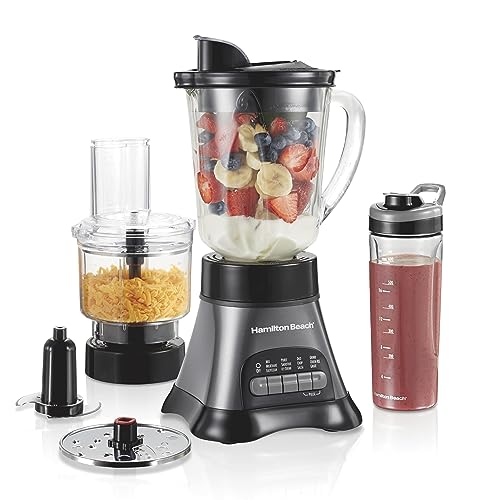
3. Hamilton Beach Blender and Food Processor Combo 58163 — Best Budget Versatility
Hamilton Beach’s combo is the budget tier’s all-purpose argument: a 700W-peak base, a 40 oz glass jar for blending, a 3-cup electric chopper attachment for the salsa-and-onion jobs a pitcher does badly, and a travel cup for solo shakes. It is the least expensive way in this guide to cover both blending and chopping with one motor.
Strengths
- Blender plus 3-cup chopper covers the two core prep formats
- Glass jar resists stains and odors
- Travel cup included for single servings
Trade-offs
- 700W peak is the modest end — frozen work needs technique
- Chopper is small-batch only
- 40 oz jar limits family batches
| Spec | Detail |
|---|---|
| Motor | 700 watts peak power |
| Jar | 40 oz glass |
| Chopper | 3-cup electric food chopper attachment |
| Also included | Blender travel cup |
The chopper is what elevates this from a budget blender to a budget all-purpose tool: onions, herbs, breadcrumbs, and salsa — the small chopping jobs that pitchers puree when you wanted them chopped — get their own vessel, and the main jar stays free for the liquids it is good at. Within its power tier, the honest technique rules apply (liquid discipline, pulsing, thawed-edge frozen fruit), and within those rules the combo covers a small household’s whole map at the guide’s friendliest price.
Its glass jar is the other quiet advantage at this price: in a machine that will meet tomato sauce and turmeric as often as fruit, stain resistance is a daily pleasure rather than a spec. First-apartment and cabin kitchens, where the blender is bought once and expected to simply work, are this combo’s natural habitat.
Buy it as the first all-purpose machine, the cabin machine, or the budget answer — and expect it to be outgrown only by households whose frozen habit turns daily and serious.
Best for: budget buyers wanting blending plus chopping in one purchase / Not suited for: heavy frozen blending or large families
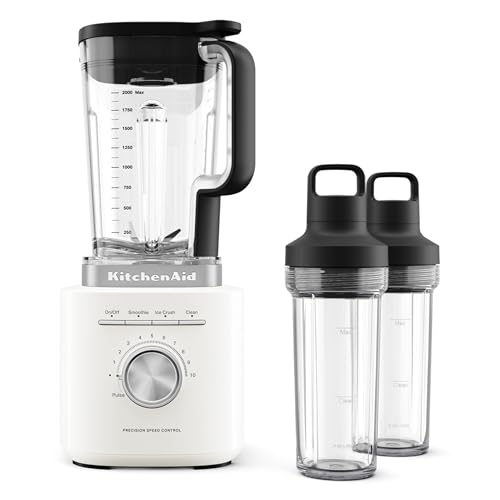
4. KitchenAid Pure Power Blender KSB2078 — Best for Big Households
KitchenAid’s Pure Power is the capacity-and-control pick: 1700 peak watts, a 68 oz blending jar, two 16 oz personal jars in the box, and a precision speed control knob with a dedicated smoothie cycle. It is an all-purpose pitcher with the personal format folded in — the big household’s answer to the two-format problem, wearing KitchenAid’s build quality.
Strengths
- 1700 peak watts — the most power in this guide
- 68 oz jar plus two 16 oz personal jars included
- Precision speed knob and smoothie cycle for control
Trade-offs
- Premium-mid pricing
- Large footprint and presence on the counter
- Personal jars are a bonus, not a full extraction system
| Spec | Detail |
|---|---|
| Motor | 1700 watts peak power |
| Jar | 68 oz blending jar |
| Also included | 2 × 16 oz personal blending jars |
| Control | Precision speed control knob, smoothie cycle |
The knob matters more than the wattage: a true precision dial lets a cook walk a blend from stir to extraction in one motion, which is the all-purpose skill — sauces want the low end, smoothies the top, and everything between gets used across a week of cooking. The personal jars handle the solo shake without the big jar’s washing tax, and the power headroom means family-size frozen loads are routine rather than events.
KitchenAid’s support ecosystem is the ownership footnote that matters at this size and price: jars, blades, and attachments for a flagship-adjacent model are stocked as a matter of course, and the brand’s appliance heritage shows in the fit of the parts. A machine this central to a kitchen should be buyable as a five-to-ten-year decision, and the Pure Power is built — and backed — like one.
Choose the Pure Power if your household is large, your blending is daily and varied, and you want one handsome machine to anchor the counter for years.
Best for: big, busy households wanting power plus control / Not suited for: small kitchens or minimal budgets

5. Oster Vortex Plus Glass Blender 1200W — Best Mid-Range
The Vortex Plus is the mid-range all-purpose sweet spot: a 1200W motor, a big 76 oz jar, four iBlend auto programs (frozen drink, milkshake, salsa, smoothie), reversible steel blades that defeat the thick-blend dome, and a Blend-N-Go cup for solo servings. It covers the map with programs where rivals offer only speeds.
Strengths
- Four iBlend programs tuned to the core all-purpose recipes
- Reversible blades keep thick mixtures circulating
- 76 oz jar plus Blend-N-Go cup covers batch and solo
Trade-offs
- At 76 oz, a full jar is bulky to pour and store
- Programs cover four recipes; the rest is manual
- Big footprint
| Spec | Detail |
|---|---|
| Motor | 1200 watts |
| Jar | 76 oz, dishwasher safe |
| Programs | 4 iBlend auto programs |
| Also included | Blend-N-Go cup |
The salsa program is the all-purpose tell: Oster tuned a cycle specifically for the pulse-and-rest rhythm that chopped texture requires, which most blenders leave to operator guesswork. Combined with the reversing blade’s thick-blend manners and the smoothie program’s walk-away finish, the Vortex Plus behaves like a machine designed by people who inventoried the ordinary map carefully. Oster’s parts ecosystem completes the ownership case.
The 76 oz jar deserves a sizing note: it is the largest pitcher in this guide, and it earns the space in households that batch — soup for the week, smoothies for a crowd, frozen drinks for a party. Smaller households should weigh the BN701’s equal competence in a slightly smaller footprint, because a pitcher bought for the annual event and cursed at the daily one is the classic all-purpose misjudgment this guide keeps warning against.
Buy it if you want programs and capacity in the middle of the price range, from a brand your replacement jar will outlive several trends with.
Best for: mid-range buyers wanting programs, capacity, and a solo cup / Not suited for: small households that will rarely fill a 76 oz jar

6. Ninja Professional Blender 2.0 BR201AMZ — Best Smoothie-Leaning All-Purpose
The Blender 2.0 is Ninja’s updated mainstream pitcher: 1200W, a 72 oz jar, four speeds, and an Auto-iQ Crush program for smoothies and frozen drinks. Its all-purpose center of gravity leans smoothie-ward — that is where its presets and blade design shine — while its size and power keep the rest of the map (soups, sauces, batters) comfortably in range.
Strengths
- 1200W Total Crushing power with an Auto-iQ Crush program
- 72 oz pitcher for family batches
- Four speeds give manual range beyond the preset
Trade-offs
- One preset only — less automation than the BN701
- No cups or chopper included
- Smoothie-leaning design; processing is out of scope
| Spec | Detail |
|---|---|
| Motor | 1200 watts |
| Pitcher | 72 oz |
| Speeds | 4 + Auto-iQ Crush program |
| Care | Dishwasher safe |
Think of the 2.0 as the BN701’s simpler sibling: slightly less power, one flagship preset instead of three, the same family-size pitcher and blade philosophy. For households whose all-purpose map is smoothie-heavy with a supporting cast of soups and sauces, the simplification costs nothing in practice — the Crush program covers the daily job, and four honest speeds cover the rest.
Its four-speed honesty cuts both ways in a useful direction: with fewer programs to hide behind, operators learn the machine’s actual behavior quickly, and the 2.0 rewards that familiarity with very repeatable results. In households that cook by feel rather than by preset, it is arguably the more satisfying Ninja — and it is frequently the better-priced one, which in an all-purpose purchase is a legitimate deciding factor.
Choose it over the BN701 when it is the better deal on the day, or when your household prefers a speed dial’s honesty to a panel of programs.
Best for: smoothie-heavy households wanting a big, simple, powerful pitcher / Not suited for: buyers wanting multiple presets or included cups
Comparison Table
| Pick | Badge | Key spec | Best for |
|---|---|---|---|
| Ninja Professional Plus BN701 | Best Overall | 1400 peak W, 72 oz, 3 Auto-iQ presets | Most households |
| Vitamix Propel Series 510 | Best Premium Compact | 48 oz, 3 programs, variable speed | Small serious households |
| Hamilton Beach Combo 58163 | Best Budget Versatility | 700W peak, 40 oz glass, 3-cup chopper | Budget blending + chopping |
| KitchenAid Pure Power KSB2078 | Best for Big Households | 1700 peak W, 68 oz jar + personal jars | Large busy households |
| Oster Vortex Plus 1200W | Best Mid-Range | 1200W, 76 oz, 4 iBlend programs | Programs and capacity |
| Ninja Professional Blender 2.0 BR201AMZ | Best Smoothie-Leaning All-Purpose | 1200W, 72 oz, Auto-iQ Crush | Smoothie-heavy routines |
Read the table as three pairs: the BN701 and BR201AMZ are Ninja’s mainstream pitchers, differing in automation; the Propel 510 and Pure Power are the control-and-craft pair, differing in size and philosophy; the Hamilton Beach Combo and Vortex Plus are the versatility-value pair, differing in whether versatility comes from a chopper or from programs. Each pair contains a real decision, and the reviews above are organized to make those three decisions well.
How to Choose an All Purpose Blender
Pitcher size vs. your real batches
All-purpose work spans single sauces to family smoothies, and the jar must serve both ends. A 48 oz container (Propel 510) vortices beautifully at household-for-two volumes and strains at a six-smoothie batch; a 72–76 oz pitcher (BN701, Vortex Plus) reverses the trade. Count your largest weekly batch, not your largest imaginable one, and buy the jar that covers it with the two-thirds working-capacity rule in mind. Households genuinely split between solo and family blending should note the two picks that fold a personal format into the box — the Pure Power’s personal jars and the Hamilton Beach Combo’s travel cup — because a big pitcher used for a single shake is the daily friction that eventually exiles a good machine to the cupboard.
Controls that span the range
All-purpose is a range claim, so judge the controls as a range: a true low for sauces and stirring, a true high for extraction, and either presets or a dial to live between them. Machines with both a program set and manual speeds (Vortex Plus, BN701) forgive beginners and reward cooks; pure dials (Propel, Pure Power) reward cooks most. Avoid any “all-purpose” machine whose control is a single button — range cannot be faked.
The pulse deserves its own sentence, because it is the all-purpose control in miniature: salsas, chopping, the first seconds of every frozen load, and the rescue of every over-thick blend all run on pulses. Every pick here pulses well; when comparing candidates beyond this list, a responsive, immediate pulse — no lag, no wind-up — is one of the most reliable in-store tests of a machine’s breeding.
Jar material for a daily driver
A daily all-purpose jar meets heat, acid, pigment, and the dishwasher in rotation. Glass (Hamilton Beach combo) shrugs off stains and odors and handles hot batches gracefully, at the cost of weight. Modern BPA-free plastic jars (the Ninja pitchers here are the examples) are lighter and drop-tolerant, and will slowly cloud — cosmetic, not functional. For a machine used five hundred times a year, choose the material whose aging you mind least. One more consideration: pigments and fats carry flavor between jobs in proportion to the material’s porosity, so households that alternate garlicky and fruity work daily will feel the glass advantage as a taste advantage, not just a cosmetic one.
The chopper question
Pitchers chop badly by design — they are built to circulate, and chopping wants the opposite. If your all-purpose map includes frequent salsa, onions, or breadcrumbs, either buy the combo format (Hamilton Beach), accept pulse-and-scrape texture, or plan on a separate small chopper later. Deciding this before purchase prevents the most common all-purpose disappointment.
How to Use One Pitcher for Everything: The All-Purpose Technique Guide
- Smoothies: liquid, soft, frozen — in that order; preset or 45–60 seconds; tamper or pause-and-push thick loads.
- Soups: blend cooked soup in half-jar batches with the lid vented and a towel on top; start low, build speed, and let each batch fully vortex before adding more.
- Salsas: pulse only — short bursts, scrape down, taste early. A salsa is finished the moment it looks right; ten extra seconds makes soup.
- Sauces and emulsions: start at the lowest speed, let the vortex form, and use the dial’s low range the way a whisk hand would — gradually.
- Batters: liquid ingredients first, dry on top, blend briefly — just until combined. Over-blending develops gluten and toughens pancakes.
- Frozen drinks: ice last, liquid present, two-stage ice addition for the most even crush.
- Between jobs: the ten-second soap-and-water blend, every time. An all-purpose pitcher’s only real enemy is yesterday’s garlic.
Troubleshooting All-Purpose Blender Problems
Problem: Salsa keeps turning into soup. Continuous blending is the cause. Pulse in one-second bursts, scrape between, and stop early — residual motion keeps cutting for a moment after each burst. A reversing or salsa-program machine (Vortex Plus) automates exactly this discipline.
Problem: The top of the pitcher never moves. Cavitation from a thick, dry load. Add liquid a little at a time, push the mixture down with the base unplugged (or use a tamper under power where the design allows), and restart with pulses.
Problem: Soup leaks or the lid lifts. Hot liquid expands and pressurizes. Half-fill, vent the lid’s center cap, start on the lowest speed, and hold the lid with a towel. Never blend a full jar of hot soup in any machine in this guide.
Problem: Green smoothies stay flecked. Time and staging: blend greens with the liquid alone for fifteen seconds before adding fruit, and give the full cycle its minute. Premium sustained power (Propel) narrows the gap; technique closes most of it.
Problem: The jar holds flavors between jobs. Gasket and blade assembly are the reservoirs. Deep-clean both, soak the gasket in baking-soda water, and run a lemon-water cycle. Glass jars (Hamilton Beach) resist the problem longest.
The Texture Map: What One Pitcher Actually Delivers
“All purpose” is ultimately a claim about texture range, so here is the map in plain terms, applicable across this guide with each pick’s ceiling noted in its review. At the smooth end — pureed soups, smoothies, sauces — every pick delivers fully; this is blending’s home territory. In the middle — salsas, pestos, rustic purees — the pitcher delivers with pulse technique, and the machines with salsa programs or reversing blades (Vortex Plus) deliver most easily. At the coarse end — chopped onions, breadcrumbs, coleslaw — the pitcher approximates and the chopper attachment (Hamilton Beach) or a processor does the real work; no honest guide should pretend otherwise.
Beyond texture lies consistency: frozen work and thick work. Frozen is a power-and-geometry question that everything here answers at least adequately and the Ninjas and Vitamix answer emphatically. Thick — smoothie bowls, hummus, frozen desserts — is where the class divides: dials and tampers (Propel, Pure Power) manage it best, presets manage it adequately, and every machine manages it better with staged liquid than with hope. Buy against your position on this map and the all-purpose promise will keep itself.
When to Add a Second Appliance (and When Not To)
The all-purpose pitcher retires most small appliances, but three additions earn their place in specific kitchens. A small food processor or chopper earns it when chopped texture is a weekly language — the combo pick in this guide builds exactly that in. An immersion blender earns it when soups are a weekly ritual, because blending in the pot beats batching in the pitcher for washing-up alone; our immersion guide covers that pairing. A personal blender earns it when one household member’s daily smoothie is the household’s most frequent blend, because cup-format convenience compounds daily.
Everything else the all-purpose pitcher genuinely covers, and the discipline of this category is resisting the sprawl: the stand mixer for one annual bread, the juicer for a January, the specialty gadget for a single recipe. Buy the pitcher first, cook with it for a season, and let evidence — not marketing — nominate the second appliance. Most households discover the pitcher was the whole answer.
All-Purpose Ownership: A Year of Maintenance in Ten Minutes a Month
A daily pitcher’s maintenance calendar is short. Daily: the rinse-and-soap-blend habit, which prevents every other problem on this list. Monthly: remove and wash the gasket as its own part, inspect it for flattening, and check the blade assembly for play or dullness by its results — longer blend times are the blade’s way of asking. Seasonally: deep-clean the jar (a baking-soda soak for plastic, a vinegar rinse for hard-water film on glass), inspect the drive socket for rounding, and confirm the brand’s parts listings for your model are still stocked — a two-minute check that protects the machine’s future.
Annually: nothing, if the monthly habits held. That is the quiet truth of mainstream all-purpose machines — the BN701s and Vortex Pluses of the world do not ask for ceremonies, just for residue to never dry and gaskets to be treated as the wear parts they are. The premium compact asks even less and gives back a self-cleaning cycle. Ownership at this level is a habit, not a hobby.
First-Week Calibration: Learning Your Pitcher
Every all-purpose blender has a personality that the spec sheet cannot convey: the liquid floor at which its vortex forms, the speed at which its salsa stays salsa, the batch size at which its soup blends in one pass. The first week is for learning it with cheap ingredients — bananas and frozen berries for the smoothie map, a forgiving tomato soup for the hot map, one onion’s worth of pulse experiments for the texture map. Take notes if you are that cook; most households simply absorb the calibration by cooking.
The calibration matters because all-purpose satisfaction is mostly technique matched to machine. The same pitcher that “cannot make salsa” in week one makes it perfectly in week three, once its operator owns the pulse rhythm. Judge the machine at the end of the calibration, not the beginning — and use the return window, if it comes to that, with evidence rather than first impressions.
All-Purpose vs. High-Performance: The Premium Question, Answered Plainly
Shoppers cross-shopping this guide against premium roundups deserve the dividing line without varnish. High-performance machines — the Vitamix class, represented here by the Propel 510 — add three things to the all-purpose map: sustained power that does not negotiate with thick or frozen loads, texture ceilings on the hardest ingredients (fibrous greens at low liquid, seeds, nut butters in the larger models), and build-and-support horizons measured in decades. Everything else on the map — the smoothies, soups, sauces, and drinks of ordinary weeks — is performed by the mainstream picks here at a level most palates cannot distinguish.
So the premium question is really a frequency question. Blend daily, thick, and fibrous, and the premium’s advantages arrive weekly; blend across the ordinary map a few times a week, and they may never arrive at all. Neither answer is a compromise — both are correct purchasing for different kitchens — and this guide’s spread, from the Hamilton Beach Combo to the Propel, exists so that each kitchen can land on its own right answer with the trade-offs stated in the open.
The Recipes That Define All-Purpose, Tested Against the Map
Five recipes, run honestly against this category, tell a shopper more than any spec comparison. The frozen berry smoothie is the entry exam: everything here passes, the Ninjas and Vitamix with distinction. The green smoothie with kale and frozen mango is the honors exam: the Propel and BN701 lead, the dial machines follow with staging technique, and the budget combo passes with thawed fruit and patience. Roasted tomato soup, blended hot in batches, is the cooked exam — universal passes, with glass (Hamilton Beach) earning style points for stain-free service.
The chunky salsa is the trick exam, because it tests restraint rather than power: the Vortex Plus’s salsa program wins it, pulse discipline ties the rest, and continuous blending fails it everywhere — a reminder that all-purpose includes knowing when not to blend. Finally, the thick smoothie bowl is the stress exam: tampers and dials (Propel, Pure Power) manage it as a recipe; preset pitchers manage it as an occasion. Hold your own five recipes against this pattern and the right pick usually announces itself before the comparison table does.
Safety Notes for a Do-Everything Pitcher
Versatility multiplies use, and use multiplies the value of three habits. First, the hot-liquid rule, repeated because all-purpose machines meet soup weekly: half-fill the jar, vent the lid, start low, towel on top — steam pressure is patient and procedural, and it only ever wins against hurry. Second, blade respect across both formats: pitcher blades and chopper blades are equally sharp, equally brush-washed, and equally never approached while the base is plugged in. Third, cord and counter discipline for a machine that lives out: cord routed away from burners and sink water, base feet dry so the machine does not walk at full tilt, and a hand near the lid during the first seconds of any frozen load.
Households teaching teenagers the family blender should teach these as the machine’s operating system, not as warnings — because on an all-purpose machine used daily, habits are the safety feature, and every pick in this guide rewards the household that builds them in week one.
Common Buying Mistakes
- Buying a specialist for an all-purpose life. A smoothie-only machine in a cooking household becomes a very good paperweight by October.
- Buying capacity for the party, not the week. Oversized pitchers blend daily small loads badly.
- Expecting pitcher chopping. If chopped texture matters weekly, buy the chopper format or a separate chopper — do not blame the pitcher.
- Ignoring control range. A single-speed “all-purpose” blender is a contradiction; range is the category.
- Blending a full jar of hot soup. Half-fill and vent, always — the one mistake in this category with a safety dimension.
- Skipping parts availability. Daily machines need replaceable jars and blades; verify before buying, not after the first crack.
Final Recommendation
The Ninja BN701 is the all-purpose blender most households should buy — the complete ordinary map, automated, in one pitcher. Budget buyers should take the Hamilton Beach Combo and enjoy the chopper, and small serious households should take the Vitamix Propel 510 as the long-term answer. Big households that cook by feel should look hard at the KitchenAid Pure Power’s dial before deciding — control is its own category of versatility.
Companion guides: Best All Around Kitchen Blenders Including Smoothies, Best All Purpose Blenders And Copper, Best 1000 Watt Blenders, Best Affordable Blenders, and Best 1500 Watt Blenders.
A closing calibration for the undecided: the all-purpose purchase succeeds when the machine’s map and the kitchen’s map coincide. Write your five most-blended recipes on a note, hold them against the texture map and recipe sections above, and the pick selects itself — usually the BN701 for the mainstream map, the Propel for the premium one, the Combo for the budget one. Everything else in this guide is commentary on that single act of matching.
Frequently Asked Questions
What is the difference between all purpose and all around blenders?
In this series, “all purpose” means one pitcher covering the whole blending map; “all around” (our companion guide) extends to multi-vessel kitchen systems with processor bowls and cup sets. The distinction is format, not quality — choose the pitcher if you value simplicity, the system if you value coverage. Many kitchens eventually own the pitcher’s simplicity for liquids and add one specialist — an immersion stick or a small chopper — for the two jobs pitchers do least well, which is the hybrid this guide’s “second appliance” section recommends.
Can an all purpose blender chop vegetables?
Roughly, by pulsing with a little liquid — fine for soup bases and rustic salsas, not for even dice. If chopping is a weekly need, the Hamilton Beach Combo’s chopper attachment in this guide, or a dedicated food processor, is the honest tool. The distinction matters because it is the most common source of all-purpose disappointment: buyers imagine a blender as a wet food processor, discover the texture gap on their first salsa, and blame a machine that was honestly specified. Read the texture map section above before buying and the disappointment never happens.
How much power does an all purpose blender need?
Roughly 1000W and up (or a strong 700W system with a chopper for the dry work) covers the ordinary map with frozen competence. Below that, frozen and thick work becomes technique-dependent; above 1400W, gains are about speed and headroom rather than new recipes — until the premium tier’s sustained power. Judge power as a system with the jar and blade, never as a lone number: the BN701’s 1400 peak watts and the Propel’s sustained variable-speed delivery are different kinds of strong, suited to different kitchens.
Is a 48 oz pitcher big enough for a family?
For families of two or three, generally yes; for four or more smoothie drinkers, batching gets tedious and a 68–76 oz pitcher (Pure Power, Vortex Plus, BN701) is the better buy. Remember working capacity is about two-thirds of the headline size. The Propel 510’s many devoted owners in larger households simply batch — a legitimate choice when the per-blend quality is the priority — but they make it knowingly, and so should you.
Can I blend hot soup in these pitchers?
Yes, in vented half-batches, starting on low speed — standard pitcher practice. Sealed personal cups and jars are the exception and must never be used for hot liquids; the personal jars included with some picks are cold-only. If soup is a weekly ritual and the batching annoys you, an immersion blender is the natural companion appliance, and our immersion guide in this series covers the pairing in detail.
How long should an all purpose blender last?
With daily use and replaceable wear parts, expect years of service from mainstream picks and a decade-class life from the premium compact. Lifespan tracks parts availability and load discipline (liquid, pulsing, rests) more than purchase price within this guide’s range.
All purpose blender or kitchen system — which should I buy?
Buy the all-purpose pitcher if your versatility lives in liquids — smoothies, soups, sauces, drinks — and your chopping is occasional. Buy the kitchen system (see our all-around guide) if chopping, dough, and multi-format serving are weekly events and your cupboards can house the parts. The pitcher is the simpler ownership; the system is the broader one; both are honest, and the wrong choice is the one made by headline rather than by your week’s actual cooking.


