Disclosure: airfryerkitchensupply.com is reader-supported. When you buy through links on our site, we may earn an affiliate commission at no extra cost to you.
Where to buy
All six blenders in this guide were verified against Amazon’s live catalog data before earning a link — model numbers, jar configurations, and ASINs confirmed — so the machine in each review is the machine behind the click. Check the current price on Amazon on the listing itself, and confirm the jar size matches the review before ordering, since affordable lineups rotate bundles between seasons.
- Hamilton Beach Power Elite Blender 58148AG — Check on Amazon
- Ninja Professional Blender BL610 — Check on Amazon
- Oster Pro 1200 Blender — Check on Amazon
- nutribullet Full-Size Blender Combo NBF50500 — Check on Amazon
- Oster Classic Series 8-Speed Blender — Check on Amazon
- Hamilton Beach Wave Crusher Blender 54221 — Check on Amazon
Introduction
The best affordable blenders have quietly ended an old compromise. A decade ago, a budget blender meant accepting chunky smoothies, a motor that feared ice, and a jar that clouded by summer. Today the affordable tier — the entry shelf of the big brands — includes a 1,000-watt Ninja with a 72-ounce pitcher, an Oster with a dual-direction blade that out-thinks machines twice its price, and glass-jar workhorses with circulation systems that make a genuinely smooth smoothie without technique or apology. What the tier still withholds is the professional class’s world: sustained torque for nut butters, near-silent running, hot-soup programs, and finishes polished to a showroom shine. For the blending most households actually do — smoothies, shakes, frozen drinks, sauces, batters — those withholdings barely matter. This flagship guide to the affordable class reviews the six verified machines that define it, explains exactly where each one’s competence ends, and gives you the buying framework to choose once and blend for years.
Because prices in this tier move constantly with promotions and seasons, this guide prints none. Each pick is positioned by what it does better than its neighbors, and every link lets you check the current price on Amazon. Judge the machines on their engineering — motors, jars, blades, drives — because those are the same whenever you read this, and they are what you will live with long after the sale ends. A blender is one of the few appliances that can plausibly serve a household for a decade; the hour you spend choosing it well, with verified models and honest expectations, is the cheapest performance upgrade in this entire category of kitchen appliances.
In this guide
Quick Picks
- Best Overall: Hamilton Beach Power Elite 58148AG — the 700-watt, glass-jar all-rounder whose Wave Action system makes even smoothies with zero technique. Check on Amazon
- Best for Frozen Smoothies: Ninja Professional Blender BL610 — a true 1,000 watts and stacked Total Crushing blades in a 72-ounce pitcher, the strongest frozen performance in the class. Check on Amazon
- Best for Cooking: Oster Pro 1200 — a glass jar, seven speeds, and a dual-direction blade that handles salsas, sauces, and batters with real control. Check on Amazon
- Best Blender Combo: nutribullet Full-Size Blender Combo NBF50500 — a 1,200-watt full-size pitcher plus single-serve cups, covering batch and personal blending in one box. Check on Amazon
- Best Budget Classic: Oster Classic Series 8-Speed — the all-metal-drive, glass-jar traditionalist built to be repaired and kept for years. Check on Amazon
- Best for Frozen Drinks: Hamilton Beach Wave Crusher 54221 — Ice Sabre blades and a circulation jar tuned for margaritas and slush-style drinks. Check on Amazon
How These Picks Were Chosen
This guide applied four filters, in order. First, brand substance: every pick comes from an established blender maker with a real parts catalog, because an affordable blender whose jar or gasket cannot be replaced is a future purchase disguised as a saving. Second, verification: each model and ASIN was confirmed against live Amazon catalog data, so the review and the link describe the same machine. Third, distinct excellence: each pick had to be the best answer to a different question — the all-rounder, the frozen specialist, the cook’s machine, the combo, the classic, the drink specialist. Fourth, honest limits: any model whose reputation rests on inflated wattage claims or unreplaceable wear parts was excluded, however impressive its listing looked.
The evaluation itself weighted the daily experience over the spec sheet: how the machine handles the standard frozen-fruit smoothie, whether its jar circulates or stratifies, how it cleans, how its controls behave at 6 a.m., and how its owners fare in year three. In the affordable tier, those factors separate the machines people love from the machines people replace — and replacement is the one outcome that makes “affordable” a lie.
Two adjacent categories were left out on purpose, and the reasoning belongs on the record. Immersion blenders — the stick format — are excellent tools for soups and in-pot purees, but they answer a different question than the countertop machines this search asks about, and they have their own guides in this series. Professional high-speed blenders were excluded by the brief itself: the moment a machine is built around a tamper and a four-figure-equivalent engineering budget, it has left the affordable conversation, however magnificent it is. A guide that respects its keyword respects its reader’s budget, and this one stays inside both.
The 6 Best Affordable Blenders

Hamilton Beach Power Elite Blender 58148AG — Best Overall
The Power Elite earns the top spot in the flagship guide for the same reason it wins so many kitchens: it makes the everyday smoothie correctly, every time, without asking anything of you. The secret is the Wave Action system — the 40-ounce glass jar is shaped so the vortex continuously folds the top of the load down into the blades, which eliminates the stratification that makes cheap blenders produce a smooth bottom and a chunky top. The 700-watt motor and stainless blade cover smoothies, purees, shakes, and drink ice without strain, and the 12 functions are a sensible spread of real speeds and pulses. It suits first-time buyers, small households, and anyone who wants one machine that simply handles the standard map of home blending. It does not suit big families — the jar serves two to three — or anyone chasing nut butters and doughs.
Strengths
- Wave Action circulation produces even smoothies with no stirring or technique.
- 40-ounce glass jar resists stains and odors and pours cleanly.
- Compact, simple, and dishwasher-friendly — the lowest-friction ownership in the class.
Trade-offs
- Two-to-three-serving capacity means families blend in rounds.
- Budget-class loudness at full speed on ice.
- No personal cup included for solo servings.
| Spec | Detail |
|---|---|
| Motor | 700 watts |
| Jar | 40 oz glass |
| Functions | 12 functions including puree and crush ice |
| System | Wave Action circulation |
Ownership is where the Power Elite separates itself. It is the blender that disappears into a routine: blend while the coffee brews, jar into the dishwasher, base wiped in seconds. Nothing about it is dramatic, and that is the point — affordable blending succeeds when the machine is beneath notice. Its edges are real but predictable: thick hummus wants added liquid, big batches want two cycles, and hot soup wants a vented, careful hand. Within the normal borders of home blending, it is the most complete answer this class offers, and the safest first recommendation in this guide.
Best for: first-time buyers and small households wanting a dependable all-rounder. / Not suited for: large families or heavy paste work.
Check the current price on Amazon
Ninja Professional Blender BL610 — Best for Frozen Smoothies
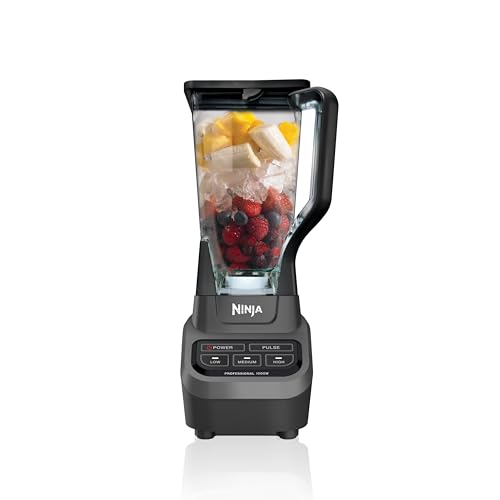
The BL610 imports a higher class’s engine into the affordable conversation: a true 1,000-watt motor, stacked Total Crushing blades that cut at several heights, and a 72-ounce pitcher. Frozen loads are its home ground. Where a traditional budget blender chews at the bottom of a frozen smoothie and leaves the top untouched, the BL610’s blade column processes the whole jar, pulling ice and frozen fruit down into an even, snow-fine result. The controls are three speeds and a pulse, the parts are dishwasher safe, and the pitcher serves a family or a party in one cycle. It suits smoothie households, frozen-drink fans, and anyone whose last blender died on ice. It does not suit the noise-sensitive — it is proudly loud — or glass-jar loyalists, since the big pitcher is plastic for practical reasons of weight.
Strengths
- True 1,000-watt power with stacked blades — the class’s best frozen performance.
- 72-ounce pitcher handles family batches and party drinks in one cycle.
- Simple controls and dishwasher-safe parts keep ownership easy.
Trade-offs
- Loud, especially on ice — a wake-the-house machine.
- Plastic pitcher and a tall profile that needs storage headroom.
- Solo drinkers will wash a big jar for small servings.
| Spec | Detail |
|---|---|
| Motor | 1,000 watts |
| Pitcher | 72 oz, dishwasher safe |
| Blade system | Total Crushing stacked blades |
| Controls | 3 speeds plus pulse |
The BL610’s value is measured in jobs refused by the rest of the tier. Frozen mango, ice, kale, and a full jar are a normal Tuesday for it. Its texture ceiling with fibrous greens is the highest here, and its parts ecosystem is as deep as any blender’s, which matters for a machine bought to work daily. If your blending is gentle — protein shakes and soft fruit — its power is surplus. If your blending is frozen, it is the affordable machine that ends the search, and it anchors the powerful end of this guide for exactly that reason.
Best for: frozen smoothie and drink households wanting maximum capability per dollar. / Not suited for: quiet kitchens or glass loyalists.
Check the current price on Amazon
Oster Pro 1200 Blender — Best for Cooking
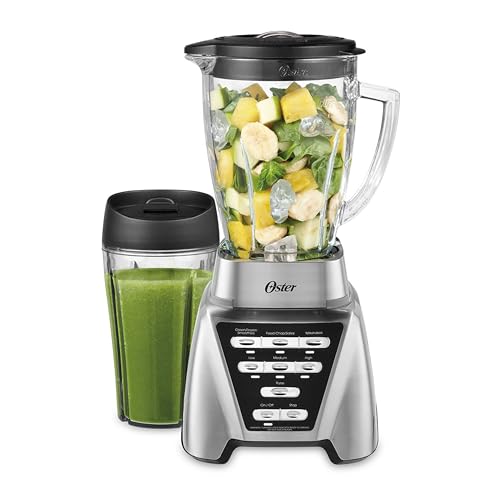
Most affordable blenders are drink machines that tolerate cooking. The Oster Pro 1200 is a cook’s blender that also makes drinks, and the difference is its dual-direction blade: instead of spinning one way and hoping the vortex behaves, it alternates direction to keep pulling ingredients through the cutting zone. Chunky salsas stop at chunky, sauces emulsify evenly, batters blend without overworking, and thick smoothies that would stratify in a classic jar keep moving. The glass jar suits warm work and washes clean of garlic and turmeric, the seven speeds provide genuine control, and the included 24-ounce smoothie cup covers the solo serving without dirtying the jar. It suits households that cook as much as they blend drinks. It does not suit party-scale batching or buyers who want automated programs.
Strengths
- Dual-direction blade delivers the best texture control in the affordable class.
- Glass jar and seven speeds make it a true cooking appliance.
- The included smoothie cup adds personal-format convenience.
Trade-offs
- Mid-sized jar; large families run second cycles.
- Ice work is good rather than class-leading.
- Preset labels take a little learning by feel.
| Spec | Detail |
|---|---|
| Jar | Glass jar |
| Controls | 7 speeds |
| Blade | Dual-direction blade technology |
| Extras | 24 oz smoothie cup included |
Cooks judge blenders by their worst load, and the Pro 1200’s worst loads are better than its rivals’. A half-jar of roasted vegetables purees without a scorched pocket at the blade; a salsa holds its texture because the reversing blade does not liquefy by default; a thick smoothie finishes without the spatula ritual. It is the pick for the reader whose blending is half in the kitchen’s savory half — and in a class crowded with drink specialists, that breadth is its distinction.
Best for: households that cook — sauces, salsas, batters — as much as they blend drinks. / Not suited for: party batches or program seekers.
Check the current price on Amazon

nutribullet Full-Size Blender Combo NBF50500 — Best Blender Combo
The Blender Combo refuses the format choice entirely: one 1,200-watt base drives both a full-size 64-ounce pitcher and single-serve cups, so the same machine that makes family smoothies on Saturday makes your solo cup on Tuesday without washing a pitcher. The pitcher handles the batch work with nutribullet’s extractor-style blending, and the cups inherit the brand’s personal-blender convenience — blend, lid, go. For households whose blending splits evenly between personal and shared, this consolidation is the smartest purchase in the class: one motor to store, one parts ecosystem to learn, both formats covered. It suits couples and families with staggered routines. It does not suit glass-jar loyalists or buyers who only ever blend one way — specialists beat combos at a single job.
Strengths
- One 1,200-watt base covers batch and personal blending completely.
- 64-ounce pitcher serves family rounds; cups serve the weekday routine.
- Strong frozen-fruit performance in both formats.
Trade-offs
- Plastic vessels throughout; no glass option.
- More parts to store and wash than a single-format machine.
- Pitcher texture finesse trails the Pro 1200’s controlled approach.
| Spec | Detail |
|---|---|
| Motor | 1,200 watts |
| Pitcher | 64 oz full-size pitcher |
| Formats | Pitcher plus single-serve cups |
| Model | NBF50500, dark gray |
The Combo’s economics deserve a sentence: buying both formats separately, even affordably, costs more counter and usually more money than this one base with its two vessel systems. Its performance is honestly strong in both modes — the cups behave like a proper nutribullet, and the pitcher handles frozen loads that embarrass most budget jars. For the genuinely mixed household, it is not a compromise pick; it is the correct architecture, and it earns its badge on logic as much as on blending.
Best for: mixed households blending both solo cups and family batches. / Not suited for: glass loyalists or single-format purists.
Check the current price on Amazon

Oster Classic Series 8-Speed Blender — Best Budget Classic
The Oster Classic is the affordable class’s elder statesman: a 6-cup glass jar, a Crush Pro 4 stainless blade, eight speeds, and the all-metal drive that has made this design a byword for longevity. That drive is the argument. The coupling between motor and blade is where budget blenders die, and Oster’s metal system survives years of ice that strip lesser couplings — while every wear part on the machine, from blade assembly to gasket to jar, is a standard, inexpensive replacement. The 700-watt motor handles the classic repertoire — smoothies, shakes, batters, sauces — with a little technique and no drama. It suits buyers who think in years and decades. It does not suit buyers who want presets, programs, or a contemporary silhouette.
Strengths
- All-metal drive is the durability benchmark of the affordable class.
- 6-cup glass jar serves families and resists stains and odors.
- Every wear part is replaceable at small cost — a genuinely repairable appliance.
Trade-offs
- Frozen loads want a pulse-and-settle technique.
- The design is dated, proudly.
- Glass is heavy when full and unforgiving when dropped.
| Spec | Detail |
|---|---|
| Motor | 700 watts |
| Jar | 6-cup glass |
| Blade | Crush Pro 4 stainless blade |
| Drive | All-metal drive |
There is a philosophy in this pick: the cheapest blender over ten years is rarely the cheapest blender on the shelf. The Classic’s design has been in production long enough that its failure modes are known, priced, and fixable — a claim no new model can make. Owners who learn its small rituals are rewarded with a machine that simply continues. In a flagship guide to affordable blending, it stands for the proposition that affordable should mean inexpensive to own, not inexpensive to buy, and on that definition it has few rivals anywhere.
Best for: long-term value seekers who want a repairable classic. / Not suited for: feature seekers or hands-off frozen blending.
Check the current price on Amazon

Hamilton Beach Wave Crusher Blender 54221 — Best for Frozen Drinks
The Wave Crusher spends its budget exactly where frozen drinks are decided: on the blade and the jar. Its Ice Sabre blades bite into ice instead of skating over it, the Wave Action jar keeps the frozen load circulating until the texture evens out, and the 14-function panel is organized around drink-making. The result is the affordable class’s most convincing margarita — uniform, sippable, free of the shard layer that betrays a weak blender — and smoothies that inherit the same evenness. The 40-ounce glass jar sizes it for two to four drinkers, which covers most home occasions honestly. It suits households whose blender works hardest on weekends. It does not suit cooks focused on hot, savory work, for whom the Power Elite is the same money better aimed.
Strengths
- Ice Sabre blades produce the most even frozen-drink texture in the tier.
- Circulation jar prevents stratification in drinks and smoothies alike.
- Glass jar and simple cleanup suit party duty.
Trade-offs
- 700 watts sets the ceiling: thick, dry loads are out of scope.
- Most owners will use only a few of the 14 functions.
- Party volume beyond four servings runs in two cycles.
| Spec | Detail |
|---|---|
| Motor | 700 watts |
| Jar | 40 oz glass |
| Blades | Ice Sabre blades |
| Functions | 14 functions |
Specialization is a form of honesty: rather than pretending to excel everywhere, the Wave Crusher excels where its buyers live. If your blender’s reputation in your household rests on Friday-night frozen drinks, this machine protects that reputation better than any generalist at its level. Its smoothies are properly good, its drinks are the class’s best, and its price stays in the tier’s friendly zone. That is a complete argument, and it closes this list.
Best for: frozen drinks, slushies, and smoothie households that prize texture. / Not suited for: heavy cooking loads.
Check the current price on Amazon
Ownership: Keeping an Affordable Blender Young
An affordable blender’s lifespan is written in its first year of habits. The gasket at the blade base wants a rinse and a flat reseat, not neglect; the jar wants cleaning before residue dries into a scrubbing project; the motor wants loads it can circulate rather than packed jars it must survive. Owners who build those three habits routinely report service lives that make the purchase price look like a rounding error. Owners who do not tend to conclude that budget blenders are disposable — a conclusion about habits wearing a conclusion about hardware as a disguise.
Storage matters more than it should. Glass jars want a shelf where they are not nested against cast iron; blade assemblies want to live assembled or in a drawer where their edges are safe; cords want a loose coil rather than a tight wrap that fatigues the insulation at the base. Counter presence matters too: every machine in this guide blends more often when it lives out, so claim a permanent spot near the sink — the prep-and-rinse triangle — and let the appliance earn its rent daily.
Finally, learn the two sounds of your machine: the healthy roar of a circulating load, and the strained pitch of a packed one. That single skill — hearing the difference and responding with liquid, a pause, or a scrape — will extend the life of any blender in this guide more than any warranty. Machines rarely die without announcing it first; ownership is mostly listening.
Which Affordable Blender Fits Your Home?
The first apartment: the Power Elite, without hesitation — compact, forgiving, and sized for the smoothies and sauces that dominate a first kitchen’s blending.
The family kitchen: the BL610 for frozen family smoothies, or the Oster Classic for a glass jar and a decade of service; both serve a crowd in one cycle, in opposite styles.
The cooking household: the Oster Pro 1200, whose dual-direction blade treats salsa and sauce as first-class work rather than as smoothie variations.
The split-routine household: the nutribullet Combo, because one base that serves the solo weekday cup and the weekend family pitcher ends the two-machine debate.
The entertainer: the Wave Crusher for the drinks, with an honorable mention to the BL610 when the guest list grows — frozen drinks are this tier’s party trick, and these two perform it best.
The keeper: the Oster Classic, bought once, maintained lightly, and handed down — the affordable class’s answer to the disposable age.
Comparison Table
| Pick | Badge | Key spec | Best for |
|---|---|---|---|
| Hamilton Beach Power Elite 58148AG | Best Overall | 700W, 40 oz glass, Wave Action | Everyday blending, small households |
| Ninja BL610 | Best for Frozen Smoothies | 1,000W, 72 oz pitcher | Frozen loads and family batches |
| Oster Pro 1200 | Best for Cooking | Glass jar, dual-direction blade | Sauces, salsas, and batters |
| nutribullet Blender Combo NBF50500 | Best Blender Combo | 1,200W, 64 oz pitcher plus cups | Mixed personal and batch blending |
| Oster Classic Series 8-Speed | Best Budget Classic | 700W, 6-cup glass, all-metal drive | Longevity and repairability |
| Hamilton Beach Wave Crusher 54221 | Best for Frozen Drinks | 700W, Ice Sabre blades | Margaritas and slush drinks |
How to Choose the Best Affordable Blender for Your Kitchen
Define “affordable” by cost per year, not by the tag
The right way to shop this tier is to divide by years. A blender that serves daily for five years is cheaper, in every sense that matters, than a slightly less expensive one replaced in eighteen months. That is why this guide’s filters privilege drives, parts catalogs, and jar quality over headline wattage: those are the components that decide how many years the division runs. When two machines tie on performance, buy the one whose wear parts are cheaper and easier to find.
Match the format to the household
Three formats divide this list. The classic pitcher (Power Elite, Oster Classic, Wave Crusher, Pro 1200) serves households and cooking. The big performance pitcher (BL610) serves frozen loads at family scale. The combo (nutribullet) serves both personal and batch routines from one base. Solo drinkers should also read the personal-blender guide in this cluster before buying a pitcher they will wash daily for one cup. Format regret is the most common regret in this category, and it is entirely avoidable with ten honest seconds of thought about your last twenty blends.
Jar material: glass leads this tier
Five of these six picks use glass, and that is not an accident. At affordable prices, glass jars are typically better built than the thin plastic pitchers of no-name rivals: they resist staining, odor, and clouding, and they handle warm ingredients gracefully. Plastic earns its place at the extremes — the BL610’s 72-ounce pitcher would be unreasonably heavy in glass, and the nutribullet’s cups are personal-format plastic by design. Choose glass for cooking and longevity, plastic for scale and portability, and do not let anyone tell you one material is simply superior.
Power: read it in context
Wattage in this tier ranges from an honest 700 to a true 1,000 and a combo’s 1,200, and the numbers mean less than the designs behind them. Circulation jars make 700 watts feel strong; stacked blades make 1,000 watts feel unstoppable on ice; dual-direction blades make control the story instead of power. Ask what the wattage is for — ice, volume, finesse — and let the reviews above answer in those terms. The buyer who shops by the biggest number alone will reliably buy the wrong machine in this tier.
Controls and programs: enough is enough
A usable low, a strong high, and an honest pulse cover ninety percent of home blending. Timed programs are a genuine convenience on machines that have them, and function counts beyond that are labels. Spend your attention instead on whether the controls work with wet hands, whether the panel wipes clean, and whether the jar’s lid seals without a wrestling match — the micro-interactions you will perform a thousand times.
How to Use an Affordable Blender for Results Above Its Class
- Load in order: liquids first, soft ingredients next, frozen items last on top, so the vortex starts in fluid and the heavy load feeds down into it.
- Fill to two-thirds with solids. Circulation space is an ingredient; a slightly smaller batch that moves beats a full jar that packs.
- Start low, then go high. A few seconds at low speed establishes the vortex and saves the motor the shock of a frozen start.
- Run the full cycle. Forty-five to sixty seconds for smoothies. Most disappointing results in this tier are under-blended, not under-powered.
- Greens first, briefly. Blend greens with the liquid alone for twenty seconds before adding frozen fruit, and strings and flecks disappear.
- Rest thick loads. For hummus and thick purees, work in twenty-second bursts with a scrape between, adding liquid by the spoonful.
- Clean in the minute after. Warm water, a drop of soap, thirty seconds on high, rinse. A clean jar is a jar you will use tomorrow.
Safety, briefly and seriously: vent lids and small batches for anything hot; never blend steaming liquid in a sealed vessel; unplug before reaching in with a spatula; and keep the cord and base dry. Affordable machines are honest machines, but they are still motors driving blades, and they reward the same respect as any power tool.
Job by Job: The Affordable Class Assessed
Smoothies and shakes
Fully solved at this tier. Every pick here makes a good smoothie; the BL610 and the nutribullet Combo make the smoothest frozen ones, and the circulation-jar Hamilton Beach models make the most forgiving everyday ones. Protein shakes are trivial everywhere on the list.
Frozen drinks
A genuine strength of the modern affordable class. The Wave Crusher and BL610 lead, the Combo follows closely, and even the classics produce respectable drinks with the pulse technique from the how-to section. The gap to premium machines is in volume and repetition, not in a single round.
Green smoothies
The tier’s frontier. Leaves are easy everywhere; fibrous stalks reward the BL610’s power and the Combo’s cup format. The greens-first technique closes most of the remaining gap for the 700-watt machines. Daily kale-stem devotees are the one smoothie audience that should consider spending above this class.
Sauces, salsas, and purees
Quietly excellent. The Pro 1200’s dual-direction control leads, the glass-jar classics follow, and everything here purees cooked vegetables without complaint. This is the work where affordable blenders embarrass their price most thoroughly.
Nut butters and doughs
The honest border. Small, loose batches are possible with oil and patience on the stronger picks; weekly production belongs to the professional class. This guide’s credibility rests on saying so plainly.
Troubleshooting: Five Fixes Before You Blame the Machine
Problem: Chunky top, smooth bottom. Stratification — the load is too dry or the jar overfilled. Add liquid, reduce the batch, start low.
Problem: The motor strains and slows. The load is packed or too thick. Rest, scrape, add liquid by the spoonful, and work in bursts.
Problem: Leaking at the jar base. The gasket is dirty, mis-seated, or worn. Clean, reseat, or replace it — the classic fix on every classic design here.
Problem: Cloudy jar. Mineral film from hard water and dishwasher detergent. A vinegar soak restores glass; prevention is a rinse before the residue dries.
Problem: Burning smell on a heavy load. The motor is at its thermal limit. Rest it fully, lighten future loads, and treat repetition of the smell as a sign the job belongs to a stronger class.
Before You Order: The Five-Minute Checklist
Run this checklist against whichever pick has your attention, and you will not need luck.
- Measure the home it will live in. Counter-to-cabinet height for the tall machines, shelf depth for all of them. A blender that does not fit its home is returned or resented.
- Count your servings honestly. The jar should match your most common batch — not your largest party or your smallest breakfast, but the Tuesday one.
- Name your most frozen ingredient. If it is ice or frozen mango daily, weight the frozen specialists. If it is soft fruit and powder, everything here passes.
- Check the parts page. Confirm the brand sells the jar, blade assembly, and gasket for the exact model. Two minutes now, years of service later.
- Confirm the model number on the listing. Affordable lineups reuse names across generations; the number — 58148AG, BL610, NBF50500 — is the identity. Match it to the review.
- Decide your cleaning religion. If you are a dishwasher household, confirm the jar and parts are dishwasher safe (most picks here are) and buy accordingly.
Notice what the checklist never asks: which machine is most powerful, or which has the most functions. Those questions feel decisive in a store and prove nearly irrelevant in a kitchen. The questions that predict satisfaction are about fit — of size, of format, of job, of habit — and they are all answerable before you spend anything. That is the quiet advantage of shopping this tier deliberately: the machines are simple enough that a five-minute checklist genuinely settles the decision, and the six reviews above have already done the engineering homework for you.
Common Buying Mistakes
- Optimizing for the sale price instead of the service life. The division that matters is cost per year, and it is decided by drives and parts, not by the tag.
- Buying a pitcher for a personal habit. If you blend one serving at a time, a personal or combo format will make you happier and your sink emptier.
- Trusting wattage across brands. Peak and rated figures mix freely in listings. Compare designs and verified models, not raw numbers.
- Ignoring the gasket and the parts catalog. Wear parts decide year three. If they are not sold, the machine is a disposable.
- Expecting professional torque. Nut butters and doughs are the next class’s job. Asking them of this tier is how good budget blenders die young.
- Skipping the fill-line lesson. Most “weak blender” stories are overfilled jars. Learn your machine’s vortex and it will feel a class stronger.
What the Next Class Up Actually Adds — and Whether You Need It
Honesty about the tier above sharpens the case for this one. Stepping up buys four real things. First, torque: the sustained, tamper-assisted force that turns nuts into butter and folds doughs — a different physical capability, not merely more of the same. Second, heat: jars and seals designed to puree steaming soup in the machine, with programs that do it unattended. Third, refinement: finer speed control, better emulsions, and measurably smoother results with the most fibrous ingredients. Fourth, quiet and finish: sound-damped designs and materials that feel like furniture rather than appliances.
Now audit your own kitchen against that list. If none of the four describes a weekly job in your home, the class above is selling you capabilities you will use at holidays, and the affordable tier — chosen as this guide chooses it — is not the budget option. It is the correct option, with money left over for the ingredients that actually determine whether a smoothie tastes good. If one of the four does describe your weekly life, buy the class above with this guide’s blessing and its framework: the same filters — brand substance, verification, distinct excellence, honest limits — apply at every price, and they will serve you there exactly as they served you here.
That is the real conclusion of a flagship guide to affordable blenders: the tier is not defined by what it lacks. It is defined by how completely it covers the blending that most kitchens do, most days, for most years of a household’s life. The six machines above cover it in six different styles. Pick the style that matches your kitchen, maintain it lightly, and blend without thinking about blenders again for a long time — which is, in the end, what every appliance purchase is actually trying to buy.
Final Recommendation
Start with the Hamilton Beach Power Elite for the most dependable everyday blending in the class. Choose the Ninja BL610 if frozen loads rule your kitchen, the Oster Pro 1200 if cooking does, the nutribullet Combo if your household blends both solo and together, the Oster Classic if you buy for decades, and the Wave Crusher if Friday night is frozen. The affordable tier, chosen this way, is not a compromise — it is the correct tool for most kitchens, at the correct price. Buy one of these six with your eyes open about what it does brilliantly and what it was never built to do, maintain its small wear parts, and it will quietly handle your blending for years while the premium debates rage on, expensively and endlessly, without you and your perfectly good fresh cold smoothie in hand.
Go deeper into the cluster: Best Affodable Blenders, Best Afforadble Blenders, Best Affordable Blenders For Frozen Drinks, Best Affordable Blenders For Green Smoothies, Best Affordable Blenders For Pureeing Hot Soup, and Best Afforadble Personal Blenders.
Related guides
Frequently Asked Questions
What is the best affordable blender overall?
For most households, the Hamilton Beach Power Elite: its circulation jar makes even smoothies without technique, its glass jar ages well, and its ownership friction is the lowest in the class. Frozen-load households will prefer the Ninja BL610, and cooks the Oster Pro 1200. That three-way answer is not evasion — “best overall” in a mature category genuinely depends on which job dominates your kitchen, and this guide’s badges exist to make that dependency explicit rather than to crown one machine for every reader. If you truly blend a bit of everything and nothing in particular, the Power Elite is the honest default, and it is the blender this guide would hand to a friend moving into a first home.
How much power does an affordable blender need?
A well-designed 700-watt machine covers smoothies, shakes, sauces, and drink ice. More power buys frozen headroom and fibrous-greens finesse, as the BL610 shows. Judge the design around the motor, not the number alone — and remember that listings mix peak and rated figures freely, so a smaller honest number from a known design routinely outperforms a larger vague one from an unknown. The verified models in this guide state their figures the way their makers publish them, and the reviews flag the convention wherever it matters.
Are affordable blenders durable?
The established models in this guide are, provided wear parts are maintained. All-metal drives, replaceable gaskets and blades, and real parts catalogs separate durable budget machines from disposable ones. The Oster Classic’s design has been in continuous production for years precisely because it can be kept alive with small parts, and the Hamilton Beach and Ninja models here benefit from the same catalog depth. Treat an affordable blender as a maintained appliance rather than a sealed gadget, and its service life stops resembling its price.
Can an affordable blender make green smoothies?
Yes — leaves blend easily everywhere here, and fibrous stalks do well in the stronger picks or with the greens-first technique: blend the greens with the liquid alone for twenty seconds before the frozen fruit goes in, and the texture improves by a full class on any machine in this guide. Only the most fibrous daily routines — kale stems, celery, and ginger as a daily staple rather than an occasional guest — justify stepping up a class, and even those readers should try the technique on an affordable machine first. Technique is free; torque is not.
Glass or plastic jar?
Glass for cooking, longevity, and stain resistance; plastic for very large pitchers and personal cups where weight and drops rule. This tier is unusually strong in glass, which is one of its quiet advantages. The deciding question is who handles the jar: a careful adult kitchen gets decades from glass, while a household of small children and stone countertops may rationally choose the big plastic pitcher and accept its eventual clouding as the price of unbreakable. Neither answer is wrong; pretending the question does not exist is.
When should I spend more than the affordable tier?
When your jobs change class: weekly nut butters, hot soups pureed in the machine, doughs, or a need for quiet running. Until then, a well-chosen affordable blender is not a stepping stone — it is the destination. The most common mistake in this category is upgrading out of restlessness rather than need: a new recipe tried once, a video of a premium machine doing a trick your kitchen will never ask for. Let your actual weekly blending make the decision, and for most households it will keep making the same decision — the affordable machine you already chose well.


