Disclosure: airfryerkitchensupply.com is reader-supported. When you buy through links on our site, we may earn an affiliate commission at no extra cost to you.
Where to buy
All six picks for the best all around kitchen blenders including smoothies are sold on Amazon. Kitchen-system blenders are bundled in many configurations — processor bowls, cups, and lids vary — so confirm the model number and included vessels match the pick before ordering, because with systems the bundle is the product: two listings under one name can differ by an entire food processor.
- Ninja Kitchen System BL770 — Check the current price on Amazon
- Ninja Professional Plus DUO Blender BN751 — Check the current price on Amazon
- Vitamix 5200 Blender — Check the current price on Amazon
- KitchenAid K400 Blender KSB4028 — Check the current price on Amazon
- nutribullet SmartSense Blender Combo NBF50700 — Check the current price on Amazon
- Oster Extreme Mix Blender 1600W — Check the current price on Amazon
Introduction
The best all around kitchen blenders including smoothies are the machines that end the appliance sprawl: one base that crushes ice for smoothies at breakfast, purees soup at lunch, processes salsa and dough in the afternoon, and still has the manners to sit on the counter looking like it belongs there. “All-around” is the most abused phrase in the category — plenty of blenders claim it while being merely adequate at everything — so this guide defines it strictly: a true all-arounder must be genuinely good at the smoothie job (frozen fruit, greens, ice), genuinely useful beyond it (soups, sauces, chopping or processing), and built to survive being the hardest-working small appliance in the house.
The six picks below span the honest range of that definition, from a value kitchen system that pairs a full pitcher with a food-processor bowl, to the premium benchmark against which all all-arounders are measured. Every pick was verified against current manufacturer data — model, wattage, vessels, programs — before earning a link, and each review states plainly where the machine’s all-around claim ends, because knowing a blender’s edges is what makes the center trustworthy.
If your kitchen blends daily and cooks seriously, this is the category worth your research time: the all-arounder is the blender that gets used five hundred times a year, and small differences in design compound across every one of those uses.
How the guide is organized: the Quick Picks give the short answer by household type; the six reviews examine each machine’s center of excellence and its edges; the buying sections translate the category’s real decision points — systems versus pitchers, presets versus dials versus sensors, the frozen standard — into criteria you can apply to any listing. Readers in a hurry can stop at the Final Recommendation; readers choosing a decade-scale appliance will find the depth sections worth their time.
In this guide
Quick Picks
- Best Overall: Ninja Kitchen System BL770 — 1500W driving a 72 oz pitcher, an 8-cup processor bowl, and two 16 oz cups: the complete all-around system. Check price on Amazon
- Best for Smoothies Plus: Ninja Professional Plus DUO BN751 — 1400 peak watts, Auto-iQ, a 72 oz pitcher plus two 24 oz extraction cups. Check price on Amazon
- Best Premium: Vitamix 5200 — the professional-grade benchmark: a 64 oz container, variable speed, and self-cleaning, built for a decade of everything. Check price on Amazon
- Best Control and Feel: KitchenAid K400 — a 5-speed dial with Intelli-Speed motor control, preset programs for ice, icy drinks, and smoothies, and a tamper included. Check price on Amazon
- Best Automatic: nutribullet SmartSense Combo NBF50700 — 1400W with a smart auto cycle that senses the load and adjusts speed, time, and function. Check price on Amazon
- Best Glass-Jar Power: Oster Extreme Mix 1600W — a 1600W motor, an 8-cup glass jar, a 10-point blade, and Blend-N-Go convenience. Check price on Amazon
How These Picks Were Chosen
Verification came first: brand, model, motor rating, vessel sizes, included attachments, and programs were confirmed against current Amazon product data for every pick. Ranking then tested the all-around claim from three directions.
First, the smoothie standard: each machine had to handle frozen fruit, ice, and leafy greens as a core competence, not a party trick — this is a guide “including smoothies,” and the smoothie is where weak all-arounders get exposed. Second, the beyond-smoothie resume: hot soups, sauces, salsas, nut and seed work within reason, and — where claimed — food processing or dough. Systems with processor bowls (BL770) and extraction cups (BN751, SmartSense) earned their versatility honestly, in the box. Third, ownership: an all-arounder is a daily appliance, so parts availability, jar replacement, and warranty support weighed heavily; every brand here supports its ecosystem.
Excluded: smoothie-only specialists (covered in our dedicated guides), budget machines whose “all-around” claim collapses at the first frozen load, and commercial units whose size and price belong to a different conversation.
A word about the price spread in this guide, because it is wider than in our budget roundups: an all-around brief legitimately spans from a value system to a premium benchmark, and the ranking is not a claim that the priciest pick is six times the machine. It is a claim that each pick is the best expression of its approach — system value, smoothie automation, premium endurance, controlled craft, sensing convenience, glass power. Readers should choose the approach first and the model second; the verdict line under each review is written to make exactly that decision easy.
The 6 Best All Around Kitchen Blenders Including Smoothies

1. Ninja Kitchen System BL770 — Best Overall
The BL770 is the all-around idea executed completely: a 1500W base, a 72 oz blending pitcher with Total Crushing blades, an 8-cup food processor bowl for chopping and dough, and two 16 oz cups for personal blends. Smoothies, salsa, pizza dough, coleslaw, frozen drinks — the system’s resume covers the actual map of home blending and processing, at a price that undercuts buying the appliances separately by a wide margin.
Strengths
- 1500W base drives pitcher, processor bowl, and personal cups
- 8-cup processor bowl adds chopping and dough to the resume
- Total Crushing blades excel at ice and frozen fruit
Trade-offs
- Many parts to store — this is a system, not a blender
- Processor is a blender-base processor, not a standalone food processor’s equal for every task
- Loud at full power, like all high-power Ninjas
| Spec | Detail |
|---|---|
| Motor | 1500 watts |
| Pitcher | 72 oz |
| Processor | 8-cup bowl |
| Also included | (2) 16 oz cups |
The smoothie case is straightforward: the same stacked-blade violence that anchors Ninja’s pitcher line, in the brand’s most complete box. Frozen fruit and ice surrender quickly, family batches fit the pitcher, and the personal cups cover the solo morning without dirtying the big vessel. The processor bowl is the differentiator against the BN751 below: it turns the base into a prep station — onions, breadcrumbs, pastry and pizza dough — which is the difference between a blender that helps with smoothies and a system that helps with dinner.
That dinner claim deserves one qualification, stated plainly: the processor bowl is a very good home prep tool, not a professional one. It chops evenly in sensible batches, kneads small doughs credibly, and makes salsas and slaws at family scale. Cooks who process in catering quantities, or who slice and shred daily, will still want a dedicated food processor — but they are a small minority of kitchens, and for the rest, the BL770’s bowl retires the question.
Storage is the honest price: cupboards must be organized. Households willing to pay it get the most complete all-around tool in this guide — and the households that organize once, at setup, rarely think about it again, because a system with a home for every part is no harder to live with than a single pitcher.
Best for: households wanting one system for smoothies, prep, and dough / Not suited for: minimalists or kitchens with no storage for a multi-part system

2. Ninja Professional Plus DUO Blender BN751 — Best for Smoothies Plus
If the BL770 is the system for cooks, the BN751 is the system for smoothie households that also cook: 1400 peak watts, three Auto-iQ programs, a 72 oz Total Crushing pitcher for batches, and two 24 oz single-serve extraction cups for the daily solo blend. The DUO format means the same base serves the family’s Saturday smoothies and one person’s Tuesday shake with equal competence.
Strengths
- 1400 peak watts with Auto-iQ presets for walk-away smoothies
- 72 oz pitcher plus two 24 oz cups cover both formats
- Extraction cups produce excellent single-serve texture
Trade-offs
- No processor bowl — chopping and dough are out of scope
- Plastic vessels throughout
- Presets favor smoothies and frozen drinks over general cooking
| Spec | Detail |
|---|---|
| Motor | 1400 peak watts |
| Pitcher | 72 oz |
| Cups | (2) 24 oz single-serve |
| Programs | 3 Auto-iQ |
Auto-iQ is the BN751’s daily dividend: the preset cycles pulse and pause the way an experienced blender operator would, so frozen smoothies finish smooth without supervision, and the results repeat identically for every household member. The extraction cups deserve their reputation — in the narrow cup, the cyclonic action reduces greens and seeds more thoroughly than the big pitcher does at small volumes, which is why the DUO’s two-format design is more than a bundle: each vessel is genuinely the better tool for its serving size.
Beyond smoothies, the pitcher covers the standard second shift — soups in batches, sauces, frozen drinks, batters — with the authority of its 1400 peak watts, and the cups moonlight for dressings and small salsas. What it will not do is chop or knead, and households should buy it with that boundary understood: it is a blending system, complete on its own terms.
Choose the BN751 over the BL770 when smoothies dominate your blending and processing is someone else’s appliance’s job.
Best for: smoothie-centric households blending both solo and family formats / Not suited for: cooks who need food processing or dough from the same base

3. Vitamix 5200 Blender — Best Premium
The 5200 is the machine the rest of this guide is implicitly compared against: a professional-grade 64 oz blender with variable speed control, a high-speed switch, stainless blades, and a self-cleaning cycle, from the company that defined high-performance blending. Its all-around claim is the simplest here — no attachments, no formats, just a pitcher that does smoothies, hot soups (friction heat included), nut butters, frozen desserts, and flours with an authority nothing else in this guide matches.
Strengths
- Professional-grade power and variable speed for every blending task
- 64 oz container handles family batches and hot soups
- Self-cleaning cycle and a build meant for years of daily use
Trade-offs
- Premium price — the most expensive pick here by a wide margin
- No personal cups or processor — one vessel, one format
- Tall container needs counter or cabinet clearance
| Spec | Detail |
|---|---|
| Container | 64 oz |
| Control | Variable speed + high-speed switch |
| Blades | Stainless steel |
| Care | Self-cleaning |
The Vitamix difference is sustained, controlled power: where budget and mid-tier machines pulse and rest, the 5200 simply works through — frozen fruit becomes silk, soup heats by friction, and the variable dial gives a cook’s control from a gentle stir to full extraction. For smoothies specifically, its texture ceiling is the highest here, especially on fibrous greens and seed-heavy blends with modest liquid.
Its ownership story is the other half of the premium case. The 5200’s design has been in production for years with an enormous service infrastructure behind it; containers, tampers, and parts are stocked as a matter of course, and the machine is built to be repaired rather than replaced. Premium pricing buys many things in appliances, but the one that compounds is time — and no blender in this guide is playing a longer game.
Buy it if the blender is a decade-scale decision and the budget stretches; the households that own these machines tend to describe them in decades, and the per-year math eventually argues in its favor even against this guide’s value picks.
Best for: serious daily blenders making a long-term investment / Not suited for: tight budgets or anyone wanting multiple formats in one box

4. KitchenAid K400 Blender KSB4028 — Best Control and Feel
The K400 is the all-arounder for cooks who value control and craft: a 5-speed variable dial with Intelli-Speed motor control that senses contents and maintains speed under load, three preset programs (Ice Crush, Icy Drinks, Smoothie), and a tamper included for working thick mixtures. Where the Ninjas are exuberant, the KitchenAid is composed — and its die-cast solidity makes it feel like the most appliance-like machine here.
Strengths
- Intelli-Speed control holds speed as loads thicken
- Presets for ice crush, icy drinks, and smoothies plus a true variable dial
- Tamper included for thick blends and frozen desserts
Trade-offs
- Single-pitcher format — no personal cups or processor
- Premium-mid pricing
- Less raw spectacle than the 1500W systems on pure ice
| Spec | Detail |
|---|---|
| Control | 5-speed variable dial, Intelli-Speed motor control |
| Programs | Ice Crush, Icy Drinks, Smoothie presets |
| Included | Tamper |
| Design | Contour Silver finish |
Intelli-Speed is the feature cooks feel: as a smoothie thickens or a soup load deepens, ordinary motors bog and surge, while the K400’s control loop compensates, holding the blade speed you dialed. The result is repeatability — the same setting produces the same texture on Thursday as on Monday — and a blending experience that feels engineered rather than improvised. The tamper extends its range into thick smoothie bowls and frozen desserts that pitcher blenders usually surrender to premium machines.
There is also the matter of presence: the K400 is the pick for kitchens where the blender lives on the counter permanently and is seen as much as used. Its Contour Silver finish and die-cast heft make it furniture-grade in a way the plastic systems are not trying to be. That is not a performance argument, but in an appliance bought for a decade of daily visibility, it is a legitimate one — and it costs nothing in capability, because the machine underneath the finish is genuinely excellent.
Choose the K400 if your all-around brief centers on cooking control and one excellent pitcher, and you are willing to let other appliances handle processing and personal cups.
Best for: control-focused cooks who want one refined pitcher / Not suited for: buyers wanting multi-format systems

5. nutribullet SmartSense Blender Combo NBF50700 — Best Automatic
The SmartSense is nutribullet’s flagship answer to the all-around question: 1400W — the brand’s most powerful class — with a smart auto cycle that senses the load and adjusts speed, time, and blend function automatically, in a combo format that covers full-size batches and single servings. It is the blender for people who want the machine to make the decisions.
Strengths
- Smart auto cycle adjusts to the load — true one-touch blending
- 1400W, nutribullet’s most powerful class
- Combo format covers family and single-serve blending
Trade-offs
- Automation means less manual finesse for experimental recipes
- Premium end of the nutribullet range
- No food-processing function
| Spec | Detail |
|---|---|
| Motor | 1400 watts |
| Control | Smart auto cycle (senses load, adjusts speed/time/function) |
| Format | Full-size blender combo |
| Finish | Gunmetal gray |
The sensing cycle earns its keep on the recipes that vary — a smoothie that’s thicker today because the bananas were greener, a soup with more body than last week’s. Where fixed programs guess, the SmartSense measures and adapts mid-blend, which produces a consistency that households notice: the same button gives the same result across ingredients that are never quite the same. Combined with nutribullet’s extraction heritage, green smoothies are a particular strength.
The honest caveat is control: cooks who enjoy steering a blend — feathering a dial through an emulsion, stopping a salsa at exactly rustic — will find the automation occasionally presumptuous, and the manual options, while present, are not the machine’s personality. The SmartSense is built for the household that wants the result, not the ritual, and judged on that brief it is the most appliance-like blender here in the best sense of the word.
Buy it if your household values walk-away reliability over dial-twiddling craft — it is the all-arounder as appliance in the best sense: press, wait, pour.
Best for: households that want automatic, repeatable results / Not suited for: hands-on cooks who prefer manual control
6. Oster Extreme Mix Blender 1600W — Best Glass-Jar Power
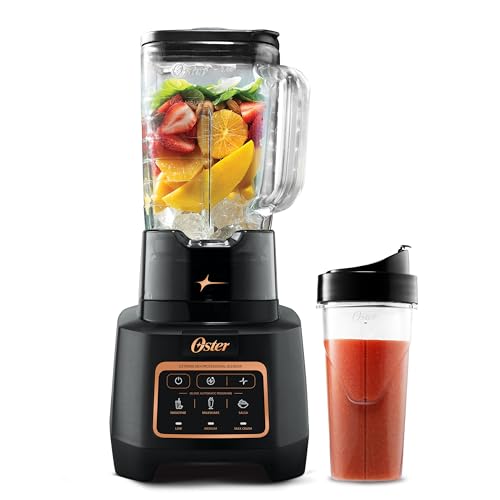
Oster’s Extreme Mix brings the guide’s biggest wattage to its preferred material: a 1600W motor, an 8-cup glass jar, a 10-point stainless blade, iBlend technology, and Blend-N-Go convenience. For households whose all-around brief includes a hard line on glass — no plastic pitcher, full stop — this is the power pick that respects it.
Strengths
- 1600W — the strongest motor in this guide
- 8-cup glass jar: family capacity without plastic
- 10-point blade and iBlend programs for varied work
Trade-offs
- A full 8-cup glass jar is seriously heavy
- No personal cups or processor bowl in the system
- Power this size is loud
| Spec | Detail |
|---|---|
| Motor | 1600 watts |
| Jar | 8-cup glass |
| Blade | 10-point stainless steel |
| Technology | iBlend, Blend-N-Go |
The Extreme Mix’s all-around case rests on headroom: with 1600 watts behind a big glass jar, frozen smoothies, crushed ice, and thick mixtures are handled with the kind of margin that makes technique less critical — the machine simply has more in reserve when a load turns stubborn. Oster’s service ecosystem backs it, and the glass jar keeps turmeric, tomato, and berry pigments from taking up residence.
It is also the pick that best serves the cook-then-blend household in glass: soups and sauces that would live in plastic in rival systems stay in a material that handles heat, acid, and staining gracefully, and the 8-cup capacity means a family soup blends in one or two batches rather than three. If your all-around center of gravity is the stove rather than the smoothie bar, this is your machine.
Choose it if glass is non-negotiable and your household blends big; renters of wrist strength should note the full jar’s weight and pour with two hands, as with all large glass pitchers.
Best for: glass-loyal households wanting maximum power and capacity / Not suited for: anyone who finds a full glass jar unwieldy
Comparison Table
| Pick | Badge | Key spec | Best for |
|---|---|---|---|
| Ninja Kitchen System BL770 | Best Overall | 1500W, 72 oz pitcher + 8-cup processor + cups | Complete kitchen system |
| Ninja Professional Plus DUO BN751 | Best for Smoothies Plus | 1400 peak W, Auto-iQ, pitcher + 2 cups | Smoothie-centric households |
| Vitamix 5200 | Best Premium | 64 oz, variable speed, self-cleaning | Long-term premium performance |
| KitchenAid K400 KSB4028 | Best Control and Feel | 5-speed dial, Intelli-Speed, tamper | Control-focused cooks |
| nutribullet SmartSense NBF50700 | Best Automatic | 1400W, smart sensing auto cycle | Walk-away consistency |
| Oster Extreme Mix 1600W | Best Glass-Jar Power | 1600W, 8-cup glass jar | Glass loyalists, big batches |
How to Choose an All Around Kitchen Blender
Define your “all around” honestly
List the jobs in your real rotation and rank them. If smoothies are eighty percent, buy a smoothie-strong system (BN751, SmartSense) and let the rest follow. If cooking prep is half the story, the BL770’s processor bowl is the feature that matters. If everything happens in one pitcher and texture is king, the Vitamix and K400 argue their case. The phrase “all around” only becomes useful when it is your kitchen’s list, not the manufacturer’s.
Systems vs. single pitchers
Systems (BL770, BN751, SmartSense) trade storage for format coverage: pitcher, cups, sometimes a processor. Single pitchers (Vitamix, K400, Oster) trade coverage for simplicity, counter manners, and often refinement. Neither is superior in the abstract — but be honest about your cupboards. A system whose processor bowl lives in the garage is a pitcher blender with extra steps.
Power and the frozen standard
For an all-arounder that includes smoothies, the frozen standard is the gate: the machine must crush ice and frozen fruit without technique heroics. Everything in this guide clears it, with margins increasing from the K400’s composed competence to the Oster’s 1600W surplus. Beyond the gate, extra power buys speed and thick-load confidence, not different recipes — until the premium tier (Vitamix), where sustained power unlocks nut butters and friction-cooked soups.
Controls: presets, dials, and sensors
Presets (Auto-iQ) maximize repeatability for standard recipes; dials (K400, Vitamix) maximize a cook’s control across everything; sensors (SmartSense) split the difference by adapting automatically. Households with many operators benefit from presets and sensors — the machine enforces consistency. Solo cooks who experiment benefit from dials. Choose the control philosophy that matches your kitchen’s population.
A practical test while shopping: imagine the least experienced person in your household making a smoothie alone. On a preset or sensing machine, they press one button and succeed. On a dial machine, they need the thirty-second briefing you will give them once — after which they own a skill, not just a smoothie. Neither outcome is wrong, but they are different purchases, and households should make the choice deliberately rather than discovering it at breakfast.
How to Use an All Around Blender Across the Whole Menu
- Smoothies: liquid first, greens and soft ingredients next, frozen last; use the smoothie preset or 45–60 seconds of blending; tamp or pause-and-push thick loads.
- Hot soups: blend in the pitcher in batches, vent the lid, start low — or use the Vitamix’s sustained speed to friction-finish a soup to serving temperature by the manufacturer’s method.
- Salsas and chopping: use pulses, not continuous blending — five to eight short pulses with a scrape between keeps texture; the BL770’s processor bowl is the better tool when volume grows.
- Dough (BL770 processor): follow the bowl’s capacity limits, pulse flour and liquid together, and stop the moment the dough forms — over-processing warms and toughens it.
- Frozen drinks: ice last, liquid present, and the ice or frozen preset engaged; add ice in two stages for the most even crush.
- Clean between roles: the ten-second soap-and-water blend between a garlicky salsa and a fruit smoothie is not optional — all-around machines carry flavors if you let them.
What “All Around” Cannot Mean: The Honest Edges
Even the best machines here have borders. None replaces a stand mixer for bread dough at volume, a grain mill for flour as a staple, or a juicer for clear juice — blending keeps fiber in, which is a virtue for smoothies and a definition for juices. The processor bowl on the BL770 is excellent for home prep but is not a full-size food processor for catering quantities. Personal-cup extraction (BN751, SmartSense) still cannot blend hot liquids. And the Vitamix’s supremacy is confined to its single pitcher: it will not chop your onions.
Knowing the edges is what makes an all-around purchase satisfying rather than resentful. Buy the machine whose center covers your week and whose edges touch only your rare occasions, and rent, borrow, or improvise the rest — that is the actual economics of a well-run kitchen, at any budget.
Troubleshooting All-Around Blender Problems
Problem: Smoothie texture varies day to day. Ingredient temperature and order are the variables: frozen fruit straight from a deep freeze blends differently than fruit tempered ten minutes. Standardize the load order, use the preset if your machine has one, and weigh frozen ingredients for a week — consistency is a measurement habit.
Problem: The processor bowl leaves big chunks. Batch size and pulse rhythm: halve the load, pulse in shorter bursts, and shake the bowl between pulses to redistribute. Processor bowls reward patience over power.
Problem: Soup tastes faintly of yesterday’s smoothie (or vice versa). Flavor carryover lives in gaskets and blade assemblies. Deep-clean both, soak the gasket in baking-soda water, and run a lemon-water blend. Glass-jar owners (Oster) will meet this problem least.
Problem: The machine bogs down on thick loads. Add liquid in small increments, use the tamper if included (K400, Vitamix class), and work in stages — blend, rest the motor a moment, blend again. Sustained bogging is a recipe problem before it is a machine problem.
A Week With an All-Around Blender: Where the Value Actually Shows
Appliance value is a weekly phenomenon. Monday opens with smoothies — the BN751’s cups or the BL770’s pitcher, depending on the household’s headcount. Tuesday is soup night, and the all-arounder purees in batches without a second thought, where a smoothie specialist would have stayed in the cupboard. Wednesday might be the K400’s or Vitamix’s fine hour: a sauce finished to silk, a hummus worked smooth with the tamper. Thursday brings the BL770’s processor bowl out for slaw or salsa. Friday is frozen drinks — the ice test every pick here passes — and the weekend adds pancake batter, a frozen dessert, and perhaps dough.
Count the jobs: a dozen or more distinct tasks, one appliance, zero compromises that anyone at the table could taste. That breadth-times-frequency is the all-around proposition, and it is why this category justifies both its prices and its counter space. A specialist blender used twice a week must be extraordinary to earn its place; an all-arounder used twice a day merely has to be good everywhere — and the six above are considerably better than merely good.
All-Around vs. Specialist: When One Machine Is Not Enough
Honesty requires naming the households that should own two machines. Daily green-smoothie devotees who also cook seriously will feel the format tension: the extraction cup is the best solo smoothie tool, the pitcher system the best cooking tool, and households that refuse to compromise either end up pairing a personal blender with a system — the BN751 and SmartSense exist precisely to soften that tension, and for many homes they close it. Bakers at volume need a stand mixer regardless of what any blender claims. And households blending for one should read our single-serve guide before buying capacity they will never fill.
For everyone else — the broad middle of home cooks who blend often, cook often, and entertain sometimes — the all-arounder is not a compromise at all. It is the correct tool, and the specialist machines are the niche purchases. Buy the center of your cooking first; let the edges wait for evidence that you need them.
Noise, Size, and Counter Politics
All-around blenders are the biggest and loudest machines in this series, and pretending otherwise helps no one. A 1500W system at full frozen tilt is a genuine event in a small apartment; a 72 oz pitcher plus a processor bowl claims real estate in cupboards that may not have it. Measure before buying: pitcher height against the space under your cabinets if it will live out, bowl and cup storage against your drawers if it will not.
Mitigation is mostly behavioral. Blend times cluster naturally around cooking, not sleeping; a folded towel under the base cuts counter-transmitted rumble; and the presets and sensors in this guide shorten total noise by finishing efficiently instead of grinding. Households for whom noise is a hard constraint should weight the K400’s composed manners and the SmartSense’s efficiency, and accept that physics gives no all-arounder a whisper.
Caring for a System: Jars, Bowls, Blades, and Gaskets
Multi-part machines multiply the care surface, and the discipline is the same one repeated per part: rinse immediately, wash the gasket as its own component, dry before storing, and keep the parts together. The processor bowl’s blade is as sharp as the pitcher’s — brush-wash both. Plastic vessels cloud less when washed promptly and kept out of prolonged high-heat dishwasher cycles; glass asks only for respect around sinks and tile.
The system’s economic advantage depends on this care, because its value case is longevity across many parts. The good news is that every brand here sells the wear parts — pitchers, cups, blade assemblies, gaskets, lids — so a dropped pitcher is an errand, not a funeral. Keep the model numbers in a note on your phone, and the all-arounder you bought this year can be the one you are still using when the kitchen around it has been repainted twice.
Reading the Spec Sheet of a System Blender
System blenders generate the longest spec sheets in the category, and most of the length is distraction. The numbers that predict your experience are few. Total vessel coverage — which formats the box actually includes — matters more than any motor figure, because a missing cup or bowl is a capability you do not own. Pitcher working capacity (roughly two-thirds of the headline ounces) tells you the real batch size. Control type — preset, dial, or sensing — predicts repeatability across operators. And parts availability, checkable in two minutes on the brand’s own listings, predicts the machine’s lifespan better than its warranty card does.
The numbers to discount are the familiar ones: peak wattage differences of a few hundred within the same class, speed counts (ten speeds and five speeds converge to the same three you will use), and program counts beyond the recipes you actually make. Read a system blender’s listing like a contract — vessels, controls, parts — and the marketing falls away, leaving the machine itself. Every pick in this guide survives that reading, which is not a coincidence but the selection method.
Smoothie Performance, Pick by Pick: A Plain-Language Summary
Because this guide’s title promises smoothies, here is the frozen-fruit verdict without the surrounding machinery. The BN751 is the most complete smoothie tool: presets that repeat perfectly, a pitcher for batches, and extraction cups that produce the finest solo texture in the mid-tier. The SmartSense matches it on automation and adds load-sensing, which smoothie makers with variable recipes will appreciate most. The BL770’s pitcher blends family smoothies with the same Ninja authority, trading the BN751’s preset polish for system breadth.
The Vitamix 5200 has the highest ceiling — the smoothest green smoothies, the least liquid needed, the most authority with seeds and fiber — at the highest price and in a single format. The K400 is the connoisseur’s smoothie machine: a dial, a tamper, and speed that holds under load, producing café-style results for cooks who enjoy the craft. The Oster Extreme Mix is the blunt instrument of the group, in the best sense: enormous power in a glass jar, ideal for households whose smoothies are big, frozen, and frequent. No pick here fails the smoothie test; they differ in how the success feels — automatic, crafted, or overwhelming.
Setting Up an All-Around Blender Station
An all-arounder earns its keep only if it is reachable, so spend twenty minutes on its habitat. The base wants a permanent counter position with the pitcher mounted — a system that must be assembled from a cupboard for every smoothie is a system in early retirement. Cups and lids belong in the nearest drawer, the processor bowl in the nearest cupboard, and the tamper (where included) in the utensil crock, because a tamper stored elsewhere is a tamper unused.
Stage the consumables of the routine beside it: the smoothie shelf in the freezer, the protein and seeds in one bin, so the morning workflow is a single motion from freezer to pitcher to glass. Keep a microfiber towel and a bottle brush at the sink for the blade assemblies, and the model’s spare-gasket listing bookmarked before you need it. None of this is glamorous, and all of it is the difference between an appliance that transforms a kitchen’s habits and one that merely occupies it. The all-arounder is infrastructure; set it up like infrastructure.
Common Buying Mistakes
- Buying the system, storing it in the garage. A multi-part blender only earns its versatility if every part lives within reach.
- Confusing “all around” with “best at everything.” Every pick here has a center of excellence; choose the one whose center is your routine.
- Ignoring the smoothie gate. An all-arounder that cannot do frozen smoothies will be resented weekly, however good its soup game.
- Overvaluing wattage within the guide. Between 1400W and 1600W systems, format and controls matter more than the number.
- Skipping the tamper technique. Thick blends fail from air pockets, not power; the tamper (or a pause-and-push) is the fix.
- Forgetting flavor carryover. One machine doing everything needs cleaning discipline between roles.
Final Recommendation
The Ninja Kitchen System BL770 is the all-arounder most households should buy: it is the only pick that adds genuine food processing to a smoothie-strong pitcher and personal cups, at a system price. Smoothie-first homes should take the BN751, and buyers making a decade-scale decision should take the Vitamix 5200 and never think about blenders again.
Companion guides in this cluster: Best All Purpose Blenders, Best Affordable Blenders For Smoothies, Best 1500 Watt Blenders, Best 1000 Watt Blenders, and Best All Purpose Blenders And Copper.
Whichever approach you choose, give the machine its first-week calibration: learn its liquid floor with cheap smoothies, its pulse rhythm with a salsa, its hot-soup manners with a forgiving batch. An all-around blender is a small ecosystem of vessels and habits, and the households that love theirs are the ones that invested that first week. After it, the machine disappears into the cooking — which, for the hardest-working appliance in the kitchen, is the highest praise available.
Frequently Asked Questions
What makes a blender truly “all around”?
Competence across three domains at once: frozen blending (smoothies, ice), cooked blending (soups, sauces), and mechanical prep (chopping, processing, or personal-cup extraction). A machine strong in only one domain is a specialist wearing an all-around label — the picks here were required to demonstrate all three, in the box.
Is a kitchen system better than a standalone premium blender?
For most households, yes on coverage and value: the BL770-class system covers more jobs for less money. The premium standalone (Vitamix 5200) wins on texture ceiling, sustained power, and longevity. Choose coverage if your cooking is varied, ceiling if your blending is intense and daily.
Can an all around blender replace a food processor?
Partially. A system with a processor bowl (BL770) covers chopping, salsa, slaw, and small doughs — the majority of home food-processor work. Large batches, slicing and shredding at volume, and pastry in quantity still belong to a dedicated processor.
Do I need a tamper?
If your recipes include thick smoothie bowls, frozen desserts, or nut-heavy blends, a tamper (included with the K400, standard in the Vitamix class) transforms the experience by collapsing air pockets without stopping the machine. For liquid smoothies and soups, it is unnecessary. Households without a tamper can approximate the technique by stopping the machine and pushing the mixture down with a spatula — slower, but effective for occasional thick work.
How long should an all around blender last?
These are daily appliances and should be bought like them: mainstream systems give years of service with jar and blade replacements along the way, and the premium pick is a decade-class machine. Parts availability — strong for every brand here — is the deciding factor in realized lifespan. Treat the gaskets and blade assemblies as scheduled maintenance rather than failures, budget a few minutes of care per week, and an all-arounder’s cost per blend falls to nearly nothing long before the machine itself wears out.
Which pick is best for smoothies specifically?
The BN751, by design: Auto-iQ presets, a family pitcher, and extraction cups for solo servings cover the smoothie map most completely. The SmartSense is its automatic rival, and the Vitamix 5200 has the highest texture ceiling of all — at a premium price and a single format.
Can these blenders make hot soup from raw ingredients?
Only the Vitamix class truly friction-cooks: sustained high speed heats a soup to steaming over several minutes of blending, by design. The other picks blend cooked soup beautifully — which is how most home soup-making works anyway — and their pitchers handle hot liquids in vented batches. If raw-to-hot soup in the blender is a signature move for you, that is a specific argument for the premium pick; otherwise, blend cooked soup in any machine here with confidence. Most households discover that cooked-soup blending covers their real menu completely, and the friction-cooking party trick stays exactly that — impressive, rarely missed.


