Disclosure: airfryerkitchensupply.com is reader-supported. When you buy through links on our site, we may earn an affiliate commission at no extra cost to you.
Where to buy
Every linked pick in this guide to the best all around microwaves was verified against Amazon’s catalog on 2026-11-21, so the model names and specs below are the models you will actually land on: Panasonic NN-SN97JS 2.2 Cu.Ft Cyclonic Inverter, TOSHIBA 1.6 Cu.Ft Inverter (Black Stainless), Panasonic NN-SN65KB 1.2 Cu.Ft Inverter, GE 1.6 Cu.Ft Countertop (Black Stainless), Sharp SMC1662KS 1.6 Cu.Ft Countertop, Farberware 1.6 Cu.Ft Countertop (Stainless Steel). All-around means the whole job — reheating, defrosting, cooking, family capacity — so picks were verified across inverter, sensor and conventional platforms. Check the current price on Amazon from any pick’s link, because finishes and configurations rotate through the catalog during the year.
The best all around microwaves are the hardest microwaves to rank, because ‘all-around’ is a promise about everything: reheating without cold centers, defrosting without cooked edges, cooking fresh food credibly, fitting a family’s dishes, and doing it all for years without drama. Most ovens are good at two of those. This guide ranks six verified models that are good at all of them — across three different technologies, because there is more than one road to balanced excellence.
The technologies matter, so here is the map before the picks. Inverter ovens (both Panasonics, the Toshiba) deliver true continuous low power and dominate delicate work. Sensor ovens judge doneness by steam and dominate reheating. The mechanical school (Sharp’s Carousel) and the mainstream school (GE, Farberware) reach balance through rotation, size and honest presets. An all-around guide that only listed inverters would be a technology pamphlet; this one is a buyer’s guide.
Every model was verified against Amazon’s catalog on 2026-11-21 — model, capacity, wattage and headline technology taken from the listing listings themselves. Where a pick’s claim is a finish or a turntable rather than a wattage, the review says so plainly.
Read by household size and cooking style. The flagship and the compact pick are the same philosophy at two scales; the family picks divide by philosophy; the value pick proves the tier is a negotiation, not a wall.
In this guide
Quick Picks
Best Overall: Panasonic NN-SN97JS 2.2 Cu.Ft Countertop Microwave with Cyclonic Inverter — Cyclonic inverter evenness, Genius Sensor judgment and a 2.2 cu.ft cavity — the microwave with no weak event.
Best for Families: TOSHIBA 1.6 Cu.Ft Countertop Microwave with Inverter (Black Stainless Steel) — Inverter power and sensor smarts in a right-sized 1.6 cu.ft black stainless package.
Best Compact All-Rounder: Panasonic NN-SN65KB 1.2 Cu.Ft Microwave with Inverter (Black) — The flagship Panasonic formula — inverter, sensor, Turbo Defrost — compressed into 1.2 cu.ft.
Best Controls and Finish: GE 1.6 Cu.Ft Countertop Microwave (Black Stainless) — Fingerprint-resistant black stainless, eight convenience settings and GE’s familiar calm.
Best Large Turntable: Sharp 1.6 Cu.Ft Countertop Microwave (Stainless Steel) — Sharp’s 13.6-inch Carousel makes evenness a mechanical guarantee for plates and platters.
Best Value in a Big Cavity: Farberware 1.6 Cu.Ft Countertop Microwave (Stainless Steel) — Full family size with sensor cooking and multi-stage programs at the friendly end of the guide.
How These Picks Were Chosen
Candidates had to be credible at every core job — reheat, defrost, cook, accommodate family dishes — with no failing grade allowed. Each model and finish was verified. We weighted evenness of results most heavily, because it is the quality owners perceive at every single use, then capacity honesty, defrost behavior, and the ownership details of finish, controls and service backing.
The six slots map the category’s real diversity: a flagship inverter, a family inverter, a compact inverter, a mainstream finish-and-controls pick, a turntable specialist and a value model with a sensor. If your household’s priorities are anywhere in the normal range, one of these six is shaped like them.
- Verified model, capacity, wattage and technology for every pick, checked 2026-11-21
- No failing grades: every pick is credible at every core job
- Three technologies represented, with their trade-offs stated plainly
- No prices or fixed ratings printed — check price on Amazon at the listing
The 6 Best All Around Microwaves, Reviewed
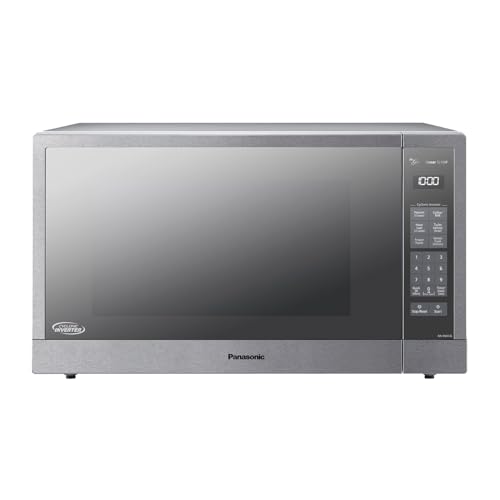
Panasonic NN-SN97JS 2.2 Cu.Ft Countertop Microwave with Cyclonic Inverter — Best Overall
The Panasonic NN-SN97JS is the all-around benchmark: 1250 watts delivered through Cyclonic inverter technology for genuinely even energy, a Genius Sensor that reheats and cooks by doneness, and a 2.2 cu.ft cavity that swallows the largest casserole a home kitchen produces. It is not the cheapest or the smallest oven here; it is the one with no weak event. All-around excellence is a high bar, and this is the microwave that clears it.
Strengths
- Cyclonic inverter power is the most even microwave energy in this guide
- Genius Sensor takes the guesswork out of reheating and fresh cooking
- 2.2 cu.ft capacity handles the biggest home dishes, and it can build in with a trim kit
Trade-offs
- Large footprint demands real counter or a planned built-in home
- Premium tier pricing — this is the flagship spend of the guide
- Power this even and strong still needs power-level discipline for delicate items
Key specs
- Power: 1250W
- Capacity: 2.2 cu.ft
- Technology: Cyclonic Wave inverter
- Sensor: Genius Sensor
- Install: Countertop / built-in (per Amazon listing)
Inverter technology is the core of this pick, so it deserves a plain explanation. Conventional ovens fake low power by cycling the magnetron on and off; an inverter delivers true continuous power at the level you set. The result is food that defrosts without cooked edges, sauces that hold together, and reheats without the rubbery ring. Panasonic’s Cyclonic variant distributes that energy in three dimensions, and the difference is visible in a bowl of soup: even, top to bottom.
The Genius Sensor is the second pillar. It reads the steam signature of the food and ends cooking at doneness rather than at a timer’s guess, which is why owners of these ovens describe reheating as ‘just right’ with suspicious consistency. Combined with the cavity size, the Panasonic becomes the rare microwave that can be a household’s only oven for days at a stretch without apology.
The honest costs are space and money, and both are stated plainly so the right households self-select. If your counter can host it and your cooking justifies it, this is the last microwave you research for a decade. If either answer is no, the picks below divide its virtues among smaller, thriftier ovens.
Best for: Households that want one microwave that is excellent at everything, for years / Not suited for: Small kitchens — this is a large oven in every dimension

TOSHIBA 1.6 Cu.Ft Countertop Microwave with Inverter (Black Stainless Steel) — Best for Families
Toshiba’s 1.6 inverter is the family answer to the flagship: true inverter power at 1250 watts, a smart sensor, auto defrost and a 13.6-inch turntable, in a black stainless body that suits modern suites. It gives up the Panasonic’s cavernous capacity and keeps nearly everything else families actually use, at a friendlier tier. For a household of three to five, this is the all-around sweet spot.
Strengths
- Inverter power at family scale without flagship bulk
- Smart sensor and auto defrost cover the two hardest everyday jobs
- 13.6-inch turntable takes large plates and medium casseroles
Trade-offs
- Black stainless shows scratches if treated roughly
- 1.6 cu.ft still says no to the very largest serving dishes
- Inverter finesse rewards owners who learn the power levels
Key specs
- Power: 1250W
- Capacity: 1.6 cu.ft
- Technology: Inverter
- Turntable: 13.6″
- Finish: Black stainless steel (per Amazon listing)
Family microwave life is a rotation — reheated plates, defrosted proteins, steamed vegetables, weekend popcorn — and the Toshiba is specified as if its designers read that rotation off a real fridge door. The sensor handles the reheats, the inverter handles the defrosts without grey edges, and the turntable handles the plates the family actually owns.
The black stainless finish is more than styling in a family kitchen: it is the most forgiving surface here for the fingerprints and splashes that family use generates hourly. Paired with a sensible control layout, the oven asks little administration from the people it serves.
Against the Panasonic above, the trade is capacity for size and spend — a trade most families should make gladly. Against everything below, the Toshiba’s claim is that it is the smallest oven in this guide that still does every job at a flagship standard.
Best for: Families that want inverter evenness in a right-sized, handsome package / Not suited for: Huge-casserole households that need the Panasonic’s 2.2 cu.ft

Panasonic NN-SN65KB 1.2 Cu.Ft Microwave with Inverter (Black) — Best Compact All-Rounder
The NN-SN65KB compresses the flagship Panasonic formula — inverter power, Genius Sensor, Turbo Defrost — into a 1.2 cu.ft black countertop oven for kitchens that cannot host the 2.2. At 1200 watts it is also genuinely quick. It is the proof that ‘all-around’ is about balance, not size: this little oven does every job well, for one to three people, on counters where the big Panasonic simply cannot live.
Strengths
- Full inverter and Genius Sensor technology in a compact body
- Turbo Defrost is the fastest gentle defrost in this guide
- 1200W keeps small-portion cooking brisk
Trade-offs
- 1.2 cu.ft caps the dish sizes — measure the casserole
- Black finish is the verified listing’s only look
- Premium-per-liter pricing: compact quality is not cheap quality
Key specs
- Power: 1200W
- Capacity: 1.2 cu.ft
- Technology: Inverter
- Sensor: Genius Sensor
- Defrost: Turbo Defrost (per Amazon listing)
Compact ovens usually ask a quality sacrifice; this one asks only a quantity sacrifice. The inverter’s continuous low power makes it the best small defroster and sauce-keeper here, and the sensor makes its reheats the equal of its big sibling’s. For a couple that cooks seriously in a small kitchen, there is no better-shaped tool in this guide.
The popcorn button deserves its sentence because Panasonic tunes it by the sensor rather than by a fixed clock, and popcorn is where fixed clocks go to burn bags. Small feature, perfect emblem of the oven’s philosophy: measure the food, not the time.
Choose it when the counter says small and the cook says serious. Choose the Toshiba above when the household outgrows 1.2 cu.ft; the two picks are the same idea at two scales, and owners graduate between them without relearning anything.
Best for: Small kitchens that refuse to give up inverter quality / Not suited for: Families — capacity is the deliberate sacrifice here

GE 1.6 Cu.Ft Countertop Microwave (Black Stainless) — Best Controls and Finish
GE’s 1.6 is the all-rounder for people who value the surface and the interface: a fingerprint-resistant black stainless finish that stays presentable in a working kitchen, 1150 watts of mainstream power, and eight convenience cook settings laid out the way GE’s enormous owner base expects. It is the pick for households that want capability without a learning curve and a finish without a wiping regime.
Strengths
- Fingerprint-resistant finish is a daily mercy in family kitchens
- 1150W and 1.6 cu.ft hit the family mainstream squarely
- GE’s control logic and service network are the category’s most familiar
Trade-offs
- Conventional cycling power, not inverter — defrosting needs technique
- Convenience settings are presets, not sensor judgment
- Black stainless suite-matching cuts both ways if your other appliances are bright
Key specs
- Power: 1150W
- Capacity: 1.6 cu.ft
- Finish: Fingerprint-resistant black stainless
- Settings: 8 convenience cook settings
- Brand: GE (per Amazon listing)
There is a real philosophy split in this guide between ovens that judge (sensors, inverters) and ovens that obey (presets, timers), and the GE is the obey school’s valedictorian. Its eight convenience settings cover the household rotation, its power is honest, and its behavior is predictable enough that the whole family converges on the same personal settings within a month.
The finish is the headline that keeps on giving. Fingerprint resistance sounds like a showroom trick until you have wiped a conventional stainless door for the fortieth time; in a kitchen where the microwave is touched by everyone, the GE’s surface is the difference between an appliance that looks kept and one that looks used.
Buy the GE if your household values calm: familiar controls, a network behind the warranty, and an exterior that forgives. The inverter picks above will out-defrost it; nothing here will out-live-with it more peacefully.
Best for: Households that want mainstream power with the tidiest exterior and simplest controls / Not suited for: Inverter devotees — this is a conventional-power oven
Check the current price of the GE 1.6 Cu.Ft Countertop Microwave (Black Stainless) on Amazon

Sharp 1.6 Cu.Ft Countertop Microwave (Stainless Steel) — Best Large Turntable
Sharp’s 1.6 pairs family capacity with the brand’s signature Carousel: a removable 13.6-inch turntable that rotates big plates and platters through the energy field completely. At 1100 watts in stainless, it is the mechanical school’s flagship in this guide — no sensor, no inverter, just the best rotation in the class and a cavity sized for real family dishes.
Strengths
- 13.6-inch Carousel is the evenness engine — big, removable, washable
- 1.6 cu.ft and 1100W cover the family mainstream without premium pricing
- Stainless finish suits the broadest range of kitchens
Trade-offs
- Timer-and-preset cooking only; evenness leans on the turntable and your technique
- No sensor, no inverter, no mute headline features
- Large turntable means the glass plate is a two-hand wash
Key specs
- Power: 1100W
- Capacity: 1.6 cu.ft
- Turntable: 13.6″ removable Carousel
- Model: SMC1662KS
- Finish: Stainless steel (per Amazon listing)
The Carousel argument is geometric: a dish only heats evenly if every part of it travels through the field’s strong zones, and a 13.6-inch plate under a family casserole does that more completely than the smaller turntables in family ovens. Owners who reheat platters — holiday leftovers, sheet-pan dinners — feel the difference in the center of the dish.
Sharp keeps the rest of the oven deliberately standard: honest power, clear controls, a stainless face. That restraint is the pick’s identity. It spends its budget on the one mechanism the brand has refined for decades and declines to charge you for electronics you may not want.
Cross-shop it against the GE: same size class, opposing philosophies — finish and familiarity versus rotation and evenness. Households that reheat plated meals nightly should lean Sharp; households that value the tidy exterior and preset calm should lean GE.
Best for: Plate-and-platter households that judge a microwave by heating evenness / Not suited for: Sensor seekers — Sharp’s answer here is mechanical, not electronic
Check the current price of the Sharp 1.6 Cu.Ft Countertop Microwave (Stainless Steel) on Amazon

Farberware 1.6 Cu.Ft Countertop Microwave (Stainless Steel) — Best Value in a Big Cavity
Farberware’s 1.6 is the value surprise of the all-around class: a full family cavity with 1100 watts, multi-stage cooking and — unusually at its tier — smart sensor cooking among its six presets. It is the pick for households that read the Panasonic review with longing and the budget with realism: most of the capability, in the same family size, at the friendly end of the guide.
Strengths
- Sensor cooking at a value tier is a genuine rarity
- 1.6 cu.ft and 1100W are full family specifications, not budget cuts
- Multi-stage cooking adds the defrost-then-cook sequence families use weekly
Trade-offs
- Conventional power delivery; defrost finesse trails the inverters
- Fit and finish are a step below the Panasonic and GE
- Six presets is a working list, not a library
Key specs
- Power: 1100W
- Capacity: 1.6 cu.ft
- Power levels: 10
- Cooking: Multi-stage, smart sensor cooking
- Presets: 6 (per Amazon listing)
Value picks earn their place by choosing the right corners to leave uncut, and Farberware’s choices are shrewd: size full, power full, sensor present, stages present — with the savings taken in surface refinement and brand prestige, the two things that never cooked a meal. A family upgrading from a dying oven will feel this as an upgrade in every direction that matters at dinner.
The sensor deserves emphasis because at this tier it is normally the first feature deleted. Its presence changes reheating from timing folklore to measurement, and it is the main reason this oven sits in an all-around guide rather than a purely budget one.
Choose the Farberware when the budget is real and the family is too. It is the guide’s proof that ‘all-around’ and ‘affordable’ are not opposites — they are a negotiation, and this oven negotiates well.
Best for: Budget-conscious families that need full size and a sensor without flagship spend / Not suited for: Buyers who want inverter technology — this is the value alternative to it
Check the current price of the Farberware 1.6 Cu.Ft Countertop Microwave (Stainless Steel) on Amazon
Comparison Table
| Pick | Badge | Key spec | Best for |
|---|---|---|---|
| Panasonic NN-SN97JS 2.2 Cu.Ft Countertop Microwave with Cyclonic Inverter | Best Overall | 1250W, 2.2 cu.ft, Cyclonic Wave inverter, Genius Sensor, countertop/built-in capable | Households that want one microwave that is excellent at everything, for years |
| TOSHIBA 1.6 Cu.Ft Countertop Microwave with Inverter (Black Stainless Steel) | Best for Families | 1250W inverter, 1.6 cu.ft, smart sensor, auto defrost, 13.6-inch turntable | Families that want inverter evenness in a right-sized, handsome package |
| Panasonic NN-SN65KB 1.2 Cu.Ft Microwave with Inverter (Black) | Best Compact All-Rounder | 1200W inverter, 1.2 cu.ft, Genius Sensor, popcorn button, Turbo Defrost | Small kitchens that refuse to give up inverter quality |
| GE 1.6 Cu.Ft Countertop Microwave (Black Stainless) | Best Controls and Finish | 1150W, 1.6 cu.ft, fingerprint-resistant black stainless, 8 convenience cook settings | Households that want mainstream power with the tidiest exterior and simplest controls |
| Sharp 1.6 Cu.Ft Countertop Microwave (Stainless Steel) | Best Large Turntable | 1100W, 1.6 cu.ft, removable 13.6-inch Carousel turntable, stainless steel | Plate-and-platter households that judge a microwave by heating evenness |
| Farberware 1.6 Cu.Ft Countertop Microwave (Stainless Steel) | Best Value in a Big Cavity | 1100W, 1.6 cu.ft, 10 power levels, multi-stage cooking, smart sensor cooking, 6 presets | Budget-conscious families that need full size and a sensor without flagship spend |
How to Choose the Right All-Around Microwave
Begin with the job you do worst now. Cold centers point to evenness technology — inverter, sensor or a big Carousel. Cooked-edge defrosting points to inverter power or Turbo Defrost. Queueing at dinner points to capacity and watts. An all-around oven is chosen by its answer to your worst job, because it will handle your easy jobs regardless.
Size honestly, using the dish test: the largest dish you microwave weekly must fit the cavity with room for the turntable to rotate it. That single measurement sorts this list into your finalists faster than any feature comparison — 2.2, 1.6 or 1.2 cu.ft is a household-size decision before it is a product decision.
Then decide your technology comfort. Inverters reward owners who use power levels; sensors reward owners who delegate; presets reward owners who cook the same rotation. None is superior in the abstract — the GE’s calm obedience is the right answer for plenty of households that would never exploit an inverter.
Finally, the ownership layer: finish forgiveness (GE, Toshiba black stainless), service network (GE, Panasonic, Sharp, Toshiba all clear the bar), and control clarity for every cook in the house. An all-around oven serves the whole household, including the teenager and the grandparent.
Inverter, Sensor or Conventional: What the Technologies Actually Buy You
Inverter power buys gentleness: continuous low power that defrosts evenly, holds sauces, melts without seizing and reheats delicate proteins without rubber edges. Its cost is price and a modest learning curve — you must actually use the power levels to collect the benefit.
Sensor cooking buys judgment: the oven measures the food’s steam and decides doneness, which removes the household’s accumulated timing folklore and replaces it with measurement. It shines on reheats and fresh vegetables, the two most common jobs in most kitchens.
Conventional power with a good turntable buys predictability and value: known behavior, honest presets, and evenness that technique can complete. The Sharp and GE prove that a well-executed conventional oven remains a rational all-around choice, especially where budget or familiarity leads.
How to Use an All-Around Microwave Like a Cook, Not a Button-Pusher
The difference between a good microwave and a great one is partly the operator. These habits are calibrated to the ovens in this guide and will raise the results from any of them.
- Step 1: Learn three power levels properly — full for liquids and reheats, 50% for dense leftovers, 20–30% for defrosting and delicate work — and use them by default, not by exception.
- Step 2: Let the sensor work where fitted: use sensor reheat for leftovers and fresh items, and resist adding ‘just thirty seconds’ until you have checked after the standing time.
- Step 3: Arrange in rings, cover for steam, and rotate or stir dense dishes halfway; even inverter ovens reward the ritual.
- Step 4: Defrost in stages with rests, separating pieces early; on the Panasonics, Turbo Defrost plus patience is unbeatable.
- Step 5: Keep a house notebook — mental or paper — of your five staple items and their settings on this oven; all-around excellence is partly a record of what worked.
- Step 6: Maintain the machine: weekly cavity wipe, monthly steam clean, turntable washed and dried — evenness degrades in a dirty cavity on any oven.
Common Buying Mistakes
- Buying the 2.2 cu.ft flagship for a counter that cannot host it, then living with a blocked cabinet for a decade.
- Paying for inverter technology and then cooking everything at full power — the benefit lives in the levels.
- Ignoring the sensor’s standing time and judging its reheats too early.
- Choosing capacity by the biggest holiday dish instead of the weekly one.
- Treating ‘all-around’ as ‘most features’ and buying a library of presets nobody opens.
The thread through these mistakes is buying the brochure instead of the routine. Your worst weekly job, your largest weekly dish and your household’s technology comfort — answer those three and this list ranks itself.
Defrosting, Decoded: Why Inverters Win and How Conventional Ovens Keep Up
Defrosting fails at the edges because microwave energy deposits at surfaces first. An inverter’s continuous low power lets heat conduct inward during the process itself, so edges stay raw while the center thaws — the single most visible quality gap in this category, and the reason both Panasonics and the Toshiba anchor the top of this list.
Conventional ovens close much of the gap with discipline: low power in short cycles, rests between bursts, pieces separated as soon as they yield, and ground meat scraped progressively. It is more attendance, honestly stated — which is why households that defrost daily should buy the inverter, and households that defrost weekly can save the money with a clear conscience.
Reheating Leftovers: The Job That Decides Owners’ Verdicts
Ask owners about their microwave and they will describe reheated leftovers, because that is the daily referendum. The winning formula across all six picks: shallow even layers, a sprinkle of water on starches, a cover for steam, moderate power for dense items, and a full minute of standing before judging. Sensor ovens automate the timing; the rest is technique, and technique is free.
The most common failure is impatience at full power — a scorched rim around a cold center, blamed on the oven. The second is skipping the cover, which lets the steam that would equalize the dish escape into the cavity. Fix those two habits and the perceived gap between this guide’s value pick and its flagship narrows to almost nothing on reheats.
Fresh Cooking in the Microwave: Vegetables, Grains and Fish
An all-around oven earns the title in fresh cooking. Vegetables steam brilliantly with a spoon of water and a cover, keeping color and bite that boiling destroys. Rice and grains cook evenly in the bigger cavities here with a rest to finish. Fish — the delicate test — rewards inverter low power or a conventional oven’s 50% setting with results that surprise skeptics.
The honest boundary is browning: no microwave-only oven browns, crisps or roasts like dry heat does. Households that want that in the same box belong in the air fryer microwave guide in this program. All-around means the full microwave repertoire done excellently — and knowing where the repertoire ends is part of the excellence.
Size Classes, Translated: 1.2, 1.6 and 2.2 Cu.Ft in Real Dishes
The 1.2 cu.ft class (NN-SN65KB) takes dinner plates, bowls and small casseroles for one to three people. The 1.6 class (Toshiba, GE, Sharp, Farberware) takes the family’s medium casserole and large plates and is the mainstream answer for households of three to five. The 2.2 class (NN-SN97JS) takes the biggest rectangular dishes and double batches, and asks for counter or built-in space in exchange.
Turntable diameter tracks these classes and matters as much as volume: a dish that fits the cavity but overhangs the plate will rock, spill and heat unevenly. Every pick here pairs its cavity with a proportionate turntable — one of the quiet ways a curated list protects you from a spec-sheet mismatch.
Popcorn, Pizza and the Preset Honor Roll
Presets are where marketing and reality negotiate, so here is the honest grading. Popcorn presets work when tuned by sensor (the Panasonics) and are approximate elsewhere — the listen-and-stop rule remains the professional method on every oven in this guide. Pizza reheat presets earn their button: they balance melting the top with not cremating the crust, a genuinely two-variable problem. Potato and vegetable presets are reliable across all six picks because the foods are forgiving and the portions standardized.
Where presets cannot help is your specific leftovers in your specific dish — the job sensors were invented for. The practical household settles into a pattern within a month: sensor for the variable jobs, two or three beloved presets for the standardized ones, and manual power levels for everything precious. Every pick here supports that pattern; they differ in how much of it they automate.
Noise, Light and the Panel: The Interface Layer
All-around excellence includes the interface you touch daily. Panel legibility in a dim kitchen, a clock you can read across the room, a beeper whose volume suits the house — the Toshiba and Panasonic sensor models add mute or soft-tone thinking that shared households bless weekly. Interior lighting matters more than brochures admit: watching milk so it does not boil over is a visual job, and the brighter cavities here make it easier.
Door feel is the other interface. A family oven’s door opens thousands of times a year; the picks here were chosen partly for doors and latches that feel like appliances. When you compare in person or in owner footage, watch the door — it is the part of the oven your hand will know best.
Placing a Big All-Around Oven: Counters, Trim Kits and Air
The flagship Panasonic’s built-in capability changes its placement story: with the matching trim kit it can live in a cabinet wall like a designed appliance, freeing the counter entirely. Countertop placement for any pick here still needs the manual’s clearances — these are powerful ovens that move real heat, and a sealed cubby shortens any oven’s life.
Measure the landing zone as carefully as the oven: a hot casserole exits toward whatever is beside the microwave, and the all-around household cooks bigger dishes more often. A clear, heat-safe landing surface within one step is the unglamorous accessory that makes a big oven pleasant instead of hazardous.
Matching the Six Picks to Six Households, One Last Time
The batch-cooking family with counter to spare takes the Panasonic flagship and stops researching microwaves for a decade. The same family in a smaller kitchen takes the Toshiba and loses nothing it will notice at dinner. The serious couple in a city apartment takes the compact Panasonic and gains a counter’s worth of workspace without surrendering inverter quality — the rarest trade in this category.
The multi-generational household, where the microwave must be operable by everyone from teenager to grandparent without a tutorial, takes the GE and its calm. The platter-and-leftovers household takes the Sharp and its Carousel. And the household that needs family size this month, on this budget, takes the Farberware and discovers that the value negotiation in this category has become genuinely favorable to buyers.
What none of these households should do is buy outside their shape: the flagship for a studio, the compact for a family of six, the value pick for a household that defrosts daily and will feel the inverter’s absence at every meal. All-around is a personal standard before it is a product standard.
How We Would Spend at Each Tier, One Paragraph Each
At the flagship tier the money buys evenness and capacity that never expire as needs: the Panasonic is the spend-once answer. At the family tier the money buys the same philosophy at household scale, and the Toshiba-versus-GE-versus-Sharp choice is a referendum on whether your household prizes judgment, calm or rotation. At the compact tier the money buys quality density — the small Panasonic costs flagship money per liter and returns it in daily results per inch of counter.
At the value tier the Farberware proves the negotiation has changed: sensor cooking and full size no longer require flagship money, and the remaining gap — refinement, inverter finesse — is one many households will never detect at dinner. Spend where your household’s edges are; save where they are not. That sentence is the entire economics of this guide.
Accessories That Complete an All-Around Setup
A microwave-safe splatter cover, a set of glass containers that travel fridge-to-oven-to-table, and a small microwave-safe steamer basket are the three accessories that multiply every pick in this guide. Together they cost less than the difference between adjacent tiers and they improve results on all of them — the rare upgrade with no wrong answer.
Skip the novelty layer: single-purpose gadgets for foods you cook twice a year, and any unverified metal-trimmed cookware. An all-around kitchen is built on versatile tools, and its microwave drawer should obey the same rule as the oven itself.
Troubleshooting the Three Complaints Every Owner Eventually Has
Complaint one: ‘It heats unevenly now.’ Work the list before blaming the oven — a dirty cavity, a turntable ring with a flat-spotted wheel, food arranged in a center pile, or a forgotten cover explain nearly every case, on every pick here. Clean, reseat, rearrange, and the oven you researched returns.
Complaint two: ‘It stopped mid-cycle / the panel froze.’ Power-cycle at the plug, check the door is fully latched, and confirm the child lock has not been engaged by small hands. Persistent faults after that are a service call, and the brands in this guide all maintain the networks to answer one.
Complaint three: ‘It smells.’ Steam-clean with lemon, wash the turntable, and inspect the cavity ceiling — the forgotten surface. Odor lives in old splatter, not in the electronics. Ten minutes monthly prevents the complaint entirely, which is why the maintenance liturgy appears in every guide in this program without apology.
A Short Word on Microwave Safety at Full Size
Bigger ovens hold bigger, heavier, hotter dishes, and the safety habits scale accordingly: two hands and dry mitts for casserole exits, a clear landing zone, and care with steam when a cover comes off a large dish — the steam volume from a family casserole is a genuine scald risk that small ovens never teach. Superheated liquids, sealed containers and in-shell eggs obey the same rules at every size in this guide.
The appliances themselves carry the same certified interlocks and shielding standards across all six picks, flagship to value. Keep the door seal clean, retire any oven whose door stops latching true, and the all-around category is as safe as it is capable.
The Ownership Decade: What All-Around Really Costs and Returns
An all-around microwave is a ten-year appliance, so judge the picks as decade-long citizens. The flagship’s case is that its evenness and capacity never become the reason to replace it. The value pick’s case is that its savings, banked at purchase, outweigh a refinement gap most dinners never reveal. Both cases are honestly made in their reviews; the tiebreaker is how often your household cooks at the edges — big, delicate, frozen — where the flagship’s advantages live.
Maintenance is the decade’s other currency, and it is cheap: the weekly wipe, the monthly steam clean, the turntable wash. Owners who pay it find that the gap between tiers narrows with age; owners who do not find that every oven becomes a budget oven eventually. Buy the pick whose ownership style matches the household that will actually own it.
Final Recommendation
For most households that can host it, the answer is the Panasonic NN-SN97JS: it is the only oven here with no weak event. Families wanting the same philosophy at a friendlier scale belong with the Toshiba 1.6 inverter; small serious kitchens with the Panasonic NN-SN65KB; calm mainstream households with the GE; platter reheating with the Sharp; and firm budgets with the Farberware.
Complete the picture with the rest of the program’s microwave guides: Best Affordable Microwaves, Best Air Fryer Microwaves, Best Above Range Microwaves, Best 900w Microwaves and Best Affordable Countertop Microwaves. Check the current price on Amazon, run the dish test before you fall for any technology, and be honest about which of the three technologies your household will actually use — that honesty is the last specification that matters.
Frequently Asked Questions
What makes a microwave ‘all-around’ rather than just big?
Balance across every core job: even reheating, gentle defrosting, credible fresh cooking, honest capacity and controls the whole household can use, with no failing grade anywhere. Size alone is not balance — the compact Panasonic here is more all-around than many larger ovens.
Is inverter technology worth the premium?
If you defrost often, cook delicate foods or reheat small portions where texture matters most, yes — continuous low power is a real, repeatable advantage. If your microwave life is reheating and popcorn, a good sensor or a big turntable delivers most of the satisfaction for less.
Which size should a family of four choose?
The 1.6 cu.ft class is the mainstream answer for a family of four — Toshiba, GE, Sharp and Farberware here all fit family plates and medium casseroles. Step to the 2.2 Panasonic if your weekly dishes are the large rectangular kind.
Can a microwave really cook fresh food well?
Vegetables, grains, fish, eggs and sauces, yes — with covers, power levels and standing time. Browning and crisping are the boundary; for those in the same appliance, look at combination air fryer microwaves instead.
Sensor or presets — which should I trust?
Trust the sensor for reheats and fresh items, where doneness varies from day to day; trust presets for standardized items like popcorn and potatoes, with a first-week calibration for your usual brands and portion sizes at home today. The ovens here let you use each where it is strong.
Do I need a trim kit or special installation for these countertop models?
No — all six are countertop ovens out of the box. The flagship Panasonic additionally supports built-in installation with its matching trim kit, which is an option for remodels, never a requirement.
How long should an all-around microwave last?
A decade of daily service is a reasonable expectation for the name-brand models here with basic care, and several of these platforms have parts support that stretches well beyond that horizon — weekly wipes, monthly steam cleans, a clean door seal. The flagship’s build and the brands’ parts networks are chosen with that horizon in mind.


