Disclosure: airfryerkitchensupply.com is reader-supported. When you buy through links on our site, we may earn an affiliate commission at no extra cost to you.
Where to buy
Every linked pick in this guide to the best 900w microwaves was verified against Amazon’s catalog on 2026-11-21, so the model names and specs below are the models you will actually land on: TOSHIBA 0.9 Cu.Ft 900W (Stainless Steel), BLACK+DECKER 0.9 Cu.Ft 900W, Chefman 0.9 Cu.Ft 900W (Stainless Steel), Farberware 0.9 Cu.Ft 900W (Stainless Steel), COMFEE’ Retro 0.9 Cu.Ft 900W, TOSHIBA 0.9 Cu.Ft 900W (Black Stainless). All six picks are 900W countertop models in the 0.9 cu.ft class, verified model by model. Check the current price on Amazon from any pick’s link, because finishes and configurations rotate through the catalog during the year.
The best 900w microwaves occupy the smartest corner of the small-microwave market. Nine hundred watts is enough power to reheat a dinner plate evenly and cook a mug cake without the rubbery edges a 700W oven can leave, yet the ovens stay compact enough for apartment counters, dorm-adjacent studios and office kitchens. This guide ranks six verified 900W models — all in the 0.9 cu.ft class — on the things that separate them: power-level control, noise, presets, finishes and doors.
Why not simply buy a 1000W or 1200W oven? Because watts are only half the story. A 900W oven with eleven power levels and a well-sized turntable will out-cook a crude 1100W box on delicate jobs, and it will do it in a footprint that leaves room for a kettle and a cutting board. The 900W class is where small kitchens stop compromising — provided you pick the right model, which is what the next sections are for.
One market note: true 900W models are less common than 700W and 1000W ones, and some listings blur the number. Every pick here was verified against Amazon’s catalog, with the wattage and capacity taken from the Amazon listing titles themselves, so the 900W on this page is the 900W in the box.
A final framing before the picks: in this class, the differences that decide satisfaction are rarely the ones printed largest on the box. Mute functions, door mechanisms, turntable diameter and finish upkeep shape daily life with a small oven far more than a tenth of a cubic foot either way. The reviews below therefore spend as much time on how each oven behaves at 7 a.m. and midnight as on what its spec sheet says — because that is where these six models genuinely part company.
In this guide
Quick Picks
Best Overall: TOSHIBA 0.9 Cu.Ft 900W Countertop Microwave (Stainless Steel) — Eleven power levels, a mute function and a proper dinner-plate turntable — the most complete 900W package in the class.
Best Value: BLACK+DECKER 0.9 Cu.Ft 900W Countertop Microwave (Stainless Steel) — The full daily checklist — 10 power levels, 6 presets, push-button door, child lock — at the friendliest end of the tier.
Best for Quiet Kitchens: Chefman 0.9 Cu.Ft 900W Countertop Microwave (Stainless Steel) — Mute option plus a +30 second button: the 900W oven designed for shared walls and sleeping households.
Best Preset Selection: Farberware 0.9 Cu.Ft 900W Countertop Microwave (Stainless Steel) — Eight auto cook presets, the longest list here, for households that actually cook by button.
Best Retro Design: COMFEE’ Retro 0.9 Cu.Ft 900W Countertop Microwave (Apricot) — Apricot retro styling over a modern 900W spec with mute and multi-stage cooking — no function penalty for the look.
Best Dark Finish: TOSHIBA 0.9 Cu.Ft 900W Countertop Microwave (Black Stainless Steel) — The Toshiba platform in fingerprint-hiding black stainless for dark appliance suites.
How These Picks Were Chosen
Candidates had to be genuinely 900W — not ‘900W class’ marketing — and in the compact countertop class this search is really about. Each model and finish was verified; listings we could not pin to an exact model were dropped. We then ranked on lived-with criteria: power-level granularity, mute and quiet features, preset usefulness, defrost behavior, door mechanism and finish upkeep.
Two Toshiba variants appear because the platform earns it and the finishes serve genuinely different kitchens; the other four slots go to four different brands so the list is a real choice, not a fan page.
We also deliberately excluded the class’s near-misses: 900W models whose listings could not be verified to an exact model, and retro-styled variants that duplicate a pick already here without adding a distinct job. A shorter, verified list serves readers better than a longer, padded one.
- Verified 900W and capacity for every pick, checked 2026-11-21
- Ranked on control, noise, presets and upkeep — not on spec-sheet length
- Each pick given one clear job; no filler slots
- No prices or fixed ratings printed — check price on Amazon at the listing
The 6 Best 900W Microwaves, Reviewed

TOSHIBA 0.9 Cu.Ft 900W Countertop Microwave (Stainless Steel) — Best Overall
The Toshiba is the 900W microwave we would hand to most people, because it treats the class seriously instead of treating it as a cut-down afterthought. Eleven power levels give finer control than the usual ten, the mute function silences the beeper that wakes roommates and babies, and the 10.6-inch turntable handles a full dinner plate without the overhang gymnastics smaller ovens demand. It is the complete small-kitchen microwave, not the cheapest one.
Strengths
- 11 power levels for finer control over delicate jobs like softening butter or proofing dough
- Mute function — a small feature that changes daily life in shared housing
- Stainless finish and LED interior lighting lift it above the class’s plasticky norm
Trade-offs
- 0.9 cu.ft still will not swallow a large rectangular casserole with handles
- Sits at the top of the 900W tier’s pricing, so it is a quality pick rather than a bargain
- Touchpad panel needs a wipe-down routine to keep looking sharp
Key specs
- Power: 900W
- Capacity: 0.9 cu.ft
- Power levels: 11
- Turntable: 10.6″ removable
- Menus: 6 auto menus (per Amazon listing)
What makes the Toshiba feel a class above is control granularity. At 900 watts, a single power level is a meaningful step, and having eleven of them means the difference between melted and scorched chocolate, or between evenly defrosted mince and mince with cooked edges. The defrost by weight and time options are both present, and the kitchen timer and clock behave the way owners expect.
Noise is the other lived difference. The mute function is not a gimmick: in an open-plan apartment, a microwave that can be silenced for the midnight reheat is the difference between a snack and a household incident. Toshiba also fits an ECO mode on this platform family, trimming standby draw between uses.
If you cook for one or two and your counter depth is limited, this is the 900W benchmark. Larger households should read the capacity notes in the buying guide below before assuming 0.9 cu.ft will stretch.
Best for: Apartments and small households that want the most complete 900W package / Not suited for: Families who regularly reheat large casserole dishes
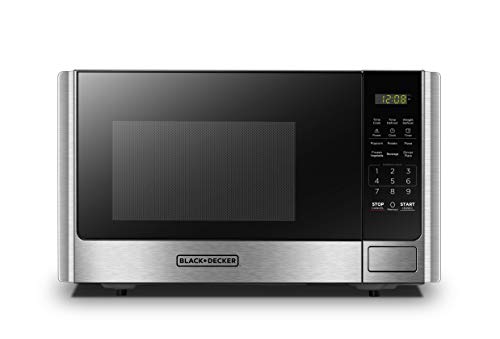
BLACK+DECKER 0.9 Cu.Ft 900W Countertop Microwave (Stainless Steel) — Best Value
BLACK+DECKER’s 0.9 cu.ft is the value anchor of the 900W class: ten power levels, six auto cook presets, a push-button door and a child safety lock, in stainless, at the tier’s friendliest end. It does not chase the Toshiba’s refinement, but it covers the whole daily checklist — reheating, defrosting, popcorn, beverages — without asking you to pay for polish you may not need. For a first apartment or a break-room upgrade, this is the sensible spend.
Strengths
- Complete core feature set: 10 power levels, 6 presets, express cooking, child lock
- Push-button door is simpler and more glove-friendly than a pull handle
- Stainless finish at the value end of the class
Trade-offs
- No mute function, so the beeper stays on duty at night
- Interior light and cavity finish are functional rather than premium
- Controls are a standard membrane pad with a learning curve for the preset codes
Key specs
- Power: 900W
- Capacity: 0.9 cu.ft
- Power levels: 10
- Door: Push-button
- Safety: Child safety lock (per Amazon listing)
The honest way to frame this oven is cost per year of service. BLACK+DECKER’s small appliances live in millions of kitchens, parts and manuals are easy to find, and the feature set has no holes that matter daily. You give up quiet-mode bragging rights and a little fit-and-finish; you keep every cooking function a 900W oven is actually used for.
The push-button door deserves a mention because door mechanisms are a real failure point on cheap microwaves. A button-release latch avoids the yank-and-flex wear of pull handles and works when your other hand is holding a hot bowl — a small ergonomic point that adds up over thousands of openings.
Ownership costs are equally plain: the cavity wipes clean, the turntable is a standard size, and the control panel has no app, no Wi-Fi and nothing to update. For buyers who measure an appliance by how little attention it demands, the BLACK+DECKER’s simplicity is a feature the spec sheet cannot express.
Best for: Budget shoppers who want a full-feature 900W oven from a household name / Not suited for: Anyone who needs a mute function for late-night use

Chefman 0.9 Cu.Ft 900W Countertop Microwave (Stainless Steel) — Best for Quiet Kitchens
Chefman’s stainless 0.9 is built around the two buttons quiet households actually press: mute and +30 seconds. The Amazon listing confirms the pairing — a mute option for silent operation and a +30 second button for the universal ‘a little longer’ — alongside ten power levels and time and weight defrost. If your kitchen shares a wall with a bedroom, this is your 900W oven.
Strengths
- Mute option for genuinely quiet late-night cooking
- +30 second button and express-style quick starts for everyday reheats
- Time and weight defrost both included, per the Amazon listing
Trade-offs
- Three one-touch presets is a shorter list than rivals with six or eight
- Stainless finish shows fingerprints and needs regular wiping
- Child safety lock is present but check the listing for the exact two-step door setting
Key specs
- Power: 900W
- Capacity: 0.9 cu.ft
- Power levels: 10
- Quick keys: +30 second button
- Sound: Mute option (per Amazon listing)
Chefman pitches this oven at real apartment life, and the details line up: the control panel favors the buttons people use hourly, the defrost options cover both planned and panic defrosting, and the mute option covers the hours when the kitchen is not really yours. It is a thoughtful spec rather than a long one.
In stainless it also looks the part in a modern small kitchen, with a digital timer display that doubles as the kitchen clock. Pair it with the setup guidance below — especially turntable seating — and it is a set-and-forget appliance.
One more consideration for shared housing: the Chefman’s footprint and weight make it the easiest pick here to move between counters, rental kitchens and break rooms. Appliances in this class get relocated more than any other, and a 0.9 cu.ft oven you can carry under one arm has a practical edge that never appears in wattage comparisons.
Best for: Shared houses, nurseries-next-door and anyone who cooks after others sleep / Not suited for: Buyers who want the widest preset library in the class

Farberware 0.9 Cu.Ft 900W Countertop Microwave (Stainless Steel) — Best Preset Selection
Farberware loads this 0.9 cu.ft oven with eight auto cook presets — the longest list in this guide — plus express cook and a +30 second function. For households that genuinely use presets rather than treating them as decoration, that breadth is the reason to pick it: the common foods are one button each, and the defrost options cover time and weight. It is the preset cook’s 900W microwave.
Strengths
- 8 auto cook presets, the most in this roundup
- Express cook and +30 second function for fast manual control
- Child safety lock and LED display round out a complete family spec
Trade-offs
- Preset results still vary by brand of popcorn and pizza; expect a learning week
- No mute function on this model
- Membrane panel graphics are busy compared with the Toshiba’s cleaner layout
Key specs
- Power: 900W
- Capacity: 0.9 cu.ft
- Presets: 8 auto cook presets
- Power levels: 10
- Quick keys: Express cook, +30 second (per Amazon listing)
Presets earn their keep when they are calibrated to real portions, and Farberware’s eight cover the foods 900W ovens are bought for: popcorn, potato, pizza, frozen vegetables, beverages and dinner plates among them. Used with the correct weight or count settings, they remove the guesswork that makes smaller ovens feel inconsistent.
Underneath the presets this is a conventional, complete 900W oven: ten power levels, defrost both ways, a kitchen timer and a child lock. Nothing is missing; the presets are a bonus layer rather than a substitute for the basics.
A word on preset honesty: presets are starting points tuned to average portions, and the Farberware’s eight are better than most because the categories are narrow — a potato program that knows it is cooking potatoes beats a generic sensor guess. Spend the first week learning which preset runs hot for your usual brands, then trust them.
Best for: Preset-driven cooks who want the oven to handle popcorn, pizza and potatoes by button / Not suited for: Minimalists who prefer manual time-and-power cooking

COMFEE’ Retro 0.9 Cu.Ft 900W Countertop Microwave (Apricot) — Best Retro Design
Most 900W microwaves are appliances; the COMFEE’ Retro is also a piece of kitchen styling. The apricot finish and rounded retro body hide a properly modern spec — 900 watts, six auto menus, multi-stage cooking and a mute function — so you are not paying a function penalty for the look. In a kitchen with any vintage or color in it, this is the microwave that gets compliments instead of being ignored.
Strengths
- Retro design with a warm apricot finish that anchors a styled kitchen
- Mute function and multi-stage cooking — modern features, not just a pretty shell
- Compact 0.9 cu.ft footprint suits small counters and dorm-adjacent spaces
Trade-offs
- Apricot is a commitment; it will not blend into a stainless suite
- Six auto menus is mid-pack rather than class-leading
- Retro knob-and-button mix takes a day to learn if you are used to flat touchpads
Key specs
- Power: 900W
- Capacity: 0.9 cu.ft
- Menus: 6 auto menus
- Sound: Mute function (per Amazon listing)
- Style: Retro, apricot finish
COMFEE’ has made the retro corner of small microwaves its own, and this 900W version is the one to get if you like the look, because it adds the power and capacity the smaller 700W retro models lack. Leftovers reheat at full-family speed while the oven still looks like it belongs in a styled kitchen.
Practical notes: the LED display keeps the clock and timer readable, the multi-stage cooking lets you defrost then cook in one program, and the mute function keeps the retro charm from being ruined by a modern-volume beeper at midnight.
Care is simple: the apricot finish wipes down like any enamel-style surface, and the interior follows the steam-clean routine in the care section below. The one discipline retro styling asks is honesty about your kitchen — if the rest of the room is stark stainless minimalism, the stainless Toshiba is the safer aesthetic bet; if the room has color and wood, the COMFEE’ will look intentional rather than accidental.
Best for: Style-led kitchens, retro remodels and anyone bored of stainless boxes / Not suited for: Buyers matching a full stainless appliance suite
Check the current price of the COMFEE’ Retro 0.9 Cu.Ft 900W Countertop Microwave (Apricot) on Amazon

TOSHIBA 0.9 Cu.Ft 900W Countertop Microwave (Black Stainless Steel) — Best Dark Finish
This is the Toshiba platform in black stainless: the same 900W, 0.9 cu.ft formula with the mute function and 10.6-inch turntable, finished in the dark tone that hides fingerprints better than any bright metal. If your range and fridge are black stainless, the standard stainless model would be the odd one out; this is the matching pick, and it loses nothing mechanically for the color.
Strengths
- Black stainless finish matches dark appliance suites and hides smudges
- Same mute function and turntable size as the Best Overall pick
- Six auto menus cover the everyday preset jobs
Trade-offs
- Black stainless can show scratches more visibly than bright stainless if abused
- Matching only works if the rest of the suite is genuinely black stainless, not black glass
- Premium finish usually prices above the standard stainless version
Key specs
- Power: 900W
- Capacity: 0.9 cu.ft
- Finish: Black stainless steel
- Turntable: 10.6″ removable
- Menus: 6 auto menus (per Amazon listing)
Finish-matching sounds fussy until you live with a mismatched suite: one bright box among dark appliances draws the eye every day. This model exists so the 900W buyer with a black stainless kitchen does not have to choose between the right oven and the right color.
Everything said about the platform in the Best Overall review applies here — the power levels, the mute, the defrost behavior — with the single addition that the dark finish is the most forgiving in this guide for households that do not wipe appliances down daily.
Buyers cross-shopping the two Toshibas should know the decision is purely cosmetic and suite-driven: same capacity, same turntable, same control logic. Choose stainless for bright kitchens and mixed-metal rooms; choose black stainless when the range and refrigerator already wear the dark finish and fingerprints are your daily annoyance.
Best for: Black stainless appliance suites and anyone who hates fingerprint upkeep / Not suited for: Kitchens built around bright stainless or white appliances
Comparison Table
| Pick | Badge | Key spec | Best for |
|---|---|---|---|
| TOSHIBA 0.9 Cu.Ft 900W Countertop Microwave (Stainless Steel) | Best Overall | 900W, 0.9 cu.ft, 11 power levels, mute function, 10.6-inch turntable | Apartments and small households that want the most complete 900W package |
| BLACK+DECKER 0.9 Cu.Ft 900W Countertop Microwave (Stainless Steel) | Best Value | 900W, 0.9 cu.ft, 10 power levels, push-button door, child safety lock | Budget shoppers who want a full-feature 900W oven from a household name |
| Chefman 0.9 Cu.Ft 900W Countertop Microwave (Stainless Steel) | Best for Quiet Kitchens | 900W, 0.9 cu.ft, 10 power levels, mute option, +30 second button | Shared houses, nurseries-next-door and anyone who cooks after others sleep |
| Farberware 0.9 Cu.Ft 900W Countertop Microwave (Stainless Steel) | Best Preset Selection | 900W, 0.9 cu.ft, 8 auto cook presets, express cook, +30 second function | Preset-driven cooks who want the oven to handle popcorn, pizza and potatoes by button |
| COMFEE’ Retro 0.9 Cu.Ft 900W Countertop Microwave (Apricot) | Best Retro Design | 900W, 0.9 cu.ft, retro styling, 6 auto menus, mute function | Style-led kitchens, retro remodels and anyone bored of stainless boxes |
| TOSHIBA 0.9 Cu.Ft 900W Countertop Microwave (Black Stainless Steel) | Best Dark Finish | 900W, 0.9 cu.ft, black stainless finish, mute function, 10.6-inch turntable | Black stainless appliance suites and anyone who hates fingerprint upkeep |
How to Choose the Right 900W Microwave for Your Kitchen
Start with the plate test, and keep your tape measure out for the rest of this section. A 0.9 cu.ft oven with a 10.6-inch turntable fits a standard dinner plate; if your household reheats from large serving bowls or rectangular meal-prep containers, measure the container’s diagonal against the cavity before ordering. Capacity in this class is about shape as much as volume.
Next, count power levels only if you cook delicately. For pure reheating, ten levels and eleven levels feel identical. For chocolate, butter, dough proofing and gentle defrosting, the extra granularity of the Toshiba’s eleven levels is a real, repeatable advantage. Match the control to the cooking you actually do.
Then be honest about noise. If anyone sleeps within earshot of the kitchen, a mute function (Toshiba, Chefman, COMFEE’) is not a luxury — it is the feature you will bless weekly. If the kitchen is a daytime-only space, the BLACK+DECKER and Farberware spend their budget on presets and value instead, which may serve you better.
Finally, the door. Push-button doors (BLACK+DECKER) are glove-friendly and avoid handle flex; flat-front designs look cleaner in styled kitchens. There is no wrong answer, but there is a wrong match for how you cook.
Is 900 Watts Enough? A Practical Power Guide
Nine hundred watts reheats a plated meal in roughly the time recipes and packaging assume, cooks frozen convenience meals without extended times, and handles popcorn reliably. Where it gives ground to 1100–1250W ovens is volume: big casseroles and multi-portion cooking take longer and benefit from a mid-cook stir or rotate that a turntable only partly replaces.
Where 900W beats the bigger ovens is texture at small scale. Mug cakes, single portions of fish, softened butter and reheated rice all suffer from too much power applied crudely; a 900W oven at a mid power level is gentler and more forgiving. If most of your cooking is for one or two, 900W is not a compromise — it is the right tool.
The other honest limit is speed on drinks and soups for a crowd. One mug is quick; four mugs in sequence will make a 1200W household impatient. Buy for your typical load, not your biggest party.
Cooking Real Food at 900 Watts: Five Everyday Jobs, Tuned
Reheating a dinner plate is the benchmark job, and the winning technique is boring: spread the food in an even layer with dense items at the rim, sprinkle starchy items with a teaspoon of water, cover, and run at full power in two shorter bursts with a stir or rotation between them, then rest for a minute. At 900 watts that routine produces a plate that is hot at the center without cremated edges — the failure mode of the single long blast.
Frozen convenience meals are calibrated by their makers for ovens around this class, so follow the box, film vents and all, but add the standing time the box asks for; it is part of the cooking, not a suggestion. Popcorn wants the preset or a listen-and-stop approach: when pops slow to a couple of seconds apart, the bag is done regardless of the clock.
Rice and grains reheat best with the water-sprinkle and cover method at 70% power, which steams them back to life instead of drying the top layer. Soups and drinks are full-power jobs where a mid-cook stir is the whole difference between even heat and a scalding top over a cold bottom. Vegetables cook fastest of all: a covered dish, a spoon of water, and short bursts keep them bright instead of army-green.
The thread through all five jobs is that a 900W oven rewards technique more than raw time. Owners who learn the cover, the ring arrangement and the rest will tell you their small oven cooks ‘better’ than the big one at their last home; what they mean is that they finally learned to drive it.
How to Set Up a 900W Microwave for Even Cooking
Small ovens reward small habits. Set the turntable ring and plate correctly on day one, learn the two or three power levels you will actually use, and arrange food the way microwave energy wants it: in rings, with dense items at the edge and a standing rest after the timer.
- Step 1: Place the oven with the clearance the manual specifies on the sides and top; small ovens overheat in tight cubbies.
- Step 2: Seat the turntable ring with its wheels in the track and the glass plate centered on the hub; a rocking plate means uneven cooking.
- Step 3: Run a one-minute water test — a cup of water should be steaming; note the time so you have a personal baseline for your oven.
- Step 4: Learn your three working levels: high for reheating and drinks, 50–60% for defrosting and dense leftovers, 20–30% for butter, chocolate and dough.
- Step 5: Arrange food in a ring with the thickest parts outward, cover with a microwave-safe lid or plate to hold steam, and always let food stand a minute before serving.
- Step 6: Wipe the cavity weekly and wash the turntable; old splatter absorbs energy and creates the hot spots owners blame on the oven.
Common Buying Mistakes
- Buying a 900W oven for a family of five and then blaming it for slow batch cooking — size the oven to the household, not the counter.
- Ignoring the turntable diameter and discovering your dinner plates do not fit through the door swing.
- Paying for presets you will never use while skipping the mute function you needed every night.
- Placing the oven flush into a cabinet cubby with no ventilation clearance.
- Assuming all ‘900W class’ listings are 900W; unverified listings blur wattage, which is why every pick here is listing-verified.
The pattern across these mistakes is buying the spec instead of the routine. Write down your five most common microwave jobs, then choose the pick whose strengths match that list.
Defrosting at 900 Watts Without Cooked Edges
Defrosting is where 900W ovens earn their keep or ruin dinner. Use the weight-based defrost when you know the weight — the programs are tuned to pulse the magnetron so the surface does not cook while the center thaws. Remove meat from its packaging, place it on a microwave-safe plate, and separate pieces as soon as they can be pried apart; a solid block thaws unevenly no matter how smart the program is.
For time-based defrosting, work in short bursts at 20–30% power and flip or break up the food between bursts. Ground meat should be scraped of thawed outer layers into a side bowl as you go. Five patient minutes at low power beats two aggressive minutes that leave you with grey, cooked edges and a frozen core.
Cleaning and Care for Small Ovens
Steam-clean the cavity monthly: a bowl of water with a slice of lemon, three minutes on high, five minutes standing with the door closed, then wipe. The turntable and ring wash in the sink; dry the ring’s wheels so they roll freely. Keep the door seal clean — a greasy seal is the usual cause of a door that feels loose.
Never run a 900W oven empty, and avoid metal trim, foil and twist ties entirely. If the interior light fails or the turntable stops rotating, check the plate seating first; both are five-minute fixes far more often than they are repairs.
900 Watts in Context: How the Power Classes Compare
Stand a 900W oven between its neighbors and the class logic becomes clear. The 700W class is the dorm and single-cup class: cheap, tiny, and slow enough that packaging times — written for higher wattages — need extending by half. The 1000–1100W class is the family default: faster on volume, bigger in every dimension. Nine hundred watts is the hinge point where an oven stops feeling like a compromise for one-to-two-person cooking while keeping the compact footprint that made you look at small ovens in the first place.
Energy use follows the same logic. A 900W oven draws less than a full-size model and finishes small jobs before a big oven’s advantage matters, so for singles and couples it is often the most efficient choice in practice, not just on paper. For a household of five reheating in sequence, the math flips — buy the bigger oven and stop queuing.
There is also a texture argument that rarely appears in spec sheets. Delicate foods — fish fillets, custards, reheated rice, butter-based sauces — are easier to land at 900 watts because each power step is a smaller absolute change. Cooks who use their microwave as a real cooking tool, not just a reheating box, often prefer this class for exactly that reason.
Measuring Your Counter and Cavity Before You Order
Two measurements prevent nearly every return in this category. First, the counter: width and depth of the oven’s footprint plus the door swing, and the vertical clearance to any shelf or cabinet above — small ovens still need the ventilation space their manuals specify, and a tight cubby shortens an oven’s life. Second, the cavity: the turntable diameter and the door opening, checked against your largest plate and your tallest mug with room to grip it.
Do the plate check with the actual plate. Dinner plates have grown over the years, and a plate that technically fits the turntable may not pass the door opening at an angle. The 10.6-inch turntables on the Toshiba models here are the class’s comfortable standard; anything smaller deserves a skeptical measurement.
Finally, plan the outlet. These ovens want a properly grounded socket and should not share a strained circuit with a kettle or toaster oven running at the same time. A dedicated moment of thought here prevents the breaker trips that owners otherwise blame on the microwave.
What the First Month of Ownership Teaches You
Week one with any 900W oven is calibration: you learn that your old oven’s ‘two minutes’ is this oven’s ‘one forty’, that the popcorn preset wants the smaller bag setting, and that the defrost program needs the pieces separated halfway. Keep a mental note of three or four personal settings — your mug, your plate, your frozen meal — and the oven stops feeling approximate.
By week four the differences between these six picks show up in habits, not specs. Mute-function owners use their ovens at night without thinking; preset owners stop reading packaging times; the retro oven’s owners notice guests commenting on it. None of that is in a comparison table, which is why this guide ranks on routines as much as on hardware.
Power Levels, Decoded: What the Numbers Actually Do
A microwave’s power levels do not throttle the magnetron down smoothly; on most ovens they cycle it on and off in pulses, so 50% power means the magnetron runs half the time. That is why low-power cooking is gentler: the off periods let heat equalize through the food instead of blasting the surface continuously. Understanding this one fact makes every 900W oven in this guide cook better, because you stop treating power level as a speed control and start treating it as a texture control.
As working rules: use full power for water, soups and straightforward reheating; 60–70% for dense leftovers like lasagna and rice, where the center needs time to catch up; 30–40% for defrosting meat and reheating delicate proteins; and 10–20% for butter, chocolate, ice cream softening and dough proofing. The Toshiba’s eleventh level simply slices those bands finer.
Inverter ovens — none of the six here, they live at higher price tiers — deliver genuinely continuous low power instead of pulses. If you defrost daily and texture is paramount, that is the upgrade path; for everyone else, pulsed power plus the standing-rest habit gets results that are honestly close.
Safety and Placement Rules for Compact Ovens
Compact microwaves follow the same safety rules as big ones, with two emphases. Keep the ventilation clearances the manual specifies — small ovens in tight dorm and apartment cubbies are the classic overheating scenario — and never operate the oven empty, which can damage the magnetron. Metal, foil and metallic-trimmed dishes stay out; the spark show is not worth the risk to the cavity.
Superheated water is the quiet hazard: a cup heated too long can erupt when disturbed. Heat drinks in shorter bursts and let them stand briefly before moving them. If the oven has a child lock — most picks here do — enable it in homes with small children; the two-step door setting prevents both accidental starts and small hands opening a hot cavity.
Place the oven where the door swing does not cross a walkway with hot food in hand, and keep the cord off the cooktop. These are boring rules, and they are also the entire difference between a decade of service and a story you tell later.
When 900 Watts Is the Wrong Choice
Honesty about limits sells the right oven to the right kitchen. Step up beyond this class if you regularly reheat for four or more people in sequence, if your household cooks large casseroles and whole chickens in the microwave, or if your biggest meal-prep containers simply do not fit a 0.9 cu.ft cavity — no technique fixes geometry. Step up, too, if you want convection or air-fry combination cooking; that is a different category with its own guide in this program.
Stay in this class if your cooking is one-to-two portions, your counter is genuinely small, or your building’s kitchen circuit is shared with other hungry appliances. The most satisfied microwave owners are not the ones with the most watts; they are the ones whose oven matches their routine. The six picks above cover that routine’s variations — quiet, styled, preset-driven, budget and dark-finished — without asking you to buy capacity you will never fill.
Final Recommendation
For most small kitchens the answer is the TOSHIBA 0.9 Cu.Ft in Stainless Steel: the eleven power levels, mute function and plate-friendly turntable make it the most complete 900W oven here. Careful budgets belong with the BLACK+DECKER, quiet households with the Chefman, preset cooks with the Farberware, styled kitchens with the COMFEE’ Retro, and black stainless suites with the Toshiba’s dark variant.
Round out your research with our related guides: Best Affordable Microwaves, Best All Around Microwaves, Best Affordable Countertop Microwaves, Best Apartment Microwaves and Best Air Fryer Microwaves. Check the current price on Amazon for the finish you choose, measure your largest plate and your tallest mug before you order, and confirm the door opens on the side your counter layout expects.
Frequently Asked Questions
Is 900 watts powerful enough for everyday cooking?
Yes, for the jobs small ovens are bought for: reheating plates, cooking frozen meals, popcorn, drinks and defrosting. It is slower than 1100–1250W ovens on large volumes, but gentler and more forgiving on small, delicate portions.
What size plate fits in a 0.9 cu.ft microwave?
A standard dinner plate fits in the models here with 10.6-inch turntables. Large rectangular containers are the usual failure — measure the diagonal of your biggest container against the cavity before ordering.
Why does the mute function matter so much?
Because microwave beepers are loud, repeated and usually unnecessary at midnight. In apartments, shared houses and homes with babies, a mute option (Toshiba, Chefman and COMFEE’ here) is the difference between using the oven at night and avoiding it.
Is 11 power levels noticeably better than 10?
For reheating, no. For delicate work — butter, chocolate, proofing, gentle defrosting — the finer steps at 900W give measurably more control, which is one reason the Toshiba tops this list.
Can a 900W microwave replace a bigger oven for a family?
For a family of three or four doing standard reheating and convenience cooking, yes. Households that batch-cook large casseroles or reheat multiple large dishes at once should step up in capacity as well as watts.
Do I need to extend cooking times from packaging written for other wattages?
Slightly, at the margins. Most frozen-food packaging assumes ovens in the 1000–1200W range; at 900W, add roughly ten percent to the stated time and lean on the standing time. Foods with times given as ranges should start at the top of the range.
How long should a countertop microwave last?
With the cavity kept clean and the door treated gently, a name-brand countertop oven typically serves for many years. Door latches and turntable motors are the wear points; the push-button and well-seated turntable designs here age gracefully.


