Disclosure: airfryerkitchensupply.com is reader-supported. When you buy through links on our site, we may earn an affiliate commission at no extra cost to you.
Where to buy
Every linked pick in this guide to the best air fryer microwaves was verified against Amazon’s catalog on 2026-11-21, so the model names and specs below are the models you will actually land on: TOSHIBA 4-in-1 Air Fryer Microwave 1.5 Cu.Ft, Panasonic HomeChef 4-in-1 (NN-CV), GE 4-in-1 Air Fry Microwave 1.0 Cu.Ft, Frigidaire 1.2 Cu.Ft Air Fryer Microwave Combo, BLACK+DECKER Over-the-Range Air Fryer Microwave, TOSHIBA 8-in-1 Air Fryer Combo 1.0 Cu.Ft. Combination ovens blur categories, so every pick was verified as a true microwave + air fry appliance — not a microwave with a crisping plate or an air fryer with a reheat button. Check the current price on Amazon from any pick’s link, because finishes and configurations rotate through the catalog during the year.
The best air fryer microwaves promise the most seductive trade in the kitchen: give up two or three appliances, get one box that microwaves, air fries, bakes and broils. The category’s dirty secret is that many combos are one good appliance wearing the others as costumes. This guide ranks six verified combination ovens by the standard that matters — the weakest mode must still be good — across countertop and over-the-range formats, from a family flagship to a compact with eight modes and no shame.
Set the physics expectation first. A microwave air fryer crisps with hot circulating air in a metal cavity, like a small convection oven — because that is what it is. It will brown fries, wings and reheated pizza in a way no microwave-only oven can, and it will do family-sized batches more slowly than a large dedicated basket air fryer. Households that air fry daily for five should keep a dedicated fryer; households that air fry a few times a week for one to four will find these combos genuinely liberating.
Every pick was verified against Amazon’s catalog on 2026-11-21, with modes, capacities and wattages taken from the listing listings themselves. In a category built on mode-count marketing, that verification is the difference between a buyer’s guide and a brochure.
One structural note: two Toshibas appear, at two sizes and two philosophies, because Toshiba’s combo line earns both slots on merit. The other four picks are four different brands, so the list remains a real choice.
In this guide
Quick Picks
Best Overall: TOSHIBA 4-in-1 Microwave Oven with Air Fryer Combo (1.5 Cu.Ft, 1000W) — A real family microwave and a real air fryer in one 1.5 cu.ft box — the combo benchmark.
Best Premium / Inverter: Panasonic HomeChef 4-in-1 Countertop Microwave Air Fryer Combo (NN-CV Series) — Inverter finesse plus air fry and convection: the quality-per-cubic-foot champion.
Best Mid-Size All-Rounder: GE 4-in-1 Air Fry Countertop Microwave Oven (1.0 Cu.Ft, White) — All four modes at 1050W in a modest footprint, backed by GE’s service network.
Best Capacity Value: Frigidaire 1.2 Cu.Ft Microwave Air Fryer Convection Combo (Stainless Steel) — Family-adequate combo capacity in stainless at the friendly end of the tier.
Best Over-the-Range Combo: BLACK+DECKER Over-the-Range Microwave Oven with Air Fryer (1.5 Cu.Ft, 900W) — Air fry, convection and sensor cooking in an OTR body — the counter-space savior.
Most Functions in a Compact Body: TOSHIBA Air Fryer Combo Microwave 8-in-1 (1.0 Cu.Ft, Black Stainless Steel) — Eight modes and a plate-size turntable in a 1.0 cu.ft black stainless compact.
How These Picks Were Chosen
Candidates had to be true combination appliances — microwave plus genuine air fry (heated air circulation), verified to an exact model. Microwave-only ovens with ‘crisp’ marketing and air fryers with token reheat modes were excluded. We ranked on the weakest-mode standard first, then on microwave quality (the mode you will use most), batch realism and the ownership layer of cleaning and support.
The six slots span the category’s honest shapes: family countertop, premium inverter, mid-size all-rounder, value capacity, over-the-range and compact maximalist. If a combo can serve your kitchen, one of these six is shaped like the way it will be used.
- Verified modes, capacity and wattage for every pick, checked 2026-11-21
- Ranked on the weakest mode, not the longest mode list
- Batch-size honesty: combo air fry vs dedicated fryer, stated plainly
- No prices or fixed ratings printed — check price on Amazon at the listing
The 6 Best Air Fryer Microwaves, Reviewed
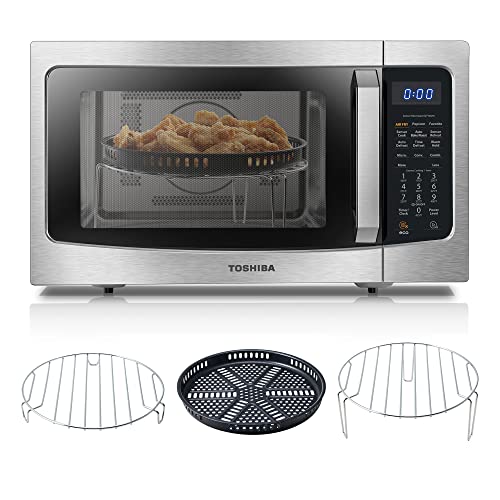
TOSHIBA 4-in-1 Microwave Oven with Air Fryer Combo (1.5 Cu.Ft, 1000W) — Best Overall
The Toshiba 4-in-1 is the combination microwave that makes the category make sense: a full 1.5 cu.ft, 1000W microwave with a smart sensor and mute function, plus genuine air fry and convection modes in the same cavity. It tops this guide because it refuses the usual combo compromise — the microwave side is a real Toshiba microwave, and the air fry side is sized and powered like a real appliance rather than a bonus mode.
Strengths
- Full-size 1.5 cu.ft cavity serves family microwave duty and family air fry batches alike
- Smart sensor, mute and position memory turntable — the microwave side is fully featured, not stripped
- Convection mode extends it to baking and roasting, not just crisping
Trade-offs
- One cavity means one job at a time — you cannot air fry and microwave simultaneously for a crowd
- Air fry capacity still trails a large dedicated basket air fryer for big batches
- Combination ovens ask for mode literacy; the first week has a learning curve
Key specs
- Power: 1000W (microwave)
- Capacity: 1.5 cu.ft
- Modes: Microwave, air fry, convection combo
- Sensor: Smart sensor
- Sound: Mute function (per Amazon listing)
The way to judge a combo is by its weakest mode, and the Toshiba’s weakest mode is merely good. As a microwave it reheats with sensor judgment at family scale; as an air fryer it crisps the frozen rotation — fries, nuggets, wings, reheated pizza — with the browning a microwave alone can never produce; as a convection oven it bakes credibly at countertop scale. Three ‘good-to-very-good’ scores beat one excellent and two apologetic ones, which is the usual combo pattern this oven avoids.
The position memory turntable is a small, telling detail: it returns the dish to the position it started in, so handles face you when the door opens. Combo ovens live or die on dozens of such details because they are used more hours per week than any single-function appliance they replace.
Buy the Toshiba if counter space is the constraint and variety is the demand. It is the pick for the kitchen that would otherwise queue three appliances deep, and it is the benchmark the rest of this list is measured against.
Best for: Most households that want one countertop box to microwave, air fry and bake credibly / Not suited for: Dedicated air fryer owners who cook large batches of fries and wings
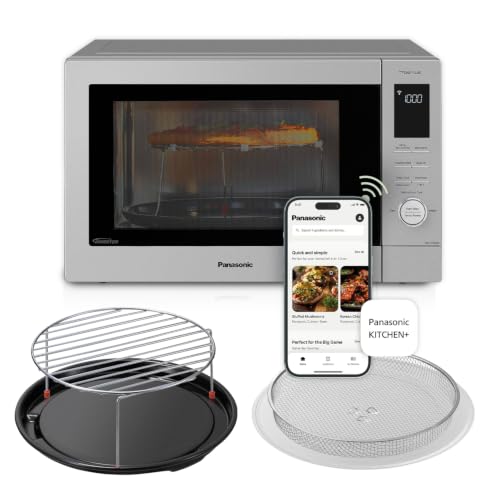
Panasonic HomeChef 4-in-1 Countertop Microwave Air Fryer Combo (NN-CV Series) — Best Premium / Inverter
The HomeChef is the connoisseur’s combo: Panasonic’s inverter technology — true continuous power — inside a 4-in-1 multi-oven with air fry and convection, twenty presets and app-linked recipes, in a 1.2 cu.ft body. Where the Toshiba wins on size and all-round value, the Panasonic wins on the quality of the microwave energy itself, which shows up in defrosting, sauces and delicate reheats that no cycling oven matches.
Strengths
- Inverter power is the gentlest, most even microwave energy in this guide
- 20 presets plus app-linked recipes give the deepest guided cooking library here
- Air fry and convection complete a genuine multi-oven, not a microwave with a garnish
Trade-offs
- 1.2 cu.ft capacity is compact for a combo; big dishes need measuring
- Premium tier pricing, the highest commitment in this guide
- App-linked features reward households that will actually use the ecosystem
Key specs
- Power: 1000W
- Capacity: 1.2 cu.ft
- Technology: Inverter multi-oven
- Modes: Microwave, air fry, convection, combo
- Presets: 20 (per Amazon listing)
Inverter matters more in a combo than in a plain microwave, because the same oven is asked to be gentle (defrosting the chicken) and fierce (air frying it) in one meal. The Panasonic’s continuous power handles the gentle half with a finesse the cycling competition cannot imitate, and its convection handles the fierce half conventionally well. That pairing is the premium case, stated plainly.
The preset library and app recipes suit cooks who like guidance: twenty starting points tuned by the manufacturer, extendable through the app. Purists will ignore the app and drive manually with equal success — the hardware underneath is the point, and it is the best microwave hardware in this guide.
Choose the HomeChef when quality per cubic foot matters more than cubic feet. Small serious kitchens, couples who cook properly, and anyone upgrading from a plain inverter Panasonic will feel at home immediately.
Best for: Quality-first cooks who want inverter microwave finesse plus air fry in one premium box / Not suited for: Large families — 1.2 cu.ft is the deliberate trade for the technology

GE 4-in-1 Air Fry Countertop Microwave Oven (1.0 Cu.Ft, White) — Best Mid-Size All-Rounder
GE’s 4-in-1 packs the complete mode list — microwave, air fry, convection and broil — into a 1.0 cu.ft white countertop oven at 1050 watts. It is the middle path of this guide: more capable than the compact combos, smaller and simpler than the family flagship, from the brand with the deepest service network in American kitchens. For a small household that cooks varied food, it is a quietly perfect fit.
Strengths
- All four modes present — nothing in the combo repertoire is missing
- 1050W microwave power is brisk for the size class
- GE service and parts backing behind a combination appliance, where it matters most
Trade-offs
- 1.0 cu.ft is a small canvas for air frying family batches
- White finish only on this verified listing — stainless kitchens take note
- Broil in a microwave cavity is for finishing, not for steakhouse ambitions
Key specs
- Power: 1050W
- Capacity: 1.0 cu.ft
- Modes: Microwave, air fry, convection, broil
- Finish: White
- Brand: GE (per Amazon listing)
Combination ovens concentrate risk: four appliances’ worth of function in one box means one failure can idle four jobs. That is the context in which GE’s backing becomes a feature rather than a footnote — manuals, parts and service that a household can actually reach. On a combo, buy the support as deliberately as the spec.
As a cooker, the GE covers the small household’s whole week: microwave reheats at honest speed, air fry for the frozen rotation and reheated pizza, convection for small bakes, broil for finishing cheese and crumbs. Portions are the discipline — this is a one-to-three-person oven, and it is excellent inside that remit.
Choose it over the Toshiba when counter depth or household size says smaller; choose it over the Panasonic when the budget or the brand network says GE. It is the guide’s middle pick in position and in philosophy.
Best for: One-to-three-person households that want the full mode list in a modest footprint / Not suited for: White-appliance avoiders, and families needing bigger cavities

Frigidaire 1.2 Cu.Ft Microwave Air Fryer Convection Combo (Stainless Steel) — Best Capacity Value
Frigidaire’s combo is the value route into the category: a 1.2 cu.ft stainless oven whose listing leads with digital air fry, convection and what Frigidaire calls Combo-Fry, at an XL-for-its-class capacity. It brings the combination concept to the friendlier end of the tier without shrinking to compact proportions, which is exactly the combination — forgive the word — that value shoppers ask for.
Strengths
- 1.2 cu.ft is family-adequate combo capacity at a value tier
- Air fry, convection and microwave modes cover the full combo brief
- Stainless finish suits renovated kitchens better than most value appliances
Trade-offs
- Conventional microwave power; defrost finesse trails the Panasonic
- Value-tier fit and finish compared with the guide’s premium picks
- Mode naming (Combo-Fry) needs a manual read to map onto your recipes
Key specs
- Capacity: 1.2 cu.ft
- Modes: Microwave, digital air fry, convection
- Finish: Stainless steel
- Feature: Combo-Fry with XL capacity (per Amazon listing)
Value in a combo category is about which corners were left uncut, and Frigidaire’s choices are sane: capacity kept, modes complete, finish presentable — with the savings taken in refinement and in microwave power delivery rather than in the air fry function buyers came for. A household entering the category to test whether combo life suits them could do far worse than start here.
The stainless exterior matters at this tier because combo ovens are large, visible objects. A value oven that looks like a compromise sits on the counter apologizing daily; the Frigidaire looks like an appliance a kitchen chose. That is not vanity — it is the difference between a purchase a household feels good about and one it replaces early.
Buy it as the category’s front door: full brief, family size, friendly tier. Graduate later only if your cooking outgrows it — many households find it simply does not.
Best for: Value shoppers who want family-adequate combo capacity in stainless / Not suited for: Inverter seekers — this is a conventional-power value play

BLACK+DECKER Over-the-Range Microwave Oven with Air Fryer (1.5 Cu.Ft, 900W) — Best Over-the-Range Combo
The BLACK+DECKER OTR is the space economist’s combo: an over-the-range microwave — vent, light and all — whose 1.5 cu.ft cavity also air fries, convection bakes and sensor cooks, in a 6-in-1 mode list. If your counter has no room for a combination oven because it has no room for anything, this pick moves the whole category up the wall and gives you the counter back.
Strengths
- Zero counter footprint: the combo lives over the range as your hood and light
- Air fry plus convection and bake in a full 1.5 cu.ft cavity
- Sensor cook keeps the microwave side honest for daily reheats
Trade-offs
- 900W microwave power is the gentlest in this guide — packaging times stretch
- OTR installation is a two-person, cabinet-and-studs job, not a countertop unboxing
- Venting is OTR-standard, not a heavy-searing extraction solution
Key specs
- Power: 900W
- Capacity: 1.5 cu.ft
- Modes: 6-in-1 incl. air fry, convection, bake
- Format: Over-the-range with vent fan
- Cooking: Sensor cook (per Amazon listing)
Judge this oven first as a kitchen-space decision. It replaces two appliances — microwave and range hood — and adds a third, the air fryer, in the same wall space. For small kitchens, galley layouts and anyone whose counters are a negotiation, that arithmetic can outweigh every spec comparison in this guide.
The air fry position over a range has one ergonomic note: loading and unloading a hot fry basket at shoulder height demands the two-hands, dry-mitts discipline described in the how-to section. Households comfortable with OTR microwaves already live that discipline; households new to the format should weigh it honestly.
Choose the BLACK+DECKER when space is the scarcest resource in your kitchen. Choose any countertop pick here when it is not — the same money buys more microwave power and simpler installation on the counter.
Best for: Kitchens that want air fry capability without surrendering any counter space / Not suited for: Countertop loyalists, and households needing the strongest venting for heavy searing

TOSHIBA Air Fryer Combo Microwave 8-in-1 (1.0 Cu.Ft, Black Stainless Steel) — Most Functions in a Compact Body
Toshiba’s second entry in this guide is the compact maximalist: an 8-in-1 combination — microwave, air fry, convection, broil and more — in a 1.0 cu.ft black stainless body with a 12.4-inch turntable and a pro defrost program. If the flagship Toshiba is the family answer, this is the small-kitchen answer from the same engineering culture: every mode, honestly sized for one to three people.
Strengths
- 8-in-1 mode list is the longest in this guide
- 12.4-inch turntable is generous for a 1.0 cu.ft cavity — real plates fit
- Black stainless finish and pro defrost lift it above compact norms
Trade-offs
- Compact cavity caps air fry batch sizes whatever the modes promise
- Mode abundance means a real manual week for new owners
- Two Toshibas in one guide is a brand concentration some buyers will want to balance with the GE or Frigidaire
Key specs
- Capacity: 1.0 cu.ft
- Modes: 8-in-1 incl. convection & broil
- Turntable: 12.4″
- Finish: Black stainless steel (per Amazon listing)
The turntable is this compact’s quiet headline. A 12.4-inch plate in a 1.0 cu.ft oven means the microwave side takes real dinner plates — the threshold that separates a compact from a toy — while the air fry side handles the single-and-couple batches the cavity is honestly for. Spec sheets lead with the eight modes; owners will live with the turntable.
Pro defrost deserves its mention in a combo context: the defrost-then-air-fry sequence — frozen wings to crispy wings in one appliance session — is the combo concept at its most useful, and a defrost program with ‘pro’ ambitions is the correct first half of that sequence.
Choose this Toshiba when the kitchen is small and the ambitions are not. It is the compact pick for cooks who read mode lists the way other people read menus — as a list of things they intend to do.
Best for: Feature maximalists in small kitchens who want every mode in a compact footprint / Not suited for: Families — the cavity is compact, however long the mode list is
Comparison Table
| Pick | Badge | Key spec | Best for |
|---|---|---|---|
| TOSHIBA 4-in-1 Microwave Oven with Air Fryer Combo (1.5 Cu.Ft, 1000W) | Best Overall | 1000W, 1.5 cu.ft, air fry + convection + microwave, smart sensor, mute, position memory turntable | Most households that want one countertop box to microwave, air fry and bake credibly |
| Panasonic HomeChef 4-in-1 Countertop Microwave Air Fryer Combo (NN-CV Series) | Best Premium / Inverter | 1000W, 1.2 cu.ft, inverter multi-oven, air fry + convection, 20 presets, app-linked recipes | Quality-first cooks who want inverter microwave finesse plus air fry in one premium box |
| GE 4-in-1 Air Fry Countertop Microwave Oven (1.0 Cu.Ft, White) | Best Mid-Size All-Rounder | 1050W, 1.0 cu.ft, microwave + air fry + convection + broil, white finish | One-to-three-person households that want the full mode list in a modest footprint |
| Frigidaire 1.2 Cu.Ft Microwave Air Fryer Convection Combo (Stainless Steel) | Best Capacity Value | 1.2 cu.ft, digital air fry, convection oven, Combo-Fry, XL capacity, stainless finish | Value shoppers who want family-adequate combo capacity in stainless |
| BLACK+DECKER Over-the-Range Microwave Oven with Air Fryer (1.5 Cu.Ft, 900W) | Best Over-the-Range Combo | 900W, 1.5 cu.ft OTR, air fryer, 6-in-1 modes, convection & bake, sensor cook, vent fan | Kitchens that want air fry capability without surrendering any counter space |
| TOSHIBA Air Fryer Combo Microwave 8-in-1 (1.0 Cu.Ft, Black Stainless Steel) | Most Functions in a Compact Body | 1.0 cu.ft, 8-in-1 with convection & broil, pro defrost, 12.4-inch turntable, black stainless | Feature maximalists in small kitchens who want every mode in a compact footprint |
How to Choose the Right Air Fryer Microwave
Start with the mode you will use most, which is the microwave. A combo whose microwave side is weak — no sensor, awkward controls, a small turntable — will disappoint you daily to delight you weekly. That is why the Toshiba flagship and the Panasonic lead this guide: their microwave sides are flagships in their own right, and the air fry arrives as a bonus on a sound foundation.
Size the cavity by the air fry batch, not the microwave dish. Air frying needs air space around the food — a crowded basket steams instead of crisping — so a 1.5 cu.ft cavity air fries for three to four, a 1.2 for two to three, and a 1.0 for one to two, whatever the microwave side could hold. Buy the batch size you actually cook.
Decide the format by your counter, not your dreams. Countertop combos are simpler to install, easier to load at waist height and simpler to replace. The over-the-range BLACK+DECKER trades loading height and installation effort for a completely free counter — the right trade in genuinely small kitchens, the wrong one everywhere else.
Finally, count modes last. Eight modes you use beat twelve you admire. The honest shortlist of modes most households touch weekly is four — microwave, air fry, convection bake, broil or grill finish — and every pick here covers it. Extra modes are welcome; they are not a ranking criterion.
Air Fryer Microwave vs Dedicated Air Fryer: The Honest Comparison
A dedicated basket air fryer is faster per batch, crisps slightly more aggressively, and can run while the microwave does something else. A combo wins on space, on appliance count, and on sequences — defrost then air fry in one cavity without a transfer — and it microwaves, which no basket fryer does. The choice is not quality versus compromise; it is throughput versus consolidation.
The households that regret combos are the ones that air fry in volume daily: two batches in a combo is a queue, and a queue at dinner is a lifestyle problem. The households that love them air fry a few times a week in household portions and microwave daily — for them the combo is not the second-best version of two appliances, it is the best version of their kitchen.
If you are between, buy by your worst week, not your average one. A household whose Friday is forty wings for a crowd should keep a dedicated fryer and a plain microwave from our other guides. A household whose Friday is a pizza and a side of fries should consolidate and enjoy the counter.
How to Air Fry in a Microwave Combo (Setup and First Cook)
Combo air frying rewards a short ritual: preheat, single layer, space around the food, and the right accessory — the rack or basket the manufacturer supplies for air fry mode, which lifts food into the circulating air. Skip any step and the mode gets blamed for the operator’s shortcuts.
- Step 1: Read the mode map in the manual once — which rack position, which pan, whether preheat is automatic — before the first cook, not during it.
- Step 2: Preheat in air fry mode; hot air from the first minute is the difference between crisped and steamed.
- Step 3: Arrange food in a single layer with gaps on the air fry rack or basket; oil lightly and season after, not before, for the cleanest cavity.
- Step 4: Cook to the mode’s guidance, turning or shaking once halfway; judge by color and texture, not by the clock alone.
- Step 5: Rest fried food a minute on the rack so the crust sets, and serve from a warm plate.
- Step 6: Wipe the cavity while it is still warm — air fry splatter bakes on harder than microwave splatter, and a warm wipe now saves a scrub later.
Common Buying Mistakes
- Buying a combo for daily family-volume air frying and discovering the batch queue.
- Judging a combo by mode count instead of by its microwave side, which you will use ten times more.
- Crowding the air fry layer and concluding the mode does not work.
- Forgetting that an OTR combo loads at shoulder height before choosing the format.
- Expecting microwave speed from air fry mode — crisping takes the minutes it takes.
Every mistake here is a mismatch between the appliance’s real physics and the buyer’s imagined one. Combos are superb within their physics; this guide’s job is to make the physics plain before you buy.
Cleaning a Combination Oven: Two Kinds of Mess, One Routine
A combo cavity collects both microwave splatter (wet, steamy, wipes easily) and air fry residue (greasy, baked, does not). The routine that handles both: wipe after air fry sessions while the cavity is warm, steam-clean weekly for the microwave side, and wash the air fry rack or basket in the sink like any pan — it is a pan, and treating it as one keeps it non-stick in behavior if not in name.
The door and the cavity ceiling are the forgotten surfaces in combo ovens, because air fry circulates grease upward. A monthly degreasing wipe of the ceiling and the door’s inner face keeps flavors honest — yesterday’s wings should not season today’s oatmeal, and in a neglected combo, they will.
Sequences: Where Combos Beat Every Separate Appliance
The combo’s killer application is the sequence. Frozen wings: defrost gently, then air fry, one cavity, no transfer, no second appliance to wash. Leftover pizza: a microwave breath to warm the interior, then air fry to re-crisp the crust — better than either mode alone achieves. Baked potatoes: microwave to tender, air fry or broil to crisp the skin, in minutes instead of an hour.
Once a household learns three or four sequences, the combo stops being a compromise appliance and becomes the kitchen’s default tool. That learning curve — a week of small experiments — is the real price of the category, and it is worth paying exactly once.
What Combo Ovens Cannot Do: The Remaining Boundaries
A combo cannot run two modes for two dishes at once — the family that needs fries air frying while soup microwaves needs two appliances, full stop. It cannot match a large dedicated fryer’s batch throughput, and its broil is a finishing tool rather than a steakhouse. Its microwave side, in the smaller models, caps dish sizes like any compact oven.
None of those boundaries is a flaw; they are the shape of consolidation. The picks here were chosen so that everything inside the boundaries is done well — which is more than can be said for most single-function appliances at the same tiers.
Benchmarks: How the Picks Handle the Four Foods Everyone Tests
Frozen fries are the category’s public exam. In the Toshiba 1.5 and the Panasonic, a household batch emerges genuinely crisp with one shake at the halfway point; the compact models do the same work in smaller batches, and the Frigidaire and GE sit between, sized by their cavities. The universal rules — preheat, single layer, gaps — matter more than the badge on the door, which is why the how-to section precedes this one in importance if not in order.
Reheated pizza is the combo’s signature party trick, and every pick here performs it: a short microwave breath to wake the cheese, then air fry to re-crisp the base. Owners consistently rate this single sequence as the moment the appliance justified itself. Wings from frozen — defrost, then air fry — are the second conversion experience, and the reason defrost quality (Panasonic’s inverter, Toshiba’s pro defrost) appears in a guide nominally about frying.
The fourth benchmark is the humble baked potato, microwaved to tenderness then finished under air fry or broil for a crisp skin. It takes a third of the oven-baked time and none of the rubbery shame of the microwave-only version. A combo that does these four foods well — and all six picks do — has passed the only entrance exam that matters.
The First Week With a Combo: A Learning Curve, Mapped
Day one is unboxing and the manual’s mode map; resist the urge to christen the oven with a complex recipe. Days two and three belong to the microwave side — reheats, defrosts, a sensor program — because that side must become boring before the interesting side can be judged fairly. By day four, air fry something forgiving: frozen fries or nuggets, preheated, single layer, and note the time your oven actually needed against the guidance.
The rest of the week is sequences and calibration: the pizza trick, a defrost-to-fry run, a small convection bake. Write down three personal settings — your fries, your pizza, your wings — because a combo’s presets are starting points and your notes are the finished calibration. Owners who do this week report the appliance ‘clicking’ into their routine; owners who skip it report a confusing box. The box is the same. The week is the difference.
The Economics of Consolidation: Space, Money and Attention
A combo’s real price comparison is not against one appliance but against the two or three it replaces, plus the counter they stood on. In a small kitchen, counter space is the scarcest commodity in the home, and an appliance that returns a square foot of it has paid a dividend no spec sheet records. The over-the-range pick takes the logic to its limit and returns the entire footprint.
Attention is the third currency. One appliance to learn, clean, maintain and eventually replace is a simpler ownership life than three, and the cleaning and support sections of this guide are shorter than they would be for a three-appliance kitchen. Consolidation is not only a purchase; it is a decision about how much of your attention the kitchen’s tools are allowed to rent.
When a Combo Is the Wrong Buy: The Honest Exits
Name the exits plainly. If your household air fries in volume most days, buy a large dedicated fryer and a strong plain microwave from our all-around guide — two specialists will out-serve one generalist at that workload. If you bake in volume — multiple racks, large roasts — the convection modes here are a supplement, not a successor, to your oven. If your microwave use is a weekly reheat and nothing more, a combo’s extra modes are rent you pay for rooms you never enter.
Every other household shape has a pick waiting in the reviews above. That is what a mature category looks like: not a universal answer, but a well-mapped set of them, with the exits signposted as clearly as the entrances.
Matching the Six Picks to Six Kitchens, Briefly
The family kitchen with one free stretch of counter takes the Toshiba 1.5 and consolidates three appliances into it. The small serious kitchen takes the Panasonic and trades size for the best microwave energy in the guide. The small household that wants no mode missing takes the GE. The budget family takes the Frigidaire and discovers the category’s front door is wider than expected.
The kitchen with no counter at all takes the BLACK+DECKER up the wall. The compact kitchen with maximal ambitions takes the Toshiba 8-in-1 and accepts batch discipline as the rent on its mode list. Six kitchens, six shapes, one principle: consolidate around the cooking you actually do, and the combo category rewards you for it.
Safety Notes Specific to Combination Ovens
Combo ovens add one safety dimension plain microwaves lack: surfaces and accessories that get genuinely hot. The air fry rack, convection pans and the cavity itself after a fry or bake cycle are oven-hot, not microwave-warm, and the household’s habits must update accordingly — mitts for combo modes, and a landing zone that tolerates a hot rack. Households with children should treat air fry and convection modes with the same respect as the main oven, because thermally, that is what they are.
The microwave rules still apply in microwave mode — no metal, no sealed containers, no empty running — and the mode-by-mode cookware discipline in the accessories section is the practical form they take in a combo. One appliance, two rulebooks; the manual’s table reconciles them, and taping it inside a cabinet door is the cheapest safety upgrade in this guide.
Accessories and Consumables for Combo Cooking
Use the manufacturer’s air fry rack or basket — it is sized to the cavity’s airflow, and improvising with random racks defeats the engineering you paid for. Microwave-safe glass and ceramic serve the microwave modes; the metal pans supplied for convection and air fry serve those modes only, and the manual’s mode-by-mode cookware table is worth taping inside a cabinet door.
Parchment liners rated for air fryers tame the worst of the grease in fry mode, and a simple splatter cover owns the microwave modes. Beyond those, the combo kitchen needs less, not more: consolidation was the point.
Final Recommendation
For most households the answer is the TOSHIBA 4-in-1 Air Fryer Microwave: a real family microwave with a real air fryer attached, which is the whole category done right. Quality-first cooks belong with the Panasonic HomeChef, small households with the GE 4-in-1, value shoppers with the Frigidaire, counter-starved kitchens with the BLACK+DECKER over-the-range, and mode maximalists with the compact Toshiba 8-in-1.
If a combo is not your shape, the single-function guides are the alternative: Best All Around Microwaves, Best Affordable Microwaves, Best Above Range Microwaves, Best 900w Microwaves and Best Affordable Countertop Microwaves. Check the current price on Amazon, size your pick by the air fry batch you actually cook, and plan the first-week learning curve into your expectations — it is the only price this category charges that money cannot pay on your behalf.
Frequently Asked Questions
Is an air fryer microwave as good as a separate air fryer?
For household batches a few times a week, close enough that most owners never miss the dedicated appliance they replaced — the combo crisps with the same hot-air principle. For daily, large or back-to-back batches, a dedicated basket fryer is faster per batch and remains the throughput winner.
Can I use metal pans in a microwave air fryer combo?
In air fry, convection and broil modes, yes — use the pans and racks the manufacturer supplies for those modes, and only those modes. In microwave mode, no metal, as with any microwave. The manual’s mode-by-mode cookware table is the authority; keep it handy.
What size combo do I need for a family of four?
The 1.5 cu.ft Toshiba is the family pick here: its cavity air fries comfortably for three to four people and microwaves at full family scale. The 1.2 cu.ft models serve smaller families or lighter air fry habits; the 1.0 cu.ft models are one-to-two-person tools.
Does air fry mode replace my oven for baking?
For small bakes — a tray of cookies, a small casserole, a few baked potatoes, reheating pastry properly — the convection modes here do credible, genuinely useful work. For large roasts and multi-rack baking, a full oven remains the right tool; combos are countertop-scale bakers.
Why does my air fried food come out steamed instead of crisp?
Almost always crowding or a skipped preheat — the two operator errors that account for nearly every disappointing first cook in this category, on every model in this guide, without exception. Air needs space around each piece, and the cavity needs to be hot before the food goes in. Single layer, gaps, preheat — the three-step fix in the how-to section above.
Do combination ovens cost more to run or maintain?
Running costs track the mode you use that day — air fry and convection draw like a small oven, microwave modes like a microwave — and consolidation means one appliance’s standby instead of three. Maintenance is the two-mess routine in the cleaning section: a warm wipe after frying and a weekly steam clean, which owners consistently describe as less total work than maintaining two or three separate appliances on the same crowded kitchen counter at home today, every single day.
Is an over-the-range air fryer microwave hard to install?
It installs like any OTR microwave — wall bracket, cabinet bolts, vent configuration, two people and a free afternoon — with no extra steps at all for the air fry function itself. The installation section of our above-range guide covers the full sequence.


