Disclosure: airfryerkitchensupply.com is reader-supported. When you buy through links on our site, we may earn an affiliate commission at no extra cost to you.
Where to buy
Every pick in this guide wakes you up without a smartphone in the loop: no app required to set the alarm, no Bluetooth pairing ritual at midnight, and no glowing feed waiting on the nightstand. Four of the six picks below were confirmed cache and carry a direct link; the remaining slots are described without a link, because we could not confirm a listing for them in this batch’s verification pass.
Before you order, decide where the clock will live. A sunrise clock needs an unobstructed spot facing the bed at roughly pillow height, while a plain digital or analog clock can sit anywhere you can see or hear it. Placement matters more than almost any feature on the box, so measure your nightstand first and buy for the space you actually have.
Philips SmartSleep Wake-up Light HF3520/60 — Check the current price on Amazon
Hatch Restore 3 (Putty) — Check the current price on Amazon
Philips SmartSleep Sleep and Wake-Up Light HF3650/60 — Check the current price on Amazon
JALL Sunrise Alarm Clock for Bedrooms — Check the current price on Amazon
REACHER Wood Grain Sunrise Alarm Clock and Sound Machine — Check the current price on Amazon
Dreamegg Sunrise 1 Alarm Clock Sound Machine — Check the current price on Amazon
The best alarm clocks without your phone solve a problem the phone itself created: the last screen you see at night and the first one you see in the morning is also your alarm, so the bedroom never really switches off. A dedicated clock breaks that loop. You set it once, it sits on the nightstand doing exactly one job, and the phone can charge in another room — which is the single change most likely to improve both how you fall asleep and how you wake up.
What separates the picks below is how they wake you. Sunrise simulators brighten gradually over twenty to forty minutes, pulling you through lighter sleep so you often open your eyes before any sound starts. Sound-based clocks rely on nature sounds, radio, or a plain tone at a set volume. A third group — simple digital and analog clocks — skips the theatre entirely and just tells the time, loudly enough, with a battery backup for outages. None of them needs an account, a subscription, or a phone within reach.
One honest warning before the picks: a phone-free alarm only works if you commit to the second half of the system, which is charging the phone somewhere else. If the phone stays on the nightstand ‘just for music,’ the clock becomes decoration. Every pick here was chosen to be fully self-contained, so nothing in this guide gives you an excuse to keep the phone by the bed.
In this guide
Quick Picks
Philips SmartSleep Wake-up Light HF3520/60 — Best Overall. The classic dedicated sunrise clock: a coloured dawn that builds over a set period, five natural wake sounds, FM radio, a sunset mode for winding down, and tap snooze on the top of the unit — all set from the clock itself.
Check the current price on Amazon
Hatch Restore 3 (Putty) — Best Wind-Down Routine. A screen-free bedside routine machine: a sunrise alarm and circadian light paired with a large library of sleep audio, designed so the nightly routine runs from the device with big, sleepy-friendly controls.
Check the current price on Amazon
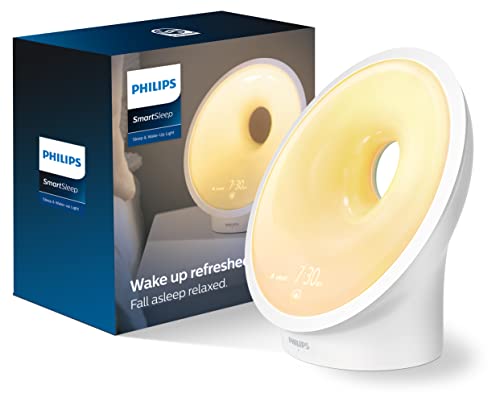
Philips SmartSleep Sleep and Wake-Up Light HF3650/60 — Best Premium Sunrise. Philips’ step-up sunrise clock with a guided wind-down breathing programme, multiple light and sound combinations, and the most polished standalone dawn in this guide.
Check the current price on Amazon
JALL Sunrise Alarm Clock for Bedrooms — Best for Heavy Sleepers Who Want Light First. A sunrise clock aimed at heavier sleepers: dawn simulation backed by a 25-sound machine, FM radio, dual alarms, and a 17-colour night light — with the volume to finish what the light starts.
Check the current price on Amazon
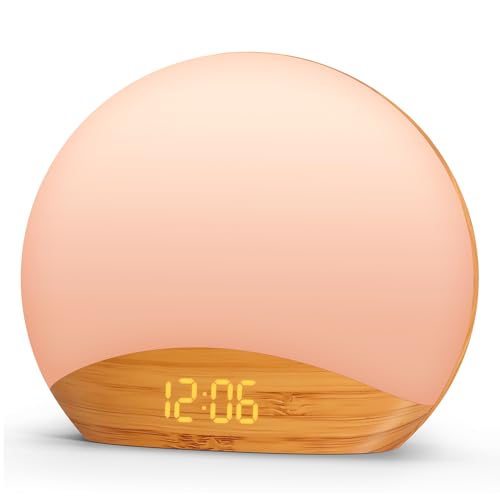
REACHER Wood Grain Sunrise Alarm Clock and Sound Machine — Best Compact. A smaller sunrise clock in a wood-grain finish with 26 sleep sounds, a dimmable display, and a nightlight — the dawn effect for tight nightstands, dorms, and spare rooms.
Check the current price on Amazon
Dreamegg Sunrise 1 Alarm Clock Sound Machine — Best No-App Simplicity. A sunrise alarm and sound machine whose listing states the brief plainly — no app required — with 29 soothing sounds and a 9-colour dimmable night light for adults and kids alike.
Check the current price on Amazon
How These Picks Were Chosen
We built this list around one hard filter: the alarm must be settable, adjustable, and reliable with no smartphone involved at any point in daily use. Clocks that need an app to change the alarm time, unlock basic sounds, or update essential settings were cut, even when the hardware itself was good. What survived are clocks you operate entirely with buttons, dials, and taps on the device itself.
Within that filter we weighted four things. First, wake quality: how gradual the light curve or how gentle the sound ramp feels in the first five minutes. Second, night-time behaviour: a display that cannot dim to near-black will undo the point of removing the phone. Third, backup: battery or capacitor backup that survives an outage without losing the alarm. Fourth, honesty of controls: if changing the alarm takes a manual and eleven button presses, most people quietly go back to the phone within a month.
Listings were cross-checked against Amazon listing data cache before any pick received a link. Picks confirmed through the API carry a Check on Amazon link; picks we could not confirm in this pass are written as unlinked specification slots, so you know exactly what to search for without us inventing a listing.
The 6 Best Alarm Clocks Without Your Phone

Philips SmartSleep Wake-up Light HF3520/60 — Best Overall
If the phrase alarm clock without a phone describes a product category, this is the product that defined it. The HF3520 is a standalone sunrise simulator: you set the wake time on the unit, choose how long the dawn should run, and the lamp brightens through warm colours toward a natural morning glow while one of five natural sounds or the FM radio fades in at the end. There is no app in the process at all — not for setup, not for daily use, not for anything.
The sunset simulation is the half of this clock people underestimate. At night the light dims gradually while you read, which gives the bedroom a hard edge the phone never does: when the light is out, the day is over. The tap snooze — literally tapping anywhere on top of the unit — is the kind of small, sleepy-friendly design detail that keeps a dedicated clock on the nightstand for years instead of weeks.
Strengths
- Fully standalone: every setting lives on the clock, no phone or account involved
- Coloured sunrise and sunset simulation in one unit, so it anchors both ends of the night
- Tap snooze and a proper reading-lamp mode make it genuinely pleasant to live with
Trade-offs
- No battery backup for the alarm itself, so an overnight outage can cost you the wake-up
- Button layout takes a few days to learn by touch in the dark
- Bulb-style dome is larger than a basic digital clock and needs clear space facing the bed
Key specs
- Wake sounds: 5 natural sounds plus FM radio (per Amazon listing title)
- Sunrise and sunset simulation, coloured light
- Tap snooze; doubles as a reading lamp
Who it suits is easy to picture: a light sleeper who hates being startled, in a bedroom dark enough for the dawn effect to register, who wants one device to replace both the phone alarm and the bedside lamp. It is less suited to very heavy sleepers, because light alone may not finish the job and the sound stage is deliberately gentle. If you routinely sleep through a phone alarm at full volume, treat this as the gentle first stage and look at the heavy-sleeper pick further down the list as your backstop rather than expecting one device to do both jobs.
Best for: light sleepers who want a gradual, phone-free dawn wake-up / Not suited for: very heavy sleepers who need volume or vibration as the primary wake method
Check the current price on Amazon

Hatch Restore 3 (Putty) — Best Wind-Down Routine
The Restore 3 is built around a routine rather than a single alarm. In the evening it runs a wind-down sequence of light and sound, overnight it can hold a steady sleep sound, and in the morning the light builds into a sunrise alarm. The hardware itself is deliberately screen-free: the top controls start and step the routine without you reading anything, which is exactly the behaviour you want at the two groggiest moments of the day.
Honesty matters here, so let us be precise about the phone question. The full sound library and routine customisation live in the Hatch app, and some content sits behind Hatch’s optional subscription. Day to day, though, the routine you have set runs from the device itself — you do not need the phone on the nightstand, open, or even in the room to fall asleep or wake up. That is a different category from clocks that are useless without an app, but it is not the zero-app purity of the Philips above, and we score it accordingly.
Strengths
- A complete wind-down, sleep-sound, and sunrise routine in one bedside unit
- Screen-free hardware controls for starting and stepping the routine at night
- Circadian-style lighting that works as a warm reading and night light between routines
Trade-offs
- Full library and deep customisation are app-based, with some content subscription-gated
- Overkill if all you want is a beep at 6:30 — this is a routine system, not a simple clock
- Costs sit in the premium tier of this category, in line with what it does
Key specs
- Sunrise alarm light with circadian lighting modes (per Amazon listing title)
- Sleep audio library of 80+ sounds per the listing title
- Screen-free bedtime routine controls on the device
Buy this if your real problem is the whole evening, not just the alarm: you scroll in bed, fall asleep late, and wake up groggy. The Restore 3 attacks all three points with one habit loop. Skip it if you are a set-it-and-forget-it sleeper who falls asleep fine and only wants the phone out of the bedroom for the morning — the simpler clocks in this guide do that job with less money and zero accounts. Either way, the nightly experience is phone-free; just know the setup and library live partly in an app before you commit.
Best for: readers whose whole bedtime routine needs replacing, not just the alarm / Not suited for: zero-app purists and simple set-and-forget sleepers
Check the current price on Amazon
Philips SmartSleep Sleep and Wake-Up Light HF3650/60 — Best Premium Sunrise
The HF3650 takes the HF3520 formula and adds the thing stressed sleepers actually ask for: help falling asleep, not just waking up. Its RelaxBreathe programme uses rhythmic light pulses to pace your breathing down at night — a small, guided ritual that gives your hands and eyes something to do instead of reaching for a phone. In the morning you get the same class of simulated sunrise and sunset with a wider set of light and sound pairings.
Everything is still operated from the unit. There are no accounts and no pairing ceremony; you learn the controls once and run it by touch. The light quality is the reason to pay the step-up: the dawn gradient is smooth, with no visible stepping between brightness levels in the early, dimmest phase, which is precisely where cheaper sunrise clocks give themselves away.
Strengths
- Guided light-breathing wind-down replaces the pre-sleep scroll with a ritual
- Smoothest dawn gradient in this guide, especially at the lowest brightness steps
- Fully standalone operation with a wide set of light and sound combinations
Trade-offs
- Premium tier pricing for what is, at heart, a clock and a lamp
- Feature set takes longer to learn than a basic sunrise clock
- Like the HF3520, it depends on mains power for the alarm to fire
Key specs
- Simulated sunrise and sunset with multiple lights and sounds (per Amazon listing title)
- RelaxBreathe guided wind-down programme
- Standalone on-device controls
This is the pick for someone who has already decided the phone leaves the bedroom and wants the replacement to feel like an upgrade rather than a sacrifice. The wind-down programme sounds like a gimmick on paper and works in practice because it occupies the exact ten minutes where the phone used to win. If your sleep onset is fine and only your mornings are broken, save the difference and take the HF3520 — the dawn you wake to is cut from the same cloth.
Best for: stressed sleepers who want guided wind-down plus a premium dawn / Not suited for: budget-first buyers and anyone who falls asleep easily already
Check the current price on Amazon

JALL Sunrise Alarm Clock for Bedrooms — Best for Heavy Sleepers Who Want Light First
Most sunrise clocks are designed for people who wake easily and just want it gentler. The JALL starts from the opposite assumption: the light begins the process, but sound has to be able to finish it. The dawn simulation runs first, and behind it sits a 25-sound library and FM radio with enough volume range to matter, plus dual alarms so a weekday and weekend schedule — or two partners — can live on the same clock.
The 17-colour night light is more useful than it sounds in a phone-free bedroom. A dim warm colour at the lowest setting replaces the phone torch for midnight trips, and because it is part of the clock you are not unlocking anything to get it. The Bluetooth speaker function exists, but treat it as a bonus: the point of this guide is a clock that works with the phone in another room, and everything essential here — alarms, sounds, light — runs without any connection at all.
Strengths
- Light-first waking with a genuinely capable sound stage behind it
- Dual alarms suit couples and split weekday/weekend schedules
- Built-in night light removes the last excuse for the phone torch
Trade-offs
- Interface has more modes than a basic clock, so setup takes a sit-down with the manual
- Bluetooth features are irrelevant to the phone-free mission and easy to ignore
- Sound quality is functional rather than hi-fi at the top of the volume range
Key specs
- Sunrise simulation with 25 sounds and FM radio (per Amazon listing title)
- Dual independent alarms
- 17-colour night light; Bluetooth speaker as a secondary feature
Choose this if you are a heavy sleeper who likes the idea of waking with light but does not trust light alone — a common and reasonable position. Set the dawn to start early, set the sound stage assertively, and let the two stages share the work. It is less ideal for minimalists: if you want three buttons and no menus, the simpler picks in this guide will make you happier, and if your bedroom gets strong morning sun through thin curtains, no sunrise clock of any brand will out-shine the window.
Best for: heavy sleepers who want light first and real sound as the backstop / Not suited for: minimalists who want the fewest possible controls
Check the current price on Amazon
REACHER Wood Grain Sunrise Alarm Clock and Sound Machine — Best Compact
Not every nightstand can host a dome-sized sunrise lamp. The REACHER packs the essential pattern — wake light, sound machine, nightlight, dimmable clock — into a compact body with a wood-grain finish that disappears into a bedroom instead of announcing itself as a gadget. For dorm rooms, guest rooms, and small apartments, that footprint is the difference between a phone-free setup that happens and one that stays a good intention.
The 26 sleep sounds matter because this class of clock often doubles as the household’s white-noise machine, and the dimmable display respects the first rule of phone-free bedrooms: at 2 a.m. the clock should tell you the time only if you ask, not broadcast it. Everything essential is set on the device; there is no companion app in the loop.
Strengths
- Compact footprint with a furniture-like finish suits small nightstands
- 26 sleep sounds cover both the wake side and the fall-asleep side
- Fully dimmable display keeps the bedroom dark until you check it
Trade-offs
- Smaller lamp area means a less enveloping dawn than the full-size Philips units
- Compact controls are fiddlier for arthritic hands than big-button clocks
- Sound machine is mono and modest — fine for noise masking, not for music listening
Key specs
- Wake-up light alarm with 26 sleep sounds (per Amazon listing title)
- Dimmable digital display and nightlight function
- Wood-grain compact housing
This is the right first phone-free clock for a teenager’s room, a dorm, or a guest room, and a sensible second clock for a spare bedroom at home. Adults with a full-size nightstand and a serious dawn-waking goal should step up to the Philips picks, where the larger light surface does more work. As a sound machine for a nursery-adjacent hallway or a travel-spare, though, the REACHER’s combination of size, sounds, and a display that can go properly dim is hard to argue with.
Best for: small nightstands, dorms, guest rooms, and first phone-free setups / Not suited for: buyers who want the largest, most enveloping sunrise possible
Check the current price on Amazon

Dreamegg Sunrise 1 Alarm Clock Sound Machine — Best No-App Simplicity
The Dreamegg Sunrise 1 earns its slot by saying the quiet part in its own name: no app required. In a category quietly filling up with clocks that want an account before they will wake you, a device that does everything from its own controls is the entire point of this guide. You get a gradual sunrise wake-up light, 29 soothing sounds for both falling asleep and waking, and a 9-colour night light that dims down for overnight use.
It is pitched at adults and kids together, and that dual audience shows in the controls: big, legible, and hard to break with a wrong press. For a child’s bedroom it doubles as the sleep-training light and sound machine; for an adult’s room it is the straightforward dawn-plus-sound alarm that asks nothing of your phone at setup or ever after.
Strengths
- Explicitly app-free: every function works from the device alone
- 29 sounds span both sleep and wake duties in one unit
- Simple, forgiving controls suit kids’ rooms and groggy adults equally
Trade-offs
- Light output is modest next to the full-size Philips simulators
- Plastic build feels functional rather than premium
- Fewer scheduling refinements than dual-alarm specialists
Key specs
- Sunrise wake-up light with 29 soothing sounds (per Amazon listing title)
- 9-colour dimmable night light
- No app required — stated in the listing title itself
Pick the Dreamegg if your priority is certainty: you want to unbox a clock, set it with your hands, and never think about software again. It is also the easiest recommendation in this guide for a child’s room, where app-linked devices create account and privacy chores nobody needs. Grown-up light sleepers chasing the smoothest possible dawn should still look at the Philips pair first — but they will pay more for the privilege, and plenty of households will find this clock’s honest simplicity is the feature that actually sticks.
Best for: app-free purists, kids’ rooms, and anyone who values simple controls / Not suited for: buyers chasing the brightest, smoothest premium dawn
Check the current price on Amazon
Comparison Table
| Pick | Badge | Key spec | Best for |
|---|---|---|---|
| Philips SmartSleep Wake-up Light HF3520/60 | Best Overall | Coloured sunrise/sunset simulation, 5 natural sounds, FM radio, tap snooze | light sleepers who want a gradual, phone-free dawn wake-up |
| Hatch Restore 3 (Putty) | Best Wind-Down Routine | Sunrise alarm + sleep audio routine system, screen-free device controls | readers whose whole bedtime routine needs replacing, not just the alarm |
| Philips SmartSleep Sleep and Wake-Up Light HF3650/60 | Best Premium Sunrise | Sunrise/sunset simulation plus RelaxBreathe wind-down, standalone controls | stressed sleepers who want guided wind-down plus a premium dawn |
| JALL Sunrise Alarm Clock for Bedrooms | Best for Heavy Sleepers Who Want Light First | Sunrise simulation, 25 sounds, FM radio, dual alarm, 17-colour night light | heavy sleepers who want light first and real sound as the backstop |
| REACHER Wood Grain Sunrise Alarm Clock and Sound Machine | Best Compact | Compact sunrise clock, 26 sleep sounds, dimmable display, nightlight | small nightstands, dorms, guest rooms, and first phone-free setups |
| Dreamegg Sunrise 1 Alarm Clock Sound Machine | Best No-App Simplicity | Sunrise wake light, 29 sounds, 9-colour night light, no app required | app-free purists, kids’ rooms, and anyone who values simple controls |
Sunrise, Sound, or Plain Beep: Choosing Your Wake Method Without a Phone
The first decision in a phone-free bedroom is not brand or budget — it is physics. Light wakes you by shifting your sleep stage before the alarm moment; sound wakes you at the alarm moment. Light is gentler and fails more often for deep sleepers; sound is reliable and can be brutal. Most people land on a hybrid: a sunrise that starts twenty to forty minutes early, with a sound stage set for the actual deadline, so easy mornings wake in the light phase and hard mornings still end on time.
Plain digital and analog clocks remain the right answer for a real group of buyers: people who fall asleep instantly, wake to any noise, and simply want the phone out of the room. For them a sunrise simulator is money spent solving a problem they do not have. Be honest about which sleeper you are — not which one you wish you were — because a gentle clock you sleep through teaches you to distrust the whole phone-free project, and the phone creeps back within a fortnight.
Also consider who else is in the room. Light is the partner-friendly option: a dawn aimed at your side of the bed disturbs a different-schedule partner far less than a beeping alarm, and dual-alarm models let two schedules share one nightstand. Vibration-based waking, covered in our hearing and heavy-sleeper guides, is the extreme version of the same courtesy.
The Features That Decide Whether a Standalone Clock Actually Sticks
Display dimming is the make-or-break feature nobody advertises properly. A clock whose display cannot go near-black reintroduces exactly the ambient glow you removed the phone to escape, and light-sensitive sleepers will find themselves turning it to the wall — at which point it is furniture, not an alarm. Look for a wide dimming range or a display that can switch off entirely while the alarm stays armed.
Backup power decides whether the system survives its first outage with your trust intact. The strongest designs keep both time and alarm through an outage on battery or capacitor backup; weaker ones keep the time but quietly drop the alarm, which is worse than useless because you discover it at 9 a.m. Check the backup behaviour for the specific model you choose, and if your area loses power often, weight this feature above everything except the wake method itself.
Finally, judge the controls by the 6 a.m. test: can a half-asleep person snooze it, and a half-awake person change the alarm, without light, glasses, or a manual? Tap snooze, big dials, and dedicated alarm switches pass. Deep menus and identical buttons fail. The clock you can operate by touch is the clock still in use next year.
- Display dimming to near-black, or a display-off mode with the alarm still armed
- Backup that preserves the alarm itself, not just the time display
- Snooze and alarm-set controls you can work by touch in the dark
- Dual alarms if two schedules share the room
- A night-light or reading-light mode, so the phone torch stays retired
Setting Up the Phone-Free Bedroom So the System Survives Week Two
Week one of a phone-free bedroom runs on motivation; week two runs on logistics. The phone needs a charging home that is not the nightstand — a hallway shelf, a kitchen counter, a landing socket — chosen before the first night, not improvised at midnight. Tell the people who might need you overnight which number reaches the house now, or set the phone’s do-not-disturb exceptions on the other side of the door; the goal is distance, not unreachability.
Replace the phone’s other nightstand jobs one by one or they will smuggle it back. Torch: a dim night light or the clock’s own lamp mode. Music and podcasts: the clock’s radio or sound library, or a separate speaker that lives in the room. Middle-of-the-night time checks: the clock itself, dimmed low. Each job you re-home removes one negotiation at 11 p.m., which is where phone-free systems actually die.
Give the dawn time to work. Sunrise clocks need a week of consistent use before your body starts surfacing in the light phase, and the first few mornings may feel no different. Keep the wake time steady — including, as far as life allows, at weekends — because a shifting schedule is the fastest way to make any alarm, phone or otherwise, feel broken.
What a Standalone Clock Will Not Do — and Why That Is the Point
A dedicated alarm clock will not read your calendar, adjust for your flight, or learn that Fridays run late. It will not track your sleep, score your night, or congratulate you on a streak. For buyers raised on phones, that list reads like a deficiency table. In the bedroom, it is the feature list. Every one of those smart behaviours is a reason for a screen to light up, a notification to land, or a metric to worry about at the exact hours when your brain is supposed to be powering down.
The honest trade is this: you give up automation and data, and you get back a room with one predictable object in it. The clock does the same thing every night whether the Wi-Fi is up or down, whether an update shipped or not, whether a service changed its terms or not. That boring reliability is why standalone clocks routinely outlast the phones that replaced them — many of the designs in this guide have been sold, largely unchanged, for years, because there is nothing in them to go obsolete.
If you do want sleep data, keep the tracker somewhere that is not the bedside alarm: a watch you already wear, or a device in another category entirely. Separating measurement from waking keeps each tool honest — the tracker can be as smart as it likes, and the clock can stay gloriously dumb. The bedroom works best when the last object you touch at night has no opinions and no feed.
Matching the Clock to the Sleeper: A Quick Field Guide
Start with the lightest sleepers, because they are the easiest to serve. If a partner’s footsteps or a neighbour’s door can wake you, almost any sunrise clock will feel luxurious — the light phase does the work and the sound stage may never be needed. Your real enemy is display brightness, so prioritise dimming range over every other specification and place the clock where its dawn spreads across the ceiling rather than firing straight at your eyes.
Average sleepers — the majority — should buy the hybrid pattern and stop over-thinking: a dawn of twenty to thirty minutes, a pleasant sound at the deadline, and controls that pass the touch test. That is exactly the profile of our Best Overall pick, and it is the profile most likely to still be in daily use a year from now, because it asks nothing unusual of you on either end of the night.
Heavy sleepers should invert the shopping order: choose the sound or vibration strength first and treat light as the supporting act. A sunrise that starts forty minutes early can genuinely lighten the final sleep stage, but the deadline still needs a finisher with authority. Dual alarms help here too — stage one for the light, stage two for the sound — and a backup plan for the three or four mornings a year when being late is not an option.
Shift workers and split-schedule couples are the last group, and their keyword is flexibility: dual alarms, weekday/weekend separation, and a display that can go fully dark for daytime sleeping. A sunrise clock still earns its place — waking to light at 3 p.m. in a blacked-out room feels far better than a beep in the dark — but scheduling features outrank dawn smoothness for this group, every time.
How to Set Up a Phone-Free Alarm Routine That Lasts
Setting up the clock takes ten minutes; setting up the system around it takes one honest evening. Do both on a weekend night, not the night before a big morning, so the first test run costs you nothing if a setting is wrong.
- Choose the phone’s new charging spot outside the bedroom and put the charger there permanently.
- Place the clock facing the bed at roughly pillow height, with nothing between the lamp and your face if it is a sunrise model.
- Set the wake time and, on sunrise models, a dawn length of twenty to forty minutes; set the sound stage for the final deadline.
- Dim the display to its lowest comfortable setting and check the room from the pillow with the lights off.
- Set the backup: fit batteries where the model takes them, and note what the clock does in an outage.
- Run one full test morning on a day when oversleeping is an inconvenience, not a disaster.
- Move the phone out, close the door, and keep the wake time fixed for the first full week.
After the first week, adjust one variable at a time: dawn length first, then sound volume, then clock position. Changing everything at once leaves you not knowing what worked. Most people settle within three weeks into a setup they then ignore for years — which is the highest compliment a bedside device can earn.
Common Buying Mistakes
Keeping the phone ‘just for the alarm backup.’ A backup phone on the nightstand is a phone on the nightstand: the scrolling returns within days and the clock becomes a ornament. If you need a backstop, use a second cheap clock or the clock’s own battery-backed second alarm — not the device you are trying to retire.
Buying a sunrise clock for a sunlit room. If dawn already floods your bedroom through thin curtains in summer, a sunrise simulator adds little for half the year. Either fix the curtains first — blackout lining makes light alarms dramatically more effective — or spend the money on a sound-based clock instead.
Setting the dawn too short. A five-minute sunrise is just a lamp switching on. The gradual phase needs twenty minutes or more to pull you through lighter sleep; buyers who judge a sunrise clock on a too-short setting conclude wrongly that light waking does not work for them.
Ignoring display brightness until night one. An undimmable bright display can wreck the very sleep the clock was bought to protect. Check the dimming range before you buy, and test it from the pillow on the first night, while returning the clock is still easy.
Assuming backup power covers the alarm. On many clocks the battery preserves only the time display. One outage later, the alarm you trusted does not fire. Read the backup specification for your exact model and test it once by pulling the plug overnight on a safe weekend.
Final Recommendation
For most readers, the Philips SmartSleep HF3520/60 is the phone-free alarm to buy: a proven standalone sunrise, natural sounds and radio behind it, a sunset mode for the other end of the night, and not an app in sight. If falling asleep is as broken as waking up, the Hatch Restore 3’s routine system or the HF3650/60’s guided wind-down earn their premium. Heavy sleepers should start with the JALL’s light-plus-sound approach, small rooms with the REACHER, and app-free purists and kids’ rooms with the Dreamegg Sunrise 1.
Whichever you choose, the clock is only half the purchase — the other half is the charger that now lives outside your bedroom. Set both up on the same evening and the phone-free morning stops being a project and becomes simply how your room works, every single night of the year, without updates, accounts, or interruptions of any kind whatsoever.
Keep exploring this cluster: Best Alarm Clocks That Wake You Up With Light Best Alarm Clocks To Wake Up Naturally Best Alarm Clocks To Wake Heavy Sleepers Best Alarm Clocks Under $50 Best Alarm Clocks For College Students Best Alarm Clocks With Usb Charger
Frequently Asked Questions
Do alarm clocks without a phone work for heavy sleepers?
Yes, but choose the mechanism honestly. Light alone is the weakest wake signal for a genuinely deep sleeper; pick a model where a capable sound stage follows the sunrise, like the JALL in this guide, or pair a gentle clock with a vibrating backstop alarm. The phone was never magic — it was just loud and close. A dedicated clock can be both, without the apps attached.
What happens to a standalone alarm clock in a power outage?
It depends on the model’s backup design, which is why we flag it in every review. Some clocks keep time and alarm on battery or capacitor backup; others keep only the display. Check your exact model’s behaviour and test it once on a safe night. If outages are common where you live, make alarm-preserving backup your top buying criterion.
Is a sunrise alarm clock worth it compared with a basic digital clock?
If you wake groggy, startled, or snooze repeatedly, the gradual dawn is a real quality-of-life upgrade and worth the step up. If you fall asleep fast and wake to any sound, a basic clock does the same job for far less. The sunrise premium buys gentleness, not reliability — decide which of those your mornings actually lack.
Can I still listen to music or podcasts at night without my phone?
Yes — that job just needs a new home. Several picks here include FM radio and built-in sound libraries, and a small dedicated speaker can live in the bedroom for audio. What matters is that the device in the room cannot turn into a feed. Radio and fixed sound libraries end; a phone’s content never does.
How long does it take to adjust to waking with light?
Most people need about a week of consistent wake times before the light phase starts surfacing them reliably. Keep the schedule steady, give the dawn at least twenty minutes, and do not judge the clock on the first two mornings. If after two consistent weeks you still sleep through the light, add or strengthen the sound stage rather than abandoning the system.
Where should the phone charge instead?
Anywhere you will not drift back to: a hallway shelf, the kitchen, a landing socket. Keep it reachable for genuine emergencies — many people set call exceptions for family — but out of arm’s reach of the pillow. The distance is the feature; everything else about the setup is supporting detail.
Should I keep a second alarm as a safety net?
For genuinely critical mornings — a flight, an exam, a wedding — yes, but make the safety net another dedicated device, not the phone returning to the nightstand. A cheap travel clock in the bathroom, set fifteen minutes later, catches the rare total failure without reopening the door to nightly scrolling. On ordinary mornings, one trusted clock plus a consistent schedule is more reliable than a pile of half-trusted alarms.

