Disclosure: airfryerkitchensupply.com is reader-supported. When you buy through links on our site, we may earn an affiliate commission at no extra cost to you.
Where to buy
Every clock below was confirmed against Amazon’s catalog data before it earned a place here, and each link points to the exact model reviewed. Sunrise clocks are sold under fast-changing brand names, so check that the listing title matches the model named in the review before you buy.
- Philips SmartSleep Sleep and Wake-Up Light HF3650/60 — Check the current price on Amazon
- Hatch Restore 3 — Check the current price on Amazon
- Philips SmartSleep Wake-up Light HF3520/60 — Check the current price on Amazon
- JALL Sunrise Alarm Clock — Check the current price on Amazon
- Dreamegg Sunrise 1 Alarm Clock Sound Machine — Check the current price on Amazon
- REACHER Wood Grain Sunrise Alarm Clock — Check the current price on Amazon
The best alarm clocks to wake up naturally do not startle you awake with a buzzer. They work the way morning itself works: light arrives gradually, your body eases out of deep sleep in response, and by the time sound joins in, you are already surfacing rather than being dragged up. That is the entire premise of the sunrise alarm clock, and it is a premise with real physiology behind it. Light is the strongest signal your circadian system listens to, and a lamp that brightens over twenty to forty minutes before your alarm time can shift you into a lighter sleep stage so the final wake moment lands gently. People who switch from a phone alarm to a wake-up light usually describe the same change: less grogginess, less reaching for snooze, and a first ten minutes of the day that feels owned rather than stolen.
Not every sunrise clock delivers that experience equally well, and the differences are not cosmetic. The quality of the light curve matters — whether brightness rises smoothly or in visible steps, whether the earliest glow is a deep warm amber that will not jolt you, and whether the lamp gets bright enough at the end to actually finish the job on a dark winter morning. The sound side matters too: natural sounds that fade in under the light work better than a radio station cutting in at full volume. And the unglamorous details decide whether you keep using the thing — a display you can dim to true black, buttons you can find half asleep, and an alarm that still fires if the power blips overnight.
This guide covers six clocks that approach natural waking from different directions. Two are from Philips, the brand that effectively created this category and still sets the standard for light quality. One is the Hatch Restore 3, which treats waking as the second half of a full sleep routine managed through an app. The others — JALL, Dreamegg, and REACHER — are value-priced sound-machine hybrids that pack a surprising amount of sunrise simulation into simpler hardware. Each one was chosen for a specific kind of sleeper, and the reviews below are blunt about who should skip each model as well as who should buy it.
In this guide
Quick Picks
- Best Overall: Philips SmartSleep Sleep and Wake-Up Light HF3650/60 — the most convincing sunrise and sunset simulation in the group, with guided wind-down breathing and a premium light curve. Check price on Amazon
- Best for App-Guided Routines: Hatch Restore 3 — circadian lighting plus a deep library of sleep audio, meditations, and routines built in the Hatch Sleep app. Check price on Amazon
- Best Mid-Range: Philips SmartSleep Wake-up Light HF3520/60 — colored sunrise and sunset with natural sounds and FM radio, the long-running classic of the category. Check price on Amazon
- Best for Heavy Sleepers: JALL Sunrise Alarm Clock — bright sunrise simulation paired with a full sound machine, Bluetooth speaker, and dual alarms for stubborn sleepers. Check price on Amazon
- Best No-App Simplicity: Dreamegg Sunrise 1 — a sunrise clock and white noise machine that deliberately skips the app and Wi-Fi entirely. Check price on Amazon
- Best Budget: REACHER Wood Grain Sunrise Alarm Clock — wake-up light, dimmable clock, and sound machine in a warm wood-grain body at a wallet-friendly tier. Check price on Amazon
How These Picks Were Chosen
Every product in this guide was verified against Amazon’s own catalog data, so the model names and listings are real and current. Beyond verification, selection followed the criteria that actually determine whether a sunrise clock changes your mornings. First, light quality: the sunrise had to start from a warm, dim glow and build smoothly, because a lamp that jumps from off to bright in a few steps is just a quieter buzzer. Second, end-point brightness: the simulation has to finish bright enough to matter in a room with blackout curtains in December, not just in a bright spring bedroom. Third, sound design: natural wake sounds that can start after the light, at low volume, rather than blasting at the alarm minute.
Fourth, nighttime behavior. A wake-up light lives on your nightstand all night, so its display must dim to darkness, its buttons must not glow, and any sunset or wind-down features were weighed as a genuine bonus because falling asleep well is half of waking up well. Fifth, reliability basics: dual alarms for couples or weekday/weekend schedules, a snooze you can hit without opening your eyes, and some form of backup so a power flicker does not silently cancel your morning. Finally, control style was treated as a real dividing line rather than a spec: app-based clocks like the Hatch offer deeper routines but demand your phone at bedtime, while button-based clocks like the Dreamegg keep the bedroom screen-free. Neither is automatically better — the right answer depends on the sleeper, and each review says which side it lands on.
The 6 Best Alarm Clocks to Wake Up Naturally
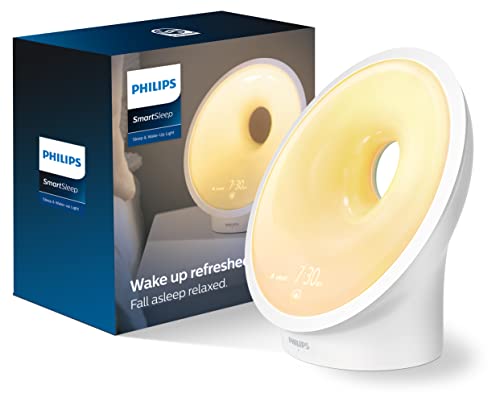
Philips SmartSleep Sleep and Wake-Up Light HF3650/60 — Best Overall
The HF3650/60 is the flagship of the Philips SmartSleep line, and it earns that position on light quality alone. Its sunrise begins at a deep, ember-like warmth and builds through a genuinely smooth curve to a bright, daylight-like finish, with colored simulation that mimics the way real dawn shifts from red through orange to yellow-white. The sunset side is equally considered: light and sound fade together over your chosen duration, and the RelaxBreathe feature pairs a gentle light rhythm with the option of sound to slow your breathing before sleep. This is the clock for someone who wants the wake-up light to be a considered piece of sleep equipment rather than a gadget, and who will actually use both ends of the day it offers.
Strengths
- The most natural light curve in this roundup, with colored sunrise and sunset simulation that changes hue as it brightens rather than simply getting louder light.
- RelaxBreathe wind-down guidance uses light (with optional sound) to pace your breathing, a genuinely useful pre-sleep tool rather than a gimmick.
- Tap-top snooze, an auto-dimming display, and a night-light function make it well behaved on the nightstand around the clock.
Trade-offs
- It sits in the premium tier of this category, costing meaningfully more than the value brands below.
- There is no app and no Bluetooth audio — your phone stays out of it, which some buyers will see as a missing feature rather than a virtue.
- The control scheme takes a few evenings to learn, since many functions share a small set of touch points.
What separates this clock in daily use is how invisible the technology feels. The sunrise does not announce itself; you simply find yourself awake a few minutes before the birdsong starts, which is precisely the effect the category promises and cheaper clocks approximate. The sunset simulation is the sleeper feature — owners consistently report that the wind-down half changes their evenings more than the wake half changes their mornings, because a lamp that dims itself gives you a cue to put the phone down that willpower alone rarely provides. Build quality is a step above the budget models too: the light is even, with no visible hot spot, and the unit feels like a lamp first and an alarm clock second.
Best for: buyers who want the most convincing dawn simulation available and will use the sunset wind-down nightly. / Not suited for: buyers who want app control, Bluetooth music, or a low price. Check the current price on Amazon

Hatch Restore 3 — Best for App-Guided Routines
The Hatch Restore 3 approaches the problem from the opposite direction: instead of a self-contained clock, it is a connected sleep system. The lamp itself is a smooth, fabric-finished dome with circadian lighting that handles both the sunset and sunrise ends of the routine, while the Hatch Sleep app supplies the depth — a large library of sleep sounds, meditations, stories, and structured routines you string together into a personalized night and morning. If you are the kind of person who likes a system to follow, with content that keeps the routine fresh month after month, nothing else in this roundup competes with it. The sunrise itself is warm and gradual, and because routines are built in the app, the sequence of light and sound can be tuned far beyond what buttons allow.
Strengths
- The deepest content library here — sleep audio, meditations, and guided routines that make the wind-down half genuinely varied.
- Circadian lighting covers both ends of the routine, and app scheduling makes weekday and weekend routines easy to keep separate.
- Simple tap controls on the device itself handle the essentials at night without opening the app.
Trade-offs
- The richest content sits inside the Hatch ecosystem, and the full library is tied to the app experience — buyers who dislike subscriptions and accounts should look at the Philips or Dreamegg instead.
- Setup and changes require your phone and a Wi-Fi connection, which cuts against a strict screen-free bedroom.
- As a pure lamp, its peak brightness and light-curve refinement do not quite match the Philips flagship.
The Restore 3 makes the most sense for someone whose problem is not the alarm moment but the whole evening: scrolling too late, sleeping restlessly, then dreading the morning. Its routines attack the full chain. Parents also gravitate to it because the same device logic works for household wind-down rituals. Just go in with clear expectations — you are buying into an app-led product, and its value rises or falls with how much of that content you actually use. If you would never open the app after setup week, the Philips gives you more clock for the money.
Best for: routine-driven sleepers who want guided content for both falling asleep and waking. / Not suited for: anyone who wants a phone-free, account-free bedside clock. Check the current price on Amazon

Philips SmartSleep Wake-up Light HF3520/60 — Best Mid-Range
The HF3520/60 is the model that popularized sunrise waking, and it remains the safest recommendation in the middle of the market. It offers colored sunrise and sunset simulation, a set of natural wake sounds, FM radio for people who prefer waking to voices and music, and a tap-top snooze that works exactly the way a half-asleep hand wants it to. The light curve is a generation behind the HF3650 flagship — the color transitions are slightly less refined — but the core experience, waking a few minutes before the sound starts because the room has slowly become morning, is fully intact. For most buyers, this is where the price-to-benefit curve bends: you get the genuine Philips light engine without paying for the flagship’s extras.
Strengths
- Proven colored sunrise simulation with natural sounds and an FM radio option for wake audio.
- Tap the top to snooze — the most natural snooze interaction in the category.
- Sunset simulation included, which many mid-priced rivals skip entirely.
Trade-offs
- No app, no Bluetooth, and no white-noise library — it is a wake-up light, not a sound machine.
- The light curve and color blending are a step behind the newer HF3650.
- Button layout is dated, and setting dual schedules is less flexible than app-based rivals.
Think of the HF3520 as the reference design: if a cheaper clock cannot match its sunrise quality, it is not actually a bargain, and if a pricier clock cannot beat it, it is not actually premium. It suits a buyer who wants natural waking as a solved problem — set it once, trust it for years, never think about firmware. Its longevity in the Philips lineup also means accessories, documentation, and troubleshooting knowledge are easy to find, a small but real ownership advantage over no-name sunrise clocks.
Best for: most buyers — the balanced default with a genuine Philips sunrise at a mid-range tier. / Not suited for: buyers who want sound-machine depth or app scheduling. Check the current price on Amazon

JALL Sunrise Alarm Clock — Best for Heavy Sleepers
Heavy sleepers are the hardest audience for a sunrise clock, because light alone may not finish the job — and the JALL is built for exactly that skepticism. It combines sunrise simulation with a full sound machine (a library of built-in sounds plus FM radio and a Bluetooth speaker), a multicolor night light, and dual alarms, so the wake sequence can escalate from light to meaningful sound at real volume. Where the Philips models are restrained, the JALL is maximal: more sounds, more colors, more functions in one bedside unit. For a deep sleeper, a teenager, or anyone whose current alarm is a phone at maximum volume across the room, that escalation ladder is the point.
Strengths
- Sunrise simulation plus a substantial sound library, FM radio, and Bluetooth audio gives heavy sleepers a real escalation path.
- Dual alarms suit couples with different wake times or weekday/weekend splits.
- The multicolor night light doubles as bedroom ambience, not just a wake tool.
Trade-offs
- The light curve is less refined than Philips — brightness steps are more noticeable at the dim end.
- Feature density means more menus to learn, and the interface is busier than a minimalist clock.
- Build and materials feel value-tier next to the Philips and Hatch units.
The honest way to use the JALL is to set the sunrise generously long and let the sound arrive as a backstop, not the main event. Heavy sleepers often discover that after a few weeks of light-first waking, the sound backstop becomes less necessary — the body starts surfacing on light alone. If it does not, the volume and variety here mean you still own a capable alarm. Either way, at its tier it is the most complete heavy-sleeper package in this guide.
Best for: deep sleepers and teenagers who need light plus assertive sound to wake reliably. / Not suited for: light sleepers who want the subtlest possible dawn, or minimalists. Check the current price on Amazon

Dreamegg Sunrise 1 Alarm Clock Sound Machine — Best No-App Simplicity
The Dreamegg Sunrise 1 makes a deliberate, almost contrarian choice: no app, no Wi-Fi, no account. It is a sunrise alarm clock and white noise machine operated entirely from the device, with a library of soothing sounds for the sleep side and a naturally graded sunrise for the morning side. The night light offers multiple colors and full dimming, and the clock display can be turned down to darkness — a detail budget clocks often botch. Dreamegg’s background is sound machines, and it shows in the audio quality and in how sensibly the controls are laid out for someone operating them by touch at 2 a.m.
Strengths
- No app or Wi-Fi required — everything works from the device, forever, with no account or updates.
- Strong sound-machine side with a broad library of soothing sounds for falling asleep and masking noise.
- Multi-color dimmable night light and a display that can go properly dark.
Trade-offs
- The sunrise, while natural, does not match Philips for peak brightness or color sophistication.
- No radio and no Bluetooth — the sound library is what you get.
- On-device programming of complex schedules is slower than an app would be.
This is the clock for the buyer who has decided the bedroom should be a low-technology room — a growing and reasonable position. It also suits guest rooms, kids transitioning to their own alarm, and anyone buying for a parent who will never install a companion app. Everything it promises works out of the box with physical controls, and that simplicity is a feature you feel every single night, not a compromise you tolerate.
Best for: screen-free bedrooms, gifts for non-app users, and sound-machine fans who want a sunrise too. / Not suited for: buyers who want app scheduling, radio, or streaming audio. Check the current price on Amazon
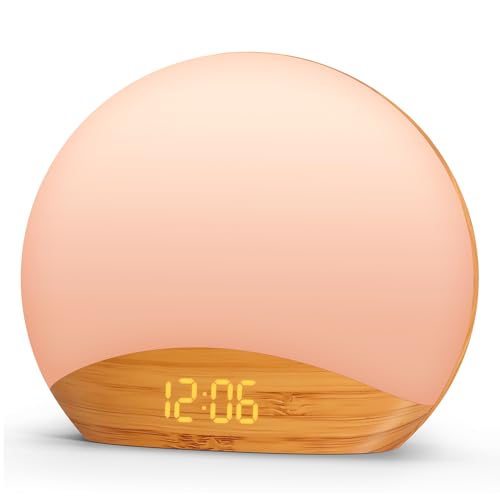
REACHER Wood Grain Sunrise Alarm Clock — Best Budget
The REACHER takes the sunrise formula down to a friendly price while keeping the pieces that matter: a wake-up light with sunrise simulation, a sound machine with a solid library of sleep sounds, and a fully dimmable digital clock, all wrapped in a wood-grain finish that looks warmer on a nightstand than the usual white plastic puck. REACHER’s sound-machine heritage shows in the audio side, which punches above the price tier. As an entry point into natural waking — or as a second clock for a guest room, dorm, or a child’s room — it delivers the core experience honestly.
Strengths
- Sunrise simulation, sound machine, and dimmable clock combined at a budget tier.
- Wood-grain finish looks like bedroom furniture rather than a gadget.
- Sleep sounds library is genuinely good, reflecting the brand’s sound-machine focus.
Trade-offs
- Peak brightness and light-curve smoothness trail the Philips models — very dark rooms and very deep sleepers may want more.
- No sunset breathing guidance, app, or radio extras.
- Controls are basic; fine for a single daily alarm, less so for complex schedules.
Budget sunrise clocks are where this category’s promises most often break, so the REACHER’s competence is the story: the light genuinely ramps, the display genuinely dims, and the sounds genuinely help. If you are sunrise-curious and not ready to commit to a premium clock, this is the low-risk way to find out whether light-based waking works for your body — most people know within two weeks.
Best for: first-time sunrise clock buyers, dorms, guest rooms, and kids’ rooms. / Not suited for: heavy sleepers in blackout-dark rooms who need maximum peak brightness. Check the current price on Amazon
Comparison Table
| Pick | Badge | Key spec | Best for |
|---|---|---|---|
| Philips SmartSleep HF3650/60 | Best Overall | Colored sunrise/sunset, RelaxBreathe wind-down, tap snooze | Most convincing dawn simulation |
| Hatch Restore 3 | Best for App-Guided Routines | Circadian lighting, app routines, large sleep-audio library | Full evening-to-morning routines |
| Philips SmartSleep HF3520/60 | Best Mid-Range | Colored sunrise/sunset, natural sounds, FM radio | The balanced default choice |
| JALL Sunrise Alarm Clock | Best for Heavy Sleepers | Sunrise plus sound machine, Bluetooth, dual alarms | Deep sleepers needing escalation |
| Dreamegg Sunrise 1 | Best No-App Simplicity | Sunrise plus white noise machine, no app or Wi-Fi | Screen-free bedrooms |
| REACHER Wood Grain Sunrise | Best Budget | Wake-up light, sound machine, dimmable clock | First sunrise clock, low risk |
How to Choose an Alarm Clock That Wakes You Naturally
Start with the light, because the light is the product. A proper sunrise simulation takes twenty to forty minutes, begins at a warm color temperature that resembles first dawn rather than a dimmed light bulb, and ends bright. Two specifications tell you most of what you need: whether the color itself changes through the ramp (true dawn simulation) or only the brightness does, and how the lamp behaves at the very start. The first five minutes matter disproportionately — if the initial glow is already bright enough to make you squint, the clock will wake you early and grumpily instead of gradually. Philips’ colored simulation is the benchmark here; budget clocks increasingly imitate it well, but the dim-end smoothness is where cheap light engines still show steps.
Next, match the sound strategy to your sleep depth. Light sleepers often find that after a week with a sunrise clock they wake before any sound plays, and for them the sound library is a wind-down bonus rather than a wake tool. Heavy sleepers should plan the opposite: choose a clock whose sound can be assertive — radio, a Bluetooth speaker, or a sound library with real volume headroom — and treat the light as the first stage of an escalation. Dual alarms deserve more attention than they get: couples with staggered starts and anyone with a different weekend schedule will use them weekly, and setting them should not require an engineering degree or, alternatively, should live in an app you already open.
Then audit the nightstand behavior, the part of ownership that lasts all night rather than ten minutes each morning. The clock display must dim to black or near it; a glowing rectangle at eye level undermines the darkness your sleep needs. Consider whether you want the wind-down half of the category at all. Sunset simulation, breathing guidance, and sleep sounds are not decoration — for people whose real problem is a racing mind at midnight, they are the main event, and the wake-up light is the bonus. That distinction is exactly what separates the Hatch Restore 3 and the Philips HF3650 (both strong at night) from a basic sunrise lamp.
Finally, decide your technology posture honestly. App-connected clocks offer deeper scheduling, fresher content, and easier setup, at the cost of accounts, Wi-Fi, and a phone in the bedtime routine. Self-contained clocks offer permanence and simplicity, at the cost of flexibility. There is no wrong answer, but there is a wrong match: buying an app clock for a technophobe parent, or a button clock for someone who wants a different routine every day of the week, guarantees the device ends up in a drawer.
How to Set Up a Sunrise Routine That Actually Works
Placement comes first. Put the clock on your nightstand at roughly pillow height and within a couple of feet of your head, angled toward your face rather than the ceiling. Light that has to bounce around a room before reaching your closed eyelids loses most of its effect; light aimed gently at the sleeper is the entire mechanism. If you share the bed and your partner sleeps later, angle the lamp toward your side and choose a model whose light is directional enough to respect the boundary.
Set the sunrise duration longer than your instinct suggests. Thirty to forty minutes is the working range for most adults; twenty minutes suits people who already wake easily. Then set the sound — if you use it — to begin at the end of the light ramp at a modest volume, and give the combination two full weeks before judging it. Circadian adjustment is gradual, and the common pattern is that the first mornings feel no different, the grogginess fades around day five, and by the second week you are waking a few minutes before the sound most days. Changing settings every night resets that learning process, so resist the urge to tinker.
Build the evening side with the same patience. Use the sunset or wind-down mode at a consistent time, dim the clock display fully, and keep the phone out of the final half hour if your clock choice allows it. Consistency of timing matters more than any single feature: a modest clock used at the same times daily will outperform a flagship used erratically. If you work shifts, anchor the routine to your sleep schedule rather than the wall clock’s social hours, and consider blackout curtains so the lamp, not the season, controls your light environment.
Common Buying Mistakes
- Buying on brightness claims alone. A lamp can be very bright and still wake you badly if its dim-end steps are coarse. Smoothness of the ramp beats raw output for everyone except the deepest sleepers.
- Ignoring the display. A clock whose numbers cannot dim to darkness will quietly sabotage the sleep it is meant to improve. Check dimming before you check anything else on a budget model.
- Expecting results in two nights. Sunrise waking retrains a rhythm; judging it after a weekend leads people to abandon a tool that would have worked by week two.
- Choosing an app clock for a screen-free bedroom (or the reverse). The control style is a lifestyle decision. Mismatching it is the most common reason these clocks get returned.
- Skipping the sunset half. Buyers fixate on the wake-up and ignore wind-down features, then discover the evening routine was the part that changed their sleep most.
- Placing the lamp across the room. Distance and angle decide whether the light reaches your eyelids at useful intensity. Nightstand placement is part of the product.
- Changing the wake time every day. A sunrise clock trains a rhythm, and a rhythm needs a fixed point. Varying your wake time by an hour or more between weekdays destroys the adaptation you are trying to build, and the clock gets blamed for a schedule problem. Pick the earliest time your life genuinely requires, hold it steady for a fortnight — weekends included, within half an hour — and only then judge whether light-based waking suits you. Consistency is the cheapest performance upgrade in this entire category, and it costs nothing but a decision.
Sunrise Clocks vs. the Other Ways People Try to Wake Naturally
It helps to place these clocks against the alternatives people usually try first. The gentlest conventional option is a radio alarm set to a talk station at low volume, and it does wake many people pleasantly — but volume arrives all at once, and if you happen to be in deep sleep at that moment, the jolt is the same as a buzzer, just with better content. A smart bulb on a schedule is closer in spirit: it can brighten gradually, and if you already own one it is worth experimenting with. Its limits are practical — the light usually comes from the ceiling rather than beside your face, color ramps are often coarse, and there is no integrated sound stage or snooze, so you end up assembling a system out of apps and hoping every piece fires.
Phone-based sunrise apps simulate dawn on a screen that is simply too small and too dim to do the physiological job, and they keep the single most sleep-disrupting object in your life on your nightstand, inches from your pillow, with its notifications. Wearables that wake you with vibration are genuinely good at not disturbing a partner, and sleep-stage-based smart alarms can time a conventional alarm to a lighter moment in your cycle — but neither gives your circadian system the light signal that makes waking feel natural rather than merely well-timed. A dedicated sunrise clock is the only option that combines the right light, in the right place, with sound and controls designed around a person who is not yet fully conscious. That integration, more than any specification, is what you are paying for.
Who a Sunrise Clock Helps Most — and Who Should Skip One
The strongest candidates share a pattern: they wake feeling drugged despite sleeping long enough, especially in winter or in bedrooms that stay dark in the morning. If your alarm goes off in what feels like the middle of the night even at a reasonable hour, you are likely being pulled out of deep sleep, and that is precisely the failure mode light prevents. Shift workers coming off nights, students with early lectures after late study, and anyone whose schedule forces waking before local dawn all benefit disproportionately, because the lamp manufactures the dawn their environment denies them. People with a bed partner on a different schedule also do well here: light aimed at one side of the bed plus a quiet sound stage disturbs the other sleeper far less than a room-filling buzzer.
There are honest exceptions. If you fall asleep easily, wake before your alarm most days, and feel fine, a sunrise clock is a pleasant luxury rather than a solution to anything — the REACHER-tier models exist for exactly that low-stakes curiosity. If your problem is total sleep time rather than wake quality — five broken hours is five broken hours however gently they end — fix the sleep first and let the clock polish it afterward. And if you sleep in a bright room where summer dawn arrives at five regardless, the lamp’s contribution shrinks; blackout curtains plus a clock restores your control, but curtains alone may do most of the work. Knowing which sleeper you are is worth more than any feature list in this guide.
Light Intensity, Color, and Distance: the Three Numbers That Decide Everything
Buyers comparing sunrise clocks run into brightness figures that are hard to interpret, so here is the practical version. What reaches your eyes depends on three things multiplied together: how much light the lamp produces, how far it sits from your face, and how directly it is aimed. Doubling the distance does not halve the effect — it quarters it, which is why the same clock that transforms mornings on a nightstand does almost nothing from a dresser across the room. This is also why headline brightness comparisons between brands mislead: a modest lamp eighteen inches from your pillow outperforms a powerful one six feet away. When you read the reviews above, the peak-brightness criticisms of the budget models assume nightstand placement; move any of them farther away and the ranking reshuffles in favor of the brightest units.
Color is the second variable, and it is about signaling, not decoration. The sky at dawn does not simply get brighter — it changes character, from deep warm tones to neutral daylight, and your circadian system reads that progression. Clocks with true colored simulation, led by the Philips models here, reproduce the progression; clocks that only dim a fixed warm bulb reproduce the brightness half of the signal. Both help, which is why budget sunrise clocks still satisfy most owners, but the colored versions consistently feel less like a lamp turning on and more like morning arriving — a subjective difference with a physiological basis.
The third variable is the one nobody markets: what the light does at the bottom of the ramp. The first minutes of a sunrise should be barely perceptible through closed eyelids. If a clock’s lowest step is already a visible glow in a dark room, it effectively starts your wake-up early and shortens the useful ramp. This is the hardest property to judge from a listing and the easiest to judge in person, so if you are choosing between two finalists and one advertises more brightness steps or a lower starting intensity, weight that heavily — it is a better predictor of a gentle morning than any sound library.
Final Recommendation
For most people, the Philips SmartSleep HF3520/60 remains the sensible center of this category: a genuine colored sunrise, a sunset to match, and a decade-proven design at a mid-range tier. Step up to the HF3650/60 if light quality is your priority and you will use the guided wind-down — its dawn is the most convincing here. Choose the Hatch Restore 3 if your evenings need as much help as your mornings and you are comfortable building routines in an app. Heavy sleepers should take the JALL’s escalation ladder, screen-free households should take the Dreamegg Sunrise 1, and the sunrise-curious should start with the REACHER and upgrade only if the habit sticks. Whichever you pick, give it two consistent weeks before you judge it — natural waking is a rhythm you build, not a jolt you buy.
Related guides in this series: Best Sunrise Simulation Alarm Clocks, Best Alarm Clocks Don Wake Your Partner, Best Alarm Clocks For Couples, Best Alarm Clocks Easy To Use, Best Alarm Clocks For Morning Haters
Related guides
Frequently Asked Questions
Do sunrise alarm clocks really work, or is it a gimmick?
They work through a real mechanism: gradually increasing light suppresses melatonin and shifts you toward lighter sleep stages, so you wake from a shallower point in the cycle and feel less groggy. The effect builds over one to two weeks of consistent use. They are least effective when the lamp is too dim, placed too far away, or used at wildly varying times.
Will a wake-up light work if I sleep with blackout curtains?
Yes — in fact that is the ideal setup, because the lamp becomes the only dawn in the room and its timing is fully under your control. Choose a model with strong peak brightness, place it close to the pillow, and use a thirty-to-forty-minute ramp.
I am a very heavy sleeper. Is light alone enough?
For most heavy sleepers, light alone is not the whole answer at first. Pick a clock with an assertive sound stage — the JALL in this guide, with its sound machine and Bluetooth speaker, is built for that pattern — and let the light act as the first stage. Many heavy sleepers find the sound becomes a rarely-needed backstop after a few weeks.
What is the difference between sunrise simulation and a lamp on a timer?
A timer switches a lamp on at full brightness, which is just a silent jolt. Sunrise simulation ramps brightness — and in better models, color — gradually over twenty to forty minutes, imitating dawn closely enough that your body begins waking before you are conscious of it. The ramp is the product.
Should I choose an app-based clock like the Hatch or a standalone one?
Choose app-based if you want varied content, guided routines, and easy scheduling, and you do not mind your phone being part of setup. Choose standalone if you want the bedroom screen-free, are buying for someone who will not use an app, or simply want a device that works unchanged for years. Both styles can wake you gently; they differ in everything around that moment.
What happens to the alarm if the power goes out overnight?
It depends on the model, and it is worth checking before you rely on any clock for a flight or an exam. Some clocks keep time through a brief outage but will not sound the alarm without power, since the lamp is the alarm; others carry a battery backup that preserves settings and can fire a basic beep. If your mornings are mission-critical, pair the sunrise clock with a phone alarm set ten minutes later as insurance — most owners find they wake with the light and the backup simply never matters, but the one night it matters, it matters completely. This is also an argument for keeping the clock plugged into a reliable outlet rather than a switched power strip that a partner or a cleaner can turn off without anyone noticing.
Can a sunrise clock help with winter mornings when it is still dark at wake time?
Winter is arguably the strongest case for one. When your alarm goes off hours before any natural dawn, the lamp becomes your dawn — the only rising light signal your body receives — and the difference between waking into gradual light and waking into a dark room with a buzzer is at its largest. People who feel their winter mornings are noticeably heavier than their summer ones are often responding to exactly this missing signal. Pair the clock with blackout curtains if street lighting leaks into the room, keep the wake time identical on weekends so the rhythm you build is not dismantled every Saturday, and expect the benefit to be most obvious in the first hour of the day: less heaviness, less caffeine urgency, and a shorter path from bed to feeling like yourself.
How long should I set the sunrise to last?
Thirty minutes is a good default for most adults. Use forty if you sleep deeply or your room is very dark, and twenty if you already wake fairly easily and just want to soften the transition. Keep the duration and wake time consistent for at least two weeks before adjusting.

