Disclosure: airfryerkitchensupply.com is reader-supported. When you buy through links on our site, we may earn an affiliate commission at no extra cost to you.
Where to buy
Every clock below is sold on Amazon, and the listing is where you confirm the details that separate a real sunrise simulation from a lamp on a timer: whether the light is coloured or plain white, how long the sunrise phase runs, and what sounds stand behind the light. Check price on Amazon when you order, and check the current app or membership terms on the Hatch listing in particular.
- Philips SmartSleep Wake-Up Light HF3520 — check price on Amazon
- Philips SmartSleep Sleep and Wake-Up Light HF3650 — check price on Amazon
- Hatch Restore 3 — check price on Amazon
- JALL Sunrise Alarm Clock — check price on Amazon
- Lumie Bodyclock Shine 300 — check price on Amazon
- Philips Wake-Up Light HF3505 — check price on Amazon
Introduction: Waking Up Is a Process, Not an Event
The best sunrise simulation alarm clocks are built on a simple observation about how waking actually works. A sound alarm treats waking as an event — silence, then noise, then a startled human. A sunrise clock treats it as a process: light in the room rises gradually over twenty to forty-five minutes, your sleep lightens in stages as the light reaches your closed eyelids, and by the time any sound plays you are often already surfacing. People who have made the switch describe the same difference in the same words — less jolt, less grogginess, less hatred of the morning — and people for whom it does not work usually turn out to have bought a white light that simply switches on, which is not the technology at all.
That distinction organises this entire guide. Every pick here performs a genuine gradual simulation; the differences are in the quality of the dawn (coloured versus white, adjustable duration versus fixed), the sound that backs it up, the evening features that share the device, and whether the clock wants to be a simple appliance or a phone-replacing sleep system. There is no single winner for every bedroom, and the reviews below are organised to match the clock to the sleeper.
All six picks were confirmed against live Amazon listings. The shortlist is deliberately top-heavy with the category’s two genuine specialists — Philips, which effectively created the mainstream wake-up light, and Lumie, which makes nothing else — plus the Hatch Restore 3 as the modern routine-based alternative and the JALL as the budget feature champion.
In this guide
Quick Picks
Six verified sunrise alarm clocks, from a budget all-rounder to a premium sleep system. Badges match the reviews below.
- Philips SmartSleep Wake-Up Light HF3520 — Best Overall — check price on Amazon
- Philips SmartSleep Sleep and Wake-Up Light HF3650 — Best Premium — check price on Amazon
- Hatch Restore 3 — Best for a Full Sleep Routine — check price on Amazon
- JALL Sunrise Alarm Clock — Best Budget — check price on Amazon
- Lumie Bodyclock Shine 300 — Best Light Quality — check price on Amazon
- Philips Wake-Up Light HF3505 — Best Simple and Compact — check price on Amazon
How These Picks Were Chosen
The first filter was the simulation itself: a gradual brightening over a meaningful period, ideally with colour progression through dawn tones. Devices that merely switch a lamp on at alarm time, or brighten in a few crude steps, were excluded regardless of how they were marketed. We then checked the supporting cast — wake sounds or radio as a backstop, a sunset or wind-down programme, dual alarms where couples need them, and display dimming, because a clock that lights the room all night defeats its own purpose.
The shortlist balances the category’s real philosophies: Philips for the proven mainstream implementation at two tiers plus a compact; Lumie for light quality and duration control; Hatch for the app-driven, phone-free routine; and JALL for maximum features at a budget tier. No static prices appear anywhere (check price on Amazon), no fixed star ratings or review counts are printed, and the Hatch listing’s app and membership terms are flagged in its review because they are part of that purchase in a way they are not for the self-contained clocks.
The 6 Best Sunrise Simulation Alarm Clocks

Philips SmartSleep Wake-Up Light HF3520 — Best Overall
The HF3520 is the sunrise clock against which the category is measured, and after years on the market it remains the default recommendation because its light is right. The simulation is coloured — beginning in deep red tones, passing through orange, and arriving at bright warm white — which mimics an actual dawn closely enough that many users find themselves waking during the light phase, before the sound starts, which is the entire point of the technology — and the reason a proper sunrise clock, tuned over a week, tends to retire the snooze button without ever arguing about it. Waking to light you have already half-registered is categorically gentler than being extracted from sleep by noise.
Strengths
- The coloured sunrise is the benchmark implementation: light that moves through dawn tones rather than simply brightening in white, which is noticeably gentler to wake into
- Sunset simulation as well as sunrise, so the same device winds the evening down
- Five natural sounds plus FM radio and a tap snooze — the complete mainstream feature set in one unit
Trade-offs
- A single alarm setting serves most, but couples on different schedules will each need their own unit or a dual-alarm rival
- The design is a lamp first and a clock second; if you want a big, glanceable time display across the room, look at the JALL
- No app and no Bluetooth — a virtue for some, a gap for others
Key specs: Coloured sunrise/sunset simulation; 5 natural sounds; FM radio; reading lamp; tap snooze; model HF3520/60 (per Amazon listing title).
Around that core it is a complete bedside device: five natural wake sounds, an FM radio for those who prefer voices, a reading lamp warm enough for a book, tap snooze on the top surface, and a sunset programme that reverses the process at night. It asks nothing of your phone and nothing of a subscription, which in this category is becoming a distinguishing feature rather than a default.
Its limits are honest ones: one alarm time, no smart features, and a lamp-like form that suits a nightstand rather than a shelf across the room. For the majority of buyers — one person or a couple sharing a schedule, wanting the proven implementation — this is the sunrise clock to buy, verified against its live listing.
Best for: Most people switching from a sound-only alarm / Not suited for: Anyone who needs two separate wake times in one device
Check on Amazon — check the current price on Amazon and confirm the drain finish and delivery options for your bathroom.
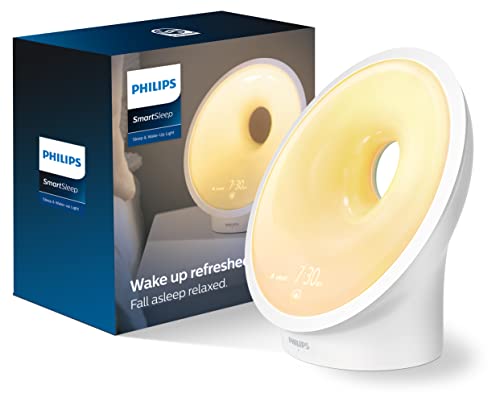
Philips SmartSleep Sleep and Wake-Up Light HF3650 — Best Premium
The HF3650 is for the person who recognises that their problem is not really the alarm — it is the whole night. Its sunrise is the equal of the HF3520’s, but the distinguishing investment is at the other end: a sunset simulation and the RelaxBreathe feature, which uses light pulses to slow your breathing toward sleep. Philips built this model around the idea of a sleep routine rather than a wake moment, and for buyers whose evenings are the disorderly part, that is the correct product philosophy.
Strengths
- The fullest Philips implementation: sunrise and sunset simulation with multiple light and sound options, plus the RelaxBreathe wind-down programme that paces your breathing down at night
- The evening half of the feature set is the real upgrade — most rivals only solve the morning
- Build and light quality sit at the top of the mainstream category
Trade-offs
- Premium tier, and part of what you are paying for is the wind-down suite — morning-only users should save with the HF3520
- Feature depth means a longer setup conversation with the manual than the simple picks
- Like the HF3520, it is a self-contained device: no app ecosystem, for better and worse
Key specs: Sunrise/sunset simulation; multiple lights and sounds; RelaxBreathe feature; model HF3650/60 (per Amazon listing title).
Everything is executed at the top of the mainstream tier: multiple light options and sounds, a lamp that reads well, and controls that stay on the device rather than migrating to a phone. In a bedroom deliberately kept screen-free, that self-containment is worth money — the clock asks for ten minutes of setup and then simply runs your evenings and mornings for years.
The discipline is to buy it for the right reason. If your evenings are fine and only your mornings are brutal, the HF3520 gives you the same dawn for less, and the difference buys a very good dinner. If both ends of the night need help, the HF3650 is the most complete single-device answer in this guide.
Best for: People who want help at both ends of the night / Not suited for: Minimalists who want a clock and nothing else
Check on Amazon — check the current price on Amazon and confirm the drain finish and delivery options for your bathroom.

Hatch Restore 3 — Best for a Full Sleep Routine
The Hatch Restore 3 comes at the problem from the opposite direction to Philips: not a lamp that wakes you, but a bedside system for the whole night, designed to replace the phone on the nightstand. You build a routine in the app — wind-down lighting and audio in the evening, sleep sounds through the night if you want them, and a sunrise that lifts you out in the morning — and then the device runs it from its own simple controls, screen-free. The listing counts 80+ sleep sounds, the deepest library in this guide by a distance.
Strengths
- A routine, not just an alarm: the Restore builds an evening wind-down, a night phase and a sunrise wake into one screen-free bedside sequence
- The sound library is the deepest here — 80+ sleep sounds and content via the Hatch app, per the listing
- Circadian lighting is designed to be lived with all evening, not just endured at dawn
Trade-offs
- The full experience is app-shaped, and some content lives behind the maker’s membership — read the listing’s current terms before buying if that matters to you
- No FM radio and no interest in being a simple clock; it wants to run your routine
- Premium tier, and its value collapses if you will not actually use the routine features
Key specs: Circadian lighting; sunrise alarm; 80+ sleep sounds via Hatch Sleep app; screen-free routine controls; Putty colourway on this listing (per Amazon listing title).
For the right buyer this is transformative, because the enemy of sleep in most modern bedrooms is the phone: the last scroll, the notifications, the alarm app that delivers you back into the feed at 6 a.m. The Restore’s bargain is that the bedroom device does everything, so the phone can charge in another room. The sunrise itself is well executed and the circadian lighting is pleasant to live under all evening.
The caveats are structural and stated plainly: the experience is app-dependent, and part of the content library is membership-based, so check the current terms on the listing and decide whether you are buying a device or joining an ecosystem. People who happily live in apps will not blink; people who chose the HF3520 precisely to avoid one should stay there. Both are correct — for different bedrooms, different budgets, different schedules and different tolerances for bedside technology, and confusing the two is the surest way to be annoyed by a good product.
Best for: People building a phone-free bedroom routine / Not suited for: Anyone who refuses app-dependent devices or subscriptions for extras
Check on Amazon — check the current price on Amazon and confirm the drain finish and delivery options for your bathroom.

JALL Sunrise Alarm Clock — Best Budget
The JALL is what happens when a maker reads every sunrise-clock wish list and simply includes all of it. Sunrise simulation for heavy sleepers, a dual alarm for two schedules, twenty-five sounds plus a white noise machine for the night, an FM radio, a Bluetooth speaker, and a night light with seventeen colours — at a budget tier. If your buying logic is maximum capability for the money, the comparison ends here, and this pick exists because that logic is legitimate.
Strengths
- The feature-per-tier champion: sunrise simulation, dual alarms, 25 sounds, a white noise machine, FM radio, Bluetooth speaker and a 17-colour night light in one budget device
- Dual alarms solve the couple problem the Philips picks leave open
- Aimed squarely at heavy sleepers, with the sound machine side doubling as night-time cover noise
Trade-offs
- The light gradient is good rather than benchmark — the dawn colour progression is less refined than the Philips or Lumie implementations
- Many features means many menus; the first week’s setup is a small project
- Budget-tier build feel — it is a lot of electronics for the tier, and it feels like it
Key specs: Sunrise simulation; 25 sounds; white noise machine; FM radio; Bluetooth speaker; dual alarm; 17-colour night light (per Amazon listing title).
Heavy sleepers are its named audience and the design serves them: the combination of a brightening light phase with a sound alarm at the end, plus a second alarm as insurance, attacks the problem from both sides. The white noise machine is the sleeper feature — pun intended — because for many people the issue is not waking but staying asleep through a household that wakes earlier, and cover noise through the night plus a sunrise at the end is a complete system.
The honest trade is refinement. The light’s colour journey is less subtle than the Philips dawn, the plastics feel budget, and the interface asks more of you. None of that prevents it waking you effectively every morning — and for students, shared houses and first-time sunrise buyers, it is the rational place to start.
Best for: Heavy sleepers and anyone wanting maximum features per tier / Not suited for: Purists who want the most refined light gradient money can buy
Check on Amazon — check the current price on Amazon and confirm the drain finish and delivery options for your bathroom.

Lumie Bodyclock Shine 300 — Best Light Quality
Lumie is the specialist’s specialist: a British company whose entire business is light-based waking, and the Bodyclock Shine 300 is its argument that the quality and control of the light matter more than the length of the feature list. Its headline capability is a custom sunrise duration — the ability to set how long dawn takes — which sounds minor until you learn that people differ enormously in how fast a light phase pulls them up, and that the difference between a fifteen-minute and a forty-five-minute dawn is the difference between a gimmick and a transformation for many users.
Strengths
- Lumie’s specialism is the light itself: warm LEDs and a customisable sunrise duration, so the dawn runs at the pace your sleep actually responds to
- Sunset as well as sunrise, with reading and night-light modes that make it a complete bedside lamp
- A focused device from a company that makes wake-up lights as its main business, not as a sideline
Trade-offs
- No radio, no Bluetooth, no sound library to speak of — the budget JALL out-features it on paper
- The premium is entirely in light quality, which only light-sensitive wakers will fully appreciate
- Fewer sold through mainstream channels historically — check the listing’s current availability and terms
Key specs: Sunrise/sunset simulation; custom light duration; warm LEDs; reading and night light modes (per Amazon listing title).
The light itself uses warm LEDs tuned for the purpose, and the sunset programme, reading light and night light make it a complete lamp for the nightstand. What it pointedly does not do is everything else: no radio, no speaker, no app carnival. Lumie’s bet is that the person buying a wake-up light primarily wants to wake well, and that bet has kept the company at the front of this category for years.
Choose the Shine 300 if you have tried a basic sunrise clock and found the fixed dawn too fast or too crude, or if you know you are light-sensitive and want the instrument built by the people who think about nothing else. Feature-counters should take the JALL; light-counters should take this.
Best for: Light-sensitive wakers who want control over the sunrise length / Not suited for: Anyone needing a built-in radio or Bluetooth speaker
Check on Amazon — check the current price on Amazon and confirm the drain finish and delivery options for your bathroom.

Philips Wake-Up Light HF3505 — Best Simple and Compact
The HF3505 is the sunrise clock for the person who has read this far, agrees with the idea, and wants none of the ceremony. It is a compact Philips with the family’s genuine sunrise simulation, two natural wake sounds, an FM radio and a bedside lamp mode — the complete essential set, in a smaller body, at the friendliest tier in the Philips line. For a spare room, a teenager’s bedroom, a small nightstand or a first experiment with light waking, it is frequently the correct purchase precisely because it refuses to be more.
Strengths
- The essentials, properly done: a genuine Philips sunrise simulation, two natural sounds, FM radio and a bedside lamp, in a compact unit
- The simplest setup and daily operation on this list — the pick for technophobes and spare rooms
- A long-running model with a proven dawn, at the accessible end of the Philips range
Trade-offs
- Two sounds is a short menu by modern standards, and there is no sunset programme on this model
- Compact means a smaller lamp and a smaller presence — big nightstands can carry the HF3520’s better light
- No dual alarm, no app, no extras: what you see is the complete list
Key specs: Sunrise simulation; 2 natural sounds; FM radio; bedside lamp; model HF3505/60 (per Amazon listing title).
Its dawn is the real thing — this is not a dimmer on a timer wearing a sunrise costume, which is the failure mode of the category’s cheapest imitations. You get the gradual brightening that does the physiological work, from the company that pioneered the category, with a radio for those who wake best to voices. The economies are in the extras: a short sound menu, no sunset, no second alarm.
Buy it as a deliberate simplification, not as a compromise you will resent. If it proves the concept in your house — and for most people it does — the household’s second sunrise clock, for the main bedroom, can be the HF3520 with everything this one taught you about how you actually wake.
Best for: Small nightstands and straightforward needs / Not suited for: Feature hunters — this is the essentials, done properly
Check on Amazon — check the current price on Amazon and confirm the drain finish and delivery options for your bathroom.
Comparison Table
| Pick | Badge | Key spec | Best for |
|---|---|---|---|
| Philips SmartSleep Wake-Up Light HF3520 — check price on Amazon | {p[“badge”]} | {p[“keyspec”]} | {p[“bestfor”]} |
| Philips SmartSleep Sleep and Wake-Up Light HF3650 — check price on Amazon | {p[“badge”]} | {p[“keyspec”]} | {p[“bestfor”]} |
| Hatch Restore 3 — check price on Amazon | {p[“badge”]} | {p[“keyspec”]} | {p[“bestfor”]} |
| JALL Sunrise Alarm Clock — check price on Amazon | {p[“badge”]} | {p[“keyspec”]} | {p[“bestfor”]} |
| Lumie Bodyclock Shine 300 — check price on Amazon | {p[“badge”]} | {p[“keyspec”]} | {p[“bestfor”]} |
| Philips Wake-Up Light HF3505 — check price on Amazon | {p[“badge”]} | {p[“keyspec”]} | {p[“bestfor”]} |
How to Choose a Sunrise Alarm Clock
Start with the dawn itself, because everything else is furniture. Ask three questions of any candidate. Is the brightening gradual over at least twenty minutes, or is it a dressed-up switch? Does the light change colour through warm dawn tones, or is it white light getting brighter — coloured simulations feel markedly more natural and are the benchmark implementations in this guide. And can you adjust the duration and final intensity? Sleepers differ: some surface happily in a short dawn, others need forty minutes and full brightness, and a clock that lets you tune both (the Lumie’s specialism) will fit more humans than one fixed programme.
Next, the backstop. Light alone wakes most people most days, but heavy sleepers, winter-dark bedrooms with blackout curtains drawn against the clock’s own light path, and high-stakes mornings all argue for a sound stage after the light phase — natural sounds, radio or a conventional tone. Decide your risk honestly: if a missed alarm costs you a flight or a job, choose a clock with a sound backstop and, like the JALL, a second alarm. Then the household questions: two schedules need dual alarms or two clocks; a partner who sleeps later needs the light placed and angled thoughtfully, since a sunrise is harder to snooze on someone else’s behalf.
Finally, the ecosystem question, which this category now forces. The self-contained clocks (Philips, Lumie, JALL) do everything on the device forever, with no account and no ongoing terms. The Hatch Restore builds a richer routine through an app, with part of its content membership-based. Neither is wrong; they are different relationships with a bedside object, and choosing consciously now prevents the particular irritation of discovering a subscription inside an alarm clock at 11 p.m. on the first night.
How to Set Up a Sunrise Routine That Actually Works
Placement first: the clock belongs on the nightstand, near the bed, with its light able to reach your face unobstructed — not across the room behind you, not inside a shelf nook, and not where a partner’s pillow fort will eclipse it. If the room has blackout curtains, the clock must be inside the curtains’ line, on your side of them; a sunrise behind blackout fabric is a rumour. Angle it toward the bed rather than the ceiling unless the model is designed to wash the room.
Then tune it like an instrument over the first week, because the factory defaults are a starting guess, not your physiology. Set the sunrise duration to thirty minutes if the clock allows a choice. Set the final light intensity one step below maximum — you can raise it if you sleep through. Set the sound stage fifteen minutes after you hope to be awake, at a modest volume, as a backstop rather than the main event; the goal of the first week is to discover whether the light alone surfaces you, and most people find that by day four or five it does. Keep your wake time consistent across the week, including one weekend morning if you can bear it, because a light routine entrains to regularity and is sabotaged by a three-hour Saturday lie-in. If you are not waking before the sound by the end of week one, lengthen the dawn or raise the final brightness before concluding the technology is not for you — in our judgement, most failures of this category are tuning failures, not product failures — a distinction worth remembering before anything is returned in frustration at the end of a badly tuned first week.
The Winter Case: Where Sunrise Clocks Earn Their Keep
For half the year in northern latitudes, the alarm goes off in full darkness, and this is the season the category exists for. A summer dawn does half the clock’s work for free; a December morning offers nothing, and the difference between being extracted from deep sleep by noise in the dark and being lifted through a simulated dawn is at its largest exactly when mornings feel worst. Two winter adjustments matter. First, expect to use a higher final brightness than you needed in June — the contrast with a dark room is total, and your summer setting may under-deliver. Second, guard the light path: winter bedrooms accumulate obstacles (extra blankets, a partner burrowed higher), and blackout blinds fitted for summer dawns must not stand between the clock and your face. Households that buy a sunrise clock in autumn and tune it honestly through the dark months tend to become the category’s permanent converts; households that buy in June sometimes conclude it is a pleasant lamp and miss the point entirely.
The Evening Half: Sunsets, Wind-Downs and Why They Matter
Half the picks in this guide work both ends of the night, and the evening features are not filler. A sunset simulation — light dimming gradually through warm tones — gives the brain the opposite slope to the morning’s: a legible signal that the day is ending, in a bedroom where the alternative is a phone screen at full brightness until the moment of attempted sleep. The HF3650’s RelaxBreathe goes further, pacing breathing with light; the Hatch builds the whole evening into a routine of light and audio. You do not need these features if your evenings are already orderly. But if your household’s pattern is bright screens, late light and a hard stop at bedtime, the evening half of a sunrise clock may improve your sleep more than the morning half improves your waking — and it is the reason the premium picks in this guide cost what they cost. Judge them as night-and-day systems, not as expensive alarms.
Teenagers, Students and Shift Workers
Three groups deserve specific advice because their sleep geometry differs. Teenagers run late by biology and are dragged early by school; a sunrise clock will not repeal the biology, but a consistent light routine — dawn at the same time daily, sunset discipline in the evening, phone charging outside the room where the Hatch pattern helps — is one of the few interventions families report actually shifting the morning battle from combat to mere grumbling. Students in shared housing should take the JALL or the HF3505: dual alarms or a cheap second unit solve the roommate problem, and nobody should take a premium device into a house-share’s casualty rate. Shift workers are the specialist case: your dawn may be at 4 p.m., and the same principles apply in mirror image — a sunrise before your shift, blackout discipline for your daytime sleep, and the clock placed inside the blackout line. A sunrise clock used with that consistency can anchor a rotating schedule better than willpower and caffeine alone, though no clock repeals the genuine difficulty of night work.
Why Not Just a Smart Bulb and a Timer?
It is a fair question, and the honest answer is: you can, and some people do, and it is usually worse. A smart bulb can brighten on a schedule, but the implementations differ in the details that matter at 6 a.m. — the ramp is often stepped or too fast at the low end where waking actually happens, the colour journey through dawn tones is rarely programmed, the sound backstop lives in a separate app, and the whole arrangement depends on WiFi, hubs and automations surviving updates and outages. A dedicated clock is a single appliance with one job, physical controls in the dark, and no failure modes involving a router. The gap narrows if you already live in a well-run smart home and enjoy tuning it; it widens for everyone else. Buy the bulb route as a hobby if you like; buy a clock from this list if you want to wake up.
Display Brightness and Night-Time Light Discipline
A sunrise clock spends twenty-three hours a day as a bedroom object, and how it behaves in those hours matters. The time display is the main offender in lesser designs: a bright LED readout can light a dark-adapted room enough to matter, and a clock bought to improve sleep that degrades the darkness is working against itself. Every pick in this guide handles display dimming respectably, but you must actually set it — choose the lowest readable level, or display-off if you do not need to read the time at night, and notice that not checking the time at 3 a.m. is itself a sleep improvement most people did not know they needed. The same discipline applies to status lights and charging indicators across the room. Think of the bedroom as a darkness budget: the sunrise clock is allowed to spend it all at dawn, and none of it before.
Travelling With a Wake Routine
Routines collapse on the road, and a few habits preserve the benefit without packing a lamp. If you travel for work regularly, consistency of wake time matters more than the device — keep the time, accept the hotel alarm as backstop, and use the brightest available light immediately on waking (bathroom lights, curtains open) as a manual sunrise. For longer stays and relocations, the compact picks in this guide — the HF3505 especially — travel well enough to be worth a suitcase corner, and returning travellers consistently report that keeping the dawn is what keeps a trip from wrecking the following week at home. Students moving between term and home addresses are the natural owners of two cheap clocks rather than one premium one, which is the JALL and HF3505’s quiet second job in this guide.
Snooze Culture: Designing the Last Ten Minutes
Every clock here handles snoozing differently, and your relationship with the snooze button should influence the choice more than it usually does. The tap-snooze on the Philips models is designed for the half-awake hand — a tap anywhere on top buys a few minutes without a hunt for a button — which suits people who snooze once, gently, as part of surfacing. If your pattern is six snoozes and a negotiation, the honest fix is not a sterner clock but a shorter one: set the alarm later, at the time you actually rise, let the sunrise do its work across the full phase, and remove the snooze from the system entirely for a fortnight to see what your mornings become. The dawn cannot lighten your sleep if you keep resetting its final act. Treat snooze as a diagnostic: needing it daily means the wake time, the dawn length or the evening before needs adjusting — the clock is reporting a schedule problem, not causing one.
One more scenario worth a paragraph, because it decides real purchases: the guest room and the gift. A sunrise clock is one of the most successful household gifts in this entire guide series — it is personal without being intimate, useful nightly, and the HF3505 and JALL sit at giftable tiers. In a guest room, the compact Philips quietly upgrades every stay, and hosts report guests asking about it at breakfast with a regularity no scented candle has ever achieved. If you are buying for someone else, favour the self-contained clocks over the app-driven Hatch: a gift that begins with an account creation and a membership screen has misunderstood the assignment.
And the simplest expectation-setting of all: a sunrise clock improves the mechanics of waking, not the quantity of sleep. If you are chronically short of sleep, the gentlest dawn in the world will still be waking a tired person, and the correct purchase sequence is an earlier night first and a better alarm second. Readers who fix the schedule and then add the light routine are the ones who write the category’s glowing accounts; the clock is the last ten percent of a sleep system, and this guide sells it as exactly that.
Power cuts and clock drift deserve thirty seconds, because an alarm that fails silently is worse than no alarm. The mainstream clocks here hold their settings through brief outages to varying degrees — check the listing for battery backup if your supply is unreliable or the stakes are high — and the phone, whatever its bedroom sins, remains a legitimate backup alarm for the mornings that truly cannot be missed. Belt and braces on a flight day is not a failure of the sunrise philosophy; it is adulthood, and every honest guide in this category should say so rather than pretend a bedside lamp is a guarantee.
Common Buying Mistakes
Buying a white light that switches on. If the brightening is not gradual over twenty-plus minutes, it is not a sunrise simulation, whatever the box says. Placing it behind blackout curtains or across the room. Light that cannot reach your face cannot wake you. Judging it after one night. Give the routine a week of consistent wake times and tuning before deciding. Ignoring the partner problem. A sunrise wakes the room, not the individual — discuss placement and schedules before the first 6 a.m. dawn breaks over someone rostered to sleep until eight. Forgetting the sound backstop on important mornings. Light is the gentle default; flights and exams deserve the alarm stage too. Discovering the app terms afterwards. On ecosystem devices, read what is included and what is membership before the first night, not during it. Leaving the display bright. A clock that glows all night is working against the sleep it is meant to improve — dim it or turn the display off if the model allows.
Final Recommendation
For most people, buy the Philips HF3520: the benchmark coloured dawn, a complete feature set, no apps and no subscriptions — the sunrise clock this category is judged against. If your evenings need as much help as your mornings, step up to the HF3650 for its wind-down suite. Light-sensitive wakers and tinkerers should take the Lumie Shine 300 for its adjustable dawn; phone-free routine builders, the Hatch Restore 3; heavy sleepers and value hunters, the dual-alarm JALL; and small nightstands or first experiments, the compact Philips HF3505. Confirm the simulation details on the listing, tune the dawn over your first week, and check price on Amazon when you order.
Related guides on this site: Best Alarm Clocks Best Wake Up Lights Best Smart Alarm Clocks Best White Noise Machines Best Bedside Lamps
Frequently Asked Questions
Do sunrise alarm clocks really work?
For most people, yes — the gradual light lightens sleep in stages, and many users find they wake during the light phase before any sound. They are not magic: heavy sleepers should keep the sound backstop set, placement matters (the light must reach your face), and the first week of tuning and consistent wake times is part of the product.
How long should the sunrise phase be?
Twenty to forty-five minutes is the working range, and the right answer is personal. Thirty minutes is the sensible default; if you sleep through it, lengthen the phase or raise the final brightness before blaming the clock. Models like the Lumie let you set the duration precisely, which is their main advantage.
Will a sunrise clock wake my partner too?
Light fills a room, so a partner will usually notice the dawn — though a gradually brightening room disturbs a sleeping partner far less than a blaring alarm, and many couples find both of them wake more gently even on one schedule. For genuinely different schedules, use dual alarms with the light angled to one side, or accept two clocks.
What is the difference between coloured and white sunrise simulation?
Coloured simulations move through red and orange dawn tones into bright warm white, mimicking a real sunrise; white simulations simply brighten. The coloured versions — the Philips implementation is the benchmark — feel more natural to wake into and are generally preferred by people who have tried both.
Do I need the sound alarm as well as the light?
Treat sound as insurance. Set it for after the light phase at modest volume; most days the light will surface you first, and the sound exists for deep-sleep nights, dark winter mornings and high-stakes wake-ups. Heavy sleepers should always run both stages.
Is the Hatch Restore worth it over a Philips?
It depends on what you are buying. The Restore is a routine system — wind-down, sleep sounds, sunrise — run through an app, with some content membership-based; the Philips clocks are self-contained appliances that do sunrise and sunset with no account. If you want the phone out of the bedroom and a guided routine, Hatch; if you want an appliance, Philips.

