Disclosure: airfryerkitchensupply.com is reader-supported. When you buy through links on our site, we may earn an affiliate commission at no extra cost to you.
Where to buy
A couples’ alarm clock lives or dies on one feature: two genuinely independent alarms, ideally with different sounds or volumes for each partner. Every clock below was confirmed through the site Amazon listing as a dual-alarm model, and the reviews say how the two alarms differ. Check the current price on Amazon from each link, and think about your nightstand’s sockets and light sensitivity before choosing between the digital, radio and sunrise styles.
- Best Overall for Couples: Odokee Digital Dual Alarm Clock — check price on Amazon
- Best Dual Clock Radio: Emerson SmartSet Dual Alarm Clock Radio — check price on Amazon
- Best for Shared Nightstands: JALL Digital Alarm Clock with FM Radio and Dual Charging — check price on Amazon
- Best Projection Clock: Mesqool Digital Projection Alarm Clock with Dual Alarms — check price on Amazon
- Best Weekday/Weekend Programming: uscce Digital Dual Alarm Clock Radio — check price on Amazon
- Best Sunrise Clock for Couples: JBER Sunrise Alarm Clock with 2 Alarms — check price on Amazon
The best alarm clocks for couples solve a small domestic negotiation that repeats every night: two people, two wake times, one nightstand. A single-alarm clock forces the earlier riser to become the later riser’s alarm clock, a job nobody applied for. A proper dual-alarm clock lets each partner set, snooze and silence their own alarm, ideally without lighting the room like a departure board or waking the other with a sound pitched for a heavy sleeper.
The six verified picks split by waking style. There are straightforward dual digital clocks with dimmable displays for light-sensitive sleepers, dual clock radios for couples who wake to news or music, a projection model that keeps the display off the nightstand entirely, and a sunrise clock with two alarms for partners who would rather be woken by light than by noise, the kindest option when wake times are close but not equal.
This guide explains the features that actually matter to two people sharing a clock: independent volumes, weekday and weekend modes so Saturday does not inherit Friday’s alarm, display dimming that goes truly dark, and backup power so a brief outage does not reset the morning. The how-to covers setting up a two-alarm household routine, because the best couples’ clock is the one both partners understand half-asleep at 6 a.m.
Key Takeaways
- Two independent alarms are non-negotiable; a snooze button is not a second alarm.
- Weekday and weekend modes end the classic Saturday 6 a.m. disaster.
- The display is a night light: choose full-range dimming, projection or sunrise light deliberately.
- Set the clock up together and rehearse it once on a morning that does not matter.
- Battery backup should preserve the alarms themselves, not just the time display.
In this guide
Quick Picks
Best Overall for Couples — Odokee Digital Dual Alarm Clock
Two alarms, weekday and weekend modes, and a display that dims from full brightness to fully off: the Odokee is the couples’ clock that handles different schedules and light-sensitive sleepers in one tidy design.
Best Dual Clock Radio — Emerson SmartSet Dual Alarm Clock Radio
Emerson’s SmartSet sets its own time automatically, offers dual alarms with AM/FM radio and 20 presets, a sleep timer and a dimmable jade display: the wake-to-the-news couples’ clock with the least setup fuss.
Best for Shared Nightstands — JALL Digital Alarm Clock with FM Radio and Dual Charging
JALL combines dual alarms and FM radio with two charging ports and an eight-colour night light, answering the shared nightstand’s other problem: two phones, one socket, and a tangle of cables.
Best Projection Clock — Mesqool Digital Projection Alarm Clock with Dual Alarms
The Mesqool projects the time onto the ceiling or wall with a 180-degree rotatable projector, runs dual alarms, and dims across five levels, so neither partner needs a glowing box beside the bed.
Best Weekday/Weekend Programming — uscce Digital Dual Alarm Clock Radio
uscce pairs dual alarms and FM radio with serious scheduling: weekday and weekend modes, a 0-100% dimmer, large numbers and two USB charging ports, for couples whose week has more than one shape.
Best Sunrise Clock for Couples — JBER Sunrise Alarm Clock with 2 Alarms
The JBER wakes with gradually brightening light and offers two alarms, 25 soothing sounds, a night light and Bluetooth speaker duties: the gentlest way to wake two people whose times are close together.
How These Picks Were Chosen
Candidates were verified, including fresh dual-alarm and sunrise dual-alarm searches during this batch. A clock only qualified if its listing confirmed two alarms; single-alarm clocks with a snooze button, however charming, were excluded, because snooze is not a second alarm and couples discover the difference on the first workday.
The final six span the waking styles couples actually choose: plain dual digital, dual with FM radio, projection, dual radio with weekday-weekend programming, a sunrise clock with two alarms, and a radio-led JALL model with charging ports for the shared nightstand. Display behaviour, charging and backup details are stated only where the verified listing supports them.
The 6 Best Alarm Clocks for Couples

Odokee Digital Dual Alarm Clock — Best Overall for Couples
The Odokee suits the most common couples’ pattern: different weekday wake times, shared weekends, and one partner who cannot sleep facing a glowing display. Its 0-100% dimmer goes properly dark, the weekday/weekend mode stops the Saturday mistake, and the dual alarms are easy to set without a manual in hand.
Strengths
- True dual alarms with weekday/weekend modes
- Display dims across the full range, including off
- Easy setting controls for half-asleep adjustments
Trade-offs
- Alarm sound is one style shared by both alarms
- No radio or sunrise light for gentler waking
- Loud top volume is more than light sleepers need
Key details: Dual alarms; 0-100% dimmable display; weekday/weekend mode; easy-set controls.
Couples features are mostly about not disturbing each other, and the Odokee is designed around that courtesy. The display can vanish entirely, which matters more than any alarm sound for many light sleepers. Weekday/weekend programming is the other quiet hero: each partner’s alarm can rest on rest days without the nightly reprogramming ritual that causes the classic Monday failure. It lacks the romance of radio or sunrise, but as a shared appliance it is the most considerate clock in this guide, and consideration is the whole category.
Best for: Couples with different weekday times and a light-sensitive partner / Not suited for: Couples who want to wake to radio or light
Check the current price on Amazon
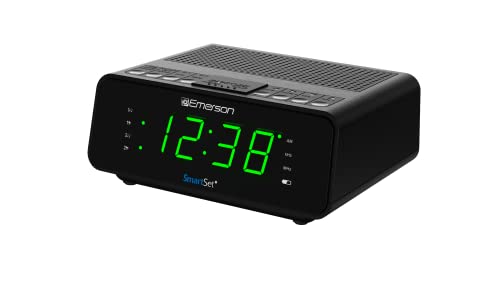
Emerson SmartSet Dual Alarm Clock Radio — Best Dual Clock Radio
The SmartSet suits couples who wake to voices and music rather than beeps, and who hate setting clocks. Its automatic time setting handles power cuts and clock changes gracefully, the dual alarms can be split between partners and stations, and the sleep timer lets the later sleeper drift off to radio after the earlier one is already asleep.
Strengths
- Automatic time setting after outages and clock changes
- Dual alarms with AM/FM and 20 station presets
- Sleep timer for falling asleep to radio
Trade-offs
- Radio waking depends on local reception quality
- Display dimming range is narrower than the Odokee’s
- Shared speaker means one radio volume for both
Key details: Dual alarms; AM/FM radio with 20 presets; automatic time setting; sleep timer; dimmable LED display.
The SmartSet’s party trick, setting itself, sounds minor until the first power cut in a single-alarm household resets a morning. For couples the deeper value is routine: preset stations mean one button to a familiar breakfast show, and dual alarms mean the news wakes one partner while the other gets a later buzzer. Emerson has made clock radios for decades and the controls show it, with the functions couples use nightly placed where thumbs expect them. If your mornings run on radio, this is the natural shared clock.
Best for: Couples who wake to news, talk or music / Not suited for: Light-sensitive sleepers needing a fully dark display
Check the current price on Amazon

JALL Digital Alarm Clock with FM Radio and Dual Charging — Best for Shared Nightstands
The shared nightstand is contested territory, and the JALL is designed for its politics. Dual alarms handle the mornings, two charging ports end the nightly negotiation over the good socket, and the night light gives the later reader or the midnight water-drinker a glow that does not require the main lamp. It suits couples whose phones also live on the nightstand.
Strengths
- Dual alarms with FM radio waking
- Two charging ports for both partners’ phones
- Eight-colour night light for low-level visibility
Trade-offs
- Night light colours will not suit display purists
- Loud alarm ceiling is aimed at heavy sleepers
- More features mean more settings to learn together
Key details: Dual alarms; FM radio; 2 charging ports; 8-colour night light; sleep sounds with timer.
Judge the JALL as nightstand infrastructure, not just a clock. The charging ports simplify the surface both partners use last and first each day, and a clock that reduces cable clutter earns goodwill no alarm tone can buy. The sleep sounds with timer help the partner who falls asleep to audio, while the dual alarms stay independent for the morning. Its night light is a feature for couples who navigate to a bathroom or a baby’s room at night, and a setting to disable for those who sleep best in true dark.
Best for: Couples sharing one nightstand and one socket / Not suited for: Minimalists wanting a clock and nothing else
Check the current price on Amazon

Mesqool Digital Projection Alarm Clock with Dual Alarms — Best Projection Clock
Projection clocks suit couples who disagree about the display itself. One partner wants to check the time at 3 a.m. without sitting up; the other wants darkness. The Mesqool projects a soft time image overhead, keeps its own display dimmable, and still runs two proper alarms with battery backup for outages.
Strengths
- Ceiling projection readable without sitting up
- Dual alarms with snooze and DST support
- Five-level dimmer for the base display
Trade-offs
- Projection brightness can still bother very light sleepers
- Needs AC power for projection, battery is backup only
- Projected image focus depends on ceiling distance
Key details: Dual alarms; 180° rotatable projector; 5-level dimmer; 12/24H and DST; AC powered with battery backup.
The ceiling is the one display position both partners share equally, and that is the Mesqool’s insight. A glance upward replaces the phone check, with its cascade of notifications, and the projector rotates to suit beds pushed against either wall. Keep the projection at its lower brightness levels and most couples find it restful rather than intrusive; the very light-sensitive can switch it off and keep the dim base display. Dual alarms, DST handling and backup power cover the practical bases without fuss.
Best for: Couples who check the time at night but hate glowing displays / Not suited for: Very light-sensitive sleepers who need total darkness
Check the current price on Amazon
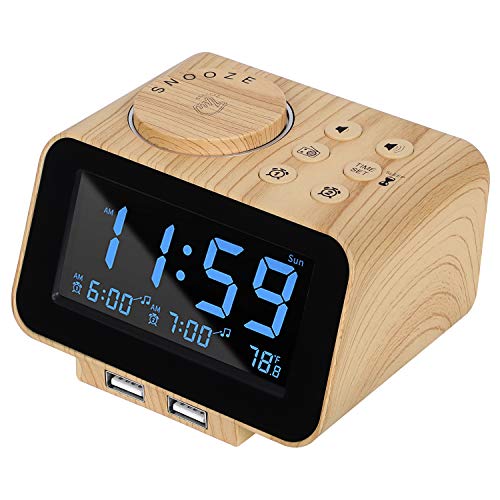
uscce Digital Dual Alarm Clock Radio — Best Weekday/Weekend Programming
Shift patterns, school runs and weekend lie-ins make many couples’ weeks irregular, and the uscce is built for that complexity. Each alarm can follow weekday or weekend logic, the display dims across the full range, and large numbers keep the time legible across the room for the partner on the far side of the bed.
Strengths
- Weekday/weekend modes on dual alarms
- Full-range 0-100% display dimmer
- Large numbers plus 2 USB charging ports
Trade-offs
- Scheduling depth takes one careful setup session
- Radio quality depends on reception and aerial placement
- Large display is overkill for small nightstands
Key details: Dual alarms with weekday/weekend modes; FM radio; 0-100% dimmer; large display; 2 USB charging ports.
The uscce is the planner’s clock. Set it once, properly, on a Sunday afternoon, and it will handle a term-time week of different wake times without nightly fiddling, which is when couples’ alarms usually fail. The full-range dimmer respects the light-sensitive, the big digits respect the short-sighted, and the charging ports respect the shared socket. It asks ten minutes of joint setup in exchange for months of not thinking about the clock, a trade most organised couples will take gladly.
Best for: Couples with complex weekly schedules / Not suited for: Couples wanting the simplest possible controls
Check the current price on Amazon

JBER Sunrise Alarm Clock with 2 Alarms — Best Sunrise Clock for Couples
Sunrise clocks wake by light first and sound second, which changes the couples’ equation: a partner whose alarm is twenty minutes later often sleeps through light that wakes the earlier riser, where a buzzer would wake both. The JBER’s two alarms, sound library and night light make it the kind option for close-but-different schedules and dark winter mornings.
Strengths
- Gradual sunrise light can wake one partner more gently
- Two alarms with a 25-sound library
- Night light and Bluetooth speaker for evening use
Trade-offs
- Light may still wake a very light-sensitive partner
- Less effective for very different wake times hours apart
- Heavier sleepers may need the sound at full commitment
Key details: 2 alarms; sunrise wake light; 25 soothing sounds; white noise machine; night light; Bluetooth speaker.
Be honest about the physics: sunrise waking works beautifully when partners’ times are near each other or when the later sleeper tolerates light well, and it is not magic for a three-hour gap. Within its honest range, the JBER is a genuinely pleasanter morning, especially in winter when both alarms fire in darkness. The white noise side helps the earlier sleeper mask household sounds, and the Bluetooth speaker covers evening audio without another device on the nightstand. Couples who dread the buzzer should start here and keep expectations calibrated.
Best for: Couples with close wake times who hate buzzers / Not suited for: Partners whose wake times are hours apart
Check the current price on Amazon
Comparison Table
| Pick | Badge | Key spec | Best for |
|---|---|---|---|
| Odokee Digital Dual Alarm Clock | Best Overall for Couples | Dual alarm, full-range dimmer | Couples with different weekday times and a light-sensitive partner |
| Emerson SmartSet Dual Alarm Clock Radio | Best Dual Clock Radio | Dual alarm radio, auto time set | Couples who wake to news, talk or music |
| JALL Digital Alarm Clock with FM Radio and Dual Charging | Best for Shared Nightstands | Dual alarm, FM, 2 charging ports | Couples sharing one nightstand and one socket |
| Mesqool Digital Projection Alarm Clock with Dual Alarms | Best Projection Clock | Dual alarm with ceiling projection | Couples who check the time at night but hate glowing displays |
| uscce Digital Dual Alarm Clock Radio | Best Weekday/Weekend Programming | Dual alarm radio, weekday/weekend modes | Couples with complex weekly schedules |
| JBER Sunrise Alarm Clock with 2 Alarms | Best Sunrise Clock for Couples | Sunrise clock, 2 alarms | Couples with close wake times who hate buzzers |
How to Choose the Best Alarm Clocks for Couples
A couples’ clock is a shared appliance, and shared appliances succeed on courtesy features: independence where it matters, darkness where it is wanted, and controls both people can run half-asleep.
Independent alarms, volumes and sounds
Two alarms that share one volume are only half independent. If one partner is a heavy sleeper and the other wakes at a whisper, look for alarms that can differ in sound or loudness, or choose a sunrise clock whose light does the first alarm’s work gently. Test both alarms on the first weekend, at the volumes you actually plan, with the other partner as the judge. A couples’ clock that wakes the wrong person reliably is worse than two separate clocks, and there is no shame in that solution either.
Weekday and weekend modes end the Saturday mistake
The most common couples’ alarm failure is not oversleeping; it is the 6 a.m. Saturday alarm nobody remembered to cancel. Weekday/weekend programming, as on the Odokee and uscce, lets each alarm rest on rest days automatically. If your schedules include shifts or term-time patterns, spend the setup time once and verify the week’s alarms together on Sunday, rather than relying on nightly memory, which is exactly the resource sleep removes.
Display behaviour decides sleep quality
A clock display is a night light whether you want one or not. Full-range dimmers that reach true off, like the Odokee and uscce, suit light-sensitive partners; projection, like the Mesqool, moves the display to the ceiling where a glance is optional; sunrise clocks invert the problem by making light the alarm itself. Decide as a couple, in the dark, with the clock at its real distance from the pillows, because showroom brightness tells you nothing about 3 a.m.
Backup power and shared-nightstand practicalities
A clock that loses its alarms in a brief outage will eventually choose the worst morning to do it, so battery backup that preserves alarms, not just the time display, is worth having. Then consider the nightstand as a system: charging ports, as on the JALL and uscce, can end cable disputes; automatic time setting, as on the Emerson, removes a chore after every cut. None of these features wake anyone up, and all of them decide whether the clock is loved or tolerated.
Light, Sound and the Science of Not Waking Your Partner
Every couples’ alarm is an exercise in selective waking: deliver a stimulus strong enough for one sleeper and weak enough for the other. Sound is a blunt instrument for this, because a bedroom shares its air and a buzzer loud enough for a heavy sleeper will reach the light sleeper at nearly the same volume. Distance helps a little, direction helps a little, and a gentler sound helps the light sleeper fall back to sleep afterwards, but sound alone rarely achieves clean separation when wake times are far apart.
Light behaves differently, which is why sunrise clocks like the JBER in this guide have become the couples’ favourite technology. Brightness ramps gradually, the sleeper nearer the light or more sensitive to it surfaces first, and the partner often sleeps through a dawn that was never aimed at them. The effect is strongest when wake times are within the ramp’s span and weakest across gaps of hours, and honest couples plan around that rather than expecting miracles from a lamp.
Vibration is the third channel, offered by wearable alarms and bed shakers rather than by the bedside clocks in this guide, and it is the most selective of all because it touches one body only. Couples whose schedules differ by hours, shift workers paired with nine-to-fivers, often end with a hybrid: the shared clock for the household’s normal rhythm, and a vibrating wearable for the outlying alarm. There is no failure in that; it is the correct engineering for an extreme case.
The practical conclusion for most couples is layered. Choose the shared clock for its independence, dimming and scheduling, as the Odokee, uscce and Emerson picks demonstrate. If your gap is small, let a sunrise clock try to separate you gently. If your gap is large, add vibration for the early alarm and let the shared clock handle everything else. The goal is not a gadget victory; it is two people waking at their own times without negotiation, which is a small daily kindness worth engineering properly.
One Clock or Two? Designing the Shared Nightstand
Some couples conclude that two separate clocks, one per nightstand, beat any shared model, and for some bedrooms they are right. Two clocks give total independence of sound, volume and display, at the cost of two devices, two sets of controls to learn and a mild arms race of snoozing. The shared dual-alarm clock wins where nightstand space is scarce, where one partner travels and the clock must serve solo, and where a single verified routine is worth more than perfect personalisation.
The shared nightstand is a small system, and the clocks in this guide increasingly acknowledge it. Charging ports, as on the JALL and uscce, remove the second-biggest nightstand dispute after the alarm itself. Automatic time setting, as on the Emerson, removes a recurring chore. Projection, as on the Mesqool, removes the display from the contested surface entirely and puts it on the ceiling, the one piece of bedroom real estate both partners own equally.
Cable discipline is the unglamorous decider. A nightstand with one clock, one cable and two charged phones looks and feels calmer than a nest of adapters, and calm at the day’s edges is the actual product being bought. When you set up your clock, route its cable once, properly, give the charging leads a home, and banish the spare chargers to a drawer. The morning will not thank you explicitly; it will simply stop containing small irritations.
Whichever architecture you choose, rehearse it and then freeze it. The couples who sleep best with technology are the ones whose bedtime routine involves no decisions: alarms already set by the weekly pattern, display already dimmed, phones already charging. A dual-alarm clock’s real feature is not any single specification in this guide. It is the absence of a nightly conversation about the morning, and that absence is worth every penny of the modest sums these clocks command.
Snooze Discipline and the Two-Alarm Household
The snooze button is the most negotiated feature in any couples’ bedroom. One partner’s gentle nine-minute negotiation with the morning is the other partner’s four extra alarms. Dual-alarm clocks do not solve this by themselves, but they contain it: each partner’s snooze belongs to their own alarm, and a household that agrees its snooze rules in daylight, how many, how long, who may snooze on workdays, has removed a daily friction that otherwise gets litigated at the least diplomatic hour of the day.
There is a respectable case for the hard rule: one snooze, then feet on the floor, with the clock placed so that the second silencing requires standing. Couples who adopt it usually report that the snooze they keep becomes a genuine pleasure, a planned luxury rather than a losing battle, and that the partner’s sleep improves out of all proportion to the change. The clock’s part in this is reliability and placement; the willpower, as ever, is supplied by the household.
Weekend snoozing deserves its own treaty. With weekday and weekend modes set, as on the Odokee and uscce picks, Saturday’s alarm can be later, gentler or absent, and its snooze rules can be looser without endangering Monday. Sunrise clocks change the negotiation again, because a snoozed sunrise restarts a light ramp that a partner may experience as a second dawn; couples using the JBER often agree that the first riser’s snooze is limited precisely because light is shared in a way sound is not.
None of this requires taking mornings terribly seriously. It requires taking them once, together, in the setup session this guide recommends, and then letting the pattern run. The couples who fight about alarms are rarely fighting about time; they are fighting about consideration, and a two-alarm clock with agreed rules is consideration, engineered and plugged in beside the bed.
Travel, Guests and Backup Plans: The Clock Beyond the Bedroom
A couples’ alarm system gets tested by its exceptions: the early flight, the guest room, the morning after a power cut. The clocks in this guide handle the ordinary week; a little planning handles the rest. For the critical morning, the flight, the wedding, the interview, the household rule worth adopting is redundancy with variety: the bedside clock set as usual, plus one phone alarm in another room, so that waking requires defeating two systems and the act of reaching the second one involves standing up, which is the point at which mornings are usually won.
Guests expose a different weakness. A spare room with no clock forces visitors onto phones and guesswork, and a simple dual-alarm clock, even an older one retired from the main bedroom, is a small hospitality that hosts consistently underrate. Couples upgrading to any pick in this guide have the perfect candidate for the guest room in the clock being replaced. Set it, leave its instructions in the drawer, and guests stop needing to ask what time breakfast is possible, because they can see for themselves.
Travel splits couples’ routines in ways worth a sentence of planning. When one partner travels, the shared clock’s pattern may wake the remaining partner at the traveller’s hour unless the weekday modes are adjusted, a thirty-second task that is easily forgotten on departure day. Add it to the leaving checklist, beside the bins and the thermostat. On return, restore the pattern in the same spirit, and verify the week’s alarms together on Sunday, as this guide’s setup routine recommends, rather than discovering a stale pattern at 5 a.m. on a workday.
Power cuts are the final exception, and the one the hardware answers directly. Battery backup that preserves alarms, automatic time setting that heals the display, and a household that knows which clocks have which protection turn an outage from a morning risk into a non-event. Check the backup batteries annually, on a date you already remember, and the clocks in this guide will carry your mornings through the grid’s occasional failures as reliably as through its ordinary service.
Alarm Clocks for Couples Who Work Different Shifts
Shift-working couples stress every assumption a normal alarm clock makes. Their week has no single shape, their sleep happens in daylight, and the partner at home becomes part of the alarm system whether they volunteered or not. The clocks that serve them best are the programmers: dual alarms with weekday and weekend logic, like the uscce and Odokee picks here, patiently re-patterned each week when the rota lands, rather than clocks that assume a five-day week and treat Saturday as a rumour.
Daylight sleeping adds the display to the negotiation. A clock face that is charming at midnight is a lantern at noon behind thin curtains, so the full-range dimmers in this guide stop being a preference and become equipment. Blackout curtains do the heavy work, but the clock should not undo it, and models whose displays reach true off respect the day sleeper in a way that merely dim ones do not. The partner at home can help further by placing the clock where its light falls away from the pillows.
The waking direction reverses too: the household’s problem is often not waking the shift worker but protecting their sleep from the other partner’s ordinary morning. Here the sunrise clock’s logic inverts, and sound discipline, a buzzer kept low, a door closed promptly, a kettle filled the night before, becomes the couples’ technology. No product in this guide can manufacture consideration, but the right clock, programmed honestly around the rota and dimmed to darkness, removes every obstacle to it that hardware can remove, and that is a genuine contribution to a hard schedule.
Couples’ Alarm Clock Buying Checklist
- Confirm two truly independent alarms, with separate times and, ideally, sounds or volumes.
- Check for weekday and weekend modes if either partner’s rest days differ from workdays.
- Test the dimmer’s lowest setting; the light-sensitive partner is the judge, in a dark room.
- Decide the waking style as a couple: buzzer, radio, projection or sunrise light.
- Verify battery backup preserves alarms, not only the clock display.
- Count nightstand sockets and phones; charging ports may end a nightly dispute.
- Place the clock within the earlier riser’s reach for silencing without acrobatics.
- Rehearse both alarms on a low-stakes morning before trusting them with a flight or a wedding.
How to Set Up a Two-Alarm Routine That Works
The clock is only half the system; the routine is the other half. Set it up together once, following these steps, and the mornings will run themselves.
- Agree the week’s wake times in daylight. Sit down together, list each partner’s earliest realistic wake time per day, including weekend exceptions, and write them on paper before touching the clock. Most alarm arguments are schedule disagreements wearing a clock costume.
- Assign alarms and sounds deliberately. Give each partner their alarm number and, where the clock allows, their sound and volume. The heavier sleeper’s alarm should not be the one that could wake the house unless it genuinely needs to be.
- Program weekday and weekend modes. Enter the patterns once, then step through the clock’s display day by day to verify what will fire on Saturday and Sunday. Verification takes two minutes and prevents the classic weekend error.
- Set the display for the darker sleeper. Dim the display to the lowest level the other partner can still read, or turn projection and display off as the clock allows. The partner who needs the time can always tap for light; the partner who needs dark cannot untap it.
- Place the clock within reach of the earlier riser. The person whose alarm fires first should be able to silence or snooze it without climbing over anyone. If the nightstand is on the wrong side, move the clock, not the marriage.
- Run a weekend rehearsal. Test both alarms at real volumes on a morning that does not matter. Adjust sound, volume and light behaviour based on who actually woke, then lock the settings and stop nightly fiddling.
A couples’ alarm routine succeeds when it becomes invisible: no nightly programming, no Saturday surprises, no phone alarms as backup because the clock is trusted. Revisit it when schedules change, not when it fails.
Common Buying Mistakes
Buying a single-alarm clock and sharing it. Snooze is not a second alarm. The earlier partner becomes a human relay, resentment accrues interest, and the fix costs exactly one dual-alarm clock, bought a month later at a worse moment.
Ignoring display brightness until bedtime. A display that seems modest in a lit room can light a pillow at 3 a.m. Check the dimmer’s lowest setting, ideally off, before you commit, especially if either partner is light-sensitive.
Forgetting the weekend pattern. Programming five perfect weekdays and leaving Saturday armed is the category’s signature own goal. Weekday/weekend modes exist precisely for this; use them and verify them.
Letting one partner own all the settings. If only one person understands the clock, the other cannot fix a mistake at 6 a.m. Set it up together, rehearse it together, and keep the manual in the nightstand drawer, not the recycling.
Using phones as the real alarms anyway. A clock that is not trusted becomes furniture while two phones buzz inconsistently. Commit to the shared clock for a fortnight, rehearse it, and let the phones charge in another room if you can.
Final Recommendation
For most couples the Odokee is the right shared clock: honest dual alarms, weekday and weekend modes and a display that can disappear. Radio households should take the Emerson SmartSet, shared-nightstand households the charging-friendly JALL, and schedule-heavy couples the uscce. Night-time time-checkers will love the Mesqool’s ceiling projection, and buzzer-haters with close wake times should choose the JBER sunrise. Set it up together, rehearse it once, and let the clock carry the mornings from there.
Odokee Digital Dual Alarm Clock · Emerson SmartSet Dual Alarm Clock Radio · JALL Digital Alarm Clock with FM Radio and Dual Charging
Best Alarm Clocks Best Alarm Clocks For Heavy Sleepers Best Sunrise Alarm Clocks Best Digital Clocks Best Clocks For Bedrooms Best Night Lights
Frequently Asked Questions
What makes an alarm clock good for couples?
Two genuinely independent alarms are the foundation, ideally with weekday and weekend modes and, where possible, different sounds or volumes for each partner. After that come courtesy features: a display that dims to darkness for light-sensitive sleepers, controls both partners can operate half-asleep, and battery backup so the alarms survive an outage. A clock with those traits stops being a compromise and starts being a shared appliance.
Can one alarm wake one partner without waking the other?
Sometimes, and sunrise clocks are the best tool for it, because gradually brightening light often wakes the intended sleeper while a partner dozes on, especially when wake times are close. Sound is less discriminating, though a quieter, nearer alarm helps. For gaps of hours, no clock is magic; the honest solutions are a vibrating wearable alarm or simply accepting that the earlier riser leaves the room promptly.
Are dual alarm clock radios better than digital clocks?
They serve different mornings. Radio models like the Emerson and uscce suit couples who wake happily to news or music and value presets and sleep timers. Plain digital dual clocks like the Odokee are simpler, often dim darker, and never depend on reception. Choose by how you like to wake, and check that the radio model still offers a buzzer option for mornings when the programme matters less than the deadline.
Do we need weekday and weekend modes?
If either partner’s weekend wake time differs from weekdays, yes, you will eventually want them. Without modes, someone must remember to disable and re-enable alarms every Friday and Sunday night, and memory fails exactly when people are tired. With modes, the pattern is set once and verified occasionally. Shift workers benefit even more, because their week rarely matches the calendar’s shape.
How bright should the display be at night?
As dim as the partner who reads it can manage, and no brighter. Full-range dimmers that reach off are ideal for light-sensitive sleepers, and projection clocks move the reading surface to the ceiling. Judge brightness in your actual dark bedroom at pillow distance, not in a shop. If one partner needs total darkness and the other needs the time, projection at low brightness or a tap-to-show display is the usual peace treaty.
What happens to the alarms in a power cut?
Models with battery backup preserve the time and, on better designs, the alarms themselves, so the morning survives a brief outage. Automatic time-setting models like the Emerson also correct themselves when power returns. Check what the backup actually covers on the model you choose, because some clocks keep only the clock ticking and quietly drop the alarms, which is the worst of both worlds.
Should each partner just use a phone alarm instead?
Phones work, but they bring the phone into the bedroom’s last and first minutes, with notifications attached, and two phones mean two unsynchronised routines. A shared dual-alarm clock centralises the household’s mornings, keeps one verified pattern, and lets phones charge elsewhere. Many couples keep a phone alarm as a backup for critical mornings only, which is a sensible belt to add to the clock’s braces rather than a reason to skip the clock.
What if one partner works night shifts?
Shift patterns are where weekday and weekend programming earns its keep, and where expectations need care: a clock can hold complex patterns, but a day-sleeping partner also needs the household’s cooperation on light and noise beyond any alarm. Set the shift pattern together weekly, use the dimmest display settings for the day sleeper’s room, and consider a vibrating wearable for alarms that must fire while the other partner is in deep daytime sleep.
Can a dual alarm clock replace two phone alarms completely?
For the ordinary week, yes, and that is the point of the category: one verified pattern, set up together, handling both partners’ mornings without either phone entering the bedroom’s first minutes. The exceptions are critical mornings, a flight, an interview, a wedding, where a backup phone alarm in another room is cheap insurance rather than a failure of trust. Couples who run the clock as the system and the phone as the rare backup get the calm of the first arrangement and the safety of the second, which is the correct engineering for something as unforgiving as a departure time.
How do we stop one partner’s snooze waking the other?
Contain it by design and by treaty. By design: give the snoozer the alarm with the gentler sound or the sunrise ramp, place the clock on the snoozer’s side so silencing is instant, and keep volumes at the minimum that works rather than the maximum available. By treaty: agree a snooze allowance, commonly one, in daylight, and treat it as a household rule rather than a nightly negotiation. If snoozing remains a genuine conflict after that, a vibrating wearable for the snooze-prone partner removes their alarm from the shared air entirely, and peace returns to the bedroom.


