Disclosure: airfryerkitchensupply.com is reader-supported. When you buy through links on our site, we may earn an affiliate commission at no extra cost to you.
Where to buy
The fastest way to buy any pick in this guide to the best alarm clocks to wake heavy sleepers is through Amazon, where each verified listing shows its current availability and delivery options. Start with our top pick, the Sonic Alert Sonic Bomb Dual Alarm Clock with Bed Shaker (Check on Amazon — check price on Amazon), and compare it against the other five below before you commit. Prices change, so we never print a fixed figure here; the listing itself is the only number worth trusting on the day you order.
Introduction
The best alarm clocks to wake heavy sleepers are built on an admission most alarm clocks avoid: sound alone is a failing strategy for a significant minority of humans. If you can sleep through a phone alarm, a partner’s alarm and, on one legendary occasion, a fire drill, your problem is not volume shopping — it is that your sleeping brain has learned to classify beeping as background. Heavy-sleeper alarms attack the problem on three different channels: extreme loudness that cannot be classified as anything, physical vibration from a bed shaker that bypasses hearing entirely, and light that exploits the circadian system’s oldest wiring. The right pick depends on which channel your brain cannot ignore.
Know your category honestly before you buy. The bed-shaker alarms — the Sonic Bomb is the genre’s founding device — are for the genuinely deep sleeper, the hearing-impaired, and anyone whose job starts before dawn with consequences. Sunrise alarms are for the heavy sleeper whose problem is a dark winter morning and a circadian system that needs light permission to wake; they are gentler technology for a different failure mode. Hybrid devices try to cover both. Every pick below was verified against Amazon’s catalogue data before linking, and we are blunt per pick about who each one will and will not wake.
One social note before the list: the loudest alarms in this guide will wake everyone in a flat, a partner, and possibly the neighbours’ opinion of you. The bed shaker exists precisely to solve that — vibration wakes the sleeper in the bed and lets the rest of the household sleep. Choose with your living situation in mind, not just your sleep depth.
In this guide
Quick Picks
- Sonic Alert Sonic Bomb Dual Alarm Clock with Bed Shaker — Best Overall for Heavy Sleepers: The founding bed-shaker: an extremely loud dual alarm plus a vibrating puck that goes under the mattress. (Check on Amazon — check price on Amazon)
- ANJANK Extra Loud Alarm Clock with Wireless Bed Shaker — Best Wireless Shaker: A wireless bed shaker — no cord across the bed — plus loud dual alarms and a dimmable light. (Check on Amazon — check price on Amazon)
- uscce Loud Dual Alarm Clock with Bed Shaker — Best Value Shaker: Adjustable shaker strength, dual alarms and easy setting at a value tier — the sensible shaker buy. (Check on Amazon — check price on Amazon)
- JALL Sunrise Alarm Clock — Best Sunrise for Heavy Sleepers: A gradual sunrise simulation with dual alarms and a deep sound library — light as the wake channel. (Check on Amazon — check price on Amazon)
- Philips SmartSleep Wake-Up Light — Best Premium Sunrise: The reference sunrise clock: refined light gradients, sunset wind-down and a premium build. (Check on Amazon — check price on Amazon)
- Hatch Restore 3 — Best Sleep Routine System: A sunrise alarm inside a full screen-free sleep routine: sounds, light and structure for both ends of the night. (Check on Amazon — check price on Amazon)
How These Picks Were Chosen
We verified each clock on this site’s own Amazon connection — several models come from the site’s verified clock cache with titles matched per model — before taking any ASIN. Alarm listings bundle shakers, lights and radios in confusing combinations, so we matched the exact feature set named in each Amazon title.
Judging criteria were wake-up mechanics. Channel first: sound ceiling, vibration, light, or a combination, and whether the channels can run together. Second, the snooze question — a heavy sleeper’s worst enemy is a big, easy snooze button, so we note how each clock handles the half-awake negotiation. Third, reliability: battery backup for power cuts, because the morning after a blackout is the classic missed shift. Fourth, household diplomacy: can this clock wake one person without declaring war on the rest of the home?
The 6 Best Alarm Clocks to Wake Heavy Sleepers

Sonic Alert Sonic Bomb Dual Alarm Clock with Bed Shaker — Best Overall for Heavy Sleepers
The Sonic Bomb is not a clock you buy speculatively; it is the clock you buy after the third warning from work. Its bed shaker slides between mattress and base and vibrates the bed itself, while the audible alarm operates at a volume that ends arguments, and the two can run together or — crucially for shared homes — the shaker can run alone. Dual alarms cover shift patterns and weekday/weekend splits. It suits deep sleepers, hearing-impaired users and pre-dawn professionals. It does not suit the merely groggy, who will find it an act of violence, or studio flats where the loud mode would wake the building.
Strengths
- Bed shaker wakes by touch — the channel deep sleepers cannot sleep through
- Shaker-only mode wakes one sleeper without sounding the whole home
- Dual alarms and battery backup cover shifts and power cuts
Trade-offs
- Maximum volume is genuinely antisocial — use it with household consent
- Display and styling are industrial, not bedside-table pretty
- The shaker’s cord must be routed safely away from the bed’s moving parts
Key specs: Dual alarms; extra-loud audible alarm; bed shaker puck; battery backup
There is a reason this design has barely changed in years: it solves the actual problem. Audible alarms ask the sleeping brain to care about a sound; the shaker removes the negotiation by moving the bed. Users who have slept through everything report the same conversion — the first morning is startling, the second is merely effective, and by the second week the anxiety of oversleeping, which itself ruins sleep, is gone. Set the shaker-only mode if you share the home, keep the audible channel for the mornings that absolutely cannot fail, and place the clock across the room so dismissing it requires standing up. That combination — vibration, placement, and a backup alarm — is the most reliable wake-up system in this guide.
Best for: The genuinely deep sleeper who has defeated ordinary alarms / Not suited for: Light sleepers, or anyone whose partner must not be disturbed by sound alone — run shaker-only
Check on Amazon — check the current price on Amazon.

ANJANK Extra Loud Alarm Clock with Wireless Bed Shaker — Best Wireless Shaker
The ANJANK answers the Sonic Bomb’s one dated feature: the shaker is wireless, so nothing trails across the bed or tangles in the frame. It adds a wake-up light element and a night light with a full dimmer, dual alarms and a choice of sounds, making it the most complete modern package in this guide. It suits couples — shaker under your side, light low — and heavy sleepers in tidy bedrooms. The wireless shaker needs charging discipline, which is the honest trade: a corded shaker never needs charging and a wireless one occasionally does, so light sleepers about charging should take the Sonic Bomb.
Strengths
- Wireless shaker removes the cord problem entirely
- Sound, vibration and light channels in one device
- Full-range dimmer keeps the clock face sleep-friendly at night
Trade-offs
- Wireless shaker must be kept charged — a routine to maintain
- Feature-rich setup takes longer than a basic clock
- Light output is a wake aid, not a full sunrise simulation
Key specs: Wireless bed shaker; dual alarms; 8 sounds; full-range dimmer; USB charging port
Modernising the bed-shaker formula turns out to matter more than expected. The cord on a classic shaker is a small nightly friction — it migrates, it catches, it reminds you the system is medical-adjacent. Removing it makes the whole arrangement feel like a normal bedroom again, while the vibration does the same ruthless work. The layered channels let you build a graduated alarm: light first, sound rising, shaker as the guarantee. For shared beds, place the shaker under your pillow side or mattress edge so the vibration is yours. Keep a charging rhythm — Sunday night, with the week’s alarms checked — and this is the most civilised heavy-duty wake-up in the guide.
Best for: Heavy sleepers who hate cords and share a bed or a room / Not suited for: Buyers wanting the simplest possible clock with zero setup
Check on Amazon — check the current price on Amazon.
uscce Loud Dual Alarm Clock with Bed Shaker — Best Value Shaker
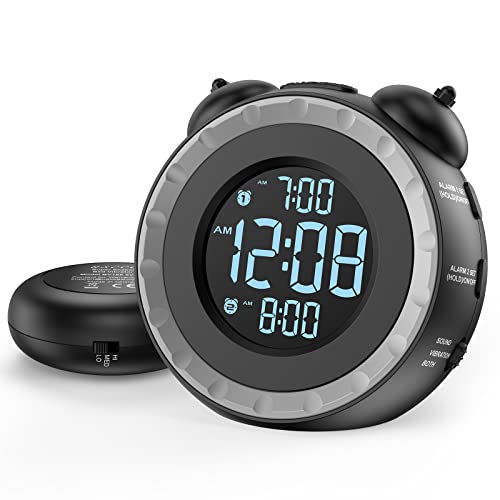
The uscce is the shaker clock for buyers who want the mechanism without the flagship tier or the feature festival. Its shaker strength adjusts — startling how much difference that makes, because a first-time user wants authority while a smaller-framed sleeper may want less — and the controls are designed to be set without a manual and a magnifying glass. Dual alarms and battery backup cover the reliability bases. It suits students in shared houses, hearing-impaired users, and anyone graduating from phone alarms. It will not suit buyers wanting sunrise light or a wireless puck; those features live in the picks above and below.
Strengths
- Adjustable vibration lets you tune the shaker to your sleep depth
- Easy-set controls respect the reality of tired people at midnight
- Battery backup and dual alarms cover the reliability essentials
Trade-offs
- Corded shaker, with the usual routing considerations
- No light-based waking channel
- Display styling is functional rather than decorative
Key specs: Adjustable bed shaker; dual alarms; full-range dimmer; battery backup; easy-set controls
Value picks in this category usually cut the wrong things — weaker shakers, toy controls. The uscce cuts the decoration instead and keeps the wake-up hardware serious: an adjustable puck, a loud dual alarm, a proper dimmer and backup power. The adjustability deserves emphasis because it changes who the product serves: the same clock can be a gentle-but-firm nudge for a teenager and a full authority wake for a deep-sleeping adult, set by a dial rather than by buying twice. If you are shaker-curious and want to find out whether vibration is your channel without flagship money, this is the experiment to run.
Best for: First-time shaker buyers and hearing-impaired users on a budget / Not suited for: Anyone wanting wireless or sunrise features
Check on Amazon — check the current price on Amazon.

JALL Sunrise Alarm Clock — Best Sunrise for Heavy Sleepers
Some heavy sleepers are not deaf to alarms; they are defeated by darkness. In winter, waking at six in a black room asks the brain to override every circadian signal it trusts, and the result is the snooze spiral. The JALL attacks that failure mode: light builds gradually before the alarm time, the brain surfaces through lighter sleep, and the sound — chosen from a large library, or the radio — lands on a mind already half awake. Dual alarms handle two schedules. It suits dark-room and winter-morning strugglers. It does not suit the truly sound-proof sleeper, who needs a shaker; know which problem you have.
Strengths
- Gradual sunrise moves waking upstream into lighter sleep
- Huge sound library plus radio lets you find a sound you cannot habituate to
- Dual alarms and night light make it a complete bedside device
Trade-offs
- No vibration channel — the deepest sleepers will still sleep through
- Light waking fails if you sleep facing away or under an eye mask
- Costs and complexity exceed a basic loud clock
Key specs: Sunrise simulation; dual alarms; 25 sounds; FM radio; Bluetooth speaker; night light
Sunrise clocks are frequently oversold as gentle luxury; for the right sleeper they are actually the more scientific tool. Sleep depth cycles through the night, and an alarm that fires into deep sleep produces the groggy, hostile inertia heavy sleepers know too well. Light that arrives twenty to thirty minutes early shifts the odds — you surface gradually and the alarm lands in light sleep, which feels less like an attack and more like a decision. The JALL’s depth of sounds matters for the same reason: rotate the alarm tone monthly and habituation never sets in. Pair it with blackout discipline in reverse — let the clock be the only light source that matters at wake time — and winter mornings change character.
Best for: Heavy sleepers whose enemy is the dark morning, not noise tolerance / Not suited for: Sleepers who need vibration — this has none
Check on Amazon — check the current price on Amazon.
Philips SmartSleep Wake-Up Light — Best Premium Sunrise
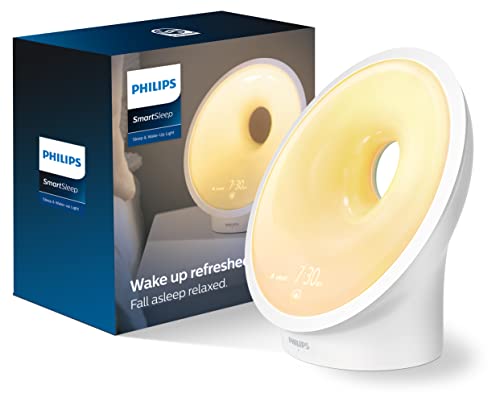
Philips essentially created the wake-up light category, and the SmartSleep is its mature form: a sunrise that builds through natural colour shifts rather than a lamp snapping brighter, a sunset programme with guided breathing to help the other end of the day, and brightness levels fine-grained enough to tune to your room. It suits heavy sleepers of the circadian kind who want the best-executed version of light waking and will pay a premium tier for polish. It is not a shaker and not a foghorn — the deepest sleepers should pair its light with a vibrating pick, or choose vibration outright.
Strengths
- Most natural, gradual light simulation in this guide
- Sunset wind-down programme improves the whole sleep routine, not just the wake
- Premium build and controls feel like a medical-adjacent device, in a good way
Trade-offs
- Premium tier — the most expensive approach to waking here
- No vibration channel for the truly sound-proof sleeper
- Light-based waking depends on your sleep position and room darkness
Key specs: Simulated sunrise and sunset; multiple light and sound options; guided wind-down; adjustable brightness
The difference between the SmartSleep and cheaper sunrise clocks is gradient quality: the light’s colour temperature travels from deep red through warm orange to bright white, mimicking an actual dawn closely enough that the half-asleep brain accepts the story. Owners consistently describe the same effect — waking a minute or two before the sound, unhurried — which is the entire circadian thesis working as designed. The wind-down side is not filler; a heavy sleeper who falls asleep faster and more regularly wakes more predictably, and the guided light-breathing routine is a genuinely effective off-ramp for wired minds. As a system for sleep, not just an alarm, it justifies its tier.
Best for: Buyers wanting the most polished light-waking experience / Not suited for: Anyone needing vibration or extreme volume
Check on Amazon — check the current price on Amazon.

Hatch Restore 3 — Best Sleep Routine System
The Restore 3 reframes the problem: many heavy sleepers wake badly because they sleep badly — late, irregular, screen-lit. Hatch’s device builds a routine: a wind-down of light and sound at a set hour, a night of masking audio if wanted, and a sunrise wake at the other end, all controlled from the device itself so the phone can live in another room. It suits the sleeper whose mornings are chaos downstream of chaotic nights. It is not for the buyer who wants a dumb clock — the ecosystem runs through an app and a content library — nor for the vibration-needing deep sleeper, for whom the shakers above remain the answer.
Strengths
- Attacks the cause: routine and wind-down, not just the wake moment
- Screen-free bedside operation keeps phones out of the bedroom
- Large sound library covers masking, wind-down and waking
Trade-offs
- Full value depends on the app and content ecosystem
- No vibration and no extreme-volume channel
- Premium tier, positioned as a sleep system rather than a clock
Key specs: Sunrise alarm light; 80+ sleep sounds via app; circadian lighting; screen-free bedside controls
Judge the Restore 3 as a sleep intervention that includes an alarm, and its design coheres: the sunrise is one scene in a day-long lighting and audio structure that regularises the very schedule heavy sleepers lack. The screen-free controls are the detail that matters most — every function you need at the bedside is a tap on the device, so the phone, with its midnight scroll gravity, can charge in the kitchen. For the sleeper whose alarm problem is actually a 1 a.m. problem, this is the only pick in the guide aimed at the real target. Everyone else should buy the simpler tool for their channel and spend the difference on blackout curtains.
Best for: Heavy sleepers whose real problem is an irregular sleep routine / Not suited for: Anyone wanting a standalone clock with no app or subscription ecosystem
Check on Amazon — check the current price on Amazon.
Comparison Table
| Pick | Badge | Key spec | Best for |
|---|---|---|---|
| Sonic Alert Sonic Bomb Dual Alarm Clock with Bed Shaker | Best Overall for Heavy Sleepers | Dual alarms; extra-loud audible alarm; bed shaker puck; battery backup | The genuinely deep sleeper who has defeated ordinary alarms |
| ANJANK Extra Loud Alarm Clock with Wireless Bed Shaker | Best Wireless Shaker | Wireless bed shaker; dual alarms; 8 sounds; full-range dimmer; USB charging port | Heavy sleepers who hate cords and share a bed or a room |
| uscce Loud Dual Alarm Clock with Bed Shaker | Best Value Shaker | Adjustable bed shaker; dual alarms; full-range dimmer; battery backup; easy-set controls | First-time shaker buyers and hearing-impaired users on a budget |
| JALL Sunrise Alarm Clock | Best Sunrise for Heavy Sleepers | Sunrise simulation; dual alarms; 25 sounds; FM radio; Bluetooth speaker; night light | Heavy sleepers whose enemy is the dark morning, not noise tolerance |
| Philips SmartSleep Wake-Up Light | Best Premium Sunrise | Simulated sunrise and sunset; multiple light and sound options; guided wind-down; adjustable brightness | Buyers wanting the most polished light-waking experience |
| Hatch Restore 3 | Best Sleep Routine System | Sunrise alarm light; 80+ sleep sounds via app; circadian lighting; screen-free bedside controls | Heavy sleepers whose real problem is an irregular sleep routine |
Alarm Sounds, Light and Vibration: Tuning Your Channel
Each wake channel has a tuning craft the manuals underplay. Sound works best when it is unlike anything else in your environment — a tone your brain has no filing category for — and when it rotates monthly so habituation never completes. Radio alarms fail heavy sleepers precisely because voices and music are the sounds human brains are best at incorporating into dreams. Light works best in a room that is genuinely dark otherwise: blackout curtains are not the enemy of a sunrise clock but its stage, because a dawn simulation competing with a streetlamp-lit room loses its contrast and its story. Set the simulation to begin twenty to thirty minutes before your target, longer in winter, and face the clock toward the bed rather than the wall.
Vibration tunes by placement and contact. A shaker puck delivers its message through the mattress structure, so its position relative to your body’s sleeping place matters more than its raw power: under the pillow zone for a focused wake, centre-mattress for a whole-bed event, always on your side when a partner’s sleep is to be protected. Test placements on weekends and mark the winner — literally, with tape on the bed base if the puck migrates — because a shaker that has wandered to the bed’s centre by Friday is waking the wrong person or no one. Tuned this way, each channel performs at its ceiling, and the combination of two tuned channels is as close to a guarantee as waking technology gets.
The Partner Problem and Other Household Diplomacy
More heavy-sleeper alarms are defeated by household politics than by sleep depth. A partner who is woken at 5 a.m. by an alarm that is not theirs will, consciously or not, begin disabling the system — snoozing it on your behalf, unplugging it during a clean, negotiating it down. The diplomacy features in this guide exist to prevent that slow sabotage: shaker-only modes that make no sound at all, your-side shaker placement, sunrise light that disturbs a partner far less than a siren, and dual alarms that keep a couple’s different schedules from becoming one shared punishment. Choose your clock as a household purchase, demonstrate the quiet mode before the loud one is ever needed, and the system will still be armed in a year.
Shift-work households deserve the same thinking in reverse: the day-sleeping worker needs the household to protect their sleep as the alarm protects their waking — door signs, agreed quiet hours, and a wake system, like a shaker under the pillow, that does not announce itself to the whole home at three in the afternoon. Waking technology is household infrastructure, and like all infrastructure it works when everyone it touches has been considered in the design. The clocks in this guide were ranked with that household view, not just the sleeper’s, which is why the civilised options score so highly here.
Travel, Hospitals and Other Beds: Portability of a Wake System
A wake system tuned to your own bed faces its test in other beds: hotels before early flights, a partner’s flat, a hospital-adjacent stay before a morning procedure, the spare room at family holidays where your failure to appear at breakfast will be noted. The shaker channel travels better than people expect — the puck works under any mattress, and several of this guide’s users keep the value uscce as a dedicated travel unit for exactly this reason — while sunrise light travels worst, depending as it does on the room’s darkness and the clock’s bulk. The phone, whatever its failures at home, should be set as a backstop layer when travelling, because redundancy abroad matters more than elegance.
The deeper point is that heavy sleepers with critical mornings should treat waking as a portable discipline rather than a bedside appliance: primary channel, backstop, tested placement, and a household — or hotel — that knows the plan. Build that discipline once and it follows you to any bed on earth. Leave it behind as a property of one clock in one room, and every trip reopens the oldest anxiety in a heavy sleeper’s life, in a strange bed, the night before the morning that matters most.
Daylight, Naps and the Heavy Sleeper’s Whole Day
Waking well is partly decided the day before, and the heavy sleeper’s day has three leverage points worth more than any alarm feature. Morning light — real daylight within an hour of waking, or the sunrise clock’s simulation as its understudy — sets the clock that will make the next morning’s waking shallower and easier; this is why the light picks in this guide compound in value over weeks. Daytime naps are the second lever: a nap longer than half an hour or later than mid-afternoon borrows deep sleep from the night and returns it as morning inertia, so heavy sleepers should nap short and early or not at all. The third lever is the wind-down the Hatch systemises: a fixed last hour of dimming light and no new inputs, which moves sleep onset earlier and steadies the cycle the alarm must land in.
None of this replaces the alarm — it loads the dice in the alarm’s favour. The sleeper who combines a tuned wake channel with morning light, disciplined naps and a regular wind-down typically reports the same surprise within a month: the alarm that once started a war now arrives as a formality, because the body had already begun waking itself. That is the actual destination. The clocks in this guide are the bridge to it, and the best of them — the routine-building Hatch, the circadian sunrise models — are explicitly designed to walk you there.
Waking Children, Teenagers and Other People’s Sleepers
The heavy sleeper in a household is often not the buyer — it is the teenager who cannot surface for school, the student whose lectures start at nine in another city, the partner whose shifts rotate. Buying an alarm for someone else changes the calculus: the device must be acceptable to the sleeper, not just effective on them, or it will be unplugged within the week. For teenagers, the sunrise channel usually wins consent — it feels like an upgrade rather than an accusation — backed by clock placement they agree to in a calm moment rather than a morning argument. For students in shared housing, the shaker is the diplomatic masterpiece: it wakes one bed in a room of four without declaring war on the other three, which is why so many of them travel to university in September. Match the channel to the sleeper’s dignity as well as their depth, involve them in the choice, and the system you install will still be running at exam season — the only deadline that ultimately matters.
A Note on Weekend Lie-Ins and Alarm-Free Mornings
A guide for heavy sleepers should defend the lie-in, because a wake system trusted completely earns its owner the opposite luxury: the deliberate morning off. The sleeper who knows the shaker will fire on Monday can sleep without a backstop anxiety on Sunday, and many heavy sleepers report that their weekend sleep deepens once the weekday system becomes boring and reliable. Protect that bargain by keeping the two mornings ritually distinct — the alarm clock stays dark and unarmed on the rest day rather than firing out of habit, and the body’s one unstructured wake per week is allowed to happen at its own hour, in its own light. Recovery sleep is not the enemy of the routine; it is part of the routine’s design, the pressure valve that keeps the disciplined mornings sustainable across years of shifts, semesters and school runs. Buy the strongest alarm you need for the mornings that matter, and let it buy you, in return, the mornings that do not.
How to Choose an Alarm Clock as a Heavy Sleeper
Diagnose your failure mode before you shop, because the three wake channels solve three different problems. If alarms play in your dreams and get incorporated — the classic sign — your brain is filtering sound, and vibration is your channel: go straight to the shaker picks. If you wake in winter feeling drugged and hostile but summer mornings are survivable, your problem is circadian and light is your channel: sunrise picks. If you wake at a different depth every day because your bedtime wanders by three hours, your problem is routine, and the Hatch or a stricter schedule is the honest fix. Buying the wrong channel at a higher price still leaves you asleep.
Then engineer the snooze out of your life. The snooze button is a negotiation your half-awake self always wins, so choose clocks whose dismissal requires thought or movement, and place any clock across the room so standing is part of switching it off. Dual alarms are not for snoozing — set the second alarm as a genuine backstop ten minutes later, at a different sound or with the shaker armed, and treat the first as the wake. Battery backup is non-negotiable if your income depends on a start time; the one morning the power fails is the morning that matters.
Finally, run the household diplomacy. A maximum-volume alarm in a shared home is a tax on everyone you live with, and it breeds the resentment that gets alarms unplugged. Shaker-only modes, shakers placed on your side of the bed, and light channels all wake one person selectively. The best heavy-sleeper alarm is the one still plugged in and armed in six months, which means it has to be livable for the whole household, not just effective for you.
Why You Sleep Through Alarms, and What Actually Helps
Sleep runs in cycles of roughly ninety minutes, moving between light and deep stages. An alarm that lands in deep sleep produces sleep inertia — the drugged, disoriented state in which you can hold a conversation with your alarm clock and remember nothing. An alarm in light sleep produces a normal wake. You cannot schedule cycles precisely, but you can shift the odds: a consistent sleep and wake time entrains the cycles so the alarm lands predictably, and a sunrise simulation surfacing you gradually makes the landing softer whenever it comes.
Habituation is the second enemy: the brain learns any repeated sound and files it as safe. This is why a new alarm works for a fortnight and then fails. Counter it by rotating alarm sounds monthly, by choosing sounds unlike anything in your environment, and — decisively — by changing channel. Vibration is so effective for sound-habituated sleepers precisely because it arrives through a sense the sleeping brain has not learned to ignore. Light works on the circadian system directly. Sound, for the truly heavy sleeper, is the supporting act, not the headline.
Building a Wake-Up System That Survives Real Life
No single device survives every failure: power cuts, a shaker left uncharged, a clock unplugged by a helpful cleaner, the night you sleep at a friend’s. Heavy sleepers with hard start times should build redundancy deliberately — a primary channel, a backstop alarm set later on a second device, and battery backup where it matters. The cost of the second layer is trivial; the cost of the missed flight, shift or exam is not.
Protect the system socially and physically. Tell the household what the alarms are and when they fire, route shaker cords where they cannot be kicked loose, charge wireless shakers on a fixed weekly rhythm, and test the whole arrangement on a weekend before trusting it on the morning of something important. A wake-up system is infrastructure; treat its commissioning with the same seriousness as its purchase.
How to Set Up a Bed Shaker Alarm for Maximum Effect
- Place the shaker correctly: Slide the puck between the mattress and the base or under your pillow, on your side of the bed. Centre-bed placement wakes partners; your-side placement is diplomacy and effectiveness in one.
- Route the cord safely: On corded models, run the cord along the bed frame away from feet, wheels and reclining mechanisms, with no tension at either end.
- Set the primary alarm: Set your true wake time with the shaker armed and the sound at a level you would choose for a normal morning.
- Set the backstop: Set the second alarm ten minutes later with every channel armed — sound at full if the morning is critical.
- Position the clock across the room: Dismissing the alarm should require standing and walking. A clock within arm’s reach is a snooze negotiation waiting to happen.
- Test on a weekend: Run the full system on a low-stakes morning and adjust shaker position and strength before trusting it on a workday.
- Maintain the rhythm: Charge wireless shakers weekly on a fixed day, and check battery backup in the clock whenever the clocks change for daylight saving.
A shaker system set up this way becomes boring, which is the goal: the drama of waking leaves your life, replaced by a bed that moves and a person who stands up. Boring mornings are the product being sold.
Common Buying Mistakes
Buying a louder version of the thing that already fails
If you sleep through sound, more sound is a worse purchase, not a better one — it wakes the household and still loses to your brain’s filter. Change the channel to vibration or light instead of escalating volume.
Living on the snooze button
Snoozed sleep is fragmented, shallow and restorative of nothing; nine-minute intervals are engineered to be too short to help and long enough to ruin the morning. Set one alarm for the real time and a backstop, and get up at the first.
Placing the clock within arm’s reach
A half-asleep person can silence a bedside clock without ever forming a memory of doing it. Across the room is the oldest and most effective alarm feature ever devised, and it is free.
Ignoring the household
Maximum-volume alarms in shared homes get resented, then unplugged. Shaker-only modes and your-side placement keep the system armed and the peace kept. An alarm everyone tolerates beats a stronger one someone disables.
Skipping battery backup
Power cuts cluster at night and strike without regard for your shift. A clock without backup fails silently exactly once — on a morning that matters. Treat backup as a requirement, not a feature.
Trusting an untested system on a critical morning
New shaker placement, a first sunrise programme, a wireless puck at half charge — all should debut on a weekend. Commission the system on a low-stakes morning and adjust it there.
Final Recommendation
If sound has stopped working for you, buy the Sonic Bomb and end the argument — or the ANJANK if you want the same guarantee without the cord and with a light assist. First-time shaker buyers on a budget should take the uscce and tune its adjustable puck to their sleep. If your enemy is the dark morning rather than noise, the JALL is the value sunrise and the Philips SmartSleep is the premium one, and if your mornings are chaos because your nights are, the Hatch Restore 3 is the pick aimed at the actual cause. Whichever channel you choose, place the clock across the room, arm a backstop, and test it all on a Sunday.
For the room the alarm lives in, our sleep coverage continues with Best Air Purifiers For Baby Room for the smallest sleepers and our bedding guides for everyone else trying to sleep as deeply as you do — on purpose, and only until the alarm.
- Sonic Alert Sonic Bomb Dual Alarm Clock with Bed Shaker — Best Overall for Heavy Sleepers: Check on Amazon
- ANJANK Extra Loud Alarm Clock with Wireless Bed Shaker — Best Wireless Shaker: Check on Amazon
- uscce Loud Dual Alarm Clock with Bed Shaker — Best Value Shaker: Check on Amazon
- JALL Sunrise Alarm Clock — Best Sunrise for Heavy Sleepers: Check on Amazon
- Philips SmartSleep Wake-Up Light — Best Premium Sunrise: Check on Amazon
- Hatch Restore 3 — Best Sleep Routine System: Check on Amazon
Best Air Purifiers For Baby Room Best Alarm Clocks Best Sunrise Alarm Clocks Best White Noise Machines Best Crib Toddler Sheet Sets
Frequently Asked Questions
Do bed shaker alarms really wake heavy sleepers?
For most sound-habituated sleepers, yes — vibration arrives through touch, a channel the sleeping brain has not learned to filter the way it filters repeated alarm sounds. Correct placement matters: between mattress and base or under the pillow, on the sleeper’s own side. Test the setup on a weekend before trusting it for a critical morning.
Will a bed shaker wake my partner?
Much less than a loud alarm will. A shaker placed on your side of the bed concentrates its effect where you sleep, and shaker-only mode makes no sound at all. Shared-bed couples are the classic bed-shaker success story — one person wakes, the other sleeps on.
Are sunrise alarms enough for a really heavy sleeper?
They are enough for the circadian kind of heavy sleeper — the one defeated by dark mornings — because gradual light surfaces you into lighter sleep before the sound starts. They are not enough for the sound-proof sleeper, who needs vibration. Honest self-diagnosis decides: if summer mornings are easy and winter is impossible, light is your channel.
How loud is too loud for an alarm clock?
If an alarm’s maximum volume is waking neighbours or distressing the household, it is the wrong tool — not because volume is impolite, but because systems people hate get disabled. The loudest picks in this guide earn their volume as a backstop channel alongside vibration, which does the real waking at a civilised setting.
Why do I keep sleeping through alarms I set on my phone?
Phones combine every weakness: a familiar sound your brain has habituated to, a snooze button designed to be tapped half-asleep, volume limits, and a bedside position within arm’s reach. A dedicated clock fixes the position and the dismissal problem; a shaker or sunrise clock fixes the channel problem. Most heavy sleepers need at least two of those three fixes.
What is the best alarm setup for shift workers?
Dual alarms for the shift pattern, a shaker as the primary channel because shift sleep is deep daytime sleep, blackout curtains to make the room night-dark, and battery backup because a missed shift start has real consequences. The Sonic Bomb and ANJANK in this guide are both built for exactly this life.

