Disclosure: airfryerkitchensupply.com is reader-supported. When you buy through links on our site, we may earn an affiliate commission at no extra cost to you.
Where to buy
Every pick below was verified against a live Amazon listing feed for this site before it earned a link. We do not print prices — they change too often to stay honest — so use the links to check the current price on Amazon for the model that fits you.
- Zojirushi Vacuum Air Pot, 1 Gallon — check the current price on Amazon
- Tiger Air Pot, 4.0 L (MAA-C401XC) — check the current price on Amazon
- Cresimo Airpot Coffee Carafe, 102 oz — check the current price on Amazon
- Zojirushi Thermal Gravity Pot AY-AE25 — check the current price on Amazon
- Zojirushi Stainless Steel Pot SH-RA19XA, 1.9 L — check the current price on Amazon
- NUPANT Commercial Airpot Coffee Brewer, 2.2 L — check the current price on Amazon
Search for the best airpot coffee makers — one word — and you land in the same world as the two-word version, but with the emphasis shifted: here the pot is the product. An airpot is a vacuum-insulated dispenser with a pump top, filled with brewed coffee and set where people serve themselves. This guide is written from the dispenser’s side of the system: how much insulation you need, how big a pot your crowd justifies, how the pump behaves in a real queue, and which pots earn their place on the serving table year after year.
The honest starting point is that an airpot brews nothing. It is a holding and serving device, and its quality is almost entirely insulation quality plus dispensing ergonomics. That simplicity is its strength — there is nearly nothing to break — and its trap: listings dress up ordinary thermal jugs in airpot vocabulary. Every pick below is a genuine pump dispenser or a brewer built around one, verified product feed attached to this site against a live Amazon listing, so the vocabulary on this page means what it says.
The buyers here are hosts, offices, teams, congregations and small venues who have coffee worth serving and people worth serving it to. If your question is the brewing half — plumbed automatics, pour-over commercials — the sibling guide to air pot coffee makers covers the full systems. This page assumes coffee exists and asks the narrower, more useful question: once brewed, what should it live in?
In this guide
Quick Picks
Six picks, six different right answers. Read the badge first, then the full review of the one that sounds like your kitchen.
- Zojirushi Vacuum Air Pot, 1 Gallon — Best Overall: Benchmark insulation: serving temperature held across a long event. — Check on Amazon
- Tiger Air Pot, 4.0 L (MAA-C401XC) — Best Large Capacity: Largest capacity here — one fill serves the biggest crowds. — Check on Amazon
- Cresimo Airpot Coffee Carafe, 102 oz — Best Value: Three litres of true pump serving at a value tier. — Check on Amazon
- Zojirushi Thermal Gravity Pot AY-AE25 — Best Gravity Dispensing: Gravity feed serves smoothly with no pumping effort. — Check on Amazon
- Zojirushi Stainless Steel Pot SH-RA19XA, 1.9 L — Best Compact: Benchmark-brand insulation in a right-sized 1.9-litre format. — Check on Amazon
- NUPANT Commercial Airpot Coffee Brewer, 2.2 L — Best With Brewer Included: Brews directly into its own airpot — the system in one box. — Check on Amazon
Key Takeaways
- An airpot holds and serves; it does not brew — plan the other half of the system.
- Vacuum insulation is the product: buy the maker’s pedigree, not the photograph.
- Right-size to your weekly crowd; an emptied pot always beats a lingering one.
How These Picks Were Chosen
We shortlisted the true pump airpots and airpot-centred brewers that lead this category on Amazon, then verified each feed. Thermal carafes, pump-free jugs and listings that could not be confirmed were excluded, however they were titled.
Criteria, weighted for the dispenser’s job: (1) insulation by design — vacuum stainless construction from makers with a retention pedigree; (2) capacity matched to real crowds, from a small meeting to a hall; (3) pump ergonomics — presses per cup, mug clearance, and one-handed use in a queue; (4) cleanability — how completely the pot, stem and pump can actually be washed, since flavour failure is this category’s real failure; and (5) versatility where it is genuine, such as rated cold retention for year-round service.
A word about the pots that did not make it, because airpot listings are a vocabulary minefield. Pump-free thermal jugs renamed for the search term, dispensers with no vacuum specification, and listings that could not be verified against a live product were all excluded — the pump, the vacuum and the listing are the three facts this category stands on, and a pick missing any of them is a different product wearing this one’s name. The six that remain divide cleanly by the only questions that matter: how much, how served, how long held, and whether a brewer must come with it.
The 6 Best airpot coffee makers
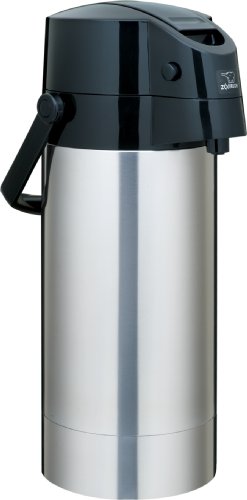
Zojirushi Vacuum Air Pot, 1 Gallon — Best Overall
The Zojirushi gallon airpot is the dispenser this category is judged by, and it earns that position the boring way: vacuum insulation that actually performs, a pump that serves a queue without fuss, and construction that survives years of event duty. Fill it from any brewer and it holds coffee at honest serving temperature for hours — the cup in hour three tasting like the cup in hour one, gently cooler rather than slowly cooked, which is the entire argument for the format.
Strengths
- Benchmark insulation: serving temperature held across a long event
- Gallon capacity covers a crowd from a single fill
- Smooth, queue-friendly pump action
Trade-offs
- Premium tier among dispensers
- Bulky for small gatherings — a gallon is a commitment
- Pump and stem need proper washing, not just rinsing
Key specs: Capacity: 1 gallon / 3.8 litres; Stainless steel vacuum insulation; Pump dispensing; Zojirushi dispenser line
Its ownership duties are the category’s duties: wash the pump and stem properly, because coffee oils accumulate where rinsing does not reach, and store the pot dry and open. Its size is the only real decision — a gallon pot serving six people is freshness working against you, since the last cups have waited longest. For the crowd it is sized for, though, nothing here beats it, and its maker support and longevity make it the buy-once answer. If you run events regularly and can only read one review on this page, this is the pot.
Best for: Regular hosts, offices and venues serving a real crowd / Not suited for: Small gatherings, where a thermal carafe is the right-sized tool — Check on Amazon

Tiger Air Pot, 4.0 L (MAA-C401XC) — Best Large Capacity
Tiger’s 4.0-litre airpot is the maximalist’s dispenser: the biggest capacity on this list, from the other great Japanese insulation house, with the distinction of rated cold retention alongside the hot. That second rating changes the ownership story — the same pot serves coffee through the winter programme and iced tea or cold brew through the summer one, living on the serving table twelve months a year instead of six.
Strengths
- Largest capacity here — one fill serves the biggest crowds
- Cold retention doubles its life: iced tea and cold brew in summer
- Japanese insulation pedigree on par with the benchmark
Trade-offs
- Largest footprint: it wants a permanent serving station
- Premium pricing among the pots
- Still a dispenser — your brewing must come from elsewhere
Key specs: Capacity: 4.0 litres (1.1 gal); Stainless steel tabletop air pot; Rated hot and cold retention; Tiger Eco Tora-Zu line
Choose it over the Zojirushi when your crowds are genuinely at the top of the range, or when the cold-service role is real rather than hypothetical. Choose the Zojirushi when a gallon already covers your biggest day, since the smaller pot cycles fresher coffee for mid-size crowds. Both are decade-class objects with the same care routine — thorough pump washing, dry open storage — and both will out-serve a string of lesser pots. In a category where insulation is destiny, Tiger and Zojirushi are the two names that have earned trust the slow way, and this pot is Tiger’s flagship argument.
Best for: Big crowds and year-round serving stations, hot and cold / Not suited for: Mid-size gatherings that a gallon already covers comfortably — Check on Amazon

Cresimo Airpot Coffee Carafe, 102 oz — Best Value
The Cresimo brings the airpot format down to a price where a family, a small team or a club can simply try it: 102 ounces of insulated stainless serving with a pump top, sized for a meeting, a party or a sideline. Its multi-beverage framing is honest value — coffee in the morning, hot water for tea in the afternoon, cocoa for the evening event — and a pot that works all day, all year, justifies its shelf in a way a coffee-only gadget cannot.
Strengths
- Three litres of true pump serving at a value tier
- Multi-beverage versatility earns year-round use
- The affordable way to test the airpot format properly
Trade-offs
- Pump action and finish are functional rather than refined
- Hold performance is a strong event, not a full day
- Brand ecosystem is thinner than the Japanese benchmarks
Key specs: Capacity: 102 oz / 3 litres; Insulated stainless steel; Pump dispensing; Coffee, tea, hot water and cocoa service
The compromises are tier-typical and manageable. The pump does its job without the silky feel of the benchmarks, and the insulation should be planned as event-length: superb across a gathering, not a promise about tomorrow. Buyers who discover the format is central to their hosting can step up later with full knowledge of what the step buys; many will find the Cresimo simply sufficient. As the entry ticket to plate-free serving, it is the easiest recommendation among the value picks in this whole cluster.
Best for: Families, clubs and small offices entering the airpot format / Not suited for: Daily heavy-duty venues that need benchmark insulation and support — Check on Amazon

Zojirushi Thermal Gravity Pot AY-AE25 — Best Gravity Dispensing
The Gravity Pot is Zojirushi’s other answer to serving: instead of a pump, it dispenses by gravity feed, which makes it the smoothest self-service option here for a fixed station — an office kitchen counter, a café’s condiment bar, a hall’s coffee corner. No pressing, no pump fatigue in a queue, and one less mechanism in the wash. The insulation underneath is the same Zojirushi discipline as the benchmark pump pot, so the coffee’s hours are equally well kept.
Strengths
- Gravity feed serves smoothly with no pumping effort
- Zojirushi insulation pedigree in a station format
- Fewer moving parts than pump pots — less to clean and wear
Trade-offs
- Gravity dispensers suit fixed stations more than carried service
- Check cup clearance against your largest mugs before buying
- Premium dispenser tier, as with the brand’s pump pot
Key specs: Zojirushi Thermal Gravity Pot dispenser; Gravity dispensing — no pump to press; Vacuum insulation; Designed for beverage service stations
The format decision is about place. A pump pot travels: fill it in the kitchen, set it on any table. A gravity dispenser belongs to its station, where its height and feed can be set up once and used without thought. Offices and venues with a permanent coffee corner will find it the most civilised serving on this page; hosts who serve in different rooms should stay with a pump pot. Either way, the cleaning rule holds — the dispensing path needs real washing on schedule, because gravity moves coffee through the same oils a pump does.
Best for: Permanent coffee stations in offices, cafés and halls / Not suited for: Hosts who serve in varying places and need a pot that travels — Check on Amazon

Zojirushi Stainless Steel Pot SH-RA19XA, 1.9 L — Best Compact
Not every serving problem is a crowd. The SH-RA19XA brings Zojirushi’s insulation to a 1.9-litre tabletop format — the size of a team meeting, a family brunch, a workshop morning — where the gallon pots would leave coffee sitting past its best. Right-sizing is a quality feature in this category: a pot filled near its capacity cycles fresh, holds temperature better, and wastes nothing, and this is the compact end of the benchmark line.
Strengths
- Benchmark-brand insulation in a right-sized 1.9-litre format
- Serves a meeting or family brunch without gallon-scale leftovers
- Compact enough for ordinary kitchen storage
Trade-offs
- Confirm the dispensing style suits your setup before buying
- Too small for hall-scale crowds
- Premium brand tier in a compact body
Key specs: Capacity: 1.9 litres; Stainless steel pot; Zojirushi thermal line; Tabletop serving size
Read the listing carefully before buying, because compact thermal pots vary in how they dispense, and your station’s habits — pump queue, pour-at-table — should choose the mechanism, not the marketing photo. What does not vary is the insulation standard the brand is bought for. Against the Cresimo, you trade capacity and value for that standard in a smaller body; against the gallon Zojirushi, you trade crowd coverage for freshness at meeting scale. Small offices that live in the six-to-twelve-cup world will find this the most honest size on the page.
Best for: Small teams and family brunches needing benchmark insulation at meeting scale / Not suited for: Crowd service — step up to the gallon pots — Check on Amazon

NUPANT Commercial Airpot Coffee Brewer, 2.2 L — Best With Brewer Included
Every other pick on this page assumes your coffee gets brewed somehow; the NUPANT is for the buyer who needs that half too. It pairs a compact pour-over commercial brewer with its own 2.2-litre insulated airpot, so a food truck, market stall, small café or modest office can go from a bare counter to brew-and-serve in one purchase, on a standard outlet, with no plumbing and no system assembly.
Strengths
- Brews directly into its own airpot — the system in one box
- Outlet-only setup suits stalls, trucks and small cafés
- Insulated serving from the first day, no extra purchases
Trade-offs
- 74 oz is small-venue scale only
- Brand support network is thinner than the big commercial names
- Extended hold claims should be read as best-case
Key specs: Pour-over brewer plus 2.2 L insulated airpot; 120V, no plumbing; Stainless steel construction; Compact commercial format
Its scale defines its buyer precisely: seventy-four ounces is a small venue’s service, and a hall will empty it in the first break. Within that scale, the logic is impeccable — coffee brewed straight into insulation, served by pump, never plated. The brand caveat from the sibling guide applies unchanged: support ecosystems matter to operators who cannot pause, and BUNN’s is deeper. For the small operator whose alternative is a glass pot on a plate, the NUPANT is not a compromise at all — it is the upgrade, complete in the box.
Best for: Small cafés, trucks, stalls and offices needing brewer and pot together / Not suited for: Larger venues, or operators who need a commercial service network — Check on Amazon
Comparison Table
| Pick | Badge | Key spec | Best for |
|---|---|---|---|
| Zojirushi Vacuum Air Pot, 1 Gallon | Best Overall | Capacity: 1 gallon / 3.8 litres | Regular hosts, offices and venues serving a real crowd |
| Tiger Air Pot, 4.0 L (MAA-C401XC) | Best Large Capacity | Capacity: 4.0 litres (1.1 gal) | Big crowds and year-round serving stations, hot and cold |
| Cresimo Airpot Coffee Carafe, 102 oz | Best Value | Capacity: 102 oz / 3 litres | Families, clubs and small offices entering the airpot format |
| Zojirushi Thermal Gravity Pot AY-AE25 | Best Gravity Dispensing | Zojirushi Thermal Gravity Pot dispenser | Permanent coffee stations in offices, cafés and halls |
| Zojirushi Stainless Steel Pot SH-RA19XA, 1.9 L | Best Compact | Capacity: 1.9 litres | Small teams and family brunches needing benchmark insulation at meeting scale |
| NUPANT Commercial Airpot Coffee Brewer, 2.2 L | Best With Brewer Included | Pour-over brewer plus 2.2 L insulated airpot | Small cafés, trucks, stalls and offices needing brewer and pot together |
How to Choose an Airpot: Capacity, Pump and Insulation
Capacity is a freshness decision disguised as a size decision. An airpot’s coffee is at its best in its first hours, so the right pot is the one your crowd empties within an event: roughly 1.9 to 2.2 litres for a meeting or family brunch, 3 litres for a classroom or team morning, 3.8 to 4 litres for a hall. Oversizing feels safe and tastes stale — the last cups of an oversized pot have waited the longest in the very device bought to protect them.
The pump deserves hands-on judgement. In a queue, a good pump fills a cup in a few easy presses, clears a tall mug, and works one-handed while the other hand holds a lid or a plate. Gravity dispensers like the Zojirushi Gravity Pot remove pumping entirely and suit fixed stations. Whichever mechanism you choose, picture your actual users — including the oldest and youngest of them — and choose the action they will find effortless at the twentieth cup, not the first.
Insulation is the specification that cannot be seen, which is why brand pedigree does real work in this category. Vacuum stainless construction is the baseline; beyond that, the makers with decades in thermal engineering — Zojirushi and Tiger here — have earned their premiums in the only currency that matters, which is the temperature of the last cup. Value pots like the Cresimo serve an event honourably; benchmark pots serve a day. Buy the hold time your events actually need.
Airpot vs Thermal Carafe vs Urn: Picking the Serving Format
A thermal carafe serves a table: it pours like a jug, holds a litre or so, and belongs to home breakfasts and small meetings. An airpot serves a queue: it sits still, dispenses by pump or gravity, holds two to four litres, and belongs wherever people help themselves across hours. An urn brews and holds in one vessel at the largest scales, trading the airpot’s separation — pot travels, brewing continues — for single-vessel simplicity at fairs and banquets.
Most serving mistakes are format mistakes. A carafe at a hall event means a volunteer pouring all morning; an airpot at a family table is machinery where a jug would do; an urn in a small office brews a day’s coffee into a vessel that cannot keep it kind. Name your event honestly — its headcount, its hours, and whether people pour for themselves — and the format chooses itself. This guide exists because for the large middle of events, the airpot is the format that fits and the one home-focused coffee advice rarely explains.
Keeping an Airpot Tasting Clean for Years
An airpot’s enemy is not time but film. Coffee oils coat the interior walls, the stem and the dispensing path, and they stale invisibly — the pot looks clean while seasoning every fill. The defence is a rhythm: rinse after every use, wash with hot water and mild detergent on a regular cycle, and soak periodically with a coffee-equipment cleaner, working the pump or tap so the solution reaches the whole path. A long bottle brush is the one accessory worth buying with the pot.
Store the pot dry with the lid open; a sealed, damp interior grows the mustiness that owners misdiagnose as the coffee’s fault. Inspect pump seals and gaskets when dispensing weakens, and descale any brewer half of your system on schedule. None of this is burdensome — it totals minutes per event — but it is the whole difference between an airpot that serves beautifully in year five and one that gets quietly replaced in year two, blamed for a crime committed by its cleaning routine.
How to Use an Airpot for an Event, From Preheat to Cleanup
Begin before the coffee exists: fill the airpot with hot water and let it stand while you brew. This preheat is the highest-value minute in airpot ownership — coffee poured into cold steel donates its heat to the pot, while coffee poured into a preheated pot keeps that heat for the cups. Brew at full, honest strength, empty the preheat water, and fill the pot promptly and completely; a full pot holds temperature better than a half-full one, another reason to size the pot to the crowd.
Set the station like you mean it: pot at comfortable dispensing height, cups and lids stacked, sweeteners and milk beside it, a small bin for stirrers, and a label if the pot holds decaf or hot water — unlabeled pots are confused at every event ever held. Pump the first cup yourself as quality control, then let the queue serve itself; that self-service is the format’s gift to the host, who is now free to be at the event instead of working it.
Close the loop the same day. Empty any remainder — do not refrigerate it in the pot or top it up tomorrow — rinse the pot, wash the pump path, and leave the pot open to dry. If the event is a recurring one, note how much coffee was actually consumed; two events of notes will tell you your true capacity better than any guide, and your next purchase — a second pot, a smaller pot, a bigger one — will be based on evidence instead of hope.
Pump Mechanics: What a Good Pump Feels Like and Why It Matters
A pump airpot dispenses by air pressure: each press of the top pushes air into the sealed pot, and the pressure drives coffee up the stem and out of the spout. That mechanism explains everything about how a good pot behaves in a queue. The press should feel smooth and return positively, a cup should fill in a few presses without splashing, and the flow should stop cleanly when you stop pressing — a pot that dribbles after the press is a pot whose seals or stem are telling you something. When you test a new pot, test it with water first: count the presses per cup and watch the spout’s behaviour, because that is the experience your hundredth guest will have.
Pump fatigue is the wear pattern to plan around. Seals age, springs tire, and a pot that once filled a cup in three presses eventually takes six — the signal that a cleaning and seal inspection are due, not necessarily a replacement. Benchmark makers support their pots with parts and documentation, which is part of what their premium buys. Value pots that cannot be serviced are still good purchases when bought knowingly — as consumable infrastructure with a shorter planned life — and bad purchases only when their price pretended otherwise.
Serving Everyone: Accessibility and the Self-Service Station
The airpot’s deepest virtue is that it makes coffee service democratic: no host pouring, no volunteer staffing, no queue for a person’s attention — just a pot, cups, and people helping themselves across hours. Designing that station well is an accessibility exercise. The pot belongs at a height where a seated person and a standing person can both work the pump; the pump itself should need modest hand strength, which is where trying before committing, or choosing gravity dispensing, genuinely matters for elderly guests and anyone with limited grip.
Labels are the other accessibility feature, and the one most often skipped. Coffee, decaf and hot water pots that look identical will be confused at every event, and the person who pays for the confusion is the decaf drinker at 9 p.m. A strip of tape and a marker, applied before the first fill, outperforms any colour-coding system improvised mid-event. Add cups that fit the dispenser’s clearance, a bin within reach, and the station runs itself so completely that the host can forget it exists — which is, of course, the entire point of buying the format.
The Second-Pot Strategy: Decaf, Hot Water and Event Insurance
experienced hosts eventually buy a second airpot, and it is rarely for more coffee. The second pot holds decaf — a real population at any event, currently served by apology at most — or plain hot water, which unlocks tea, cocoa and instant options for the non-coffee drinkers at almost no cost. Between events, the second pot is insurance: a pump failure, a forgotten wash, a surprise crowd, and the service continues while the problem is solved calmly later.
Buy the second pot when the first has proven the format in your house — sized by the evidence of real events, not by the optimism of the first purchase. Many households find the ideal fleet is asymmetric: the benchmark gallon pot for coffee, and a value-tier pot like the Cresimo for hot water or decaf duty, where insulation demands are lighter. That pairing spends the premium exactly where the drinking is, and it is the configuration this guide would assemble for its own events.
Calibrate your pot’s promise before your biggest event: fill it with coffee at serving temperature, note the time, and pour a test cup every hour, tasting and checking the temperature against what you would happily serve. Every pot has an honest window — the hours inside which its coffee is genuinely good — and knowing yours turns event planning from hope into scheduling. Write the window on a card kept with the pot; the next person to run the station will thank you, and the coffee will never be served past its best on your watch.
Insulation, Explained in Plain Terms
An airpot works because of what is not in its walls: a vacuum. Heat escapes a container three ways — conduction through the material, convection in moving air, and radiation — and a vacuum gap defeats the first two almost completely, which is why the double-wall vacuum design, shared by every serious pot in this guide, holds temperature so much longer than single-wall or foam-filled rivals. The shiny interior surface handles the third route, reflecting radiant heat back toward the coffee. When a listing avoids the word vacuum, it is usually selling you foam or air gaps, and its hold time will tell on it by the second hour.
This is also why preheating matters more than any other user habit: the inner wall, cold, is the one remaining heat thief, drinking the brew’s first degrees to warm itself. A pot preheated with hot water presents the coffee with walls already at temperature, and the vacuum then does its nearly perfect work. Judge competing pots, therefore, less by their first-hour temperature — all are hot at one hour — than by the shape of their decline, and trust the makers whose entire reputations, across decades of thermos engineering, rest on that curve. Insulation cannot be inspected in a photograph; it can only be inherited from a maker who has earned it.
Travel and Outdoor Service: The Airpot Beyond the Hall
The airpot’s least advertised career is outdoors, where its virtues compound: no power at the serving point, no flame, no glass, and coffee that stays hot through a youth-sports morning, a market stall’s trading hours or a worksite’s shift. Fill it at home from your ordinary brewer, and the pot becomes the coffee infrastructure for any place people gather without a kitchen. The practical rules are transport rules — carry it upright, fill it completely so it cannot slosh, and set it on the ground or a tailgate rather than a wobbling camp table, because a full pot is heavy and its contents are near-scalding. Anglers, coaches, stallholders and site crews have run this system for decades while home coffee advice looked the other way. If your life includes feeding coffee to people outdoors, the value pot in this guide may be the most-used object you buy this year — and its cost per serving will be measured in pennies by Christmas.
Common Buying Mistakes
Buying capacity for the biggest imaginable day. The pot you fill weekly matters more than the pot you fill yearly. Oversized pots serve stale last cups at ordinary events. Size for the regular crowd; rent or borrow for the exceptional one.
Skipping the preheat. Coffee into cold steel loses its edge before the first cup is poured. Hot-water preheating during brewing is free hold time — the easiest quality win in the category.
Confusing rinsing with cleaning. A rinse removes coffee; it does not remove oil film. Without scheduled real washes, every fill tastes a little more like the last one, and the pot gets blamed.
Topping up old coffee with fresh. Mixing batches gives you the worst of both — the freshness of neither. Let a pot empty, rinse if you can, and refill clean.
Leaving the pot sealed and damp in storage. A closed, damp interior grows musty flavours that greet the next event. Store dry, lid open, and the pot stays neutral for years.
Transporting a full airpot lying down or half-empty. A half-full pot sloshes, cools faster and stresses its seals in transit. Fill it fully, keep it upright, and carry it by its handle with two hands when it is at capacity.
Reading the Room: Matching the Pot to the Gathering You Actually Host
One final calibration, because hosts consistently buy for the gathering they wish they hosted rather than the one on their calendar. Count the last four real events: the heads through the door, the cups each person actually took, and the hour at which the coffee stopped mattering. That evidence — not the annual festival, not the hoped-for crowd — is the pot you should own, with the festival covered by a borrowed second pot or a rented urn on the one week it happens. The brunch host who serves six people monthly owns a different correct pot from the one who serves twenty at Christmas, and the Christmas pot, bought for December, will spend eleven months serving six people worse than the smaller pot would. Buy for the calendar you have, label the pot with the hold window you measured in your own test, and let the exceptional event be the exception it claims to be — your ordinary Saturdays will taste better for the honesty.
Final Recommendation
For most serving tables, the Zojirushi gallon airpot is the answer: benchmark insulation, a crowd’s capacity, and a pump that treats a queue kindly. Bigger and more versatile service points to the Tiger 4.0-litre with its cold-retention second life, while fixed stations should consider the Zojirushi Gravity Pot for effortless dispensing. On a value tier, the Cresimo delivers the genuine format for a fraction of the benchmark cost, and small meetings are best served by the compact Zojirushi SH-RA19XA.
If your setup lacks a brewer entirely, the NUPANT’s one-box system is the pragmatic start for small venues. Whatever you choose, size it to your real crowd and wash it like you mean it — those two habits matter more than any specification in this category.
Read the system’s other half in Best Air Pot Coffee Makers, compare home-scale thermal serving in Best 12 Cup Thermal Coffee Makers, and see the everyday alternative in Best Affordable Countertop Coffee Makers. For the largest single-vessel events, Best 20 Cup Coffee Makers covers the urn class.
Whichever pot you choose, inaugurate it properly: a full test fill on an ordinary day, an honest note of how long the coffee stayed genuinely good, and a label with the pot’s name and that window kept where the pot is stored. That small ceremony converts a purchase into a known quantity, and known quantities are what event mornings run on. The airpot is the simplest machine in this entire cluster — no power, no parts to speak of, nothing to programme — and it rewards, more than any of them, the owner who understands it completely.
And if you are buying for an organisation rather than a household, put the pot on the asset list, not the supplies shelf: record its purchase date, its measured hold window and its gasket history in the same place you track every other piece of service equipment. Objects that are tracked get maintained; objects that are merely owned get replaced. The airpot, tracked, is a decade of service for the price of a season of café runs.
Short on time? Start with the three most-chosen picks in this guide — Zojirushi Vacuum Air Pot, 1 Gallon, Tiger Air Pot, 4.0 L (MAA-C401XC) and Cresimo Airpot Coffee Carafe, 102 oz — check the current price on Amazon for each, and let the full reviews above settle any remaining doubt.
Frequently Asked Questions
What does an airpot do that a thermal carafe does not?
Scale and self-service. An airpot holds two to four litres and dispenses by pump or gravity while sitting still, so a queue can serve itself for hours. A thermal carafe holds about a litre and is poured by hand at a table. Both insulate; they serve different social situations.
How long will coffee stay hot in a good airpot?
Through a long event — a morning meeting, a brunch, a service — at proper serving temperature, cooling gently rather than cooking. Benchmark vacuum pots like the Zojirushi and Tiger hold longest; preheating the pot before filling extends any pot’s hold.
Can an airpot keep drinks cold too?
Insulation works both ways, and some models — the Tiger here — are explicitly rated for cold retention, making them year-round servers for iced tea and cold brew. With any airpot used for cold drinks, wash it thoroughly before it returns to coffee duty.
Does an airpot brew coffee?
No — with one exception on this list, the NUPANT, which pairs a brewer with its airpot. Standard airpots only hold and dispense. You fill them from a drip machine, an urn, or any brewer; that separation is what lets the pot travel while brewing continues.
Pump or gravity dispensing — which is better?
Pump pots travel and serve anywhere; gravity dispensers live at fixed stations and serve with zero effort per cup. Choose by whether your pot moves between rooms or owns a permanent counter corner.
Why does coffee from my airpot taste stale?
Almost always the cleaning, not the pot. Oil film builds in the interior and dispensing path and seasons every fill. A real wash cycle with coffee-equipment cleaner, plus dry open storage, restores a pot completely in most cases.
Why does my airpot pump weakly or not at all?
Work the causes in order: the lid seal is not seated or has hardened, the stem is blocked by scale or grounds, or the pot is nearly empty and the stem cannot reach. A thorough wash of the pump path and a seal inspection restore most weak pumps without any parts.
Can I put an airpot in the dishwasher?
Treat it as hand-wash equipment unless the maker states otherwise. The pump mechanism, seals and vacuum body all prefer hot water, detergent and a brush to a dishwasher’s heat and chemistry — and the pot is large enough that hand-washing is genuinely the faster route anyway.
Why does my airpot lose heat faster than it used to?
Usually the lid seal: a hardened or coffee-fouled gasket lets warm air trade places with cool air at the top, defeating the vacuum below. Clean the seal and its seat first; replace the gasket if it has hardened. A pot whose vacuum itself has failed — rare, and usually from a hard drop — cannot be repaired and should be retired.
Can an airpot serve cold drinks at a summer event?
Yes — insulation is direction-blind, and models like the Tiger are explicitly rated for cold retention. Pre-chill the pot with cold water before filling, wash it thoroughly before it returns to coffee duty, and expect the same long, gentle temperature curve that makes it good at heat.
How do I stop my airpot smelling of the last event?
Smell is residue, and residue is a cleaning-schedule problem: wash the pot the day it is used, soak it periodically with coffee-equipment cleaner worked through the pump, and store it dry with the lid open so the interior can air. A pot stored clean and open stays neutral for years; a pot stored rinsed and sealed will greet every event with the ghost of the last one, and no quality of fresh coffee poured into it will fully cover the greeting.


