Disclosure: airfryerkitchensupply.com is reader-supported. When you buy through links on our site, we may earn an affiliate commission at no extra cost to you.
Where to buy
Every pick below was verified against a live Amazon listing feed for this site before it earned a link. We do not print prices — they change too often to stay honest — so use the links to check the current price on Amazon for the model that fits you.
- BUNN VPR APS Pour Over Air Pot Brewer — check the current price on Amazon
- BUNN CWTF15-APS Automatic Airpot Brewer — check the current price on Amazon
- Zojirushi Vacuum Air Pot, 1 Gallon — check the current price on Amazon
- Cresimo Airpot Coffee Carafe, 102 oz — check the current price on Amazon
- Tiger Air Pot, 4.0 L (MAA-C401XC) — check the current price on Amazon
- NUPANT Commercial Airpot Coffee Brewer, 2.2 L — check the current price on Amazon
The best air pot coffee makers solve the serving problem that ruins office, church-hall and brunch coffee everywhere: a great pot, brewed at eight, tasting cooked by nine. An air pot system separates brewing from holding — the brewer fills a vacuum-insulated pump pot, and the pot then serves coffee for hours by pump or gravity, holding temperature without a warming plate slowly destroying it. This guide covers the complete systems: the commercial-style brewers that fill air pots, and the air pots themselves from the makers whose insulation actually performs.
Be clear about the category’s shape before you buy, because listings blur it deliberately. Some products here are brewers with an air pot included or designed-in; some are air pots alone, which must be filled from a brewer, an urn or a kettle, and which are the right purchase if your brewing already works and only your serving is broken. Both halves are covered, with the picks labelled honestly, and every pick was verified product feed attached to this site against a live Amazon listing.
The buyers for this category are consistent: offices tired of burnt glass-pot coffee, congregations and clubs serving a hall, hosts who brunch seriously, and small cafés and food trucks that need counter service without a full espresso programme. For all of them the economics are the same — an air pot holds coffee at serving quality for hours, eliminates the plate-cooked waste pot, and turns one brewing session into a whole event’s coffee. The six picks below span plumbed automatic brewing to a simple, superb pump pot.
In this guide
Quick Picks
Six picks, six different right answers. Read the badge first, then the full review of the one that sounds like your kitchen.
- BUNN VPR APS Pour Over Air Pot Brewer — Best Overall: Commercial BUNN build designed for years of daily service. — Check on Amazon
- BUNN CWTF15-APS Automatic Airpot Brewer — Best Automatic: Plumbed and automatic: coffee at the pace of a real venue. — Check on Amazon
- Zojirushi Vacuum Air Pot, 1 Gallon — Best Air Pot Only: Zojirushi insulation is the benchmark — coffee stays serving-hot for hours. — Check on Amazon
- Cresimo Airpot Coffee Carafe, 102 oz — Best Value Air Pot: Three litres of insulated serving at a value tier. — Check on Amazon
- Tiger Air Pot, 4.0 L (MAA-C401XC) — Best for Hot and Cold: Four litres — the largest serving capacity among the pots here. — Check on Amazon
- NUPANT Commercial Airpot Coffee Brewer, 2.2 L — Best All-in-One: The complete system in one box — brewer and air pot together. — Check on Amazon
Key Takeaways
- Buy the system, not the item: brewer, pot and a second pot, budgeted together.
- Size the pot to the event you run weekly, not the largest you can imagine.
- Preheat the pot, label it with contents and brew time, and wash the pump path on schedule.
How These Picks Were Chosen
We shortlisted the air pot brewers and air pots that lead this category on Amazon and verified every one feed — brand and model matched to a live listing, no exceptions. Products that called themselves air pot systems but were ordinary thermal carafes with new vocabulary were cut.
Criteria: (1) the brewer–pot system logic — does the brewer brew directly into the pot, and is the pot included, matched, or a separate purchase you must plan? (2) Insulation performance by design — vacuum stainless construction and realistic hold expectations, since hold time is the entire point. (3) Throughput — gallons per hour for brewers, servings per fill for pots. (4) Dispensing ergonomics — pump effort, cup clearance, and whether a queue of people can serve themselves without instruction. (5) Commercial serviceability — parts, gaskets and support from makers like BUNN and Zojirushi whose products live in this world.
The list’s shape follows from one deliberate refusal: no product was included on the strength of the words ‘air pot’ in its title. Several listings use the vocabulary for ordinary thermal jugs with no pump, no brewer compatibility and no verifiable specification, and they were removed at the verification stage. Equally, brewers were only listed where their air pot logic is real — a dispensing clearance, a brew-into-pot design, a throughput figure a venue can plan around. In a category bought by organisations spending other people’s money, that verification discipline is not pedantry; it is the service the guide exists to provide.
The 6 Best air pot coffee makers
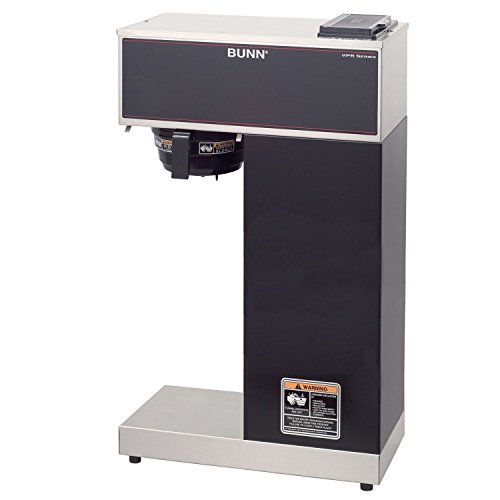
BUNN VPR APS Pour Over Air Pot Brewer — Best Overall
The VPR APS is the classic way small organisations escape burnt coffee: a commercial BUNN pour-over brewer that brews directly into an air pot, which then goes wherever the people are. Because it is pour-over, it needs no plumbing — an outlet and a counter in a kitchen, office or hall suffice — and because it is BUNN, its parts, support and design life are measured in years of daily duty. Pair it with a quality 3-litre air pot and you have the system most of this category’s buyers actually need.
Strengths
- Commercial BUNN build designed for years of daily service
- Pour-over design installs anywhere with an outlet — no water line
- Brews into the air pot, so coffee never sits on a burner
Trade-offs
- Air pot is a separate purchase — budget for the system, not the brewer alone
- Commercial footprint and looks: it is equipment, not décor
- Pour-over means a person fills the reservoir for each brew
Key specs: Pour-over commercial brewer — no plumbing required; Brews directly into air pots (pot sold separately); 120V standard outlet power; BUNN commercial construction
Plan the purchase as a system. The brewer is one cost; the air pot (or two, so one can be washed while one serves) is another, and listings that blur that fact cause most of this model’s disappointed reviews. In service, the routine is simple: fill the reservoir, load the basket, brew into the pot, carry the pot to the serving table. Coffee quality jumps immediately for one structural reason — the pot holds temperature by insulation rather than by a plate cooking it. For offices, congregations, clubs and serious hosts, this is the reference setup, and everything else here is a variation on its logic.
Best for: Offices, churches, clubs and hosts who want the classic brew-and-serve system / Not suited for: Buyers wanting an all-in-one box with the pot included — see the NUPANT below — Check on Amazon

BUNN CWTF15-APS Automatic Airpot Brewer — Best Automatic
When the pour-over routine itself becomes the bottleneck — when someone is always refilling the brewer during the event — the CWTF15-APS is the step up: plumbed, automatic, and rated at 3.8 gallons per hour, brewing into air pots continuously as the venue demands. This is genuine light-commercial equipment for cafés, large offices, banquet operations and houses of worship whose coffee service runs all morning, every week, without a dedicated operator babysitting a reservoir.
Strengths
- Plumbed and automatic: coffee at the pace of a real venue
- 3.8 gallons per hour covers meetings, services and rushes
- BUNN commercial ecosystem of parts and service
Trade-offs
- Requires a water line installation — not a casual countertop buy
- Air pot still sold separately
- Oversized for homes and tiny offices — match throughput to need
Key specs: Plumbed automatic brewer; Throughput: 3.8 gallons per hour; Brews into air pots (sold separately); 120V operation
The installation commitment is the decision. A water line and a proper setup are part of the purchase, and the throughput is wasted on a ten-person office — the VPR above exists for them. But for a venue that recognises itself in the words ‘the coffee ran out during the break’, this brewer ends that sentence permanently. As with the VPR, budget the air pots separately and buy two; the system shines when a full pot is serving while the next brews. Judged as venue infrastructure rather than as an appliance, it is the most capable pick on this page.
Best for: Venues and large offices whose coffee demand outgrew pour-over brewing / Not suited for: Homes and small offices — its capacity and plumbing are more than you need — Check on Amazon
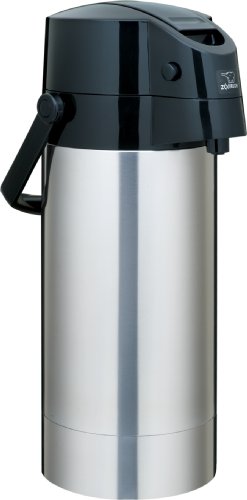
Zojirushi Vacuum Air Pot, 1 Gallon — Best Air Pot Only
If your brewing is already solved — a good urn, a big drip machine, a café next door — and only your serving is broken, this is the purchase: Zojirushi’s gallon vacuum air pot, the dispenser against which others are measured. Fill it with brewed coffee and it will serve a hall, an office floor or a long brunch at proper temperature for hours, one pump at a time, with no plate, no reheating and no cooked flavour creeping in by the second hour.
Strengths
- Zojirushi insulation is the benchmark — coffee stays serving-hot for hours
- A full gallon serves a crowd from one fill
- Pump dispensing is one-handed and queue-friendly
Trade-offs
- It holds and serves — it does not brew; you need a coffee source
- Gallon size is bulky for small kitchens and small gatherings
- Pump mechanism needs periodic deep cleaning to stay fresh
Key specs: Capacity: 1 gallon / 3.8 litres; Stainless steel vacuum insulation; Pump dispensing; Zojirushi beverage dispenser line
Zojirushi’s vacuum insulation is why this pot leads the dispenser half of the list — temperature retention is the entire product, and this is the maker that treats it as engineering rather than marketing. The ownership duties are simple but real: the pump and stem accumulate coffee oils and must be washed properly, not just rinsed, and a gallon of coffee is a commitment that small gatherings will not finish at its best. Buy it as infrastructure for a crowd you actually have, pair it with any brewer in this guide, and the serving problem is solved for years.
Best for: Anyone with brewing sorted who needs crowd serving that stays hot / Not suited for: Small households — a thermal carafe serves you better at a fraction of the size — Check on Amazon

Cresimo Airpot Coffee Carafe, 102 oz — Best Value Air Pot
The Cresimo is the value route into air pot serving: 102 ounces of insulated stainless capacity with pump dispensing, at a tier that lets a host, a small office or a team parent buy the serving upgrade without a commercial budget. Its versatility is part of the value — the same pot that serves coffee at the morning meeting serves hot water for tea or cocoa at the evening event, which is how a single-purpose-looking object earns year-round cupboard space.
Strengths
- Three litres of insulated serving at a value tier
- Versatile: coffee in the morning, hot water or cocoa for events
- Pump serving suits parties where guests help themselves
Trade-offs
- Value-tier fit and finish — pump action is functional, not silky
- Long-hold claims are best-case; plan on a strong morning, not eternity
- No brewing — a dispenser only, like the Zojirushi
Key specs: Capacity: 102 oz / 3 litres; Insulated stainless steel construction; Pump dispensing; Suited to coffee, hot water, tea and cocoa service
Set expectations at its tier and it will meet them happily. The pump and lid are functional rather than luxurious, and insulation claims should be read as best-case: plan on coffee holding serving temperature through a long event, not indefinitely. What you are buying is the format — insulated, self-serve, plate-free — at the price where trying the format makes sense. Organisations that discover they live in the format can step up to the Zojirushi; households and occasional hosts may find the Cresimo is simply the answer, full stop.
Best for: Hosts, small offices and teams wanting air pot serving at a value tier / Not suited for: Heavy daily commercial use — the Zojirushi is built for that life — Check on Amazon

Tiger Air Pot, 4.0 L (MAA-C401XC) — Best for Hot and Cold
Tiger is the other great Japanese insulation name, and its 4.0-litre air pot is the largest and most versatile dispenser here: hot coffee through a winter morning, iced tea or cold brew through a summer afternoon, from the same tabletop pot. The hot-and-cold rating is not a gimmick — a pot that serves both seasons never goes to the back of the cupboard, and for offices and community spaces that run year-round events, that dual life is the value case.
Strengths
- Four litres — the largest serving capacity among the pots here
- Rated for cold retention too: iced tea and cold brew service
- Tiger’s Japanese insulation pedigree, like Zojirushi’s
Trade-offs
- The biggest footprint of the dispensers — needs its serving station
- Dispenser only: bring your own brewed coffee
- Premium tier among the pots on this list
Key specs: Capacity: 4.0 litres (1.1 gal); Tabletop stainless steel air pot; Hot and cold retention; Tiger Eco Tora-Zu line
As with every dispenser on this list, be honest that it brews nothing; it is the serving half of a system, and it deserves a brewing half worthy of it — any brewer here, or the urn your organisation already owns. Its size asks for a real station: a table corner where the pot lives during service rather than being carried full across rooms. Within that setup, Tiger’s insulation does what the brand promises across long events. Buyers choosing between this and the Zojirushi are choosing capacity and cold service against the benchmark name; either is a decade-class purchase.
Best for: Year-round event spaces wanting one pot for hot coffee and cold drinks alike / Not suited for: Buyers who need a brewer included, or who serve small groups only — Check on Amazon

NUPANT Commercial Airpot Coffee Brewer, 2.2 L — Best All-in-One
The NUPANT answers the objection the BUNN systems raise — ‘where is the pot?’ — by including it: a pour-over commercial brewer and a 2.2-litre insulated air pot carafe in one purchase, sized for the small end of the serving world. Food trucks, small cafés, salon and studio service, market stalls and modest offices get the full brew-into-insulation logic without assembling a system from separate commercial parts.
Strengths
- The complete system in one box — brewer and air pot together
- Compact commercial format for small venues and food trucks
- Insulated carafe ends warming-plate staleness immediately
Trade-offs
- Capacity is modest: 74 oz serves a small venue, not a hall
- Lesser-known brand — support ecosystem is thinner than BUNN’s
- Extended-hold ratings are best-case; serve within the event
Key specs: Brewer with 2.2 L / 74 oz insulated airpot carafe included; Pour-over operation, 120V; Stainless steel construction; Thermal carafe rated for extended holding
Scale is the honest limit: seventy-four ounces is a small venue’s morning, not a congregation’s, and organisations bigger than that should buy the BUNN systems and separate pots. The brand consideration is real too — BUNN’s parts and service network is a genuine asset the NUPANT cannot match, which matters most to buyers who cannot tolerate downtime. For the small operator who needs the format working this week, in one box, at a non-commercial tier, this is the pragmatic pick — and the format itself will improve their coffee on day one.
Best for: Small cafés, food trucks and modest offices wanting one-box air pot brewing / Not suited for: Large venues, or buyers who need a commercial service network — Check on Amazon
Comparison Table
| Pick | Badge | Key spec | Best for |
|---|---|---|---|
| BUNN VPR APS Pour Over Air Pot Brewer | Best Overall | Pour-over commercial brewer — no plumbing required | Offices, churches, clubs and hosts who want the classic brew-and-serve system |
| BUNN CWTF15-APS Automatic Airpot Brewer | Best Automatic | Plumbed automatic brewer | Venues and large offices whose coffee demand outgrew pour-over brewing |
| Zojirushi Vacuum Air Pot, 1 Gallon | Best Air Pot Only | Capacity: 1 gallon / 3.8 litres | Anyone with brewing sorted who needs crowd serving that stays hot |
| Cresimo Airpot Coffee Carafe, 102 oz | Best Value Air Pot | Capacity: 102 oz / 3 litres | Hosts, small offices and teams wanting air pot serving at a value tier |
| Tiger Air Pot, 4.0 L (MAA-C401XC) | Best for Hot and Cold | Capacity: 4.0 litres (1.1 gal) | Year-round event spaces wanting one pot for hot coffee and cold drinks alike |
| NUPANT Commercial Airpot Coffee Brewer, 2.2 L | Best All-in-One | Brewer with 2.2 L / 74 oz insulated airpot carafe included | Small cafés, food trucks and modest offices wanting one-box air pot brewing |
How to Choose an Air Pot Coffee System: Brewer, Pot, or Both
Start by identifying which half of your system is broken. If the coffee itself is fine but dies on the warming plate, you need only a pot — the Zojirushi, Cresimo or Tiger — filled from your existing brewer. If you have no brewing capacity at serving scale, you need a brewer too: pour-over like the BUNN VPR APS or the NUPANT for outlet-only simplicity, or plumbed automatic like the CWTF15-APS when refilling becomes the bottleneck. Most disappointed buyers in this category bought the wrong half.
Size the pot to the event, in servings. A 2.2-litre pot covers a small team or a family brunch; 3 litres covers a meeting or a classroom morning; a gallon covers a hall. Coffee held past its best hours is waste wearing a system costume, so resist the biggest-is-best instinct — two mid-size pots, one serving while one is washed or brewed into, usually serve better than one giant. For brewers, match throughput honestly: gallons per hour is a venue specification, and homes should ignore it in favour of the pour-over simplicity of the VPR class.
Finally, think about the queue. Air pot serving is self-service, so judge the pump: it should pour a cup in a few presses, at a height that fits a mug, without instructions taped to it. If your crowd includes children, elderly guests or anyone with limited hand strength, pump effort matters more than any other specification on this page.
Why Air Pots Keep Coffee Better Than Warming Plates
A warming plate keeps coffee hot by adding heat continuously, and heat is coffee’s enemy after brewing: it drives off aromatics, concentrates bitter compounds, and gives a pot that unmistakable cooked taste within the hour. An air pot adds no heat at all. Vacuum insulation simply slows the coffee’s own heat loss, so the cup poured in hour three tastes like the cup from hour one, a little cooler — and a little cooler can be fixed by a hot mug, while cooked cannot be fixed at all.
The practical consequence is a planning change, not just a taste change. With a plate, you brew small and often, and someone is always tending the machine. With an air pot, you brew once at the event’s start, at full quality, and the coffee service runs itself. That is why this format owns offices, halls and brunch tables — and why the correct comparison for an air pot system is not a bigger drip machine, but the staff time and wasted pots the plate system quietly consumes every week.
Air Pot Care: Keeping a Serving System Tasting Clean
Air pots fail by flavour before they fail by function. Coffee oils coat the interior, the stem and the pump mechanism, and yesterday’s oils season today’s coffee whether you want them to or not. The routine that prevents it: rinse after every use, wash with hot water and a mild detergent regularly, and periodically soak the pot and pump parts with a coffee-equipment cleaner to strip the oil film that rinsing cannot reach. A bottle brush sized to the pot pays for itself in a month.
Brewers need the same respect plus descaling — a commercial brewer moving gallons of water scales faster than a home machine, and its spray head is where scale announces itself as uneven brewing. Wipe the serving station daily, check gaskets and pump seals when dispensing weakens, and store pots with lids open so interiors dry fully. A system cared for this way serves clean coffee for years; a neglected one becomes the reason people say air pot coffee tastes stale, when the truth is that neglected anything does.
How to Set Up an Air Pot Coffee Station for an Event
Position the station before you brew: a stable table with the pot at a comfortable pouring height, cups, lids, sweeteners and a small bin within arm’s reach, and the brewer — if it is part of the setup — close enough to refill without carrying a full pot across a room. Preheat the air pot with hot water while the coffee brews; pouring fresh coffee into a cold pot donates its first degrees to the steel, and preheating is the cheapest hold-time you will ever buy. Empty the preheat water just before filling.
Brew a full batch at proper strength — serving coffee is usually dosed a touch generously, because it must taste right across hours and through milk and sugar additions. Fill the pot promptly, close it, and pump a first small cup yourself to check temperature and taste before the crowd does; that cup is quality control, not impatience. Set a small sign if the pot holds something other than the expected coffee — decaf and hot water pots get confused at every event ever held.
During service, resist topping up a half-empty pot with fresh coffee unless the event demands it: mixing batches muddies both. When the pot empties, rinse it before refilling if time allows, and at the event’s end, empty, rinse and wash the pot the same day — coffee left overnight in an air pot is tomorrow’s off flavour, pre-installed. Store the pot dry with the lid ajar. That closing routine is the difference between a system that serves beautifully for years and one that slowly seasons itself into retirement.
Sizing a Fleet: Why Two Pots Beat One Big One
Organisations that serve coffee weekly learn the same lesson: the system works best as a small fleet, not a single vessel. Two mid-size air pots let one serve while the other is washed, preheated or being brewed into, so the station never goes dark during the exact minutes the crowd arrives. A decaf drinker population, which every real crowd contains, gets its own labelled pot instead of a apologetic side arrangement. And when one pot’s pump eventually needs attention, the service continues — redundancy is a feature that only looks like a luxury until the morning it saves the event.
The arithmetic usually favours the fleet too. Two 2.2-to-3-litre pots cover more real scenarios — one room or two, coffee or coffee-plus-hot-water, ordinary Sunday or double Sunday — than a single gallon pot used at half capacity most of the year. Start with the brewer and one benchmark pot, learn your crowd’s true consumption across a month of events, and let that evidence size the second pot. Buying the fleet in one guess is how organisations end up storing a giant pot they use twice a year beside the right pot they use weekly.
Brewer Compatibility and the Logistics of Filling
An air pot brewer and its pot are a matched pair in one specific dimension: height. The brewer’s dispensing clearance must fit the pot with its lid open or brew funnel in place, and that clearance — not brand loyalty — is the compatibility that matters. BUNN’s APS brewers are built around standard air pot heights, which is one quiet reason their ecosystem dominates this category; when mixing brands, measure the pot’s fill height against the brewer’s clearance before the purchase, not during the first event.
The filling routine deserves the same forethought. Brew directly into the preheated pot whenever the system allows it — every transfer through an intermediate carafe costs temperature and adds a washing item. Where the pot must be filled from an urn or a separate brewer, set the pot on a stable surface at comfortable pouring height, fill it completely, and move it full as seldom as possible: a gallon of coffee is a serious weight, and the serving station should be arranged so the full pot travels feet, not yards. These logistics sound humble and decide everything — they are the difference between a coffee station that runs itself and one that needs a volunteer with strong wrists.
The True Cost of Group Coffee: Air Pot Systems vs the Alternatives
Run the numbers the way an organisation actually experiences them. The warming-plate system looks free because the machine is cheap, but it bills you continuously: pots brewed small and often, the last third of each pot poured away cooked, and someone’s time spent tending, refilling and apologising. An urn removes the tending but locks brewing and serving into one vessel in one place. An air pot system costs more on day one and then removes the recurring bills — one full-quality brew, served anywhere, with waste measured in the occasional leftover cup rather than the routine leftover pot.
The break-even arrives quickly for any group serving weekly, and it arrives in quality before it arrives in money: the first event where the last cup tastes like the first is the moment the system justifies itself to the people drinking. Budget honestly for the whole system — brewer, two pots, a bottle brush and cleaning solution — rather than discovering the accessories as surprises, and the purchase will read, correctly, as infrastructure: bought once, maintained lightly, and used without discussion for years.
Before the first real event, run a rehearsal brew with water only — or with coffee for the setup crew — and walk the full path: fill the brewer, brew into the preheated pot, carry the pot to its station, and pump a cup at the exact spot guests will stand. Rehearsals expose the mundane failures that ruin event mornings: the pot that does not fit under the brewer with its lid open, the station too far from an outlet for the brewer’s second batch, the cup stack placed where the queue cannot reach it. Fifteen rehearsal minutes protect the event completely.
Running the Station: Volunteers, Labels and the Flow of a Crowd
An air pot system succeeds socially or not at all, so run the station like a tiny café. Put the person-flow in order: cups first, then the pot, then milk and sweeteners, then the bin — a queue that doubles back on itself is a queue that spills. Label every pot before it is filled, with the contents and the time brewed; the time label is the freshness conscience of the whole system, the thing that lets whoever is in charge retire a pot at its honest hour instead of serving it on hope. At recurring events, the same volunteer should not be the coffee person every week unless they love it — systems that depend on one saint fail when the saint is on holiday.
Brief whoever brews with the three numbers that matter: the dose for a full batch, the fill line, and the hold window you have decided the coffee is good for. Write them on a card taped inside the cupboard where the filters live. That card is the difference between an institution’s coffee and a person’s coffee — the institution’s survives staff changes, and tastes the same in the hands of the third volunteer as it did in the hands of the first. It takes ten minutes to write and it is the highest-value document in this entire category.
Coffee for Special Diets and Preferences at Group Scale
Group serving has a quiet inclusivity problem that air pot systems solve better than any alternative: the decaf drinker, the half-caf mixer, the tea-only guest and the child after cocoa are all minorities at a coffee event, and a single-pot system serves them by exception and apology. A two-pot station — coffee in one, and a rotating second pot — normalises them. Hot water in the second pot is the most democratic choice of all, because it converts the station into a drinks station: tea, cocoa, instant options and cup soups all become possible at no extra equipment cost, and the non-coffee population stops being an afterthought at events that were supposedly for everyone. Label clearly, keep the hot-water pot dedicated so it never tastes of coffee, and the station’s hospitality doubles for the price of the value pot in this guide. Organisations consistently report this as the upgrade their people actually mention — not hotter coffee, but being thought of.
Common Buying Mistakes
Buying a brewer when only the pot was broken. If your coffee brews well and dies on the plate, a dispenser alone fixes it for far less than a system. Diagnose which half is failing before spending on both.
Forgetting the pot is sold separately. Commercial BUNN brewers here brew into air pots that are a separate purchase. Budget the system — brewer plus one or two pots — or the unboxing will disappoint.
One giant pot for every event size. Coffee held for many hours past its best is waste. Two mid-size pots used in rotation serve fresher coffee than one oversized pot filled hopefully.
Never deep-cleaning the pump. Rinsing is not cleaning. Oils build in the pump and stem and stale every fill. Schedule real washes with coffee-equipment cleaner, not just event-day rinses.
Skipping the preheat. Fresh coffee into a cold pot loses its serving edge immediately. A hot-water preheat during brewing costs two minutes and buys an hour of hold.
Serving from a pot with no time label. Without a brewed-at time, nobody knows when the coffee should be retired, so it is served on hope. A strip of tape and a marker on every fill is the cheapest quality control in group coffee.
Reading the Room: Matching the System to the Gathering You Actually Host
One final calibration, because organisations consistently buy for the gathering they wish they hosted rather than the one on their calendar. Count the last four real events: the heads through the door, the cups each person actually took, and the hour at which the coffee stopped mattering. That evidence — not the annual festival, not the hoped-for growth — is the system you should own, with the festival covered by a borrowed second pot or a rented urn on the one week it happens. The same honesty applies at home: the brunch host who serves six people monthly owns a different correct system from the one who serves twenty at Christmas, and the Christmas system, bought for December, will spend eleven months serving six people worse than the smaller system would. Buy for the calendar you have, label the pots with the windows you measured, and let the exceptional event be the exception it claims to be.
Final Recommendation
The classic system is the recommendation for most buyers: the BUNN VPR APS brewer paired with the Zojirushi gallon air pot covers offices, halls and serious home hosting with commercial longevity and benchmark insulation. Venues that outgrow pour-over refills should step to the plumbed CWTF15-APS and never think about coffee logistics again. Small operators who need everything in one box should take the NUPANT and accept its modest scale as the price of simplicity.
If you only need the serving half, the choice is between the Zojirushi’s benchmark gallon, the Tiger’s larger hot-and-cold versatility, and the Cresimo’s value route into the format. Any of them will rescue good coffee from a warming plate, which is the single largest quality upgrade available to group coffee service.
Related reading in this cluster: Best Airpot Coffee Makers approaches the same format from the dispenser’s side, Best 12 Cup Thermal Coffee Makers covers thermal serving at home scale, and Best Affordable Countertop Coffee Makers handles the everyday counter decision. For very large gatherings, Best 20 Cup Coffee Makers covers the urn class.
Start smaller than your ambition and scale on evidence: the brewer, one benchmark pot, a month of real events, then the second pot sized by what the month taught you. Organisations that buy the full vision on day one usually own one pot too many and one pot too few at the same time. The system rewards the patient buyer exactly as it rewards the patient brewer — and either way, the first morning the last cup tastes like the first, the argument for the whole format is over.
Short on time? Start with the three most-chosen picks in this guide — BUNN VPR APS Pour Over Air Pot Brewer, BUNN CWTF15-APS Automatic Airpot Brewer and Zojirushi Vacuum Air Pot, 1 Gallon — check the current price on Amazon for each, and let the full reviews above settle any remaining doubt.
Frequently Asked Questions
What is an air pot coffee maker, exactly?
It is a two-part system: a brewer that brews into a vacuum-insulated pot, and the pot itself, which dispenses by pump or gravity and holds coffee at serving temperature for hours without a warming plate. Some products are the brewer, some are the pot, and a few — like the NUPANT here — include both.
How long does coffee stay hot in an air pot?
A quality vacuum air pot holds coffee at good serving temperature through a long event — a morning’s meeting or brunch — with gradual, gentle cooling rather than the cooked flavour a plate produces. Preheating the pot before filling extends the hold meaningfully.
Do I need a special brewer, or can I fill an air pot from my drip machine?
You can fill an air pot from any brewer whose carafe can pour into it — many buyers start exactly there. Dedicated air pot brewers like the BUNN models brew directly into the pot at serving scale, which matters when one home-size batch is not enough.
Air pot or coffee urn — which should my organisation buy?
Urns brew and hold in one vessel and suit very large single events. Air pot systems separate brewing from serving, so the pot can travel to the table while brewing continues — better for offices, multi-room venues and all-morning service. Match the format to how your people actually gather.
How do I clean an air pot properly?
Rinse after every use, wash regularly with hot water and mild detergent, and periodically soak the pot and pump parts with coffee-equipment cleaner to remove oil film. Store it dry with the lid open. Most ‘stale air pot coffee’ is a cleaning problem, not a product problem.
Is a plumbed brewer worth it over pour-over?
Only when refilling is your bottleneck. Pour-over models like the VPR APS install anywhere and serve most small venues perfectly. Plumbed automatics earn their installation cost in large venues where coffee demand is continuous and staff time is scarce.
Can an air pot system replace our office’s pod machine?
For shared office coffee, usually yes — and the per-cup economics improve dramatically, since one brewed pot replaces dozens of individual pods. Keep a small single-serve option if the office has genuine one-cup-at-odd-hours traffic, and let the air pot carry the morning peak it is built for.
How many cups does a 3-litre air pot actually serve?
About twelve standard 8-ounce cups, or twenty-plus small event cups. Count your crowd in the cups they will actually hold — halls pour small and refill, offices pour large and leave — and size the pot to that behaviour, not to the litre number alone.
What coffee should we buy for an air pot system?
A medium-roast, freshly dated blend from a roaster or a reputable grocery line, ground for drip or ground in-house if the organisation has a grinder. Serving coffee is tasted by more people than home coffee, so freshness discipline — smaller amounts, sealed storage — matters more, not less, at scale.
Can we brew tea or keep soup in an air pot?
Hot water, tea and cocoa serve beautifully from a dedicated pot. Soup is where we draw the line for shared equipment: its fats and particles defeat the pump and haunt later coffee. Keep a pot beverage-dedicated and it will serve for years; a pot that has held soup belongs to soup.


