Disclosure: airfryerkitchensupply.com is reader-supported. When you buy through links on our site, we may earn an affiliate commission at no extra cost to you.
Where to buy
Every pick in this guide to the best air purifiers to remove smoke is sold through Amazon, so you can compare sizes, colors and current availability in one place. Use the links below to jump straight to a pick, or read the full reviews further down before you decide. Prices move around with sales and stock, so each link simply lets you check the current price on Amazon rather than us printing a number that could be out of date tomorrow.
- WINIX 5510 Air Purifier — Best Overall: Check on Amazon
- Austin Air HealthMate Plus (B450) — Best for Heavy Smoke Odor: Check on Amazon
- IQAir GC MultiGas XE — Best Premium for Gases and Odors: Check on Amazon
- Medify MA-40 Air Purifier — Best for Large Rooms: Check on Amazon
- LEVOIT Core 600S-P Smart Air Purifier — Best Smart Large-Room Pick: Check on Amazon
- Oransi TrueCarbon 200C — Best Compact Carbon Specialist: Check on Amazon
Shopping for the best air purifiers to remove smoke starts with a fact the marketing prefers to blur: smoke is not one pollutant. It is a mixture of fine solid particles — the visible haze — and invisible gases that carry the smell and cling to a room. A HEPA filter is superb at the first and does nothing for the second. Only activated carbon, in meaningful quantity, adsorbs the gases. Every pick in this guide was chosen with that two-part chemistry in mind, and each badge tells you which half of the problem it solves best.
A note on framing, because this site keeps it strict: this guide talks about air quality and comfort — fresher-smelling rooms, less visible haze, less lingering odor. Air purifiers are comfort appliances, not medical devices, and nothing here is a health claim or a substitute for removing the source of smoke or ventilating when outdoor air allows. Within that honest frame, the right purifier makes a dramatic, immediately noticeable difference to how a home smells and feels.
All six picks were verified against Amazon’s catalog data integration before earning a link, and the coverage figures quoted are the manufacturers’ own ratings from those verified listings. Where a rating assumes the loudest fan speed, we say so — because a purifier you cannot sleep next to is a purifier you will switch off.
You will also find this guide unusually interested in what happens after the purchase: where the machine stands, when it runs, and the month its carbon quietly gives up. Smoke exposes lazy purification faster than any other pollutant — a dusty room forgives, a smoky room announces itself at the front door. The picks, the setup steps and the maintenance notes below are all aimed at the same outcome: a home that smells like a home, checked at the door by someone who does not live there.
In this guide
Quick Picks
Short on time? These are the six best air purifiers to remove smoke we would point a friend to first, each chosen for a different priority. The full reviews below explain the trade-offs behind every badge.
- WINIX 5510 Air Purifier — Best Overall. The balanced answer for most homes: true HEPA for smoke particles, a high-deodorization carbon filter for the smell, auto mode with an air-quality sensor, and coverage for large rooms up to 1,881 sq ft in an hour. — Check on Amazon
- Austin Air HealthMate Plus (B450) — Best for Heavy Smoke Odor. The carbon heavyweight: four-stage filtration built around a deep bed of activated carbon and zeolite, covering up to 1,500 sq ft, with a filter rated to last up to five years instead of a season. — Check on Amazon
- IQAir GC MultiGas XE — Best Premium for Gases and Odors. The specialist’s specialist: a Swiss-made machine with granular carbon cartridges designed for gases, chemicals and odors across rooms up to 1,125 sq ft, on wheels, with WiFi monitoring. — Check on Amazon
- Medify MA-40 Air Purifier — Best for Large Rooms. Big-room muscle with a HEPA filter rated to 0.3 microns, covering 1,793 sq ft in an hour — the pick for open-plan spaces, busy fireplaces and wildfire smoke days. — Check on Amazon
- LEVOIT Core 600S-P Smart Air Purifier — Best Smart Large-Room Pick. Smart-home convenience at scale: HEPA filtration for rooms up to 2,933 sq ft, app and Alexa control, auto mode and a quiet sleep mode — the connected pick for bigger spaces. — Check on Amazon
- Oransi TrueCarbon 200C — Best Compact Carbon Specialist. A small-room odor assassin: 3.2 lb of treated activated carbon in a compact unit for rooms up to 375 sq ft, ozone-free, assembled in the USA — built for smoke smell, not just smoke particles. — Check on Amazon
How These Picks Were Chosen
Our first filter was filtration honesty. Machines that advertise ‘HEPA-type’ or ‘HEPA-style’ filters without a true HEPA element were cut, as were purifiers whose entire carbon provision was a thin foam sheet — fine for dust, decorative against smoke odor. Survivors needed a genuine HEPA stage for particles and, for the odor-focused badges, a carbon bed measured in pounds rather than grams.
Next we weighed capacity against reality: coverage ratings are quoted at maximum speed, so we favored machines whose useful, tolerable speeds still cycle a real room’s air several times an hour — the working rule is at least two full air changes per hour for smoke, more during an event. Sensor-driven auto modes scored highly because smoke is episodic and a responsive machine gets left on.
Finally, running costs. A purifier is a filter subscription wearing an appliance costume; we compared filter life and replacement burden alongside purchase tier, which is how a five-year-filter machine and a cartridge-based machine earned their places next to cheaper units with hungrier appetites.
A word on what did not make the cut and why: several well-known compact purifiers were excluded because their smoke credentials rest on a combination filter whose carbon content is nominal — adequate for dust and pollen duty, outmatched by tobacco or woodsmoke within weeks. A guide that cannot distinguish a carbon bed from a carbon scent would be steering smoke sufferers toward the most common disappointment in this category, and we would rather recommend fewer, heavier machines.
The 6 Best Air Purifiers to Remove Smoke

WINIX 5510 Air Purifier — Best Overall
Smoke is two problems wearing one name: fine particles you can see in a sunbeam, and gases you can only smell. The WINIX 5510 is built for both halves. Its true HEPA filter handles the particulate side, while the high-deodorization carbon filter — a step up from the token carbon sheets in cheaper machines — works on the lingering odor that makes a room smell like last night’s fire or a smoker’s lounge long after the air looks clear.
Strengths
- True HEPA plus a dedicated high-deodorization carbon filter — both halves of the smoke problem addressed
- Auto mode reads air quality and adjusts fan speed, so it works harder exactly when smoke appears
- Rated for large rooms up to 1,881 sq ft in one hour, with app support for scheduling and monitoring
Trade-offs
- Carbon filters are consumables: heavy smoke exposure shortens their effective life and replacements add up
- Like every purifier, it cannot remove smoke that has already soaked into curtains, upholstery and walls
- Turbo speed is audible — effective during a smoke event, less welcome overnight in a bedroom
| Coverage | Up to 1,881 sq ft in 1 hr |
| Filtration | True HEPA + high-deodorization carbon |
| Modes | Auto mode, air quality sensor, app support |
The 5510 earns the top spot by being the machine we would hand to the widest range of smoke problems: a wood stove that puffs on lighting, a partner who smokes by an open window, wildfire days that turn the sky orange. The sensor-driven auto mode matters more than it sounds — smoke is episodic, and a purifier that idles quietly then ramps when the air changes will actually be left switched on, which is the only state in which any purifier works. For chronic, heavy indoor smoking, look at the carbon-heavy specialists below; for everything else, start here.
Best for: most homes dealing with fireplace, cooking or occasional tobacco smoke / Not suited for: rooms saturated by years of heavy indoor smoking, where soft furnishings hold the smell
Check the current price on Amazon

Austin Air HealthMate Plus (B450) — Best for Heavy Smoke Odor
When the problem is not a little smoke but the smell of smoke — the kind that lives in a room — filter weight is destiny. The HealthMate Plus carries a deep bed of activated carbon blended with zeolite, a mineral that is particularly hungry for the gases in tobacco and wood smoke. Where most purifiers carry a carbon-impregnated sheet, this carries kilograms of adsorbent, and that difference is exactly the difference between freshening air and changing how a room smells.
Strengths
- Deep activated carbon + zeolite bed targets smoke gases and odors, not just particles
- Filter life measured in years (up to five) rather than months — low long-term hassle
- Steel housing and simple controls; built like an appliance, not a gadget
Trade-offs
- Premium tier purchase, and the unit is heavy and visually plain
- No smart features, app or air-quality display — it simply runs
- The big filter is a significant replacement cost when the day finally comes
| Coverage | Up to 1,500 sq ft |
| Filtration | 4-stage, activated carbon + zeolite bed |
| Filter life | Up to 5 years |
Choose the HealthMate Plus when odor is the complaint and the source is ongoing: a household smoker, a busy fireplace, a workshop attached to the house. Its economics are unusual — expensive to buy, cheap to run, because the carbon bed that makes it effective also makes it long-lived. The trade-offs are real: it will not show you a particle count, it will not connect to your phone, and it looks like equipment. For the specific misery of a room that smells of smoke, none of that matters as much as the chemistry inside the drum.
Best for: persistent tobacco or wood-smoke odor in living spaces up to 1,500 sq ft / Not suited for: buyers wanting smart features, sensors and a sleek look
Check the current price on Amazon
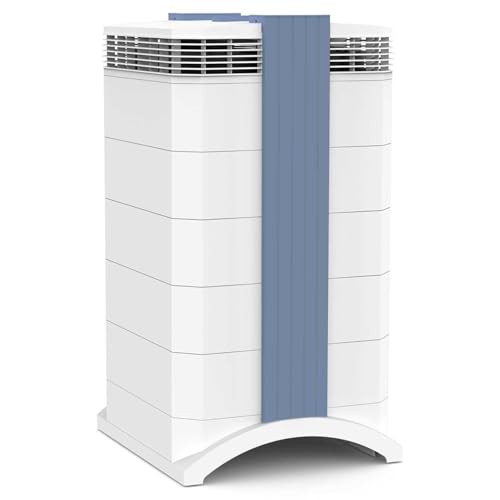
IQAir GC MultiGas XE — Best Premium for Gases and Odors
IQAir’s GC MultiGas XE exists for the version of the smoke problem that defeats ordinary purifiers: the gaseous fraction. Its cartridge-based granular activated carbon system holds far more adsorbent, in a far more effective form, than flat carbon filters, and the XE generation adds WiFi monitoring to a design that has been the reference point for gas-phase filtration for years. It is a serious machine at a serious tier, bought by people who have already tried the ordinary route.
Strengths
- Granular carbon cartridges provide the deepest gas and odor adsorption in this guide
- Cartridge system lets you replace the carbon stage independently as it exhausts
- Wheeled, solidly built, with WiFi monitoring — a long-term installation, not a trial purchase
Trade-offs
- The most expensive pick here by a wide margin, in purchase and in cartridges
- Large and heavy; it claims floor space permanently
- Overkill for occasional fireplace puff-back or a few wildfire days a year
| Coverage | Up to 1,125 sq ft |
| Filtration | Granular activated carbon cartridges + particle stages |
| Build | Swiss made, wheeled, WiFi |
The honest framing: this is the purifier for smoke problems that are really chemical problems — heavy tobacco environments, homes near traffic or industry, workshops, and households that want the strongest available reduction in gases and odors as a matter of everyday comfort. Its particle handling is excellent too, but you are paying for the carbon, and the carbon is the point. If your smoke issue is a wood stove used on winter weekends, the WINIX above solves it for a fraction of the commitment; if the smell is woven into daily life, this is the machine that changes the equation.
Best for: heavy, ongoing smoke and odor environments where gas-phase removal is the priority / Not suited for: occasional smoke, small budgets, or anyone wanting a discreet appliance
Check the current price on Amazon

Medify MA-40 Air Purifier — Best for Large Rooms
Open-plan living defeats small purifiers: by the time a desktop unit has cycled the air near the sofa, the smoke from the kitchen or stove has colonized the whole floor. The MA-40 is sized for that reality, moving enough air to cover 1,793 square feet in an hour with HEPA filtration to 0.3 microns — the size range where smoke particles live. It is the straightforward, high-throughput answer for large, connected spaces.
Strengths
- High air throughput rated for 1,793 sq ft in one hour — genuine large-room capacity
- HEPA filtration to 0.3 microns targets the fine fraction of smoke
- Simple, sturdy tower format that suits living rooms and open-plan floors
Trade-offs
- Its carbon stage is lighter than the specialists above, so odor removal is good rather than elite
- A big tower is a visible piece of furniture; plan its corner before it arrives
- Filter replacements for a machine this size are a real running cost
| Coverage | 1,793 sq ft in 1 hr |
| Filtration | HEPA to 0.3 microns |
| Format | Tower |
Wildfire smoke is the scenario this machine was born for: the whole house smells faintly of a campfire, the outdoor air is worse than the indoor air, and the job is to cycle a large volume of air through fine filtration continuously. The MA-40 does that job with capacity to spare and without smart-home fuss. Pair it with the common-sense steps in our how-to section — sealed windows, the purifier near the room’s center of life — and an open-plan home stays comfortable through smoke season. For odor-dominated problems in smaller rooms, the carbon specialists will serve you better.
Best for: open-plan homes, large living rooms and wildfire smoke events / Not suited for: small bedrooms or odor problems dominated by one heavy smoker
Check the current price on Amazon

LEVOIT Core 600S-P Smart Air Purifier — Best Smart Large-Room Pick
LEVOIT’s Core 600S-P is the machine for people who will actually use a purifier more if it lives in their apps. It covers very large rooms — up to 2,933 square feet on its headline rating — with a 3-in-1 filter that includes HEPA and carbon stages, an air-quality sensor driving auto mode, and full app and voice control. For smoke that arrives on a schedule (the evening fire, the cooking hour), scheduling alone justifies it.
Strengths
- Largest headline coverage in this guide, with smart scheduling via app and Alexa
- Air-quality sensor and auto mode respond to smoke events without babysitting
- Quiet HEPA sleep mode makes it bedroom-viable despite its size
Trade-offs
- The combined 3-in-1 filter means the carbon stage is modest — odor removal trails the carbon specialists
- Smart features need WiFi setup and an app account; not for the tech-averse
- Headline coverage assumes high fan speed; at sleep-mode quiet it covers far less
| Coverage | Up to 2,933 sq ft (headline) |
| Filtration | 3-in-1 HEPA + carbon |
| Controls | App, Alexa, auto mode, sleep mode |
Rate the 600S-P as the convenience champion. Its smoke-particle performance in big rooms is strong, its automation is genuinely useful, and its running experience — quiet at night, responsive in auto — is the one most households will sustain for years, which is the hidden variable in all purification. The carbon compromise is the price: for a home where the smell of tobacco is the main enemy, the Austin Air or IQAir will outperform it on odor while doing less of everything else. Know which problem is yours.
Best for: large rooms in connected homes; scheduled and sensor-driven smoke control / Not suited for: odor-dominated problems or buyers avoiding apps entirely
Check the current price on Amazon

Oransi TrueCarbon 200C — Best Compact Carbon Specialist
Most small purifiers are particle machines with a carbon-scented gesture. The TrueCarbon 200C inverts that: its heart is 3.2 pounds of treated activated carbon, an amount that embarrasses many full-size units, aimed squarely at odors, smoke smell and VOCs in rooms up to 375 square feet. For the spare room that hosts a smoker, the home office next to the kitchen, or the bedroom that catches the fireplace’s drift, it is a precision tool.
Strengths
- 3.2 lb of treated activated carbon — serious odor capacity in a compact body
- Ozone-free by design, a meaningful reassurance for a machine that runs all day
- Assembled in the USA, with a focused, no-gimmick control scheme
Trade-offs
- 375 sq ft ceiling: it is a one-room specialist, not a whole-home answer
- Carbon-first design means particle filtration is present but not its headline talent
- Carbon eventually saturates in heavy smoke; replacement cadence depends on exposure
| Coverage | Up to 375 sq ft |
| Filtration | 3.2 lb treated activated carbon |
| Notes | No ozone, assembled in USA |
The 200C is the connoisseur’s answer to a specific sentence: ‘this one room smells of smoke.’ A den, a study, a rental room, a nursery-adjacent office — anywhere a full-size tower is too much machine and a scented candle is an insult. Its carbon bed gives it staying power that sheet-filter minis cannot match, and its compact footprint means it can live where the problem lives. Just respect its room-size ceiling; asked to cover a floor, it will lose politely and continuously.
Best for: single rooms up to 375 sq ft with a persistent smoke smell / Not suited for: large or open-plan spaces, or particle-heavy wildfire events
Check the current price on Amazon
Comparison Table
| Pick | Badge | Key spec | Best for |
|---|---|---|---|
| WINIX 5510 Air Purifier | Best Overall | True HEPA + deodorization carbon, 1,881 sq ft/hr | most homes dealing with fireplace, cooking or occasional tobacco smoke |
| Austin Air HealthMate Plus (B450) | Best for Heavy Smoke Odor | Carbon + zeolite bed, 1,500 sq ft, 5-year filter | persistent tobacco or wood-smoke odor in living spaces up to 1,500 sq ft |
| IQAir GC MultiGas XE | Best Premium for Gases and Odors | Granular carbon cartridges, 1,125 sq ft, WiFi | heavy, ongoing smoke and odor environments where gas-phase removal is the priority |
| Medify MA-40 Air Purifier | Best for Large Rooms | HEPA 0.3 micron, 1,793 sq ft/hr coverage | open-plan homes, large living rooms and wildfire smoke events |
| LEVOIT Core 600S-P Smart Air Purifier | Best Smart Large-Room Pick | Smart HEPA, up to 2,933 sq ft, app + Alexa | large rooms in connected homes; scheduled and sensor-driven smoke control |
| Oransi TrueCarbon 200C | Best Compact Carbon Specialist | 3.2 lb activated carbon, 375 sq ft, ozone-free | single rooms up to 375 sq ft with a persistent smoke smell |
How to Choose an Air Purifier for Smoke: Particles, Gases and Carbon Weight
Hold the two halves of smoke apart in your mind and every specification starts making sense. Particles — ash, soot, the fine fraction that hangs in light — are captured mechanically: a HEPA filter traps them as air passes through, and its effectiveness is described by the machine’s clean air delivery and the room volume it can cycle. Gases — the compounds that make a room smell of tobacco, woodsmoke or last night’s frying — pass straight through HEPA media. They are removed by adsorption onto activated carbon, a material riddled with microscopic pores that trap gas molecules on contact.
Why carbon weight is the number that matters
Adsorption capacity is roughly proportional to how much carbon the air meets. A carbon-coated sheet holds grams and exhausts in weeks under smoke load; a bed holding pounds — the Austin Air and Oransi approach — keeps working for months or years. Treated carbons, blended with minerals like zeolite or impregnated for specific gases, outperform plain carbon on smoke’s particular chemistry. When a listing hides its carbon weight, assume it is small.
Size the machine by air changes, not floor area alone
Coverage figures assume a standard ceiling and the highest speed. For smoke, target a machine that can cycle your room’s air at least twice an hour on a speed you can tolerate in the room — and during a smoke event, run it on turbo and accept the noise for the hour that matters. A slightly oversized machine loafing on medium will out-clean and out-quiet a small machine screaming on max.
CADR, Room Ratings and Other Numbers, Translated
CADR (Clean Air Delivery Rate) is the useful figure where published: it describes how much filtered air a machine delivers, and smoke has its own CADR value, distinct from dust and pollen, because smoke particles are the finest and hardest to capture. As a rule of thumb, choose a smoke CADR at least two-thirds of your room’s square footage for standard ceilings. AHAM verification, which several picks here carry, means those numbers were independently checked rather than invented by a marketing department.
Decibels deserve the same skepticism as square footage. Every purifier is quiet on its lowest speed and few are quiet on turbo. What matters is the noise at the speed that delivers your needed air changes — for bedrooms, look for a dedicated sleep mode in the low-20s dB range, as the LEVOIT and WINIX picks offer, and plan to run higher speeds while the room is empty or the household is awake.
The Layered Defense: Where a Purifier Sits Among Your Other Options
A purifier works best as the middle layer of a three-layer approach. The first layer is source control — a stove door that seals, a range hood that actually vents outside, a smoking spot that is genuinely outdoors. No filter outperforms not making the smoke. The second layer is the purifier, cycling the room’s air through HEPA and carbon. The third is the reservoir: washable curtains, hard-surface furniture and washable slipcovers in smoke-prone rooms, so absorbed odor has fewer places to live.
Ventilation is the honorable exception to ‘keep windows closed’. When outdoor air is clean and the smoke is indoors — after heavy cooking, for instance — an open window and a cross-draft will clear a room faster than any machine. The purifier’s kingdom is everything else: when the outdoors is the problem (wildfire season), when the source is continuous, and during the long tail after an event when gases linger but opening up is not an option.
How to Set Up and Run a Purifier for Smoke
A good purifier badly placed is a mediocre purifier. Placement, settings and a few household habits decide how much of your purchase you actually receive.
Step 1: Place it in the room where smoke lives, with breathing room
Purifiers clean the air that reaches them. Put the machine in the room where smoke is generated or lingers most, at least a foot from walls and furniture so intake and exhaust are unobstructed, and not behind a sofa where its clean air short-circuits into a corner. For fireplace drift, between the stove and the seating is the sweet spot.
Step 2: Run it before, during and after the smoke event
Start the purifier when the fire is lit or cooking begins, not when the room already smells. Keep it running for at least an hour after the source stops — the gases that cause lingering odor are still airborne and adsorbable during that window, and this is when the carbon earns its keep.
Step 3: Use turbo for events, auto for life
During an active smoke event, run maximum speed and tolerate the noise; it is temporary and it is when the air changes matter most. For the rest of the day, sensor-driven auto mode (on the WINIX and LEVOIT picks) keeps the machine responsive without fan drone, and dramatically increases the odds it stays on for months rather than days.
Step 4: Close the room off from worse air
During wildfire events or when a smoker is active elsewhere in the home, close the door of the room you are protecting and seal the obvious gaps. A purifier maintaining one closed room will win; the same machine asked to defend an open house against the outdoors will merely lose slowly.
Step 5: Maintain filters on the smoke schedule, not the calendar
Manufacturer filter intervals assume average homes. Under regular smoke load, check the carbon stage sooner: when treated air starts carrying a faint sour or stale note, the carbon is saturating regardless of what the indicator says. Vacuum washable pre-filters monthly — a clogged pre-filter starves the whole machine.
Step 6: Keep a simple smoke log for the first month
Note the events — fire lit at seven, cooking smoke at eight, smell gone by ten — against the machine’s settings. Patterns emerge fast: most households find one daily window does most of the damage, and a scheduled turbo hour around it (easy on the app-driven picks) delivers most of the benefit at a fraction of the noise and filter wear of running hard all day.
What a Purifier Cannot Do: The Honest Limits
A purifier cleans air that passes through it. It does not clean the smoke already absorbed into curtains, upholstery, carpets and paint — the reservoir that re-releases odor for weeks and makes a room smell of smoke on a warm afternoon with no source active. Deep or repeated smoke exposure eventually requires washing textiles, cleaning hard surfaces, and time. The purifier’s job in that situation is to stop the reservoir refilling and to keep the air itself fresh meanwhile; set expectations there and the machine will delight you rather than disappoint you.
It also cannot compensate for an active, overwhelming source in a small sealed room, and it is not a safety device: smoke alarms, carbon monoxide alarms and ventilation remain the safety layer of any home with combustion in it. This guide’s claims stop at comfort and air quality, deliberately.
Smoke by Source: Fireplace, Tobacco, Cooking and Wildfire
Different smokes stress a purifier differently. Wood smoke is particle-rich with a strong gas fraction; a HEPA-strong machine with a real carbon bed (the WINIX or Austin Air pattern) handles it best, and puff-back during stove lighting is exactly what auto sensors are for. Tobacco smoke is gas- and odor-dominated and relentless in frequency — carbon weight decides satisfaction, which is why the carbon specialists top the relevant badges here.
Cooking smoke is episodic and greasy: range ventilation first, purifier second, and expect pre-filters to need attention sooner. Wildfire smoke is a whole-house, multi-day particle siege where throughput and runtime rule — the Medify’s capacity and any machine’s ability to run continuously and quietly at useful speeds matter more than peak odor performance. Naming your smoke honestly is half of choosing correctly.
Filter Economics: The Price You Pay After the Price
Two purifiers with identical shelf appeal can differ by hundreds over five years once filters enter the ledger. Sheet-filter machines in heavy smoke may want fresh carbon every few months; deep-bed designs like the Austin Air spread a larger replacement across up to five years; cartridge systems like the IQAir let you renew only the exhausted stage. Before buying, price the replacement filter, note its rated life, and divide — cost per year of clean air is the honest comparison, and it routinely reverses the ranking the shelf prices suggest.
There is a behavioral cost too. Machines whose filters are easy to find, easy to swap and honestly priced get maintained; machines with obscure, expensive consumables get run on dead carbon for years while their owners wonder why performance faded. Every pick in this guide uses mainstream, readily available filters for exactly this reason.
Guests, Rentals and Shared Air: The Social Life of a Purifier
Smoke is rarely a solo issue. Hosts run purifiers so non-smoking guests can enjoy an evening by the fire; landlords and tenants negotiate rooms that must be handed back smelling neutral; families protect a child’s bedroom from a grandparent’s habit without making it a referendum on the habit. In all of these, placement and discretion matter: a quiet machine in the room where people gather, started before guests arrive, does more social work than a powerful one roaring in the corner mid-evening.
For shared and rented spaces, the compact carbon specialist pattern — the Oransi’s badge — is often the pragmatic answer: one room, one machine, no renovation, no argument. And for anyone preparing a home for sale or a new tenant, remember the reservoir rule from the limits section: run the purifier hard while you wash the textiles and wipe the hard surfaces, because air and surfaces have to be cleaned together or the smell simply moves house between them.
Reading a Smoke Room: A Quick Diagnostic Before You Buy
Spend one evening diagnosing before you spend money. First question: is your complaint visible or olfactory? If the air hazes in lamplight but smells fine an hour later, particles dominate and a HEPA-strong machine is your answer. If the air looks clear but the room greets you with yesterday’s fire every morning, gases and the textile reservoir dominate, and carbon weight plus a laundry session will do more than any particle rating.
Second question: is the source episodic or continuous? Episodic smoke (a nightly fire, weekend cooking) rewards sensor-driven auto machines that surge and rest. Continuous smoke (a resident smoker, a busy commercial-adjacent kitchen) rewards deep carbon and honest filter budgets. Third: which room actually matters? Most households discover the answer is the bedroom — eight hours of breathing beats two hours of television — and that a mid-size machine there outperforms a giant in the living room. The six badges above map onto these answers deliberately; find your diagnosis, then take its badge.
Common Buying Mistakes
Buying a HEPA-only machine for an odor problem
If the complaint is smell, HEPA alone will leave you disappointed no matter how fine its particle numbers are. Odor is gas; gas needs carbon, in quantity.
Undersizing for the room
A desktop purifier in a 500 sq ft living room is a scented candle with a fan. Match air changes to the real room volume, and size up when in doubt — bigger machines can run slower and quieter.
Placing it in the hallway to ‘do the whole house’
Purifiers clean rooms, not floor plans. One machine per problem room beats one machine wandering the corridor, every time.
Switching it off when the visible haze clears
The smell-carrying gases remain airborne after the air looks clean. Give the carbon its hour after the event; that is when it does the work you bought it for.
Ignoring filter replacement until the indicator insists
Under smoke load, carbon saturates before timers expire. A stale note in the exhaust air is the real signal — act on it, or the machine becomes a fan recirculating yesterday’s smoke.
Trusting the headline coverage number
That figure assumes the highest, loudest speed and a standard ceiling. A machine ‘for 2,900 sq ft’ may effectively serve a third of that at sleep-friendly speeds. Buy for air changes at tolerable noise, not for the biggest number on the box.
Treating scent as cleanliness
A room that smells of fragrance spray over smoke is a room with two problems. Adsorption removes the smoke compounds; masking adds perfume to them. If your current routine involves candles and sprays, a carbon-bed purifier is not an upgrade to that routine — it is a replacement for it.
Final Recommendation
For most homes, the WINIX 5510 is the best air purifier to remove smoke: it respects both halves of the problem, senses and responds on its own, and covers big rooms without a premium-tier commitment. If the smell of smoke is the entrenched enemy, the Austin Air HealthMate Plus and its deep carbon-zeolite bed are the answer, with the IQAir GC MultiGas XE as the ultimate step up for gas-heavy environments.
Large and open-plan spaces should look to the Medify MA-40’s throughput or the LEVOIT Core 600S-P’s smart coverage, and a single problem room belongs to the Oransi TrueCarbon 200C. Whichever you choose, run it through the event and an hour beyond, keep its filters honest, and the difference will greet you at the front door.
A closing discipline that separates satisfied owners from disappointed ones: give any new purifier a two-week trial in the room that matters, run it the way this guide describes, and judge it at the front door after an evening with the fire lit — not by its lights, its app or its first-hour performance. Smoke is a cumulative problem and it yields to cumulative, correctly aimed filtration. Every machine above can deliver that; the badge that matches your diagnosis is the one that will.
- Best Overall: the WINIX 5510 Air Purifier — Check on Amazon
- Best for Heavy Smoke Odor: the Austin Air HealthMate Plus (B450) — Check on Amazon
- Best Premium for Gases and Odors: the IQAir GC MultiGas XE — Check on Amazon
- Best for Large Rooms: the Medify MA-40 Air Purifier — Check on Amazon
- Best Smart Large-Room Pick: the LEVOIT Core 600S-P Smart Air Purifier — Check on Amazon
- Best Compact Carbon Specialist: the Oransi TrueCarbon 200C — Check on Amazon
Keep exploring the same cluster: Best Air Purifier For A Smokers House Best Air Purifiers For Smoke And Allergies Best Air Purifiers For Fire Smoke Best Air Purifiers For Odor Elimination Best Air Purifier For Cigar Smokers Best Air Purifiers For Large Spaces
Frequently Asked Questions
Do air purifiers really remove smoke smell, or just the particles?
Both — but only if the machine carries enough activated carbon. HEPA filters remove the particles; the smell lives in gases, which only carbon adsorbs. That is why this guide weighs carbon quantity so heavily and why the odor badges go to the carbon-bed machines.
How long does it take a purifier to clear a smoky room?
On turbo, a correctly sized machine visibly clears haze within tens of minutes. The smell takes longer — typically an hour or more of continued running after the source stops — because the gases must cycle through the carbon repeatedly. Undersized machines may never fully win against an ongoing source.
Can one purifier handle a whole house?
Realistically, no. Purifiers clean the room they are in, especially with doors closed. Whole-house smoke problems are solved with one machine per key room, or by prioritizing the rooms where people sleep and spend their evenings.
How often will I replace filters if I have smoke regularly?
More often than the box suggests. HEPA stages under smoke load commonly need annual attention; carbon stages saturate according to exposure — months under heavy tobacco use, years in the Austin Air’s deep bed under moderate use. A stale smell in the exhaust is the practical signal.
Is ozone a concern with air purifiers?
It can be with ionizing and ozone-generating designs, which this guide avoided. Every pick here relies on mechanical HEPA filtration and carbon adsorption; the Oransi is explicitly ozone-free. If a purifier advertises ionization, check its ozone credentials before it runs in a bedroom.
Will a purifier help with wildfire smoke?
Yes — that is primarily a particle problem, and HEPA machines sized for the room, run continuously with windows closed, keep indoor air dramatically fresher than outdoor air during smoke events. The Medify MA-40’s throughput makes it this guide’s wildfire pick for large spaces.
Should I run my purifier all the time or only when there is smoke?
Both, in different gears. Run it on auto continuously so it catches events you do not notice and keeps baseline air fresh; surge it to turbo during and after smoke events. A purifier that lives on auto uses modest energy and is simply there when the fire is lit early or a neighbor’s bonfire drifts in — the two moments a switched-off machine always misses.


