Disclosure: airfryerkitchensupply.com is reader-supported. When you buy through links on our site, we may earn an affiliate commission at no extra cost to you.
Where to buy
For serious odor problems, start with the Austin Air HealthMate Plus — its deep bed of activated carbon and zeolite is the strongest odor tool in this guide. For most homes that want odor control plus everyday particle cleaning at a sensible tier, the WINIX 5510 is the balanced buy. If budget is secondary and you want the most engineered machine here, look at the IQAir HealthPro Plus XE. Every linked pick was verified against Amazon’s catalog before publication. Use the Check on Amazon buttons to check the current price on Amazon and confirm filter availability for your model.
Introduction
Most air purifier shopping advice fails odor sufferers in the same way: it talks about dust and pollen, then waves at odors as an afterthought. That is backwards if your actual problem is smell. The best air purifiers for odor elimination are built differently from allergy machines, because odors are gases, not particles. A HEPA filter — excellent at trapping dust, dander, and pollen — does almost nothing to a cooking smell, a litter-box smell, cigarette smoke odor, or the chemical tang of new paint. Gases pass straight through HEPA media. What removes odors is adsorption: activated carbon, ideally in serious quantities, often paired with zeolite or other gas-phase media that grab odor molecules and hold them.
That single fact drives every pick in this guide. We prioritized carbon mass and gas-phase filtration over headline particle specs, because a purifier can have spectacular dust numbers and still leave your kitchen smelling like last night’s fish. The six machines below range from a compact bedroom unit with a real deodorization filter to a medical-grade Swiss machine, and each badge reflects the odor job it does best: pet odor, smoke odor, cooking odor, chemical/VOC odor, or whole-house background odor. We will also be honest about limits — no purifier erases an odor source you leave in place, and carbon filters saturate. Used correctly, though, the right machine changes a room’s smell within hours, not weeks.
In this guide
Quick Picks
- Austin Air HealthMate Plus — Best Overall for Odor Elimination. A deep bed of activated carbon and zeolite with a filter rated for years of service; the odor specialist’s choice. Check on Amazon
- IQAir HealthPro Plus XE — Best Premium. Swiss-made, medical-grade filtration with serious gas-phase capability and WiFi control for large rooms. Check on Amazon
- WINIX 5510 — Best Value Odor Fighter. True HEPA plus a high-deodorization carbon filter and app support; strong odor performance at a mid-range tier. Check on Amazon
- Rabbit Air MinusA2 SPA-780A — Best for Pet Odors / Wall-Mount. Slim, wall-mountable design with a dedicated odor-remover filter stage. Check on Amazon
- Medify MA-40 — Best for Large Rooms. Big coverage numbers and HEPA filtration with carbon for smoke and household odors in open-plan spaces. Check on Amazon
- COWAY Mighty AP-1512HH — Best Compact for Bedrooms. A proven compact tower with a deodorization filter, air quality monitor, and auto mode for smaller rooms. Check on Amazon
How These Picks Were Chosen
Odor elimination was the primary criterion, evaluated through the filter stack rather than marketing language. We looked for, in order: the amount and type of gas-phase media (pounds of activated carbon beat a carbon-coated mesh every time; zeolite and potassium-permanganate-style media add chemical-odor capability); whether the carbon stage is replaceable separately or bundled; the manufacturer’s stated coverage, treated skeptically and matched to realistic room sizes; fan power sufficient to actually move room air through a dense carbon bed, since thick filters strangle weak fans; and noise at the speeds you will actually run, because an odor purifier that gets switched off for being loud removes nothing.
We also weighed filter replacement economics. Odor control is an ongoing cost, not a one-time purchase: carbon saturates, and a saturated carbon filter can even re-release odors. Machines with long-life carbon beds (the Austin Air approach) cost more up front and less per year; machines with cheaper, more frequent filter changes reverse that math. Both models appear on this list, labeled honestly. Finally, every pick was verified — product identity and ASIN confirmed against Amazon’s own catalog data — before it earned a link here. We excluded purifiers whose “carbon filter” is a thin foam sheet with no meaningful adsorption capacity, however good their particle specs looked.
The 6 Best Air Purifiers for Odor Elimination

1. Austin Air HealthMate Plus — Best Overall for Odor Elimination
If odor is the problem, this is the answer most indoor-air specialists reach for first. The HealthMate Plus runs a four-stage system built around a substantial bed of activated carbon blended with zeolite — zeolite’s porous mineral structure is particularly good at adsorbing the smaller chemical molecules that plain carbon handles less well, including many paint, solvent, and new-furniture VOCs. It suits homes fighting persistent odors: smoke, cooking, pets, musty basements, and chemical smells from renovations. It is less suited to shoppers who want smart-home features — there is no app or air quality display — and to anyone who needs a machine they can move between rooms daily, because it is a solid, stay-in-place unit covering up to roughly 1,500 square feet on the manufacturer’s rating.
Strengths
- Deep activated-carbon and zeolite bed — the most serious gas-phase filtration on this list.
- Filter life measured in years rather than months, which transforms the running-cost math.
- Steel construction and simple mechanical controls: nothing to break, nothing to update.
Trade-offs
- No app, no sensor display, no auto mode — you set the speed and it works.
- Premium tier purchase price, justified by filter longevity rather than features.
- On high speed it is audible; most owners run it lower overnight.
The HealthMate Plus earns Best Overall because odor elimination is fundamentally a chemistry problem, and this machine brings the most chemistry. Thin carbon sheets — the kind folded into many stylish purifiers — saturate in weeks under real odor load. A deep carbon bed keeps adsorbing for years, which is why Austin Air can rate its filter the way it does. Owners dealing with a smoker in the house, a home business that produces smells, or a chronic mustiness that survives cleaning consistently find this category of machine is the first thing that actually works. Buy it for the room where the odor lives, run it continuously on a moderate speed, and expect the background smell of the room — not just the air near the machine — to change.
Best for: persistent smoke, chemical, cooking, and musty odors in larger spaces. / Not suited for: smart-feature shoppers or small budgets.
Check on Amazon — check the current price on Amazon.

2. IQAir HealthPro Plus XE — Best Premium
IQAir’s HealthPro Plus XE is the most engineered purifier in this guide: Swiss-made, medical-grade positioning, HyperHEPA particle filtration, a dedicated gas-phase stage, WiFi connectivity, and wheels for moving a substantial machine between rooms. It suits buyers who want one flagship unit for a large living space — the rating covers rooms up to about 1,125 square feet — and who care about both ultrafine particles and gases. It is less suited to value shoppers, and its size and weight make it a poor fit for small apartments where floor space is precious.
Strengths
- Combines top-tier particle filtration with a real gas and chemical filtration stage.
- WiFi and app control let you run higher speeds when away and quieter speeds at home.
- Modular filter design: replace the stage that is spent, not the whole stack.
Trade-offs
- The highest tier on this list by a clear margin.
- Large, heavy cabinet — the wheels help, but it is not a casual carry.
- Replacement stages are premium-priced as well.
Where the Austin Air is a specialist tool, the IQAir is a complete air-treatment system that also handles odors seriously. Its modular approach matters for odor owners: gas-phase media exhausts on its own schedule depending on your odor load, and being able to replace just that stage is more economical than full-stack machines suggest. The app control is not a gimmick for odor use either — odor events are episodic (cooking, guests who smoke, a pet accident), and the ability to push the machine to high from your phone before you get home, then let it settle to quiet by evening, matches how odor control actually works in a lived-in house.
Best for: large rooms, buyers who want particles and odors handled by one flagship machine. / Not suited for: tight budgets or small spaces.
Check on Amazon — check the current price on Amazon.

3. WINIX 5510 — Best Value Odor Fighter
The WINIX 5510 — the current generation of the long-running 5500 series — pairs True HEPA filtration with a high-deodorization carbon filter and adds app support and auto mode. It suits the broad middle of odor shoppers: pet owners, regular cooks, and anyone whose home smells “lived in” rather than chemically challenged. Coverage is rated for large rooms up to about 1,881 square feet per hour of cleaning on the manufacturer’s figures; treat that as a large-room rating and expect the strongest odor effect in the room it occupies. It is less suited to severe smoke or industrial chemical odor, where the deep-bed machines above are worth their premium.
Strengths
- High-deodorization carbon filter is a genuine odor stage, not a token sheet.
- Auto mode with air quality sensing ramps the fan when odors and particles spike.
- Mid-range tier with widely available replacement filters.
Trade-offs
- Carbon capacity is far below the Austin Air’s bed — expect filter changes on a household schedule, not a multi-year one.
- Odor performance depends on running it consistently; auto mode helps but is not magic.
- Plastic construction feels ordinary next to the metal-bodied picks.
The 5510 is the machine we recommend when someone says “my house smells like dog and dinner” — the two most common household odor complaints. Its carbon stage is honestly sized for that job, its sensor actually responds to cooking events, and its price tier means the replacement filters sting less, which matters because odor owners who delay filter changes lose the benefit entirely. Think of it as the balanced default: not the strongest chemistry here, but strong enough for ordinary homes, with the convenience features that keep a purifier running instead of sitting switched off in a corner.
Best for: pet and cooking odors in typical homes, value-focused buyers. / Not suited for: heavy smoke or chemical odor remediation.
Check on Amazon — check the current price on Amazon.
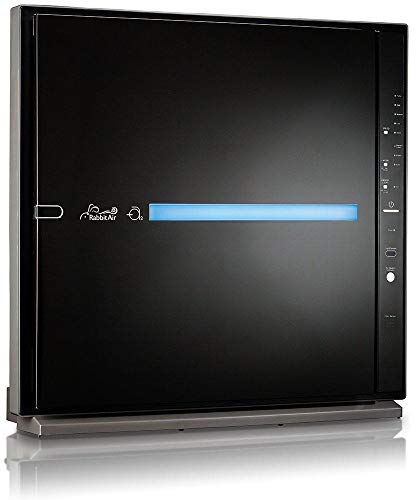
4. Rabbit Air MinusA2 SPA-780A — Best for Pet Odors / Wall-Mount
The MinusA2 is the design outlier: a slim panel that can stand on the floor or mount on a wall, with a customizable filter stack that includes a dedicated odor-remover stage. It suits pet owners — especially in apartments and condos where floor space is scarce and litter boxes live uncomfortably close to living areas — and anyone who wants a purifier that disappears into a room rather than squatting in it. It is less suited to very large open-plan spaces, and its premium positioning means you pay for the design as well as the filtration.
Strengths
- Dedicated odor-remover filter option targeted at pet and household smells.
- Wall-mountable slim profile frees floor space and keeps the intake near odor pathways.
- Very quiet operation suits bedrooms and nurseries.
Trade-offs
- Premium tier for its coverage class.
- Custom filter panels add a small recurring cost and a choice to manage.
- Not the tool for whole-house or heavy smoke odor.
Pet odor is a placement problem as much as a filtration problem: the smell is generated at floor level, in specific spots, all day. A slim purifier that can mount on the wall of the room where the litter box or the dog bed lives — running quietly enough to be forgotten — attacks that problem in the right place. The MinusA2’s odor-remover stage is formulated for the ammonia-adjacent and organic smells pets produce, which generic carbon handles only adequately. For apartment pet owners, this is frequently the difference between “guests can tell we have a cat” and not.
Best for: pet odor in apartments and bedrooms, space-conscious buyers. / Not suited for: large open-plan homes or heavy smoke.
Check on Amazon — check the current price on Amazon.

5. Medify MA-40 — Best for Large Rooms
The Medify MA-40 is the coverage play: rated by the manufacturer for very large spaces (up to about 1,793 square feet in an hour on its figures), with HEPA filtration addressing smoke, wildfire intrusion, odors, pollen, and pets. It suits open-plan living areas, large family rooms, and homes in wildfire-prone regions where odor events arrive from outside as smoke. It is less suited to small bedrooms, where it is simply more machine than the room needs, and to buyers who want the deepest carbon chemistry — its odor stage is competent household grade rather than a deep bed.
Strengths
- Large-room airflow moves enough air to matter in open-plan spaces.
- Addresses the smoke-odor scenario — wildfire and fireplace — that defeats small purifiers.
- Mid-tier positioning for its size class.
Trade-offs
- Physically large; measure your intended spot.
- Carbon stage sized for household odors, not chemical remediation.
- Fan noise scales with its airflow on the highest settings.
Odor control in a big room is an air-volume problem before it is a chemistry problem: a brilliant filter in a weak fan only perfumes the corner it sits in. The MA-40’s contribution is throughput — enough air changes to bring a large room’s background odor down, including the lingering smoke smell after a wildfire event or a winter of wood-stove use. Pair it with source control (sealed windows during smoke events, prompt ash removal) and it handles the class of odor problem that most often sends people shopping in the first place.
Best for: open-plan spaces, wildfire and fireplace smoke odor. / Not suited for: small rooms or severe chemical odors.
Check on Amazon — check the current price on Amazon.

6. COWAY Mighty AP-1512HH — Best Compact for Bedrooms
The Coway Mighty is one of the most proven compact purifiers on the market: a small tower with HEPA filtration, a dedicated deodorization filter, an air quality monitor, auto and eco modes, and a timer, rated for rooms up to about 1,748 square feet on the manufacturer’s generous figures — in practice, it is a bedroom and small-living-room machine. It suits odor problems at bedroom scale: a musty spare room, a nursery that hosts a diaper pail, a home office that smells of the dog who sleeps under the desk. It is less suited to whole-floor odor or to kitchens while heavy cooking happens, where its compact carbon stage will saturate quickly.
Strengths
- Real deodorization filter in a genuinely compact footprint.
- Air quality monitor and auto mode make it set-and-forget in a bedroom.
- Long track record and easy filter availability.
Trade-offs
- Compact carbon capacity — kitchen and smoke duty will exhaust it fast.
- Coverage ratings are optimistic; think one room, not a floor.
- No app connectivity on this long-running model.
Bedroom odor is a distinct problem: you notice it most at night, it is usually mild but constant, and the machine that solves it must be quiet and unobtrusive for eight hours at a stretch. The Mighty fits that brief better than any other compact we considered, because its deodorization stage is real and its auto mode keeps it working without lighting up or droning. It is also the right scale for a first purifier: if you are unsure whether air purification will change your home’s smell, start with the room you sleep in and judge from there.
Best for: bedroom-scale odor, nurseries, home offices. / Not suited for: kitchens, heavy smoke, whole-floor coverage.
Check on Amazon — check the current price on Amazon.
Comparison Table
| Pick | Badge | Key spec | Best for |
|---|---|---|---|
| Austin Air HealthMate Plus | Best Overall for Odor | Activated carbon + zeolite bed, multi-year filter | Persistent smoke, chemical, musty odors |
| IQAir HealthPro Plus XE | Best Premium | HyperHEPA + gas stage, WiFi, wheels | Large rooms, flagship all-in-one |
| WINIX 5510 | Best Value | True HEPA + high-deodorization carbon, app | Pet and cooking odors, typical homes |
| Rabbit Air MinusA2 SPA-780A | Best for Pet Odors | Odor-remover filter, wall-mountable | Apartments, litter-box rooms |
| Medify MA-40 | Best for Large Rooms | High airflow, large-space rating | Open-plan rooms, wildfire smoke |
| COWAY Mighty AP-1512HH | Best Compact | Deodorization filter, air quality monitor | Bedrooms, nurseries, offices |
How to Choose an Air Purifier for Odor Elimination
Begin by naming your odor precisely, because different smells reward different machines. Cooking odors are mostly organic vapors and fine grease aerosols: a good carbon filter plus a washable pre-filter that catches grease before it coats the carbon works well, and placement near (not in) the kitchen matters. Pet odors combine dander particles with ammonia-adjacent litter smells and general animal musk; you want HEPA for the dander plus a carbon stage, placed in the room where the animals actually live. Smoke odor — tobacco or wildfire — is the hardest common case: it is both particulate and gaseous, it soaks into soft furnishings, and it demands the deepest carbon you can afford plus patience. Chemical and VOC odors from paint, new furniture, and renovation call for carbon blended with zeolite or similar media, the Austin Air formula. Musty odors mean moisture first: fix the water source, then use a purifier to clear the lingering smell; a purifier over an active leak is a subscription to disappointment.
Next, weigh the carbon honestly. Manufacturers describe carbon in vague adjectives; what matters is mass and contact time. A deep bed of granular carbon adsorbs for years; a carbon-impregnated pad lasts weeks to months under odor load. If a product page will not tell you anything about the carbon beyond the word “carbon,” assume the pad. Then match the machine to the room: purifiers clean the room they are in, so buy for your worst room rather than your whole house, and run the numbers on the manufacturer’s coverage as a ceiling, not a promise — for odor work, choose a machine rated for at least your room’s size, and preferably more, so you can run it on a quieter middle speed and still get enough air changes.
Finally, budget for the filter relationship, not just the machine. Odor control fails quietly when owners stretch a saturated carbon filter to save money. Before buying, price the replacement carbon stage and its realistic interval in a home with your odor load; the cheapest machine with expensive, frequent filters often costs more over three years than the deep-bed alternative. If that math pushes you toward a smaller room-by-room approach — a Coway Mighty in the bedroom now, a bigger unit later — that is a legitimate strategy, because odor is experienced room by room.
How to Set Up and Run an Odor Purifier for Best Results
Placement decides half your results. Put the purifier in the room where the odor is generated, with clearance around its intake and outlet — a few inches from walls and furniture at minimum, and never boxed into a corner behind a couch where it recirculates its own cleaned air in a tiny loop. For pet odor, place it in the same room as the litter box or dog bed, but not so close that litter dust cakes the pre-filter. For cooking odor, the adjacent dining or living area usually beats the kitchen itself, where grease will foul filters quickly.
Run it continuously. Odor molecules are emitted continuously by their sources — the dog, the carpet, the smoking habit, the damp wall — so a purifier that runs two hours a day is fighting a twenty-four-hour problem with a part-time tool. Use auto mode if your machine has it, or a steady medium speed, and reserve high speed for events: while cooking and for an hour after, when guests arrive, after a pet accident is cleaned. Close the door of the room being treated when you can; purifiers change a defined volume of air far more effectively than an open-plan drift.
Maintain the front of the filter stack. Vacuum or wash the pre-filter on the schedule the manual suggests — a clogged pre-filter starves the carbon of airflow and shortens its life. Keep a simple calendar note for the carbon stage: the date installed, and the date your nose tells you the room’s background smell is creeping back despite the machine running. That nose test, honestly applied, is the most reliable carbon-saturation gauge a home has. When it fails, replace the carbon promptly; a saturated filter does not merely stop helping, it can become a mild odor source itself as previously adsorbed compounds re-release.
Activated Carbon Explained: Beds, Pads, Zeolite, and Saturation
Since carbon does nearly all the odor work in this category, it pays to understand what you are buying. Activated carbon is charcoal treated to develop an enormous internal pore surface; when odor-laden air passes through it, gas molecules stick to those surfaces in a process called adsorption. The physics rewards two things: the total mass of carbon, and the time air spends in contact with it. A deep granular bed — literally pounds of loose carbon pellets that air must percolate through — wins on both counts, which is why the Austin Air’s design has remained the odor benchmark for so long despite its plain appearance.
At the other end sit carbon pads and carbon-coated meshes: a thin layer of carbon dust bonded to a filter sheet. These are not useless — they freshen mild odors in small rooms — but their capacity is a small fraction of a bed’s, and under a real odor load (a smoker, two large dogs, daily frying) they can saturate in a matter of weeks. Between the two extremes are molded carbon blocks and heavier impregnated filters, such as the deodorization stages in the WINIX and Coway picks: honest mid-capacity solutions for ordinary household odor.
Zeolite deserves its own mention. It is a naturally occurring porous mineral whose cage-like structure adsorbs certain small molecules — ammonia and many solvent vapors among them — that plain carbon handles less completely. Blended carbon-zeolite beds therefore cover a broader chemical range, which is exactly the profile you want for renovation fumes, new-furniture off-gassing, and the mixed chemical signature of a garage-adjacent room. Some manufacturers also impregnate carbon with compounds that chemically neutralize specific gases; the principle is the same — more and better-targeted adsorption chemistry.
Saturation is the fate of every carbon filter: the pores fill, adsorption slows, and eventually the filter can release previously captured compounds back into the air, particularly when temperature or humidity swings. There is no dashboard light that measures this directly in most home machines, so use the practical test — run the machine continuously for two days in the problem room with the door mostly closed; if the background odor is clearly creeping back, the carbon is spent. Planning replacements around that signal, rather than around a generic calendar, is how odor owners avoid both waste and disappointment.
Odor Control Room by Room: A Practical Playbook
The kitchen. Cooking odor is episodic and intense. The winning pattern is a purifier in the dining or living area adjacent to the kitchen, run on high during cooking and for an hour after, with the range hood doing the first-pass work at the stove. Keep the purifier out of the immediate grease zone; aerosolized cooking oil coats pre-filters and carbon and shortens their lives dramatically. The WINIX 5510’s sensor-driven auto mode fits this rhythm well.
The litter-box room and pet zones. Continuous low-speed running beats heroic bursts, because the source emits continuously. Place the machine in the same room, elevated if possible so its intake samples the air the room’s occupants breathe, and stay disciplined about the box itself — a purifier is not a substitute for daily scooping, it is what makes a well-kept box stop announcing itself down the hall. The Rabbit Air’s wall mounting exists precisely for these tight, dedicated rooms.
The smoker’s room. Be realistic: this is the heaviest duty in home odor control. Choose the deepest carbon you can afford, run it continuously, wash soft furnishings, and understand that the machine is managing an ongoing source. Many households find the Austin Air class of machine is the first purchase that moves the needle from “smells like smoke” to “smells faintly, near the chair.” Complete elimination while smoking continues indoors is not a promise any filter can honestly keep.
The musty basement or spare room. Find and fix the moisture first — a purifier over an active damp problem is money spent perfuming a leak. Once the room is dry, a carbon-equipped machine clears the residual mustiness from the air and, over weeks, draws down the odor stored in furnishings. A dehumidifier holding the room at moderate humidity prevents the smell from regenerating.
The nursery and bedroom. Prioritize quiet and a real deodorization stage at compact scale — the Coway Mighty pattern. Diaper pails and night-time pet visits are mild but constant sources, and a set-and-forget auto machine that never wakes anyone is worth more than a powerful unit that gets switched off at bedtime.
Common Buying Mistakes
Buying a HEPA purifier for a gas problem. HEPA traps particles; odors are gases. Without a substantial carbon stage, a purifier can leave a room dust-free and still smelling exactly the same.
Trusting a “carbon filter” that is a thin pad. A foam sheet with carbon dusting saturates in weeks under real odor load. Carbon mass is the spec that matters, even when you have to dig for it.
Sizing for the whole house. One purifier cleans the room it sits in. A machine rated generously for your worst room, door closed, beats a giant rating spread thin across an open floor plan.
Ignoring the source. No purifier outruns an unchanged litter box, a damp crawl space, or ashtrays that are never emptied. Remove the source first; let the machine handle the residue and the ongoing background.
Stretching carbon filters past saturation. The savings are imaginary — you pay for electricity to run a fan that no longer removes odor, and saturated carbon can re-release smells.
Hiding the purifier. Tucking a unit behind furniture or inside a cabinet starves its intake. Odor control needs airflow; give the machine room to breathe.
When a Purifier Is Not Enough: Stubborn Odor Situations
Some odor problems arrive as emergencies rather than background annoyances, and they deserve their own playbook. Moving into a home that smells of the previous occupants — smoke, pets, cooking oil in the walls — is the classic case. The purifier is one leg of a three-legged fix: deep-clean or replace soft materials (carpet padding is the worst offender and often must go), seal porous surfaces with an odor-blocking primer where smoke is involved, and run a deep-carbon purifier continuously through the first weeks to strip the airborne fraction and keep cleaned rooms from re-absorbing smell. Skipping the first two legs and expecting the machine to do everything is the most expensive mistake in this category.
Preparing a home for sale inverts the problem: you need the house to smell neutral to a stranger’s fresh nose within days. Here, source removal (pet items out, ashtrays gone, soft furnishings cleaned) plus a strong purifier running in the main living area, and ideally a compact unit in the primary bedroom, gets most homes to neutral. Sellers should resist scented cover-ups on top of purification — buyers read fragrance-over-odor instantly, and it raises suspicion rather than comfort.
Renters face the constraint that they cannot renovate. For them, the calculus favors portable machines with real carbon — a WINIX-class unit that moves with them — plus washable textiles and, for smoke drifting from a neighbor’s unit, a door seal and a purifier placed near the entry path of the smell. Post-renovation chemical odor is the fourth case: ventilate aggressively first (fresh air is free carbon-free purification), then let a carbon-zeolite machine polish what remains; new paint and flooring off-gas fastest in the first weeks, and the purifier’s job is to shorten the tail, not to make a freshly painted room safe to seal yourself into on day one.
In every one of these scenarios, the pattern repeats: remove or seal the source, ventilate when you can, and let the right purifier do the continuous background work it is actually good at. Buyers who follow that order rarely feel let down by their machine; buyers who skip to step three often do.
Running Costs: The Filter Economics Behind Each Pick
Odor purifiers are subscriptions disguised as appliances, and the honest way to compare them is cost per year of effective odor control. The deep-bed model, represented by the Austin Air, front-loads the expense: a premium machine whose filter is rated for years of service. Spread across that lifespan, its annual cost is often the lowest on this list, and it has a second, underappreciated virtue — a filter you replace rarely is a filter you actually replace on time, because the event is memorable rather than a recurring chore you keep postponing.
The mid-capacity model — WINIX 5510, Medify MA-40, Coway Mighty — reverses the shape: a friendlier purchase price, then replacement filter sets on a roughly annual rhythm, sooner in odor-heavy homes. The trap is behavioral, not financial: owners stretch a tired carbon stage “one more month,” month after month, and conclude the purifier stopped working. It did not stop; its carbon filled up, on schedule, doing its job. If you choose this class, buy the first replacement filter the same day you buy the machine and store it where you will see it.
The modular premium model, the IQAir, sits between: staged filters replaced individually as each exhausts, with the gas stage’s lifespan depending heavily on your actual odor load. Its economics reward owners who track which stage is spent rather than swapping the whole stack by habit. And the Rabbit Air adds a modest twist: the customized filter panel system lets you pay a small increment for the odor-focused configuration rather than replacing capability you do not use.
Electricity is the smaller line item but not zero: these machines run continuously by design, and a large unit on a high speed draws meaningfully more than a compact on low. Auto modes and sensible speed discipline — high for events, medium for maintenance — keep that cost proportionate. When you total machine, filters, and power over a three-year horizon, the ranking in this guide often inverts the sticker ranking, which is precisely why we badge the Austin Air as the overall odor pick despite its plain feature list.
A note on expectations for allergy-adjacent odor complaints: some “odor” problems are partly particle problems — pet dander and dust carry smell through a home — which is why the HEPA-equipped picks here (WINIX, IQAir, Coway) often improve a room’s smell beyond what their carbon alone predicts. Conversely, if a room smells musty despite a running purifier and a dry inspection, suspect the soft furnishings: carpet padding and upholstery foam store odor the way carbon stores it, except they release it back into your air indefinitely. Cleaning or replacing those reservoirs, with the purifier running interference, closes cases that filtration alone leaves open.
One more placement nuance for odor work: height matters less than people think, because odors mix through a room’s air rather than stratifying neatly — but distance to the source matters a great deal. A purifier across the room from the litter box cleans the room’s average air; a purifier in the same corner as the box intercepts odor at its highest concentration, before it dilutes into the whole space, and the room’s perceived smell improves faster. When a purifier “isn’t working,” moving it six feet toward the source is the cheapest experiment available, and it resolves a surprising share of cases before any filter is replaced or any larger machine is bought.
Finally, a word on scented shortcuts: plug-in fragrances, scented sprays, and odor-masking candles do not remove odor molecules — they add competing ones, and in a room with a real odor problem the result is the original smell wearing perfume, which most noses judge worse. Worse, heavy fragrance loads give a purifier’s carbon extra work that has nothing to do with your actual problem. Remove sources, ventilate when weather allows, and let adsorption do its quiet chemistry; a room that smells like nothing is the goal, and nothing is what a good carbon filter produces.
And if the smell returns the week after a deep clean, treat that as information rather than failure: a recurring odor on a short cycle always has a living source — moisture, an animal, a habit — and the purifier has just given you a clean baseline against which to notice it. That diagnostic clarity is an underrated benefit of running one.
Final Recommendation
For a dedicated odor problem — smoke, chemicals, mustiness, a house that never quite smells clean — buy the Austin Air HealthMate Plus and let its carbon-and-zeolite bed work for years. If you want one flagship machine that handles odors and ultrafine particles together in a large room, the IQAir HealthPro Plus XE justifies its premium tier. For the everyday reality of pets and cooking in a normal home, the WINIX 5510 is the value pick we would buy ourselves. Apartment pet owners should look hard at the wall-mountable Rabbit Air MinusA2; open-plan and wildfire-smoke households at the Medify MA-40; and anyone starting with a single bedroom at the COWAY Mighty. Whichever you choose, commit to running it continuously and replacing carbon on time — technique matters as much as the machine.
Related guides in this cluster: Best Air Purifiers For Smokers, Best Air Purifiers For Pets, Best Air Purifiers For Allergies, and Best Air Purifiers For Large Rooms.
Frequently Asked Questions
Do air purifiers really remove odors, or just mask them?
The right ones remove them. Activated carbon adsorbs odor molecules — physically trapping gases in its pore structure — which is removal, not masking. Machines without a meaningful carbon stage, however, do little for odor no matter how good their particle filtration is.
How long does it take a purifier to clear a smelly room?
For an episodic smell like cooking, a correctly sized machine makes a clear difference within an hour or two of running on a higher speed. For odors that have soaked into carpets and furnishings over months, expect steady improvement over days to weeks of continuous running as the room’s materials slowly off-gas into cleaned air.
How often do carbon filters need replacing for odor control?
It depends entirely on carbon mass and odor load. Thin carbon pads in odor-heavy homes can saturate in a few months; deep-bed machines like the Austin Air are rated for years. Your nose is the test: when the background smell returns despite continuous running, the carbon is done.
Can one purifier handle odors for a whole house?
Realistically, no. Purifiers treat the air in the room they occupy. Most households do best with one strong unit in the worst room — often where pets live or cooking happens — and smaller units in bedrooms if needed.
Is ozone a concern with odor purifiers?
The picks in this guide clean air mechanically with filters rather than by generating ozone. If you consider any device that advertises ozone or ionization as its main odor weapon, research it carefully first; filter-based carbon adsorption is the safer, better-understood approach for homes.
Will a purifier remove cigarette smoke smell from a room?
It will reduce it substantially with enough carbon and continuous running, especially the airborne component. Smoke that has penetrated paint, carpet, and upholstery over years also needs cleaning of those surfaces; the purifier handles the air and the ongoing source if smoking continues indoors — though the only complete fix for that is smoking outside.

