Disclosure: airfryerkitchensupply.com is reader-supported. When you buy through links on our site, we may earn an affiliate commission at no extra cost to you.
Where to Buy
Every verified pick in this guide is sold through Amazon, where you can confirm the exact size, colour and configuration before ordering. Prices and stock move often, so use the links below to check the live listing rather than trusting any number quoted elsewhere.
- LEVOIT Vital 200S-P Smart Air Purifier (Best Overall for Most Homes): check price on Amazon
- WINIX 5510 Air Purifier (Best for Odours and Smoke): check price on Amazon
- WINIX 5520 Air Purifier (Best with Air Quality Monitor): check price on Amazon
- Levoit Core 300-P Air Purifier (Best for Bedrooms): check price on Amazon
- BLUEAIR Blue 211i Max Air Purifier (Best for Large Spaces): check price on Amazon
- COWAY Mighty AP-1512HH Air Purifier (Best Proven All-Rounder): check price on Amazon
An air purifier is a years-long relationship with a filter schedule, so the purchase to judge is not the box but the system: room coverage honestly matched to your largest room, replacement filters that are easy to buy, and noise low enough that you will actually leave it running. Every pick below is listing-verified, and this guide frames purifiers strictly as comfort and air-quality appliances — cleaner-feeling air, less dust, fewer odours — with no medical promises attached.
Choosing the best air purifiers for your home starts with a sizing truth the marketing works hard to blur: a purifier only cleans the air it can move, in the room it actually sits in. A brilliant bedroom unit does nothing for the living room, and an undersized unit on a big open-plan floor is an expensive ornament. The honest way to shop is room by room — largest room first — matching the purifier’s stated coverage to the space, and accepting that a whole home usually means two or three machines, not one heroic box in a hallway.
Within that frame, the differences that matter are filtration type, noise, and running discipline. True HEPA filtration is the standard for fine particles such as dust and pollen; activated carbon is what handles odours and smoke; and an auto mode with an air-quality sensor is what turns a machine you must manage into a machine that manages itself. Noise is the silent specification: a purifier that is too loud on its effective speeds gets turned off, and an off purifier cleans nothing.
The six picks below are all verified and cover the realistic shape of a home: a smart large-room Levoit, two Winix models with serious carbon filtration, the compact Core 300-P that has become the default bedroom machine, a Blueair flagship for very large spaces, and the long-proven Coway Mighty. Throughout, benefits are framed as comfort and air quality — fresher rooms, less settled dust, reduced household odours — because that is what a purifier honestly delivers to a home.
In this guide
Quick Picks
Six verified purifiers spanning bedroom to open-plan coverage. Badges mark each machine’s home territory, from the default bedroom pick to the large-space flagship.
- LEVOIT Vital 200S-P Smart Air Purifier — Best Overall for Most Homes: smart, AHAM-verified coverage to 1,875 sq ft with an air quality monitor and a quiet bedroom-friendly profile. — Check on Amazon
- WINIX 5510 Air Purifier — Best for Odours and Smoke: true HEPA plus a high-deodorisation carbon filter and app support, for homes where smells are the problem. — Check on Amazon
- WINIX 5520 Air Purifier — Best with Air Quality Monitor: the 5510 formula plus a prominent air quality monitor, for households that like to see the data. — Check on Amazon
- Levoit Core 300-P Air Purifier — Best for Bedrooms: the compact default bedroom purifier: quiet HEPA sleep mode and coverage for rooms to about 1,073 sq ft stated. — Check on Amazon
- BLUEAIR Blue 211i Max Air Purifier — Best for Large Spaces: the large-space flagship: stated coverage to 3,235 sq ft, WiFi, auto mode and quiet HEPASilent filtration. — Check on Amazon
- COWAY Mighty AP-1512HH Air Purifier — Best Proven All-Rounder: the long-serving Mighty: HEPA plus deodorisation, air quality monitor, auto and eco modes, and a multi-year warranty. — Check on Amazon
How These Picks Were Chosen
Every purifier here was cross-checked through the airfryerkitchensupply.com Amazon listing data connection: brand and model searched, the returned listing title matched — including its stated coverage figure — and only then was the ASIN linked. Coverage claims in this category vary wildly in honesty, so preference went to manufacturers whose figures carry AHAM verification or a long, consistent record, and the reviews repeat each machine’s stated coverage as a claim to match against your room, not as a guarantee.
Judging criteria were coverage honesty, filtration completeness — particle filtration plus meaningful carbon for odours — noise on the speeds you will actually use, and the ownership trail: filter availability, filter life, and whether the machine has auto sensing or demands manual management. Whole-home framing was applied throughout: each pick is recommended for the rooms it genuinely serves, and the guide says plainly where one machine stops being enough.
Excluded were no-name machines with unverifiable coverage numbers and novelty devices — desktop USB gadgets and ioniser-only units — that cannot move enough air to matter in a real room. What remains is a shortlist of machines with service ecosystems behind them, because a purifier without a future filter supply is a purchase with an expiry date.
The 6 Best Air Purifiers for Your Home

1. LEVOIT Vital 200S-P Smart Air Purifier — Best Overall for Most Homes
The Vital 200S-P is the machine to build a home’s purification around: smart controls, an air quality monitor that shows the machine working, AHAM-verified performance claims, and coverage stated for genuinely large rooms. It suits the main living space of most homes, households with pets whose hair and odours are a daily reality, and anyone who wants the purifier to run itself on auto while they get on with life.
Strengths
- AHAM-verified claims give its coverage figure unusual credibility
- Air quality display and auto mode make effective use effortless
- Smart control suits schedules, away mode and multi-room households
Trade-offs
- Its stated coverage assumes the higher fan speeds; quiet speeds clean less air per hour
- Smart features are wasted if you prefer purely manual appliances
- Filter replacements are an ongoing cost to budget for
Key specs: Coverage up to 1,875 sq ft (stated); AHAM VERIFIDE; air quality monitor; smart app control; HEPA filtration
The Vital’s real advantage is behavioural: the visible air-quality readout and competent auto mode mean it actually runs, at the right speed, for the hours that matter — after cooking, during pollen-heavy evenings, when the dog has been on the sofa. Purifiers fail in homes not through weak filtration but through disuse, and this machine is engineered against disuse. Place it in the largest living room, let auto do its work, and add bedroom units from the smaller picks below as budget allows.
The Vital 200S-P’s app becomes genuinely useful in one scenario owners did not expect: the away pattern. Running the machine harder while the house is empty, then letting it settle before you return, means the air is at its best exactly when you are home to breathe it, and the readout history quietly teaches you your own home’s rhythm — cooking nights, pollen days, the weekend the windows stayed open. It is the purifier most likely to still be running, correctly, in year three, because it asks the least of its owner.
Best for: main living spaces and pet households wanting set-and-forget operation / Not suited for: buyers wanting the absolute quietest bedroom machine at this size
Check on Amazon — check the current price on Amazon for the exact configuration you need.

2. WINIX 5510 Air Purifier — Best for Odours and Smoke
The WINIX 5510 is the pick when the complaint is smell as much as dust: cooking odours that linger, a smoker in the household’s orbit, a fireplace, or a home near traffic. Its high-deodorisation carbon stage is the differentiator — carbon is the only common filtration that addresses gases and odours — backed by true HEPA for particles and app-supported auto operation.
Strengths
- Serious activated carbon stage for odours, smoke and cooking smells
- True HEPA particle filtration behind the carbon
- Auto mode with app support keeps it running appropriately
Trade-offs
- Carbon filters saturate and need replacing to keep deodorising
- Larger footprint than the compact bedroom picks
- Overkill for a small, odour-free flat
Key specs: Coverage up to 1,881 sq ft in 1 hr (stated); True HEPA; high-deodorisation carbon filter; auto mode; app support
Particle-only purifiers leave odour households disappointed, because a HEPA filter cannot catch the gas-phase molecules that noses detect. The 5510 is built around that gap, and in kitchens-adjacent living spaces and fireplace rooms the difference is the difference between a purifier that impresses and one that gets returned. Keep the carbon fresh — a saturated carbon stage silently stops deodorising while the machine still hums — and this is the most complete home purifier in the guide for mixed particle-and-smell problems.
The WINIX 5510 earns a specific reputation in fireplace and wood-stove homes, where winter evenings load the air with exactly the mixed particle-and-odour burden its two-stage design addresses. Owners in those homes learn to respect the carbon calendar: the first season the carbon is fresh, the room simply stops smelling of last night’s fire by morning; the season it is neglected, the smell returns while the machine sounds identical. Put the carbon replacement on the same autumn checklist as the chimney sweep and the pairing will serve for years.
Best for: homes battling cooking, smoke or fireplace odours in larger rooms / Not suited for: small odour-free rooms, where its size and carbon go unused
Check on Amazon — check the current price on Amazon for the exact configuration you need.
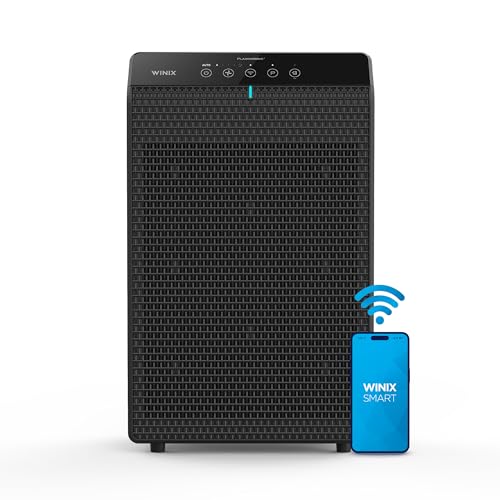
3. WINIX 5520 Air Purifier — Best with Air Quality Monitor
The 5520 takes the same large-room, carbon-forward formula as its sibling and adds a prominent air quality monitor, suiting households who trust what they can see: the readout spikes when you cook, vacuum or open a window on a polluted day, and settles as the machine works. It is the pick for the analytically minded, and for anyone whose family needs visible proof before a purifier earns its floor space.
Strengths
- Air quality monitor makes performance visible and motivating
- Full carbon plus true HEPA coverage of smells and particles
- Auto mode responds to events without manual speed changes
Trade-offs
- Overlaps heavily with the 5510; choose on price and preference, not fear
- Monitor brightness may need managing in a bedroom at night
- Same carbon replacement discipline as its sibling
Key specs: Coverage up to 1,882 sq ft in 1 hr (stated); True HEPA; high-deodorisation carbon filter; air quality monitor; auto mode
There is a genuine behavioural science to the monitor: households run purifiers more, and place them better, when the machine reports back. The 5520 therefore tends to deliver more real-world cleaning than a marginally stronger but mute rival. As with the 5510, its carbon stage is the headline for odour-prone homes, and its stated coverage suits large living spaces. Between the two Winix models, let the monitor be the tiebreaker — if data motivates your household, it is worth having.
The 5520’s monitor changes placement behaviour in a way spec sheets never capture: owners move the machine twice in the first week, chasing the readout, and end up with it in the room’s real air path rather than the corner it was first parked in. That accidental optimisation is worth real performance. Its display also settles household arguments — the purifier’s value stops being an opinion when the numbers spike at cooking time in front of everyone — which makes it the diplomat’s choice for families divided on whether the machine earns its floor space.
Best for: data-minded households with large, odour-prone living spaces / Not suited for: bedrooms where a display is unwelcome at night
Check on Amazon — check the current price on Amazon for the exact configuration you need.

4. Levoit Core 300-P Air Purifier — Best for Bedrooms
The Core 300-P is the machine that made home purification normal: compact, quiet on its sleep setting, and honestly sized for bedrooms and home offices. It suits the second and third rooms of a whole-home plan — the bedrooms where a large flagship would be absurd — and first-time buyers who want a proven, low-commitment entry before scaling up.
Strengths
- Compact footprint fits nightstands, desks and small rooms
- Quiet sleep mode suits overnight bedroom running
- Proven, widely owned model with easy filter availability
Trade-offs
- Not a large-room machine; open-plan spaces will outrun it
- Carbon capacity is modest compared with the Winix picks
- No smart sensing at this tier; you manage the speeds
Key specs: Coverage up to 1,073 sq ft (stated); HEPA filtration; quiet sleep mode; AHAM VERIFIDE; compact footprint
Bedrooms are where purifiers earn their keep most quietly: eight hours of running in the room where you breathe most deeply and consistently, at a noise level that disappears into sleep. The Core 300-P is calibrated exactly for that duty, and its enormous installed base means filters and advice are never scarce. Buy it for bedrooms and offices without a second thought; just do not ask it to purify a double-height living room and then blame the category.
The Core 300-P’s ownership pattern is multiplication: households buy one for the main bedroom, then a second for a child’s room or the office, because the first one quietly proved the concept at a scale and price that make the second purchase easy. Its filter is a known, stocked, unglamorous consumable, and that boring reliability is the product. Treat it as infrastructure rather than a gadget — set it, run it on sleep mode nightly, change the filter when indicated — and it will be the least-considered appliance in the house, which is the highest compliment home equipment can earn.
Best for: bedrooms, nurseries’ adjacent rooms and home offices / Not suited for: large open-plan living spaces as the only purifier
Check on Amazon — check the current price on Amazon for the exact configuration you need.

5. BLUEAIR Blue 211i Max Air Purifier — Best for Large Spaces
The Blue 211i Max is the open-plan answer: a flagship built for very large stated coverage, with Blueair’s HEPASilent approach that aims for strong cleaning at lower noise, plus WiFi and auto mode. It suits big combined living-kitchen spaces, high-ceilinged rooms and households that would rather run one substantial machine in the main space than a parliament of small ones.
Strengths
- Largest stated coverage in this guide for genuine open-plan duty
- HEPASilent design targets high cleaning with restrained noise
- Washable pre-filter stage reduces consumable frequency
Trade-offs
- Premium tier in both purchase and physical presence
- Large rooms still benefit from a bedroom unit for overnight duty
- Its full output is realised on higher speeds, as with all purifiers
Key specs: Coverage up to 3,235 sq ft (stated); HEPASilent filtration; WiFi and auto mode; AHAM verified; washable pre-filter options
Open-plan homes defeat ordinary purifiers by volume: the air mass is simply too large for a bedroom-class machine to turn over meaningfully. The 211i Max is one of the few consumer machines whose stated numbers belong in that conversation, and its relatively civilised noise at working speeds is why owners actually let it work. Pair it with Core-class units in the bedrooms and you have the two-tier architecture this guide recommends for larger homes: a flagship where the family lives, satellites where the family sleeps.
The Blue 211i Max changes how a large room feels across a whole evening: cooking smells that used to settle into the open-plan space for the night are processed as an event, not a residence. Its scale cuts both ways socially — it is a visible appliance, and rooms must make peace with its presence — but in the big, high-ceilinged spaces it is designed for, smaller machines are not a subtler alternative, they are simply an ineffective one. Owners who run it on auto and keep the pre-filter washed describe the rare flagship experience of a product that matches its brochure.
Best for: large open-plan living spaces and high-ceilinged rooms / Not suited for: small flats, where it is expensive overkill
Check on Amazon — check the current price on Amazon for the exact configuration you need.

6. COWAY Mighty AP-1512HH Air Purifier — Best Proven All-Rounder
The Coway Mighty is the veteran: a design that has served in homes for years, with HEPA and deodorisation filtration, an air quality monitor, auto and eco modes, and a warranty that signals a manufacturer expecting the machine to last. It suits buyers who value a proven track record over the newest app, and medium-to-large rooms wanting one dependable machine.
Strengths
- Long production history with a deep base of owner experience
- Balanced particle and odour filtration for general home duty
- Eco mode trims running effort when air is already clean
Trade-offs
- Design and interface feel a generation older than the smart picks
- No app ecosystem for those who want remote control
- Coverage sits a step below the largest flagships
Key specs: Coverage up to 1,748 sq ft (stated); HEPA and deodorisation filters; air quality monitor; auto and eco modes; timer
There is a particular confidence in buying the machine a decade of households already bought: filter supply is secure, failure modes are known and rare, and the auto and eco logic is sorted. The Mighty does not win any single specification contest in this guide, and wins the ownership contest instead — the purifier equivalent of the car model mechanics recommend. For a household that wants to buy once, place it in the living room and think about it twice a year at filter time, it remains a deeply sensible answer.
The Mighty’s longevity has created a secondary virtue: knowledge. Whatever question a Mighty owner has — filter timing, a rattle, a sensor quirk — a decade of other owners has answered it somewhere, and replacement parts and filters remain in ready supply. In a category where models churn yearly and last year’s machine can become an orphan, that ecosystem is a form of insurance. Buy the Mighty if your instinct is to keep appliances until they are old; it is the purifier designed by a company that appears to share the instinct.
Best for: medium-large rooms wanting proven, low-drama ownership / Not suited for: smart-home enthusiasts wanting app-first control
Check on Amazon — check the current price on Amazon for the exact configuration you need.
Comparison Table
| Pick | Badge | Key spec | Best for |
|---|---|---|---|
| LEVOIT Vital 200S-P Smart Air Purifier | Best Overall for Most Homes | 1,875 sq ft stated, smart, AHAM verified | main living spaces and pet households wanting set-and-forget operation |
| WINIX 5510 Air Purifier | Best for Odours and Smoke | True HEPA, heavy carbon, 1,881 sq ft stated | homes battling cooking, smoke or fireplace odours in larger rooms |
| WINIX 5520 Air Purifier | Best with Air Quality Monitor | True HEPA, carbon, AQI monitor | data-minded households with large, odour-prone living spaces |
| Levoit Core 300-P Air Purifier | Best for Bedrooms | Compact, sleep mode, 1,073 sq ft stated | bedrooms, nurseries’ adjacent rooms and home offices |
| BLUEAIR Blue 211i Max Air Purifier | Best for Large Spaces | 3,235 sq ft stated, HEPASilent, WiFi | large open-plan living spaces and high-ceilinged rooms |
| COWAY Mighty AP-1512HH Air Purifier | Best Proven All-Rounder | 1,748 sq ft stated, AQI monitor, eco mode | medium-large rooms wanting proven, low-drama ownership |
Compare coverage against your largest room, not your whole home’s floor area: purifiers clean room air, and doors are real. The Winix pair lead on odours, the Blueair on sheer volume, the Levoits on smart ease and bedroom quiet respectively, and the Coway on proven all-round ownership. Most homes end up with a flagship plus a bedroom satellite — the table is a menu for that architecture.
How to Choose Air Purifiers for Your Home
Begin with the largest room the machine must serve, measured honestly, and compare it with the manufacturer’s stated coverage — understanding that the headline figure usually assumes the highest fan speed. A useful rule is to choose a machine whose stated coverage comfortably exceeds your room, so that it can clean effectively on its middle, quieter speeds. A purifier running calmly at medium in the right room beats a small machine screaming at maximum in a big one, in both air cleaned and sanity preserved.
Filtration is the second decision. For particles — dust, pollen, pet dander — look for HEPA-grade filtration, with ‘true HEPA’ the established benchmark language. For odours, smoke and cooking smells, only a substantial activated carbon stage helps; a token carbon sheet is marketing, while the Winix picks’ deodorisation filters are the real article. Homes with both problems need both stages, in that order of build.
Finally, judge the ownership: auto mode and a sensor so the machine responds to real events; a sleep mode quiet enough for bedrooms; filters that are stocked, sensibly priced in qualitative terms, and rated for months rather than weeks. The purifier is the cheap part of purification over five years — the filters are the subscription — so buy the machine whose ongoing supplies you can actually sustain.
Placement and Running Habits That Decide Results
A purifier cleans the air that reaches it, so placement is performance. Give the machine clearance around its intakes, keep it in the room where the problem lives — the living room for the family machine, the bedroom for the overnight one — and resist the hallway compromise, which serves every room a little and none of them well. Doors matter: a closed bedroom door at night makes a small purifier dramatically more effective in that room.
Run it more than feels necessary. Purifiers are not rescue devices to switch on when the air feels bad; they are maintenance devices whose benefit accumulates over hours of turning the room’s air over. Auto mode exists precisely to make that running effortless, rising for cooking and cleaning events and settling when the air is clear. The households that report the clearest difference — less settled dust, fresher mornings — are uniformly the ones whose machines run most of the day.
Keep expectations in the comfort frame where they belong: a purifier reduces airborne particles and household odours in the rooms it serves. It does not ventilate, it does not remove the need to clean, and it makes no medical promises — it makes rooms feel fresher and surfaces dust more slowly, which is a genuine and sufficient reason to own one.
Filters: The Real Cost and the Real Schedule
Every purifier in this guide is a filter-delivery system, and the filter calendar is the ownership contract. Pre-filters catch the coarse load and on several picks are washable; the HEPA stage captures the fine particles and is replaced on a months-to-annual rhythm depending on use and environment; carbon stages saturate fastest in smoky or cooking-heavy homes and announce it by simply stopping deodorising while the machine sounds perfectly healthy.
Write the purchase date on the filter when you install it, set a reminder for its rated life, and buy replacements from the manufacturer’s channel so the fit and media are right. Third-party filters of unknown media can quietly downgrade a good machine. Budget-wise, treat purification as a modest annual running cost per machine; households that balk at filter time and stretch filters for years are running expensive fans, not purifiers.
One Big Purifier or Several Small Ones?
The physics favour distribution: air does not commute between rooms efficiently, so a flagship in the living room plus a compact unit in the main bedroom cleans a home better than any single machine anywhere. The economics favour starting with the room that matters most — usually the living space by day, the bedroom by night — and adding the second machine later, which is why this guide is built as a menu of territories rather than a single winner.
The exception is the genuinely small home: a studio or one-bedroom flat is one air mass, and one well-chosen mid-size machine, placed centrally and run on auto, serves it completely. Match the architecture to the floor plan, and let the stated coverage figures be checked against rooms, never against the whole dwelling.
Air Purifiers Room by Room: A Whole-Home Plan
The living room is the flagship’s post: the largest air volume, the most occupants, the cooking and pet events. Size the machine to this room with the comfort margin the buying guide describes, place it in the room’s air path rather than its tidiest corner, and let auto mode carry the day. Kitchens themselves are usually better served by extraction while cooking, with the living-space purifier processing what escapes — a partnership that keeps both appliances in the work they do best.
Bedrooms are the satellite posts, and the rules invert: noise outranks power, because the machine must run all night at a level sleep can ignore, and a closed door shrinks the effective room so a compact model like the Core 300-P performs above its paper size. Home offices follow the bedroom pattern at desk scale. Hallways, landings and other compromises serve nobody — the plan that works is a machine in each room where people spend hours, bought in order of hours spent, as budget allows.
What Air Purifiers Cannot Do: Keeping Expectations Honest
A purifier does not remove carbon dioxide, does not ventilate a stuffy room, and does not substitute for opening windows when weather and outdoor air allow. It does not clean surfaces: the dust already on the shelf stays there, though new settling slows noticeably in a well-purified room. It does not address moisture, mould growth on walls, or any source problem — a damp house needs its damp fixed, and a purifier run in it is a garnish, not a remedy.
This guide also makes no medical claims, deliberately. Purifiers are comfort and air-quality appliances: they reduce airborne particles and household odours in the rooms they serve, and owners experience that as fresher-feeling air and slower dust. Anyone choosing a purifier for a health condition should have that conversation with a clinician, who can advise on their specific situation. Bought for the right reasons and run with the discipline this guide describes, a purifier is a genuinely satisfying appliance — the honesty about its limits is what keeps it satisfying in year two.
Noise, Speed and the Truth About Coverage Figures
A purifier’s stated coverage is measured at its highest fan speed, and its highest fan speed is the one nobody sleeps or watches television beside. This single fact explains most purifier disappointment, and the industry is not exactly hiding it — the figure is a laboratory maximum, printed because competitors print it. The buyer’s correction is simple: choose a machine rated well above your room, so that the middle speeds you will actually tolerate still turn the room’s air over at a meaningful rate. Every pick in this guide was selected with that margin in mind, and the bedroom picks were selected for the opposite virtue — a sleep speed quiet enough to disappear.
Noise itself deserves a more careful read than a single decibel figure. What disturbs a room is not just loudness but character: a smooth, low whoosh vanishes into background within minutes, while a quieter but uneven tone — a wobble, a tick, a resonance at one speed — draws the ear all evening. You cannot fully judge character from a listing, which is one more argument for the proven models in this guide, whose acoustic behaviour is documented by years of owners rather than promised by a render. When in doubt, size up and run slower: it is the quietest decision in the category.
Purifiers and Pets, Cooking and Open Windows: Living With the Machine
Pet households are the purifier’s natural constituency, and the honest account of what changes is specific: dander and hair load in the air falls, the sofa-adjacent smell of dog lifts, and guests stop performing the polite fiction that they cannot tell a pet lives here. What does not change is the hair on the floor and the need to vacuum it; the machine handles the airborne fraction, and its pre-filter will show you, monthly, exactly how much of that fraction there was. Pet owners should treat pre-filter cleaning as a fortnightly rhythm rather than a monthly one, because the machine is doing visibly more work.
Cooking is the purifier’s daily exam, and the division of labour matters: the extractor over the hob is the first responder, and the purifier is the cleanup crew for everything that escaped into the living space. Carbon-equipped picks like the Winix pair are the ones that finish that job; particle-only machines clear the haze and leave the smell. Open windows, finally, are not the purifier’s enemy but its context: on clean-air days, ventilation does in minutes what no machine can, and the purifier’s role shrinks to pollen and particle duty with the windows shut. A household that understands these three partnerships will get more from a mid-tier machine than a careless household gets from a flagship.
Purifiers for Renters and Small Homes
Renters face a specific version of the purifier question: no installation is possible, the floor plan is not theirs to optimise, and the machine must be worth moving when the lease ends. The category suits them unusually well — every pick in this guide is a portable appliance that plugs in and leaves no trace — and the strategy is to buy for the room that matters most in this home, in a size that will plausibly matter in the next one. A mid-size machine like the Coway Mighty or the Levoit Vital is the renter’s sweet spot: substantial enough for a living room now, never absurd in a bedroom later.
Small homes should resist the flagship temptation for a subtler reason than budget: an oversized machine in a small flat spends its life on its lowest speed, which is fine for air but means the household paid for capacity it cannot use and floor space it cannot spare. One well-matched mid-size unit, run on auto in the main room with the bedroom door open by day and a compact satellite by night if needed, serves a small home completely. Portability, honest sizing and the filter calendar — that is the whole renter’s doctrine.
One Last Check Before You Order
Before ordering, do the three sums this guide has insisted on. Measure the room the machine must serve and set it against the stated coverage, with margin for the quieter speeds. Price the ownership, not the box: find the replacement filter for the exact model you are buying, confirm it is stocked, and note its rated life, because a purifier whose filter cannot be bought is a purchase already expiring. And decide the placement now — the real spot, with clearance, in the room’s air path — because a machine with a planned home gets installed properly on day one, filters unwrapped, while a machine bought on spec drifts to a corner and underperforms beautifully for years. Do those three things and any pick in this guide will serve you as its owners report: quietly, cumulatively, and for a long time.
How to Set Up and Maintain a Home Air Purifier
A purifier needs fifteen minutes of setup and fifteen minutes of maintenance a few times a year. This routine covers both, and the habits are what separate machines that transform a room from machines that gather dust of their own.
- Unpack the machine and remove every filter from its protective plastic bag inside the unit — the single most common setup error is running a purifier for months with its filter still sealed.
- Place it in the target room with clear space around the intakes and outlet, away from corners and curtains, and near — not inside — the main activity zone.
- Run it on its highest speed for the first hour to turn the room over, then switch to auto mode as the everyday setting, or sleep mode overnight in bedrooms.
- Vacuum or wash the pre-filter monthly, or as the machine indicates; a clogged pre-filter starves everything downstream of it.
- Note each filter’s install date and set reminders for its rated replacement window; replace carbon stages promptly in odour-prone homes, since saturation is silent.
- Every few months, wipe the air-quality sensor lens if your model has one, and vacuum the intake grilles — a blind sensor makes auto mode stupid.
Follow that rhythm and the machine will hold its performance for years. Neglect it, and the decline is invisible — the fan still spins, the lights still glow, and the air quietly stops being cleaned. The filter calendar is the whole game.
Common Buying Mistakes
Buying one purifier for a whole house. Air does not flow between closed rooms. One machine serves its room; a home needs a flagship plus bedroom coverage, or honest acceptance of partial results.
Running it only when the air feels bad. Purification is cumulative maintenance, not rescue. Auto mode, run for most of the day, is what produces the less-dust, fresher-room difference owners report.
Leaving the filter in its plastic bag. A startling share of purifiers run for months sealed. Always open the unit and unwrap the filters before first use — and check any machine that seems to do nothing.
Ignoring carbon saturation. A spent carbon filter stops removing odours without any visible sign. In cooking or smoke-prone homes, replace carbon on schedule, not on symptoms.
Undersizing to save money. A small machine on maximum in a big room is loud, ineffective and soon switched off. Buy for the room, run at medium, and the purchase actually works.
Final Recommendation
Build the system in this order: a flagship for the living space — the Levoit Vital 200S-P for smart ease, a Winix for odour-heavy homes, the Blueair 211i Max for true open-plan volume, or the Coway Mighty for proven all-round ownership — then the Levoit Core 300-P in the main bedroom. That two-tier architecture covers the way homes actually live, day and night.
Whatever you start with, unwrap the filters, place it properly, and let auto mode run. A purifier’s benefits are quiet and cumulative — fresher rooms, slower dust, easier evenings — and they belong entirely to the households that keep the machine running.
Related reading on this site: Best Air Purifiers For Allergies Best Air Purifiers For Large Rooms Best Air Purifiers For Pet Hair Best Air Purifiers For Bedrooms Best Air Purifiers For Smoke Best Air Purifiers For Odor Elimination
Related guides
Frequently Asked Questions
How many air purifiers does a home need?
Usually one for the main living space and one for the main bedroom, because purifiers clean the room they are in. Small flats are a single air mass and can be served by one well-placed machine.
What is the difference between HEPA and carbon filtration?
HEPA filtration captures fine particles such as dust, pollen and dander. Activated carbon adsorbs gases and odours, including smoke and cooking smells. Homes with both problems need a machine with both stages, like the Winix picks.
How loud are home air purifiers?
On sleep and low settings, the bedroom picks here are designed to sit beneath conversation and sleep. Higher speeds are louder on every machine, which is why sizing up lets you clean effectively at quieter middle speeds.
How often do filters need replacing?
It varies by model and environment, from months for carbon in smoky homes to around a year for HEPA stages in cleaner ones. Follow each model’s indicator and rated life, and write install dates on the filters.
Should I run my purifier all day?
Auto mode is designed for exactly that: it rises when the air needs work and settles when it does not. Continuous auto running is what produces the cumulative comfort benefits owners notice.
Can an air purifier replace ventilation and cleaning?
No — it complements them. A purifier reduces airborne particles and odours in its room; fresh air, vacuuming and dusting remain necessary. Think of it as the third leg of a cleaner-feeling home, framed purely in comfort and air-quality terms.

