Disclosure: airfryerkitchensupply.com is reader-supported. When you buy through links on our site, we may earn an affiliate commission at no extra cost to you.
Where to Buy
Shopping for the best air purifier for smokers house? Every verified pick in this guide is sold through Amazon, where you can check price on Amazon for the current listing, confirm the exact model and filter type, and arrange delivery. The shortlist:
- COWAY Airmega 400 — Best Overall for a House. Check the current price on Amazon.
- BLUEAIR Blue 211i Max — Best for Open-Plan Floors. Check the current price on Amazon.
- LEVOIT Core 600S-P — Best Smart Whole-Floor. Check the current price on Amazon.
- Honeywell HPA5300B — Best XL Capacity. Check the current price on Amazon.
- Medify MA-50 V3.0 — Best Fast Turnover. Check the current price on Amazon.
- Austin Air HealthMate Plus B450 — Best Odor Anchor. Check the current price on Amazon.
Availability and filter stock move around; if a listing shows a different model suffix than the one named here, match the model name in this guide rather than the photograph.
A house is a different problem from a flat, and the best air purifier for smokers house use has to be chosen at house scale. More rooms, more floor area, stairwells that act as chimneys for warm smoky air, and soft furnishings measured in sofas rather than chairs — a house absorbs a smoking habit into a far larger reservoir, and it takes a deliberate, multi-machine strategy to keep the whole building’s background fresh.
Start with the physics that no marketing can repeal: a purifier cleans the air in the room it occupies. In a house, that means the winning strategy is a strong anchor machine on the main living floor — ideally where the smoking happens or in the open-plan space it drifts into — supported by the discipline of doors, and, in larger homes, a second machine for the other principal floor. Whole-house salvation from a single box in a hallway is the category’s most persistent myth, and this guide will not sell it to you.
What the six machines below offer is the strongest realistic version of house coverage: the largest verified capacities on the market, washable pre-filters that survive dusty real homes, auto modes that manage themselves across long days, and one deep-carbon anchor for the room where the smoke is actually made. Combined with the house strategy in the guide sections, they are how a smoking household keeps an entire house presentable — to family, to guests, and to the people who live there.
In this guide
Quick Picks
Best Overall for a House — COWAY Airmega 400: Dual filtration for very large spaces, washable pre-filter, 5-year warranty. Rated coverage: Up to 3,120 ft². Check the current price on Amazon.
Best for Open-Plan Floors — BLUEAIR Blue 211i Max: HEPASilent filtration, quiet 23dB, WiFi and auto mode, AHAM Verified. Rated coverage: Up to 3,235 ft². Check the current price on Amazon.
Best Smart Whole-Floor — LEVOIT Core 600S-P: 3-in-1 HEPA filter rated for smoke, AHAM Verifide, app and voice control. Rated coverage: Up to 2,933 ft². Check the current price on Amazon.
Best XL Capacity — Honeywell HPA5300B: HEPA for XL rooms, auto mode, black finish. Rated coverage: 2,423 ft² in 1 hr. Check the current price on Amazon.
Best Fast Turnover — Medify MA-50 V3.0: HEPA filtration to 0.3 microns, rated for smoke and odors, large coverage. Rated coverage: 2,640 ft² in 1 hr. Check the current price on Amazon.
Best Odor Anchor — Austin Air HealthMate Plus B450: Activated carbon + zeolite, 4-stage filtration, 5-year filter life. Rated coverage: Up to 1,500 sq ft. Check the current price on Amazon.
How These Picks Were Chosen
Every product in this guide was verified on this site’s own storefront connection before it was written about: we searched by brand and model, matched the returned listing title to the product, and only then used its ASIN for links. Models we could not verify with confidence were left out or written about without links — we do not guess at product identifiers.
With the verified shortlist established, picks were scored on the factors that decide real-world smoke performance. First, the filter stack: a HEPA stage for particles, and activated carbon with genuine substance for odor, because smoke is both problems at once. Second, honest capacity: coverage figures quoted by makers and, where available, backed by AHAM verification, always with headroom above the rooms these machines will serve. Third, liveability: noise at working speeds, auto modes and sensors, and the size and shape a machine brings into a real room.
House-scale shortlisting demanded the biggest verified coverage ratings available, pre-filters that can be washed or vacuumed rather than replaced, and build quality backed by long warranties — a house asks more of a machine and keeps it longer. Every pick is rated for smoke by its maker and sized for floors, not bedrooms.
Finally, we applied two honesty filters. Products with safety recalls were excluded outright. And nothing in this guide carries a fixed price or a fixed star rating: prices and ratings change constantly, so linked picks simply say to check the current price on Amazon, and prose describes tiers — budget, mid-range, premium — instead of numbers that would go stale.
The 6 Best Options: Best Air Purifier for a Smoker’s House Picks Reviewed
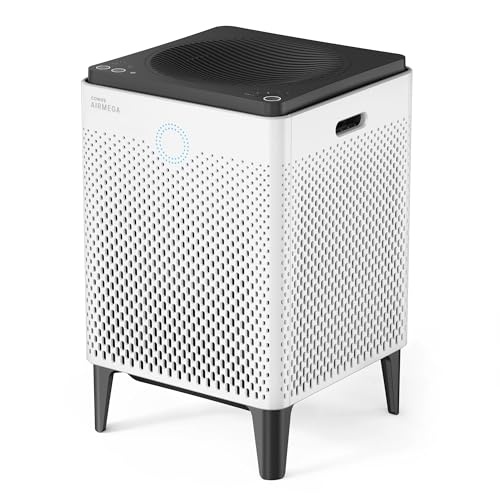
COWAY Airmega 400 — Best Overall for a House
The Airmega 400 is what you buy when the smoking happens in an open-plan space and smaller machines have already lost. Its rated coverage tops this list, it pulls air through a washable pre-filter before the HEPA stage — a detail that matters when the air carries ash dust and pet hair as well as smoke — and COWAY backs it with a five-year warranty. The honest framing: no single purifier truly services a whole house of closed rooms, but for one big, open living level where someone smokes, this is as close as one box gets, and its auto mode lets it surge after a session and settle down overnight.
The Airmega 400 is the house anchor: the biggest coverage rating here, a washable pre-filter that suits a dusty, lived-in building, and a five-year warranty that matches a house-scale commitment. Placed on the main living floor, it sets the tone for the whole home’s air.
A machine of this size is a household commitment, and its ownership profile matches: filter sets are substantial purchases, best planned annually with the date written down, and the washable pre-filter should be rinsed monthly in a smoking or pet home to protect them. The five-year warranty is the longest reassurance in this guide. Electricity at high speed is real but intermittent — auto mode exists to spend it only when the air demands it. Owners who treat it as infrastructure, like a boiler, get infrastructure-grade service from it.
Strengths
- The biggest coverage rating on this list, aimed at open-plan floors rather than single rooms
- Washable pre-filter keeps the expensive HEPA stage cleaner for longer in dusty, smoky homes
- A five-year warranty is the strongest cover in this roundup
Trade-offs
- It is a large, premium-tier appliance that needs a permanent home on the floor
- Whole-floor ratings assume open space; closed doors still defeat any single machine
- Replacement filter sets for a machine this size are a serious recurring cost
| Specification | Detail (from maker listing) |
|---|---|
| Coverage (maker rating) | Up to 3,120 ft² |
| Filtration | Washable pre-filter and HEPA filter rated for smoke |
| Modes | Auto and sleep, with AQI display |
| Warranty (maker listing) | 5 years |
Best for: Open-plan living levels and large homes with one main smoking area / Not suited for: Small homes, closed-off rooms, or budgets that cannot absorb premium filter costs
Check the current price on Amazon.

BLUEAIR Blue 211i Max — Best for Open-Plan Floors
The Blue 211i Max is the quiet giant of the list. BLUEAIR’s HEPASilent approach pairs electrostatic and mechanical filtration to move a lot of air without the roar, and the rated coverage is the largest here alongside the Airmega 400. In a smoking home, its job is volume: turning over the air of a big living space again and again so smoke never gets to settle into fabrics. The caveat is odor depth — its carbon provision is not in the Austin league — so think of it as the machine that keeps a large, lived-in space fresh and clear, ideally in a home where smoking is regular but not relentless.
For open-plan ground floors — kitchen, dining and living flowing together — the 211i Max’s combination of huge capacity and genuine quiet is unmatched. It keeps a big social floor turning over without making the room feel like an airport lounge, which is precisely what a house’s main space needs.
Owning the 211i Max means managing a fabric pre-filter and a main filter on different clocks: vacuum the fabric whenever the room is vacuumed — in pet homes that rhythm is the difference between rated and real performance — and replace the main filter on the maker’s cycle, shortened by heavy smoke. Its low-speed efficiency keeps electricity costs gentle for a machine of this capacity. The design divides opinion but the ownership does not: it is a large, quiet appliance that asks for little and complains less.
Strengths
- Huge rated coverage paired with a very quiet low setting, a rare combination
- HEPASilent approach blends particle capture with lower noise and energy use than brute-force designs
- Fabric pre-filter catches the coarse load — hair, lint, ash dust — before the main filter
Trade-offs
- Its filtration leans particle-first; the deepest smoke odor still belongs to heavy-carbon machines
- The tall, soft-edged design is distinctive, which not every room wants
- Pre-filter fabric needs regular vacuuming in a pet-and-smoke home to stay effective
| Specification | Detail (from maker listing) |
|---|---|
| Coverage (maker rating) | Up to 3,235 ft² |
| Filtration | HEPASilent |
| Noise (maker rating) | Quiet 23dB on its lowest setting |
| Verification | AHAM Verified |
Best for: Large, open living spaces where noise matters as much as power / Not suited for: Small rooms, or the deepest cigar odor problem, where carbon mass wins
Check the current price on Amazon.

LEVOIT Core 600S-P — Best Smart Whole-Floor
The Core 600S-P is LEVOIT’s big-room hammer: the highest coverage figure in its range, an AHAM Verifide badge behind the claim, and a 3-in-1 filter the maker rates for smoke, pet odor and dust. The detail that matters most to a smoking household is in the accessory line — LEVOIT sells a smoke-remover replacement filter for this exact model, with high-efficiency activated carbon. That is the upgrade path that turns a general purifier into a smoke specialist. Add app scheduling and voice control, and you get a machine that can run a daily rhythm — high after the evening smoke, quiet overnight — without daily fiddling.
The Core 600S-P is the smart-house option: app scheduling across a long day, voice control, and a smoke-remover filter path for the floor where smoking happens. In a house with a routine — work hours, evening sessions, quiet nights — its automation keeps the system honest without a householder’s attention.
The 600S-P’s ownership story improves sharply if you adopt its smoke-remover replacement filter as your standard cartridge rather than an upgrade: it is the configuration this guide’s recommendation assumes in a smoking home. The standard 3-in-1 cartridge serves lighter duty between. App scheduling reduces wasted runtime, the pre-filter wants a monthly vacuum in dusty homes, and the machine’s size means filter swaps are a two-handed, sit-down job — easy, but not a one-minute task. Budget the smoke cartridge as a recurring household consumable.
Strengths
- The largest coverage rating in the LEVOIT line here, with AHAM verification behind the headline number
- A dedicated smoke-remover replacement filter exists for this model, which tells you the platform takes smoke duty seriously
- Full smart control set makes scheduled, always-on running easy to stick with
Trade-offs
- Big-room ratings still shrink in a real smoking room; place it where the smoke is, not down the hall
- The standard 3-in-1 filter is a compromise; heavy smokers should plan on the smoke-focused replacement
- It is a large appliance that wants a permanent corner, not a closet between uses
| Specification | Detail (from maker listing) |
|---|---|
| Coverage (maker rating) | Up to 2,933 ft² |
| Filtration | 3-in-1 filter with HEPA sleep mode |
| Verification | AHAM Verifide |
| Controls | App, Alexa and remote control |
Best for: Large living rooms and open-plan spaces with regular smoke / Not suited for: Small single rooms where its capacity and footprint are wasted
Check the current price on Amazon.
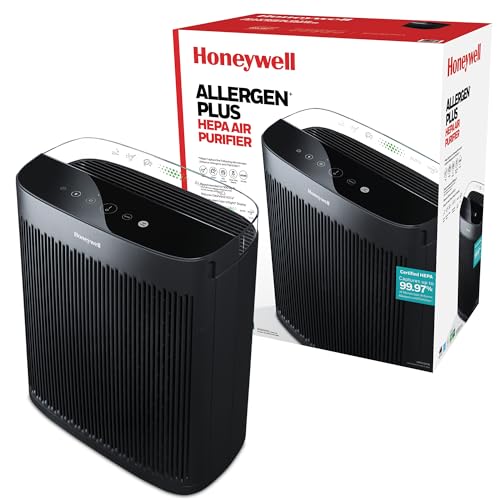
Honeywell HPA5300B — Best XL Capacity
The HPA5300B is Honeywell’s extra-large-room answer: a HEPA machine rated to clean very large spaces within the hour, with an auto mode and a black housing that forgives the grime of a smoking household. Honeywell’s long presence in this category shows in the boring places — filters stay available, controls make sense, and the machine does not need a phone to run. For smoke, treat it as a high-volume particle and general-odor worker: excellent at keeping a big room’s air turning over, best paired with realistic expectations about the deepest smells.
The HPA5300B brings extra-large capacity in a black, grime-forgiving housing with a simple auto mode. It suits the big family room or the finished basement where a household actually gathers — the high-traffic spaces of a house that smaller machines cannot hold.
Honeywell ownership is the conservative choice: a vast, stable filter ecosystem, controls that need no explanation, and an auto mode that spends electricity only when the air worsens. In a smoking home, the general-purpose filter set should be checked quarterly — the carbon portion works across every odor the home produces, not just smoke, and loads accordingly. The black housing hides the dust film between cleanings. Nothing about owning this machine is exciting, which after five years feels like a compliment.
Strengths
- XL-room rating with an auto mode that reacts without supervision
- Black finish hides the dust film that smoking homes deposit on appliances
- Honeywell’s filter ecosystem is widely stocked, which matters years into ownership
Trade-offs
- A big, plain appliance; the design will not win any room a style award
- Odor work is shared across a general filter set rather than a smoke-specific carbon bed
- At the speeds that clear a smoked room quickly, it is plainly audible
| Specification | Detail (from maker listing) |
|---|---|
| Coverage (maker rating) | Cleans 2,423 ft² rooms in 1 hour |
| Filtration | HEPA, for allergens, dust, pollen, pet dander, odors and smoke |
| Modes | Auto mode |
| Finish | Black |
Best for: Extra-large rooms and open spaces needing hands-off, high-volume cleaning / Not suited for: Style-led rooms or the deepest odor problems
Check the current price on Amazon.

Medify MA-50 V3.0 — Best Fast Turnover
Medify built its name on smoke — the brand’s machines are marketed hard at wildfire country — and the MA-50 is its large-room entry, rated to turn over a big space within the hour and to capture particles down to 0.3 microns. Tobacco smoke particles sit right in that fine range, which is why the fit is natural. It is a simpler machine than the app-driven rivals: fewer graphs, more fan. For a heavy-use room, that simplicity plus throughput is the appeal. Expect it to clear visible haze and cut smell substantially; expect the deepest odor work to still favor the carbon-heavy specialists.
Where a house’s smoking concentrates in one large room — a den, a conservatory, a garage conversion — the MA-50’s fast turnover is the specialist tool: it strips haze and refreshes the room between sessions at a pace the gentler machines cannot match.
The MA-50 keeps ownership mechanically simple: one filter system to track, controls on the box, and no app dependency to age badly. In heavy smoke, its fine-particle strength means the filter loads visibly — check it on a schedule rather than waiting for performance to sag, and expect the carbon portion to define the real interval. Its large-room appetite makes it most economical when it is genuinely needed; run on auto-less discipline, use its speeds deliberately — high for sessions, medium after, low overnight.
Strengths
- Explicitly rated by the maker for smoke and odors, with large-room coverage
- Fine-particle capture down to 0.3 microns addresses the particle fraction of smoke directly
- A straightforward, controls-on-the-box machine without app dependency
Trade-offs
- Less smart feedback than sensor-equipped rivals; you manage speeds yourself
- Carbon depth is not its headline feature, so odor work leans on air changes
- Big coverage claims still assume an open room and a closed door
| Specification | Detail (from maker listing) |
|---|---|
| Coverage (maker rating) | 2,640 ft² in 1 hr |
| Filtration | HEPA, removal to 0.3 microns |
| Rated uses (maker listing) | Smoke, wildfires, odors, pollen, pets |
Best for: Large rooms with frequent smoke that need fast, simple air turnover / Not suited for: Buyers who want detailed air-quality feedback and automation
Check the current price on Amazon.

Austin Air HealthMate Plus B450 — Best Odor Anchor
The HealthMate Plus is the old-school answer to a chemistry problem. Tobacco and cannabis smoke are two problems wearing one coat: fine particles, which any decent HEPA stage handles, and gases and odor molecules, which sail straight through HEPA media. Austin Air attacks the second problem with a deep bed of activated carbon blended with zeolite, a mineral that is particularly hungry for the volatile compounds in smoke. There is no app, no light show and no sensor graph. You turn a knob, the machine pulls room air through several pounds of adsorbent media, and it keeps doing that for years on one filter. For a room that is smoked in every day, that boring reliability is the point.
Every house plan needs one machine whose only job is odor depth, placed where the smoke is made. The HealthMate Plus is that anchor: its carbon-and-zeolite bed defends the rest of the house by winning the fight in the source room, and its years-long filter life suits a permanent installation.
Ownership is where the Austin quietly wins arguments. The combined filter is rated by the maker for years rather than seasons, so the annualised filter cost in a smoking home undercuts lighter machines that need fresh cartridges two or three times a year. There is no app to maintain, no firmware, no account — the controls are a dial. The costs that remain are electricity at sustained speeds and the physical reality of a heavy, boxy unit that you will place once and not move often. For a permanent smoking room, that is the right shape of ownership.
Strengths
- The carbon-and-zeolite stage is the heaviest gas-and-odor media on this list, which is exactly the part of smoke a HEPA filter cannot touch
- A filter life rated in years, not months, suits homes where smoke is a daily constant rather than an occasional event
- Steel, boxy, no-nonsense build with simple manual controls that never need an app or an account
Trade-offs
- Premium tier pricing and a footprint closer to a small cabinet than a bedside appliance
- No air quality sensor or auto mode, so you choose the speed yourself and live with the trade-off
- At full speed it moves serious air and sounds like it; the quiet claim belongs to its lower settings
| Specification | Detail (from maker listing) |
|---|---|
| Coverage (maker rating) | Up to 1,500 sq ft |
| Filtration | 4-stage, with activated carbon and zeolite |
| Filter life (maker rating) | 5 years |
Best for: Homes with daily, heavy smoke where odor control matters more than smart features / Not suited for: Buyers who want app control, a compact footprint, or the lowest purchase price
Check the current price on Amazon.
Comparison Table
| Pick | Badge | Key spec | Best for |
|---|---|---|---|
| COWAY Airmega 400 | Best Overall for a House | Dual filtration for very large spaces, washable pre-filter, 5-year warranty | Open-plan living levels and large homes with one main smoking area |
| BLUEAIR Blue 211i Max | Best for Open-Plan Floors | HEPASilent filtration, quiet 23dB, WiFi and auto mode, AHAM Verified | Large, open living spaces where noise matters as much as power |
| LEVOIT Core 600S-P | Best Smart Whole-Floor | 3-in-1 HEPA filter rated for smoke, AHAM Verifide, app and voice control | Large living rooms and open-plan spaces with regular smoke |
| Honeywell HPA5300B | Best XL Capacity | HEPA for XL rooms, auto mode, black finish | Extra-large rooms and open spaces needing hands-off, high-volume cleaning |
| Medify MA-50 V3.0 | Best Fast Turnover | HEPA filtration to 0.3 microns, rated for smoke and odors, large coverage | Large rooms with frequent smoke that need fast, simple air turnover |
| Austin Air HealthMate Plus B450 | Best Odor Anchor | Activated carbon + zeolite, 4-stage filtration, 5-year filter life | Homes with daily, heavy smoke where odor control matters more than smart features |
How to Choose the Best air purifier for smokers house
Think floor by floor, not house by house. Identify the main living floor — where the smoking happens and where the family spends its waking hours — and anchor it with the largest verified capacity that fits the space. If the house is open-plan on that floor, one top-tier machine can genuinely dominate it. If the floor is a warren of closed rooms, accept the geometry: the smoking room gets its own machine first, and the anchor covers the shared spaces.
Respect the stairwell. Warm air rises, and a house’s stairs carry smoky air to the landing and bedrooms whether you invite it or not. Two defenses work together: keep the smoking room’s door closed so the stairwell never receives the load, and consider the landing or a principal bedroom as the second machine’s post. Houses are won at their choke points — the smoking room door and the top of the stairs — more cheaply than by brute capacity everywhere.
Choose for a decade, not a season. A house installation is semi-permanent, so ownership factors dominate: washable pre-filters to survive real dust and pet loads, replacement filters that are mainstream and stocked, warranties measured in years, and machines heavy enough to stay where they are put. The six picks above were filtered on exactly those criteria; a cheaper machine that needs replacing in three years is the expensive option in a house.
The Honest Whole-House Strategy: Anchors, Doors and Choke Points
Sellers of single machines promise whole-house purification; physics promises something narrower and, used well, nearly as good. Air in a house mixes slowly between closed rooms and quickly within open ones. A strategy that works with that grain — rather than pretending it away — has three elements, and none of them is a product.
First, win the source room: the strongest odor machine lives where smoking happens, behind a door that stays closed while it works. Second, anchor the open living floor with the largest quiet capacity you can place well, so the shared air the family breathes all evening is continuously polished. Third, defend the sleeping floor’s choke point — a landing unit or a main-bedroom machine — because bedrooms are where a house’s air quality is ultimately judged, in bedding and in sleep. Follow that order, add machines only when a zone demonstrably needs one, and a house of almost any size can hold its background freshness against a daily habit. That is the whole secret, and it is mostly logistics.
Old Houses, New Builds and the Reservoir Problem
Houses differ from flats in one respect that dominates everything else: reservoir. A house holds more air, more fabric, more carpet, more curtains and more years of accumulated smoking history in its materials. That reservoir is why a house can keep smelling of smoke for weeks after the smoking stops entirely — and why new owners sometimes inherit a smell along with the keys. A purifier system cannot drain that reservoir quickly, and any guide that promises otherwise is lying to you. What it does is stop the inflow completely and let the reservoir fade at its natural pace, which for most houses means a transformation measured in one to two months, not days.
New-build houses present the opposite quirk: they are sealed so efficiently that, once a purifier system has cleaned them, they stay clean with less effort than any draughty older house — but they also concentrate fresh smoke faster while it is being produced, which argues for the anchor machine living exactly where the smoking happens. Older houses leak helpfully and hinder simultaneously: free ventilation dilutes smoke, and the same gaps let it wander into rooms it was never invited to. In both cases the strategy from this guide holds — win the source room, anchor the living floor, defend the sleeping floor — and the house’s character merely sets the timeline on which the reservoir surrenders.
Sizing the Machine to Your Room: A Worked Example
House sizing is floor arithmetic. Take the main living floor: if it is open-plan at, say, 600 square feet of connected space, the anchor should come from the largest class in this guide — the picks rated around 3,000 square feet and above — because that rating must survive being discounted for real speeds and real furniture. If the floor is divided into closed rooms, stop adding its area together; size instead for the smoking room and the largest living room separately, and let two machines do what one rating cannot. Upstairs, a landing or main bedroom of 150 to 200 square feet is defended by a mid-size pick run on auto. Measure each zone, write the numbers down, and buy against them in the order this guide sets out.
What It Costs to Own One of These Machines
Strip away the launch prices — which this guide deliberately does not print, because they change — and a purifier’s ownership reduces to three streams. Electricity is the smallest: these are fan appliances, and on the low and auto settings where they spend most of their lives they draw about as much as the room’s lighting. Filters are the middle stream and the one that matters: a repeating cartridge purchase whose interval your habit sets, with smoking homes at the brisk end of every maker’s schedule. The third stream is your own attention, and it is the one whose bankruptcy closes the most purifiers into cupboards.
Design your ownership to spend the least attention possible. Machines with sensors and auto modes convert attention into electricity at a favorable rate. Machines with washable pre-filters convert a purchase into a chore of two minutes. Machines with mainstream filter supply convert a potential crisis — a discontinued cartridge in year four — into a non-event. Judge every pick in this guide on those three conversions and you will understand the ranking better than any specification table can explain it. The best machine is the one still running, correctly, on an ordinary Tuesday three years from now.
How to Set Up Purifiers Across a House
A half-day installation, in the order that makes each step make the next one easier.
- Map the house into three zones on paper: the smoking room, the main living floor, and the sleeping floor. Note which spaces are open-plan and which doors are normally closed — the map decides machine sizes, not the brochure.
- Install the odor anchor in the smoking room first, check the door closes properly, and run the machine there for several days. Source control lightens every other zone’s job.
- Place the main-floor anchor in the largest shared space, clear of furniture, and set it to auto. Live with it for a week and do the doorway test each evening: the living floor should smell noticeably better than the hall.
- Walk the stairwell with your nose at different times of day. If smoke is reaching the landing, the smoking-room door discipline or a landing unit is the fix — in that order.
- Add the bedroom defense last: a right-sized machine in the main bedroom, or a landing machine serving open bedroom doors, on a quiet auto setting.
- Create the house maintenance rhythm: one calendar reminder for all pre-filters monthly, filter dates written on a card kept with the spare filters, and a quarterly walk-through nose audit, room by room.
Three Houses, Three Right Answers
The open-plan new build: kitchen, dining and living in one long space, smoking at the far end by the garden doors. One anchor from the largest class — the Airmega 400 or Blue 211i Max — placed mid-space, governs the floor honestly, and the sealed building fabric keeps the victory overnight. Upstairs takes care of itself longer than in any other house type; a bedroom defender is a refinement here, not a rescue.
The Victorian terrace conversion: tall rooms, chimney breasts, doors everywhere, and a smoking room that used to be the front parlour. Compartmentation is the ally: a carbon anchor in the parlour, door discipline, and the living floor’s second room served by the overflow and one mid-size machine. The stairwell gets a landing check in the first month; if the bedrooms pass the morning test, the house is done at two machines.
The large detached house with a smoker’s den: a converted garage or a garden room where the habit lives apart. Treat the den as its own building — the Austin or the Medify, sized to it alone — and the main house may need nothing more than a living-floor anchor for drift and guests. Distance is the cheapest filtration ever sold; the den setup merely has to keep the house’s side of the bargain, which is that the smell stays in the den.
The house with a home business: clients in the front room, family in the back, smoking in the study between them. Professional air is a business asset here, and the plan treats the client room as the house’s clean room — defended by the living floor’s anchor, never smoked in, and checked before every appointment. The Airmega 400’s scale suits the double duty; the discipline — the study door, the schedule, the quarterly audit — is what makes clients never know there was anything to manage.
Keeping It Working: The Four Jobs That Matter
Job one is the pre-filter, monthly, without exception in a smoking home. It is the cheapest component and the most consequential: everything behind it depends on air arriving, and a matted pre-filter silently converts a large machine into a small one. Wash it if it washes, vacuum it if it does not, and let it dry fully before it goes back.
Job two is the sensor, if your machine has one: a soft, dry cloth across its window whenever you clean the pre-filter. Sensor-driven auto mode is only as honest as the sensor’s eyesight, and a dust-filmed sensor makes a smart machine behave stupidly — slow to respond to a fresh cigarette, slow to settle afterwards. Job three is placement discipline: after every furniture rearrangement, party or seasonal change, confirm the machine still has clear space and still lives in the room the smoke does. Machines get exiled by tidiness more often than they fail by engineering.
Job four is the filter decision, taken on evidence. Keep a simple record — the date each cartridge went in, and a word about the room’s clearing time that month. When clearing stretches and the morning-after smell returns, the carbon has finished; replace it that week rather than negotiating. Owners who keep that small record stop experiencing filter changes as surprises and start experiencing them as fuel stops — planned, quick, and priced in. That change of relationship with the machine is, in the end, what separates the households in this guide’s success stories from the cupboard full of abandoned purifiers.
One last ownership truth, learned from every category of appliance that filters anything: the machine you maintain is the machine you own, and the machine you neglect is a fan in a box. Nothing in this section requires skill, tools or money beyond the filters themselves — a calendar note, a cloth, a vacuum, and the willingness to believe your own nose when it reports that performance has changed. Households that build those four small habits get the full value of every pick in this guide. Households that do not will conclude, wrongly and expensively, that the category itself is a fraud. The difference was never the machines; it is the rhythm, and the rhythm is free. Set it once, this week, while the purchase is still new and the intention is still warm, and let the calendar carry the discipline from here.
Common Buying Mistakes
One machine in the hallway, bought for the whole house. The classic house-scale error. The hallway will have magnificent air; every closed room will keep its own. Anchors belong in lived-in spaces, and source rooms get their own machines.
Ignoring the stairwell chimney. Warm smoky air rises. Without door discipline at the source and a defense at the landing, the bedrooms inherit the ground floor’s habit every night.
Anchoring the wrong floor. A superb machine in a little-used floor’s room does nothing for the floor the family lives on. Anchor where the people and the smoke are, in that order.
Buying capacity without maintainability. In a house, filters are logistics. Machines with washable pre-filters and mainstream replacement cartridges stay performing; exotic ones quietly expire in year two.
Declaring victory in week one. A house’s furnishings hold a reservoir of old odor that takes weeks of clean air to fade. Judge the system at one month, not at the first weekend.
Final Recommendation
Anchor the house in order: the Austin Air HealthMate Plus winning the smoking room on carbon depth, the COWAY Airmega 400 or BLUEAIR Blue 211i Max dominating the main living floor, the LEVOIT Core 600S-P where smart scheduling suits the household’s routine, and the Honeywell HPA5300B or Medify MA-50 where one large room needs raw turnover. Defend the landing and the main bedroom next if the nose audit says so. That system — not any single box — is what ‘whole house’ honestly means. Read alongside: Best Air Purifier For Smokers Home, Best Air Purifier For Smokers, Best Air Purifier For Heavy Smokers and Best Air Purifier For Cigarette Smokers.
If you are deciding today, the shortlist to compare first is: COWAY Airmega 400, BLUEAIR Blue 211i Max, LEVOIT Core 600S-P. Check the current price on Amazon for each, confirm the filter type matches the model name, and buy the one whose strengths match your room.
Frequently Asked Questions
Can one air purifier really clean a whole house?
No — not a house of separate, closed rooms. One top-tier machine can dominate an open-plan floor, which is genuinely valuable, but closed doors divide a house into separate air problems. The realistic whole-house answer is a small system: source room, main floor anchor, bedroom defense.
How many purifiers does a typical house need for a smoker?
Most houses settle at two to three: one in the smoking room, one anchoring the main living floor, and one defending the main bedroom or landing. Larger or heavily smoked-in houses add a second-floor machine. Buy in that order and let results decide each next step.
Where should the main machine go in a house?
In the largest shared living space on the floor where the family spends its evenings — or in the smoking room itself if that is a separate space, in which case the living floor gets the second machine. Clear airflow around it matters more than the exact corner.
Does a purifier help with smoke rising to upstairs bedrooms?
Indirectly and significantly: winning the source room and keeping its door closed stops most smoke ever reaching the stairs. A landing or bedroom machine handles the remainder. The combination is far more effective than a bigger machine downstairs alone.
What size machine counts as house-scale?
Look for the largest verified coverage class — the machines here are rated for several thousand square feet at maximum output — and then discount the claim for real rooms, doors and livable speeds. House-scale is as much about build, warranty and filter logistics as the headline number.
How long until a whole house smells fresher?
The air itself improves within days; the background smell held in furnishings fades over two to six weeks of continuous running. Houses are reservoirs, and reservoirs turn over slowly — but they do turn over, and the change, once it arrives, is obvious to everyone who walks in.


